 Английский язык
Похожие презентации:





Revision of class materials. Grammar
1. Revision of class materials. Grammar.
Astana IT UniversityDepartment of General Disciplines
English for Academic Purposes
B1- level
Revision of class
materials. Grammar.
Week 5 Lesson 5
Grammar
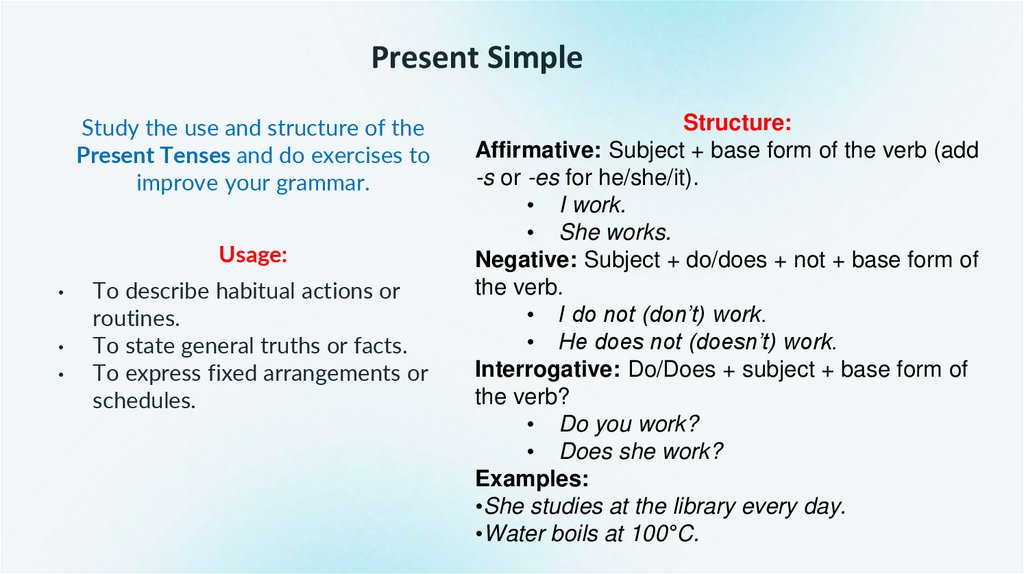
2. Present Simple
Study the use and structure of thePresent Tenses and do exercises to
improve your grammar.
Usage:
To describe habitual actions or
routines.
To state general truths or facts.
To express fixed arrangements or
schedules.
Structure:
Affirmative: Subject + base form of the verb (add
-s or -es for he/she/it).
• I work.
• She works.
Negative: Subject + do/does + not + base form of
the verb.
• I do not (don’t) work.
• He does not (doesn’t) work.
Interrogative: Do/Does + subject + base form of
the verb?
• Do you work?
• Does she work?
Examples:
•She studies at the library every day.
•Water boils at 100°C.
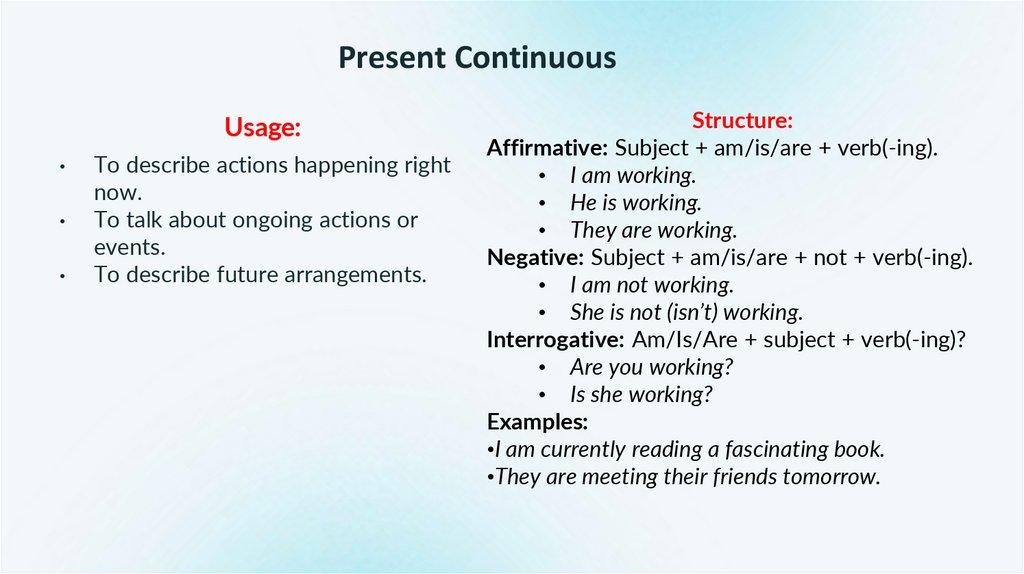
3. Present Continuous
Usage:To describe actions happening right
now.
To talk about ongoing actions or
events.
To describe future arrangements.
Structure:
Affirmative: Subject + am/is/are + verb(-ing).
• I am working.
• He is working.
• They are working.
Negative: Subject + am/is/are + not + verb(-ing).
• I am not working.
• She is not (isn’t) working.
Interrogative: Am/Is/Are + subject + verb(-ing)?
• Are you working?
• Is she working?
Examples:
•I am currently reading a fascinating book.
•They are meeting their friends tomorrow.
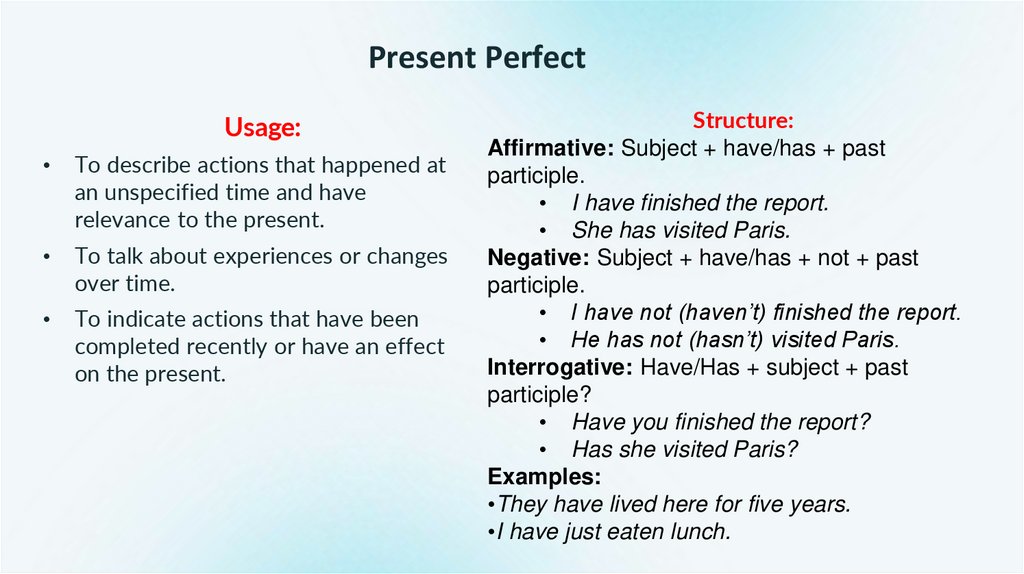
4. Present Perfect
Usage:To describe actions that happened at
an unspecified time and have
relevance to the present.
To talk about experiences or changes
over time.
To indicate actions that have been
completed recently or have an effect
on the present.
Structure:
Affirmative: Subject + have/has + past
participle.
• I have finished the report.
• She has visited Paris.
Negative: Subject + have/has + not + past
participle.
• I have not (haven’t) finished the report.
• He has not (hasn’t) visited Paris.
Interrogative: Have/Has + subject + past
participle?
• Have you finished the report?
• Has she visited Paris?
Examples:
•They have lived here for five years.
•I have just eaten lunch.
5.
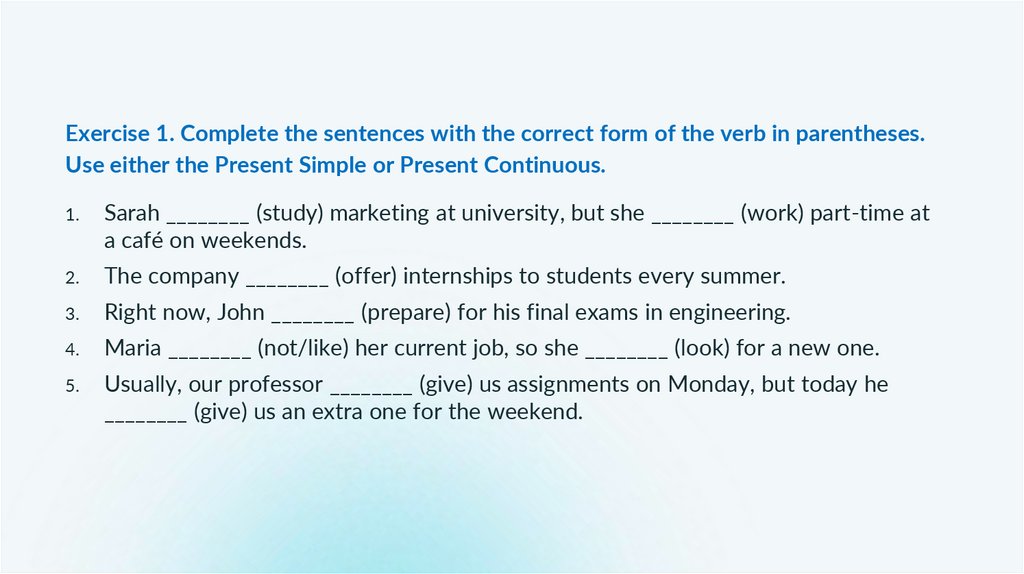
Exercise 1. Complete the sentences with the correct form of the verb in parentheses.Use either the Present Simple or Present Continuous.
1.
Sarah ________ (study) marketing at university, but she ________ (work) part-time at
a café on weekends.
2.
The company ________ (offer) internships to students every summer.
3.
Right now, John ________ (prepare) for his final exams in engineering.
4.
Maria ________ (not/like) her current job, so she ________ (look) for a new one.
5.
Usually, our professor ________ (give) us assignments on Monday, but today he
________ (give) us an extra one for the weekend.
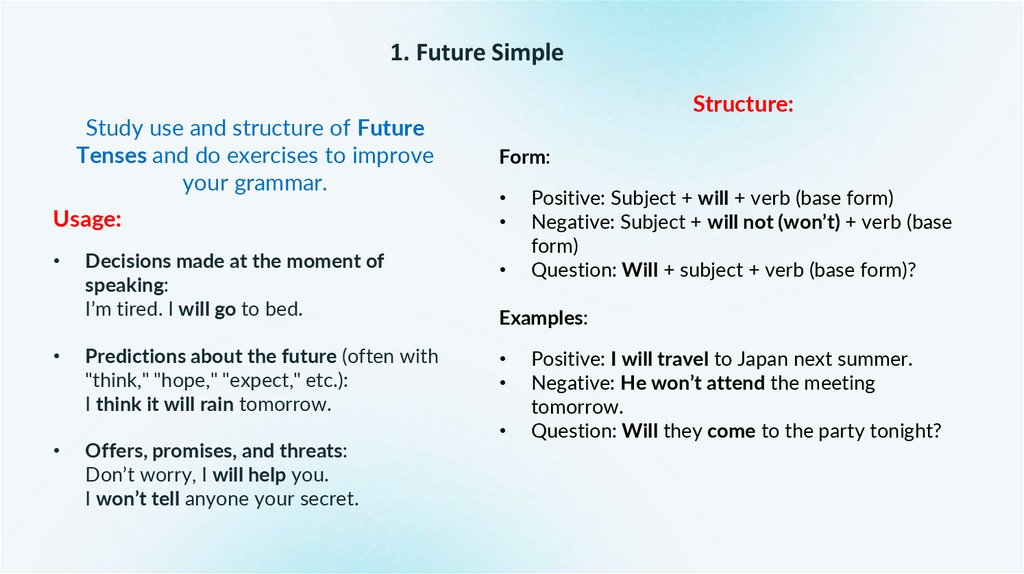
6. 1. Future Simple
Study use and structure of FutureTenses and do exercises to improve
your grammar.
Usage:
Decisions made at the moment of
speaking:
I’m tired. I will go to bed.
Predictions about the future (often with
"think," "hope," "expect," etc.):
I think it will rain tomorrow.
Offers, promises, and threats:
Don’t worry, I will help you.
I won’t tell anyone your secret.
Structure:
Form:
Positive: Subject + will + verb (base form)
Negative: Subject + will not (won’t) + verb (base
form)
Question: Will + subject + verb (base form)?
Examples:
Positive: I will travel to Japan next summer.
Negative: He won’t attend the meeting
tomorrow.
Question: Will they come to the party tonight?
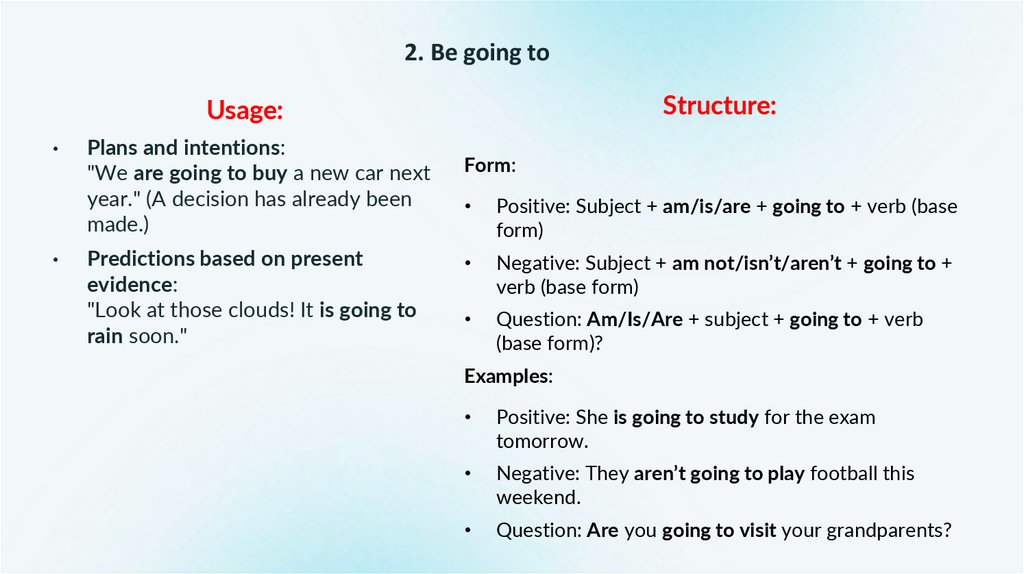
7. 2. Be going to
Structure:Usage:
Plans and intentions:
"We are going to buy a new car next
year." (A decision has already been
made.)
Predictions based on present
evidence:
"Look at those clouds! It is going to
rain soon."
Form:
Positive: Subject + am/is/are + going to + verb (base
form)
Negative: Subject + am not/isn’t/aren’t + going to +
verb (base form)
Question: Am/Is/Are + subject + going to + verb
(base form)?
Examples:
Positive: She is going to study for the exam
tomorrow.
Negative: They aren’t going to play football this
weekend.
Question: Are you going to visit your grandparents?
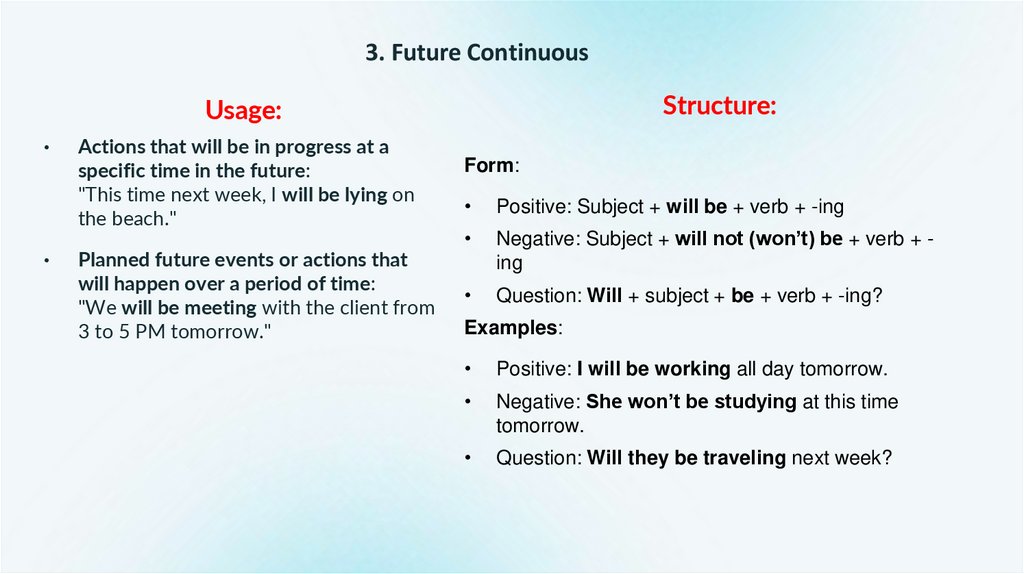
8. 3. Future Continuous
Structure:Usage:
Actions that will be in progress at a
specific time in the future:
"This time next week, I will be lying on
the beach."
Planned future events or actions that
will happen over a period of time:
"We will be meeting with the client from
3 to 5 PM tomorrow."
Form:
Positive: Subject + will be + verb + -ing
Negative: Subject + will not (won’t) be + verb + ing
Question: Will + subject + be + verb + -ing?
Examples:
Positive: I will be working all day tomorrow.
Negative: She won’t be studying at this time
tomorrow.
Question: Will they be traveling next week?
9.
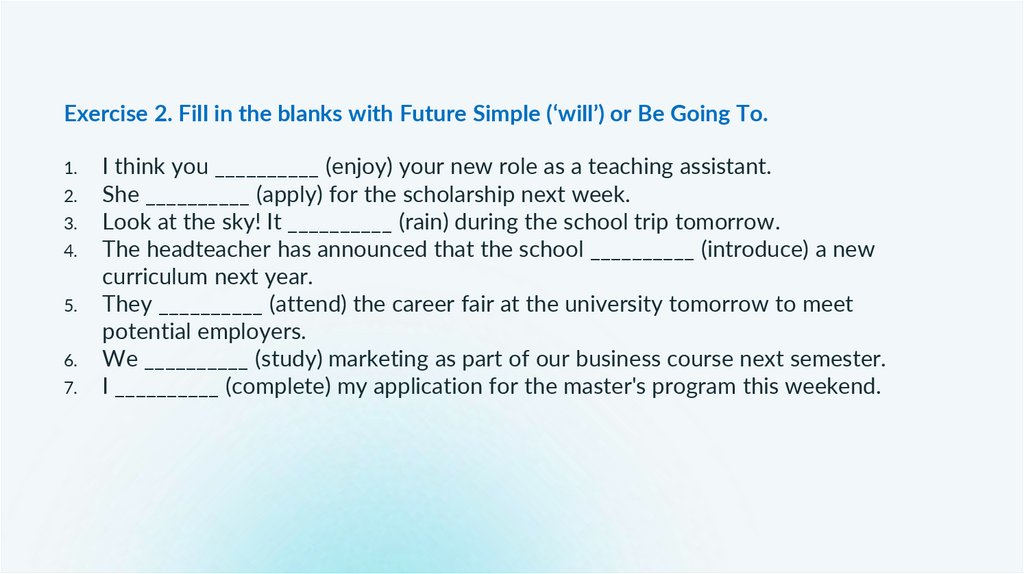
Exercise 2. Fill in the blanks with Future Simple (‘will’) or Be Going To.1.
2.
3.
4.
5.
6.
7.
I think you __________ (enjoy) your new role as a teaching assistant.
She __________ (apply) for the scholarship next week.
Look at the sky! It __________ (rain) during the school trip tomorrow.
The headteacher has announced that the school __________ (introduce) a new
curriculum next year.
They __________ (attend) the career fair at the university tomorrow to meet
potential employers.
We __________ (study) marketing as part of our business course next semester.
I __________ (complete) my application for the master's program this weekend.
10.
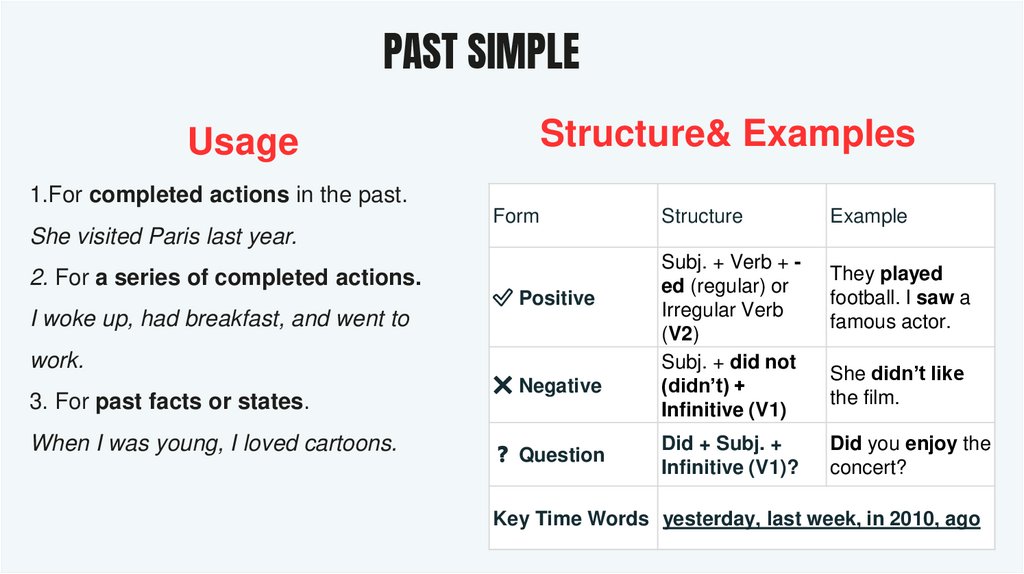
PAST SIMPLEStructure& Examples
Usage
1.For completed actions in the past.
Form
Structure
Example
She visited Paris last year.
2. For a series of completed actions.
✅ Positive
I woke up, had breakfast, and went to
work.
3. For past facts or states.
When I was young, I loved cartoons.
❌ Negative
❓ Question
Subj. + Verb + ed (regular) or
Irregular Verb
(V2)
Subj. + did not
(didn’t) +
Infinitive (V1)
Did + Subj. +
Infinitive (V1)?
They played
football. I saw a
famous actor.
She didn’t like
the film.
Did you enjoy the
concert?
Key Time Words yesterday, last week, in 2010, ago
11.
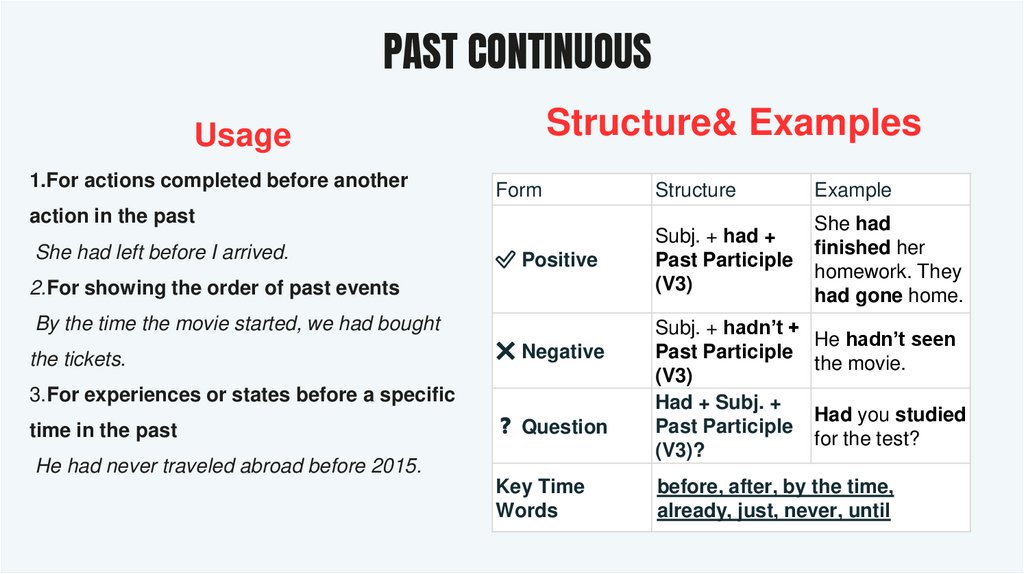
PAST CONTINUOUSStructure& Examples
Usage
1.For actions completed before another
Form
Structure
Example
✅ Positive
Subj. + had +
Past Participle
(V3)
She had
finished her
homework. They
had gone home.
action in the past
She had left before I arrived.
2.For showing the order of past events
By the time the movie started, we had bought
the tickets.
❌ Negative
3.For experiences or states before a specific
time in the past
❓ Question
He had never traveled abroad before 2015.
Key Time
Words
Subj. + hadn’t +
Past Participle
(V3)
Had + Subj. +
Past Participle
(V3)?
He hadn’t seen
the movie.
Had you studied
for the test?
before, after, by the time,
already, just, never, until
12.
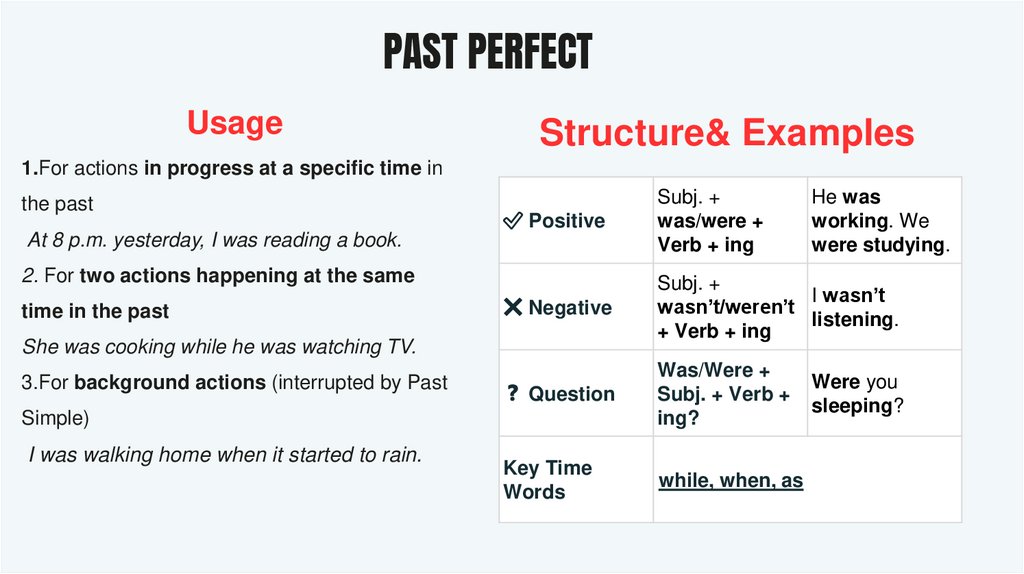
PAST PERFECTUsage
Structure& Examples
1.For actions in progress at a specific time in
the past
At 8 p.m. yesterday, I was reading a book.
✅ Positive
Subj. +
was/were +
Verb + ing
❌ Negative
Subj. +
I wasn’t
wasn’t/weren’t
listening.
+ Verb + ing
❓ Question
Was/Were +
Subj. + Verb +
ing?
Key Time
Words
while, when, as
2. For two actions happening at the same
time in the past
She was cooking while he was watching TV.
3.For background actions (interrupted by Past
Simple)
I was walking home when it started to rain.
He was
working. We
were studying.
Were you
sleeping?
13.
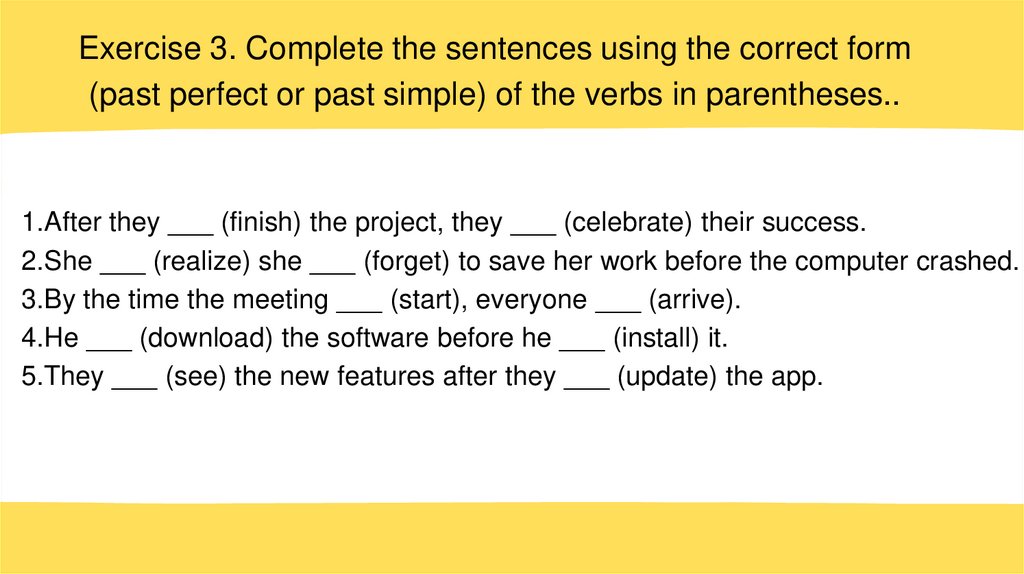
Exercise 3. Complete the sentences using the correct form(past perfect or past simple) of the verbs in parentheses..
1.After they ___ (finish) the project, they ___ (celebrate) their success.
2.She ___ (realize) she ___ (forget) to save her work before the computer crashed.
3.By the time the meeting ___ (start), everyone ___ (arrive).
4.He ___ (download) the software before he ___ (install) it.
5.They ___ (see) the new features after they ___ (update) the app.
14.
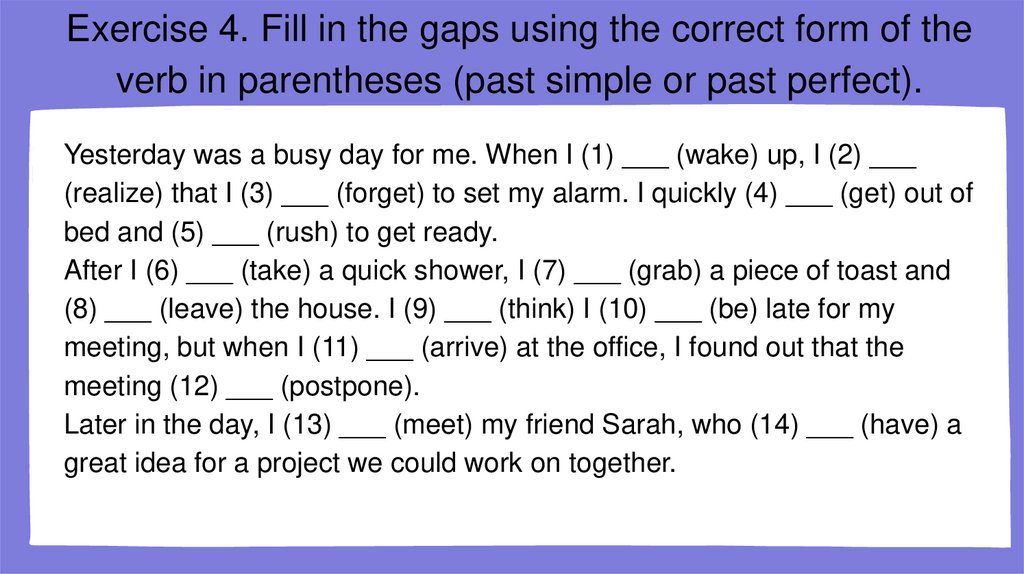
Exercise 4. Fill in the gaps using the correct form of theverb in parentheses (past simple or past perfect).
Yesterday was a busy day for me. When I (1) ___ (wake) up, I (2) ___
(realize) that I (3) ___ (forget) to set my alarm. I quickly (4) ___ (get) out of
bed and (5) ___ (rush) to get ready.
After I (6) ___ (take) a quick shower, I (7) ___ (grab) a piece of toast and
(8) ___ (leave) the house. I (9) ___ (think) I (10) ___ (be) late for my
meeting, but when I (11) ___ (arrive) at the office, I found out that the
meeting (12) ___ (postpone).
Later in the day, I (13) ___ (meet) my friend Sarah, who (14) ___ (have) a
great idea for a project we could work on together.