







 Английский язык
Похожие презентации:








English language teaching. Chapter 9
1. Chapter 9. English language teaching
By Zaiko & Besedina
2. INTRODUCTION
• Key Thesis: The traditional English LanguageTeaching (ELT) model is outdated.
• Core Problem: The model is built around
the native English speaker episteme.
• Learning Goal: To imitate a native speaker,
who is considered the ideal teacher and model.
• Reality: Most real-world communication in
English occurs between non-native
speakers using English as a Lingua Franca
(ELF).
Conclusion: The traditional approach fails
to prepare students for real-world language
use.
3. INTRODUCTION
NATIVE AND NON-NATIVEThe terms are vague and subjective.
Vagueness: The only "advantage" is childhood
acquisition. All proficiency skills can be achieved
by non-natives.
Judgmental: Creates a hierarchy where the nonnative is forever "inferior."
Unrepresentative: Even native speakers speak
different varieties; linguistic backgrounds are often
unclear.
Conclusion: A native speaker is not
unconditionally the perfect teacher.
4. The Solution: What is GELT?
GELT = Global Englishes LanguageTeaching.
Aim: To prepare students for real international
communication, moving away from the "native
speaker" ideal.
Foundation: Recognizes the diversity of
English and the value of multilingualism.
5. 6 Key Proposals of GELT
6 Key Proposals ofGELT
1. Increasing WE and ELF Exposure: Incorporate different
accents and varieties (World Englishes, ELF) into the curriculum.
2. Emphasizing Respect for Multilingualism: The student's
first language is a resource, not an obstacle. Multicompetent
users are the new role models.
3. Raising Awareness of Global Englishes: Directly
teach students about the global nature of the English language.
6. 6 Key Proposals of GELT
6 Key Proposals ofGELT
4. Raising Awareness of ELF Strategies: Teach strategies for
successful communication in multicultural contexts (e.g., using
meta-language).
5. Emphasizing Respect for Diverse Cultures: Culture is a
fluid concept. Focus not only on Anglo-Saxon realities.
6. Changing Teacher Hiring Practices: Value multilingual
teachers for their experience, knowledge of the students'
language, and cultural background.
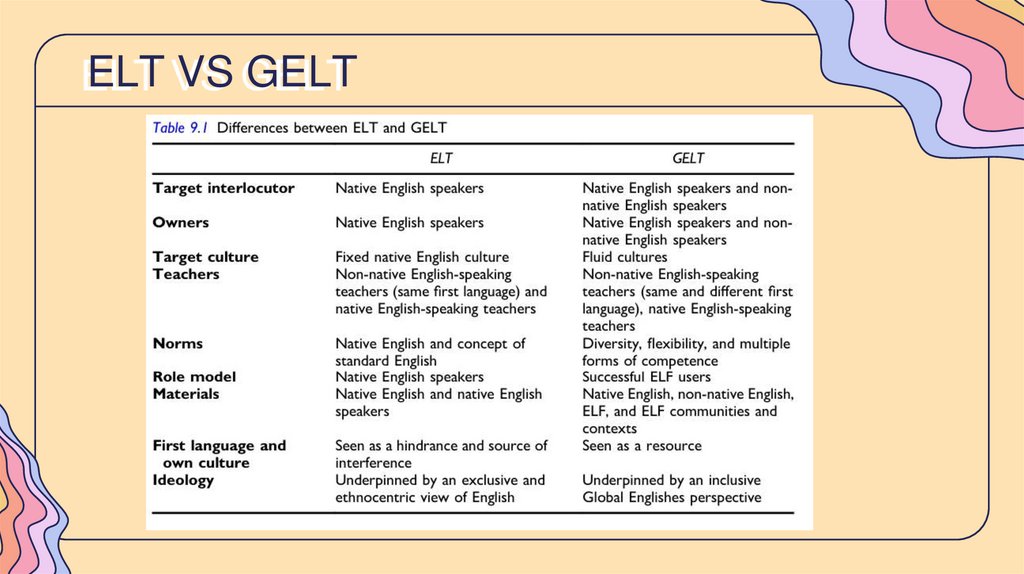
7. ELT VS GELT
8. What Makes a Perfect Teacher?
Student preference Teacher's skills > native speaker status.Key Qualities:
Sensitivity to student needs
Ability to give clear explanations
Ability to motivate and design engaging lessons
Good pronunciation (not necessarily "perfect")
Advantage of Non-Native
Teachers: Understanding of the language learning process
and, often, a shared linguistic and cultural background with
students.
9. Barriers to Implementing GELT
1. Lack of Teaching Materials: Textbooks still promotenative-speaker norms.
2. Standardized Tests: IELTS/TOEFL use native proficiency
as a yardstick.
3. Teacher Resistance: Habituation to the old paradigm,
suspicion of new approaches.
4. Commercial Interests: Marketing and recruitment in the
ELT industry perpetuate the native-speaker image.
10. The Japan Experiment
o Who: Nicola Galloway and Heath Rose.o What: A 13-week course on Global Englishes for
undergraduates.
o Methods: Weekly listening journals, classroom debates,
readings.
o Results:
• Increased student motivation and confidence.
• Changed attitudes towards English varieties and teachers.
• Students began to question the concept of "Standard"
English.
11. Conclusion
The traditional ELT model is outdatedand must be replaced.
GELT is the new, relevant paradigm.
Its Aims:
To emancipate learners from the
"native speaker" ideal.
To value multilingualism and diversity.
To prepare students for real global
communication.