





















 Английский язык
Похожие презентации:






Time to Talk
1.
2.
LessonTitle
Pages
In this lesson:
1
What Are You Interested In?
4-7
Find a flatmate
2
Did You Enjoy Your Trip?
8 - 11
Talk about your last holiday
3
A Day in a Life
12 - 15
Tell people about a typical day in your life
4
I Take After My Father
16 - 19
Talk about your family
Favourite Things
20 - 23
Talk about possessions
6
Works of Art
24 - 27
Tell people about a work of art you like
7
Say No
28 - 31
Refuse requests politely
8
A New Look
32 - 35
Guess what happened
9
Special Offers
36 - 39
Make a radio advertisement
10
Skills
Café Society
40 - 43
Talk about the kind of café you like
11
She’s More Talkative than Me
44 - 47
Compare yourself to someone you know
12
It Has the Best Cheesecake in
Town
48 - 51
Tell people about good places to go in your area
13
On the Underground
52 - 55
Give someone directions on the trains
14
Opinions
56 - 59
Guess who is lying about their opinions
15
Skills
Movie Night
60 - 63
Talk about watching films
16
Imagine
64 - 67
Plan a dream dinner party
17
I Used to Have Long Hair
68 - 71
Talk about how things used to be
18
It Was an Accident
72 - 75
Tell people about an accident
19
Any Plans?
76 - 79
Tell people about next weekend
20
Skills
Read All About It!
80 - 83
Discuss the best source of news
5
Skills
2
Lesson 1
3.
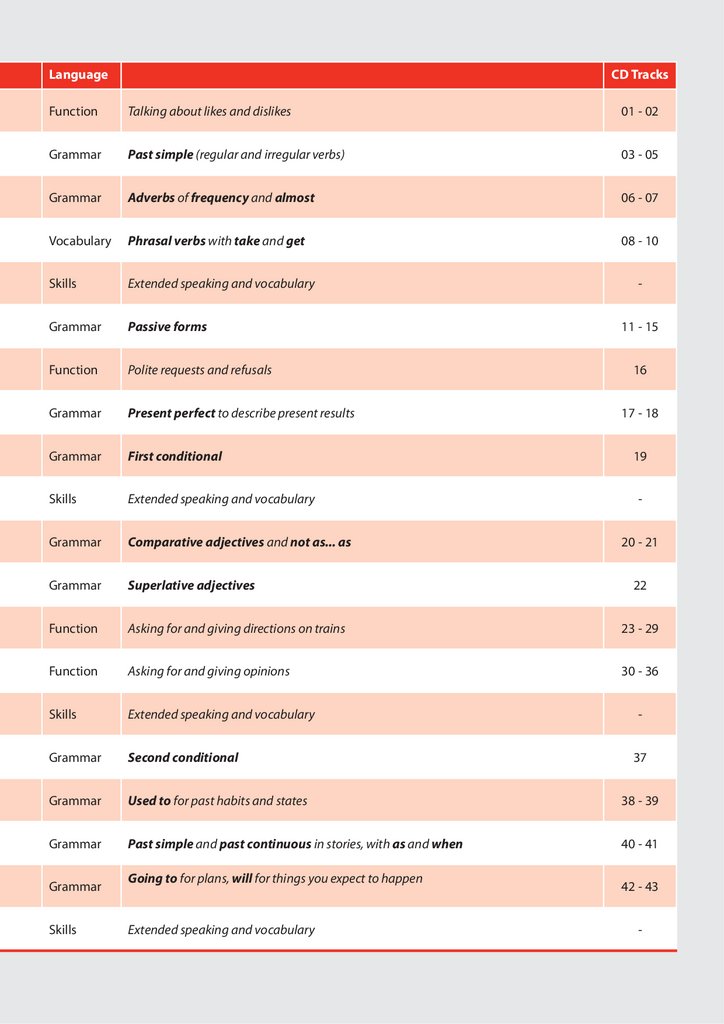
LanguageCD Tracks
Function
Talking about likes and dislikes
01 - 02
Grammar
Past simple (regular and irregular verbs)
03 - 05
Grammar
Adverbs of frequency and almost
06 - 07
Vocabulary
Phrasal verbs with take and get
08 - 10
Skills
Extended speaking and vocabulary
-
Grammar
Passive forms
Function
Polite requests and refusals
Grammar
Present perfect to describe present results
Grammar
First conditional
19
Skills
Extended speaking and vocabulary
-
Grammar
Comparative adjectives and not as... as
Grammar
Superlative adjectives
Function
Asking for and giving directions on trains
23 - 29
Function
Asking for and giving opinions
30 - 36
Skills
Extended speaking and vocabulary
-
Grammar
Second conditional
37
Grammar
Used to for past habits and states
38 - 39
Grammar
Past simple and past continuous in stories, with as and when
40 - 41
Grammar
Skills
Going to for plans, will for things you expect to happen
Extended speaking and vocabulary
11 - 15
16
17 - 18
20 - 21
22
42 - 43
-
Lesson 1
3
4.
LESSON1
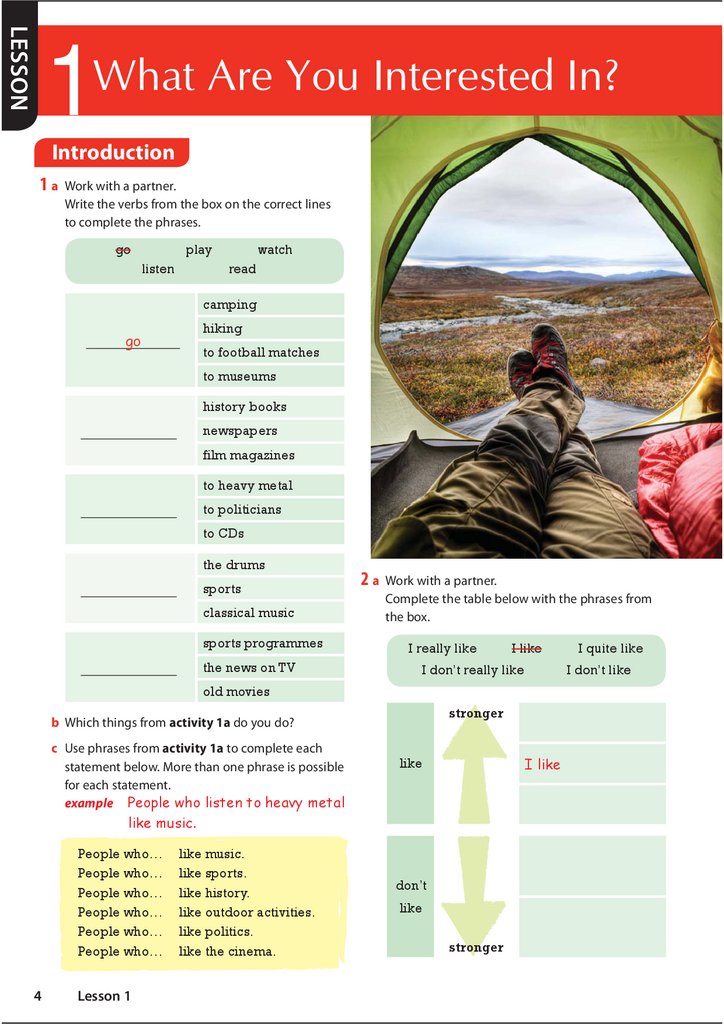
:KDW $UH <RX ,QWHUHVWHG ,Q"
Introduction
1 a Work with a partner.
Write the verbs from the box on the correct lines
to complete the phrases.
go
play
listen
watch
read
camping
hiking
go
to football matches
to museums
history books
newspapers
film magazines
to heavy metal
to politicians
to CDs
the drums
sports
classical music
sports programmes
the news on TV
2 a Work with a partner.
Complete the table below with the phrases from
the box.
I really like
I like
I don’t really like
I don’t like
old movies
stronger
b Which things from activity 1a do you do?
c Use phrases from activity 1a to complete each
statement below. More than one phrase is possible
for each statement.
example People who listen to heavy metal
I like
like
like music.
People who…
People who…
People who…
People who…
People who…
People who…
4
Lesson 1
like music.
like sports.
like history.
like outdoor activities.
like politics.
like the cinema.
don’t
like
stronger
I quite like
5.
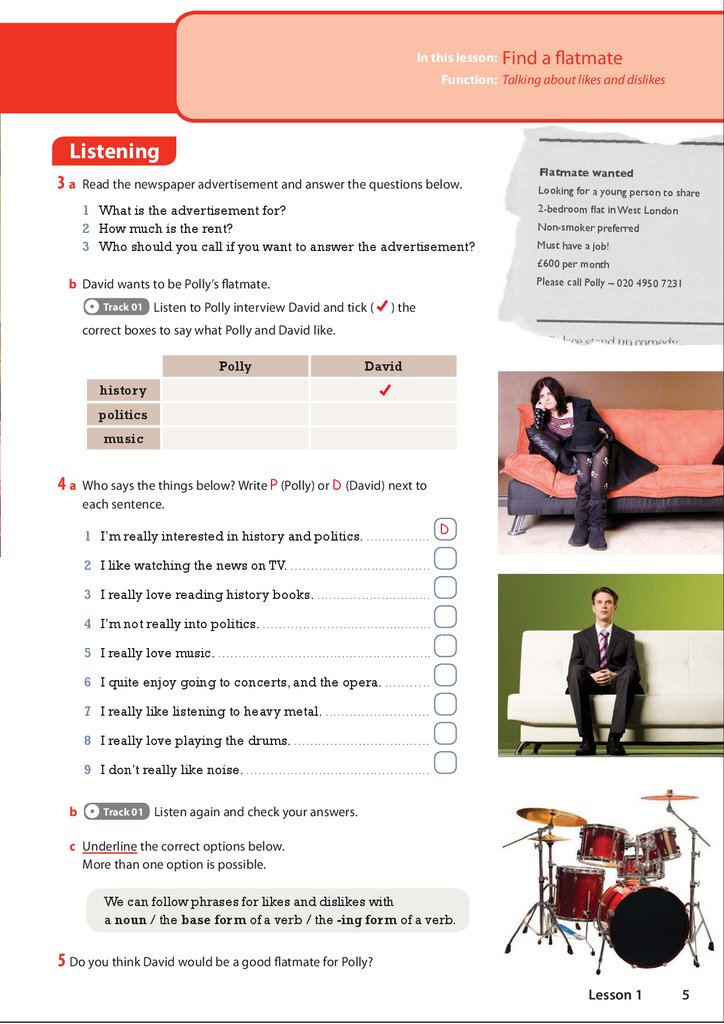
In this lesson: Find a flatmateFunction: Talking about likes and dislikes
Listening
3 a Read the newspaper advertisement and answer the questions below.
1 What is the advertisement for?
2 How much is the rent?
3 Who should you call if you want to answer the advertisement?
Flatmate wanted
Looking for a young person to share
2-bedroom ¾at in West London
Non-smoker preferred
Must have a job!
£600 per month
Please call Polly – 020 4950 7231
b David wants to be Polly’s flatmate.
Track 01
Listen to Polly interview David and tick (
) the
correct boxes to say what Polly and David like.
Polly
David
history
politics
music
4 a Who says the things below? Write P (Polly) or D (David) next to
each sentence.
1 I’m really interested in history and politics. ................ D
2 I like watching the news on TV. ...................................
3 I really love reading history books. .............................
4 I’m not really into politics. ...........................................
5 I really love music. ......................................................
6 I quite enjoy going to concerts, and the opera. ...........
7 I really like listening to heavy metal. ..........................
8 I really love playing the drums. ..................................
9 I don’t really like noise. ..............................................
b
Track 01
Listen again and check your answers.
c Underline the correct options below.
More than one option is possible.
We can follow phrases for likes and dislikes with
a noun / the base form of a verb / the -ing form of a verb.
5 Do you think David would be a good flatmate for Polly?
Lesson 1
5
6.
Language Focus1. We can talk about likes and dislikes in
different ways.
Expressing likes
I love / like / enjoy
I’m interested in
I’m into
+
noun
-ing form of the verb
2. We can use really and quite after be and
before other main verbs to make our
statements stronger or weaker.
We use really with positive and
negative statements.
I love chocolate.
I really love chocolate. (stronger)
I’m interested in politics.
I enjoy going to museums.
I’m not into opera.
I’m not really into opera. (weaker)
Expressing dislikes
I hate
I don’t like /
don’t enjoy
I’m not interested in
I’m not into
We can use quite with positive statements
only, to make them weaker.
+
noun
-ing form of the verb
I’m not interested in sports.
I’m not into reading history books.
I like watching TV.
I quite like watching TV. (weaker)
X I don’t quite like listening to music.
We don’t use quite with love or hate.
X I quite love history.
Questions and short answers
What are you interested in?
Do you like politics?
Yes, I do. / No, I don’t.
Are you into music?
Yes, I am. / No, I’m not.
Practice
6 Write the words in the correct order to make sentences.
a hate / to / the dentist / I really / going
I really hate going to the dentist.
b I’m not / hiking / really / into
c cooking / enjoy / do / you
d into / tennis / she’s / really
e interested / in / what / you / are
f in / quite / foreign films / he’s / interested
g new / people / they / really / love / meeting
6
Lesson 1
X I quite hate listening to heavy metal music.
7.
Sounding Natural7a
Track 02
Listen. What sound can you hear in the underlined parts of the sentences?
1 What are you interested in?
2 Are you interested in sport?
3 Are you into outdoor activities?
b
Track 02
Listen again and copy the pronunciation.
Time to Talk
8 a Read the questions below and make a note of your answers.
1. Do you enjoy outdoor activities?
2. Do you like listening to classical music?
3. Are you interested in politics?
4. Are you into playing sports?
5. What music do you like?
6.
7.
8.
b Write three more questions about likes and dislikes and add them to the list in activity 8a.
9 a Work with a partner. Ask and answer the questions from activity 8.
Ask more questions to get extra information and decide if you would be good flatmates.
example
A: Do you enjoy outdoor activities?
B: Not really.
A: Why not?
Homework WXUQ WR SDJH
b Tell the class about your partner's answers.
Lesson 1
7
8.
LESSON2
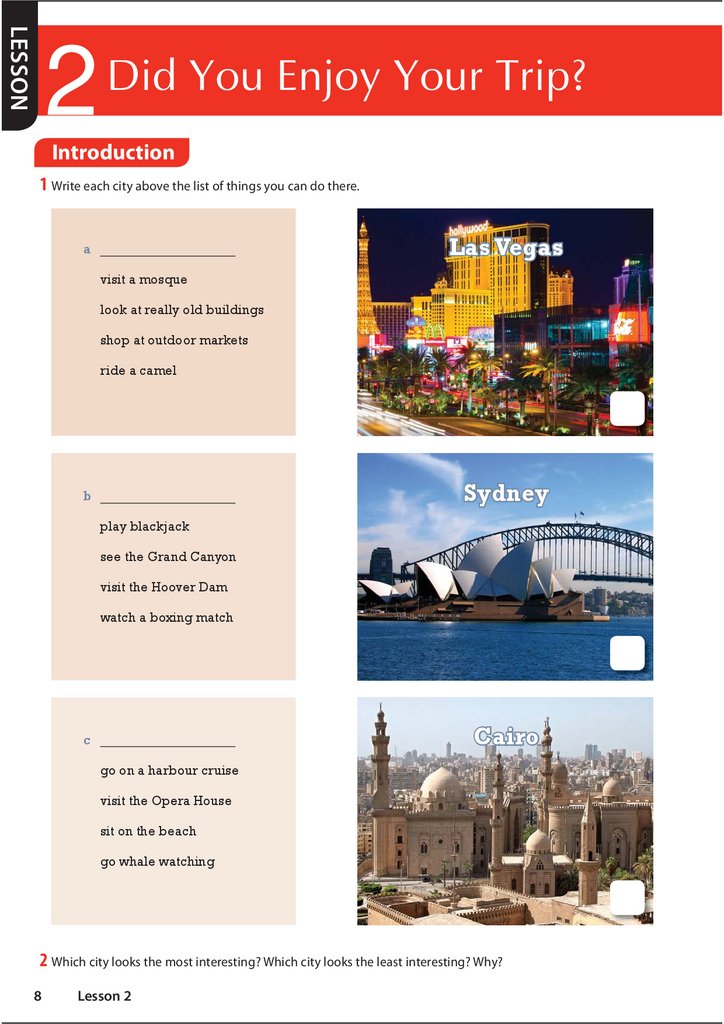
'LG <RX (QMR\ <RXU 7ULS"
Introduction
1 Write each city above the list of things you can do there.
Las Vegas
a
visit a mosque
look at really old buildings
shop at outdoor markets
ride a camel
Sydney
b
play blackjack
see the Grand Canyon
visit the Hoover Dam
watch a boxing match
Cairo
c
go on a harbour cruise
visit the Opera House
sit on the beach
go whale watching
2 Which city looks the most interesting? Which city looks the least interesting? Why?
8
Lesson 2
9.
In this lesson: Talk about your last holidayGrammar: Past simple (regular and irregular verbs)
Listening
3a
b
Listen to two people talking. Tick (
in activity 1 they talk about.
Track 03
) the city
Listen again and write T (true) or F (false) next
to the statements.
Track 03
1 Paul had a great time. ....................................
T
2 Paul flew to Sydney. .......................................
3 Megan had a good holiday. ............................
4 Megan ate junk food . ....................................
c Match the questions with the answers.
Number the boxes.
1
When did you get back?
2
How did you get there? By plane?
3
Did you stop on the way?
4
Where did you stay?
5
Did you have a good holiday?
Yes, I stopped in Canberra for one night.
Well, I have some family there, so I stayed with them.
No, I had a boring time at home.
1
Last night. About ten o’clock.
No, I drove.
d
Track 03
Listen again and check your answers.
4 Who is happy about their holiday? Who isn’t so happy? Why?
Lesson 2
9
10.
Language FocusWe use the past simple to talk about
completed actions in the past (we often say
when it happens, e.g. yesterday, last
Saturday/week/summer, at the weekend).
Practice
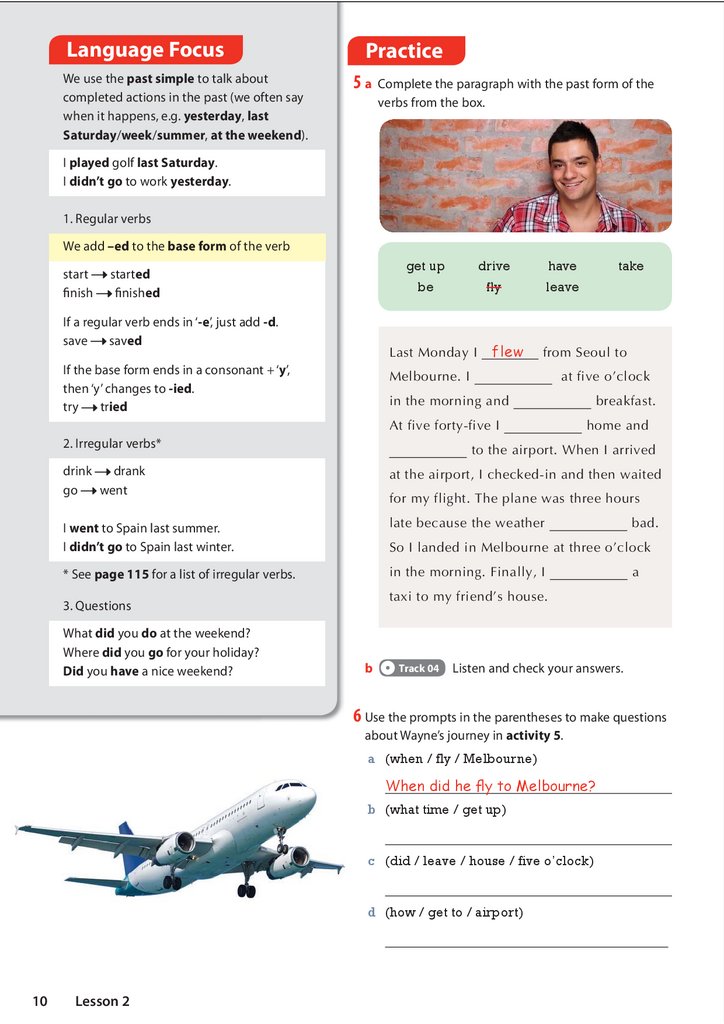
5 a Complete the paragraph with the past form of the
verbs from the box.
I played golf last Saturday.
I didn’t go to work yesterday.
1. Regular verbs
We add –ed to the base form of the verb
start
finish
started
finished
If a regular verb ends in ‘-e’, just add -d.
saved
save
get up
drive
have
be
fly
leave
/DVW 0RQGD\ , flew
If the base form ends in a consonant + ‘y’,
then ‘y’ changes to -ied.
tried
try
take
IURP 6HRXO WR
0HOERXUQH ,
DW ILYH R©FORFN
LQ WKH PRUQLQJ DQG
EUHDNIDVW
$W ILYH IRUW\ ILYH ,
KRPH DQG
2. Irregular verbs*
WR WKH DLUSRUW :KHQ , DUULYHG
drink
drank
go
went
DW WKH DLUSRUW , FKHFNHG LQ DQG WKHQ ZDLWHG
I went to Spain last summer.
I didn’t go to Spain last winter.
ODWH EHFDXVH WKH ZHDWKHU
6R , ODQGHG LQ 0HOERXUQH DW WKUHH R©FORFN
* See page 115 for a list of irregular verbs.
LQ WKH PRUQLQJ )LQDOO\ ,
IRU P\ IOLJKW 7KH SODQH ZDV WKUHH KRXUV
D
WD[L WR P\ IULHQG©V KRXVH
3. Questions
What did you do at the weekend?
Where did you go for your holiday?
Did you have a nice weekend?
EDG
b
Track 04
Listen and check your answers.
6 Use the prompts in the parentheses to make questions
about Wayne’s journey in activity 5.
a (when / fly / Melbourne)
When did he Áy to Melbourne?
b (what time / get up)
c (did / leave / house / five o’clock)
d (how / get to / airport)
10
Lesson 2
11.
Sounding Natural7a
Listen to the sentences below.
How do we say the underlined words when we speak naturally?
1 Did you have a good holiday?
Track 05
2 What did you do last night?
3 When did you get back?
4 Did you play golf at the weekend?
b
Track 05
Listen again and copy the pronunciation.
Time to Talk
8 a Read the questions below and make a note of your answers.
1. When was your last holiday?
2. Where did you go?
3. Who did you go with?
4. Do you want to go there again?
5.
6.
7.
b Write three more questions for your partner about what they did on their last holiday.
9 a Work with a partner. Ask and answer the questions in activity 8.
example
A: When was your last holiday?
B: Last autumn.
b Tell the class about your partner's answers.
example
Dominic went to Venice with his wife last autumn.
Homework WXUQ WR SDJH
Lesson 2
11
12.
LESSON3
$ 'D\ LQ D /LIH
Introduction
1 Work with a partner.
Write the words from the box in the correct places to complete the diagram below.
never
always
hardly ever
sometimes
usually
often
0%
100%
never
2 a Work with a partner.
Match the activities on the left with the correct occupations on the right.
have business lunches
read reports
leave work at 3 a.m.
make business decisions
a barman
get up late
have business lunches
have meetings with staff
get ready for work in the morning
get ready for work in the evening
go on business trips
the CEO of
a company
b Tell your partner which things from activity 2a you do.
example
I have meetings with staff, but I don·t have business lunches.
c Tell the class about your partner’s answers.
example Zena has meetings with staff, but…
Reading
3 a You are going to read a magazine article on page 13 about a typical day in the life of Damien, a club DJ.
Which things from activity 2 do you think the article will talk about?
b Read the article quickly and check your ideas.
12
Lesson 3
13.
In this lesson: Tell people about a typical day in your lifeGrammar: Adverbs of frequency and almost
A Day in the Life of a DJ
W
I get ready for work at about ½ve o’clock
e asked DJ Damien to tell us about a typical
day in his life.
I leave work at three or four in the morning,
so I never / usually get up late. I always /
hardly ever have a good breakfast because I
think breakfast is important. I almost always have
toast, cereal, fruit and yoghurt, but I sometimes
/ never make a big bacon sandwich because I just
in the evening. I have a shower, dress and pack
my records, CDs and headphones. I go around to
a friend’s house, have a beer and practise for two
hours, then we get something to eat in a restaurant.
I love foreign food, so we often / hardly ever
have a curry, or Chinese food, or something like
that.
love bacon.
After breakfast, I look at my emails, and then
I go into town and look around the music shops. It’s
a good thing to do because I can never / often
½nd interesting records and CDs that I can use
when I play. I almost never have lunch, because I’m
hardly ever / always hungry in the afternoon,
but I sometimes / always meet my accountant
and have a business lunch with him in a café.
4 a Work with a partner.
Read the article again and underline the correct
options in bold to complete each paragraph.
b Write T (true) or F (false) next to each
statement below.
1 Damien finishes work in the morning. T
2 Damien always has toast, cereal, fruit and
yoghurt for breakfast.
3 Damien hardly ever has lunch.
4 Not all the DJs go to a party after
the club.
5 Damien is 27 years old.
When I get to the club, I check who the
other DJs are and see who is on the guest list. The
club opens at 11, but I don’t play until about two
because I’m quite popular now. The popular DJs
sometimes / always play late. At the end of the
night almost all the DJs go to an after-club party, but
I don’t. I’m quite old now (I’m 26, but I’m almost 27
– my birthday is next month!), so I never / often
just go home.
c Find the highlighted words in the article and read
the sentences they are in.
Does each pair of words below have the same (S)
or a different (D) meaning? Circle S or D.
1
almost always
always
S / D
2
almost never
hardly ever
S / D
3
almost all
all
S / D
4
almost 27
27
S / D
5 Would you like to do Damien’s job? Why or why not?
Lesson 3
13
14.
Language Focus1 We call words like never, hardly ever, sometimes, often, usually, and always, adverbs of
frequency. We use them to talk about how common it is for us to do something.
Adverbs of frequency usually go after be, but in front of other main verbs.
I’m always hungry in the afternoon.
They aren’t usually tired in the morning.
I sometimes make a big bacon sandwich.
He doesn’t usually eat lunch.
Questions and short answers
When does he usually finish work?
What do you usually have for breakfast?
When are you usually here?
Do you ever work late? Yes, sometimes/often. / No, never.
2 We can use almost in front of words like always, never, all, every, everyone, and no one.
We can also use it in front of numbers.
almost never = not never but very close (hardly ever)
almost all = not all, but very close (maybe 99%)
almost no one = not no one, but very close (maybe one or two people)
almost 27 = less than 27, but very close (maybe his birthday is next month)
I almost always have breakfast.
She almost never eats meat, but sometimes she has a bacon sandwich.
Almost everyone went for a drink after work, but I went home.
He won almost every time. We played 10 games and I beat him only once.
There were almost 30 people at the party - maybe 27 or 28.
Be careful: We don’t usually follow almost with a noun.
X Almost people in my office are American.
Almost all the people in my office are American.
Almost everyone in my office is American.
Practice
6 a Work with a partner. Write the words in the correct order to make sentences.
1 almost / it’s / five o’clock It·s almost Àve o·clock.
2 usually / mornings / the / tired / she’s / in
3 I / TV / almost / watch / never
4 always / office / work / almost / we / late / in / our
5 isn’t / Tim / for / often / late / meetings
6 business / I / trips / ever / go / on / hardly
7 you / buy / food / where / usually / do
8 for / work / ever / late / you / are
b
14
Track 06
Lesson 3
Listen and check your answers.
15.
Sounding Natural7a
Track 07
Listen. What sound can you hear in the underlined parts of the sentences?
1 He almost always works late.
2 She almost never smiles.
3 We almost always finish early.
b
Track 07
Listen again and copy the pronunciation.
Time to Talk
8 a Work on your own.
Make a note of two or more things you do on a typical day in each part of the table below.
Try to use almost and three or more different adverbs of frequency.
in the morning
lunch
in the evening / at night
b Work with a partner.
Use your notes to tell them about a typical day in your life.
example
I almost always get up at 6.30.
Listen to your partner, ask questions to get more information and make a note of what they say.
example
What do you usually have for breakfast?
Notes:
c Tell the class about your partner’s answers.
Homework WXUQ WR SDJH
Lesson 3
15
16.
LESSON4
, 7DNH $IWHU 0\ )DWKHU
Introduction
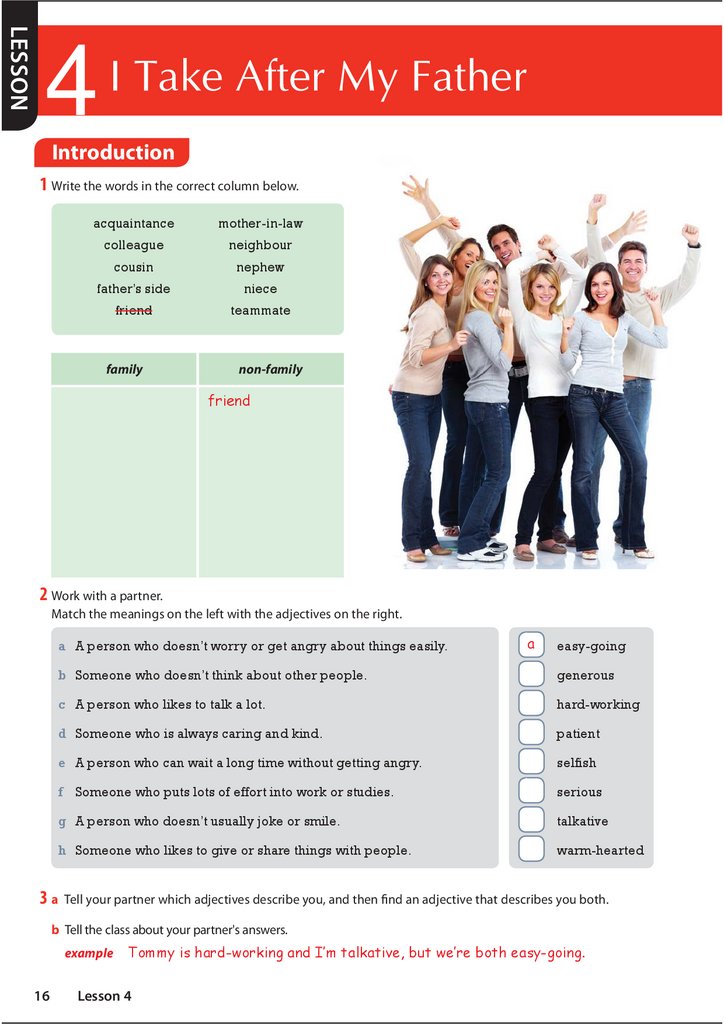
1 Write the words in the correct column below.
acquaintance
mother-in-law
colleague
neighbour
cousin
nephew
father’s side
niece
friend
teammate
family
non-family
friend
2 Work with a partner.
Match the meanings on the left with the adjectives on the right.
a A person who doesn’t worry or get angry about things easily.
a
easy-going
b Someone who doesn’t think about other people.
generous
c A person who likes to talk a lot.
hard-working
d Someone who is always caring and kind.
patient
e A person who can wait a long time without getting angry.
selfish
f Someone who puts lots of effort into work or studies.
serious
g A person who doesn’t usually joke or smile.
talkative
h Someone who likes to give or share things with people.
warm-hearted
3 a Tell your partner which adjectives describe you, and then find an adjective that describes you both.
b Tell the class about your partner's answers.
example
16
Tommy is hard-working and I·m talkative, but we·re both easy-going.
Lesson 4
17.
In this lesson: Talk about your familyVocabulary: Phrasal verbs with take and get
Listening
4
Listen to two people talking. How does Naomi describe her family?
Match the family members on the left to the adjectives on the right.
Track 08
mother
serious and selfish
sister
easy-going and talkative
father
warm-hearted and generous
brother
serious and patient
5 a Match the questions on the left with the answers on the right.
1 Who do you take after?
2 Do you get along with your sister?
3 Who does she take after?
4 Do you like your brother?
b
Track 09
Yes, I get on with him very well.
I suppose she takes after my father. He’s
serious, too.
Well no, I don’t really like her.
1 I think I take after my mother. We’re both
really easy-going and talkative.
Listen and check your answers.
6 Who does Naomi like, her brother or sister?
7 Match the words on the left with the meanings on the right.
get on with/get along with
to be similar to someone
take after
to have a good relationship with someone
Lesson 4
17
18.
Language Focus1. We use get on (with) / get along (with) to say that we have a good relationship with someone.
I get on with the people at work. They’re all so nice.
I don’t get along with my brother. He’s very selfish.
2. We use take after to say we are similar in appearance or personality to other people in our family.
She takes after her mother. They’re both very generous.
I take after my father. We’re both tall.
Practice
8 Underline the correct option to complete each sentence below.
a Christina and I like all the same things. That’s why I get on with / take after her so well.
b We got along with / didn’t get along with each other when we were kids. We fought every day.
c Do you get on with / take after your colleagues at work?
d Damon doesn’t get along with / takes after his mother. They’re both really easy-going and patient.
e He’s very selfish, that’s why he gets along with / doesn’t get along with his teammates.
f My daughter gets along with / takes after her father. She looks just like him.
g His brother is so different from him, but they get on with / take after each other so well.
Sounding Natural
9a
Track 10
Listen to the words below. Write the number of syllables next to each adjective.
easy-going
b
18
4
selfish
generous
serious
hard-working
talkative
patient
warm-hearted
Track 10
Lesson 4
Listen again and copy the pronunciation.
19.
Time to Talk10 a Read the questions below and make a note of your answers.
1. Who do you get on with on your mother·s side?
2. Which person in your family do you take after?
3. Do you get on with your neighbours?
4. Did you get on with all of your high school classmates?
5.
6.
b Write two more questions for your partner about
who they take after and get on with.
11 a Work with a partner.
Ask and answer the questions in activity 10.
Make a note of your partner’s answers.
example
A: Do you get on with your neighbours?
B: Yes, I talk to them every day.
b Tell the class about your partner's answers.
example
Marge gets on with her neighbours
and she talks to them every day.
Homework WXUQ WR SDJH
Lesson 4
19
20.
LESSON5
)DYRXULWH 7KLQJV
Introduction
1 a Complete the table below with the words from the box.
cricket bat
cloth
1
curtains
envelope
made of metal
2
knife
corkscrew
plastic
scissors
metal
3
made of leather
belt
handbag
wallet
shampoo bottle
made of wood
chest of drawers
coffee table
cricket bat
4
5
made of
comb
CD case
6
made of
blanket
shirt
made of paper
letter
magazine
b Add one more thing to each box in activity 1a.
2 Complete the conversations below with a phrase from the box.
get it
got it from
got it in
gave it to
made of
1 A: That’s a beautiful handbag, Laura!
B: Thanks, my husband gave it to me for my birthday.
2 A: That scarf looks really expensive. What’s it
?
B: Silk, I think. It’s my favourite scarf.
3 A: Wow! I love your dress. Where did you
?
B: At a department store. It was half-price.
4 A: This is my favourite necklace. I
my grandmother.
5 A: Where did you buy this painting?
B: I
3 a Work with a partner.
Europe.
Choose something from your bag and use the phrases from activity 2 to tell your partner about it.
example
I got this key chain from my friend. I think she got it in London.
b Tell the class about your partner’s possession.
example
20
Lesson 5
Linda got her key chain from her friend. She thinks...
21.
In this lesson: Talk about possessionsSkills: Extended speaking and vocabulary
Time to Talk 1
4 a Imagine your house is on fire. Your family, photographs and documents are safe.
You can save three more things. Make a list below.
you
your partner
one
two
three
b Work with a partner. Show your partner your list and explain your choices.
Ask questions to get extra information about your partner’s things.
Make a note of their answers in the table above.
example
A: I saved my electric guitar. It·s made of maple wood.
B: Why is it special?
A: I got it from my grandparents for my sixteenth birthday.
I love it!
5 Tell the class about your partner's answers.
example
Sophie saved her electric guitar. It·s made of maple wood.
She got it from her grandparents.
Lesson 5
21
22.
Vocabulary6 a Complete the situations on the left of the table with the words from the box.
driving
living
being
advantage
working
disadvantage
You work long hours.
1
working in a high-paying job
2
in a large house
3
rich
4
an expensive car
b Write the numbers to match each statement below with a situation in activity 6a.
You have lots of space for your things.
You can buy the things you want.
1
You work long hours.
You spend lots of money on insurance.
c Work with a partner.
Decide if the statements in activity 6b describe advantages or disadvantages of the situations
in activity 6a. Write each statement in the correct place in the table.
7 Complete the rest of the table in activity 6a with your own ideas.
22
Lesson 5
23.
Time to Talk 28 a Work with a partner. Read the list of things that can make people happy.
Add four more of your own ideas.
living in a big house
driving an expensive car
owning beautiful art
wearing designer clothes
b Rank the things from 1-8 (1= the most important thing for a happy life).
9 a Change partners and compare your lists from activity 8.
Choose the five most important things for a happy life.
b As a class, discuss your ideas.
Decide the three most important things for a happy life.
Homework WXUQ WR SDJH
Lesson 5
23
24.
LESSON6
:RUNV RI $UW
Introduction
1 a Work with a partner.
Match the verbs from the box with the kinds of art in the table below.
Some verbs can go with more than one kind of art.
direct
illustrate
paintings
make
paint
publish
release
take
write
sculptures
CDs
films
novels/
short stories
paint
photographs
b Underline the correct options to complete the statements below.
1 If you illustrate / publish a novel, you make pictures to
go with the story.
2 If you illustrate / publish a novel, you make it ready for
people to buy.
3 You write novels and short stories before / after you
publish them.
4 You make CDs and films before / after you
release them.
c Which kinds of art from activity 1a do you have in your home?
2 Look at the works of art on the right.
Tell the class which ones you recognise and what you know about them.
example
24
I know the sculpture in picture 2.
I think it·s in Italy…
Lesson 6
1
25.
In this lesson: Tell people about a work of art you likeGrammar: Passive forms
Listening
3 a Use the words from the box to complete the information about the works of art in the pictures.
1888
1930
American
marble
Italy
flowers
Germany
Grant Wood
Italian
Puppy
Van Gogh
$300
$40 million
name
Picture 1
Picture 2
Picture 3
SunÁowers
David
American
Gothic
Bernini
artist
artist’s
nationality
Picture 4
Jeff Koons
Dutch
American
1623
date
1992
where made/
painted
France
America
materials
oil paint
oil paint
price
b
Track 11
Track 12
Track 13
Track 14
Listen and check your ideas.
c Write numbers to match the statements below with the pictures.
1 This sculpture was made in Italy.
Picture 2
2 The painting is called Sunflowers.
Picture
3 They were made by Americans.
Pictures
4 It was bought for $40 million.
Picture
and
4 Which work of art from activity 3 do you like the most? Why?
Lesson 6
25
26.
Language Focus5 Work with a partner.
Read the sentences, and then underline the correct option to answer each question below.
a The painting is called Sunflowers.
b David was made in Italy.
c American Gothic and Puppy were made by Americans.
d Sunflowers was bought for $40 million.
1 Does sentence a mention who calls the painting Sunflowers?..
yes / no
2 Does sentence b mention who made David?...........................
yes / no
3 Does sentence d mention who bought the picture?.................
yes / no
4 In all the sentences, which is more important?.........................
the works of art / the people
We can use passive forms when we don’t know
or we aren’t really interested in who does
an action.
With passive forms, we change be to form
the tense.
Puppy is made of flowers. (present simple)
Puppy was made in 1992. (past simple)
be (not) + past participle
These sculptures are made of marble. They
aren’t made of flowers.
Questions and short answers
When was the Mona Lisa painted?
Who was it bought by?
That sculpture is called Puppy. It isn’t
called David.
Were they made in Italy?
Yes, they were. / No, they weren’t.
For regular verbs, the past participle
looks the same as the past form.
call
called
Is it made of plastic?
Yes, it is. / No, it isn’t.
If we want to mention who does the action we
use by.
called
There is a list of common irregular verbs
on page 115.
David was made by Michelangelo.
Practice
6 Use be (not) and a verb from the box in the correct form to complete the sentences below.
Use each word only once.
allow
build
hurt
a She fell down, but it’s OK. She wasn·t
b When
make
c All my shoes are Italian. The best shoes
Lesson 6
wake
we
to take photographs?
?
e My bicycle
f I
g Where
26
steal
hurt . d My camera is in my bag.
this house
in Italy.
paint
.
up by a loud noise.
this picture
?
27.
Sounding Natural7 a Write 1, 2, or 3 next to each word to say how many syllables it has.
2
novel
photograph
film
sculpture
painting
story
b
Track 15
Listen and check your answers.
c
Track 15
Listen again and copy the pronunciation.
Time to Talk
8 a Work on your own.
Think of a work of art you really like, or one that you have in your home.
It could be a painting, a sculpture, a book, a film, a CD or something else.
Make notes in the table below.
what it is
what it is called
who it was made by
when it was made
other information
b Work with a partner. Tell them about the work of art you made notes on.
Listen to your partner and make a note of what they say.
Ask questions to get more information.
example
I really like a novel. It·s called…
Was it illustrated?
Notes:
c Tell the class about your partner’s answers.
example
Kali really likes a novel called…
Homework WXUQ WR SDJH
Lesson 6
27
28.
LESSON7
6D\ 1R
Introduction
1 a Work on your own. Read the questions below and
make a note of your answers.
1 When was the last time you asked someone
to do something for you? What was it?
2 When someone asks you to do something,
is it easy for you to say ‘no’? Why?
3 Are the people below easy or difficult for
you to say ‘no’ to?
Write E (easy) or D (difficult) next to
each person.
family
friends
people you don’t know
colleagues
teachers at school
b Work with a partner.
Discuss your answers to the questions in activity 1a.
c Tell the class about your partner's answers.
28
Lesson 7
29.
In this lesson: Refuse requests politelyFunction: Polite requests and refusals
1
2
3
4
5
6
Reading
2 Work with a partner. Look at the pictures.
Match each picture with a sentence in Column A and a sentence in Column B.
Column A
Lend me some money.
Column B
2
Can you show me how to use this?
Show me how to use this.
Do you think you could lend me some money?
Lend me your dictionary.
Could you give me a glass of red, please?
Tell me the way to the village.
Could you not park your car here, please?
Give me a glass of red.
Can you lend me your dictionary?
Don’t park your car here.
Would you mind telling me the way to the village?
2
3 Read the requests in activity 2 again, then underline A (Column A) or B (Column B) to answer the questions below.
a In which column do the requests use modal verbs (can/could/would)? ...... A / B
b In which column are the requests in Yes / No question form? ...................... A / B
c In which column are the requests more polite? ........................................... A / B
4 a Write numbers to match the polite refusals with the requests in activity 2.
1 I’m afraid we don’t have any left. Would you like white?
1
2 I would, but I don’t have any.
3 I’d usually say yes, but I’m using it right now.
4 I’m sorry, but I don’t live around here.
5 I’d like to, but I don’t know this programme.
6 I’m sorry, but our car is broken down.
b Underline the refusals in activity 4a that we usually use only with people we are friendly with.
Lesson 7
29
30.
Language FocusWe can use modal verbs to make polite requests in
different ways.
can
could
you (not) + base form of the verb
Practice
5 a Use the prompts to make the requests polite.
1 Take these letters to the post office.
Do you think you could take these
letters to the post ofÀce?
Can you open the window, please?
Could you not park your car here, please?
Do you think you could (not) + base form of the verb
Do you think you could lend me a hundred pounds?
Do you think you could not make so much noise?
Would you mind (not) + –ing form of the verb
Would you mind telling me the way to the village?
Would you mind not using all the milk?
2 Bring me the bill.
Can
3 Buy me a drink.
Could
4 Don’t smoke in here.
Would you mind
5 Lend me your bicycle.
When we refuse requests politely we can apologise
and give a reason:
apology
reason
I’m sorry, but
I’m afraid
our car is broken down.
we don’t have any left.
Do you think
b Write numbers to match the replies below to the
requests in activity 5a.
1 I’d love to, but I haven’t got any money.
We can use phrases with I would when we refuse
requests from people we are friendly with.
2 I would, but I don’t have time. Would
phrase with I would, but
reason
3 No problem. I’ll go outside.
I would*, but
I’d usually say yes, but
I’d like to, but
I don’t have any.
I’m using it right now.
I don’t know this
programme.
4 I’d usually say yes, but I need it to get
* In response to Would you mind... ?
we can say I wouldn’t, but…
We can use the following expressions to
agree to requests:
Of course.
No problem.
Certainly.
Sure.
OK.
In response to Would you mind…? we can
agree with Not at all.
30
Lesson 7
you mind doing it yourself?
to work.
5 Certainly, sir. Right away.
3
31.
Sounding Natural7a
Track 16
Listen. Does the intonation go up or down at the end of each request?
Circle the correct arrow.
1 Can you show me how to use this? .....................................
2 Could you lend me your dictionary? .................................
3 Do you think you could lend me some money? .................
b
Track 16
Listen again and copy the pronunciation.
Time to Talk
You are going to role-play two situations making and responding to requests.
Work in two groups, A and B.
Group A: read below.
Group B: go to page 84.
7 a Read the information for Role-play 1 and think about what to say.
Role-play 1
• You and your partner are colleagues. You work together in the same office.
• Tomorrow is your colleague’s day off, but it’s a working day for you. You want to take the day off (it’s your birthday!)
• Go to your colleague’s desk and say hello.
• Ask your colleague to change their day off with you.
b Do the role-play with your partner.
example
A: Hi, Jo. How are you?
B: Oh, hello Kim...
A: Jo… I want to ask you something…
c Do the same with Role-play 2.
Role-play 2
• You live in a house and your partner is your neighbour.
• You are selling your sofa. The sofa is on the street.
• Someone will come to take it away in 20 minutes.
• Your neighbour comes to your door. Listen to what your neighbour says and respond.
Homework WXUQ WR SDJH
Lesson 7
31
32.
LESSON8
$ 1HZ /RRN
Introduction
1 a Use the verbs from the box to complete the ideas
for how you can change your look.
1
burn
cut
get
buy
dye
join
Burn your old clothes and
2
your hair a different colour.
3
a perm.
4
a gym.
5
your hair short.
new ones.
b Which suggestion in activity 1a do you think is the best?
32
Lesson 8
33.
In this lesson: Guess what happenedGrammar: Present perfect to describe present results
Listening
2a
Track 17
Listen to Pat and Sam talking, and then look at their pictures below and underline the correct name.
1 Pat / Sam
2 Pat / Sam
b Draw a line to match the questions in Column 1 with the answers in Column 2.
Column 1
c
Column 2
1
Have you changed your
hair colour?
Yes. I’ve joined a gym.
2
Have you lost weight?
Yeah, I’ve cut it.
3
Have you done something
to your hair?
Yes, I’ve dyed it black and
Track 17
got a perm.
Listen and check your answers.
3 Underline the correct option to complete the sentences below.
a Pat and Sam are talking about actions that happened in the present / the past.
b They can / can’t see the results of the actions now.
4 Do you think Pat and Sam will see each other again? Why?
Lesson 8
33
34.
Language FocusWe can use the present perfect to talk about a past action that has a connection to the present.
have/has + the past participle form of the verb
You’ve* lost weight. (I can see that you look thinner.)
She’s** dyed her hair. (I can see that her hair is a different colour.)
Has she gone out? (I don’t see her now.)
*you’ve = you have
**she’s = she has
Practice
5 Write the words in the correct order to make present perfect statements, then match each statement with a
present result on the right.
Use contracted forms (e.g. he’s, she’s) where possible.
a
he / his / has / lost / glasses
He·s lost his glasses.
b
His teacher is angry.
shops / to / gone / the / has / Linda
She’s not home right now.
34
c
diet / I / started / have / a
d
of / they / people / a / have / invited / lot
e
has / his / Timmy / homework / forgotten / do / to
f
have / late / I / woken / up
g
have / I / finished / the / newspaper / reading
Lesson 8
I’m late for work.
You can read it now.
There’s nowhere to sit at the party.
a He can’t see the TV clearly.
I’m always hungry.
35.
Sounding Natural6a
Track 18
Listen. Underline the main stress in each sentence on the left.
1 Mary’s bought a new dress.
(she didn’t steal it)
2 Mary’s bought a new dress.
(it wasn’t second-hand)
3 Mary’s bought a new dress.
(it isn’t a blouse)
4 Mary’s bought a new dress.
1 (Jane didn’t buy it)
b Match each sentence with a meaning on the right.
c
Track 18
Listen again and copy the pronunciation.
Time to Talk
Work in two teams, A and B.
Team A: read below.
Team B: go to page 85.
7 a Read the prompts below. As a team, write two more similar prompts.
You·ve lost your wallet.
You·ve caught a cold.
You·ve eaten a really hot chilli pepper.
You·ve spilled sauce on your shirt.
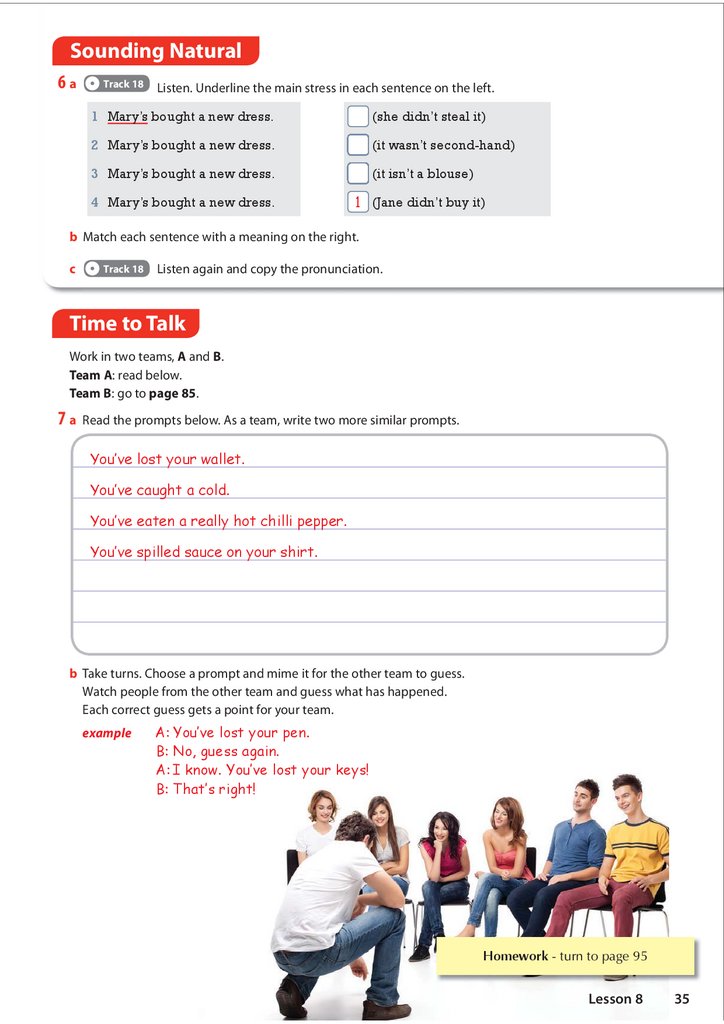
b Take turns. Choose a prompt and mime it for the other team to guess.
Watch people from the other team and guess what has happened.
Each correct guess gets a point for your team.
example
A: You·ve lost your pen.
B: No, guess again.
A: I know. You·ve lost your keys!
B: That·s right!
Homework WXUQ WR SDJH
Lesson 8
35
36.
LESSON9
6SHFLDO 2IIHUV
Introduction
1 As a class, make a list of all the different places you can see
or hear advertisements.
2 a Work with a partner. Ask and answer the questions below.
1 Do you ever buy things because of
advertisements? What?
2 Are there any advertisements that make
you laugh? Which ones? Why?
3 Are there any advertisements that make
you angry? Which ones? Why?
b Tell the class about your partner’s answers.
3 Use the words from the box to complete the definitions below.
bargain
product
delivery
trial
guarantee
two for the price of one
a Something a company makes to sell is called
product
a
b A
.
is a promise by a
company to repair or exchange a product that
has a problem.
c A
is when you can try
something for a short time before you buy it.
d A
is when a company
sends a product to your home or work.
e When you pay for one product and the
company gives you one more for free, you
.
get
f If you buy something very good for a low price,
you get a
36
Lesson 9
.
37.
In this lesson: Make a radio advertisementGrammar: First conditional
1
3
3
2
Reading
4 a Work with a partner. You are going to read
advertisements for five different products.
Before you read, look at the picture on
each advertisement and guess what it
is advertising.
example
A: I think advertisement 2 is for chocolates.
B: Yes, expensive chocolates!
b Read the advertisements and check your ideas.
4
5
5 a Match the words in Column A with words in Column B to make sentences.
Then write numbers in Column C to match each sentence with an advertisement.
Column A
Column B
If you buy this cereal,
delivery will be free.
If you drink this,
you’ll get a plastic dinosaur.
If you order online,
you won’t be fat.
If you use this,
you’ll be fit.
If you come here,
you can watch TV on the train.
Column C
3
b Read the sentences in activity 5a again and underline the correct options to complete the
statements below.
1 The sentences in activity 5a talk about situations in the present / the future.
2 The sentences in activity 5a describe definitely true / possibly true situations.
c Which products in activity 4 are you interested in? Why?
Lesson 9
37
38.
Language FocusWe can use the first conditional to talk about possible situations in the future.
if + present simple // will + base form of the verb
possible situation
result
If you order online,
If you drink this,
If you don’t order now,
delivery will be free.
you won’t be fat.
you’ll miss a great offer.
We can replace will in the result part of the sentence with some other modals.
possible situation
result
If you use this product,
If you enter our competition,
you can watch TV on the train.
you might win a car.
In questions, we usually put the will-part of the sentence first.
If the will-part comes first, we don’t use a comma between the two parts.
will + base form of the verb // if + present simple
possible situation
result
What will I get
Will you give me a new product
if I order online?
if there is a problem?
Practice
6 a Use the words in parentheses in the correct form to complete the phrases on the left.
1 If we
don·t leave
2 If you
3 Will he
(not/leave) now,
if they miss the last train?
(be) hungry,
his boss will sack him.
(come) to the party
1
we may miss our flight.
4 If she
(want) a bargain,
the picnic will be cancelled.
5 If Max
(be) late again,
I’ll make you a sandwich.
6 How will they
(get) home
you’ll be tired tomorrow.
7 If the weather
(not/improve),
if I invite him?
8 If you
(not/go) to bed early,
she can try that discount shop.
b Match each phrase with words on the right to make first conditional sentences.
38
Lesson 9
39.
Sounding Natural7a
Track 19
Listen. Underline the words you hear
on each line.
Column A ̸ࡱ
Column B LJ
1
I won’t
I want
2
we won’t
we want
Listen again and copy the pronunciation.
3
they won’t
they want
c Take turns saying one phrase from each
line in activity 7a.
Can your classmates tell if the phrase is from Column A
or Column B?
4
you won’t
you want
5
I won’t
I want
6
they won’t
they want
7
we won’t
we want
8
you won’t
you want
b
Track 19
Time to Talk
Work with a partner.
You are going to make a 30-second radio advertisement for one of the products in activity 4.
8 a Choose a product from activity 4 and use the table below to plan your advertisement.
Choco l·amour
product
Your wife will be happy. Your friend will love you.
good things that
will happen if
you buy it
Your friend will be disappointed.
bad things that
may happen if
you don’t buy it
If you order two boxes, we·ll send you Áowers.
special offer
(you can decide
what these are)
b Decide what to say in the radio advertisement and write a script.
example
Choco l·amour luxury chocolates – for the lady in your life.
If you love her, you·ll give her Choco l·amour.
If you give her Choco l·amour, she·ll love you!
9 a Act out your advertisement for the class.
b As a class, decide who made the best advertisement.
Homework WXUQ WR SDJH
Lesson 9
39
40.
LESSON10
&DIé 6RFLHW\
Introduction
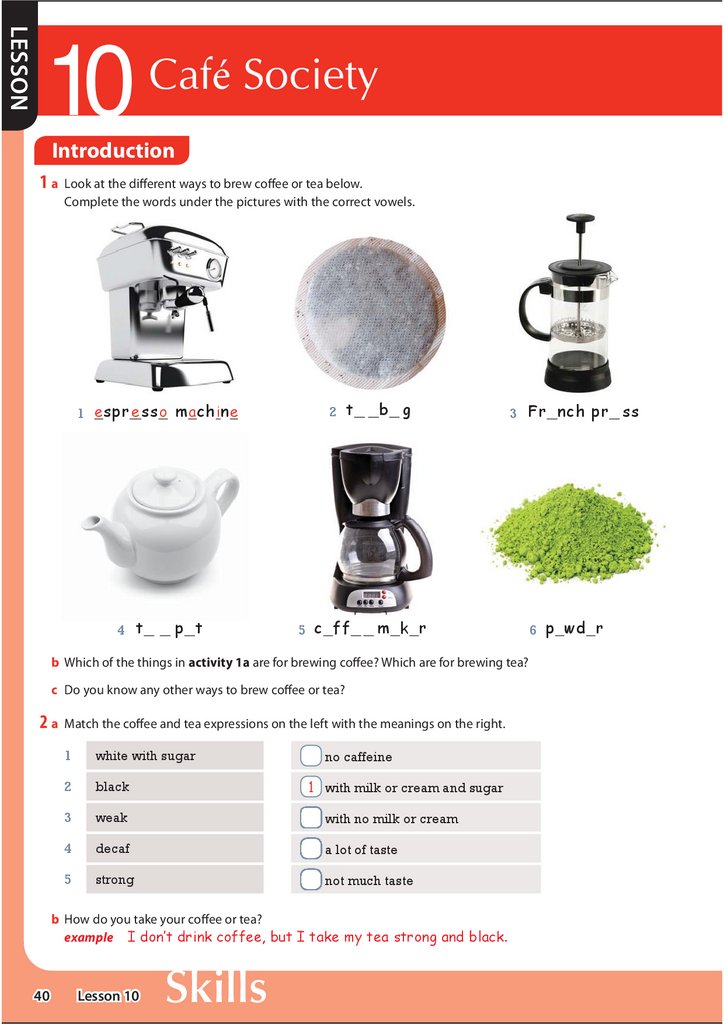
1 a Look at the different ways to brew coffee or tea below.
Complete the words under the pictures with the correct vowels.
1 e spr e ss o m a ch i n e
4 t
p t
2 t
5 c ff
b g
3 Fr nch pr
m k r
6 p wd r
b Which of the things in activity 1a are for brewing coffee? Which are for brewing tea?
c Do you know any other ways to brew coffee or tea?
2 a Match the coffee and tea expressions on the left with the meanings on the right.
1
white with sugar
2
black
3
weak
with no milk or cream
4
decaf
a lot of taste
5
strong
not much taste
no caffeine
1 with milk or cream and sugar
b How do you take your coffee or tea?
example I don·t drink coffee, but I take my tea strong and black.
40
Lesson 10
ss
41.
In this lesson: Talk about the kind of café you likeSkills: Extended speaking and vocabulary
Time to Talk 1
3 a Work on your own. Read the questions below and make a note of your answers.
1. How do you usually make tea?
2. How often do you drink coffee?
3. What things are important for a good cup of coffee or tea?
4. Do you usually take milk in your coffee?
5.
6.
b Write two more questions about coffee or tea and add them to the list in activity 3a.
4 a Work with a partner.
Ask and answer the questions in activity 3.
example
A: How do you usually make tea?
B: I make it in a teapot. I usually let it brew for about three minutes.
b Tell the class about your partner's answers.
example
Rachel makes her tea in a teapot. She lets it brew for three minutes.
Lesson 10
41
42.
Vocabulary5 Write the adjectives from the box in the correct column below.
Some adjectives can go in more than one column.
atmosphere
decor
skilful
traditional
young
quiet
reasonable
relaxing
lively
modern
polite
convenient
delicious
expensive
location
staff
food and drink
convenient
6 Complete the sentences with the headings in activity 5.
a This restaurant has a really nice atmosphere . It makes me feel
comfortable and relaxed.
b My favourite pub has a great selection of
, and the prices
are reasonable.
c I love the
in this lobby. All the furniture and lights are very
modern and cool.
d That restaurant is in a great
. It’s right next to the beach.
It should be successful.
e The
baristas make the best lattes.
42
Lesson 10
in that café are really friendly and polite, and their
43.
Time to Talk 27 a Work with a partner. You’re going to open a café.
Read the list of things below that are needed for a
successful café.
Add three more of your own ideas.
atmosphere
staff
decor
location
selection of coffee/tea
b Which things on your lists do you think are the
most important for a successful café?
Rank the things in activity 7a from 1-8
(1 = the most important thing needed for a successful café).
8 a Change partners.
Compare your ideas.
Decide on the three most important things needed
for a successful café.
b Share your ideas with the class.
As a class, decide on the most important thing
needed for a successful café.
Homework WXUQ WR SDJH
Lesson 10
43
44.
LESSON11
6KH©V 0RUH 7DONDWLYH WKDQ 0H
Introduction
1 a Write numbers to match the adjectives on the
left with their opposites on the right.
Which column has mostly positive meanings?
Which has mostly negative meanings?
1
pretty
selfish
2
smart
quiet
3
outgoing
rude
4
polite
stupid
5
tidy
mean
6
talkative
messy
7
considerate
shy
8
kind
1 ugly
b Underline the correct option to complete the
sentences below.
1 Tom is really smart / stupid. He didn’t
know he needed a passport to fly to America.
2 Mika gets nervous talking to new people
because she’s really outgoing / shy.
3 A phone call to my sister always lasts so long
because she’s so talkative / quiet.
2 a Work with a partner. Discuss the questions below.
1 Which adjectives in activity 1a describe
your parents?
2 Which describe your best friend?
b Tell the class about your partner’s parents and best friend.
44
Lesson 11
45.
In this lesson: Compare yourself to someone you knowGrammar: Comparative adjectives and not as... as
Listening
3
Track 20
4a
Listen to the conversation and tick (
) the adjectives in activity 1a you hear.
Listen again to the conversation between Stuart and Tony.
Write Patricia or Alison in the correct places below.
Track 20
very
smart
very
outgoing
very
talkative
not
outgoing
not
talkative
Patricia
not
smart
b Look at the lines in activity 4a and underline the correct option to complete the sentences below.
1 Patricia is smarter than / not as smart as Alison.
2 But Patricia’s more outgoing / not as outgoing as Alison.
3 Alison is more talkative / quieter than Patricia.
5 Do you think Stuart will introduce his sister to Tony? Why or why not?
Lesson 11
45
46.
Language FocusWe can compare two things using the
comparative forms of adjectives.
Who’s messier?
My brother’s messier than me.
Practice
6 Use the prompts to rewrite the sentences below.
For each sentence, use the same adjective and keep
the meaning the same.
a Peter is friendlier than Becky.
We form comparative adjectives in this way:
1 Adjectives with one syllable:
add –er
Becky isn’t as friendly as Peter.
b Tommy isn’t as tall as Ian.
Ian’s taller than Tommy.
Tina’s kinder than her sister.
c I’m not as outgoing as my parents.
2 Adjectives with two syllables, ending in –y:
replace –y with –ier
Greg’s lazier than his brother, Colin.
3 Most other adjectives use:
more + adjective
My sister’s more talkative than me.
Two common irregular adjectives:
good
better
bad
worse
My parents are
d Jonathan’s desk is tidier than mine.
My desk isn’t
e My father isn’t as talkative as my mother.
My mother’s
f My new neighbours aren’t as considerate
as my old ones.
We can also use not as…as to compare two
things or people.
She’s not as hard-working as Patricia.
She isn’t as hard-working as Patricia.
My old neighbours were
g Marcos is older than Manny.
Manny isn’t
h I’m not as considerate as my brother.
My brother’s
46
Lesson 11
47.
Sounding Natural7a
Track 21
Listen to the sentences below and mark ( ) the stressed words.
1 Ian is taller than Tommy.
2 Today isn’t as cold as yesterday.
3 Marcos is older than Manny.
b
Track 21
Listen again and copy the pronunciation.
Time to Talk
8 a Write your best friend’s name below.
b Think about how you compare to your best friend. Then read the questions below and make a note of your answers.
1. Who is more talkative?
2. Which one of you is tidier?
3. Are you as hard-working as your best friend?
4. Who is kinder?
5.
6.
c Write two more questions to ask your partner.
9 a Work with a partner.
Ask and answer the questions in activity 8. Make a note of your partner’s answers.
example
A: Who is more talkative?
B: I am. My friend Gina is a very quiet person.
b Tell the class about your partner’s answers.
example
Betty is more talkative than her
friend Gina.
Homework WXUQ WR SDJH
Lesson 11
47
48.
LESSON12
,W +DV WKH %HVW &KHHVHFDNH
LQ 7RZQ
Introduction
1 a Work with a partner.
Write S (similar) or D (different) next to the pairs of adjectives to say if they
have a similar or different meaning.
1
big
large
S
2
good
bad
D
3
fashionable
trendy
4
famous
well-known
5
exciting
boring
6
international
cosmopolitan
7
peaceful
lively
8
down-to-earth
romantic
b Underline the correct option to complete the sentences.
1 The place I live is really boring / famous. There are no shops
and nothing to do.
2 I know a really lively / romantic bar. There are always lots of
customers laughing and chatting.
3 That shop has all the latest fashions. It’s really famous / trendy.
4 It’s a very down-to-earth / well-known museum. It’s always on TV.
5 Low lights, soft music and candles on the tables. It’s a really
international / romantic little restaurant.
6 I live in a very cosmopolitan / famous part of town. There are
people and shops from all over the world.
2 Describe two places you know with adjectives from activity 1.
example The park near the station is very peaceful in the evening.
48
Lesson 12
49.
In this lesson: Tell people about good places to go in your areaGrammar: Superlative adjectives
City Break Holidays
/RQGRQ LV WKH ODUJHVW PRVW
FRVPRSROLWDQ FLW\ LQ (XURSH DQG WKH PRVW
SRSXODU WRXULVW GHVWLQDWLRQ LQ WKH ZRUOG 2YHU
PLOOLRQ SHRSOH YLVLW WKH FLW\ HYHU\ \HDU – LW©V
HDV\ WR VHH ZK\
/RQGRQ KDV VRPH RI WKH PRVW
EHDXWLIXO SDUNV LQ WKH ZRUOG PDQ\ H[FHOOHQW
IUHH PXVHXPV DQG IDQWDVWLF VKRSSLQJ ,W DOVR
KDV VRPH RI WKH EHVW WKHDWUHV EXW ERRN LQ
DGYDQFH LI \RX ZDQW WR FDWFK D VKRZ
3DULV LV IRU ORYHUV &RPH WR WKH
PRVW URPDQWLF FLW\ LQ WKH ZRUOG IRU WKH
PRVW URPDQWLF KROLGD\ RI \RXU OLIH
7DNH D ERDW WULS GRZQ WKH 6HLQH FOLPE
WKH (LIIHO 7RZHU DQG YLVLW WKH &KDPSV
(O\VHHV – WKH PRVW IDVKLRQDEOH VWUHHW LQ
WKH ZRUOG
:KHQ \RX ZDQW D UHVW \RX FDQ
UHOD[ LQ D FDIé DQG ZDWFK WKH ZRUOG JR
E\ <RX PXVW WU\ WKH FUHSHV – WKH PRVW
GHOLFLRXV LQ WKH ZRUOG
*RRG WLPHV DUH JXDUDQWHHG LQ WKH
EHDXWLIXO 0HGLWHUUDQHDQ FLW\ RI %DUFHORQD
%DUFHORQD LV IDPRXV IRU LWV QLJKW PDUNHWV
%DUFHORQD KDV ORWV WR RIIHU LQ WKH GD\ WRR
$ IDQWDVWLF EHDFK JUHDW DUFKLWHFWXUH DQG
RI FRXUVH WKH IDPRXV /DV 5DPEODV VWUHHW
:LWK VWUHHW SHUIRUPHUV VWDOOV DQG OLYH
PXVLF /DV 5DPEODV LV WKH OLYHOLHVW VWUHHW LQ
6SDLQ
Reading
3 a Look at the holiday brochure above. What cities are shown in the pictures?
Read the brochure and check your ideas.
b Work with a partner.
Read the holiday brochure for weekend breaks to three famous European cities and find the answers
to the questions below.
Underline the places in the brochure where you find the answers.
1 Why is London a good place to go if you like parks?
2 Why is London a good place for people who like going to the theatre?
3 Why is the Champs Elysees a good place to go if you are interested in clothes?
4 Why is Paris a good place to go if you like crepes?
5 Why is Barcelona a good place to go if you like nightlife?
c Read the brochure again and circle YES or NO to answer the questions below.
1 Is there a larger city in Europe than London?............................................... Yes / No
2 Is there a more popular tourist destination than London? ........................... Yes / No
3 Is there a more fashionable street than the Champs Elysees? ................
Yes / No
4 Is there a livelier street in Spain than Las Ramblas? ..................................... Yes / No
4 Which city break would you like to go on? Why?
Lesson 12
49
50.
Language FocusWe use the superlative forms of adjectives
to compare three or more things.
Two common irregular adjectives
good
bad
London is the largest city in Europe.
= No city in Europe is larger than London.
Paris is the most romantic city.
= No city is more romantic than Paris.
best
worst
We form superlatives in this way:
We normally use the before superlative
adjectives.
After superlatives, we normally use in with a
place, and of with a period of time.
Adjectives with one syllable
add -est
The most romantic city in the world.
The most romantic holiday of your life.
fast
slow
fastest
slowest
We can also use one of the/some of the
before superlatives.
It’s one of the most expensive rooms in
the hotel.
= It may not be the most expensive, but not
many rooms are more expensive.
Adjectives with two syllables, ending in -y
change the -y to -iest
trendy
friendly
trendiest
friendliest
They make some of the best cars in
the world.
= They may not be the best, but not many
cars are better.
Other adjectives
use most
popular
romantic
most popular
most romantic
Look at Language Reference, page 110 for
more spelling rules for regular superlative adjectives.
5 Work with a partner.
Look at the brochure in activity 3 and find one example of each kind of regular superlative adjective.
Practice
6 Work with a partner.
Use the prompts to write sentences with one of the/some of the, a superlative, and of or in.
a My wedding was a very happy day.
It was
one of the happiest days of
my life.
b That’s a really beautiful park.
It’s
my area.
c August is a very hot month.
It’s
the year.
d That restaurant makes delicious fish and chips.
It makes
town.
e That stall sells cheap clothes.
They sell
the market.
f Six o’clock is a very busy time.
It’s
50
Lesson 12
the day.
51.
Sounding Natural7a
Track 22
Listen. How do we say the underlined words when we speak naturally?
1 It was one of the happiest days of my life.
2 It’s one of the most beautiful parks in my area.
3 They make some of the most delicious fish and chips in town.
b
Track 22
Listen again and copy the pronunciation.
Time to Talk
8 a Work with a partner.
Think of three places in your town that you can recommend to visitors.
Use the table below to make notes about the places and why you recommend them.
Try to use at least one superlative for each place.
place:
place:
place:
Why you recommend it:
Why you recommend it:
Why you recommend it:
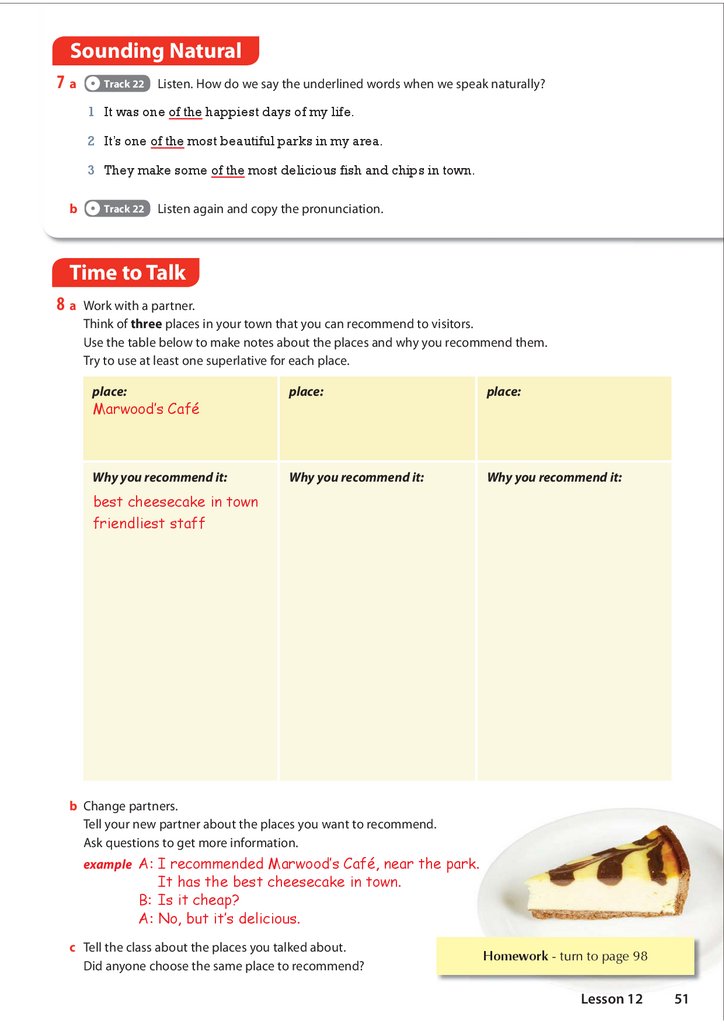
Marwood·s Café
best cheesecake in town
friendliest staff
b Change partners.
Tell your new partner about the places you want to recommend.
Ask questions to get more information.
example A: I recommended Marwood·s Café, near the park.
It has the best cheesecake in town.
B: Is it cheap?
A: No, but it·s delicious.
c Tell the class about the places you talked about.
Did anyone choose the same place to recommend?
Homework WXUQ WR SDJH
Lesson 12
51
52.
LESSON13
2Q WKH 8QGHUJURXQG
Introduction
1 a Work with a partner. Discuss the questions below.
1 How much time do you spend on the underground a week?
2 Do you enjoy riding on the underground? Why or why not?
b Tell the class about your partner's answers.
2 Complete the paragraph below about things you do at the underground station with the words from the box.
map
platform
stops
ticket barrier
ticket machine
:KHQ \RX DUULYH DW WKH VWDWLRQ FKHFN KRZ PDQ\ stops WR \RXU GHVWLQDWLRQ RQ WKH
%X\ \RXU WLFNHW IURP WKH
WKURXJK WKH
IRU \RXU WUDLQ WR DUULYH
52
Lesson 13
)LQDOO\ ZDLW RQ WKH
DQG WKHQ JR
53.
In this lesson: Give someone directions on the trainsFunction: Asking for and giving directions on trains
Listening
3 Look at the map below and answer the following questions.
a What line is Goodge Street on?
b How many stops can you see on the Central Line?
c What colour is the Piccadilly Line?
EUSTON
BAKER
STREET
GOODGE
STREET
MARBLE
ARCH
QUEENSWAY
OXFORD
CIRCUS
NOTTING
HILL GATE
HYDE PARK
CORNER
GREEN
PARK
4a
PICCADILLY
CIRCUS
COVENT
GARDEN
LEICESTER
SQUARE
CHARING
CROSS
KNIGHTSBRIDGE
Northern Line
Metropolitan Line
Bakerloo Line
Jubilee Line
Victoria Line
Central Line
Piccadilly Line
HOLBORN
TOTTENHAM
COURT
ROAD
BOND
STREET
RUSSELL
SQUARE
VICTORIA
Listen to the three conversations at Oxford Circus Station and
circle the names of the stations on the map the people want to go to.
Track 23
Track 24
Track 25
b Look at where each person in activity 4a wants to go to on the map above.
Underline the correct options below to complete the directions from Oxford Circus Station.
1 Goodge Street? Take an eastbound train on the Bakerloo Line / Central Line and change
at Tottenham Court Road / Holborn. Then take the Northern Line.
2 Notting Hill Gate is the first / fourth stop on the Bakerloo Line / Central Line. That’s the
westbound platform.
3 Take the southbound train on the Bakerloo Line / Victoria Line and change at Green Park,
and then take the westbound train on the Piccadilly Line / Jubilee Line. Hyde Park Corner
is the first / second stop.
c
Track 23
Track 24
Track 25
Listen again and check your answers.
Lesson 13
53
54.
Language Focus1. We use the base form of the verb to give directions.
Take the Central Line to Baker Street.
Change at Green Park Station.
2. To say where stations are we can say:
It’s on (the Central Line).
It’s the (second) stop on (the Piccadilly Line).
3. We can use bound for to say which direction the train is going.
Take the Piccadilly Line bound for Heathrow Terminal 5.
We can also use bound as a suffix.
Take the northbound train to Goodge Street.
4. We can ask for directions with the following phrases:
What’s the best way to get to Goodge Street?
How do I get to Hyde Park Corner from here?
Does this train go to Notting Hill Gate?
Practice
5 a Work with a partner.
Dundas
Yorkdale
Look at the starting point ( ) on the map and then
complete each conversation below with words from
the box. Some words can be used more than once.
Summerhill
best
change
eastbound
Downsview
Concordia
Rosedale
Finch
Lansdowne
Keele
1 A: Excuse me. What’s the best way to
High
Park
Union
Station
to Rosedale Station?
B:
King
Broadview
an
train on the
Green Line and
at Broadview
Station. It’s two
on the
Yellow Line.
Bathurst
Bloor Street
2 A: Excuse me.
do I get to
Yonge Street?
St Clair
B:
Davisville
southbound
stops
take
get
how
second
Lawrence
a
Blue Line and
Yonge
Street
stop.
Track 26
Track 27
Listen and check your answers.
Lesson 13
at St. Clair
Station, then take the Red Line. It’s the
b
54
train on the
55.
Sounding Natural6a
b
Track 28
What happens to the underlined
7a
Track 29
Listen. Circle the underlined part of
parts of the sentences when we speak naturally?
the sentence that is silent.
1 Take the eastbound train.
1 Take the northbound train.
2 Take the westbound train.
2 Take the southbound train.
Listen again and copy
the pronunciation.
Track 28
b
Listen again and copy
the pronunciation.
Track 29
Time to Talk
8 a Work on your own. Think of a place you often go to by train from your home station.
Draw the train route you take from your house below.
b Work with a partner. Show your partner the map you drew.
Use the map to explain your train route. Decide who has the hardest journey.
example
I take the Orange Line from Vendome Station and change at Lionel-Groulx,
then I go three stops on the Green Line to Peel Station. That·s where I work.
Homework WXUQ WR SDJH
Lesson 13
55
56.
LESSON14
2SLQLRQV
Introduction
1 a Work with a partner. Ask and answer the questions below.
1 Did you wear a school uniform when you were at school?
2 If you wore a uniform, did you like it? Did you change it in any way?
3 If you didn’t wear a uniform, what did you wear?
b Tell the class about your partner’s answers.
56
Lesson 14
57.
In this lesson: Guess who is lying about their opinionsFunction: Asking for and giving opinions
Listening
A
B
C
) the correct option
good idea
good idea
good idea
under each picture to say if the person
bad idea
bad idea
bad idea
D
E
F
good idea
good idea
good idea
bad idea
bad idea
bad idea
2 a We asked six people for their opinion
about school uniforms.
Track 30
Track 31
Track 32
Track 33
Track 34
Track 35
Listen and tick (
thinks school uniforms are a good or
bad idea.
b Work with a partner.
Underline the correct options to
complete the dialogues below, and then
write letters to match each picture
with a dialogue.
1 A: What’s your opinion on school uniforms?
B: Personally, I think that they’re a bad idea / a good idea. I wore a uniform at school, and I
hated it! Picture
E
2 A: Do you think that wearing school uniforms is a good idea / thought?
B: Yes. I like my uniform. I think it’s pretty. Picture
3 A: How do you feel / think about school uniforms?
B: I think they’re all right. I wear a suit to the office. It’s not so different. Picture
4 A: What do you think about / on wearing school uniforms?
B: In my opinion / thought, they’re stupid. I want to wear my own clothes. Picture
5 A: Do you think that school uniforms are a good idea?
B: Yes, definitely / No, not at all. I think that the children look so nice in them. Picture
6 A: Do you agree that school uniforms are a good idea?
B: I’m not so sure / Yes, definitely. They’re expensive and uncomfortable. Kids can’t relax.
Picture
c
Track 30
Track 31
Track 32
Track 33
Track 34
Track 35
Listen again and check your answers.
3 Which person in activity 2 do you agree with the most?
Lesson 14
57
58.
PracticeLanguage Focus
5 a Work with a partner.
Asking for someone’s opinion
Write letters to match two of the responses
below to each of the following questions.
Open questions
noun
-ing form of the verb
1 What’s your opinion on designer clothes?
What’s your opinion on theme parks?
What do you think about eating meat?
How do you feel about children smoking?
2 How do you feel about people kissing on
what/how phrase +
Be careful:
We do not use how with think when we ask
about opinions.
What do you think about school uniforms?
How do you feel about school uniforms?
X How do you think about school uniforms?
a
the street?
3 What do you think about politicians?
4 Do you agree that summer is the best time
of year?
5 Do you think that living in the country is a
good idea?
Yes/No questions
Do you agree that women are smarter than men?
Do you think that doing exercise is a good idea?
The responses:
a Personally, I love wearing them.
Giving an opinion
b In my opinion, they get too much money.
In my opinion, school uniforms are a great idea.
I think that young people are very polite.
Personally, I think that eating meat is bad for you.
Agreeing and disagreeing
4 Use the expressions for agreeing and disagreeing
from the box to complete the diagram below.
I suppose so.
I’m not (so) sure.
No, I completely disagree.
Yes.
No, not at all.
Yes, definitely.
c Personally, I think it’s very romantic.
d I think that they are too expensive.
e No, not at all. There are no shops, and
there’s nothing to do.
f I suppose so. The city is quite dirty.
g Yes, definitely. I love hot weather.
h In my opinion, it’s rude.
i I think that they do a great job.
stronger
j No, I completely disagree. I like the spring.
agree
b Tell your partner which of the responses are closest
to your own opinions.
Yes.
disagree
No, I completely disagree.
58
Lesson 14
stronger
59.
Sounding Natural6a
Track 36
Listen. Mark ( ) the stressed word in the underlined part of each sentence below.
1 What’s your opinion on designer clothes?
2 How do you feel about people kissing on the street?
3 What do you think about politicians?
b
Track 36
Listen again and copy the pronunciation.
Time to Talk
7 a Work on your own.
Make a note of your opinions on the questions below.
Three opinions must be true, and two opinions must be false. You choose which ones.
1. Do you agree that steak is tastier than Àsh?
2. How do you feel about gambling?
3. What·s your opinion on young people?
4. Do you think that giving food to cats in the park is a good idea?
5. What do you think about black and white Àlms?
b Work with a partner. Ask and answer the questions in activity 7a.
example
A: Do you agree that steak is tastier than Àsh?
B: Yes, deÀnitely. How about you?
A: I·m not so sure. Personally, I love tuna. Why do you like steak?
Listen to your partner and make a note of their answers.
c Tell the class about your partner’s answers. Say which opinions you think were not true.
example
Jem said steak is tastier than Àsh,
but I think he really likes Àsh.
Homework WXUQ WR SDJH
Lesson 14
59
60.
LESSON15
0RYLH 1LJKW
Introduction
1 a Cross out the word that doesn’t go with the one on the right.
1
wide / healthy / cheap
snacks
2
not much / plenty of / close
legroom
3
wide / long / high-definition
screen
4
cheap / high-quality / comfortable
sound system
5
art / close / commercial
film
6
tasty / expensive / comfortable
seat
b Complete the sentences with words from activity 1a.
1 I hope you have a
comfortable
seat because it’s a long film. You’ll be sitting for a
long time.
2 I like
films by Bergman or Fellini. I don’t like those expensive
Hollywood films.
3 Our old TV was terrible, but now the new TV has a
screen, so the
picture is really clear.
4 My mum only allows me to eat celery, carrots, and
like that.
5 I’m very tall, so I don’t like watching films at the cinema because there’s
legroom.
6 I couldn’t enjoy the film because of the
sound system.
I couldn’t hear anything.
60
Lesson 15
snacks
61.
In this lesson: Talk about watching filmsSkills: Extended speaking and vocabulary
Time to Talk 1
2 a Work with a partner.
You’re going to have a movie night at your home.
Read the list of things below that can make a movie night fun.
Add four more things to the list.
pizza
comfortable sofa
plenty of drinks
good friends
b Rank the things in activity 2a from 1-8
(1 = very important to have for a fun movie night).
3 a Change partners and compare your lists.
Choose the four most important things to have a fun movie night.
b Share your ideas with the class.
As a class, decide on the three most important things to have for
a fun movie night at home.
Lesson 15
61
62.
Vocabulary4 a Match the types of films from the box with the pictures below.
action
comedy
science fiction
animated
horror
western
horror
1
4
2
3
5
6
b Work with a partner. Think of an example for each type of film in activity 4a.
1
Dracula
4
2
3
5
6
c Share your ideas with the class.
5 Match the words with the definitions on the right.
62
a
film critic
The person who tells the actors what to do
b
star
Words at the bottom of the screen to help people understand
what the actors are saying
c
subtitles
Actors’ voices replaced with other voices speaking a
different language
d
dubbed
An article that describes how good or bad a film is
e
director
The main actor or actress in a film
f
review
Lesson 15
a A person who writes articles about how good or bad a film is
63.
Time to Talk 26 a Work on your own. Read the questions below and make a note of your answers.
1. What was the last Àlm you saw? Who was it directed by?
2. Do you prefer watching Àlms at home or at the cinema? Why?
3. Do you read Àlm reviews?
4. Do you prefer foreign Àlms that are dubbed or with subtitles?
5.
6.
b Write two more questions about watching films and add them to the list in activity 6a.
7 a Work with a partner.
Ask and answer the questions in activity 6.
example
A: What was the last Àlm you saw?
B: It was Star Wars.
b Tell the class about your partner’s answers.
example
The last Àlm Allan saw was Star Wars.
Homework WXUQ WR SDJH
Lesson 15
63
64.
LESSON16
,PDJLQH
Introduction
1 a Work with a partner.
Write numbers to match the different kinds of
gambling with the pictures.
1 the football pools
2 horses
3 the lottery
4 roulette
5 scratch cards
6 slot machines
b Cross out the words on the left that do not go
with the types of gambling on the right.
Sometimes more than one word is possible.
1 bet on / do / play
the football pools
2 bet on / do / play
horses
3 bet on / do / play
the lottery
4 bet on / do / play
roulette
5 bet on / do / play
scratch cards
6 bet on / do / play
slot machines
2 a Work with a partner.
Ask and answer the questions below.
1 Are you a lucky or an unlucky person?
Why do you think so?
2 Which kinds of gambling in activity 1
have you tried? Did you win anything?
b Tell the class about your partner’s answers.
64
Lesson 16
1
65.
In this lesson: Plan a dream dinner partyGrammar: Second conditional
Reading
3 a Work on your own.
Read the questionnaire about winning a million pounds and circle the best answer to each
question for you.
Job
NLQJ
XVLQHVV
b … ,©G VWDUW D E
NLQJ
MRE DQG VWRS ZRU
\
P
LW
TX
G
,©
…
c
RU
a … ,©G NHHS Z
Fr iends/Family
O DQ\RQH
IULHQGV
H PRQH\ WR FORVH
b … ,©G JLYH VRP
RU
G NHHS PRVW RI LW I
DQG IDPLO\ EXW ,©
P\VHOI
P\
O WKH PRQH\ ZLWK
c … ,©G VKDUH DO
IULHQGV DQG IDPLO\
Q©W WHO
a … , ZRXOG
Home
KRPH
KRWHO
b … ,©G OLYH LQ D
KHUH , DP
c … ,©G VWD\ Z
Z
a … ,©G EX\ D QH
Me
KDQJH
VDPH , ZRXOGQ©W F
H
WK
D\
VW
G
,©
…
a
XFK
D OLWWOH EXW QRW P
b … ,©G FKDQJH
HO\ GLIIHUHQW
… ,©G EH FRPSOHW
c
b Work with a partner. Compare your answers.
c Tell the class about your partner’s answers. How many of your answers were different? Which ones?
4 Work with a partner. Underline the correct option to complete each statement below.
a The questionnaire talks about a real / an imagined situation.
b The questionnaire talks about a situation in the future / past.
c The situation the questionnaire talks about is likely / unlikely.
Lesson 16
65
66.
Language FocusWe use the second conditional to talk about unlikely, imagined situations in the present or future.
if + past simple // would + base form of the verb
unlikely situation
action or result
If I won a million pounds,
If I could be an animal,
If he quit his job,
I’d quit my job.
I’d be a tiger.
he wouldn’t have money.
We often use were instead of was in the if- part of the sentence.
unlikely situation
action or result
If I were you,
If she weren’t married,
I wouldn’t complain.
I’d ask her for a date.
We can put the would- part of the sentence first.
If we do this, we don’t use a comma between the two parts.
I’d quit my job if I won a million pounds.
I’d ask her for a date if she weren’t married.
Questions and answers
What would you do if you won a million pounds?
I’d buy a big house.
If you could live in another country, where would you live?
Maybe I’d live in Brazil.
Would you be happy if you were rich?
Yes, I would. / No, I wouldn’t.
Practice
5 Work with a partner. Use would and the correct form of the verbs in parentheses to complete the sentences.
Use short forms when you can.
a If I
owned
b I
a car, I·d drive
tired if I
c If I
more sleep. (not/be, get)
a wallet on the street, I
d If this building
e I
everywhere. (drive, own)
it to the police. (find, take)
air conditioning, we
in France if I
f What
so hot. (not/be, have)
speak French. (can, live)
you
if you
you
if I
your job? (do, lose)
g What
to marry me? (ask, say)
66
Lesson 16
you
67.
Sounding Natural6a
Track 37
Listen and tick (
Column A
) the first phrase you hear in each pair below.
Column B
1
I keep working.
I’d keep working.
2
I stay the same.
I’d stay the same.
3
I buy expensive clothes.
I’d buy expensive clothes.
4
I play tomorrow.
I’d play tomorrow.
5
I make cakes.
I’d make cakes.
6
I have a holiday.
I’d have a holiday.
b Choose a phrase from Column A or Column B and say it.
Can other people say which column it is from?
Time to Talk
7 a Work on your own. Imagine you are going to have a small dinner party.
• You can invite three people from history.
• You can choose anyone, living or dead, but you cannot invite your family or friends.
Use the table below to make a note of what you would like to do.
The people I would invite
Why I’d invite them
What I’d ask them/say to them
1
2
3
What food and drink I’d serve
Other details
(music, what I’d wear, etc.)
b Work with a partner.
Compare your plans and ask questions to get more information.
example
A: I·d invite Elvis Presley.
B: Why?
A: I love his music…
c Tell the class about your partner’s plans.
Homework WXUQ WR SDJH
Lesson 16
67
68.
LESSON17
, 8VHG WR +DYH /RQJ +DLU
Introduction
1 a Work with a partner. Discuss the questions below.
1 Do you like history? Why or why not?
2 If you could go back in time, what
decade would you go to? Why?
b Tell the class about your partner's answers.
68
Lesson 17
69.
In this lesson: Talk about how things used to beGrammar: Used to for past habits and states
Reading
2 Look at the pictures above.
Write the decade you think they’re from in the boxes.
3 a Read the sentences below and underline the years they are about.
1 Men used to wear hats when they went out. .........................
1920s
1960s
2 People used to wear tie-dyed clothes. .................................
1920s
1960s
3 The Beatles used to be very popular. ..................................
1920s
1960s
4 2MT made the first radio broadcast in the United Kingdom. ..
1920s
1960s
5 Young people used to dance the Twist. ................................
1920s
1960s
6 People used to watch silent films. .......................................
1920s
1960s
7 Neil Armstrong landed on the moon. ...................................
1920s
1960s
8 People used to dance the Charleston. .................................
1920s
1960s
b Look at the sentences again in activity 3a. Tick (
) the ones that happen only once.
Lesson 17
69
70.
Language Focus1. We can use used to when we talk about repeated actions in the past that aren’t true now.
used to / didn’t use to + base form of the verb
Young people used to dance the Twist.
People didn’t use to wear tie-dyed clothes.
2. We can also use used to to talk about past states.
used to / didn’t use to + base form of the verb
The Beatles used to be very popular.
I didn’t use to be happy.
3. Questions and short answers
Where did you use to work?
Did you use to live in Australia?
Yes, I did. / No, I didn’t.
Practice
4 a Read the sentences below. Underline the one that cannot be rewritten with used to / didn’t use to.
1 I was very healthy.
I used to be very healthy.
2 John smoked twenty cigarettes a day before he quit.
3 Jane had a lovely necklace when she was in the UK.
4 Jane bought a lovely necklace when she was in the UK.
5 I didn’t like spicy food.
6 Hanna was very outgoing when she was young.
7 My father hated using computers.
8 Everyone liked disco music in the seventies.
b Rewrite the other sentences with used to / didn’t use to.
c
70
Track 38
Listen and check.
Lesson 17
71.
Sounding Natural5a
Track 39 Listen to the sentences below.
How do we say the underlined parts of the sentences when we speak naturally?
1 People used to wear tie-dyed clothes.
2 Young people used to dance the Twist.
3 People didn’t use to watch television.
b
Track 39
Listen again and copy the pronunciation.
Time to Talk
6 a Work on your own. Choose a decade in the past that you know about.
Write the decade at the top of the table below.
Write two examples of what used to be different for each section of the table.
1980·s
decade
Michael Jackson
music
shoulder pads
fashion
video recorders
technology
people earned good salaries
culture
b Tell the class what used to be different in the decade you chose, but don’t say when it was.
Can people guess which decade you’re talking about?
example
A: Michael Jackson used to be the most famous singer in the world.
B: It was the 1980s!
Homework WXUQ WR SDJH
Lesson 17
71
72.
LESSON18
,W :DV DQ $FFLGHQW
Introduction
1 a Work with a partner.
Ask and answer the questions below.
1 Can you drive a car?
2 If you can drive, do you like driving? Why or why not?
3 If you can’t drive, would you like to? Why or why not?
b Tell the class about your partner’s answers.
2 a Look at the pictures. Cross out ( X ) one sentence that does not describe it.
1 The bus approaches the
traffic lights.
2 The bus goes towards
the traffic lights.
3 The bus moves away
from the traffic lights.
1 The road is busy.
2 The road is clear.
3 The road is empty.
1 The car crashes into
the bus.
2 The car overtakes
the bus.
3 The car passes the bus.
b Underline the correct option to complete each sentence below.
1 I saw an accident yesterday. A bicycle moved away from /
crashed into a car, but no one was hurt.
2 I tell my children to wait and cross the road when it is
busy / clear.
3 My car is really slow. All the other cars approach / overtake it.
4 I overtake / pass the station every day on my way to work.
72
Lesson 18
73.
In this lesson: Tell people about an accidentGrammar: Past simple and past continuous in stories, with as and when
1
Reading
3 a Work with a partner.
Jane was in a traffic accident.
Look at the pictures showing what happened.
Match each box below with a picture to put the
description of Jane’s accident into the correct order.
A
2
As I was approaching the bend, I saw a bus.
It was coming from the opposite direction.
B
I was going around the bend when I saw an
orange sports car. It was overtaking the bus
and coming towards me!
C
1
3
I was driving north along the London Road.
The road was clear, and there was a bend in the
road in front of me.
D
I went off the road and crashed into a wall.
Luckily, I was wearing a seatbelt and I
wasn’t hurt.
b
Track 40
Listen and check your answers.
4
c Who drove badly, Jane or the person in the
orange car?
Lesson 18
73
74.
Language Focus4 Write the words in the box from Jane’s story in the correct positions on the timeline.
I was going around the bend.
I saw an orange sports car.
SDVW
QRZ
IXWXUH
When we tell stories, we often use as and when to join the past continuous and the past simple together
in the same sentence.
We do this to show that one event happened while another event was in progress.
event that was in progress
an event that happened
past continuous
past simple
As I was approaching the bend,
I was going around the bend
I saw a bus.
when
I saw an orange sports car.
an event that happened
event that was in progress
past simple
past continuous
I saw a bus
I saw a red sports car
as
I was approaching the bend.
when
I was going around the bend.
5 Study the example sentences with as and when above. Then, underline the correct word to complete the rules.
a as / when usually comes between the two parts of the sentence.
b as / when usually comes at the beginning of the past continuous part of the sentence.
c In sentences with ‘as’, we use / don’t use a comma if the past continuous part comes first.
Practice
6 a Work with a partner. Complete the sentences with the verbs in parentheses.
Put one verb into the past simple and the other verb into the past continuous.
1 As I
was listening
to the radio, I
2 She
down as she
3 He
his finger as he
4 As they
the traffic lights, they
b Use when to rewrite the sentences from activity 6a.
1
2
3
4
74
Lesson 18
heard
the news. (hear, listen)
up the stairs. (fall, walk)
. (cook, cut)
the accident. (approach, see)
75.
Sounding Natural7a
Track 41
Listen to the sentences. How do we say was and were when we speak naturally?
1 It was coming towards me.
2 I was overtaking the bus.
3 We were standing on the street.
4 They were coming towards the traffic lights.
b
Track 41
Listen again and copy the pronunciation.
Time to Talk
8 a Work on your own. Use the table below to make notes about an accident. It can be:
• an accident that happened to you
• an accident that you saw
• an accident that you heard about
background detail
what I was doing at
the time
what other people
were doing
other information.
(weather, clothing, etc.)
the main events of
the story
standing on the
a woman – riding
about two years
I saw a woman fall
street
a bicycle, talking
ago
off her bicycle.
on her phone
b Work with a partner. Tell your story.
example
About two years ago, as I was standing on the street,
I saw a woman fall off her bicycle. She was…
c Tell the class about your partner’s story.
example
Rick saw a woman fall off her bicycle.
He was standing on the street…
Homework WXUQ WR SDJH
Lesson 18
75
76.
LESSON19
$Q\ 3ODQV"
Introduction
1 a Work with a partner.
Match the verbs on the left with the definitions on the right.
expect
be pleased and excited about something in the future
dread
think that something is likely to happen
look forward to
be worried or frightened about something in the future
b Use the verbs from activity 1a in the correct form to complete the sentences. Use each verb only once.
1 I haven’t talked to my son for a long time and I’m really
seeing him tomorrow.
2 My boss is really angry, so I’m
our meeting this afternoon.
3 He hasn’t studied for the exam, so he’s
a bad result.
2 Is there anything you are looking forward to in the next seven days?
Is there anything you are dreading?
Tell the class.
example
A: I·m looking forward to the weekend.
B: Me too!
Listening
3 Read the list of things below.
Which things do you think are good to do after retirement?
Which do you think are not so good? Tell the class.
start a new hobby
move to a different country
76
Lesson 19
relax and don’t do anything
stay at home every day and watch TV
learn a new language
travel
77.
In this lesson: Tell people about next weekendGrammar: Going to for plans, will for things you expect to happen
4 a Ben is going to retire next week. Look at the pictures. What do you think his plans are?
b
Listen to Ben talk about his retirement with his friend, Dave.
Check your ideas from activity 4a and write T (true) or F (false) next to each statement below.
Track 42
1 Ben plans to travel around the world. ....................................... T
2 Ben plans to sell his house. ......................................................
3 Ben plans to travel on his own. .................................................
4 Ben plans to sleep in a tent. .....................................................
5 Ben hasn’t planned where to go first. .......................................
5 a Underline the correct option in each sentence to complete what Ben says.
1 I will / I’m going to leave the country and see the world.
2 We will / We’re going to sell the house.
3 We will / We’re going to buy a camper van and drive around the world.
4 Mary’s going to / Mary will come with me.
5 We’ll / We’re going to usually sleep in the van.
6 Perhaps we’ll / we’re going to stay in cheap hotels.
7 We haven’t got any plans, but we’ll / we’re going to probably go to Morocco.
b
Track 42
Listen again and check your answers.
c Do you think Ben has good plans for his retirement?
Lesson 19
77
78.
Language FocusWe can use going to when we talk about plans for the future.
be + going to + base form of the verb
I’m going to leave the country and see the world.
Mary’s going to come with me.
They aren’t going to work late tonight.
We can use will to talk about what we expect to happen in the future.
will + base form of the verb
We’ll sleep in the van.
We won’t finish work early.
We can use probably and perhaps with will if we are less sure about what we expect.
Probably usually comes after will and before won’t.
Perhaps usually comes before the subject (before will and won’t).
We’ll go to Morocco.
more sure
We’ll probably go to Morocco.
Perhaps we’ll go to Morocco.
We won’t go to Morocco.
We probably won’t go to Morocco.
less sure
Perhaps we won’t go to Morocco.
Practice
6 Underline the correct words to complete the sentences.
a I’ll probably / I’m going to catch the seven o’clock train.
I’ve already got my ticket.
b Sorry, I can’t come to the pub with you tonight.
You see, I’ll / I’m going to watch a film with Rachel.
c I want to get up early on Saturday, but
I’ll probably / I’m going to oversleep – I usually do!
d I don’t know, but perhaps I’ll / I’m going to have
a haircut this weekend.
e I’ll / I’m going to buy a new car because
I need a better one.
f A: What are you going to do this weekend?
B: I’m not really sure yet, but
I’ll probably / I’m going to rent some DVDs.
78
Lesson 19
79.
Sounding Natural7a
Track 43
Listen. What happens to the underlined parts of the sentences when we speak naturally?
1 Perhaps I’ll watch a DVD.
2 Perhaps I’ll go shopping.
3 I’ll probably get a takeaway.
4 I’ll probably have a lie-in.
b
Track 43
Listen again and copy the pronunciation.
Time to Talk
8 a Work on your own.
Use the table to make a note of two things you plan to do, and four things you expect to happen next weekend.
what I plan to do
go for a drink – Friday night
what I expect to happen
go to Rick·s bar
b Work with a partner. Tell them about what you plan and expect to happen next weekend.
Listen to your partner. Ask questions to get more information.
example
A: I·m going for a drink after work on Friday night.
We·ll probably go to Rick·s bar.
B: Why there?
A: We always go there.
c Tell the class about your partner's answers.
Homework WXUQ WR SDJH
Lesson 19
79
80.
LESSON20
5HDG $OO $ERXW ,W
Introduction
SALE SALE SA
LE SALE SALE
SALE SALE SA
SALE SALE SA
LE SALE SALE
LE SALE SALE
SALE SALE SA
SALE SALE SA
LE
LE SALE STAR
TS MONDAYY
1 Label the
newspaper with
the words from
the box.
Dictator Ouste
d
advert
article
headline
2 Match the meanings
on the left with
words on the right.
a
A piece of writing about an important topic in a newspaper
or magazine.
b
The title of a story in a newspaper or magazine, usually written in
large letters.
article
c
Words or pictures about products to make people want to buy them.
broadsheet
d
Contains lots of stories about sport, gossip and entertainment news.
headline
e
Contains more serious news and articles.
tabloid
c advert
3 The underlined words are in the wrong sentence. Write them on the correct line.
80
a
My father usually turns to the horoscope to check the football results.
b
Tanya loves reading about famous people, so she turns to the sports
pages first.
c
I don’t know much about business, so I never read the comic pages.
d
I always read my gossip column to see if I’m going to have a good or
bad day.
e
Even though I’m 40 years old, I still turn to the financial pages. They
always make me laugh.
Lesson 20
horoscope
81.
In this lesson: Discuss the best source of newsSkills: Extended speaking and vocabulary
Time to Talk 1
4 a Read the questions below. Make a note of your answers.
1. How often do you read newspapers?
2. What part of the newspaper do you turn to Àrst?
3. What type of newspaper do you like reading?
4. Do you read your horoscope?
5.
6.
7.
b Write three more questions about reading newspapers. Add them to the list in activity 4a.
5 a Work with a partner.
Ask and answer the questions in activity 4.
Make a note of your partner’s answers.
example
A: What part of the newspaper do you read Àrst?
B: I always read the gossip column Àrst. I love reading about famous people.
b Tell the class about your partner's answers.
example
Abby always reads the gossip column Àrst because she loves…
Lesson 20
81
82.
Vocabulary6 Look at the different sources of news below. Match the pictures with the words from the box.
Internet
social media
a
newspaper
d
radio
newspaper
television
word of mouth
b
c
e
f
7 a Match the nouns in Column 1 with the correct meanings in Column 2.
Column 1
Column 2
1
accuracy
wanting to know or learn about something
nt r st ng
2
speed
facts about an event, person or situation
nf rm t v
3
interest
4
bias
shows only one side of the story
b
5
information
how fast something moves
f st
1 how true or correct something is
b Complete the adjectives in Column 3 with the correct vowels.
82
Column 3
Lesson 20
a cc u r a t e
s d
83.
Time to Talk 28 a Work with a partner. Look at the different ways to get news. Add one more way.
accurate
interesting
biased
informative
fast
1 2 3 4 5 1 2 3 4 5 1 2 3 4 5 1 2 3 4 5 1 2 3 4 5
social
media
tabloids
television
word of
mouth
b Rate (
) the different sources of news for each category 1-5 (1 = the best).
9 a As a class, discuss your ideas.
Decide the best source of news.
Homework WXUQ WR SDJH
Lesson 20
83