 Политика
Похожие презентации:





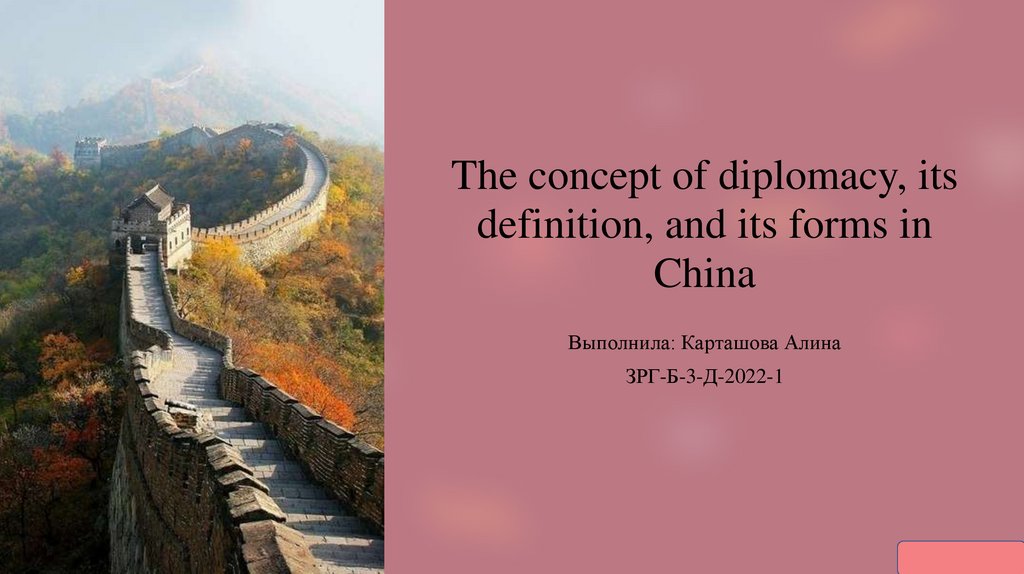
The concept of diplomacy, its definition, and its forms in China
1.
The concept of diplomacy, itsdefinition, and its forms in
China
Выполнила: Карташова Алина
ЗРГ-Б-3-Д-2022-1
2.
What is diplomacy?Implementation of foreign policy
China's "Relational Practice"
Diplomacy is a systematic process of
achieving a state's foreign policy
objectives through communication,
negotiation, and the management of
bilateral and multilateral relations.
In the Chinese context, this concept
goes beyond mere representation, being
viewed as a "relational practice" — the
art of building and maintaining longterm, harmonious international
relationships.
Chief Executive Officer: Ministry of
Foreign Affairs of China
The main institution is the Ministry of
Foreign Affairs of China (MFA), whose
activities are strictly regulated and
guided by principles that originate in
ancient Chinese philosophy.
Chinese diplomacy focuses not only on current interests, but also on creating a favorable "environment" for its longterm development.
3.
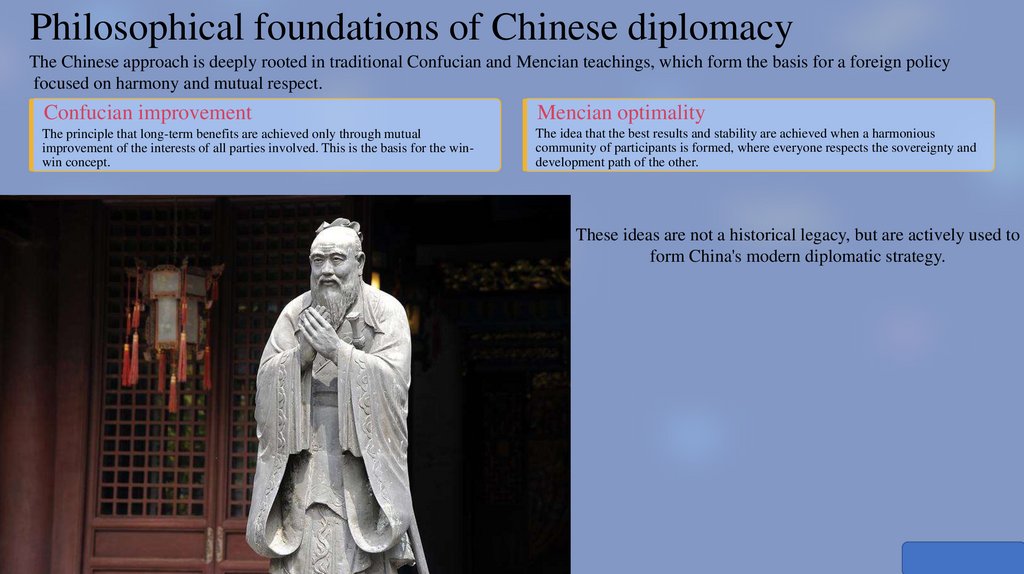
Philosophical foundations of Chinese diplomacyThe Chinese approach is deeply rooted in traditional Confucian and Mencian teachings, which form the basis for a foreign policy
focused on harmony and mutual respect.
Confucian improvement
Mencian optimality
The principle that long-term benefits are achieved only through mutual
improvement of the interests of all parties involved. This is the basis for the winwin concept.
The idea that the best results and stability are achieved when a harmonious
community of participants is formed, where everyone respects the sovereignty and
development path of the other.
These ideas are not a historical legacy, but are actively used to
form China's modern diplomatic strategy.
4.
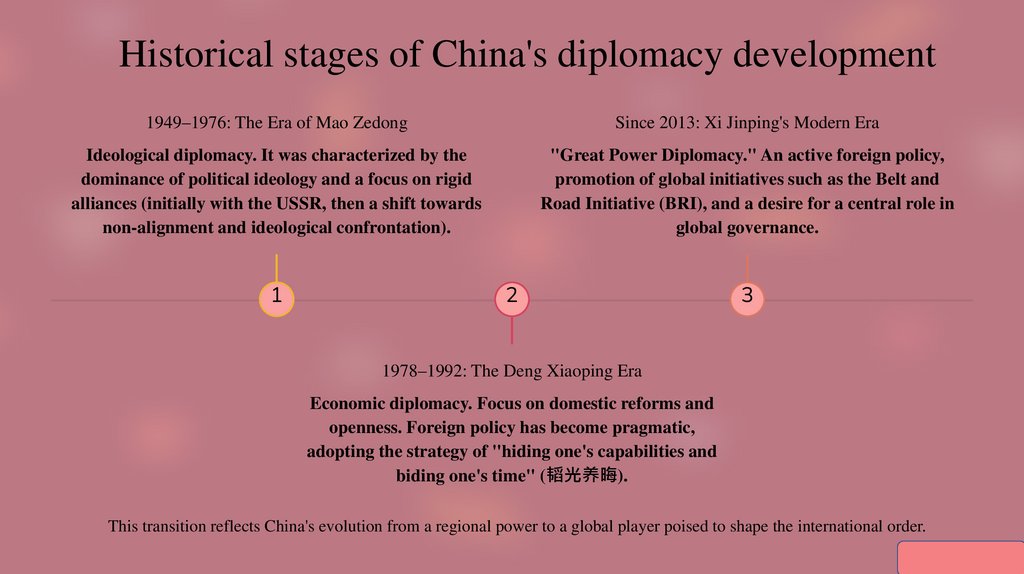
Historical stages of China's diplomacy development1949–1976: The Era of Mao Zedong
Since 2013: Xi Jinping's Modern Era
Ideological diplomacy. It was characterized by the
dominance of political ideology and a focus on rigid
alliances (initially with the USSR, then a shift towards
non-alignment and ideological confrontation).
"Great Power Diplomacy." An active foreign policy,
promotion of global initiatives such as the Belt and
Road Initiative (BRI), and a desire for a central role in
global governance.
1
2
3
1978–1992: The Deng Xiaoping Era
Economic diplomacy. Focus on domestic reforms and
openness. Foreign policy has become pragmatic,
adopting the strategy of "hiding one's capabilities and
biding one's time" (韬光养晦).
This transition reflects China's evolution from a regional power to a global player poised to shape the international order.
5.
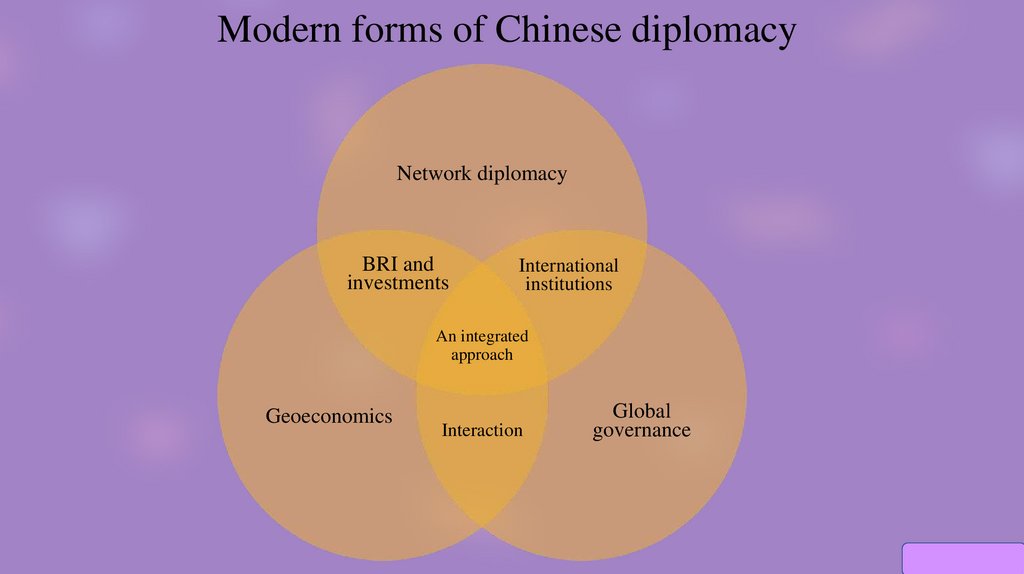
Modern forms of Chinese diplomacyNetwork diplomacy
BRI and
investments
International
institutions
An integrated
approach
Geoeconomics
Interaction
Global
governance
6.
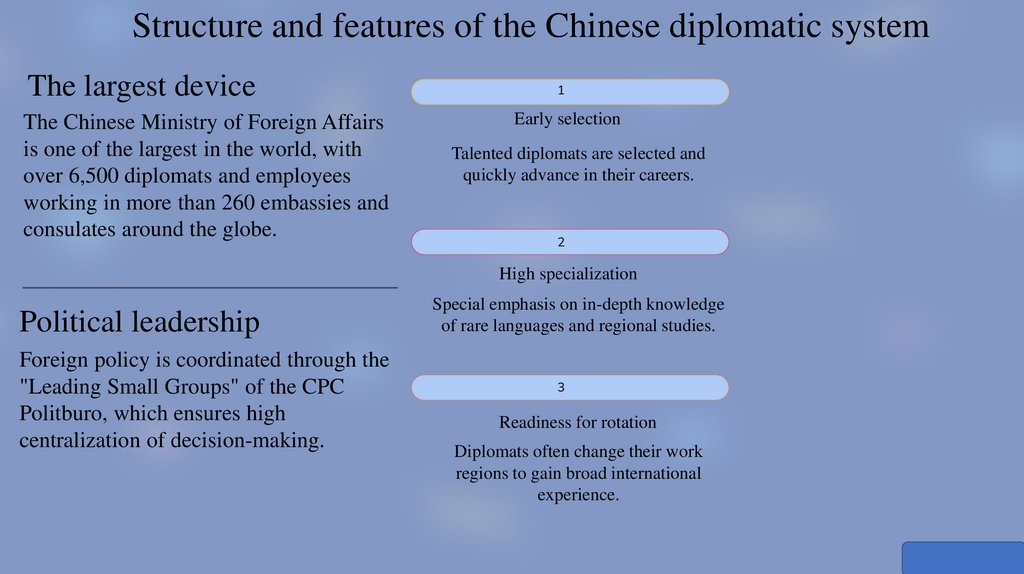
Structure and features of the Chinese diplomatic systemThe largest device
The Chinese Ministry of Foreign Affairs
is one of the largest in the world, with
over 6,500 diplomats and employees
working in more than 260 embassies and
consulates around the globe.
1
Early selection
Talented diplomats are selected and
quickly advance in their careers.
2
High specialization
Political leadership
Foreign policy is coordinated through the
"Leading Small Groups" of the CPC
Politburo, which ensures high
centralization of decision-making.
Special emphasis on in-depth knowledge
of rare languages and regional studies.
3
Readiness for rotation
Diplomats often change their work
regions to gain broad international
experience.
7.
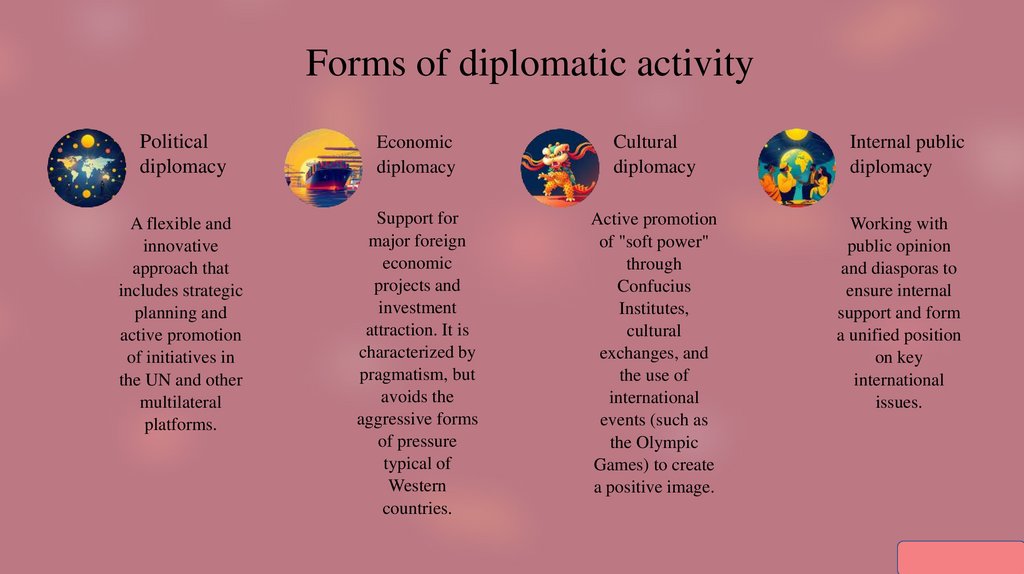
Forms of diplomatic activityPolitical
diplomacy
Economic
diplomacy
Cultural
diplomacy
Internal public
diplomacy
A flexible and
innovative
approach that
includes strategic
planning and
active promotion
of initiatives in
the UN and other
multilateral
platforms.
Support for
major foreign
economic
projects and
investment
attraction. It is
characterized by
pragmatism, but
avoids the
aggressive forms
of pressure
typical of
Western
countries.
Active promotion
of "soft power"
through
Confucius
Institutes,
cultural
exchanges, and
the use of
international
events (such as
the Olympic
Games) to create
a positive image.
Working with
public opinion
and diasporas to
ensure internal
support and form
a unified position
on key
international
issues.
8.
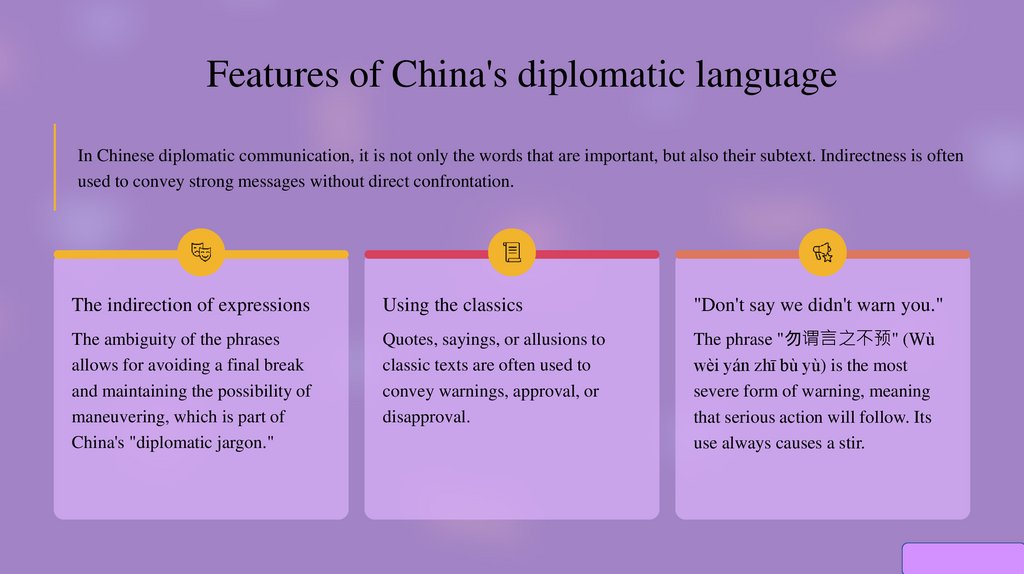
Features of China's diplomatic languageIn Chinese diplomatic communication, it is not only the words that are important, but also their subtext. Indirectness is often
used to convey strong messages without direct confrontation.
The indirection of expressions
Using the classics
"Don't say we didn't warn you."
The ambiguity of the phrases
allows for avoiding a final break
and maintaining the possibility of
maneuvering, which is part of
China's "diplomatic jargon."
Quotes, sayings, or allusions to
classic texts are often used to
convey warnings, approval, or
disapproval.
The phrase "勿谓言之不预" (Wù
wèi yán zhī bù yù) is the most
severe form of warning, meaning
that serious action will follow. Its
use always causes a stir.
9.
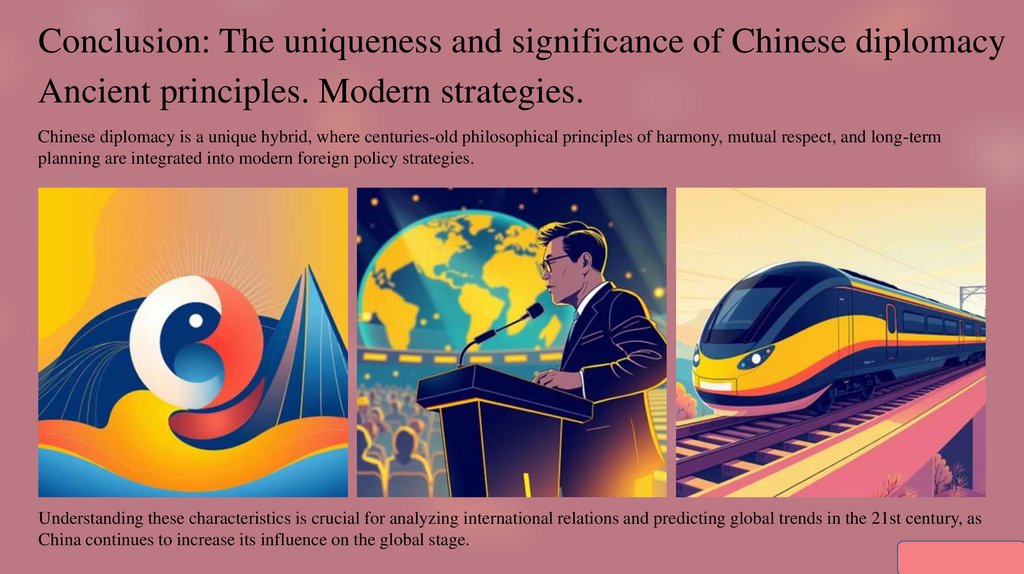
Conclusion: The uniqueness and significance of Chinese diplomacyAncient principles. Modern strategies.
Chinese diplomacy is a unique hybrid, where centuries-old philosophical principles of harmony, mutual respect, and long-term
planning are integrated into modern foreign policy strategies.
Understanding these characteristics is crucial for analyzing international relations and predicting global trends in the 21st century, as
China continues to increase its influence on the global stage.