
 Английский язык
Похожие презентации:




Compound Sentence: Structure and Arrangement of Clauses
1. Compound Sentence: Structure and Arrangement of Clauses
Gafarova Rushana2. .
The compound sentence is a composite sentence built on theprinciple of coordination. Coordination can be expressed:
o Syndetically (by means of coordinative connectors and, or,
else, but, etc.) or conjunctive adverbs (otherwise, however,
nevertheless, yet, still, therefore, etc.) - «The darkness was
thinning, but the street was still dimly lit»
o Asyndetically (without a conjunction or conjunctive adverb)
– «The rain fell softly, the house was quiet»
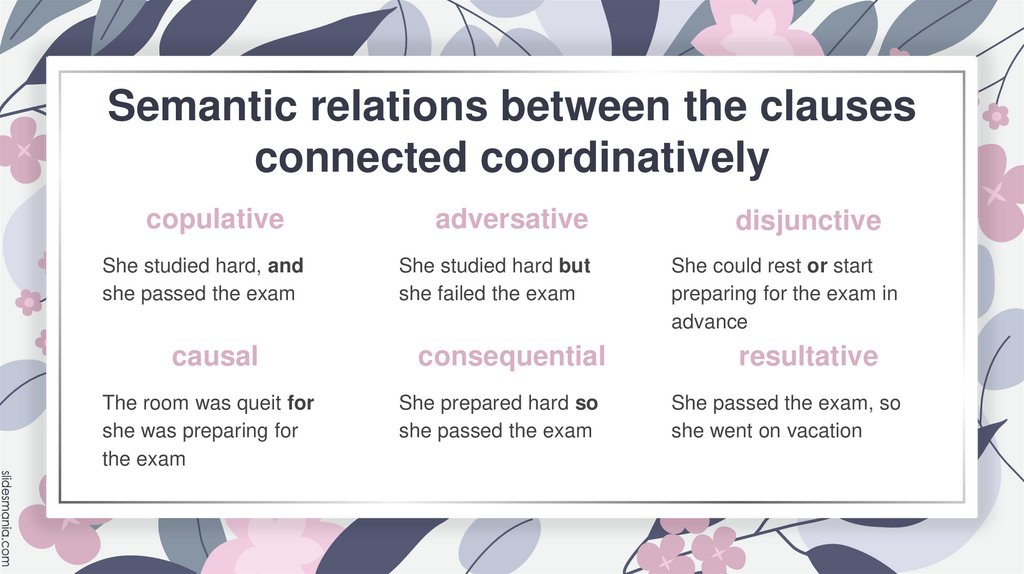
3. Semantic relations between the clauses connected coordinatively
copulativeShe studied hard, and
she passed the exam
adversative
She studied hard but
she failed the exam
causal
consequential
The room was queit for
she was preparing for
the exam
She prepared hard so
she passed the exam
disjunctive
She could rest or start
preparing for the exam in
advance
resultative
She passed the exam, so
she went on vacation
4. Is there a difference between a compound sentence and a text sequence of independent sentences?
Sequence of Simple Sentences:
«Jane adored that actor. Hockins could not stand the sight of him, but each was
convinced of one's own artistic judgement.» (These are separate thoughts that
cannot be justified in any syntactic or semantic sense)
Compound Sentence:
«Jane adored that actor but Hockins could not stand the sight of him. Each was
convinced of one's own artistic judgement.» (The conjunction but immediately
sets up a direct contrast between the two ideas)
5. .
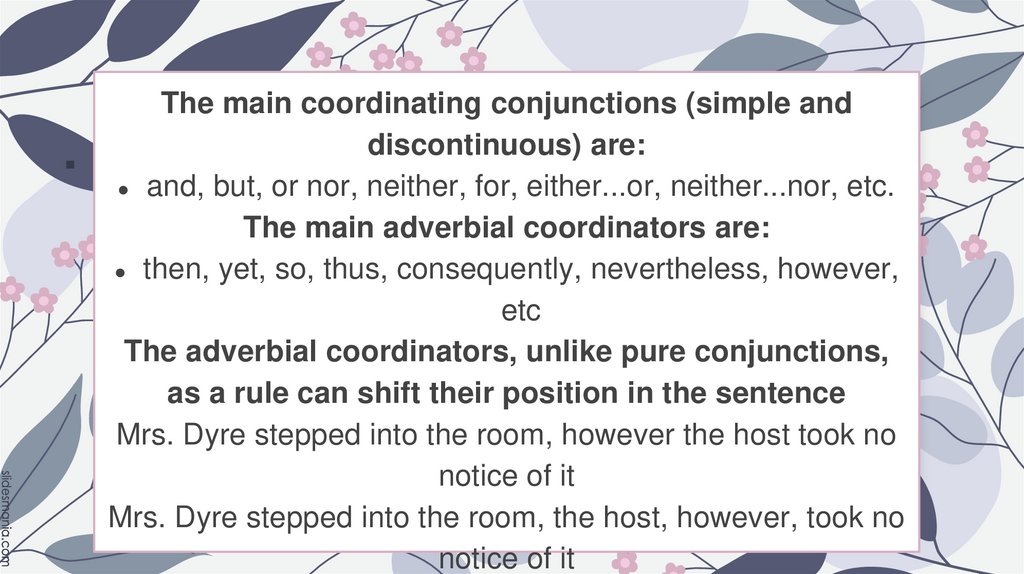
The main coordinating conjunctions (simple anddiscontinuous) are:
● and, but, or nor, neither, for, either...or, neither...nor, etc.
The main adverbial coordinators are:
● then, yet, so, thus, consequently, nevertheless, however,
etc
The adverbial coordinators, unlike pure conjunctions,
as a rule can shift their position in the sentence
Mrs. Dyre stepped into the room, however the host took no
notice of it
Mrs. Dyre stepped into the room, the host, however, took no
notice of it
6. Connection between the clauses from the semantico-syntactic point of view
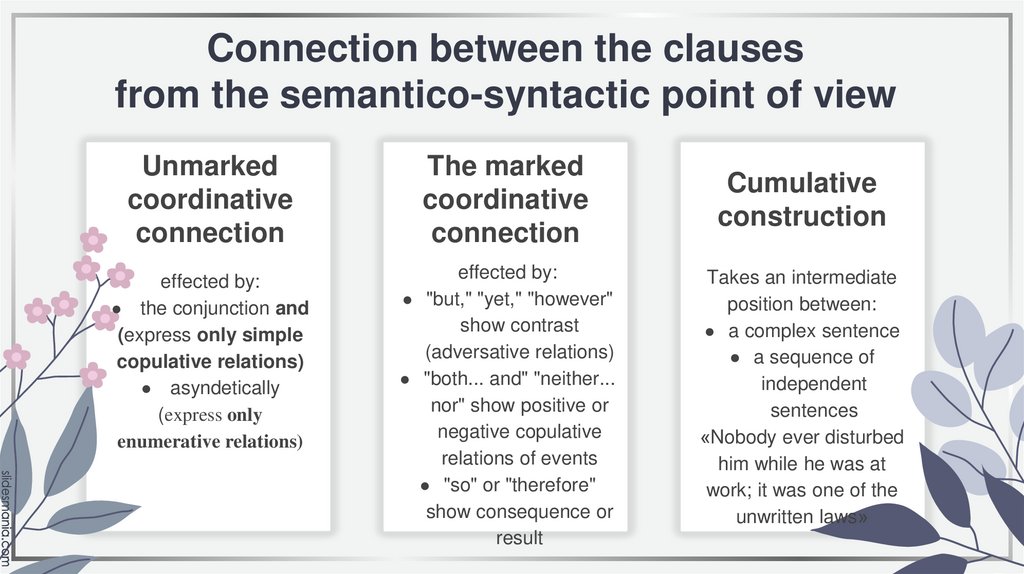
Unmarkedcoordinative
connection
The marked
coordinative
connection
Cumulative
construction
effected by:
● the conjunction and
(express only simple
copulative relations)
● asyndetically
(express only
enumerative relations)
effected by:
● "but," "yet," "however"
show contrast
(adversative relations)
● "both... and" "neither...
nor" show positive or
negative copulative
relations of events
● "so" or "therefore"
show consequence or
result
Takes an intermediate
position between:
● a complex sentence
● a sequence of
independent
sentences
«Nobody ever disturbed
him while he was at
work; it was one of the
unwritten laws»
7. The length of the compound sentence
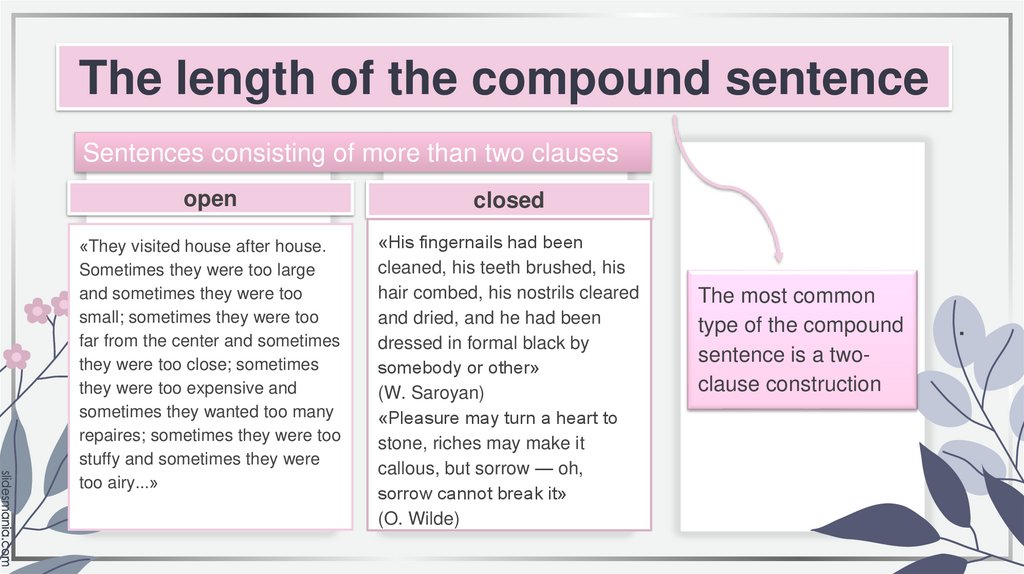
Sentences consisting of more than two clausesopen
closed
«They visited house after house.
Sometimes they were too large
and sometimes they were too
small; sometimes they were too
far from the center and sometimes
they were too close; sometimes
they were too expensive and
sometimes they wanted too many
repaires; sometimes they were too
stuffy and sometimes they were
too airy...»
«His fingernails had been
cleaned, his teeth brushed, his
hair combed, his nostrils cleared
and dried, and he had been
dressed in formal black by
somebody or other»
(W. Saroyan)
«Pleasure may turn a heart to
stone, riches may make it
callous, but sorrow — oh,
sorrow cannot break it»
(O. Wilde)
The most common
type of the compound
sentence is a twoclause construction
.