 Английский язык
Похожие презентации:




Graphic Organizer Structure
1.
Graphic Organizer StructureUsing a graphic organizer in AP English to
break a text into small sections and focus on
stylistic details can help students analyze the
writing more effectively.
2.
When you plan an essay,what’s your first step?
3.
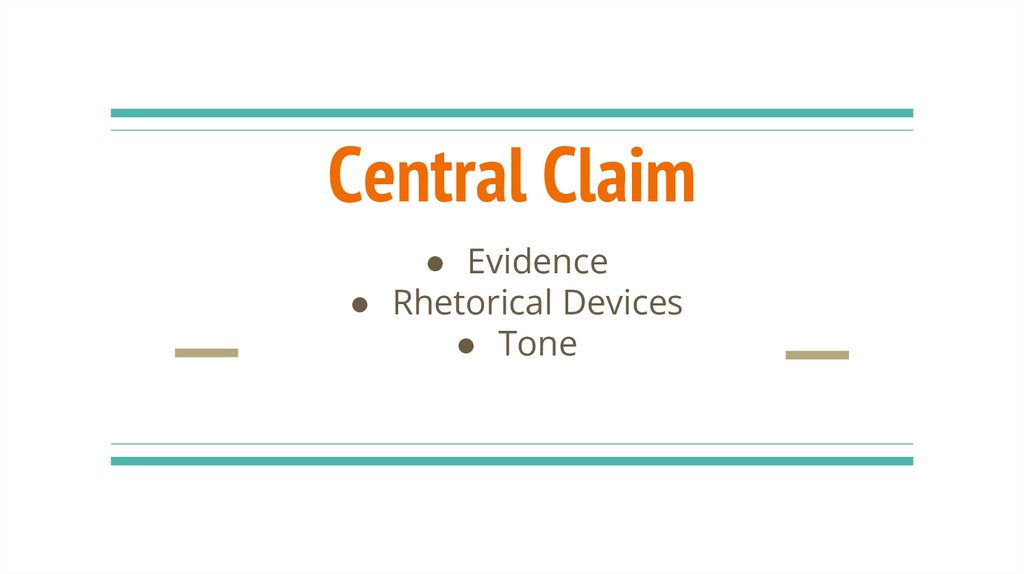
Central Claim● Evidence
● Rhetorical Devices
● Tone
4.
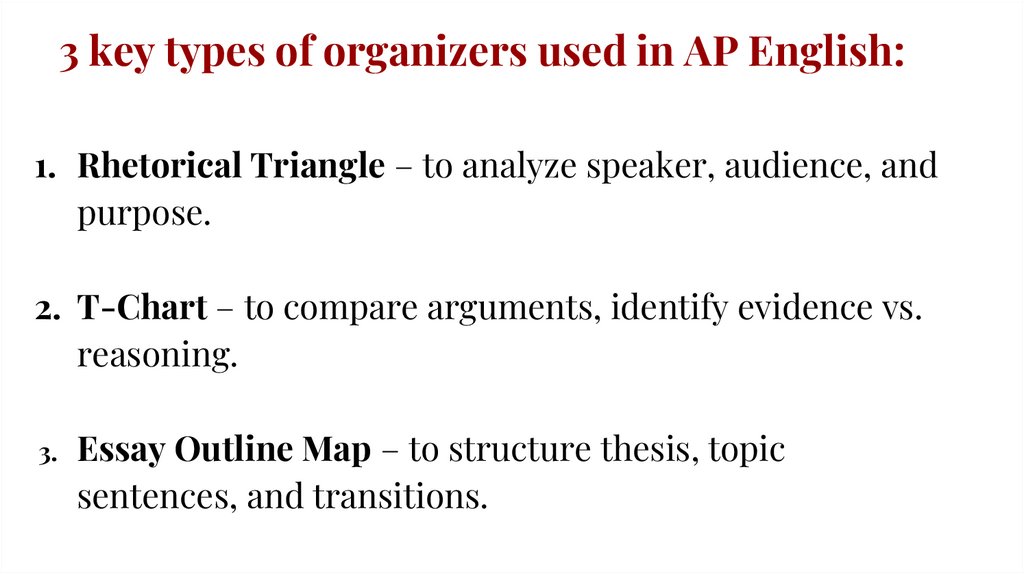
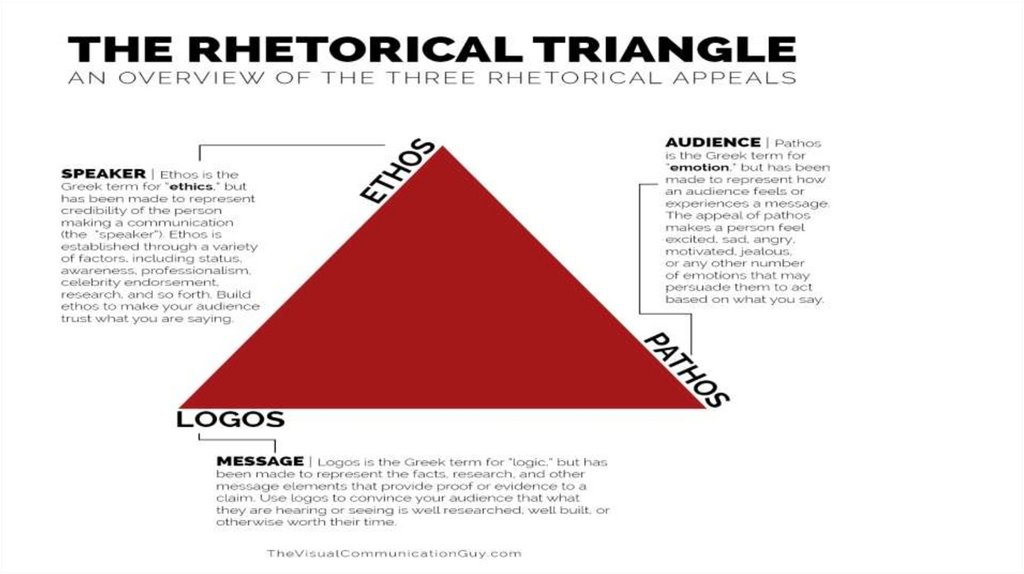
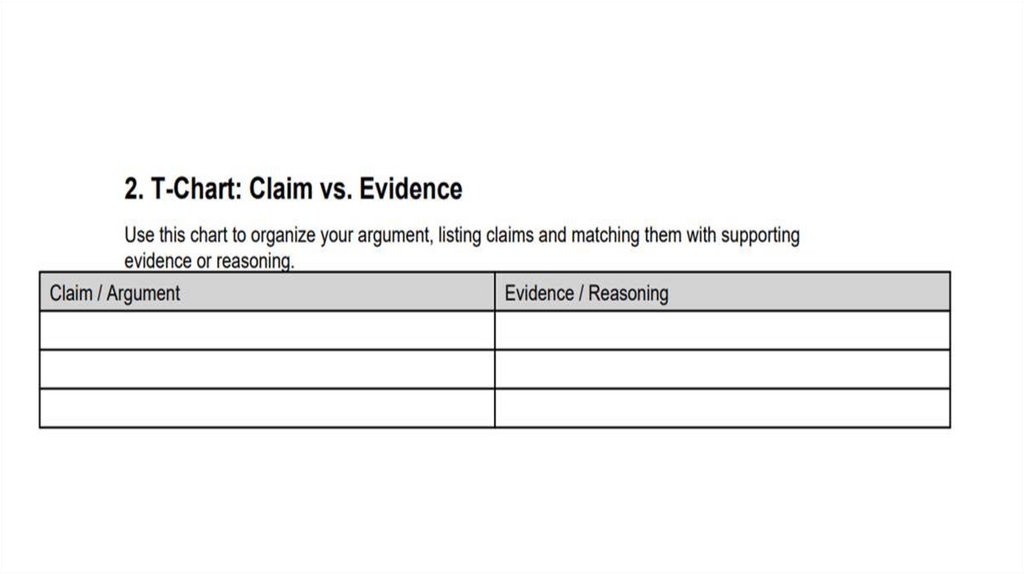
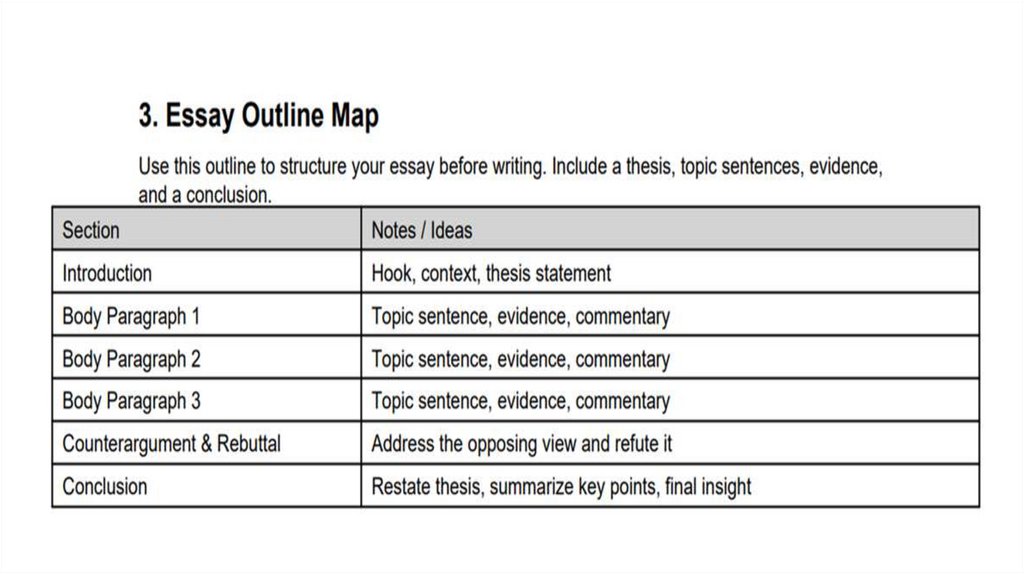
3 key types of organizers used in AP English:1. Rhetorical Triangle – to analyze speaker, audience, and
purpose.
2. T-Chart – to compare arguments, identify evidence vs.
reasoning.
3.
Essay Outline Map – to structure thesis, topic
sentences, and transitions.
5.
6.
7.
8.
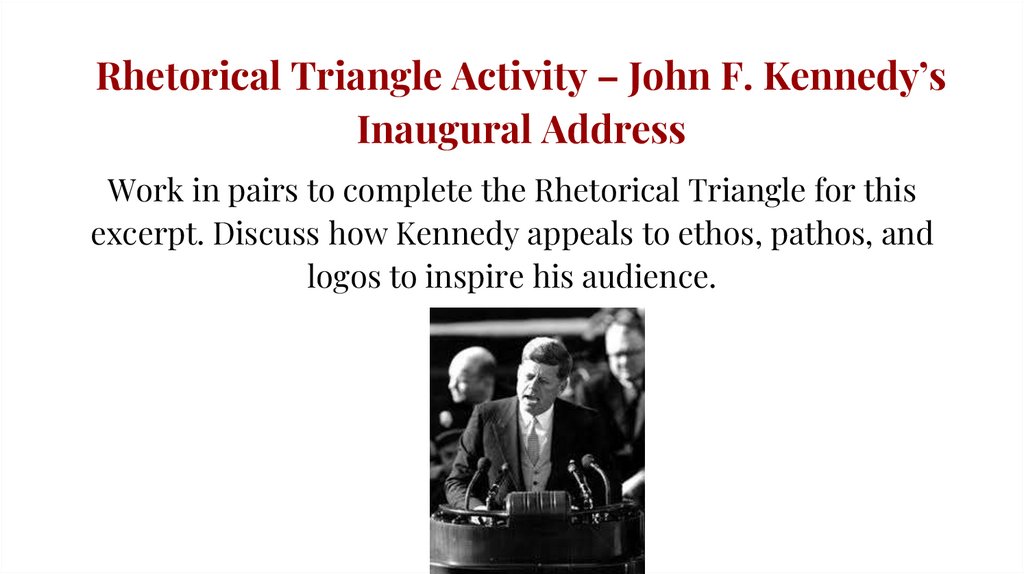
Rhetorical Triangle Activity – John F. Kennedy’sInaugural Address
Work in pairs to complete the Rhetorical Triangle for this
excerpt. Discuss how Kennedy appeals to ethos, pathos, and
logos to inspire his audience.
9.
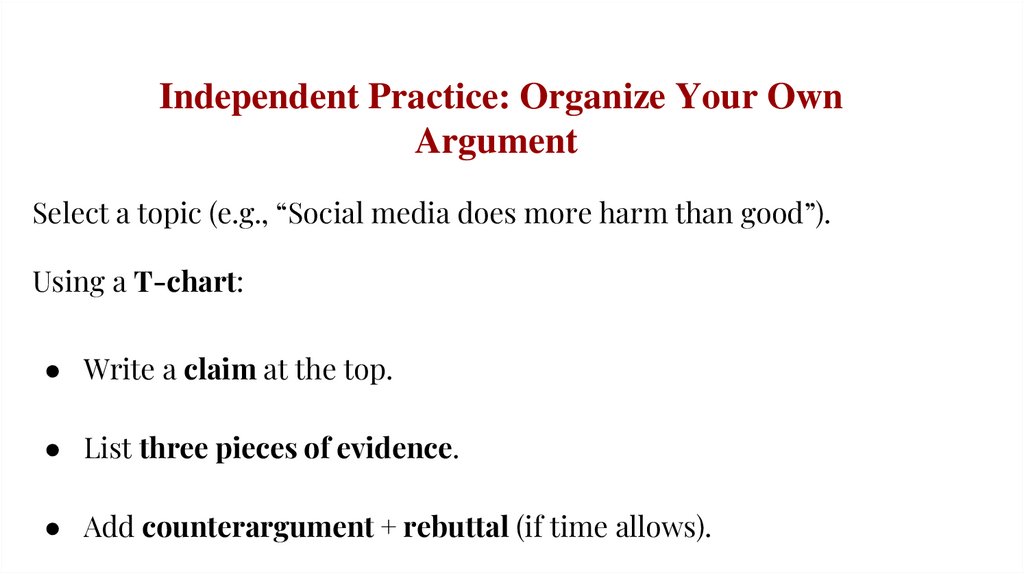
Independent Practice: Organize Your OwnArgument
Select a topic (e.g., “Social media does more harm than good”).
Using a T-chart:
● Write a claim at the top.
● List three pieces of evidence.
● Add counterargument + rebuttal (if time allows).
10.
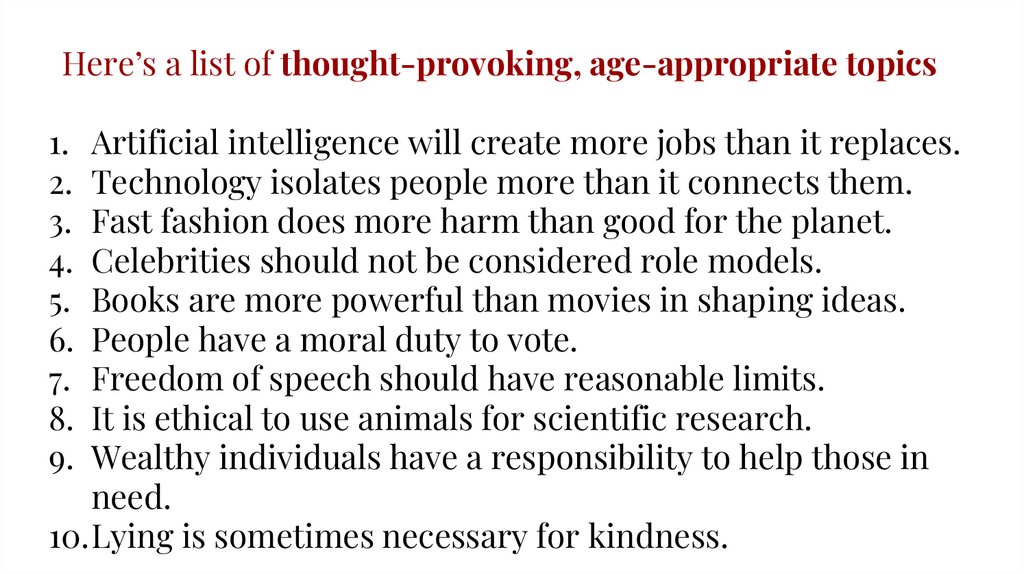
Here’s a list of thought-provoking, age-appropriate topics1. Artificial intelligence will create more jobs than it replaces.
2. Technology isolates people more than it connects them.
3. Fast fashion does more harm than good for the planet.
4. Celebrities should not be considered role models.
5. Books are more powerful than movies in shaping ideas.
6. People have a moral duty to vote.
7. Freedom of speech should have reasonable limits.
8. It is ethical to use animals for scientific research.
9. Wealthy individuals have a responsibility to help those in
need.
10.Lying is sometimes necessary for kindness.
11.
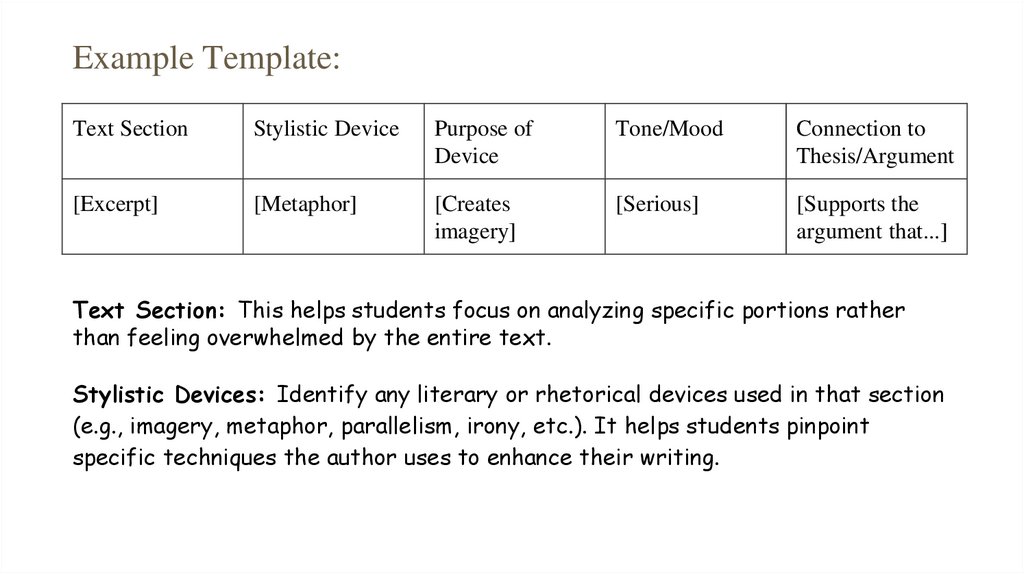
Example Template:Text Section
Stylistic Device
Purpose of
Device
Tone/Mood
Connection to
Thesis/Argument
[Excerpt]
[Metaphor]
[Creates
imagery]
[Serious]
[Supports the
argument that...]
Text Section: This helps students focus on analyzing specific portions rather
than feeling overwhelmed by the entire text.
Stylistic Devices: Identify any literary or rhetorical devices used in that section
(e.g., imagery, metaphor, parallelism, irony, etc.). It helps students pinpoint
specific techniques the author uses to enhance their writing.
12.
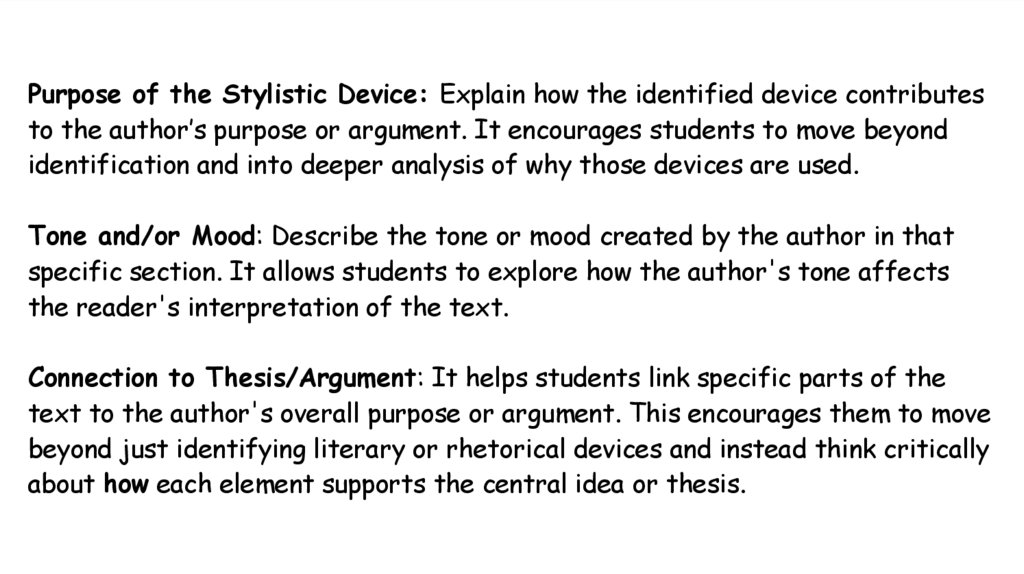
Purpose of the Stylistic Device: Explain how the identified device contributesto the author’s purpose or argument. It encourages students to move beyond
identification and into deeper analysis of why those devices are used.
Tone and/or Mood: Describe the tone or mood created by the author in that
specific section. It allows students to explore how the author's tone affects
the reader's interpretation of the text.
Connection to Thesis/Argument: It helps students link specific parts of the
text to the author's overall purpose or argument. This encourages them to move
beyond just identifying literary or rhetorical devices and instead think critically
about how each element supports the central idea or thesis.
13.
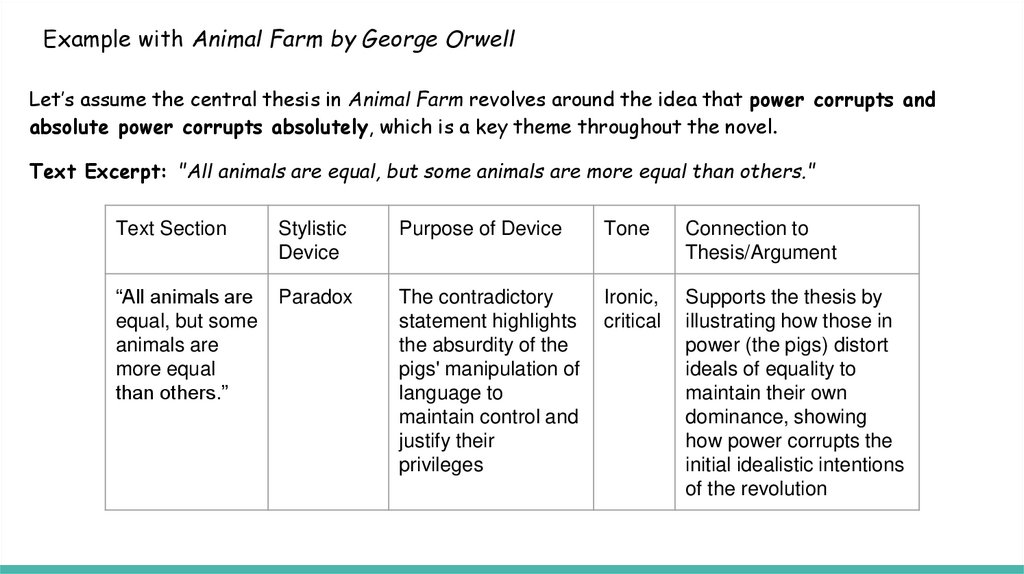
Example with Animal Farm by George OrwellLet’s assume the central thesis in Animal Farm revolves around the idea that power corrupts and
absolute power corrupts absolutely, which is a key theme throughout the novel.
Text Excerpt: "All animals are equal, but some animals are more equal than others."
Text Section
Stylistic
Device
Purpose of Device
Tone
Connection to
Thesis/Argument
“All animals are
equal, but some
animals are
more equal
than others.”
Paradox
The contradictory
statement highlights
the absurdity of the
pigs' manipulation of
language to
maintain control and
justify their
privileges
Ironic,
critical
Supports the thesis by
illustrating how those in
power (the pigs) distort
ideals of equality to
maintain their own
dominance, showing
how power corrupts the
initial idealistic intentions
of the revolution
14.
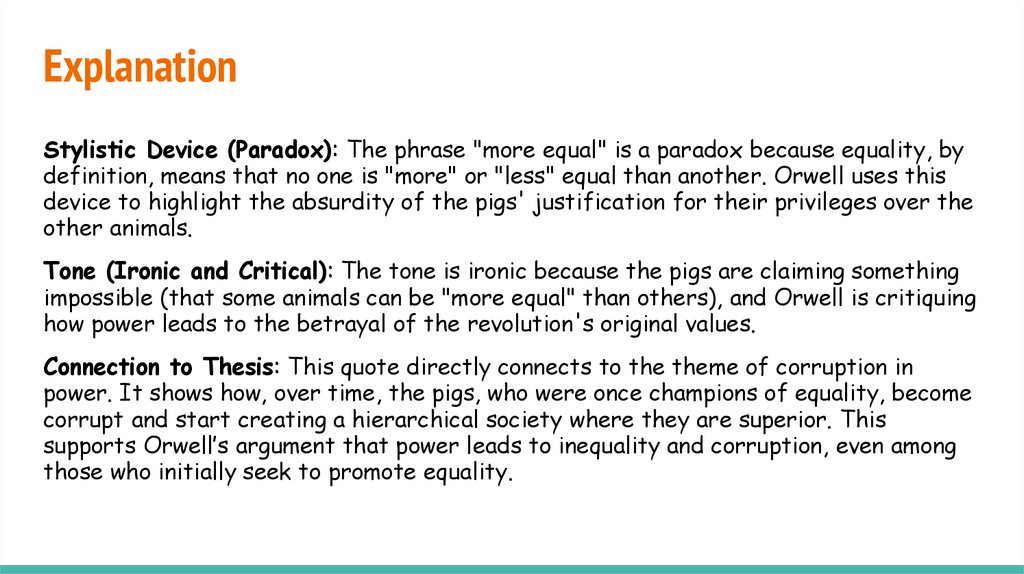
ExplanationStylistic Device (Paradox): The phrase "more equal" is a paradox because equality, by
definition, means that no one is "more" or "less" equal than another. Orwell uses this
device to highlight the absurdity of the pigs' justification for their privileges over the
other animals.
Tone (Ironic and Critical): The tone is ironic because the pigs are claiming something
impossible (that some animals can be "more equal" than others), and Orwell is critiquing
how power leads to the betrayal of the revolution's original values.
Connection to Thesis: This quote directly connects to the theme of corruption in
power. It shows how, over time, the pigs, who were once champions of equality, become
corrupt and start creating a hierarchical society where they are superior. This
supports Orwell’s argument that power leads to inequality and corruption, even among
those who initially seek to promote equality.
15.
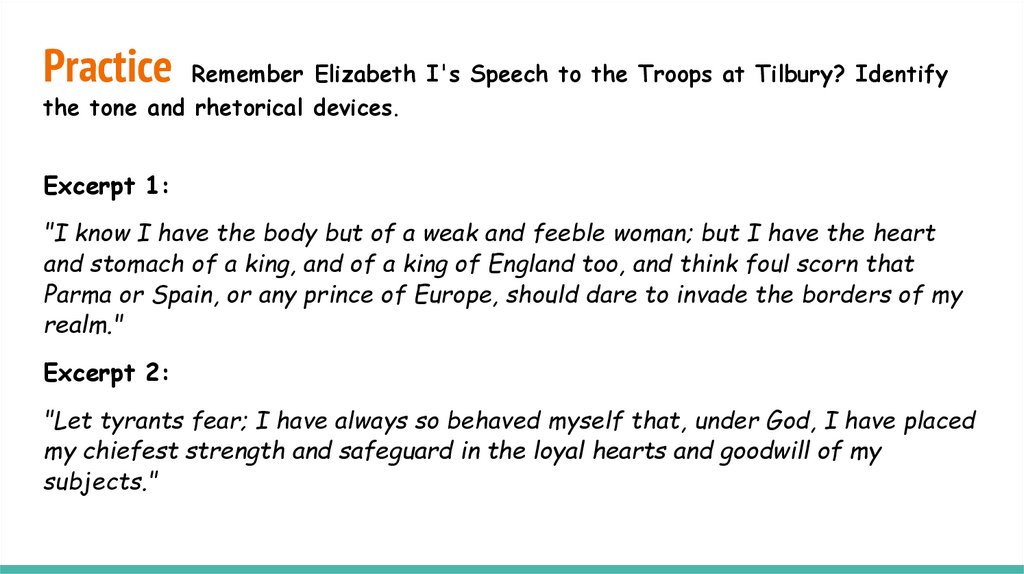
Practice Remember Elizabeth I's Speech to the Troops at Tilbury? Identifythe tone and rhetorical devices.
Excerpt 1:
"I know I have the body but of a weak and feeble woman; but I have the heart
and stomach of a king, and of a king of England too, and think foul scorn that
Parma or Spain, or any prince of Europe, should dare to invade the borders of my
realm."
Excerpt 2:
"Let tyrants fear; I have always so behaved myself that, under God, I have placed
my chiefest strength and safeguard in the loyal hearts and goodwill of my
subjects."
16.
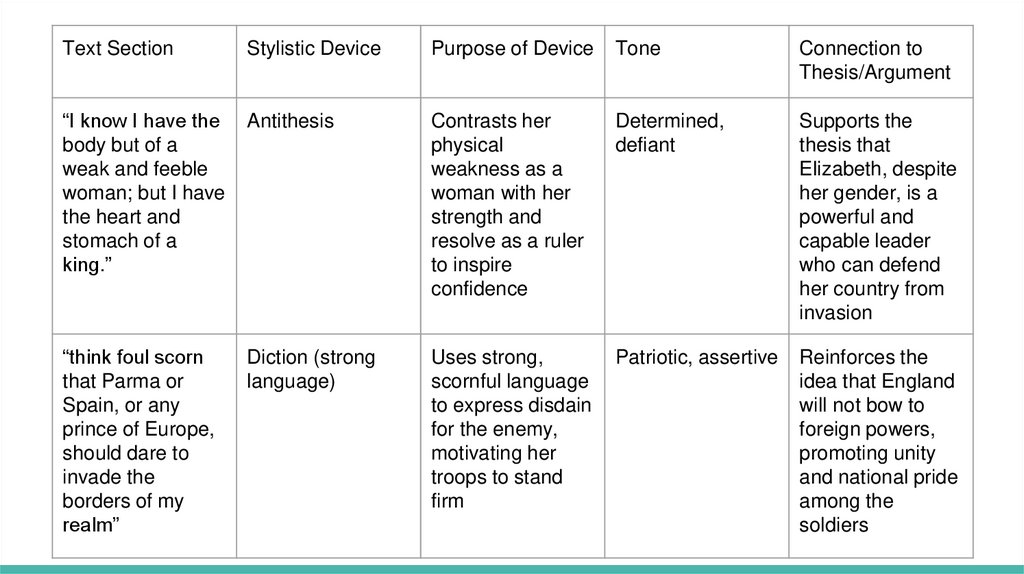
Text SectionStylistic Device
Purpose of Device
Tone
Connection to
Thesis/Argument
“I know I have the
body but of a
weak and feeble
woman; but I have
the heart and
stomach of a
king.”
Antithesis
Contrasts her
physical
weakness as a
woman with her
strength and
resolve as a ruler
to inspire
confidence
Determined,
defiant
Supports the
thesis that
Elizabeth, despite
her gender, is a
powerful and
capable leader
who can defend
her country from
invasion
“think foul scorn
that Parma or
Spain, or any
prince of Europe,
should dare to
invade the
borders of my
realm”
Diction (strong
language)
Uses strong,
scornful language
to express disdain
for the enemy,
motivating her
troops to stand
firm
Patriotic, assertive
Reinforces the
idea that England
will not bow to
foreign powers,
promoting unity
and national pride
among the
soldiers
17.
● Homework: Choose one essay topicand complete a full essay outline
graphic organizer for the next class.