

 Информатика
Похожие презентации:







You Need to Know. IT-English: Top 8 Words
1.
IT-English: Top 8 WordsYou Need to Know
Mastering key vocabulary is the first step toward fluency in the global language of
technology. This presentation introduces 8 essential terms every aspiring and current IT
professional must understand.
2.
Chapter 1: The FoundationWhy These Words Matter
The world of Information Technology communicates almost exclusively in
English. From documentation and coding standards to conferences and
team meetings, English serves as the universal language. For students and
junior specialists, recognizing this core vocabulary is crucial.
These eight terms are not just definitions; they are foundational concepts
that appear everywhere—in job descriptions, technical specifications, and
daily discussions. Understanding them minimizes communication barriers
and accelerates your integration into the tech community.
Let's start building your technical vocabulary!
3.
Word 1: BugBug
Definition: An error, flaw, or fault in a computer program or system that causes it to produce an incorrect or unexpected result, or to behave in unintended ways.
Example: "The developers are fixing a bug in the new update that prevents users from logging in."
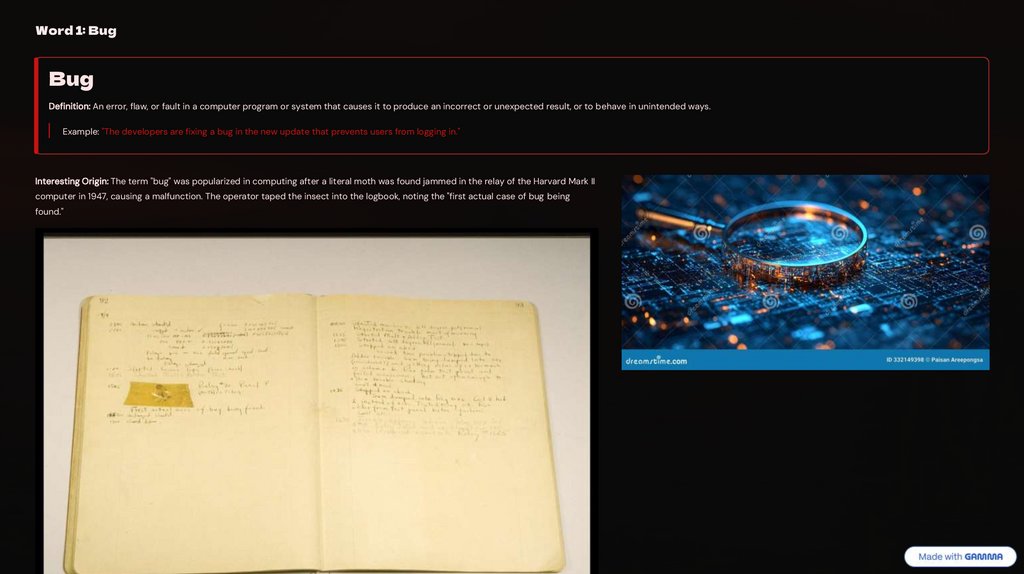
Interesting Origin: The term "bug" was popularized in computing after a literal moth was found jammed in the relay of the Harvard Mark II
computer in 1947, causing a malfunction. The operator taped the insect into the logbook, noting the "first actual case of bug being
found."
4.
Word 2 & 3: Hardware / SoftwareThe Dual Nature
of Computing
Hardware
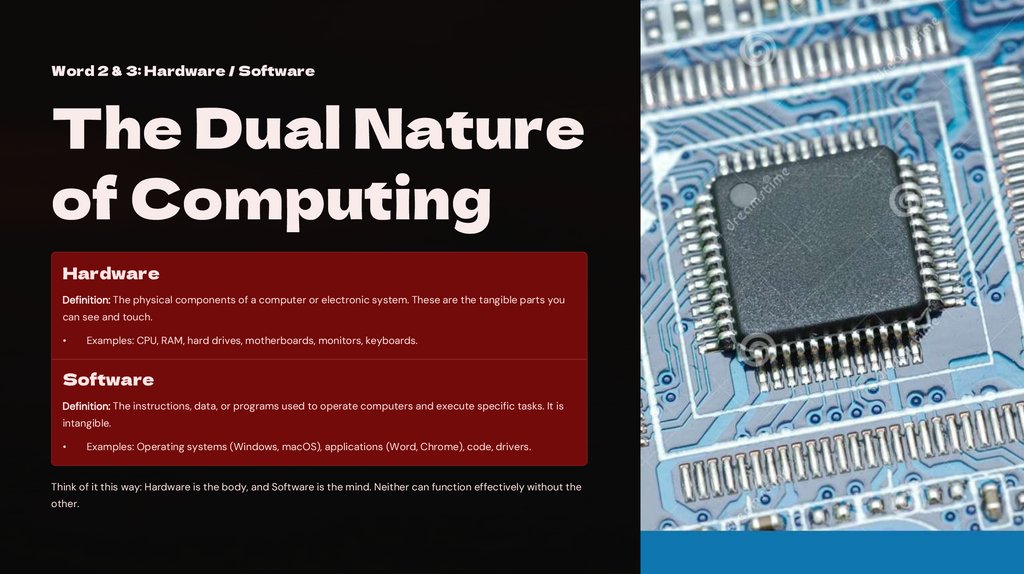
Definition: The physical components of a computer or electronic system. These are the tangible parts you
can see and touch.
Examples: CPU, RAM, hard drives, motherboards, monitors, keyboards.
Software
Definition: The instructions, data, or programs used to operate computers and execute specific tasks. It is
intangible.
Examples: Operating systems (Windows, macOS), applications (Word, Chrome), code, drivers.
Think of it this way: Hardware is the body, and Software is the mind. Neither can function effectively without the
other.
5.
Word 4: AlgorithmAlgorithm
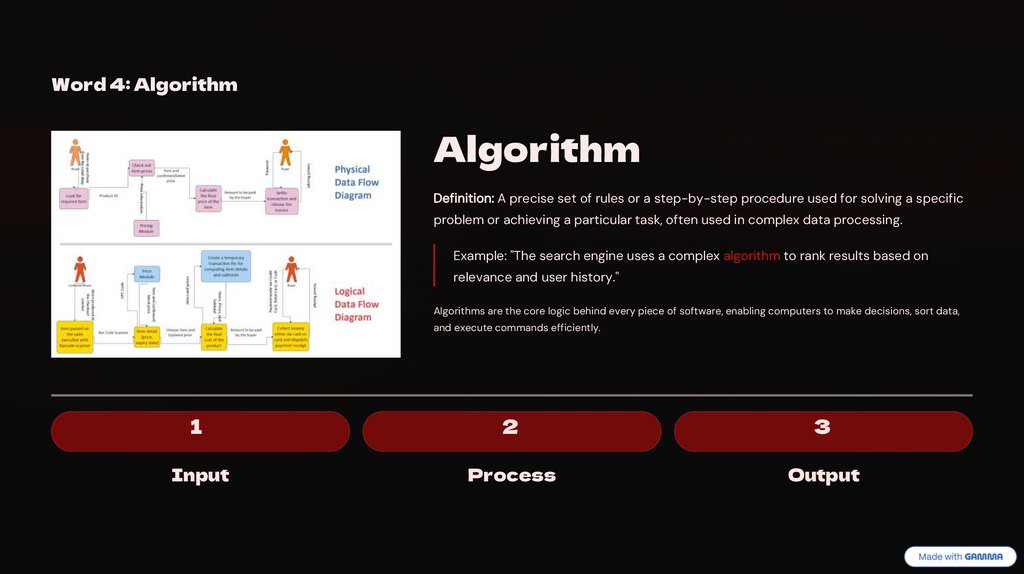
Definition: A precise set of rules or a step-by-step procedure used for solving a specific
problem or achieving a particular task, often used in complex data processing.
Example: "The search engine uses a complex algorithm to rank results based on
relevance and user history."
Algorithms are the core logic behind every piece of software, enabling computers to make decisions, sort data,
and execute commands efficiently.
1
2
3
Input
Process
Output
6.
Word 5 & 6: Cloud and APICloud (Cloud Computing)
Definition: The delivery of computing services—including servers, storage,
API (Application Programming
Interface)
databases, networking, software, and analytics—over the internet ("the cloud").
Definition: A set of rules and protocols that allows two separate software
applications to communicate with each other. It acts as a messenger between
It allows companies and individuals to store and access data and programs
different programs.
online instead of on a local hard drive.
APIs enable integration, such as letting a website use Google Maps
Example: "We migrated all our data storage to the Cloud to improve
scalability and remote access."
functionality or process payments through a third-party service.
Example: "The mobile app uses a secure API to request customer data from
the main server."
7.
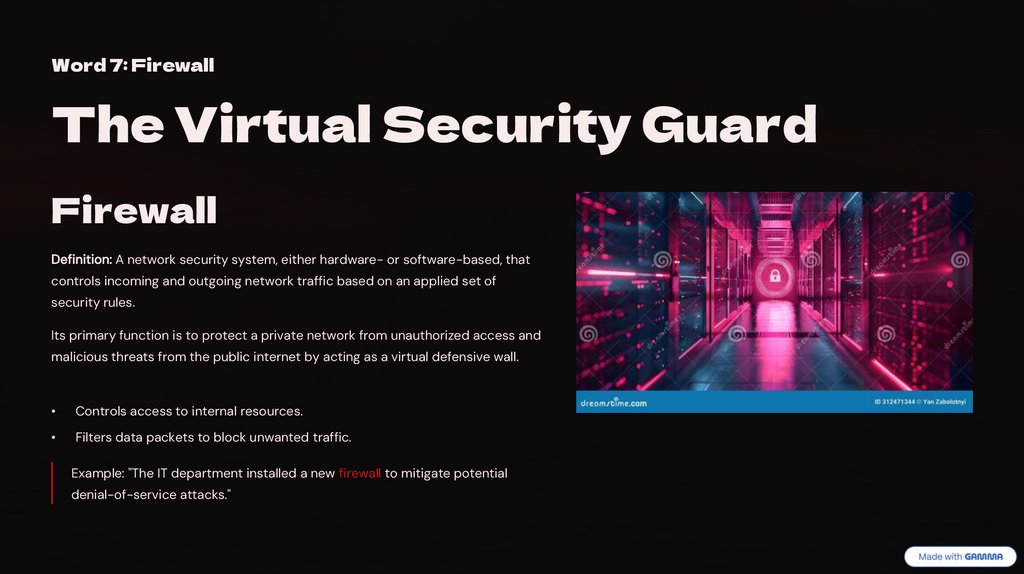
Word 7: FirewallThe Virtual Security Guard
Firewall
Definition: A network security system, either hardware- or software-based, that
controls incoming and outgoing network traffic based on an applied set of
security rules.
Its primary function is to protect a private network from unauthorized access and
malicious threats from the public internet by acting as a virtual defensive wall.
Controls access to internal resources.
Filters data packets to block unwanted traffic.
Example: "The IT department installed a new firewall to mitigate potential
denial-of-service attacks."
8.
Chapter 2: Next StepsReady to
Speak Tech?
The Core Vocabulary
These seven words—Bug, Software, Hardware, Algorithm, Cloud, API, and Firewall—represent the
essential components of modern IT. Knowing them allows you to follow technical conversations
and documentation with confidence.
Next Level Learning
Continue expanding your vocabulary by focusing on your specific domain (e.g., DevOps,
Cybersecurity, Data Science). Use flashcards and try to incorporate at least one new technical
term into your daily conversations.
Practice Makes Perfect
Read technical blogs, listen to English-language tech podcasts, and immerse yourself in English
documentation. Consistent exposure is key to translating theoretical knowledge into practical
fluency.