









 История
Похожие презентации:










History of the Yakutia
1.
2.
HISTORY OF THE YAKUTIA3.
4.
PL
A
N
T
H
E
A
N
C
I
E
N
T
M
I
D
D
L
E
A
G
E
S
R
U
S
S
I
A
N
S
XIX
XX
XXI
C
E
N
T
U
R
Y
C
E
N
T
U
R
Y
C
E
N
T
U
R
Y
5.
AN
C
I
E
N
T
6.
AN
C
I
E
N
T
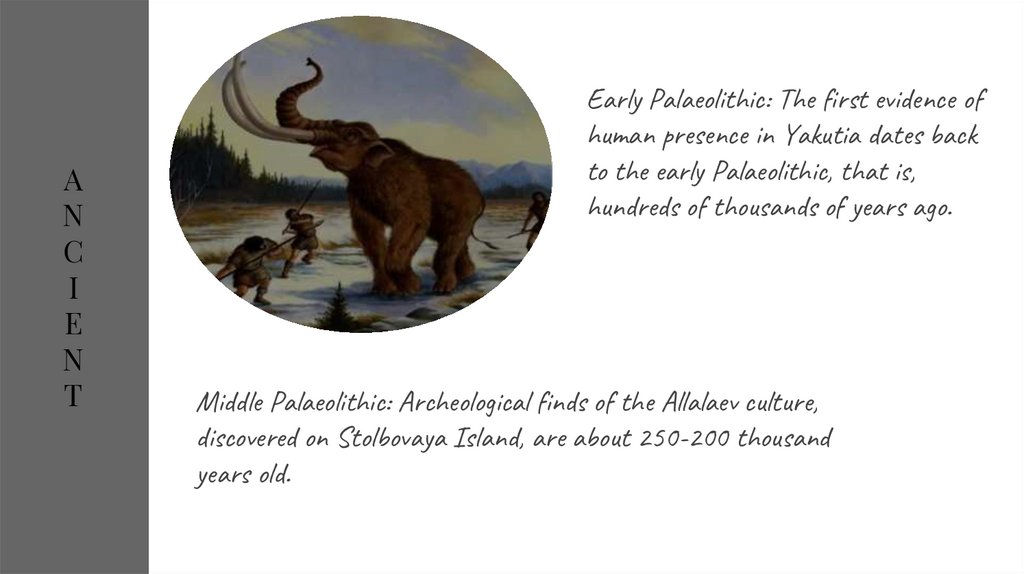
Early Palaeolithic: The first evidence of
human presence in Yakutia dates back
to the early Palaeolithic, that is,
hundreds of thousands of years ago.
Middle Palaeolithic: Archeological finds of the Allalaev culture,
discovered on Stolbovaya Island, are about 250-200 thousand
years old.
7.
TH
E
M
A
N
I
D
C
D
I
E
L
N
E
T
A
G
E
S
8.
TH
E
M
A
N
I
D
C
D
I
E
L
N
E
T
A
G
E
S
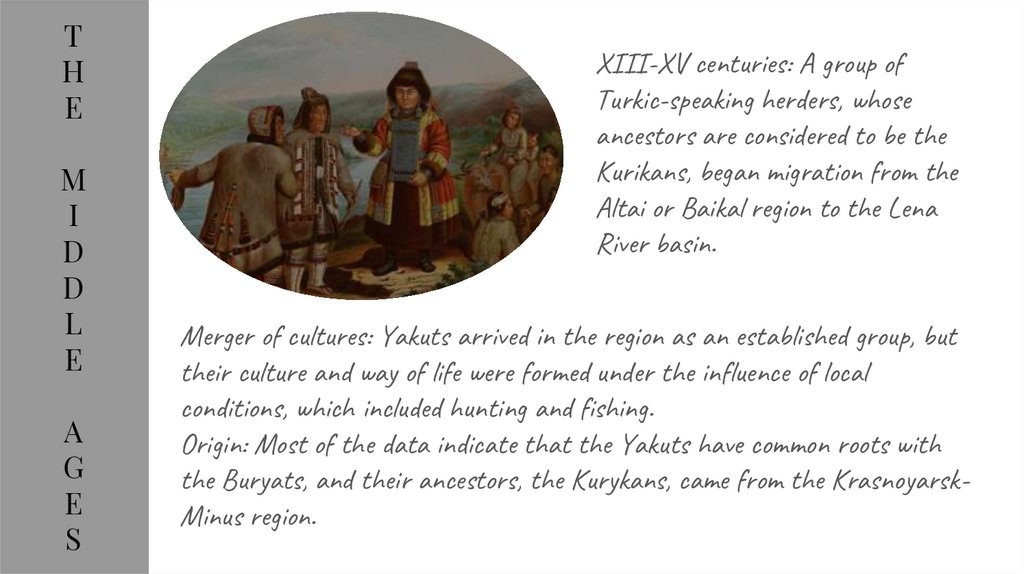
XIII-XV centuries: A group of
Turkic-speaking herders, whose
ancestors are considered to be the
Kurikans, began migration from the
Altai or Baikal region to the Lena
River basin.
Merger of cultures: Yakuts arrived in the region as an established group, but
their culture and way of life were formed under the influence of local
conditions, which included hunting and fishing.
Origin: Most of the data indicate that the Yakuts have common roots with
the Buryats, and their ancestors, the Kurykans, came from the KrasnoyarskMinus region.
9.
TH
E
R
M
A
U
N
I
S
D
C
S
D
I
I
E
L
A
N
E
N
T
S
A
G
E
S
10.
TH
E
R
M
A
U
N
I
S
D
C
S
D
I
I
E
L
A
N
E
N
T
S
A
G
E
S
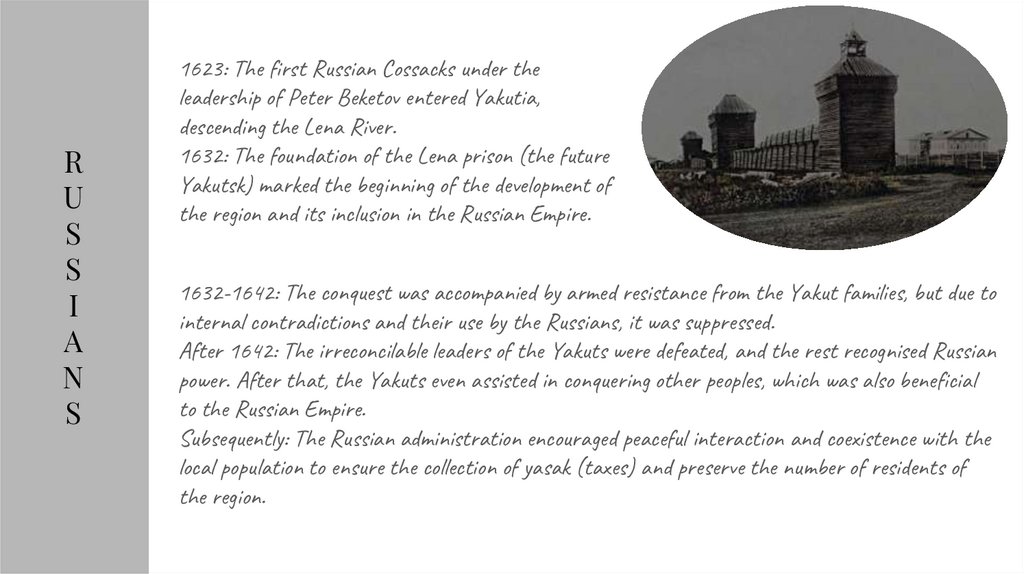
1623: The first Russian Cossacks under the
leadership of Peter Beketov entered Yakutia,
descending the Lena River.
1632: The foundation of the Lena prison (the future
Yakutsk) marked the beginning of the development of
the region and its inclusion in the Russian Empire.
1632-1642: The conquest was accompanied by armed resistance from the Yakut families, but due to
internal contradictions and their use by the Russians, it was suppressed.
After 1642: The irreconcilable leaders of the Yakuts were defeated, and the rest recognised Russian
power. After that, the Yakuts even assisted in conquering other peoples, which was also beneficial
to the Russian Empire.
Subsequently: The Russian administration encouraged peaceful interaction and coexistence with the
local population to ensure the collection of yasak (taxes) and preserve the number of residents of
the region.
11.
TH
E
XIX
R
M
A
U
N
C
I
S
D
C
E
S
D
N
I
I
T
E
L
A
N
U
E
N
R
T
S
A
Y
G
E
S
12.
TH
E
XIX
R
M
A
U
N
C
I
S
D
C
E
S
D
N
I
I
T
E
L
A
N
U
E
N
R
T
S
A
Y
G
E
S
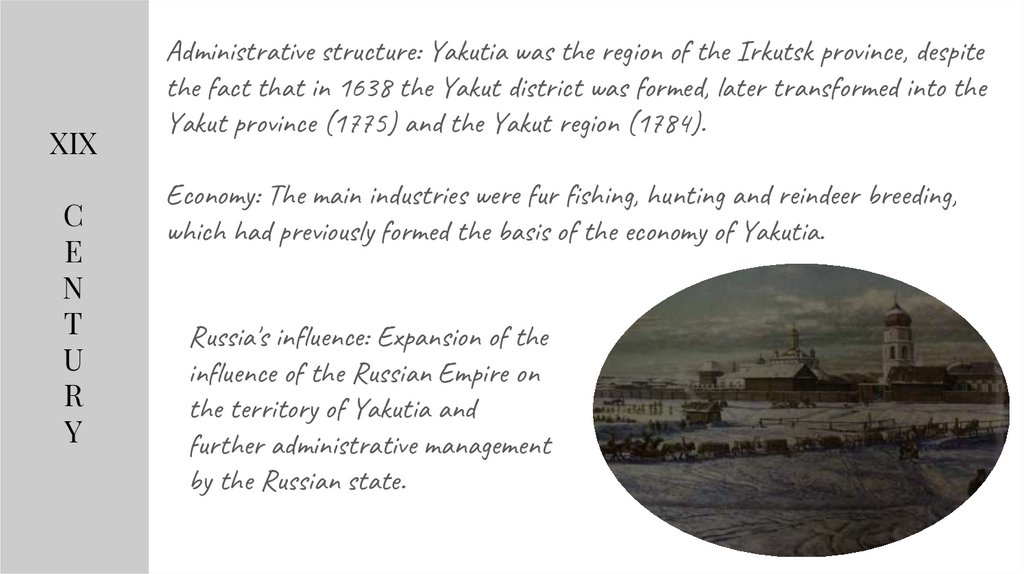
Administrative structure: Yakutia was the region of the Irkutsk province, despite
the fact that in 1638 the Yakut district was formed, later transformed into the
Yakut province (1775) and the Yakut region (1784).
Economy: The main industries were fur fishing, hunting and reindeer breeding,
which had previously formed the basis of the economy of Yakutia.
Russia's influence: Expansion of the
influence of the Russian Empire on
the territory of Yakutia and
further administrative management
by the Russian state.
13.
TH
E
XX
XIX
R
M
A
U
C
N
C
I
S
E
D
C
E
S
N
D
N
I
I
T
T
E
L
A
U
N
U
E
N
R
R
T
S
Y
A
Y
G
E
S
14.
TH
E
XX
XIX
R
M
A
U
C
N
C
I
S
E
D
C
E
S
N
D
N
I
I
T
T
E
L
A
U
N
U
E
N
R
R
T
S
Y
A
Y
G
E
S
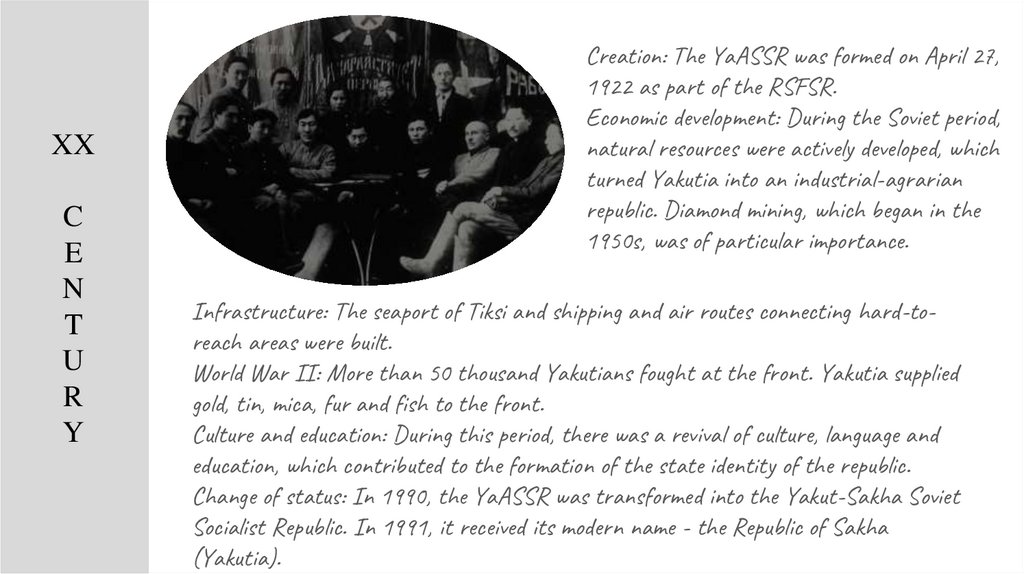
Creation: The YaASSR was formed on April 27,
1922 as part of the RSFSR.
Economic development: During the Soviet period,
natural resources were actively developed, which
turned Yakutia into an industrial-agrarian
republic. Diamond mining, which began in the
1950s, was of particular importance.
Infrastructure: The seaport of Tiksi and shipping and air routes connecting hard-toreach areas were built.
World War II: More than 50 thousand Yakutians fought at the front. Yakutia supplied
gold, tin, mica, fur and fish to the front.
Culture and education: During this period, there was a revival of culture, language and
education, which contributed to the formation of the state identity of the republic.
Change of status: In 1990, the YaASSR was transformed into the Yakut-Sakha Soviet
Socialist Republic. In 1991, it received its modern name - the Republic of Sakha
(Yakutia).
15.
TH
E
XX
XIX
XXI
R
M
A
U
C
N
C
I
S
E
D
C
E
S
N
D
N
I
I
T
T
E
L
A
U
N
U
E
N
R
R
T
S
Y
A
Y
G
E
S
16.
TH
E
XX
XIX
XXI
R
M
A
U
C
N
C
I
S
E
D
C
E
S
N
D
N
I
I
T
T
E
L
A
U
N
U
E
N
R
R
T
S
Y
A
Y
G
E
S
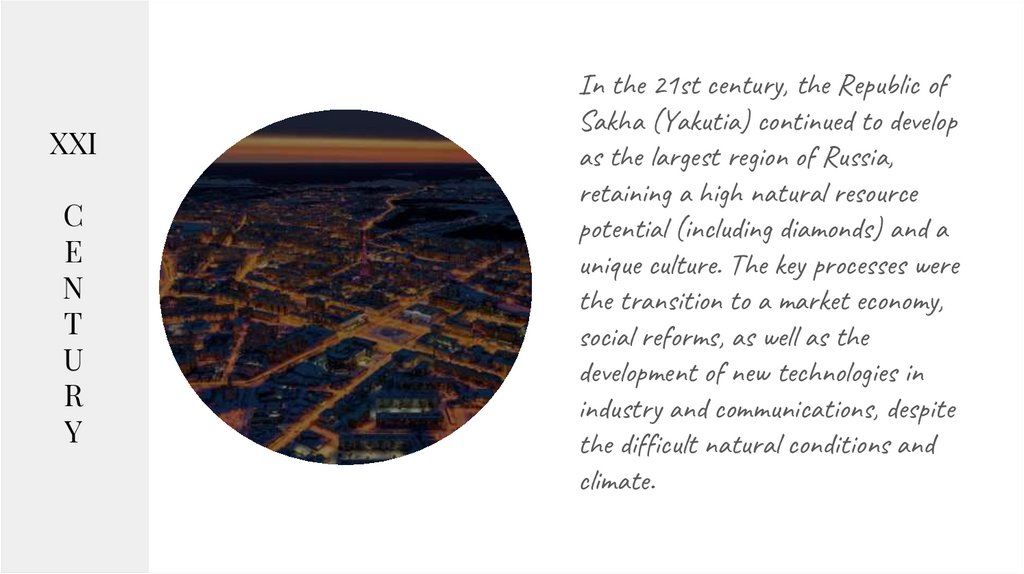
In the 21st century, the Republic of
Sakha (Yakutia) continued to develop
as the largest region of Russia,
retaining a high natural resource
potential (including diamonds) and a
unique culture. The key processes were
the transition to a market economy,
social reforms, as well as the
development of new technologies in
industry and communications, despite
the difficult natural conditions and
climate.
17.
TH
E
A
N
C
I
E
N
T
M
I
D
D
L
E
A
G
E
S
R
U
S
S
I
A
N
S
XIX
XX
XXI
C
E
N
T
U
R
Y
C
E
N
T
U
R
Y
C
E
N
T
U
R
Y
18.
TH
E
A
N
C
I
E
N
T
M
I
D
D
L
E
A
G
E
S
R
U
S
S
I
A
N
S
XIX
XX
XXI
C
E
N
T
U
R
Y
C
E
N
T
U
R
Y
C
E
N
T
U
R
Y
19.
TH
E
Thank you for your attention!
A
N
C
I
E
N
T
M
I
D
D
L
E
A
G
E
S
R
U
S
S
I
A
N
S
XIX
XX
XXI
C
E
N
T
U
R
Y
C
E
N
T
U
R
Y
C
E
N
T
U
R
Y