
 Бизнес
Похожие презентации:







Operational Management of Insurance Business 5FNCE006C
1. Operational Management of Insurance Business 5FNCE006C
Hasan UmarovFinance Department
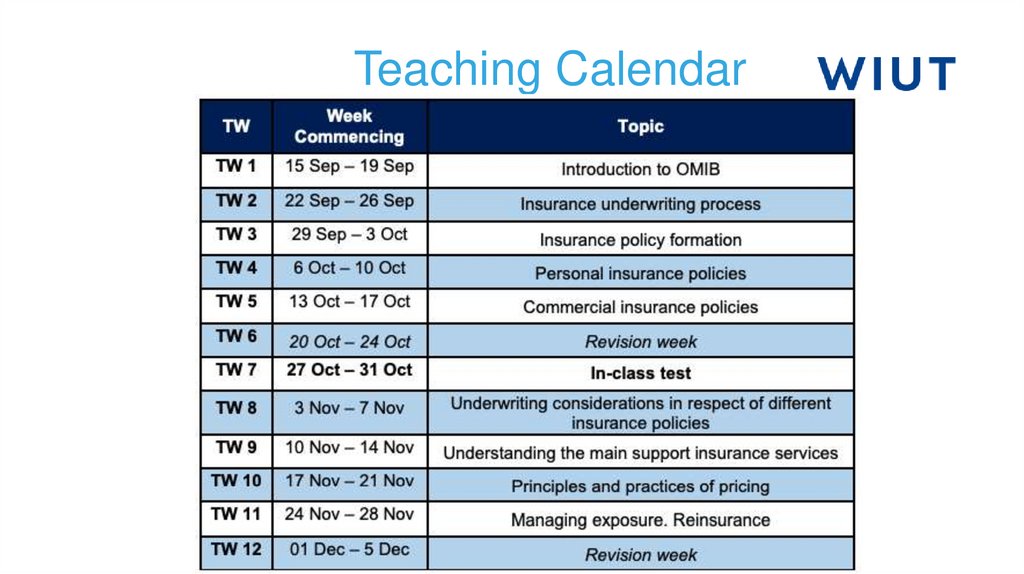
2. Teaching Calendar
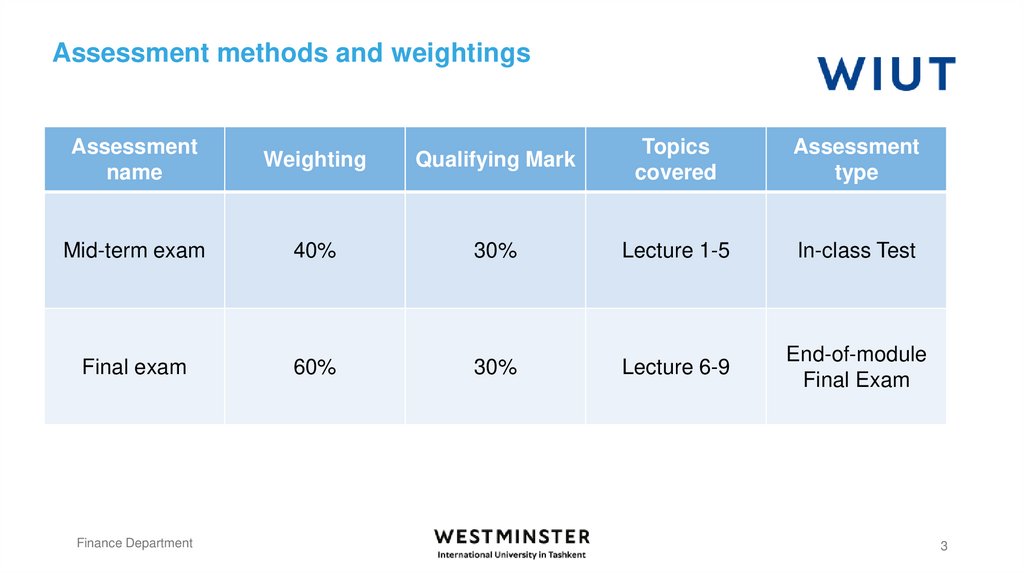
3. Assessment methods and weightings
Assessmentname
Weighting
Qualifying Mark
Topics
covered
Assessment
type
Mid-term exam
40%
30%
Lecture 1-5
In-class Test
Final exam
60%
30%
Lecture 6-9
End-of-module
Final Exam
Finance Department
3
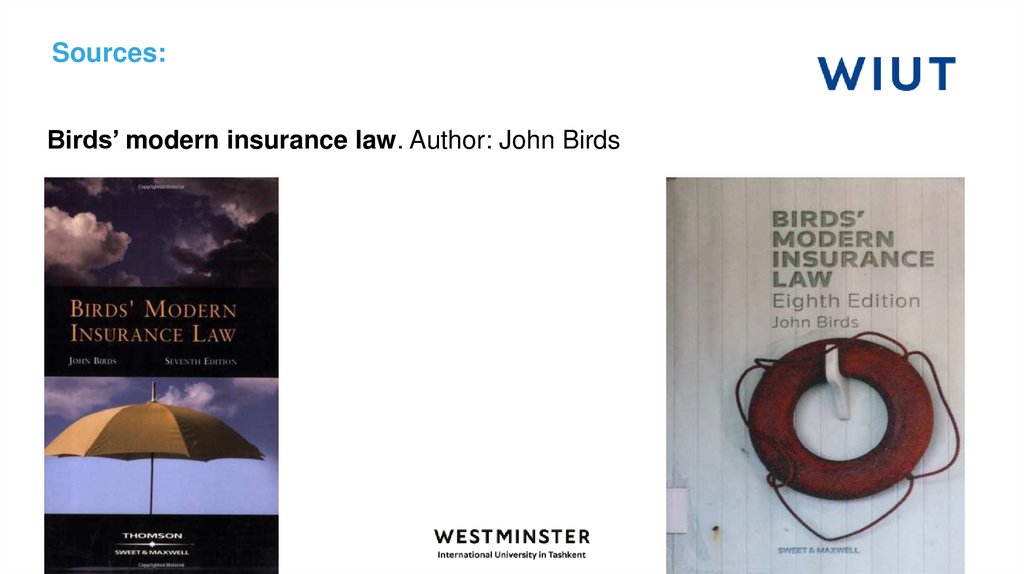
4. Sources:
Birds’ modern insurance law. Author: John BirdsFinance Department
4
5. Lecture 1 Introduction to Operational Management of Insurance Business
Finance Department6. The Chartered Insurance Institute (CII)
The CII is the largest professional body for the Insurance and Financial Planningprofessions, with more than 125,000 members in over 150 countries.
It was founded in Y1912.
Success in CII qualifications is universally
recognized as evidence of knowledge and
technical expertise.
CII offers a range of globally recognized
qualification and certification from entry level to
advanced professional designations, including:
1. Certificate in Insurance
2. Diploma in Insurance
3. Advanced Diploma in Insurance
Finance Department
6
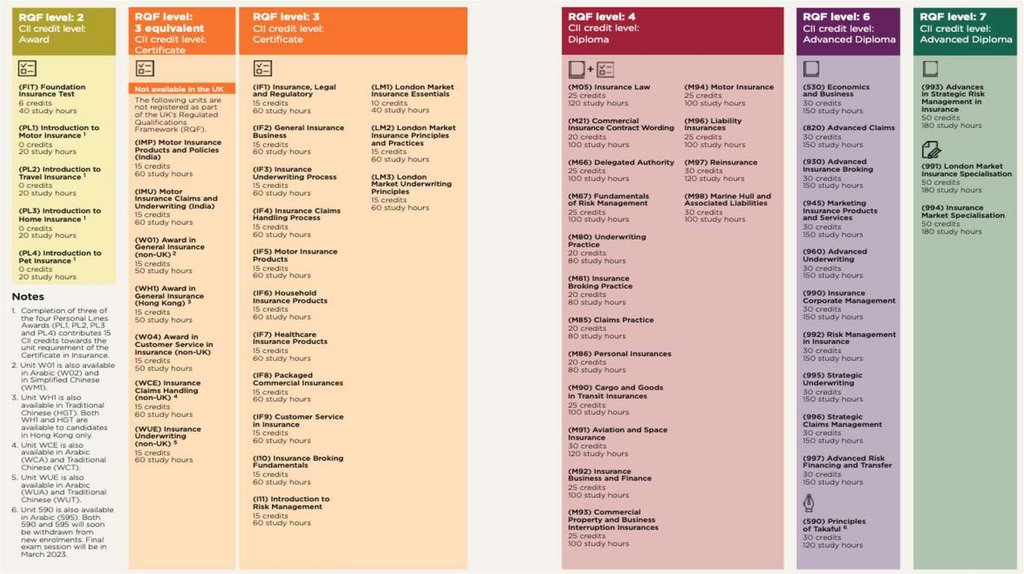
7. The Chartered Insurance Institute (CII)
Finance Department7
8. Certificate in Insurance
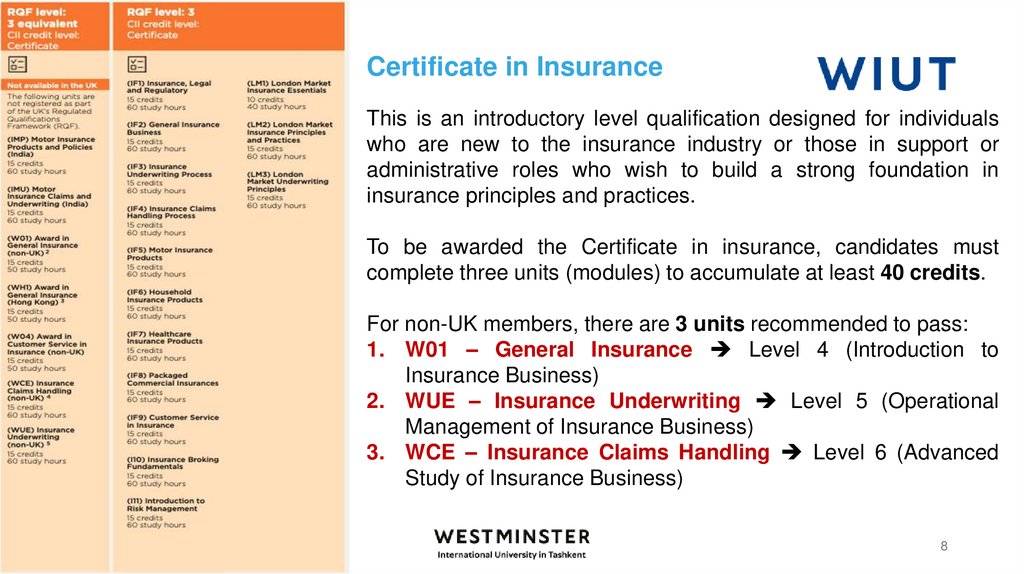
This is an introductory level qualification designed for individualswho are new to the insurance industry or those in support or
administrative roles who wish to build a strong foundation in
insurance principles and practices.
To be awarded the Certificate in insurance, candidates must
complete three units (modules) to accumulate at least 40 credits.
For non-UK members, there are 3 units recommended to pass:
1. W01 – General Insurance Level 4 (Introduction to
Insurance Business)
2. WUE – Insurance Underwriting Level 5 (Operational
Management of Insurance Business)
3. WCE – Insurance Claims Handling Level 6 (Advanced
Study of Insurance Business)
Finance Department
8
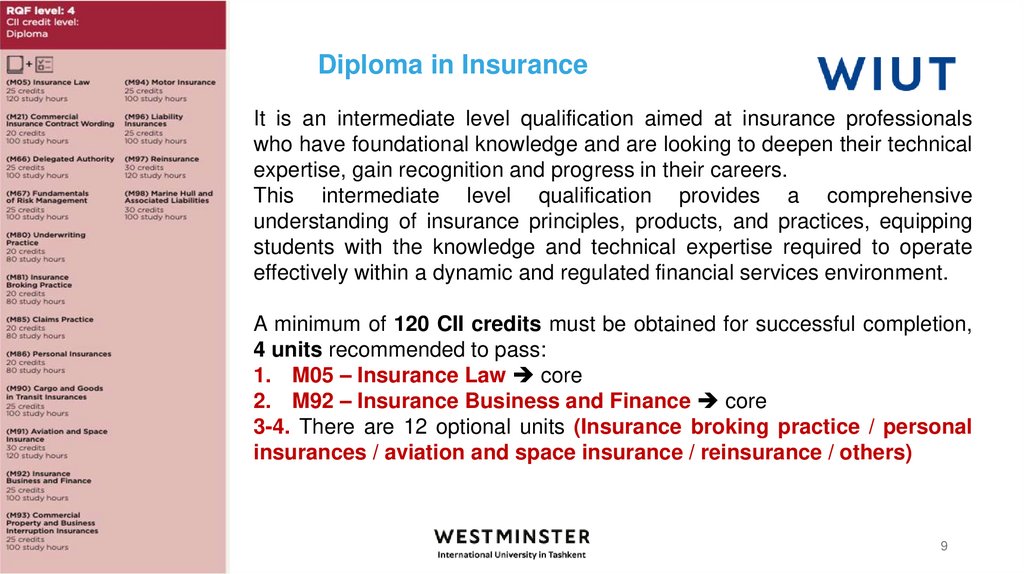
9. Diploma in Insurance
It is an intermediate level qualification aimed at insurance professionalswho have foundational knowledge and are looking to deepen their technical
expertise, gain recognition and progress in their careers.
This intermediate level qualification provides a comprehensive
understanding of insurance principles, products, and practices, equipping
students with the knowledge and technical expertise required to operate
effectively within a dynamic and regulated financial services environment.
A minimum of 120 CII credits must be obtained for successful completion,
4 units recommended to pass:
1. M05 – Insurance Law core
2. M92 – Insurance Business and Finance core
3-4. There are 12 optional units (Insurance broking practice / personal
insurances / aviation and space insurance / reinsurance / others)
Finance Department
9
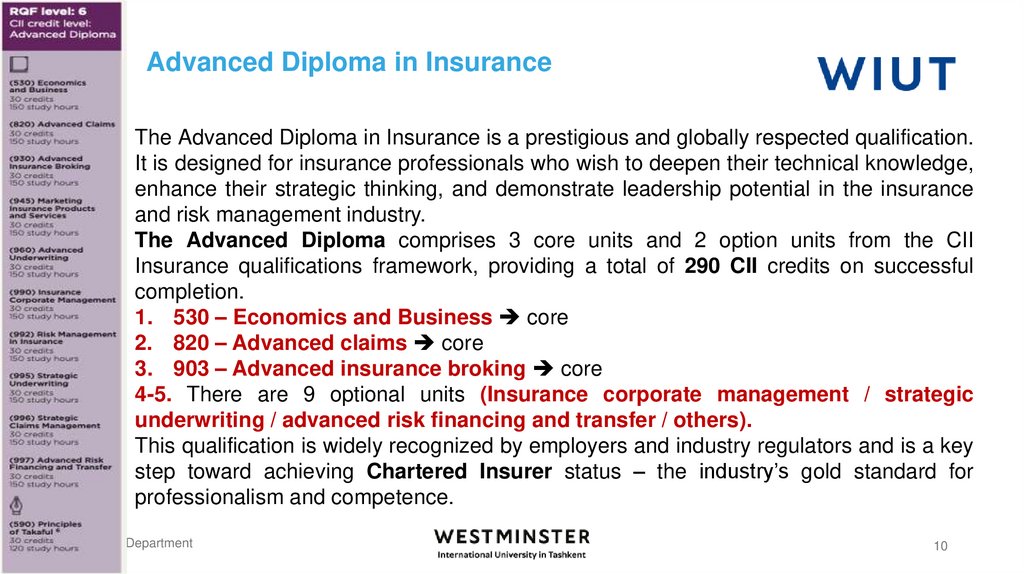
10. Advanced Diploma in Insurance
The Advanced Diploma in Insurance is a prestigious and globally respected qualification.It is designed for insurance professionals who wish to deepen their technical knowledge,
enhance their strategic thinking, and demonstrate leadership potential in the insurance
and risk management industry.
The Advanced Diploma comprises 3 core units and 2 option units from the CII
Insurance qualifications framework, providing a total of 290 CII credits on successful
completion.
1. 530 – Economics and Business core
2. 820 – Advanced claims core
3. 903 – Advanced insurance broking core
4-5. There are 9 optional units (Insurance corporate management / strategic
underwriting / advanced risk financing and transfer / others).
This qualification is widely recognized by employers and industry regulators and is a key
step toward achieving Chartered Insurer status – the industry’s gold standard for
professionalism and competence.
Finance Department
10
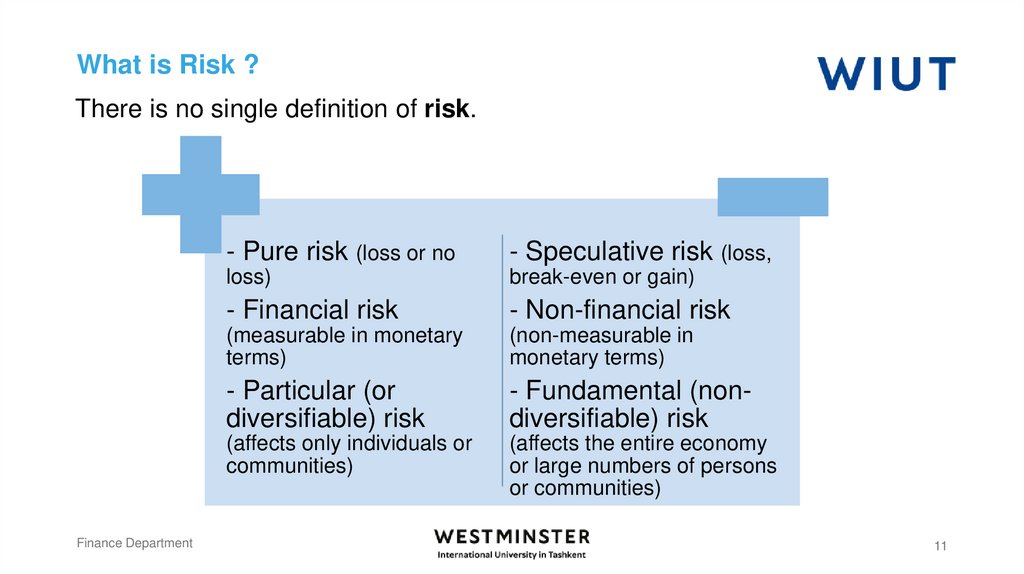
11. What is Risk ?
There is no single definition of risk.Finance Department
- Pure risk (loss or no
- Speculative risk (loss,
loss)
break-even or gain)
- Financial risk
- Non-financial risk
(measurable in monetary
terms)
(non-measurable in
monetary terms)
- Particular (or
diversifiable) risk
- Fundamental (nondiversifiable) risk
(affects only individuals or
communities)
(affects the entire economy
or large numbers of persons
or communities)
11
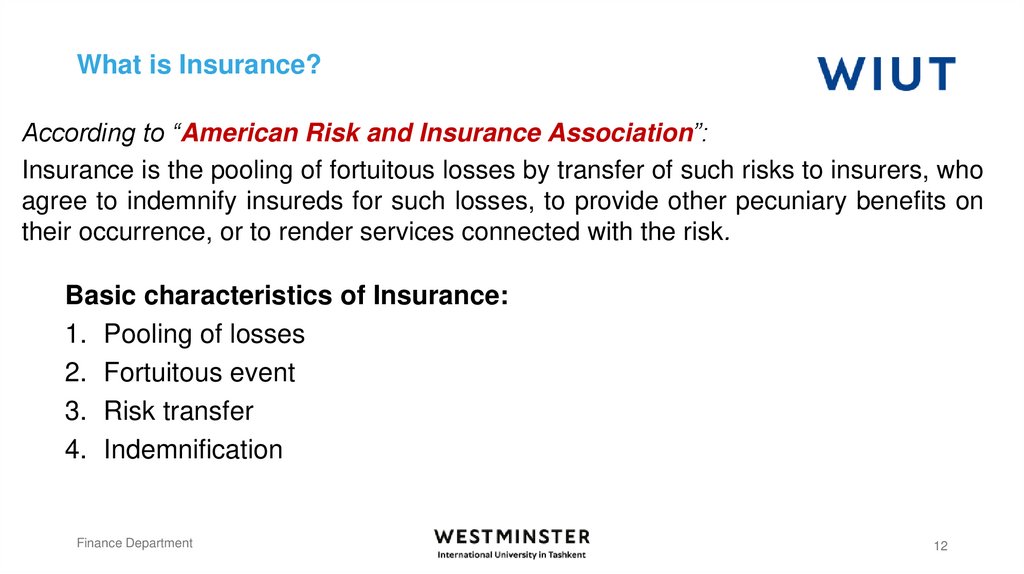
12. What is Insurance?
According to “American Risk and Insurance Association”:Insurance is the pooling of fortuitous losses by transfer of such risks to insurers, who
agree to indemnify insureds for such losses, to provide other pecuniary benefits on
their occurrence, or to render services connected with the risk.
Basic characteristics of Insurance:
1. Pooling of losses
2. Fortuitous event
3. Risk transfer
4. Indemnification
Finance Department
12
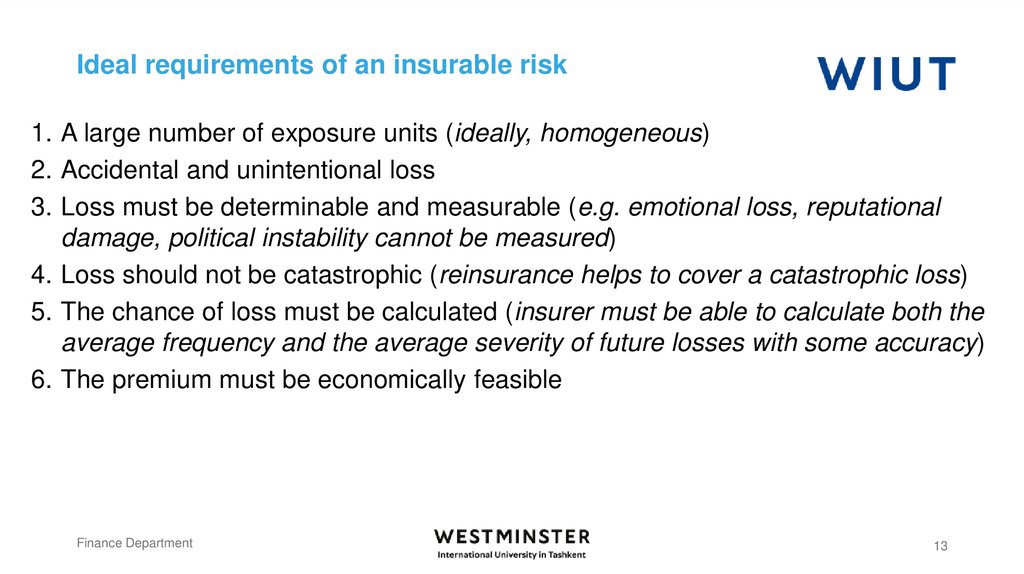
13. Ideal requirements of an insurable risk
1. A large number of exposure units (ideally, homogeneous)2. Accidental and unintentional loss
3. Loss must be determinable and measurable (e.g. emotional loss, reputational
damage, political instability cannot be measured)
4. Loss should not be catastrophic (reinsurance helps to cover a catastrophic loss)
5. The chance of loss must be calculated (insurer must be able to calculate both the
average frequency and the average severity of future losses with some accuracy)
6. The premium must be economically feasible
Finance Department
13
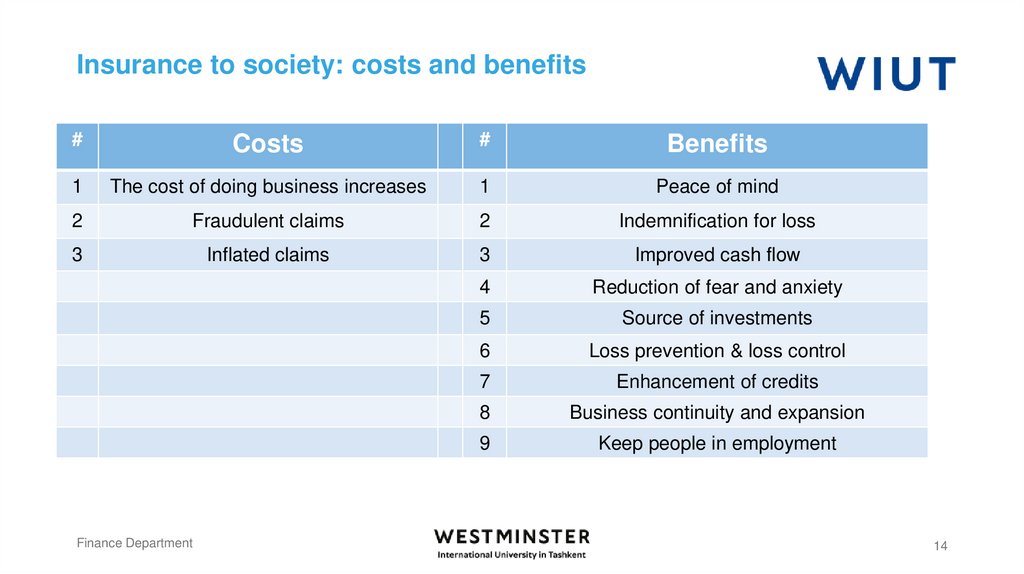
14. Insurance to society: costs and benefits
#Costs
#
Benefits
1
The cost of doing business increases
1
Peace of mind
2
Fraudulent claims
2
Indemnification for loss
3
Inflated claims
3
Improved cash flow
4
Reduction of fear and anxiety
5
Source of investments
6
Loss prevention & loss control
7
Enhancement of credits
8
Business continuity and expansion
9
Keep people in employment
Finance Department
14
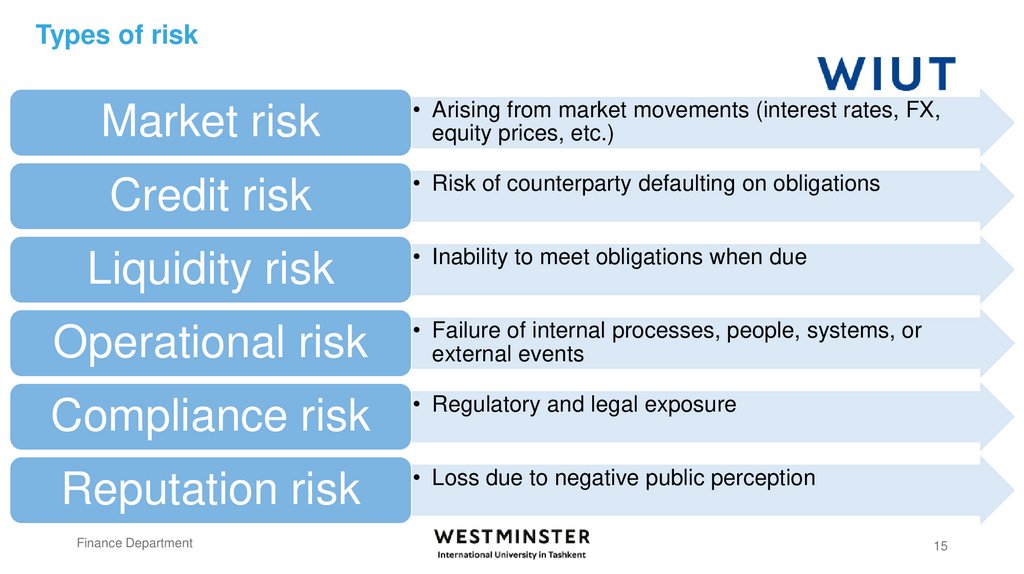
15. Types of risk
Market risk• Arising from market movements (interest rates, FX,
equity prices, etc.)
Credit risk
• Risk of counterparty defaulting on obligations
Liquidity risk
• Inability to meet obligations when due
Operational risk
• Failure of internal processes, people, systems, or
external events
Compliance risk
• Regulatory and legal exposure
Reputation risk
• Loss due to negative public perception
Finance Department
15
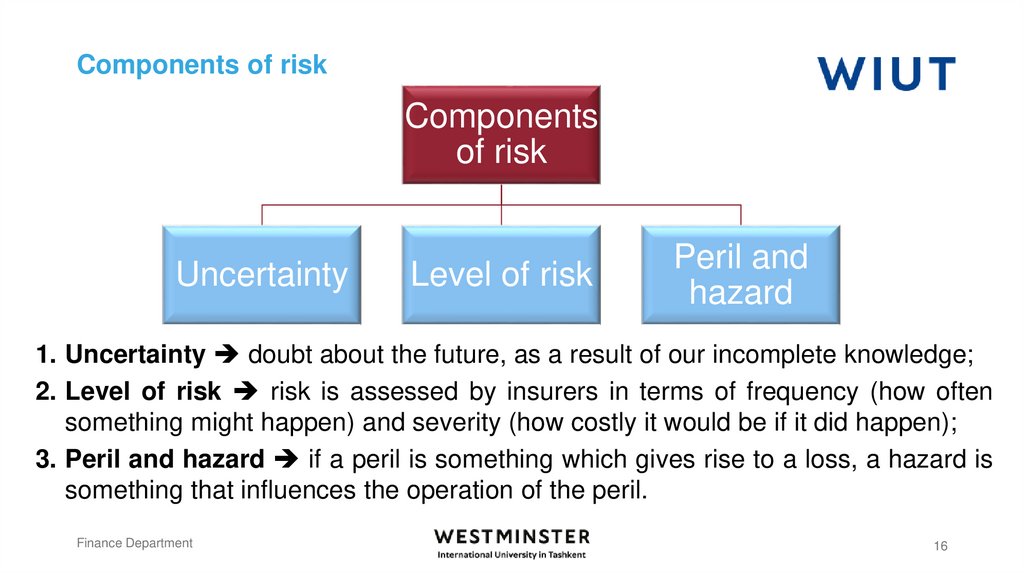
16. Components of risk
Componentsof risk
Uncertainty
Level of risk
Peril and
hazard
1. Uncertainty doubt about the future, as a result of our incomplete knowledge;
2. Level of risk risk is assessed by insurers in terms of frequency (how often
something might happen) and severity (how costly it would be if it did happen);
3. Peril and hazard if a peril is something which gives rise to a loss, a hazard is
something that influences the operation of the peril.
Finance Department
16
17. Risk management
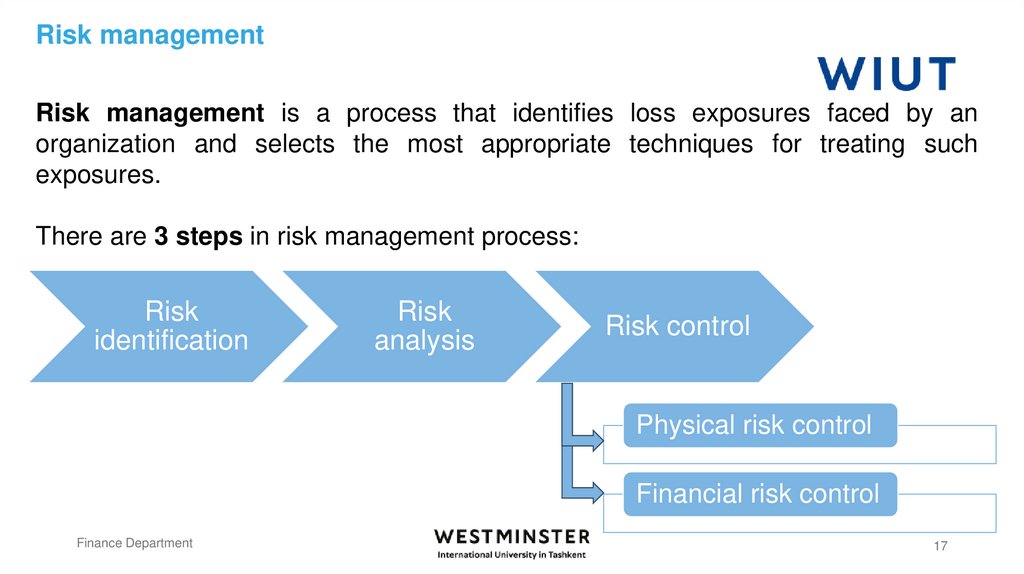
Risk management is a process that identifies loss exposures faced by anorganization and selects the most appropriate techniques for treating such
exposures.
There are 3 steps in risk management process:
Risk
identification
Risk
analysis
Risk control
Physical risk control
Financial risk control
Finance Department
17
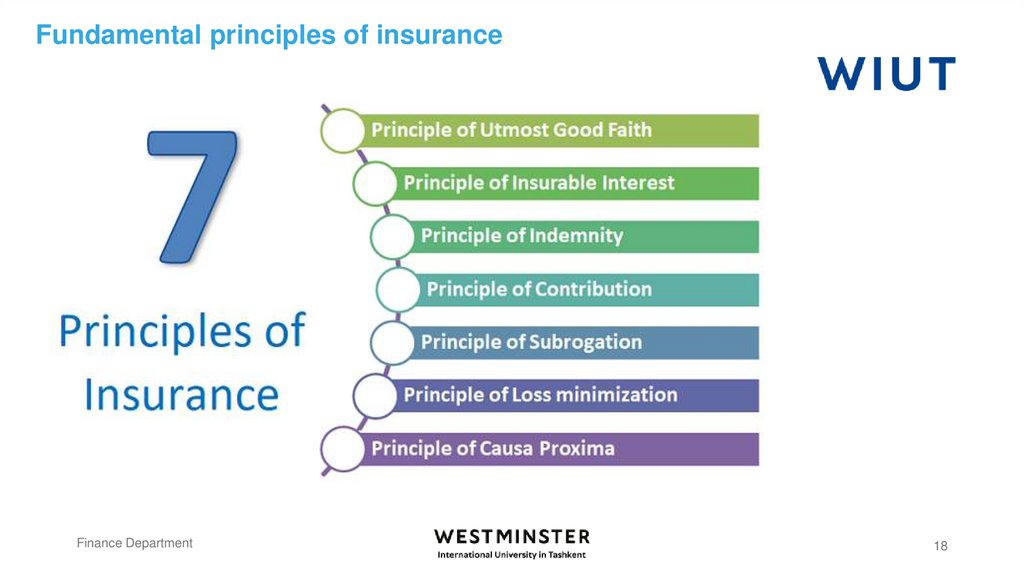
18. Fundamental principles of insurance
Finance Department18
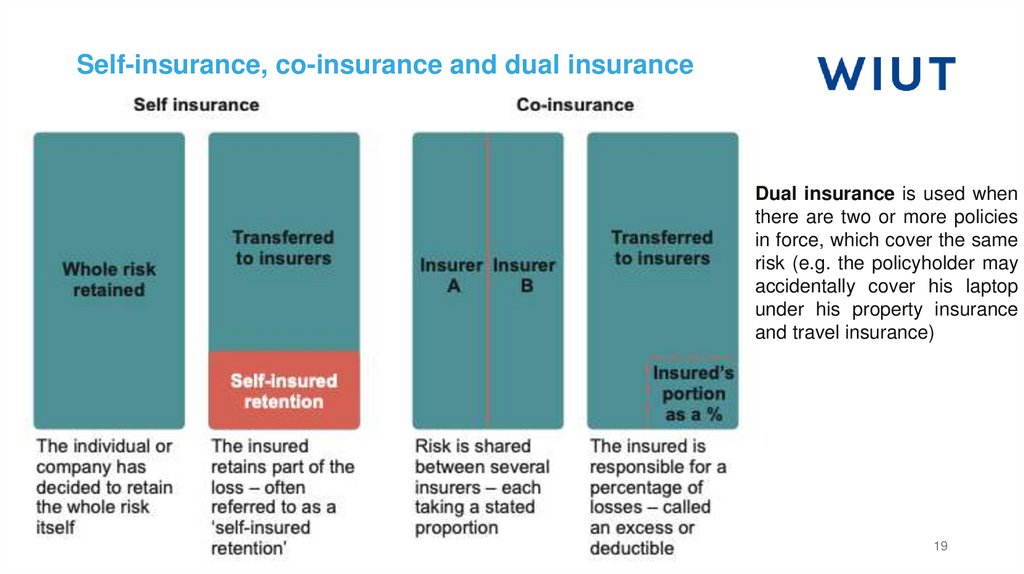
19. Self-insurance, co-insurance and dual insurance
Dual insurance is used whenthere are two or more policies
in force, which cover the same
risk (e.g. the policyholder may
accidentally cover his laptop
under his property insurance
and travel insurance)
Finance Department
19
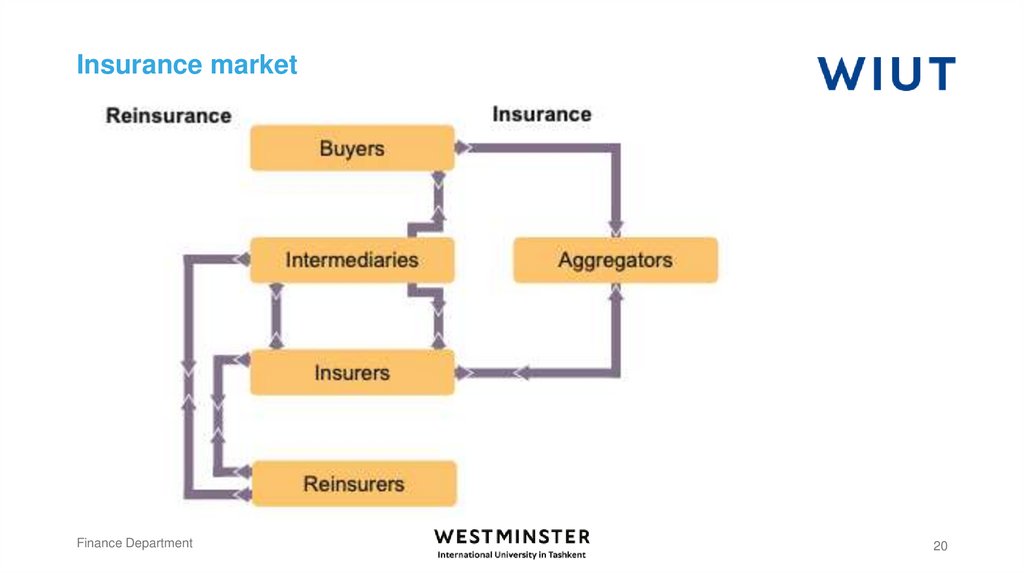
20. Insurance market
Finance Department20
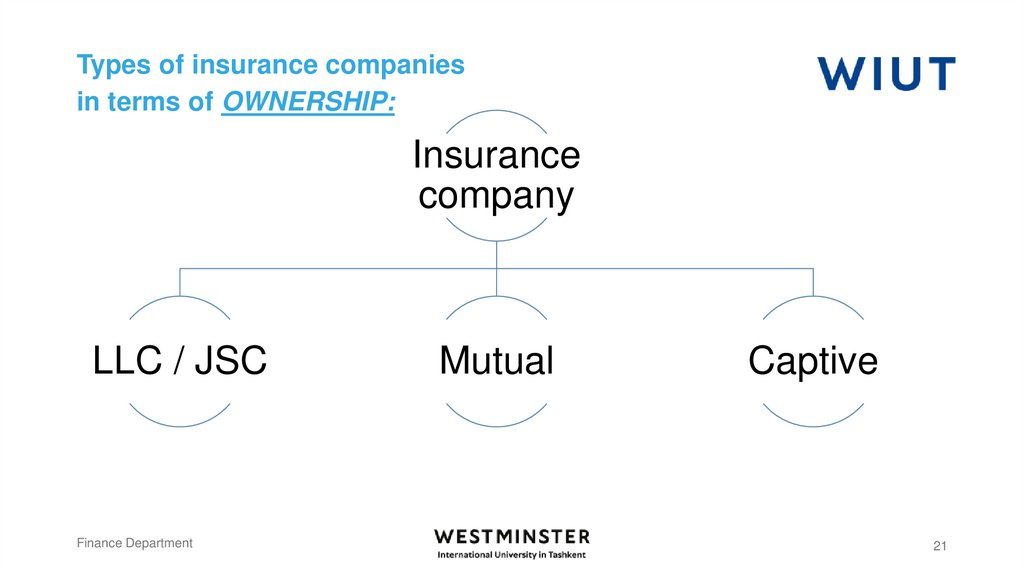
21. Types of insurance companies in terms of OWNERSHIP:
Insurancecompany
LLC / JSC
Finance Department
Mutual
Captive
21
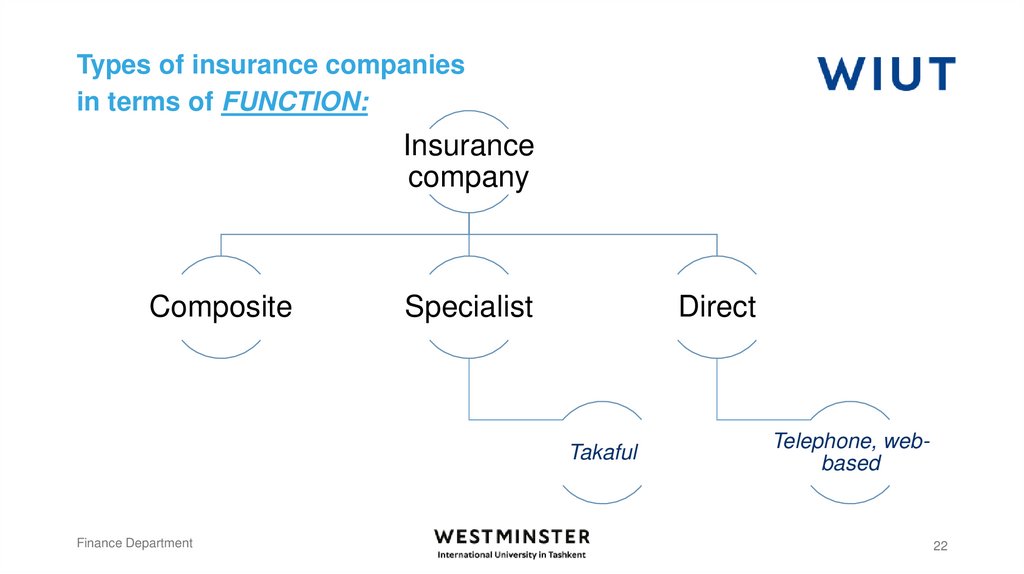
22. Types of insurance companies in terms of FUNCTION:
Insurancecompany
Composite
Specialist
Direct
Takaful
Finance Department
Telephone, webbased
22
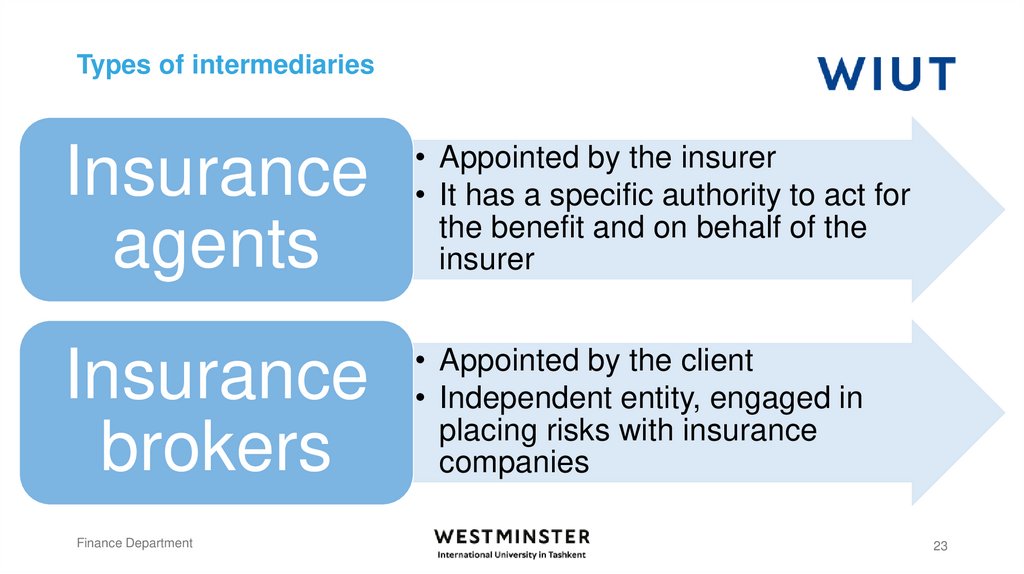
23. Types of intermediaries
Insuranceagents
• Appointed by the insurer
• It has a specific authority to act for
the benefit and on behalf of the
insurer
Insurance
brokers
• Appointed by the client
• Independent entity, engaged in
placing risks with insurance
companies
Finance Department
23
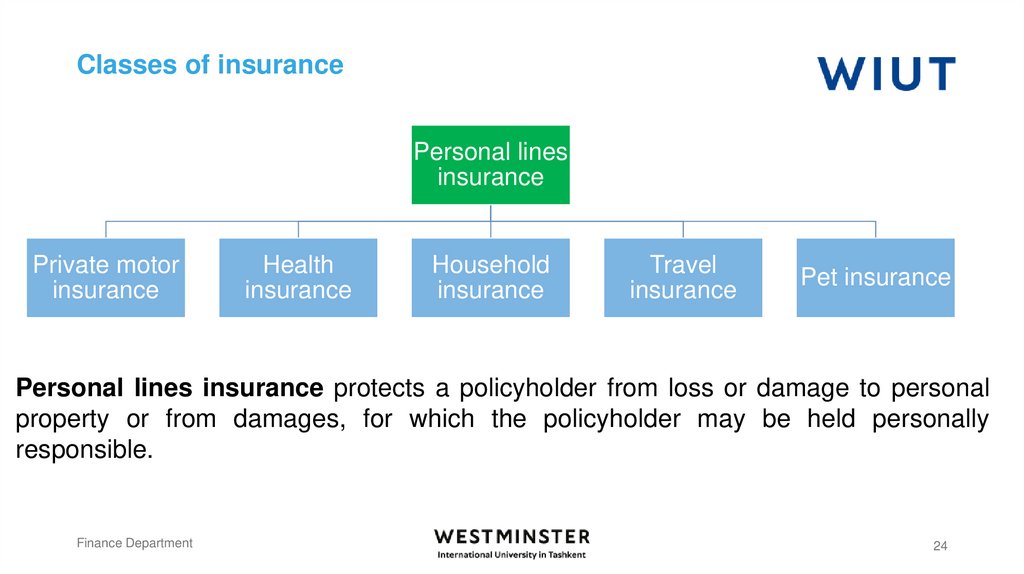
24. Classes of insurance
Personal linesinsurance
Private motor
insurance
Health
insurance
Household
insurance
Travel
insurance
Pet insurance
Personal lines insurance protects a policyholder from loss or damage to personal
property or from damages, for which the policyholder may be held personally
responsible.
Finance Department
24
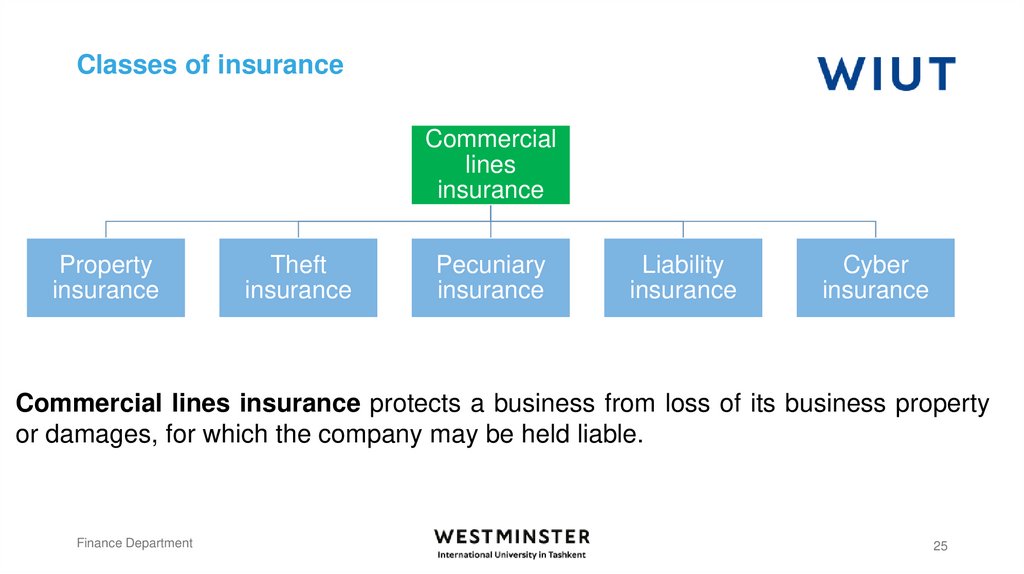
25. Classes of insurance
Commerciallines
insurance
Property
insurance
Theft
insurance
Pecuniary
insurance
Liability
insurance
Cyber
insurance
Commercial lines insurance protects a business from loss of its business property
or damages, for which the company may be held liable.
Finance Department
25
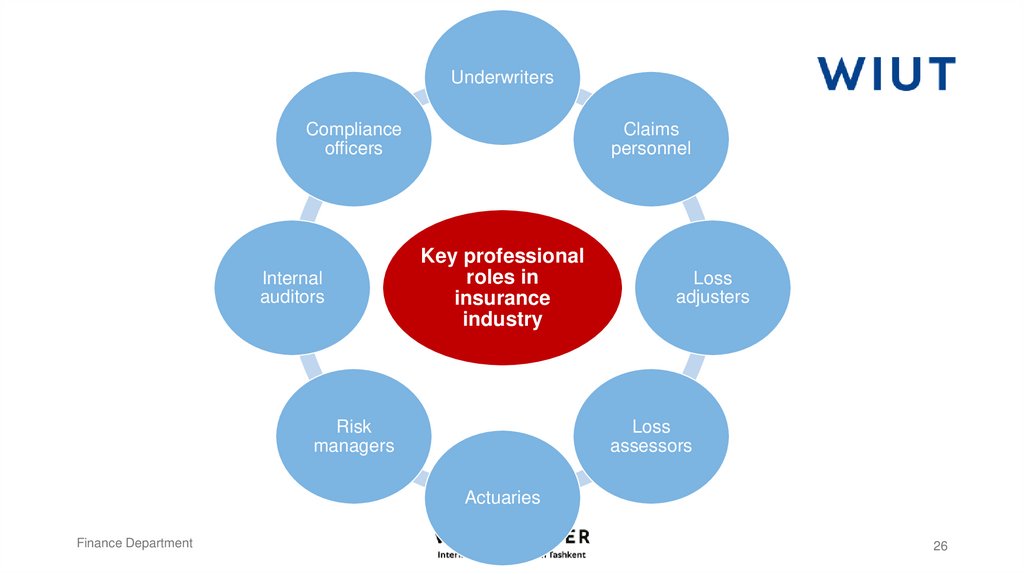
26.
UnderwritersCompliance
officers
Internal
auditors
Claims
personnel
Key professional
roles in
insurance
industry
Risk
managers
Loss
adjusters
Loss
assessors
Actuaries
Finance Department
26
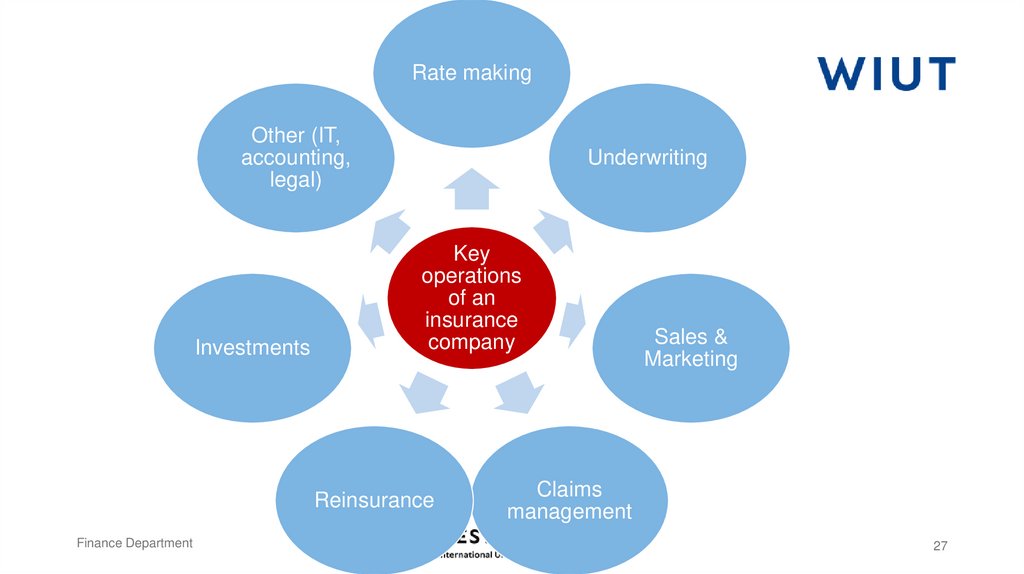
27.
Rate makingOther (IT,
accounting,
legal)
Investments
Underwriting
Key
operations
of an
insurance
company
Reinsurance
Finance Department
Sales &
Marketing
Claims
management
27
28. Thank you
Finance Department28