
 Финансы
Похожие презентации:





Personal insurance policies. Lecture 4
1. Lecture 4 Personal insurance policies
Hasan UmarovFinance Department
2. Lecture 4. Learning Outcomes:
• Describe the basic features and typical policy cover of theLecture 4.
insurance types detailed
Learning Outcomes: • Explain the underwriting approach and considerations for
various classes of insurance
Finance Department
2
3. Personal lines Private motor insurance
A brief history:In 1897 in USA a first auto insurance policy
In 1920-s it became widely spread in many countries. The UK introduced
compulsory TPL insurance in 1930. Auto liability insurance is compulsory in many
countries (it became compulsory in Uzbekistan in 2008).
In most countries, insurance cover is applied to the car (not to a named driver).
There are generally two different levels of cover available as follows:
• third party only
• comprehensive
Finance Department
3
4.
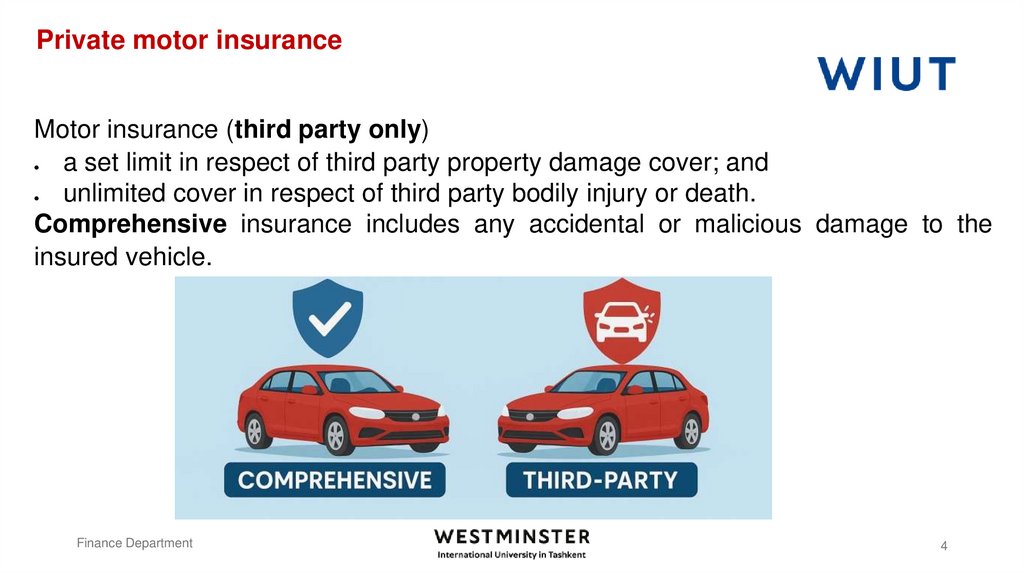
Private motor insuranceMotor insurance (third party only)
a set limit in respect of third party property damage cover; and
unlimited cover in respect of third party bodily injury or death.
Comprehensive insurance includes any accidental or malicious damage to the
insured vehicle.
Finance Department
4
5.
Private motor insurance(Exclusions)
Comprehensive insurance has some exclusions, which include:
wear and tear;
depreciation, i.e. reduction in the value of the vehicle following an accident;
loss of use, i.e. costs for alternative transport while the vehicle is off the road;
mechanical and electrical failure; and
tyre damage from punctures or blow-outs (though any resultant damage would be
covered).
There will be general & market exclusions in addition to the specific exclusions:
contractual liability
war risks
use other than as specified
riot and civil commotion
sonic bangs
Finance Department
5
6.
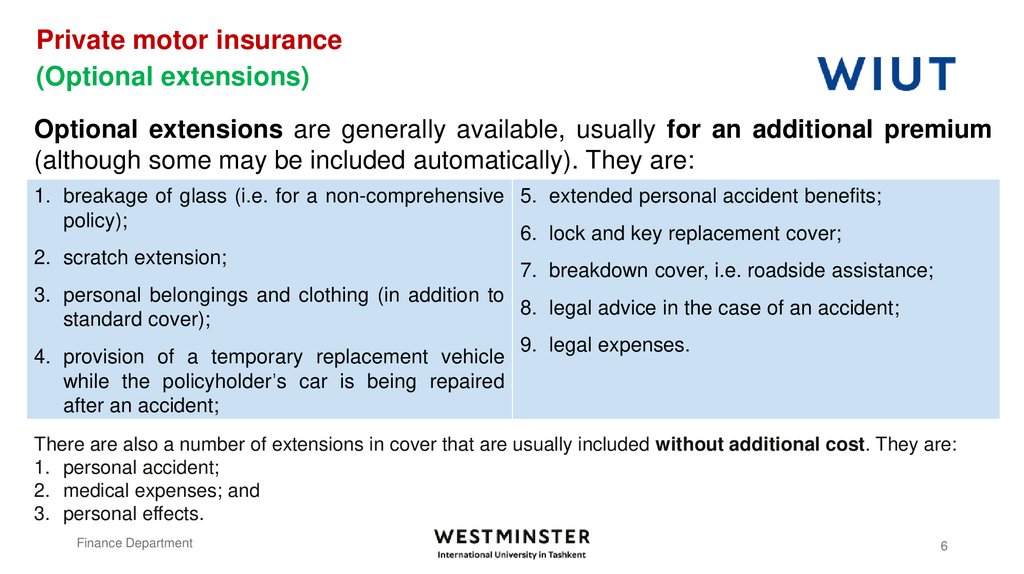
Private motor insurance(Optional extensions)
Optional extensions are generally available, usually for an additional premium
(although some may be included automatically). They are:
1. breakage of glass (i.e. for a non-comprehensive 5. extended personal accident benefits;
policy);
6. lock and key replacement cover;
2. scratch extension;
7. breakdown cover, i.e. roadside assistance;
3. personal belongings and clothing (in addition to
8. legal advice in the case of an accident;
standard cover);
9. legal expenses.
4. provision of a temporary replacement vehicle
while the policyholder’s car is being repaired
after an accident;
There are also a number of extensions in cover that are usually included without additional cost. They are:
1. personal accident;
2. medical expenses; and
3. personal effects.
Finance Department
6
7.
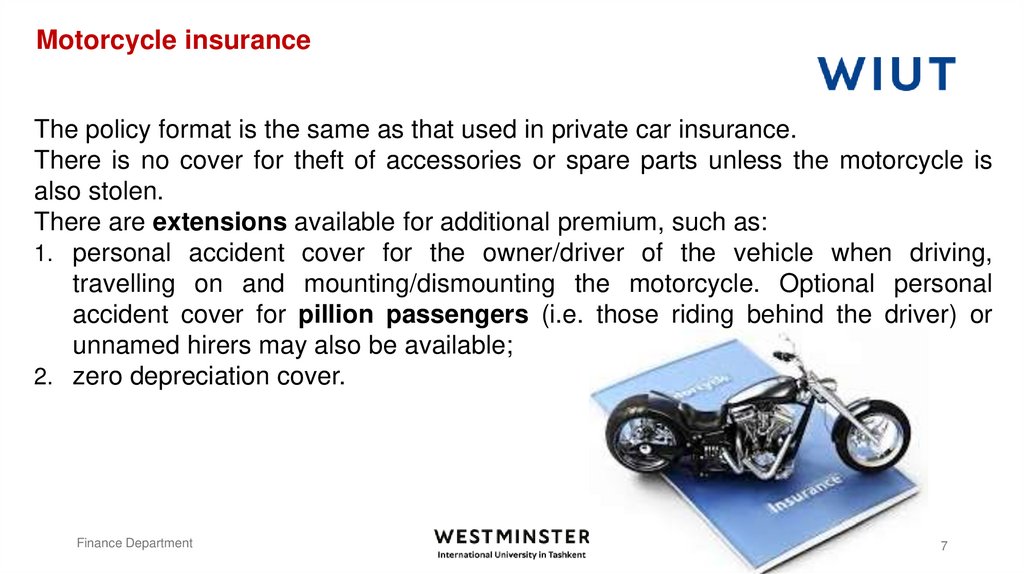
Motorcycle insuranceThe policy format is the same as that used in private car insurance.
There is no cover for theft of accessories or spare parts unless the motorcycle is
also stolen.
There are extensions available for additional premium, such as:
1. personal accident cover for the owner/driver of the vehicle when driving,
travelling on and mounting/dismounting the motorcycle. Optional personal
accident cover for pillion passengers (i.e. those riding behind the driver) or
unnamed hirers may also be available;
2. zero depreciation cover.
Finance Department
7
8. Commercial vehicle insurance
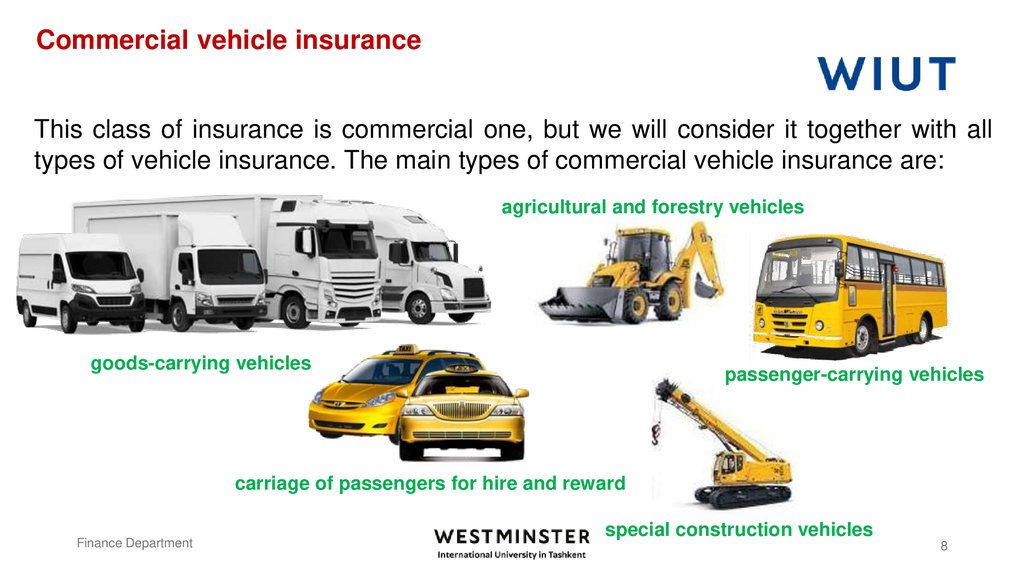
This class of insurance is commercial one, but we will consider it together with alltypes of vehicle insurance. The main types of commercial vehicle insurance are:
agricultural and forestry vehicles
goods-carrying vehicles
passenger-carrying vehicles
carriage of passengers for hire and reward
Finance Department
special construction vehicles
8
9. Commercial vehicle insurance
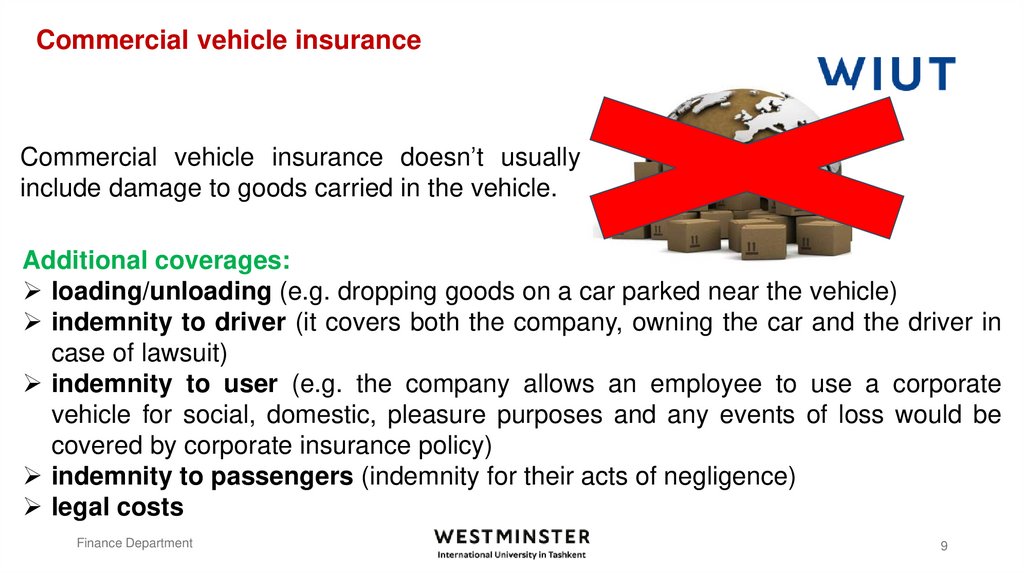
Commercial vehicle insurance doesn’t usuallyinclude damage to goods carried in the vehicle.
Additional coverages:
loading/unloading (e.g. dropping goods on a car parked near the vehicle)
indemnity to driver (it covers both the company, owning the car and the driver in
case of lawsuit)
indemnity to user (e.g. the company allows an employee to use a corporate
vehicle for social, domestic, pleasure purposes and any events of loss would be
covered by corporate insurance policy)
indemnity to passengers (indemnity for their acts of negligence)
legal costs
Finance Department
9
10. Commercial vehicle insurance (Extensions & Exclusions)
Commercial vehicle insurance(Extensions & Exclusions)
There are extensive range of optional extensions for an additional premium (e.g.
medical expenses coverage; windscreen cover, exceeding the limit, fixed in the
policy; loss of use; personal belongings; etc.).
Standard exclusions: outside a specified geographical area; any consequential
losses; losses, arising from nuclear weapons, war, invasion; if the vehicle is being
used for purposes other than those in the policy.
Finance Department
10
11. Commercial vehicle insurance (Fleet insurance)
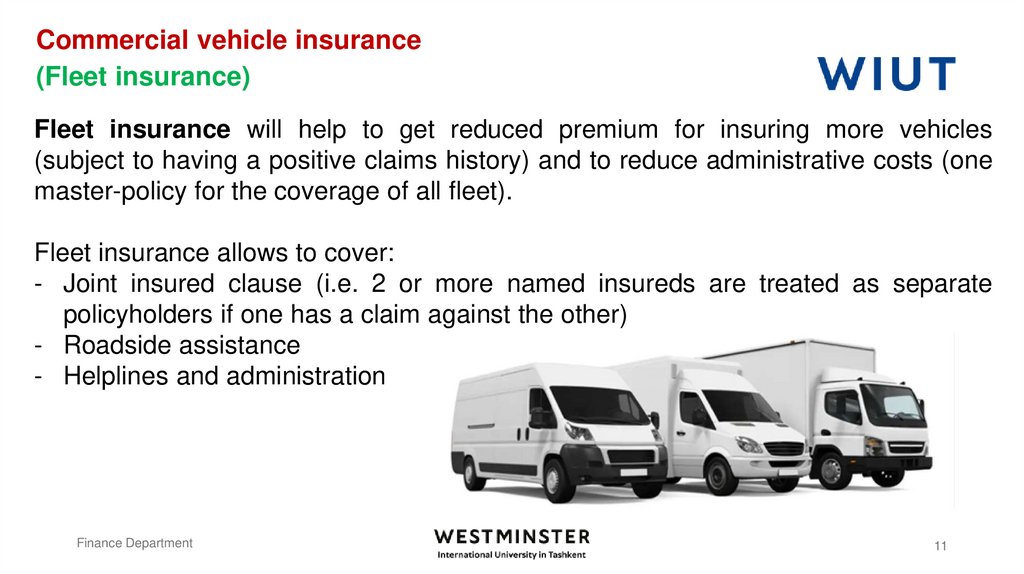
Fleet insurance will help to get reduced premium for insuring more vehicles(subject to having a positive claims history) and to reduce administrative costs (one
master-policy for the coverage of all fleet).
Fleet insurance allows to cover:
- Joint insured clause (i.e. 2 or more named insureds are treated as separate
policyholders if one has a claim against the other)
- Roadside assistance
- Helplines and administration
Finance Department
11
12. Health insurance
Health insurance can be broken down as follows:1. Personal accident which provides payments in the event of accidental death or
bodily injury.
2. Sickness cover which provides payment for disablement due to sickness.
3. Medical expenses which provide cover for individuals who require treatment
when they are ill or injured.
A personal accident and sickness policy is a benefit policy, as opposed to a
policy of indemnity.
An operative time of cover is defined in the policy. For example, terms such as
“during the policyholder’s usual occupation” or “24 hours” or “while travelling in the
insured vehicle”’.
Finance Department
12
13. Health insurance
Personal accident policy covers:Death
Loss of limbs, eyesight, speech, hearing
Permanent total disablement (PTD), occurred within an agreed period (usually
during 52-104 weeks of the accident date)
Permanent partial disablement (PPD). There is pre-set scale of benefits to
calculate lump sum payments (e.g. loss of finger will result in 20% of payment of
of total lump sum payment for death)
Temporary total disablement (TTD). A weekly benefit is payable within certain
period (usually, 52-104 weeks). There is franchise applied to TTD of 7, 14 or 21
days
Finance Department
13
14. Health insurance
Sickness or illness cover is usually offered as an extension to the personalaccident policy and provides weekly benefits for persons unable to perform any part
of their normal job (i.e. TTD).
A franchise almost always applied (usually, 7 days).
There are exclusions (affected by alcohol / suicidal case / childbirth / pre-existing
illness / etc.). The Insured can “buy-back” some exclusions.
Medical expenses insurance covers members of the public, either individually or in
group schemes, against most of the expenses of undergoing in-patient or outpatient treatment in private hospitals.
These policies are often sold as group schemes to businesses as an employment
benefit for staff and their families.
Finance Department
14
15. Household insurance
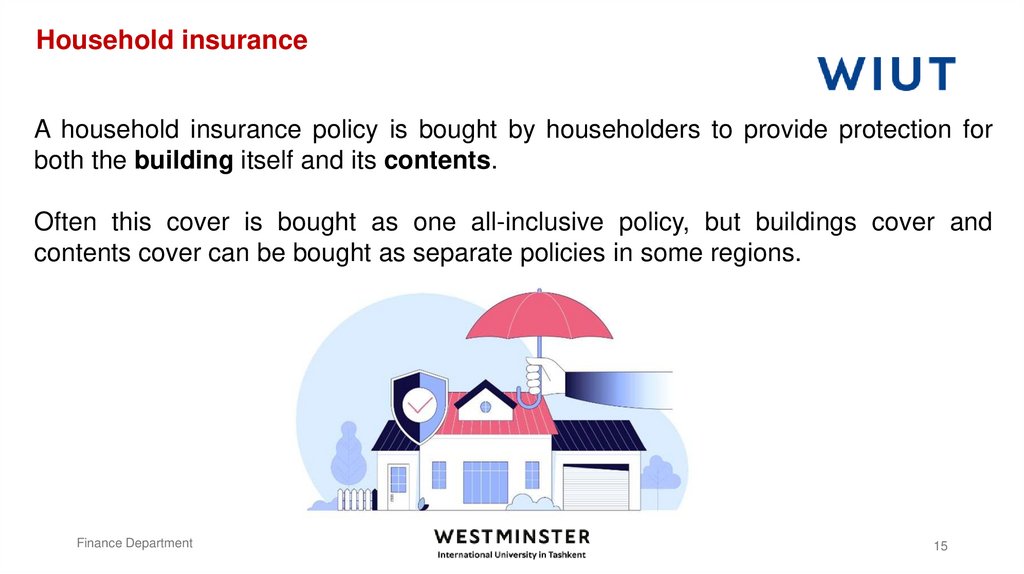
A household insurance policy is bought by householders to provide protection forboth the building itself and its contents.
Often this cover is bought as one all-inclusive policy, but buildings cover and
contents cover can be bought as separate policies in some regions.
Finance Department
15
16. Household insurance (Buildings insurance)
Buildings insurance covers the main structure (incl. garages, swimming pools,etc.) and the stuff, not removable (like air conditioning, fitted furniture, etc.)
The cover generally available is as follows:
Fire, lightning, explosion and earthquake
Riot, civil commotion, strikes, etc.
Storm, cyclone, typhoon, tempest, hurricane, etc.
Escape of water (only in case the house isn’t occupied for more than 30 or
60 days
Theft
Accidental breakage of glass and sanitary fixtures
Legal fees
Debris removal
Loss of rent
Finance Department
16
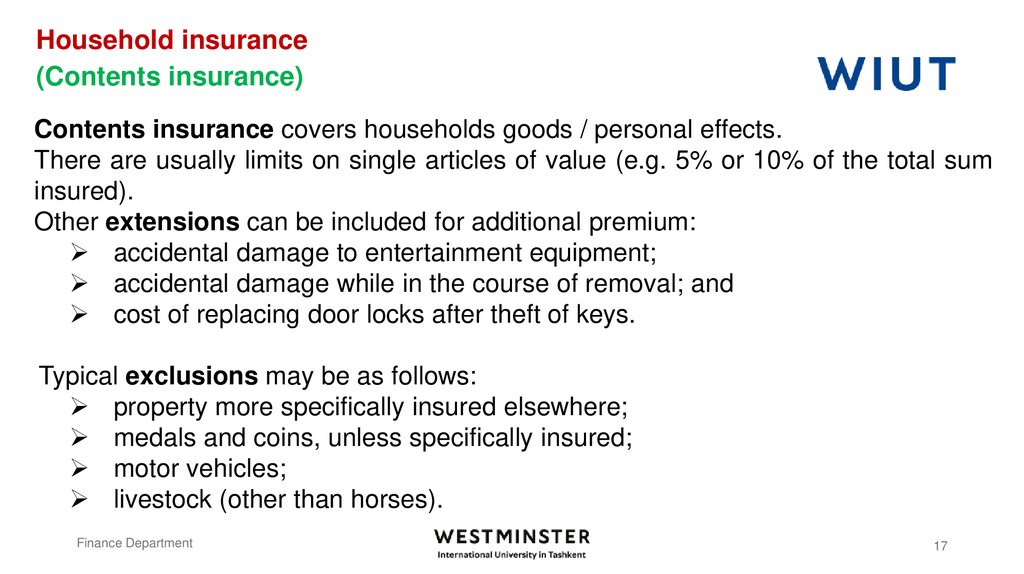
17. Household insurance (Contents insurance)
Contents insurance covers households goods / personal effects.There are usually limits on single articles of value (e.g. 5% or 10% of the total sum
insured).
Other extensions can be included for additional premium:
accidental damage to entertainment equipment;
accidental damage while in the course of removal; and
cost of replacing door locks after theft of keys.
Typical exclusions may be as follows:
property more specifically insured elsewhere;
medals and coins, unless specifically insured;
motor vehicles;
livestock (other than horses).
Finance Department
17
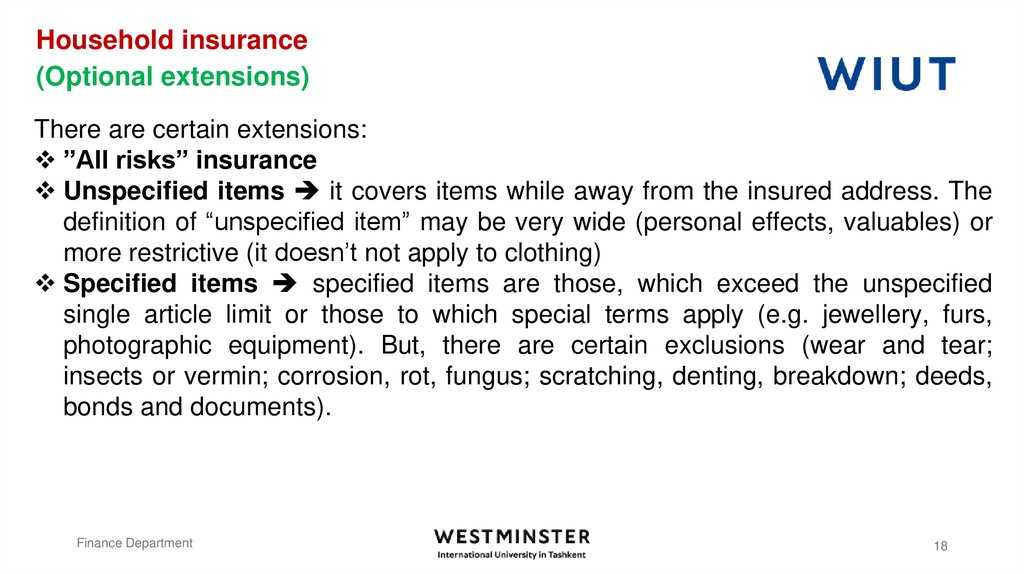
18. Household insurance (Optional extensions)
There are certain extensions:”All risks” insurance
Unspecified items it covers items while away from the insured address. The
definition of “unspecified item” may be very wide (personal effects, valuables) or
more restrictive (it doesn’t not apply to clothing)
Specified items specified items are those, which exceed the unspecified
single article limit or those to which special terms apply (e.g. jewellery, furs,
photographic equipment). But, there are certain exclusions (wear and tear;
insects or vermin; corrosion, rot, fungus; scratching, denting, breakdown; deeds,
bonds and documents).
Finance Department
18
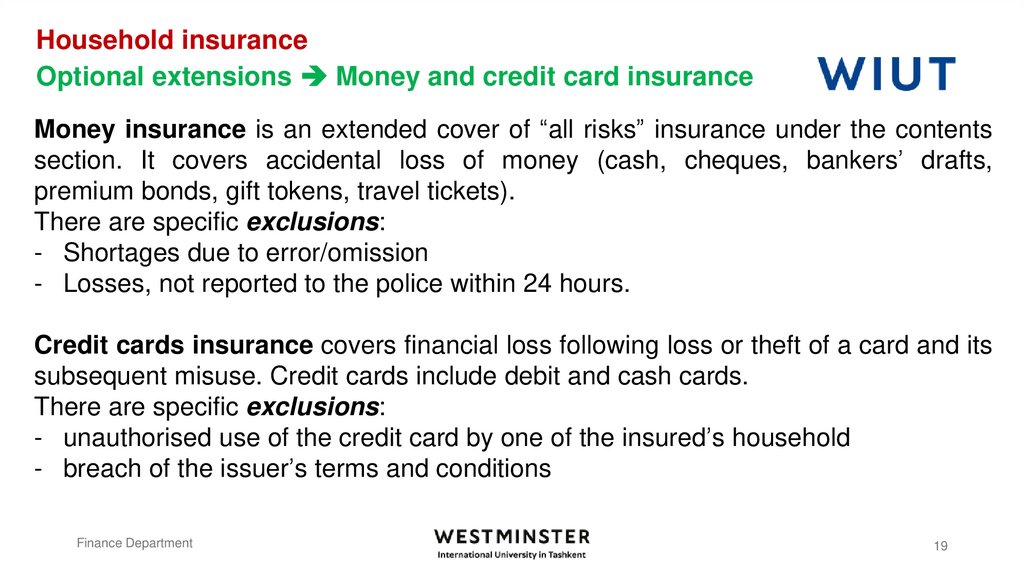
19. Household insurance Optional extensions Money and credit card insurance
Household insuranceOptional extensions Money and credit card insurance
Money insurance is an extended cover of “all risks” insurance under the contents
section. It covers accidental loss of money (cash, cheques, bankers’ drafts,
premium bonds, gift tokens, travel tickets).
There are specific exclusions:
- Shortages due to error/omission
- Losses, not reported to the police within 24 hours.
Credit cards insurance covers financial loss following loss or theft of a card and its
subsequent misuse. Credit cards include debit and cash cards.
There are specific exclusions:
- unauthorised use of the credit card by one of the insured’s household
- breach of the issuer’s terms and conditions
Finance Department
19
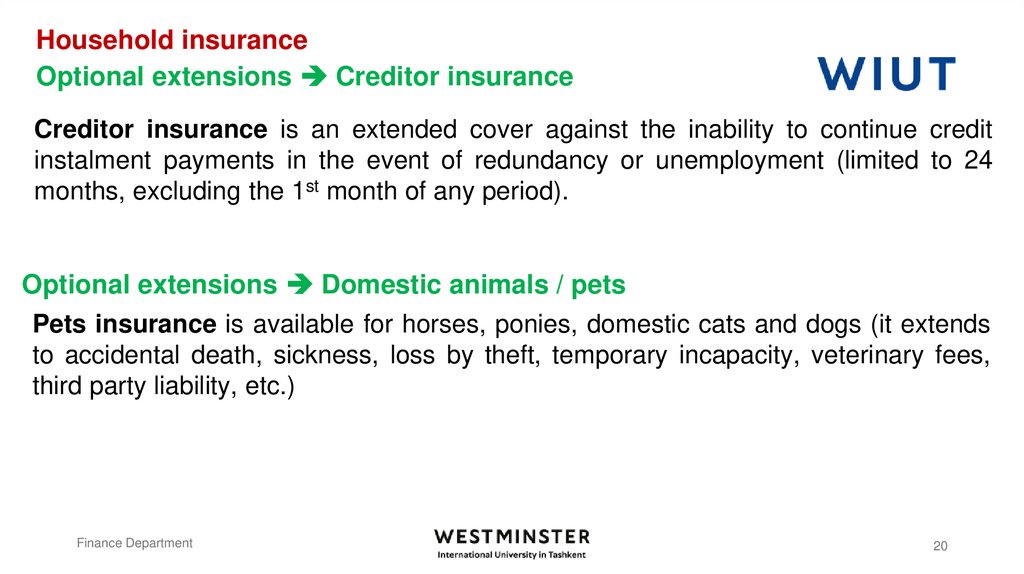
20. Household insurance Optional extensions Creditor insurance
Household insuranceOptional extensions Creditor insurance
Creditor insurance is an extended cover against the inability to continue credit
instalment payments in the event of redundancy or unemployment (limited to 24
months, excluding the 1st month of any period).
Optional extensions Domestic animals / pets
Pets insurance is available for horses, ponies, domestic cats and dogs (it extends
to accidental death, sickness, loss by theft, temporary incapacity, veterinary fees,
third party liability, etc.)
Finance Department
20
21. Household insurance Optional extensions Legal expenses
Household insuranceOptional extensions Legal expenses
The legal expenses extension provides cover for the following:
Recovery costs: for legal action taken to enforce the legal rights of the insured
against third parties.
Civil defence costs: for the defence of certain types of civil claims not covered
by other forms of insurance.
Prosecution defence costs: for the defence of certain criminal charges which
may arise from unintentional acts of the insured.
Employment dispute costs.
Specific exclusions: claims relating to events occurring outside the specified
territorial/geographical limits; appeals; costs and expenses not agreed by the
insurer; claims arising out of the insured’s business, deliberate or criminal act or
omission, libel and slander, divorce or matrimonial matters.
Finance Department
21
22. Travel insurance
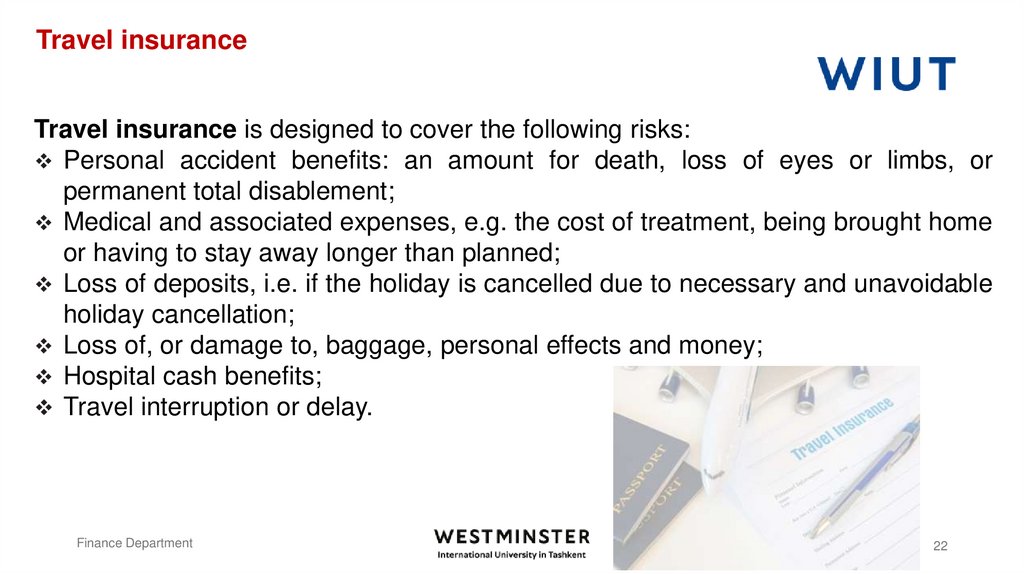
Travel insurance is designed to cover the following risks:Personal accident benefits: an amount for death, loss of eyes or limbs, or
permanent total disablement;
Medical and associated expenses, e.g. the cost of treatment, being brought home
or having to stay away longer than planned;
Loss of deposits, i.e. if the holiday is cancelled due to necessary and unavoidable
holiday cancellation;
Loss of, or damage to, baggage, personal effects and money;
Hospital cash benefits;
Travel interruption or delay.
Finance Department
22
23. Travel insurance
There are some optional extensions available:lack of services or amenities at the hotel because of industrial action;
loss of passport;
hijacking;
legal expenses.
There are certain exclusions:
childbirth
confiscated luggage
Suicide
physical or mental disability
damage to fragile objects.
Finance Department
23
24. Extended warranties
Extended warranty policy is used to extend warranty period for differentpurchases (car, TV set, electrical goods, etc.).
These policies issued by insurers and some large authorized retailers.
There is usually a condition that the repairs must be carried out by the supplier.
There are certain exclusions:
negligent handling and/or failure to comply with manufacturers’ instructions;
risks normally covered by a household contents policy;
war;
the cost of repairs to items such as bulbs, aerials, external wires, knobs,
handles and driving belts.
Finance Department
24
25. Thank you
Finance Department25