 Педагогика
Похожие презентации:









Listening (part 4)
1.
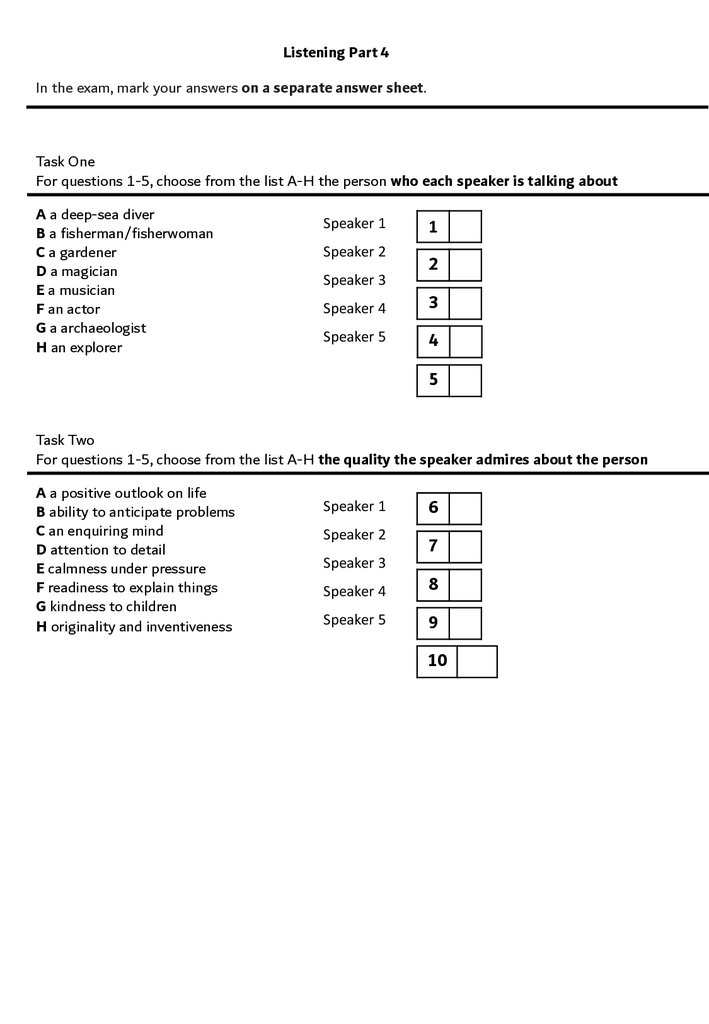
Listening Part 4In the exam, mark your answers on a separate answer sheet.
Task One
For questions 1-5, choose from the list A-H the person who each speaker is talking about
A a deep-sea diver
B a fisherman/fisherwoman
C a gardener
D a magician
E a musician
F an actor
G a archaeologist
H an explorer
Speaker 1
1
Speaker 2
2
Speaker 3
Speaker 4
3
Speaker 5
4
5
Task Two
For questions 1-5, choose from the list A-H the quality the speaker admires about the person
A a positive outlook on life
B ability to anticipate problems
C an enquiring mind
D attention to detail
E calmness under pressure
F readiness to explain things
G kindness to children
H originality and inventiveness
Speaker 1
6
Speaker 2
7
Speaker 3
Speaker 4
8
Speaker 5
9
10
2.
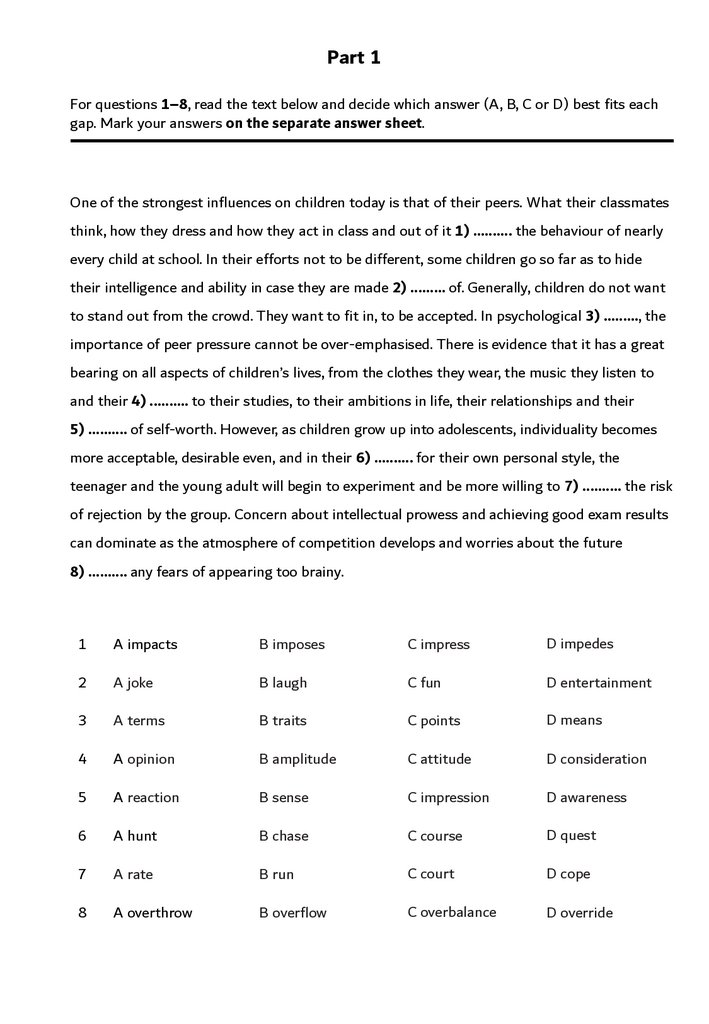
Part 1For questions 1–8, read the text below and decide which answer (A, B, C or D) best fits each
gap. Mark your answers on the separate answer sheet.
One of the strongest influences on children today is that of their peers. What their classmates
think, how they dress and how they act in class and out of it 1) .......... the behaviour of nearly
every child at school. In their efforts not to be different, some children go so far as to hide
their intelligence and ability in case they are made 2) ......... of. Generally, children do not want
to stand out from the crowd. They want to fit in, to be accepted. In psychological 3) ........., the
importance of peer pressure cannot be over-emphasised. There is evidence that it has a great
bearing on all aspects of children’s lives, from the clothes they wear, the music they listen to
and their 4) .......... to their studies, to their ambitions in life, their relationships and their
5) .......... of self-worth. However, as children grow up into adolescents, individuality becomes
more acceptable, desirable even, and in their 6) .......... for their own personal style, the
teenager and the young adult will begin to experiment and be more willing to 7) .......... the risk
of rejection by the group. Concern about intellectual prowess and achieving good exam results
can dominate as the atmosphere of competition develops and worries about the future
8) .......... any fears of appearing too brainy.
1
A impacts
B imposes
C impress
D impedes
2
A joke
B laugh
C fun
D entertainment
3
A terms
B traits
C points
D means
4
A opinion
B amplitude
C attitude
D consideration
5
A reaction
B sense
C impression
D awareness
6
A hunt
B chase
C course
D quest
7
A rate
B run
C court
D cope
8
A overthrow
B overflow
C overbalance
D override
3.
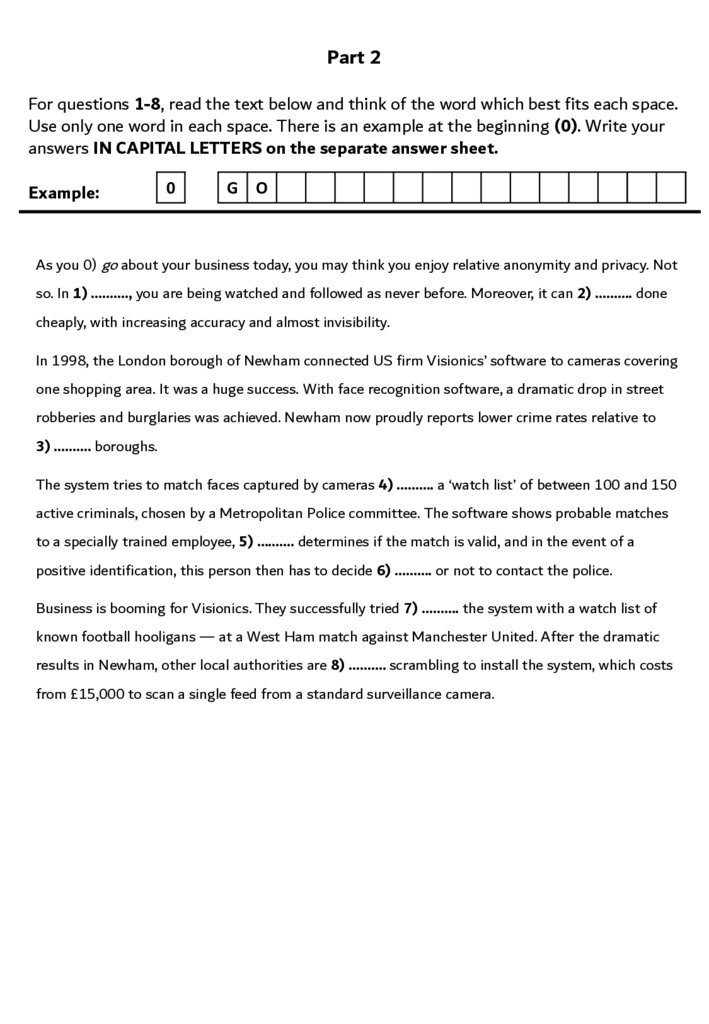
Part 2For questions 1-8, read the text below and think of the word which best fits each space.
Use only one word in each space. There is an example at the beginning (0). Write your
answers IN CAPITAL LETTERS on the separate answer sheet.
Example:
0
G O
As you 0) go about your business today, you may think you enjoy relative anonymity and privacy. Not
so. In 1) ………., you are being watched and followed as never before. Moreover, it can 2) ………. done
cheaply, with increasing accuracy and almost invisibility.
In 1998, the London borough of Newham connected US firm Visionics’ software to cameras covering
one shopping area. It was a huge success. With face recognition software, a dramatic drop in street
robberies and burglaries was achieved. Newham now proudly reports lower crime rates relative to
3) ………. boroughs.
The system tries to match faces captured by cameras 4) ………. a ‘watch list’ of between 100 and 150
active criminals, chosen by a Metropolitan Police committee. The software shows probable matches
to a specially trained employee, 5) ………. determines if the match is valid, and in the event of a
positive identification, this person then has to decide 6) ………. or not to contact the police.
Business is booming for Visionics. They successfully tried 7) ………. the system with a watch list of
known football hooligans — at a West Ham match against Manchester United. After the dramatic
results in Newham, other local authorities are 8) ………. scrambling to install the system, which costs
from £15,000 to scan a single feed from a standard surveillance camera.
4.
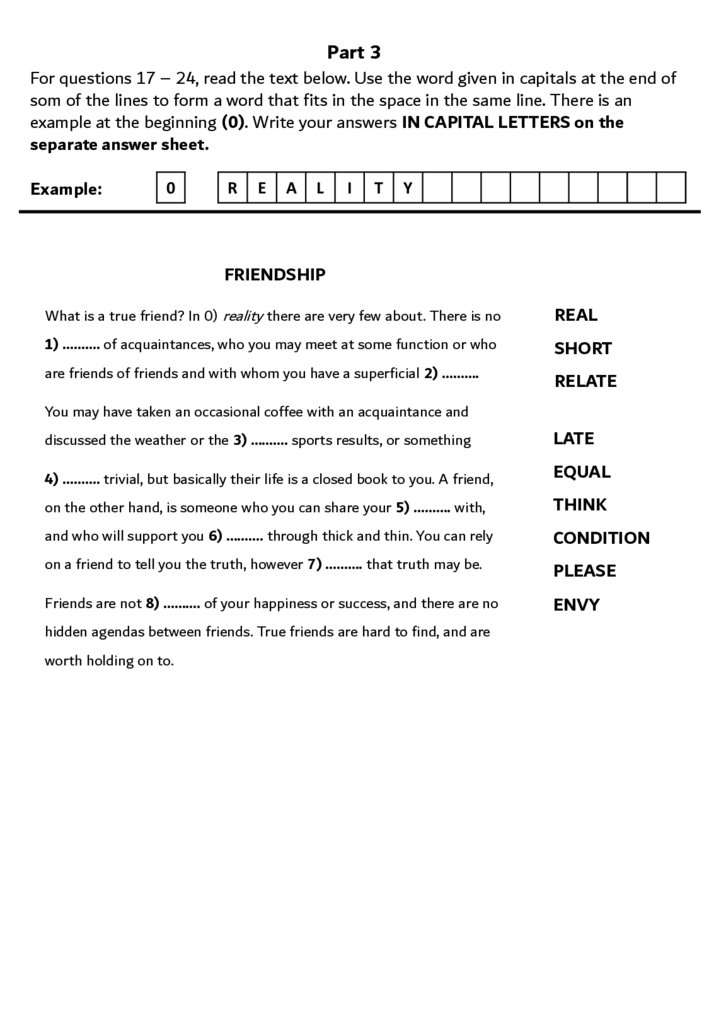
Part 3For questions 17 – 24, read the text below. Use the word given in capitals at the end of
som of the lines to form a word that fits in the space in the same line. There is an
example at the beginning (0). Write your answers IN CAPITAL LETTERS on the
separate answer sheet.
Example:
0
R
E
A
L
I
T
Y
FRIENDSHIP
What is a true friend? In 0) reality there are very few about. There is no
REAL
1) ………. of acquaintances, who you may meet at some function or who
SHORT
are friends of friends and with whom you have a superficial 2) ……….
RELATE
You may have taken an occasional coffee with an acquaintance and
discussed the weather or the 3) ………. sports results, or something
LATE
4) ………. trivial, but basically their life is a closed book to you. A friend,
EQUAL
on the other hand, is someone who you can share your 5) ………. with,
THINK
and who will support you 6) ………. through thick and thin. You can rely
CONDITION
on a friend to tell you the truth, however 7) ………. that truth may be.
PLEASE
Friends are not 8) ………. of your happiness or success, and there are no
ENVY
hidden agendas between friends. True friends are hard to find, and are
worth holding on to.
5.
Part 4For questions 1-8, complete the second sentence so that it has a similar meaning to the first
sentence, using the word given. Do not change the word given. You must use
between three and six words, including the word given. Here is an example (0).
Example:
Do you mind if I watch you while you paint?
OBJECTION
Do you ……………………………………………... you while you paint?
0
have any objection to my watching
1. Please don’t mention this to anyone.
GRATEFUL
I would ………………………………….. mention this to anyone.
2. I tried to reach her by the phone several times.
MADE
I ………………………………….. reach her by phone.
3. John’s attempt to win the marathon did not succeed.
UNSUCCESSFUL
John ………………………………….. to win the marathon.
4. This recipe combines sweet and sour flavours.
COMBINATION
This recipe ………………………………….. sweet and sour flavours.
5. She revived when we splashed cold water on her face
ROUND
We ………………………………….. splashing cold water on her face.
6. It’s possible that he misunderstood what you told him.
UNDERSTOOD
He ………………………………….. what you told him.
6.
Part 5For questions 1-6 choose the best answer A, B, C or D which you think fits best according to the
text. In the exam, mark your answers on a separate answer sheet.
1. According to the writer, an important factor in success at university is
A. the ability to understand markets
B. acquaintance with lecturers and markets
C. clever use of other people’s ideas
D. an understanding of what is required
2. In the third paragraph, the writer warns against
A. trying to guess lecturers’ opinions
B. expecting to be rewarded
C. using ideas of other students
D. offering money to academic staff
3. In his relationship with his lecturers, the writer tried to
A. mislead them about how much research he had done
B. do his work in a style which matched their expectations
C. always have sone new ideas to impress them with
D. never upset them by submitting ground-breaking work
4. How did the writer cope with long lists of required reading?
A. He ignored them.
B. He wrote his own.
C. He was selective.
D. He summarised them.
5. Why did the writer not practice writing exam questions?
A. He was advised not to.
B. He though the practice was rather boring.
C. He wanted to approach his exams with a fresh perspective.
D. He thought it might prejudice staff against him.
6. The writer suggests that to get a First
A. you must follow his advice.
B. you need to enjoy your student life.
C. you should spend long hours in the library.
D. each individual need to approach things their own way.
7.
How I Got my First-Class Degree“Don't spend too much time at the student lounge, do tum up for most lectures at tutorials and do submit all
coursework – eventually.” That, I was told by a student during freshers’ week, was all I needed to do to get a
2:2. For a 2:1, require a better attendance record and have to work harder, but not at the expense being cut
off from civilisation. And for a First, I would have to become some sort of social outcast, go to every lecture
and tutorial (scribbling notes madly), spend every waking moment immersed in academic books, and be
among the last to be thrown out of the university library at 10pm closing time.
Well, I did not give up my life for study. I didn't attend every lecture and tutorial. I didn't write down every
word spoken in lectures. I didn't get 80% or more in every essay, project, test or exam. I was usually behind
with my reading and occasionally mystified by the syllabus. Sometimes I couldn't be bothered to go to
university and stayed at home instead. But I always knew where I was, what I had to do, and what not to
bother with. And I always worked hard on the things that counted: assignments and exams.
Getting a degree is about learning, but it isn’t just about learning biology, history, English or whatever. It's
about understanding what you need to succeed — what, in fact, the university wants from you and what you
will get in return. You have to have a feel for the education market and really sell your inspirations. What does
the lecturer want? What is the essay marker searching for? Some students try to offer something not
wanted. Others want to give very little — they steal the thoughts of others and submit them as their own.
But they all want to be rewarded. Exchange, but don't steal, and you'll get a degree.
I saw lecturers as customers who fell into two broad categories. There were those for I whom lecturing was
an unwelcome interruption to their research work. After all, we were students and what did we know? I would
deliberately pitch my essays to this kind of academic so that my opinions appeared more as evidence that I
had read and understood the key contributions to the debate, rather than as an attempt to pull down
monuments. The other type of academic were those who enjoyed teaching and discussing new ideas. They
wanted more. They wanted something different, inspirational, iconoclastic. I would present my arguments to
show that I had done my reading and understood the key concepts, but I would also try to add something
more to the issue rather than rake over familiar ground. Essentially, it was a case of working out what was
wanted and then delivering it, I can't state exactly how successful this tactic was, except to say that I sold
more essays than I had returned as faulty.
I could guarantee every book on my reading list was out on long loan from the university library within five
seconds of the list being issued. This was worrying at first, but I quickly learned that it was impossible to read
all of the books on an average reading list anyway. I sought shortcuts. Collections of selected readings or
journal articles were excellent sources that often saved me the bother of reading the original texts.
References in books dragged me all over the place but, with all the courses I had to do, there wasn't enough
time to be dragged too far. I would flick through the book, read the introduction, note any summaries, look at
diagrams, skim the index, and read any conclusions. I plucked out what was needed and made my escape.
I revised by discarding subject areas I could not face revising; reading; compiling notes; and then condensing
them onto one or two sheets of A4 for each subject area. Leading up to the exam, I would concentrate on just
the condensed notes and rely on my memory to drag out the detail behind them when the time came. I didn't
practice writing exam questions, although it was recommended. I prefer to be spontaneous and open-minded.
I didn't want pre-formed conclusions filling my mind.
And nor should you: there is no secret to getting a First - this is just an account of how I got my First. Be a
happy student by striking the right balance between working and enjoying yourself. Take what you do
seriously and do your best. And, no matter what you do, don’t forget to appreciate every day of your
university studies: it is one of the greatest periods of your life.