 Педагогика
Похожие презентации:





Summative assessment process
1. SUMMATIVE ASSESSMENT PROCESS
Types of tests2.
• Summative Assessment (SA) is given to the students after he or she haspassed all the formative assessments. The effectiveness of teaching and
instruction is evaluated on the basis of student‘s performance. SA comes at
the end of course. SA is done at the end of instruction to measure at what
extend the students have attained their achievement.
• SA is concerned with the learning outcomes in the teaching-learning
process. The results are statistically analyzed and interpreted. SA involves
the final tests or the annual examinations that declare a student‘s
promotion to the next higher class or detention in the same class. A
summative evaluator gathers information and judges the merit of overall
instructional sequence to retain or adapt that sequence. Teachers adopt
the role students assume the roles to make final decisions about
instructional activities. The formative and summative assessments are
complimentary to each other in teaching-learning.
3.
• Characteristics of Summative AssessmentIt is descriptive analysis.
This focus mainly on analysis.
It tends to stress the effects.
It also provides the appropriateness of course and effect of instruction.
4. DIFFERENCE BETWEEN FORMATIVE AND SUMMATIVE ASSESSMENT
• The instructional programme in formative assessment is still following but insummative assessment is not following in most of cases.
• The formative assessment is to develop not for judgments in nature as the
summative assessment judges the merit of instructional sequences.
• Formative assessment is the assessment made during the instructional phase
about progress in learning but the summative assessment is the terminal
assessment of performance at the end of instruction.
• Formative assessment the scores of individual pattern of pass-fail whereas in
summative assessment report is given in terms of total scores.
• Formative assessment content focus is detailed and it is narrow and in
summative assessment content is general and broad.
• In formative assessment process is given in daily assignments in observation
method but in summative assessment process in projects and test.
5.
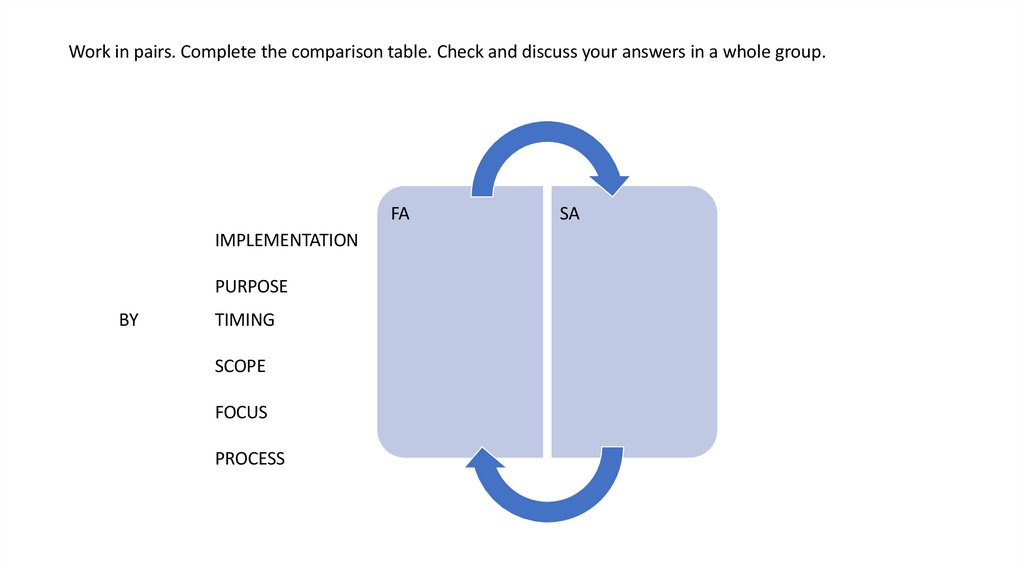
Work in pairs. Complete the comparison table. Check and discuss your answers in a whole group.FA
IMPLEMENTATION
PURPOSE
BY
TIMING
SCOPE
FOCUS
PROCESS
SA
6. TESTS
• The test is to measure the ability, knowledge or performance developed during thecourse of learning. Here two types of test are given to assess the knowledge of students
they are Teacher Made Tests and Standardized Tests.
Teacher Made Tests
• These tests are designed by the teachers for the purpose of conducting classroom tests.
These teacher made tests can be in the form of oral tests and written tests. These tests
have a limited area of application and are prepared almost by all teachers according to
their requirements.
• A teacher is more concerned with the teacher – made tests as she is directly involved in
its construction. Moreover, the teacher made tests have an advantage over standardized
tests because they can be constructed to measure outcomes directly related to
classroom specific objectives and particular class situations. These tests are within the
means of every teacher and most economical. Teacher made oral tests are designed to
measure the performance of students skills like listening and speaking in language
learning. Written tests are designed to test the abilities of student‘s knowledge
comprehension and written expression.
7.
Standardized Tests• A Standardized test is one which norms have been established. The test has been given to a large
number of students. A norm is an average score which measures achievement. So, every
standardized test has norms. It is intended for general use and covers a wider scope of material
than is covered in an ordinary teacher made test. A standardized test is one in which the
procedure, apparatus and scoring have fixed so that precisely the same test can be given at
different time and places. A standardized test is one which has been given to so many people that
the test makers have been able to determine fairly accurately how well a typical person of a
particular age or grade in school will succeed in it.
Role of Standardized Test
• Information becomes easier to convince the guardians of students
• Information in much less time than provided by other devices.
Information for all guidance workers.
Aspects of the behaviour which otherwise could not be obtained.
• Objectives and impartial informative about an individual.
What are the main differences between teacher-made tests and standardized tests in terms of purpose, scope, and application?
8.
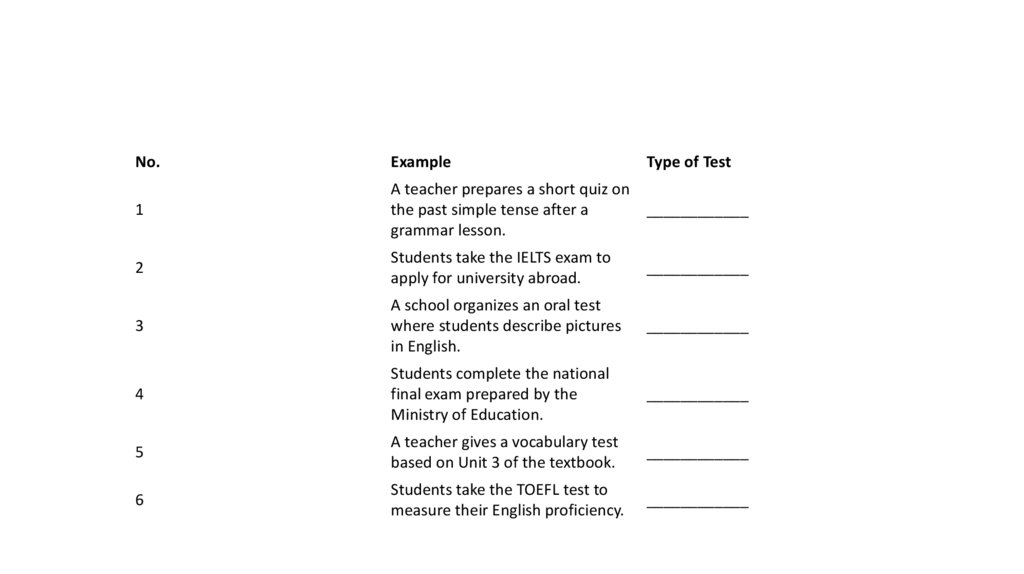
No.Example
Type of Test
1
A teacher prepares a short quiz on
the past simple tense after a
____________
grammar lesson.
2
Students take the IELTS exam to
apply for university abroad.
____________
3
A school organizes an oral test
where students describe pictures
in English.
____________
4
Students complete the national
final exam prepared by the
Ministry of Education.
____________
5
A teacher gives a vocabulary test
based on Unit 3 of the textbook.
____________
6
Students take the TOEFL test to
measure their English proficiency.
____________
9. Teacher made Test vs. Standardized Tests
• The standardized test is based on the general content and objectivescommon to many schools all over the country whereas the teacher
made test can be adapted to content and objectives specific to his
own situation. The standardized test deals with large segments of
knowledge or skill whereas the teacher made test can be prepared in
relation to any specific limited topic. The standardized test is
developed with the help of professional writers, reviewers and editors
of tests items whereas the teacher made test usually relies upon the
skill of one or two teachers. The standardized test provides norms for
various groups that are broadly representative of performance
throughout the country whereas the teacher made test lack this
external point of reference.
10. Teacher made Test vs. Standardized Tests
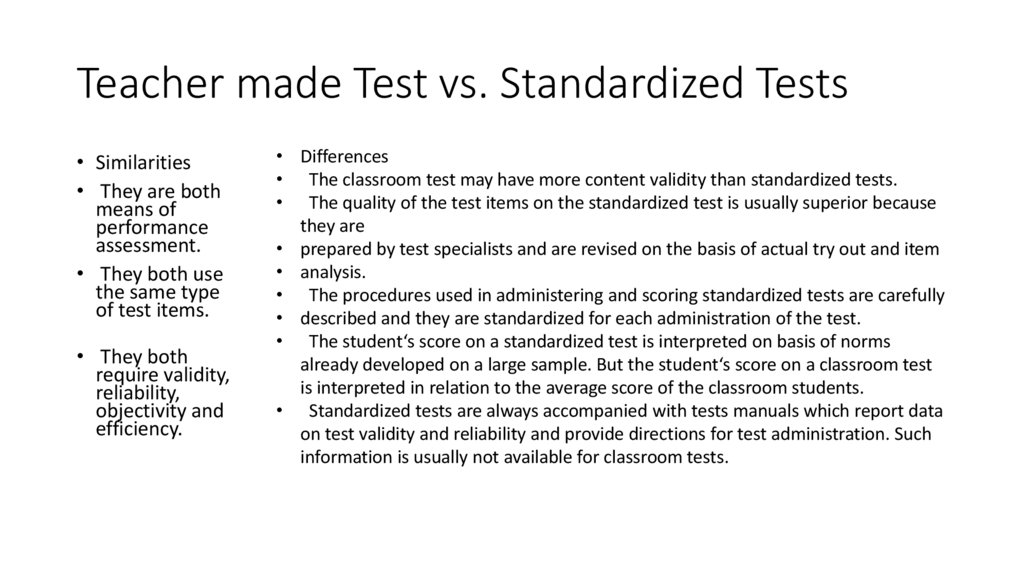
• Similarities• They are both
means of
performance
assessment.
• They both use
the same type
of test items.
• They both
require validity,
reliability,
objectivity and
efficiency.
• Differences
• The classroom test may have more content validity than standardized tests.
• The quality of the test items on the standardized test is usually superior because
they are
• prepared by test specialists and are revised on the basis of actual try out and item
• analysis.
• The procedures used in administering and scoring standardized tests are carefully
• described and they are standardized for each administration of the test.
• The student‘s score on a standardized test is interpreted on basis of norms
already developed on a large sample. But the student‘s score on a classroom test
is interpreted in relation to the average score of the classroom students.
• Standardized tests are always accompanied with tests manuals which report data
on test validity and reliability and provide directions for test administration. Such
information is usually not available for classroom tests.
11. Steps Involved in Standardized Test
• A standardized test is tried out and administered on a number of subjectsfor the expressed purpose of refining the items by subjecting the
performances of the standard decision to pertinent statistical analysis. The
steps for the standardized test is constructed by test specialists or experts
they are
• Proper planning
• Adequate preparations
• Try-out of the test
• Preparation of proper, norm
• Preparation of a manual containing instruction of administering a tool or
test.
• Item analysis
12. Characteristics of a Standardized Test
• Standardized tests are based on the content and objectives of teaching common to manyschools.
• Not just one, but a team of experts are involved in the writing of test items.
• Items analysis is done on the basis of a pilot study, unlike in the case of a class room test.
• Norms are calculated for the purpose of comparison between grades, schools, age levels and
sexes.
• They cover large segments of knowledge and skills.
• Test manuals are prepared.
• Fairly a large same, not just one class is involved in the standardization of a test.
• Teacher need to test student performance. Test results are critical, not only because the affect
careers, but because of the influence they exercise on motivation to learn. Teacher must be aware
of different testing techniques, because they give useful information to both the teacher and the
students. Testing techniques are often similar the teaching techniques, but with a different
purpose.
13. Importance of Testing
• 1. Tests tell the teacher what the students can and cannot do andhere are how successful the teaching has been.
• 2. They also tell the teacher what areas need to be taught in the
future.
• 3. Test tell the students how well they are progressing, and where
they need to focus their attention as learners.
• 4. Regular tests also encourage students to take their learning
seriously, and give them a series of definite goals to aim towards.
14. EXISTING PRACTICES
• Class /Unit Tests• A class test is an assessment intended to measure a test- takers knowledge, skill,
aptitude, physical fitness or classification in many other topics in a class. A test may be
administered verbally, on paper, on a computer, or in a confined area that requires a test
taker to physically perform a set of skills. Tests vary in style, rigor and requirements. A
test may be administered formally or informally. Formal testing often results in a grade
or a test score. A test score may be interpreted with regards to a norm or criterion, or
occasionally both. The norm may be established independently or by statistical analysis
of a large number of participants.
• In a syllabus of any standard or subject, there will be six to ten units. The teachers
supposed to teach a unit in a month. Besides the weekly tests in a class, they will be
conducting a test as soon as the whole unit is covered at the end of a month. This may
be called as a unit test. The date and the nature of the question pattern may be at the
wish of the teacher. This may help the teacher to know the level; of understanding of the
learner.
15.
• Half- Yearly and Annual Examinations• After the quarterly exams two more will be taught and exam will be conducted
for the whole portion. This will be called half-yearly exam. When all the units are
covered probably in the in the month of March or April, the terminal examination
or annual examination will be conducted. This is the regular pattern of
conducting examination. Now, the tri-semester has been introduced in schools
where one semester consists of three months. The specialty of the system is,
once the semester is over, the learner will not be tested again on the previous
portion.
• Board Examination
• In India, board examinations refer to the public examinations that occur at the
end of the 9th to 10th grade education (SSC) or at the end of the 11th to 12th
grade education (HSC). The scores achieved in these exams are considered very
important for getting into university, getting into professional courses or training
programmes, and even possibly in finding employment.
16.
• Entrance Test• An entrance examination is an examination that many educational institutions use to
select students for admission. These exams may be administered at any level of
education, from primary to higher education, although they are more common at higher
levels.
• In Kazakhstan, entrance examinations are mainly confined to universities and specialized
institutions, especially in fields such as Medicine, Engineering, and Education. The most
well-known national exam is the Unified National Test (ҰБТ), which determines students’
eligibility for higher education. Admission to top universities like Nazarbayev University
or Kazakh National University is extremely competitive — only a small percentage of
applicants succeed. Experts point out that in a country where many different boards are
present common entrances are essential, but application skills rather than cramming
should be stressed on. Frequent changes in the pattern of examination are essential
since sticking to a 'standard text' or 'standard pattern' alone will favour the coaching
industry and the role- learners.
17.
• QUESTION BANK• Question Bank is a collection or reservoir of questions for timely use. But
haphazard collection of question will not make a Question Bank. The questions in
a Question Bank must be reliable and valid and should be suitable for testing
different traits and the candidates. Therefore, each question in a Question Bank is
scrutinized on the basis of its quality and relevance and is included in the bank
only after assigning technical values to enable the users to use them according to
their requirements.
• The technical specifications help the user of the bank to understand the type of
question, what it test, to which level it is applicable etc. These statistical
specifications further help in standardizing the questions are processed through
field trial to derive certain statistical specifications such as difficulty level,
discriminative index etc., these statistical specifications further help in
standardizing the question banks and increasing their utility.
• What qualities must the questions in a Question Bank have to be considered
useful and reliable?
18. PSYCHOLOGICAL TESTS
• Psychological test refers to the administration of psychological tests. Apsychological test is "an objective and standardized measure of a sample of
behavior". The term sample of behavior refers to an individual's
performance on tasks that have usually been prescribed beforehand. The
samples of behavior that make up a paper-and-pencil test, the most
common type of test, are a series of items. Performances on these items
produce a test score. A score on a well-constructed test is believed to
reflect a psychological construct such as achievement in a school subject,
cognitive ability, aptitude, emotional functioning, personality and etc.
Differences in test scores are thought to reflect individual differences in the
construct the test is supposed to measure. The technical term for the
science behind psychological testing is psychometrics.
• What does a psychological test measure, and how are test scores used to
reflect individual differences?
19. Principles of Psychological Test Psychological tests are given below:
• Standardization - All procedures and steps must be conducted withconsistency and under the same environment to achieve the same testing
performance from those being tested.
• Objectivity - Scoring such that subjective judgments and biases are
minimized, with results for each test taker obtained in the same way.
• Test Norms - The average test score within a large group of people where
the performance of one individual can be compared to the results of others
by establishing a point of comparison or frame of reference.
• Reliability - Obtaining the same result after multiple testing.
• Validity - The type of test being administered must measure what it is
intended to measure.
20. Types of Psychological Tests
There are several broad categories of psychological tests, there are given below:• IQ/Achievement Tests
• IQ tests purport to be measures of intelligence, while achievement tests are
measures of the use and level of development of use of the ability. IQ (or
cognitive) tests and Achievement tests are common norm-referenced tests. In
these types of tests, a series of tasks is presented to the person being evaluated,
and the person's responses are graded according to carefully prescribed
guidelines
• Attitude Tests
• Attitude test assess an individual's feelings about an event, person, or object.
Attitude scales are used in marketing to determine individual (and group)
preferences for brands, or items. Typically attitude tests use either a Thurstone
scale, or Likert scale to measure specific items.
21.
• Neuropsychological Tests• These tests consist of specifically designed tasks used to measure a psychological
function known to be linked to a particular brain structure or pathway.
Neuropsychological tests can be used in a clinical context to assess impairment
after an injury or illness known to affect neurocognitive functioning. When used
in research, these tests can be used to contrast neuropsychological abilities
across experimental groups.
• Personality Tests
• Psychological measures of personality are often described as either objective
tests or projective tests. The terms "objective test" and "projective test" have
recently come under criticism in the Journal of Personality Assessment. The more
descriptive "rating scale or self- report measures" and "free response measures"
are suggested, rather than the terms "objective tests" and "projective tests,"
respectively.
22. ALIGNS FORMATIVE AND SUMMATIVE ASSESSMENTS
• Assessment innovations require explicitly challenging teachers‘ assessmentconceptions. In changing towards outcome based curricula, aligning
formative to new summative assessments is a challenge. It aims to provide
concrete insights into what teacher conceptions hinder the development of
aligned formative assessment practices. In a structured collaborative action
research, practitioners, researchers and consultants analyze teachers‘
formative practices; identify underlying current conceptions and their
misalignment to the new summative assessment system. An iterative
process resulted in an overview of current conceptions versus required
conceptions; showing required conceptual changes that are prerequisite
for teachers to change towards formative assessment practices that are
aligned to the new outcome based summative assessment system.
• What changes do teachers need to make in their assessment beliefs to
align formative and summative assessments successfully?
23. SRSP
• 1. Development of summative assessment tasks for the term andassessment of tasks
• 2. The Purpose and Role of SA in Evaluating Student Learning
Outcomes
• 3. Advantages and disadvantages of summative assessment in higher
education
• 4. The Impact of Summative Assessment on Student Motivation
• 5. The impact of summative assessment on students’ test anxiety and
performance