
Похожие презентации:








Teaching-IELTS-Reading-Effectively
1.
TeachingIELTS
Reading
Effectively
Strategies, Scaffolding, and Classroom Practice
2.
S ession OverviewThis masterclass is designed for English language teachers who want to
strengthen their understanding of IELTS Reading and develop effective
classroom techniques for improving student performance on the
General and Education modules.
3.
Session Objectives1
Identify Key Skills
Understand the core competencies assessed in the IELTS Reading test across all question types.
2
Recognize Band-Level Challenges
Pinpoint common obstacles learners face at different proficiency levels.
3
Apply Scaffolding Techniques
Master step-by-step guidance strategies to support student comprehension.
4
Design Engaging Activities
Create classroom exercises targeting specific reading skills and question types.
5
Integrate Strategy Instruction
Weave explicit reading strategies into regular lessons for lasting impact.
4.
S ession S tructureUnderstanding IE LTS R eading
1
Purpose, format, and test structure
2
Common Challenges
Student obstacles at different levels
K ey S kills by Question Type
3
Essential competencies for success
4
Model Classroom Activity
Live demonstration of effective teaching
R eflection & Q&A
Discussion and additional resources
5
5.
Core Principles of E ffective IE LTSR eading Instruction
S trategy Awareness
Process Focus
Teach students how to approach each
Emphasize reading for meaning before
question type, not just find answers.
testing comprehension.
S caffolding S upport
Provide step-by-step guidance, moving from guided to independent practice.
Paraphrasing S kills
Highlight recognizing synonyms and rephrased ideas—essential for IELTS accuracy.
Authenticity
Use real IELTS-style texts to develop familiarity with exam format and timing.
6.
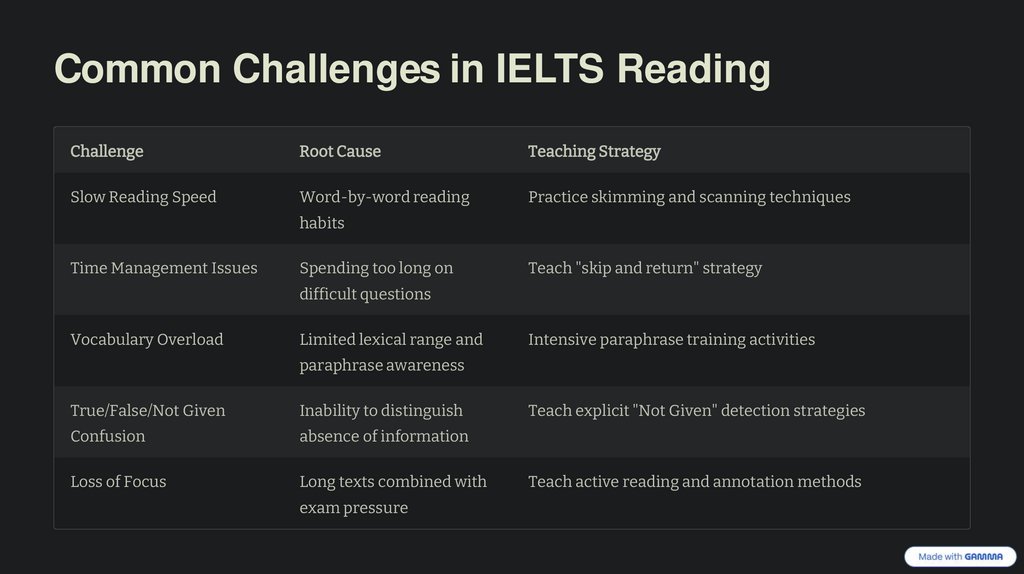
Common Challenges in IELTS ReadingChallenge
Root Cause
Teaching Strategy
Slow Reading Speed
Word-by-word reading
Practice skimming and scanning techniques
habits
Time Management Issues
Spending too long on
Teach "skip and return" strategy
difficult questions
Vocabulary Overload
Limited lexical range and
Intensive paraphrase training activities
paraphrase awareness
True/False/Not Given
Inability to distinguish
Confusion
absence of information
Loss of Focus
Long texts combined with
exam pressure
Teach explicit "Not Given" detection strategies
Teach active reading and annotation methods
7.
Solution 1: Skimming &Scanning Practice
What These Techniques Mean
How to Teach It
Skimming: Reading quickly to
Ask: "What's the main idea of
grasp the general idea or main
each paragraph?" (skimming
topic of each paragraph
practice)
Scanning: Reading rapidly to
locate specific information like
dates, names, or numbers
Why It Works
Struggling students often read every
Provide word lists; students find
them quickly in text (scanning)
Use timed challenges: "Find all
dates in 30 seconds"
Expected Outcome
word, wasting precious time. These
Students master time management
techniques train efficient
and understand overall meaning
information location without panic.
efficiently.
8.
S olution 2: S kip and Return S trategyRecognize Difficult Questions
Mark and S kip
Temporarily skip the question and move forward to maintain momentum
Identify questions that seem too challenging or unclear to answer quickly
Complete Easier Questions
Answer all clear, straightforward items first to maximize your score
Return with Fresh E yes
Review unanswered questions at the end using accumulated text clues and
context
Why This Matters: IELTS Reading is timed (60 minutes for 40 questions). Spending too long on one question reduces total score. This strategy prevents frustration while
increasing correct attempts.
9.
Solution 3: Paraphrase TrainingThe Critical Insight
In IELTS Reading, the correct answer is almost never written in the same words as
the question. Understanding synonyms and paraphrasing is fundamental to
accuracy.
Keyword Hunt Activities
Sentence Rewriting Exercises
Students locate synonyms and
Practice expressing the same idea
related expressions in original texts
using different vocabulary and
to build awareness of vocabulary
grammatical structures
relationships
Paraphrase Matching Tasks
Match expressions like "rise in prices" with synonyms such as "increase in cost"
Result: Students become faster at linking questions to text evidence—the cornerstone
of IELTS Reading success.
10.
Solution 4: Detecting Not Given StatementsMastering True/False/Not Given Questions
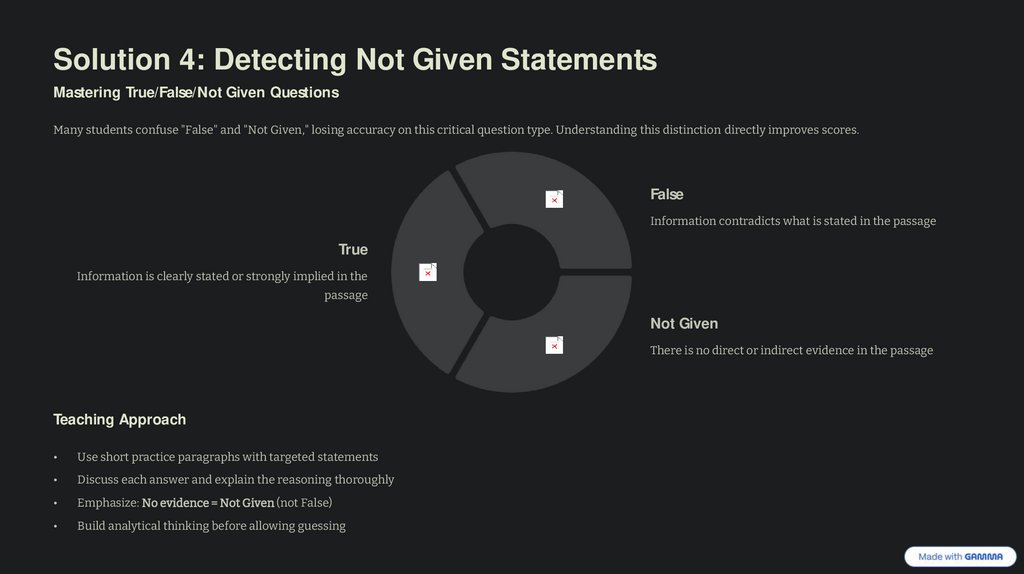
Many students confuse "False" and "Not Given," losing accuracy on this critical question type. Understanding this distinction directly improves scores.
False
Information contradicts what is stated in the passage
True
Information is clearly stated or strongly implied in the
passage
Not Given
There is no direct or indirect evidence in the passage
Teaching Approach
Use short practice paragraphs with targeted statements
Discuss each answer and explain the reasoning thoroughly
Emphasize: No evidence = Not Given (not False)
Build analytical thinking before allowing guessing