 Образование
Похожие презентации:








Teaching GE/IELTS Reading Effectively: Strategies, Scaffolding, and Classroom Practice
1. Teaching GE/IELTS Reading Effectively: Strategies, Scaffolding, and Classroom Practice
2.
Session OverviewThis masterclass is designed for English language teachers who want to
strengthen their understanding of IELTS Reading and develop effective
classroom techniques for improving student performance.
3.
Session ObjectivesBy the end of the session, participants will be able to:
1. Identify the key skills assessed in the IELTS Reading test.
2. Recognize common challenges learners face at different
band levels.
3. Apply scaffolding techniques to support students’
comprehension.
4. Design engaging classroom activities that target specific
reading skills.
5. Integrate strategy instruction into regular reading lessons.
4.
Session Structure1. Introduction – Understanding the purpose and structure of the IELTS Reading test.
2: Common Challenges in GE/IELTS Reading
3: Key Skills by Question Type
4 : Model Classroom Activity
5: Reflection
6: Q&A and Wrap-Up – Sharing experiences and additional resources
5.
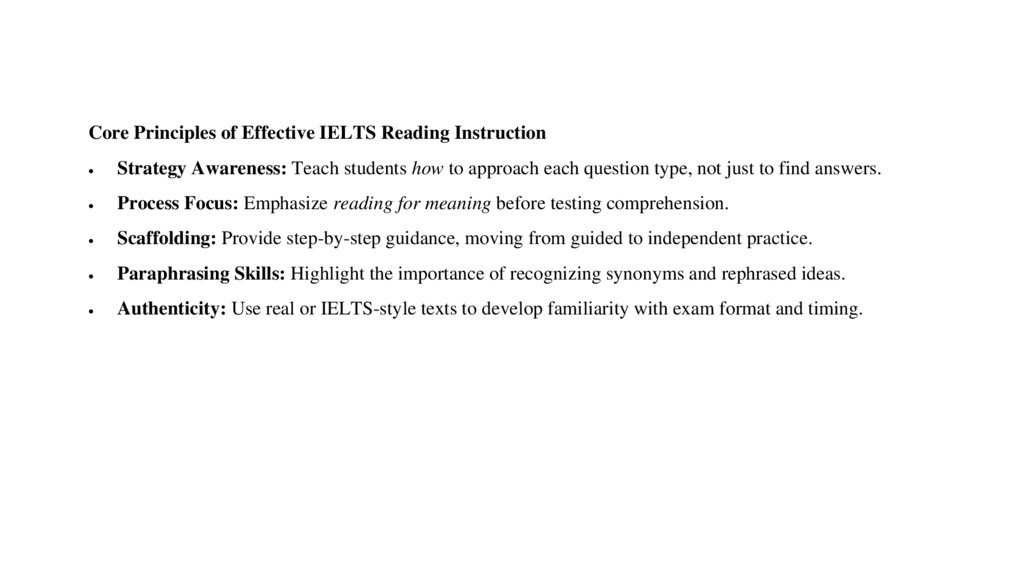
Core Principles of Effective IELTS Reading InstructionStrategy Awareness: Teach students how to approach each question type, not just to find answers.
Process Focus: Emphasize reading for meaning before testing comprehension.
Scaffolding: Provide step-by-step guidance, moving from guided to independent practice.
Paraphrasing Skills: Highlight the importance of recognizing synonyms and rephrased ideas.
Authenticity: Use real or IELTS-style texts to develop familiarity with exam format and timing.
6.
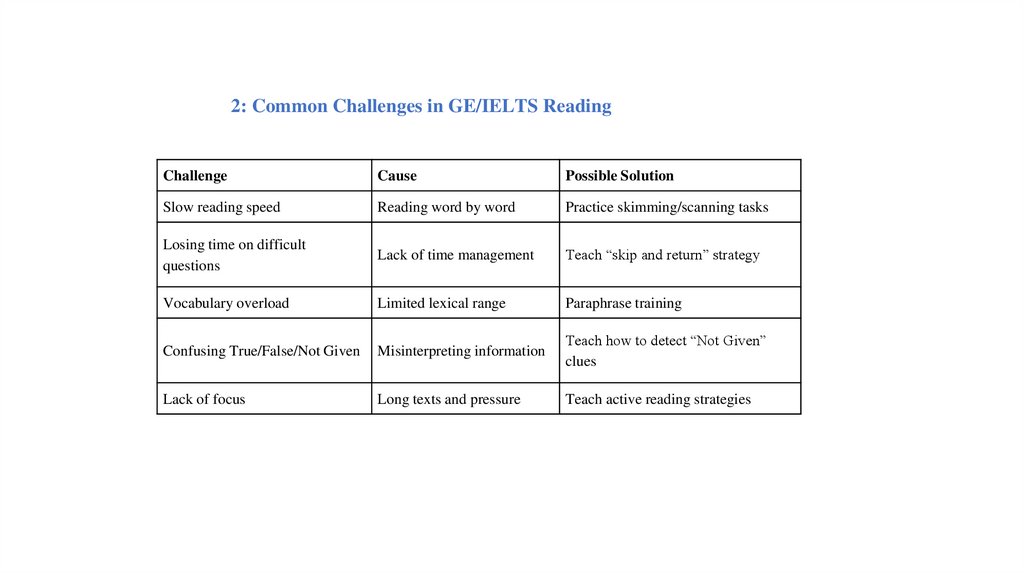
2: Common Challenges in GE/IELTS ReadingChallenge
Cause
Possible Solution
Slow reading speed
Reading word by word
Practice skimming/scanning tasks
Losing time on difficult
questions
Lack of time management
Teach “skip and return” strategy
Vocabulary overload
Limited lexical range
Paraphrase training
Confusing True/False/Not Given
Misinterpreting information
Teach how to detect “Not Given”
clues
Lack of focus
Long texts and pressure
Teach active reading strategies
7. 2: Common Challenges in GE/IELTS Reading
Challenge CausePossible Solution
Slow
reading
speed
Reading
word by
word
Practice skimming/scanning tasks
Losing
time on
difficult
questions
Lack of
time
manageme
nt
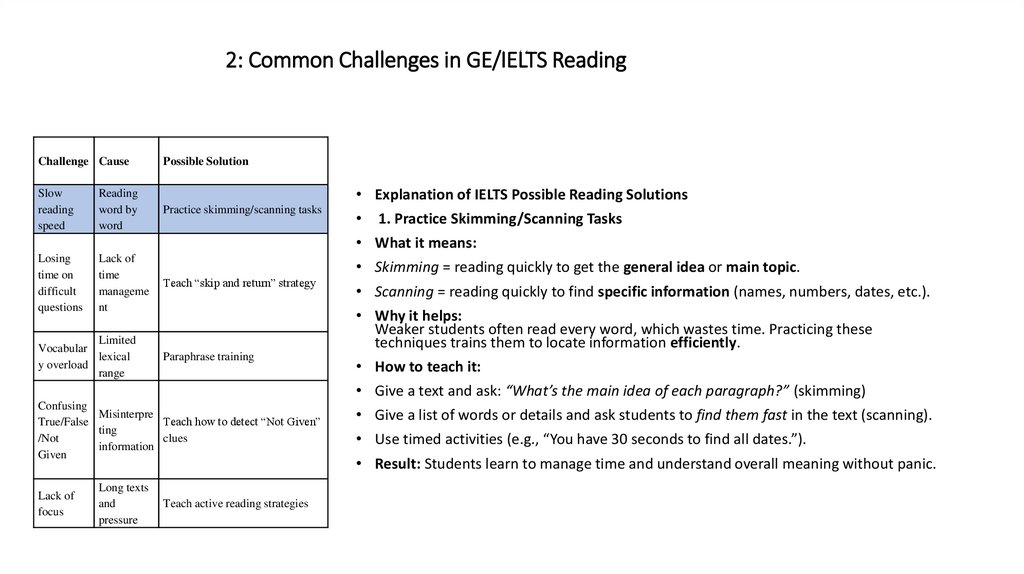
• Explanation of IELTS Possible Reading Solutions
1. Practice Skimming/Scanning Tasks
• What it means:
Limited
Vocabular
lexical
y overload
range
• Skimming = reading quickly to get the general idea or main topic.
Teach “skip and return” strategy
• Scanning = reading quickly to find specific information (names, numbers, dates, etc.).
• Why it helps:
Weaker students often read every word, which wastes time. Practicing these
techniques trains them to locate information efficiently.
Paraphrase training
• How to teach it:
• Give a text and ask: “What’s the main idea of each paragraph?” (skimming)
Confusing
Misinterpre
True/False
Teach how to detect “Not Given”
ting
clues
/Not
information
Given
Lack of
focus
Long texts
and
pressure
Teach active reading strategies
• Give a list of words or details and ask students to find them fast in the text (scanning).
• Use timed activities (e.g., “You have 30 seconds to find all dates.”).
• Result: Students learn to manage time and understand overall meaning without panic.
8.
2.Common Challenges in GE/IELTS ReadingChallenge
Cause
Reading
Slow reading
word by
speed
word
Possible Solution
Practice
skimming/scanning
tasks
Losing time
on difficult
questions
Lack of time Teach “skip and
management return” strategy
Vocabulary
overload
Limited
Paraphrase training
lexical range
Confusing
Misinterpreti Teach how to
True/False/N ng
detect “Not Given”
ot Given
information clues
Lack of focus
Long texts
Teach active
and pressure reading strategies
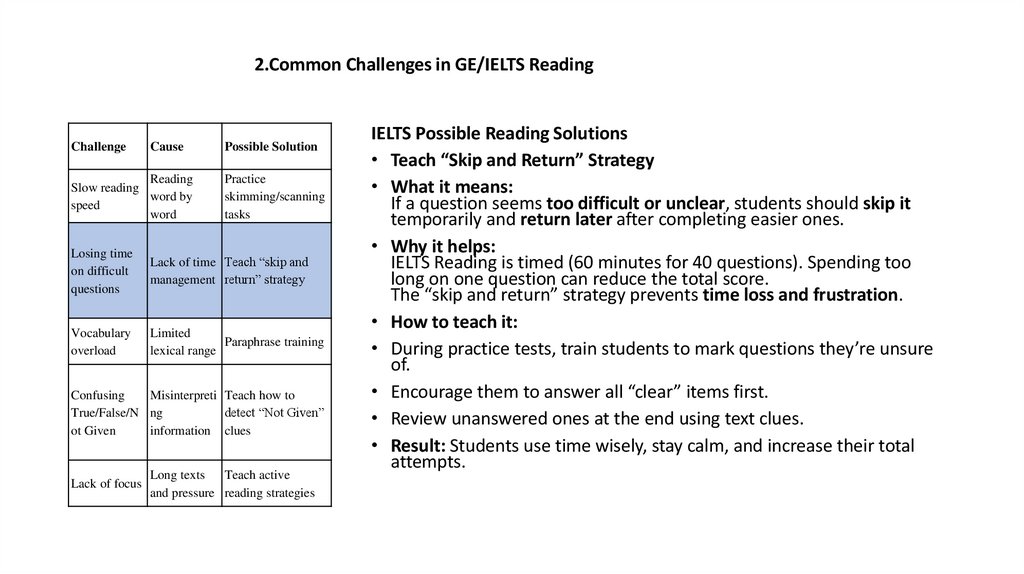
IELTS Possible Reading Solutions
• Teach “Skip and Return” Strategy
• What it means:
If a question seems too difficult or unclear, students should skip it
temporarily and return later after completing easier ones.
• Why it helps:
IELTS Reading is timed (60 minutes for 40 questions). Spending too
long on one question can reduce the total score.
The “skip and return” strategy prevents time loss and frustration.
• How to teach it:
• During practice tests, train students to mark questions they’re unsure
of.
• Encourage them to answer all “clear” items first.
• Review unanswered ones at the end using text clues.
• Result: Students use time wisely, stay calm, and increase their total
attempts.
9.
2.Common Challenges in GE/IELTS ReadingChallenge
Cause
Possible Solution
Slow reading
speed
Reading word
by word
Practice
skimming/scanning
tasks
Losing time on
Lack of time
difficult
management
questions
Teach “skip and
return” strategy
Vocabulary
overload
Limited lexical
Paraphrase training
range
Confusing
True/False/Not
Given
Misinterpretin Teach how to detect
g information “Not Given” clues
Lack of focus
Long texts and Teach active reading
pressure
strategies
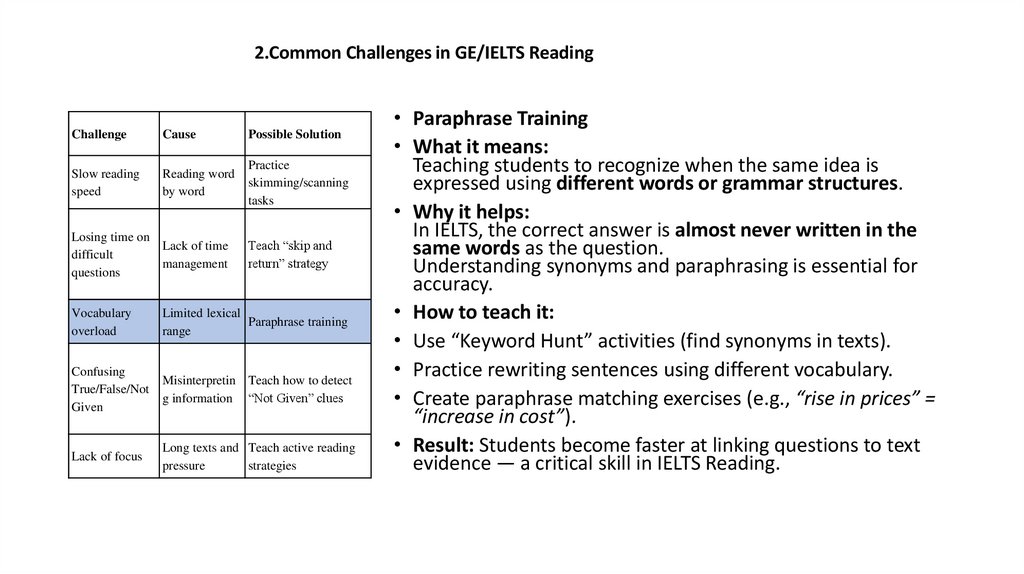
• Paraphrase Training
• What it means:
Teaching students to recognize when the same idea is
expressed using different words or grammar structures.
• Why it helps:
In IELTS, the correct answer is almost never written in the
same words as the question.
Understanding synonyms and paraphrasing is essential for
accuracy.
• How to teach it:
• Use “Keyword Hunt” activities (find synonyms in texts).
• Practice rewriting sentences using different vocabulary.
• Create paraphrase matching exercises (e.g., “rise in prices” =
“increase in cost”).
• Result: Students become faster at linking questions to text
evidence — a critical skill in IELTS Reading.
10. Common Challenges in GE/IELTS Reading
ChallengeCause
Possible Solution
Slow reading
speed
Practice
Reading word
skimming/scanning
by word
tasks
Losing time on
Lack of time
difficult
management
questions
Teach “skip and
return” strategy
Vocabulary
overload
Paraphrase training
Limited
lexical range
Confusing
Misinterpretin Teach how to detect
True/False/Not
g information “Not Given” clues
Given
Lack of focus
Long texts and Teach active reading
pressure
strategies
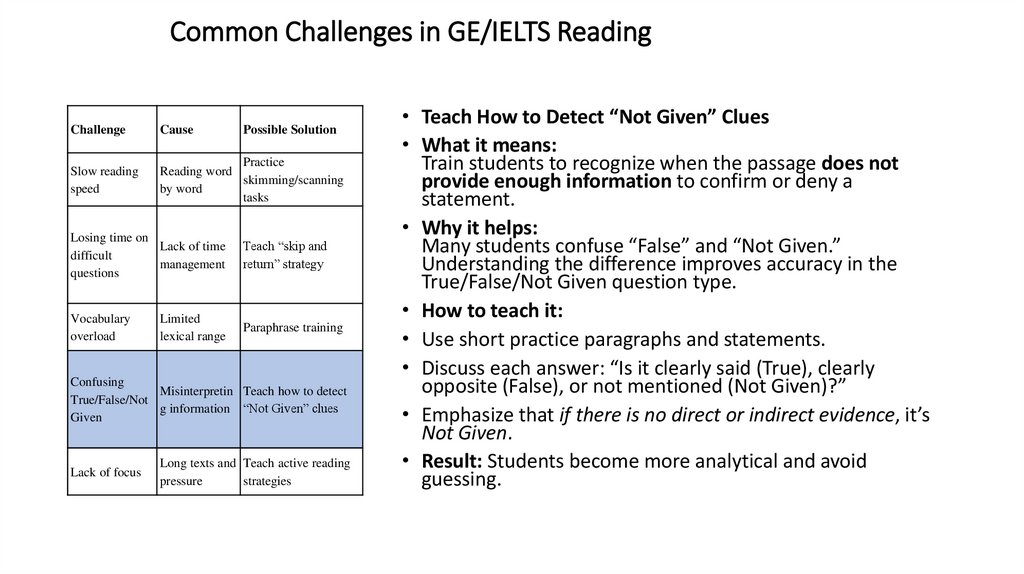
• Teach How to Detect “Not Given” Clues
• What it means:
Train students to recognize when the passage does not
provide enough information to confirm or deny a
statement.
• Why it helps:
Many students confuse “False” and “Not Given.”
Understanding the difference improves accuracy in the
True/False/Not Given question type.
• How to teach it:
• Use short practice paragraphs and statements.
• Discuss each answer: “Is it clearly said (True), clearly
opposite (False), or not mentioned (Not Given)?”
• Emphasize that if there is no direct or indirect evidence, it’s
Not Given.
• Result: Students become more analytical and avoid
guessing.
11. Common Challenges in GE/IELTS Reading
ChallengeCause
Reading
Slow reading
word by
speed
word
Possible Solution
Practice
skimming/scanning
tasks
Losing time
on difficult
questions
Lack of time Teach “skip and
management return” strategy
Vocabulary
overload
Limited
Paraphrase training
lexical range
Confusing
Misinterpreti
Teach how to detect
True/False/No ng
“Not Given” clues
t Given
information
Lack of focus
Long texts
Teach active
and pressure reading strategies
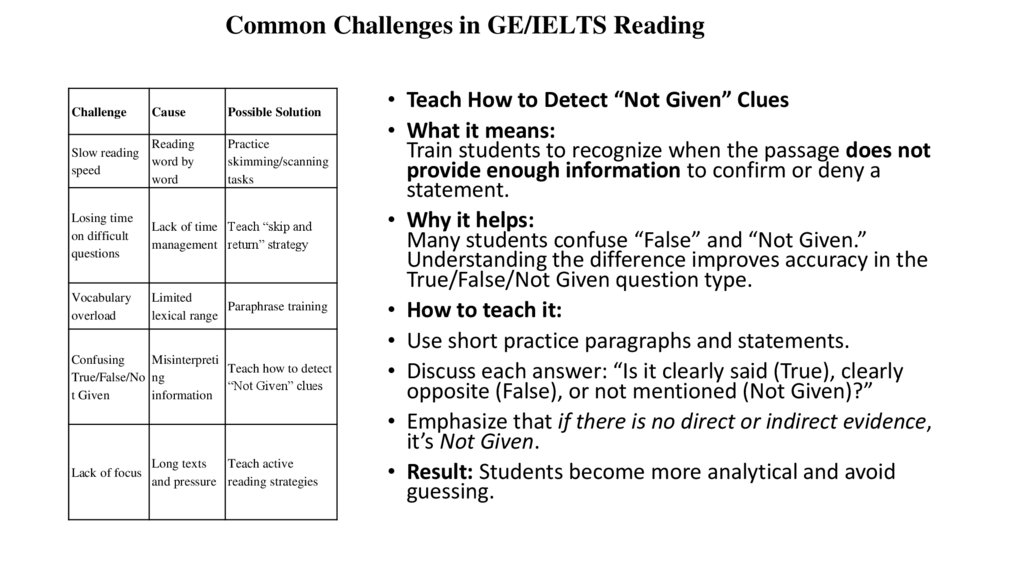
• Teach How to Detect “Not Given” Clues
• What it means:
Train students to recognize when the passage does not
provide enough information to confirm or deny a
statement.
• Why it helps:
Many students confuse “False” and “Not Given.”
Understanding the difference improves accuracy in the
True/False/Not Given question type.
• How to teach it:
• Use short practice paragraphs and statements.
• Discuss each answer: “Is it clearly said (True), clearly
opposite (False), or not mentioned (Not Given)?”
• Emphasize that if there is no direct or indirect evidence,
it’s Not Given.
• Result: Students become more analytical and avoid
guessing.
12. Teach Active Reading Strategies
ChallengeCause
Possible Solution
Slow reading
speed
Reading word
by word
Practice
skimming/scanning
tasks
Losing time on
difficult
questions
Lack of time
management
Teach “skip and return”
strategy
Vocabulary
overload
Limited lexical
range
Paraphrase training
Confusing
True/False/Not
Given
Misinterpreting Teach how to detect
information
“Not Given” clues
Lack of focus
Long texts and
pressure
Teach active reading
strategies
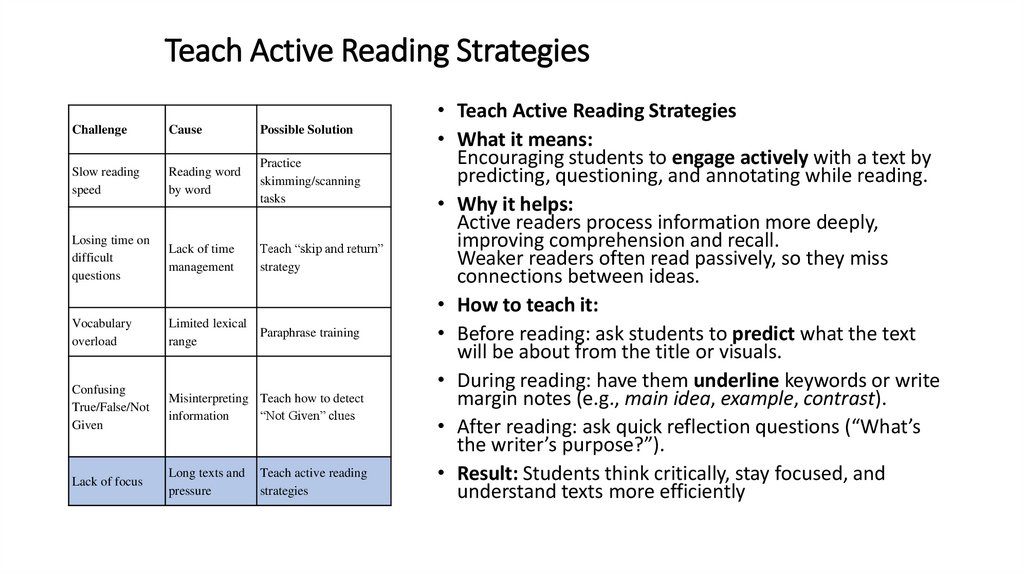
• Teach Active Reading Strategies
• What it means:
Encouraging students to engage actively with a text by
predicting, questioning, and annotating while reading.
• Why it helps:
Active readers process information more deeply,
improving comprehension and recall.
Weaker readers often read passively, so they miss
connections between ideas.
• How to teach it:
• Before reading: ask students to predict what the text
will be about from the title or visuals.
• During reading: have them underline keywords or write
margin notes (e.g., main idea, example, contrast).
• After reading: ask quick reflection questions (“What’s
the writer’s purpose?”).
• Result: Students think critically, stay focused, and
understand texts more efficiently
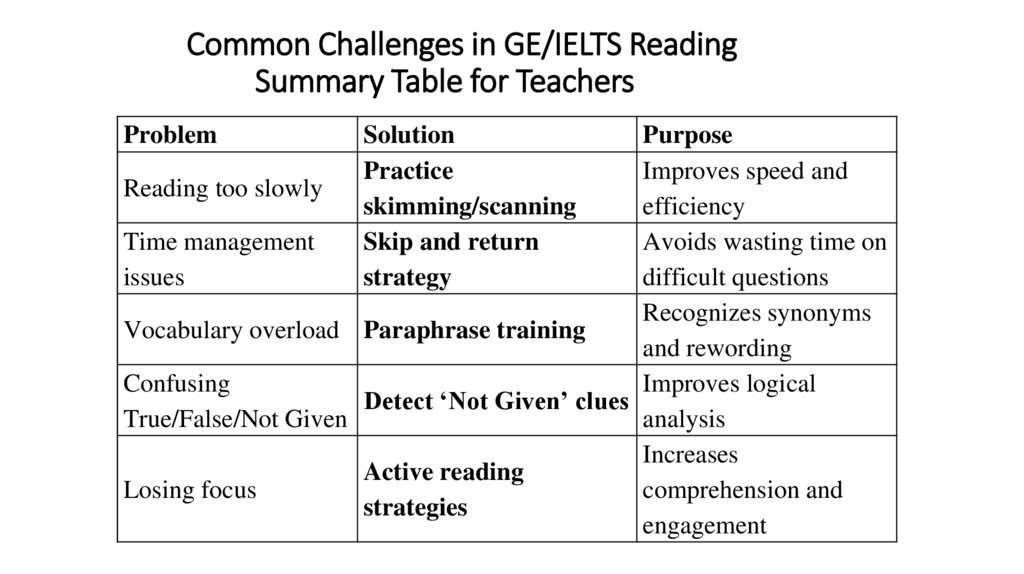
13. Common Challenges in GE/IELTS Reading Summary Table for Teachers
ProblemSolution
Practice
skimming/scanning
Skip and return
strategy
Purpose
Improves speed and
Reading too slowly
efficiency
Time management
Avoids wasting time on
issues
difficult questions
Recognizes synonyms
Vocabulary overload Paraphrase training
and rewording
Confusing
Improves logical
Detect ‘Not Given’ clues
True/False/Not Given
analysis
Increases
Active reading
Losing focus
comprehension and
strategies
engagement
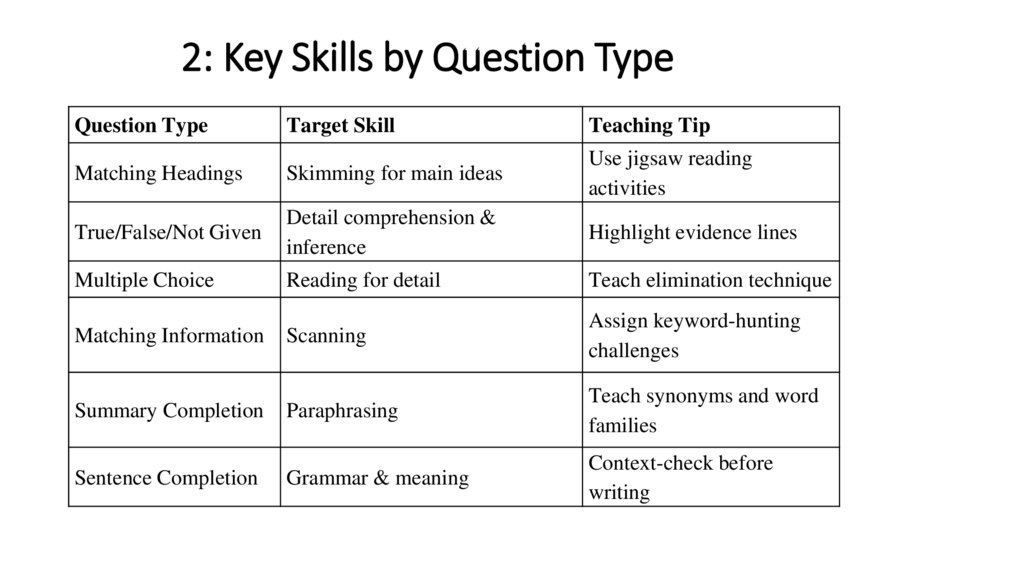
14. 2: Key Skills by Question Type
Question TypeTarget Skill
Teaching Tip
Matching Headings
Skimming for main ideas
Use jigsaw reading
activities
True/False/Not Given
Detail comprehension &
inference
Highlight evidence lines
Multiple Choice
Reading for detail
Teach elimination technique
Matching Information
Scanning
Assign keyword-hunting
challenges
Summary Completion
Paraphrasing
Teach synonyms and word
families
Sentence Completion
Grammar & meaning
Context-check before
writing
15. 2: Key Skills by Question Type
QuestionType
Target Skill
Teaching Tip
Matching
Headings
Skimming for main
ideas
Use jigsaw
reading activities
True/False/No Detail comprehension Highlight
t Given
& inference
evidence lines
Multiple
Choice
Matching
Information
Summary
Completion
Reading for detail
Scanning
Paraphrasing
Teach elimination
technique
Assign keywordhunting
challenges
Teach synonyms
and word families
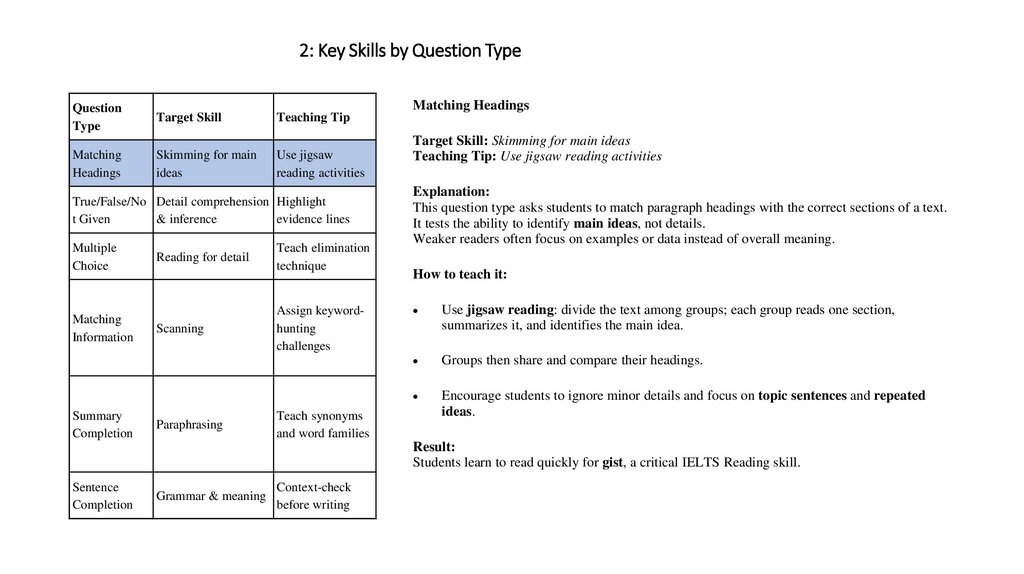
Matching Headings
Target Skill: Skimming for main ideas
Teaching Tip: Use jigsaw reading activities
Explanation:
This question type asks students to match paragraph headings with the correct sections of a text.
It tests the ability to identify main ideas, not details.
Weaker readers often focus on examples or data instead of overall meaning.
How to teach it:
Use jigsaw reading: divide the text among groups; each group reads one section,
summarizes it, and identifies the main idea.
Groups then share and compare their headings.
Encourage students to ignore minor details and focus on topic sentences and repeated
ideas.
Result:
Students learn to read quickly for gist, a critical IELTS Reading skill.
Sentence
Completion
Grammar & meaning
Context-check
before writing
16. 2: Key Skills by Question Type
Question Type Target SkillTeaching Tip
Matching
Headings
Skimming for main Use jigsaw
ideas
reading activities
True/False/Not
Given
Detail
comprehension &
inference
Highlight
evidence lines
Multiple Choice Reading for detail
Teach elimination
technique
Matching
Information
Scanning
Assign keywordhunting
challenges
Summary
Completion
Paraphrasing
Teach synonyms
and word families
Sentence
Completion
Grammar &
meaning
Context-check
before writing
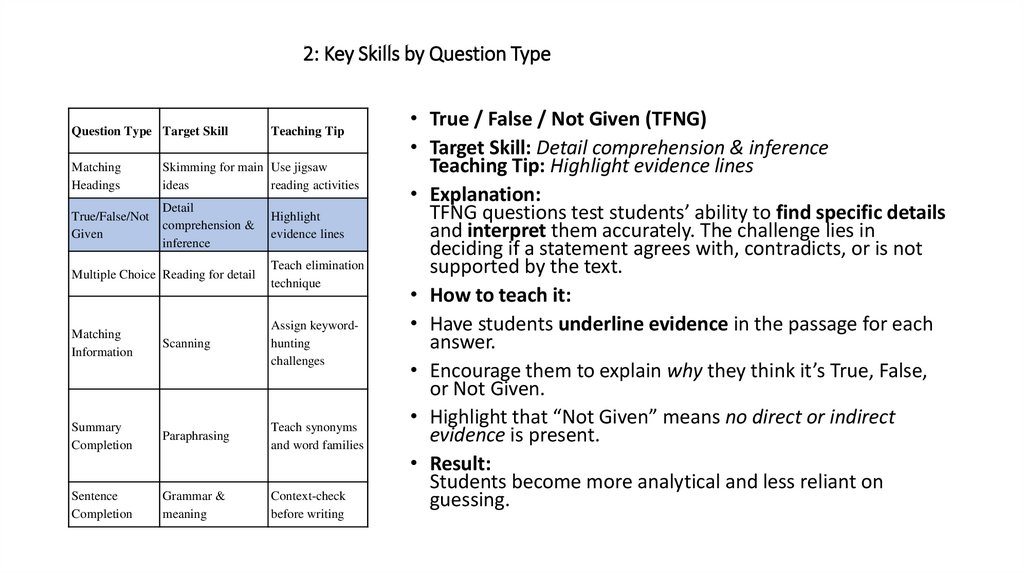
• True / False / Not Given (TFNG)
• Target Skill: Detail comprehension & inference
Teaching Tip: Highlight evidence lines
• Explanation:
TFNG questions test students’ ability to find specific details
and interpret them accurately. The challenge lies in
deciding if a statement agrees with, contradicts, or is not
supported by the text.
• How to teach it:
• Have students underline evidence in the passage for each
answer.
• Encourage them to explain why they think it’s True, False,
or Not Given.
• Highlight that “Not Given” means no direct or indirect
evidence is present.
• Result:
Students become more analytical and less reliant on
guessing.
17. 2: Key Skills by Question Type
Question Type Target SkillTeaching Tip
Matching
Headings
Use jigsaw reading
activities
Skimming for main
ideas
True/False/Not Detail comprehension Highlight evidence
Given
& inference
lines
Multiple
Choice
Reading for detail
Teach elimination
technique
Matching
Information
Scanning
Assign keywordhunting challenges
Summary
Completion
Paraphrasing
Teach synonyms
and word families
Sentence
Completion
Grammar & meaning
Context-check
before writing
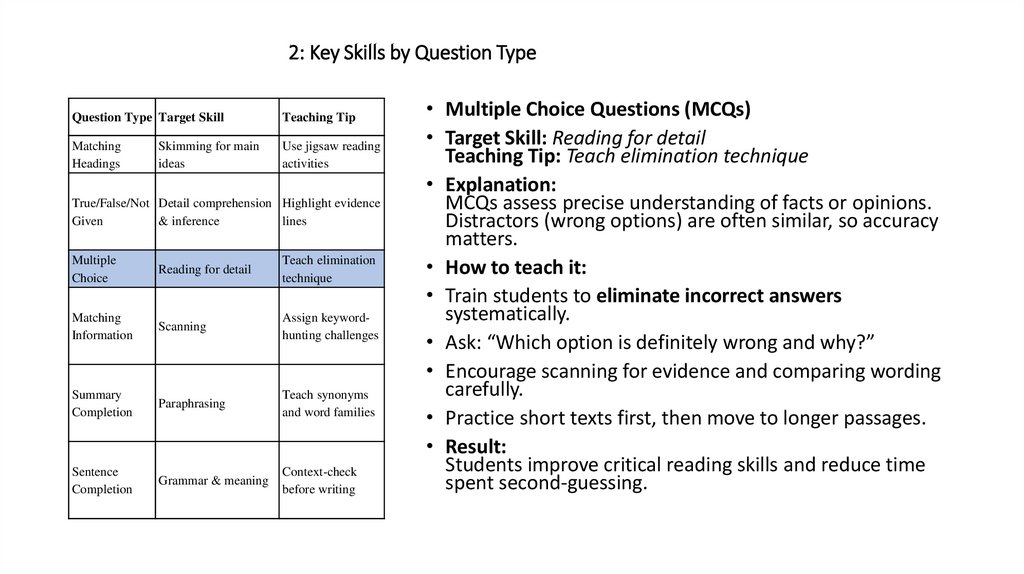
• Multiple Choice Questions (MCQs)
• Target Skill: Reading for detail
Teaching Tip: Teach elimination technique
• Explanation:
MCQs assess precise understanding of facts or opinions.
Distractors (wrong options) are often similar, so accuracy
matters.
• How to teach it:
• Train students to eliminate incorrect answers
systematically.
• Ask: “Which option is definitely wrong and why?”
• Encourage scanning for evidence and comparing wording
carefully.
• Practice short texts first, then move to longer passages.
• Result:
Students improve critical reading skills and reduce time
spent second-guessing.
18. 2: Key Skills by Question Type
QuestionType
Target Skill
Teaching Tip
Matching
Headings
Skimming for main
ideas
Use jigsaw
reading activities
Detail
True/False/No
comprehension &
t Given
inference
Highlight
evidence lines
Multiple
Choice
Reading for detail
Teach elimination
technique
Matching
Information
Scanning
Assign keywordhunting
challenges
Summary
Completion
Paraphrasing
Teach synonyms
and word families
Sentence
Completion
Grammar & meaning
Context-check
before writing
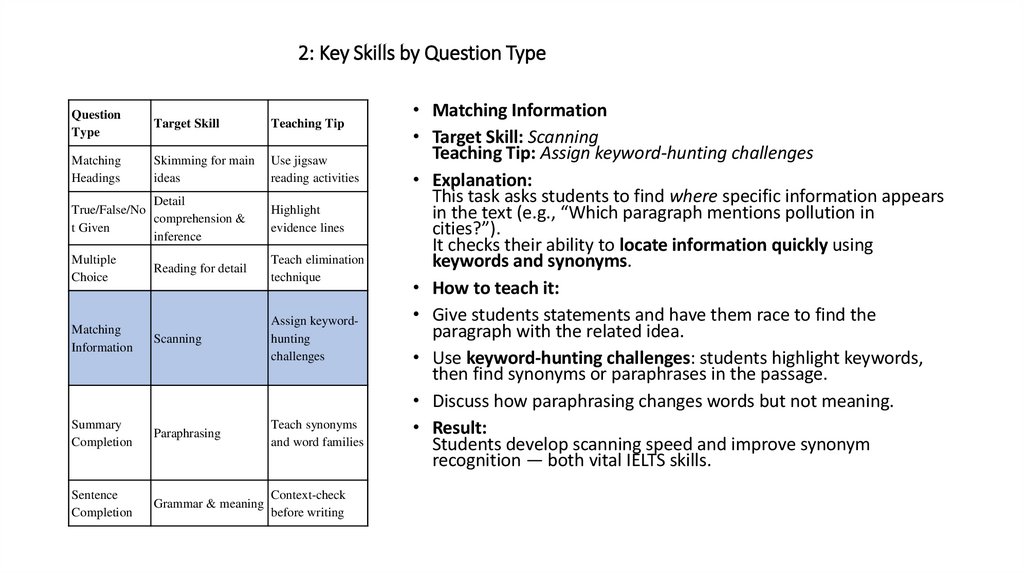
• Matching Information
• Target Skill: Scanning
Teaching Tip: Assign keyword-hunting challenges
• Explanation:
This task asks students to find where specific information appears
in the text (e.g., “Which paragraph mentions pollution in
cities?”).
It checks their ability to locate information quickly using
keywords and synonyms.
• How to teach it:
• Give students statements and have them race to find the
paragraph with the related idea.
• Use keyword-hunting challenges: students highlight keywords,
then find synonyms or paraphrases in the passage.
• Discuss how paraphrasing changes words but not meaning.
• Result:
Students develop scanning speed and improve synonym
recognition — both vital IELTS skills.
19. 2: Key Skills by Question Type
QuestionType
Target Skill
Teaching Tip
Matching
Headings
Skimming for main
ideas
Use jigsaw
reading activities
True/False/N
ot Given
Detail
comprehension &
inference
Highlight
evidence lines
Reading for detail
Teach
elimination
technique
Scanning
Assign keywordhunting
challenges
Summary
Completion
Paraphrasing
Teach synonyms
and word
families
Sentence
Completion
Grammar &
meaning
Context-check
before writing
Multiple
Choice
Matching
Information
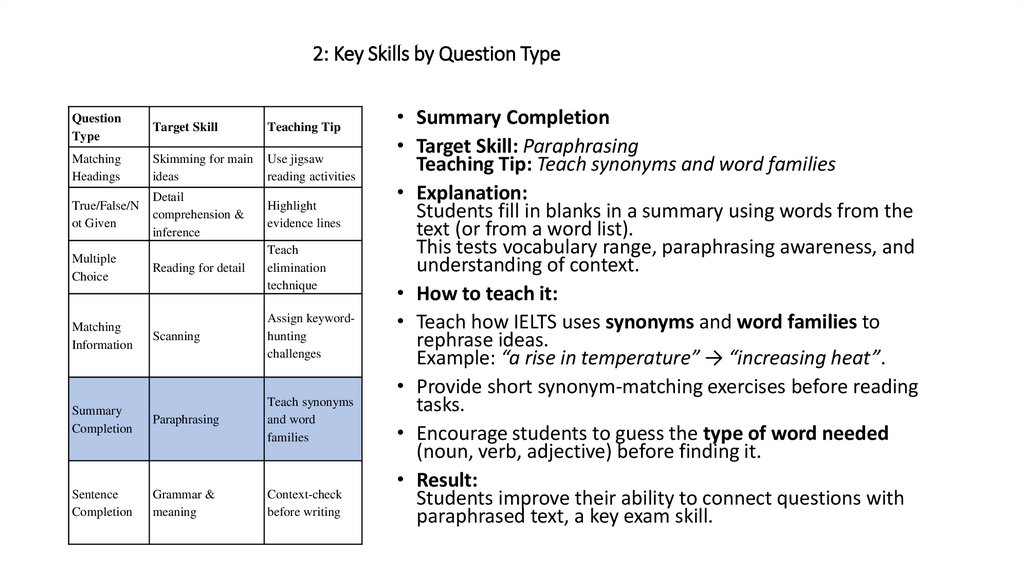
• Summary Completion
• Target Skill: Paraphrasing
Teaching Tip: Teach synonyms and word families
• Explanation:
Students fill in blanks in a summary using words from the
text (or from a word list).
This tests vocabulary range, paraphrasing awareness, and
understanding of context.
• How to teach it:
• Teach how IELTS uses synonyms and word families to
rephrase ideas.
Example: “a rise in temperature” → “increasing heat”.
• Provide short synonym-matching exercises before reading
tasks.
• Encourage students to guess the type of word needed
(noun, verb, adjective) before finding it.
• Result:
Students improve their ability to connect questions with
paraphrased text, a key exam skill.
20. 2: Key Skills by Question Type
QuestionType
Target Skill
Teaching Tip
Matching
Headings
Skimming for main
ideas
Use jigsaw
reading activities
True/False/Not Detail comprehension Highlight
Given
& inference
evidence lines
Multiple
Choice
Reading for detail
Teach elimination
technique
Matching
Information
Scanning
Assign keywordhunting challenges
Summary
Completion
Paraphrasing
Teach synonyms
and word families
Sentence
Completion
Grammar & meaning
Context-check
before writing
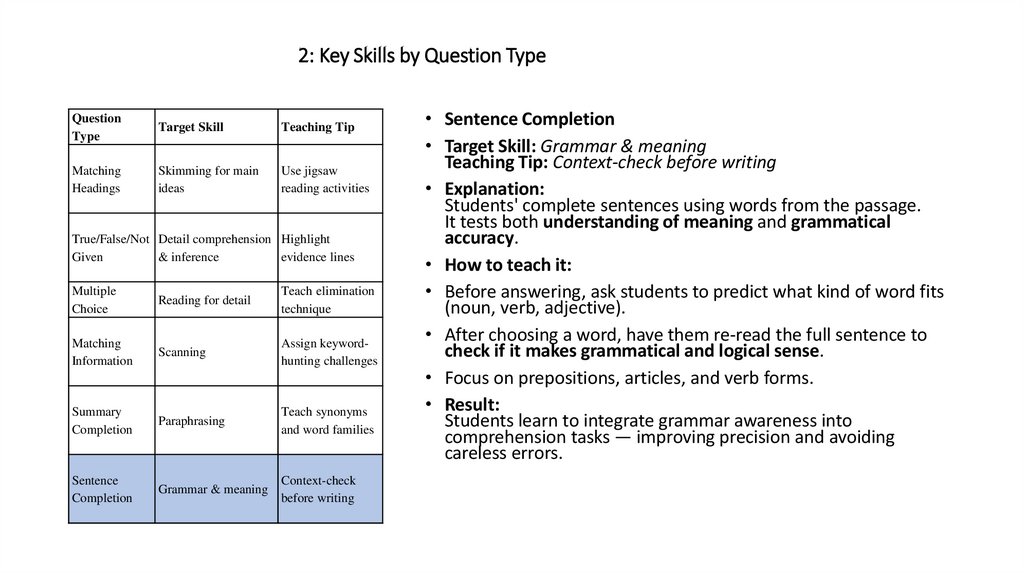
• Sentence Completion
• Target Skill: Grammar & meaning
Teaching Tip: Context-check before writing
• Explanation:
Students' complete sentences using words from the passage.
It tests both understanding of meaning and grammatical
accuracy.
• How to teach it:
• Before answering, ask students to predict what kind of word fits
(noun, verb, adjective).
• After choosing a word, have them re-read the full sentence to
check if it makes grammatical and logical sense.
• Focus on prepositions, articles, and verb forms.
• Result:
Students learn to integrate grammar awareness into
comprehension tasks — improving precision and avoiding
careless errors.
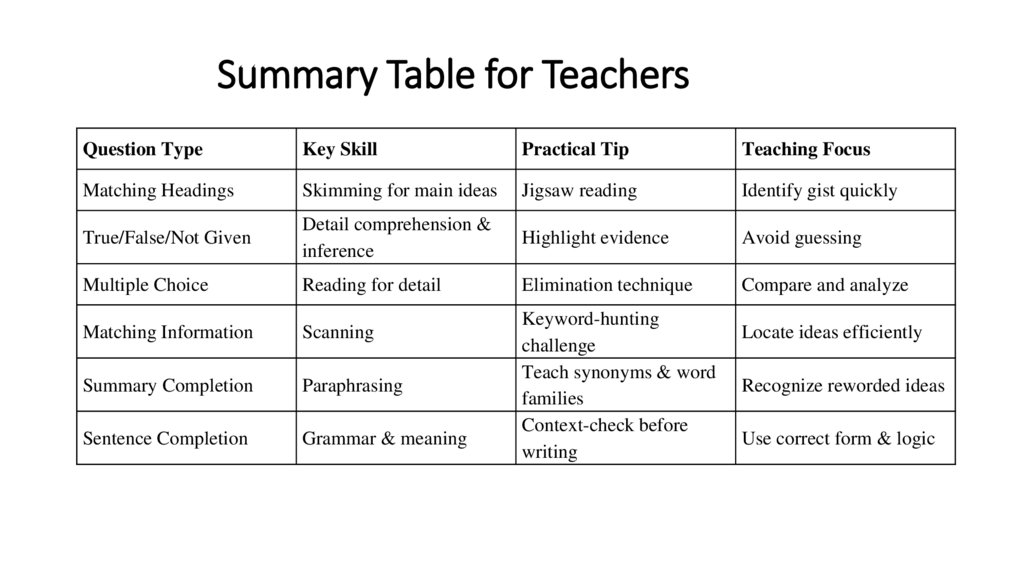
21. Summary Table for Teachers
Question TypeKey Skill
Practical Tip
Teaching Focus
Matching Headings
Skimming for main ideas
Jigsaw reading
Identify gist quickly
True/False/Not Given
Detail comprehension &
inference
Highlight evidence
Avoid guessing
Multiple Choice
Reading for detail
Elimination technique
Compare and analyze
Matching Information
Scanning
Summary Completion
Paraphrasing
Sentence Completion
Grammar & meaning
Keyword-hunting
challenge
Teach synonyms & word
families
Context-check before
writing
Locate ideas efficiently
Recognize reworded ideas
Use correct form & logic
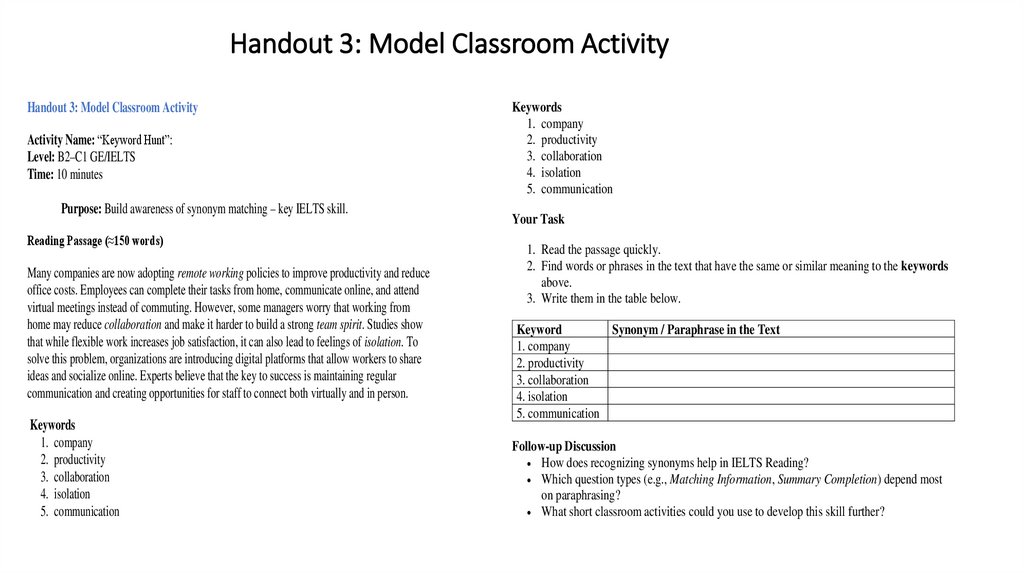
22. Handout 3: Model Classroom Activity
Handout 3: Model Classroom ActivityActivity Name: “Keyword Hunt”:
Level: B2–C1 GE/IELTS
Time: 10 minutes
Purpose: Build awareness of synonym matching – key IELTS skill.
Reading Passage (≈150 words)
Many companies are now adopting remote working policies to improve productivity and reduce
office costs. Employees can complete their tasks from home, communicate online, and attend
virtual meetings instead of commuting. However, some managers worry that working from
home may reduce collaboration and make it harder to build a strong team spirit. Studies show
that while flexible work increases job satisfaction, it can also lead to feelings of isolation. To
solve this problem, organizations are introducing digital platforms that allow workers to share
ideas and socialize online. Experts believe that the key to success is maintaining regular
communication and creating opportunities for staff to connect both virtually and in person.
Keywords
1. company
2. productivity
3. collaboration
4. isolation
5. communication
Keywords
1. company
2. productivity
3. collaboration
4. isolation
5. communication
Your Task
1. Read the passage quickly.
2. Find words or phrases in the text that have the same or similar meaning to the keywords
above.
3. Write them in the table below.
Keyword
Synonym / Paraphrase in the Text
1. company
2. productivity
3. collaboration
4. isolation
5. communication
Follow-up Discussion
How does recognizing synonyms help in IELTS Reading?
Which question types (e.g., Matching Information, Summary Completion) depend most
on paraphrasing?
What short classroom activities could you use to develop this skill further?
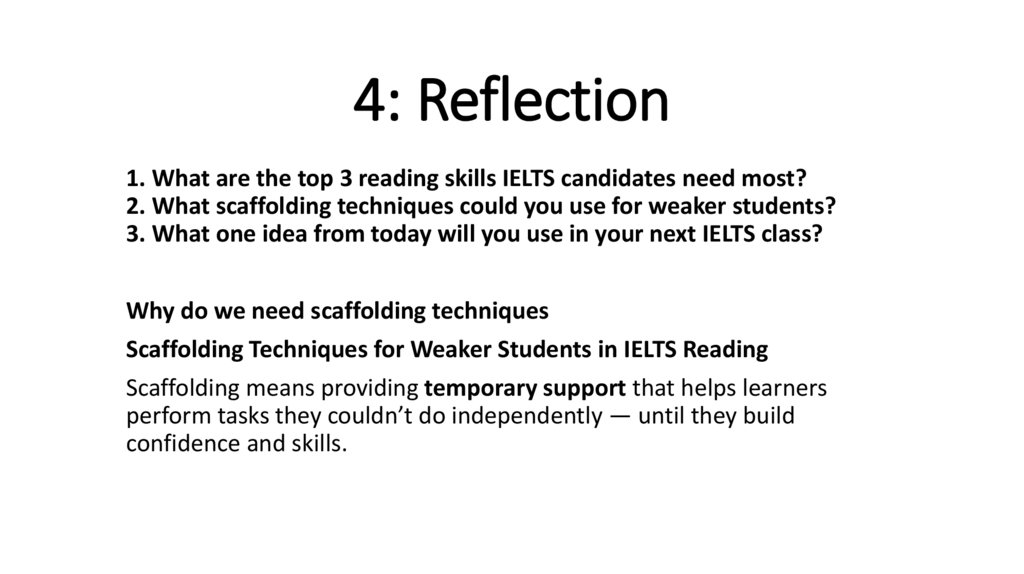
23. 4: Reflection
1. What are the top 3 reading skills IELTS candidates need most?2. What scaffolding techniques could you use for weaker students?
3. What one idea from today will you use in your next IELTS class?
Why do we need scaffolding techniques
Scaffolding Techniques for Weaker Students in IELTS Reading
Scaffolding means providing temporary support that helps learners
perform tasks they couldn’t do independently — until they build
confidence and skills.
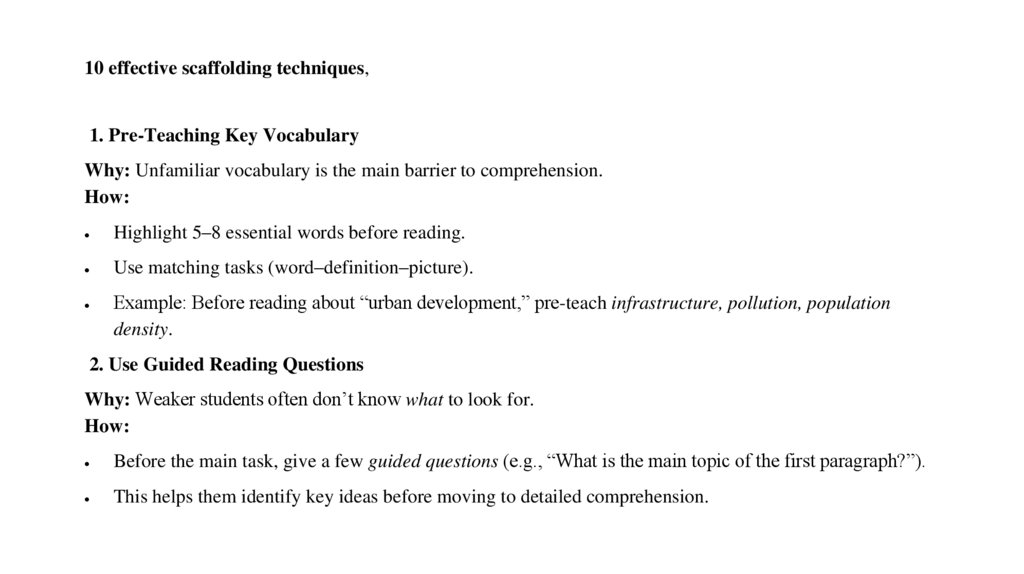
24.
10 effective scaffolding techniques,1. Pre-Teaching Key Vocabulary
Why: Unfamiliar vocabulary is the main barrier to comprehension.
How:
Highlight 5–8 essential words before reading.
Use matching tasks (word–definition–picture).
Example: Before reading about “urban development,” pre-teach infrastructure, pollution, population
density.
2. Use Guided Reading Questions
Why: Weaker students often don’t know what to look for.
How:
Before the main task, give a few guided questions (e.g., “What is the main topic of the first paragraph?”).
This helps them identify key ideas before moving to detailed comprehension.
25.
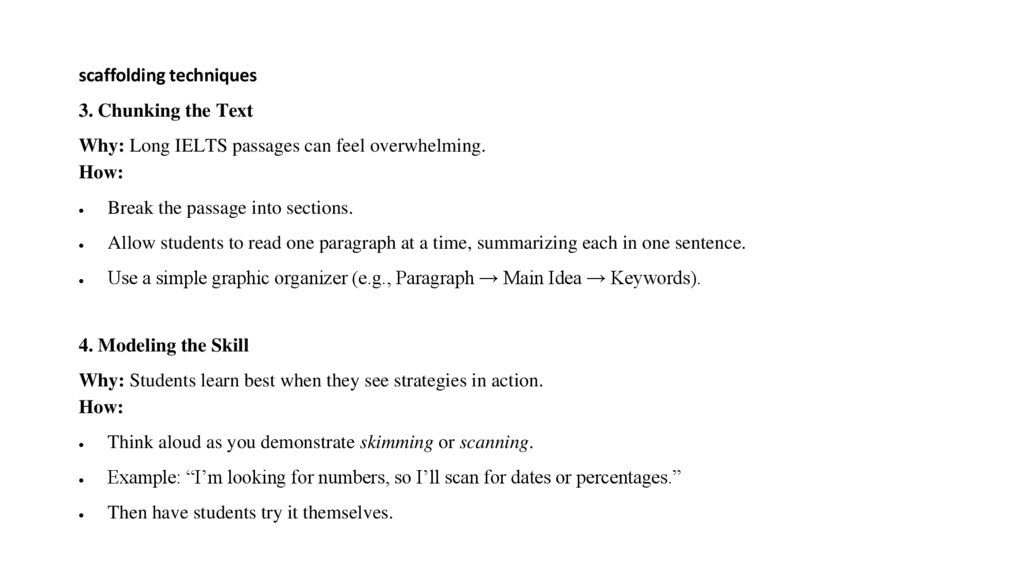
scaffolding techniques3. Chunking the Text
Why: Long IELTS passages can feel overwhelming.
How:
Break the passage into sections.
Allow students to read one paragraph at a time, summarizing each in one sentence.
Use a simple graphic organizer (e.g., Paragraph → Main Idea → Keywords).
4. Modeling the Skill
Why: Students learn best when they see strategies in action.
How:
Think aloud as you demonstrate skimming or scanning.
Example: “I’m looking for numbers, so I’ll scan for dates or percentages.”
Then have students try it themselves.
26.
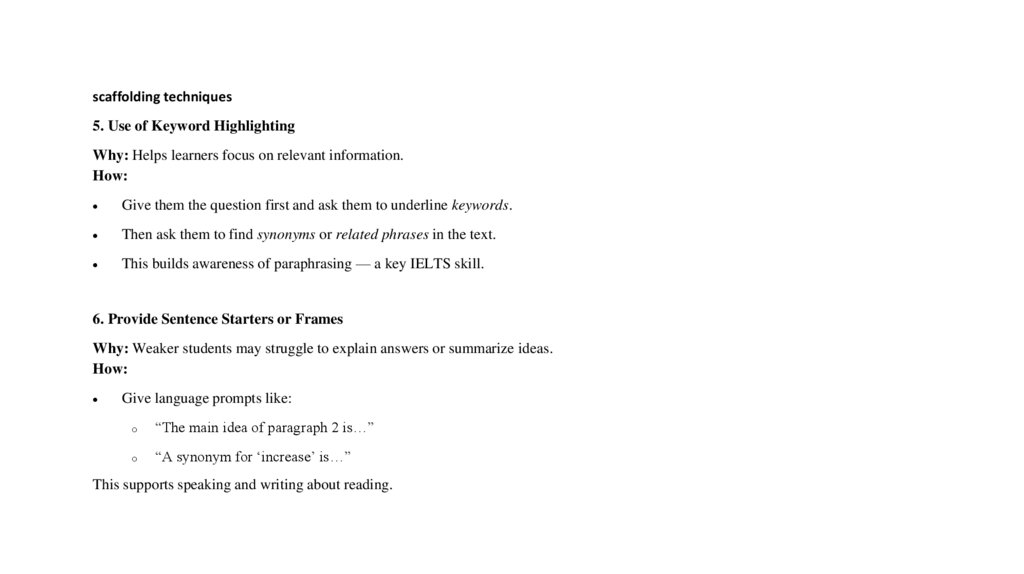
scaffolding techniques5. Use of Keyword Highlighting
Why: Helps learners focus on relevant information.
How:
Give them the question first and ask them to underline keywords.
Then ask them to find synonyms or related phrases in the text.
This builds awareness of paraphrasing — a key IELTS skill.
6. Provide Sentence Starters or Frames
Why: Weaker students may struggle to explain answers or summarize ideas.
How:
Give language prompts like:
o
“The main idea of paragraph 2 is…”
o
“A synonym for ‘increase’ is…”
This supports speaking and writing about reading.
27.
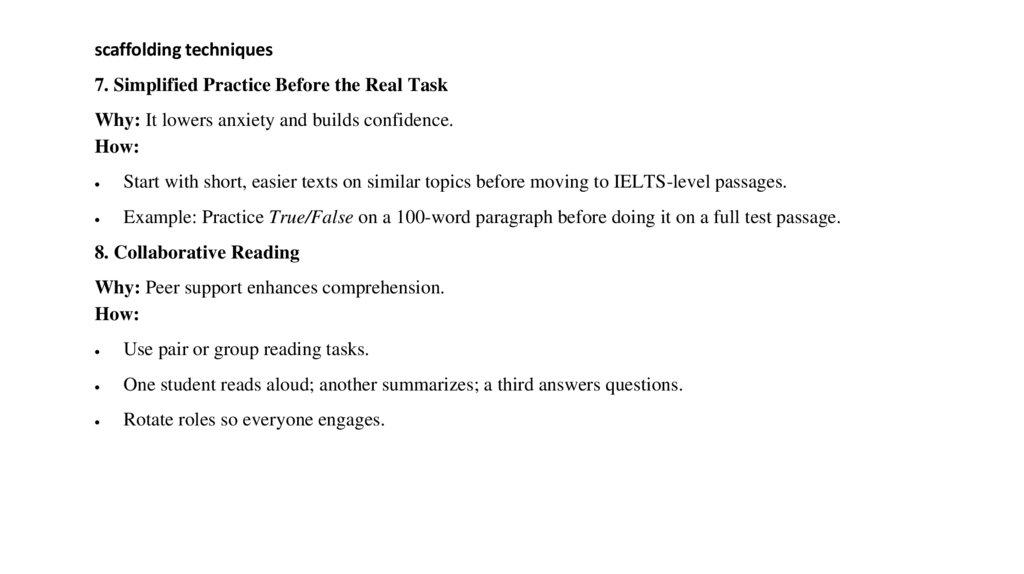
scaffolding techniques7. Simplified Practice Before the Real Task
Why: It lowers anxiety and builds confidence.
How:
Start with short, easier texts on similar topics before moving to IELTS-level passages.
Example: Practice True/False on a 100-word paragraph before doing it on a full test passage.
8. Collaborative Reading
Why: Peer support enhances comprehension.
How:
Use pair or group reading tasks.
One student reads aloud; another summarizes; a third answers questions.
Rotate roles so everyone engages.
28.
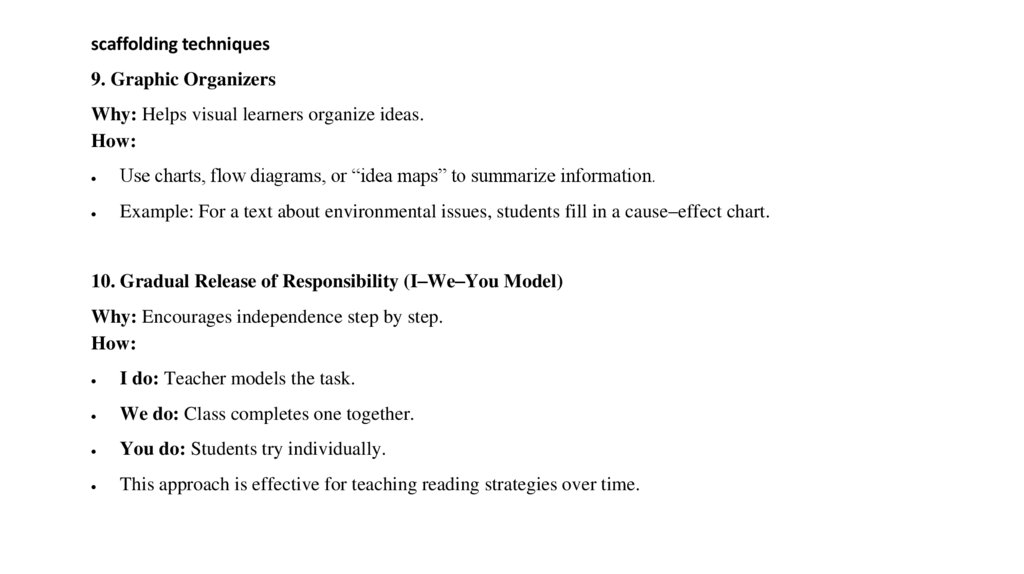
scaffolding techniques9. Graphic Organizers
Why: Helps visual learners organize ideas.
How:
Use charts, flow diagrams, or “idea maps” to summarize information.
Example: For a text about environmental issues, students fill in a cause–effect chart.
10. Gradual Release of Responsibility (I–We–You Model)
Why: Encourages independence step by step.
How:
I do: Teacher models the task.
We do: Class completes one together.
You do: Students try individually.
This approach is effective for teaching reading strategies over time.
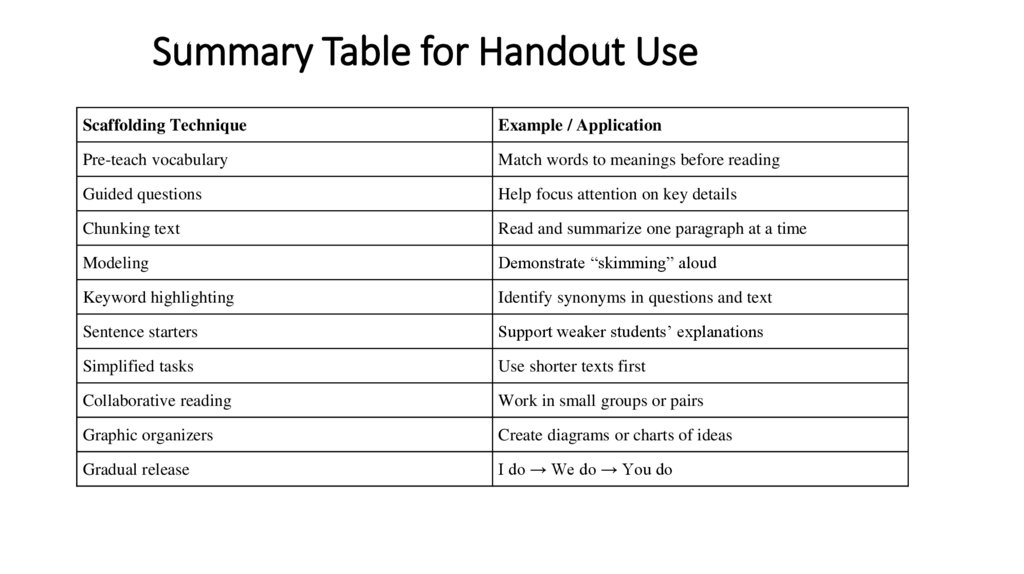
29. Summary Table for Handout Use
Scaffolding TechniqueExample / Application
Pre-teach vocabulary
Match words to meanings before reading
Guided questions
Help focus attention on key details
Chunking text
Read and summarize one paragraph at a time
Modeling
Demonstrate “skimming” aloud
Keyword highlighting
Identify synonyms in questions and text
Sentence starters
Support weaker students’ explanations
Simplified tasks
Use shorter texts first
Collaborative reading
Work in small groups or pairs
Graphic organizers
Create diagrams or charts of ideas
Gradual release
I do → We do → You do