Похожие презентации:






The-Most-Dangerous-Professions
1.
The Most DangerousProfessions
Subtitle: A Look at the Jobs That Risk Lives Daily
Gibaeva Karina/Фпл-ят-213Б
2.
Introduction: What Makes aJob "Dangerous"?
Defining Risk in the Workplace
A profession is considered "dangerous" based on key statistical data:
Fatality Rate: The number of fatal injuries per 100,000 full-time
workers.
Injury Rate: The frequency of non-fatal injuries requiring time off work.
Long-Term Health Risks: Exposure to harmful substances, extreme
stress, or physical strain.
Key Factors: Heights, heavy machinery, transportation incidents,
unpredictable environments, and isolation.
3.
The Methodology: How DoWe Know?
Data Sources
This ranking is primarily based on data from official sources like:
The U.S. Bureau of Labor Statistics (BLS) Census of Fatal Occupational
Injuries.
International Labour Organization (ILO) reports.
National health and safety agencies.
Note: Rankings can vary slightly by country and year, but the most
dangerous jobs consistently appear at the top.
4.
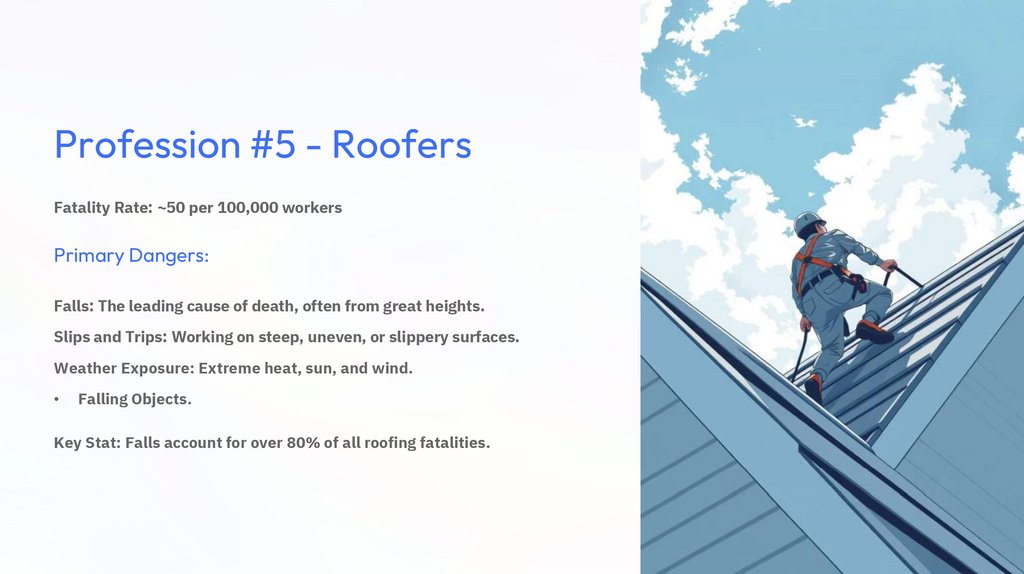
Profession #5 - RoofersFatality Rate: ~50 per 100,000 workers
Primary Dangers:
Falls: The leading cause of death, often from great heights.
Slips and Trips: Working on steep, uneven, or slippery surfaces.
Weather Exposure: Extreme heat, sun, and wind.
Falling Objects.
Key Stat: Falls account for over 80% of all roofing fatalities.
5.
Profession #4 - Aircraft Pilotsand Flight Engineers
Fatality Rate: ~55 per 100,000 workers
Primary Dangers:
Transportation Accidents: Crashes are rare but often fatal.
Unpredictable Weather: Turbulence, icing, low visibility.
Human Error & Mechanical Failure.
High Stress & Fatigue: Especially for emergency medical and small
cargo pilots.
Note: This includes commercial airline pilots, but the risk is highest for
small aircraft pilots (e.g., crop dusters, bush pilots).
6.
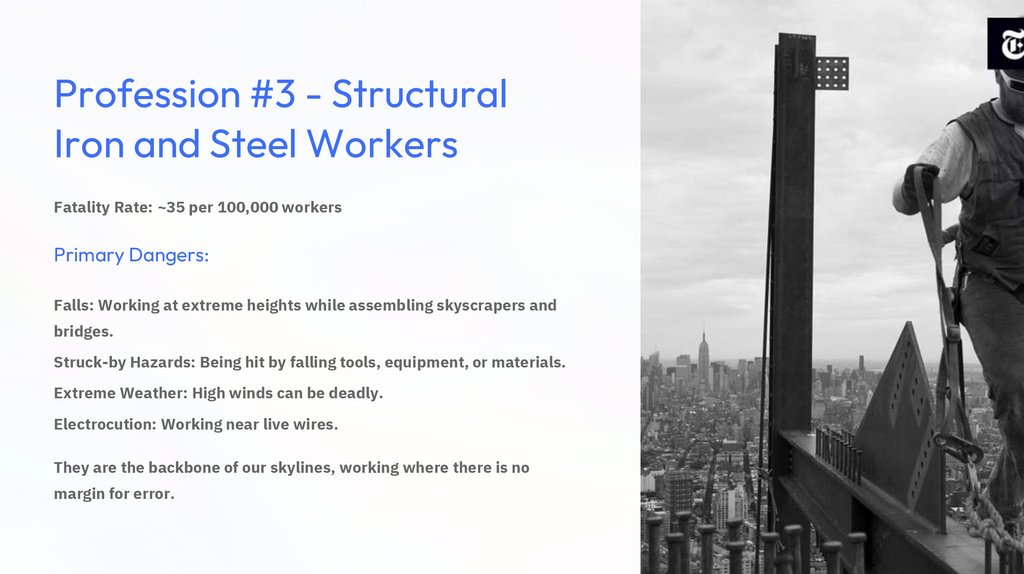
Profession #3 - StructuralIron and Steel Workers
Fatality Rate: ~35 per 100,000 workers
Primary Dangers:
Falls: Working at extreme heights while assembling skyscrapers and
bridges.
Struck-by Hazards: Being hit by falling tools, equipment, or materials.
Extreme Weather: High winds can be deadly.
Electrocution: Working near live wires.
They are the backbone of our skylines, working where there is no
margin for error.
7.
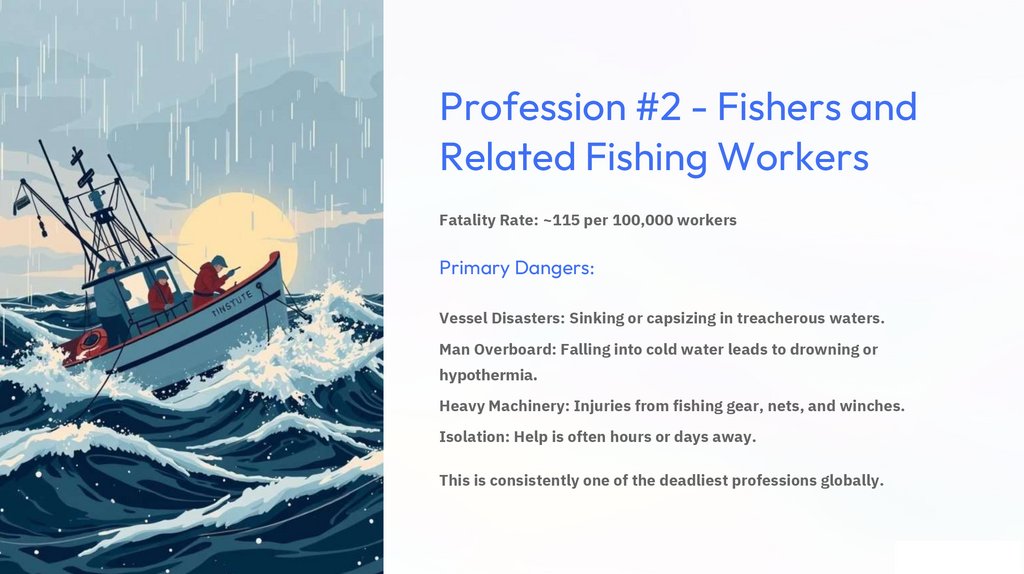
Profession #2 - Fishers andRelated Fishing Workers
Fatality Rate: ~115 per 100,000 workers
Primary Dangers:
Vessel Disasters: Sinking or capsizing in treacherous waters.
Man Overboard: Falling into cold water leads to drowning or
hypothermia.
Heavy Machinery: Injuries from fishing gear, nets, and winches.
Isolation: Help is often hours or days away.
This is consistently one of the deadliest professions globally.
8.
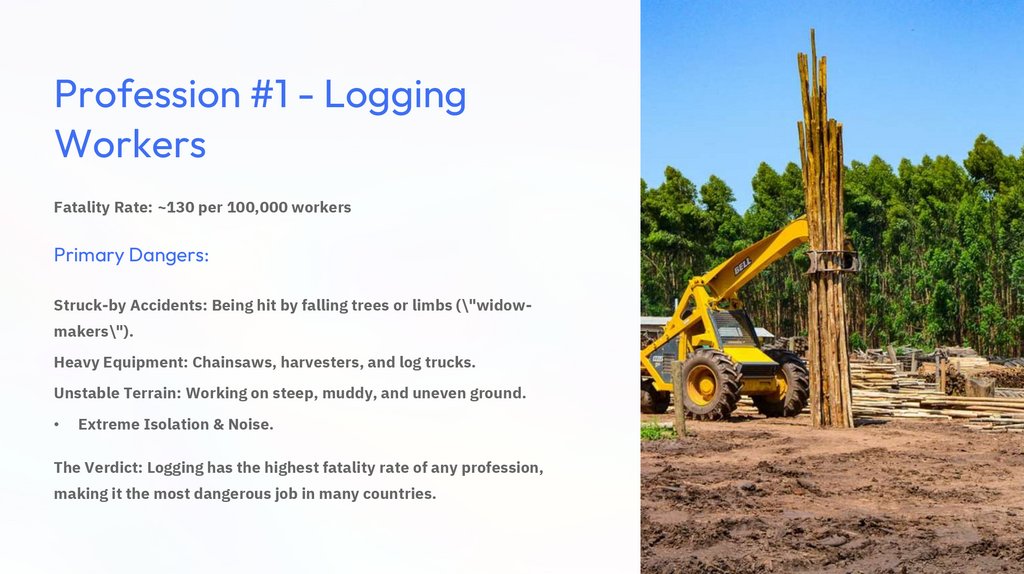
Profession #1 - LoggingWorkers
Fatality Rate: ~130 per 100,000 workers
Primary Dangers:
Struck-by Accidents: Being hit by falling trees or limbs (\"widowmakers\").
Heavy Equipment: Chainsaws, harvesters, and log trucks.
Unstable Terrain: Working on steep, muddy, and uneven ground.
Extreme Isolation & Noise.
The Verdict: Logging has the highest fatality rate of any profession,
making it the most dangerous job in many countries.
9.
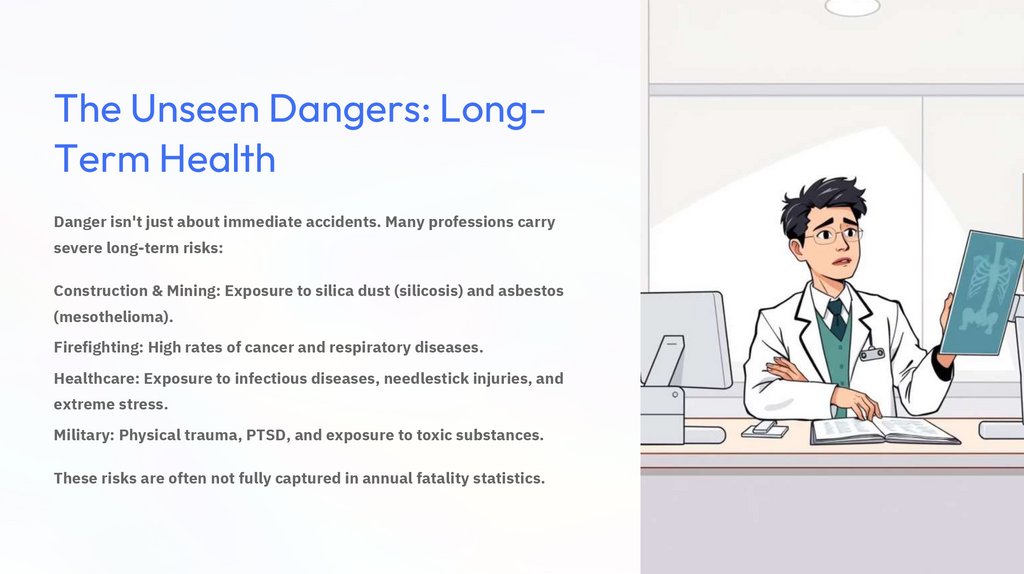
The Unseen Dangers: LongTerm HealthDanger isn't just about immediate accidents. Many professions carry
severe long-term risks:
Construction & Mining: Exposure to silica dust (silicosis) and asbestos
(mesothelioma).
Firefighting: High rates of cancer and respiratory diseases.
Healthcare: Exposure to infectious diseases, needlestick injuries, and
extreme stress.
Military: Physical trauma, PTSD, and exposure to toxic substances.
These risks are often not fully captured in annual fatality statistics.
10.
Conclusion & Safety FirstSummary
The most dangerous jobs often involve working at heights, with transportation, or in unpredictable natural environments.
Logging, Fishing, and Construction consistently top the lists.
The Path Forward:
Strict Safety Regulations: Enforcement of OSHA (Occupational Safety and Health Administration) standards is crucial.
Improved Technology & PPE: Better gear, machinery, and communication devices save lives.
Continuous Training: Preparing workers for worst-case scenarios.
Final Thought: These professions are essential to our society. Recognizing their risks is the first step toward ensuring these
workers return home safely every day.