


 Менеджмент
Похожие презентации:










«Online Surveys: The Key to Uncovering User Needs»
1.
«Online Surveys:The Key to Uncovering User Needs»
Completed by: student of group 4878M
Isaeva Ekaterina Sergeevna
Ryazan 2025 г.
2.
Requirements elicitationThe process of collecting, analyzing,
documenting, and understanding the
needs and constraints of stakeholders
and users.
Subject area
Online surveys
An effective content format and a tool that
allows you to establish a strong connection
between the brand and the audience and
find out their opinion about the product.
Features of questionnaires
Structured
Types of questions
Logical sequence
Clarity and brevity
Anonymity
Digital integration
2
3.
RelevanceIn the modern world, business automation is widespread and it
is necessary to identify them when developing requirements
for the product being developed.
Researching online surveys serves as a
key strategy for successfully identifying
and analyzing user needs, facilitating the
improvement of products and services,
and
enhancing
overall
customer
satisfaction.
Today, the method of identifying requirements through online
surveys is becoming increasingly popular.
The use of online surveys allows for:
• Real-time data collection
• Wide audience coverage
• Reduction of time and financial costs
• Ensuring respondent anonymity
3
4.
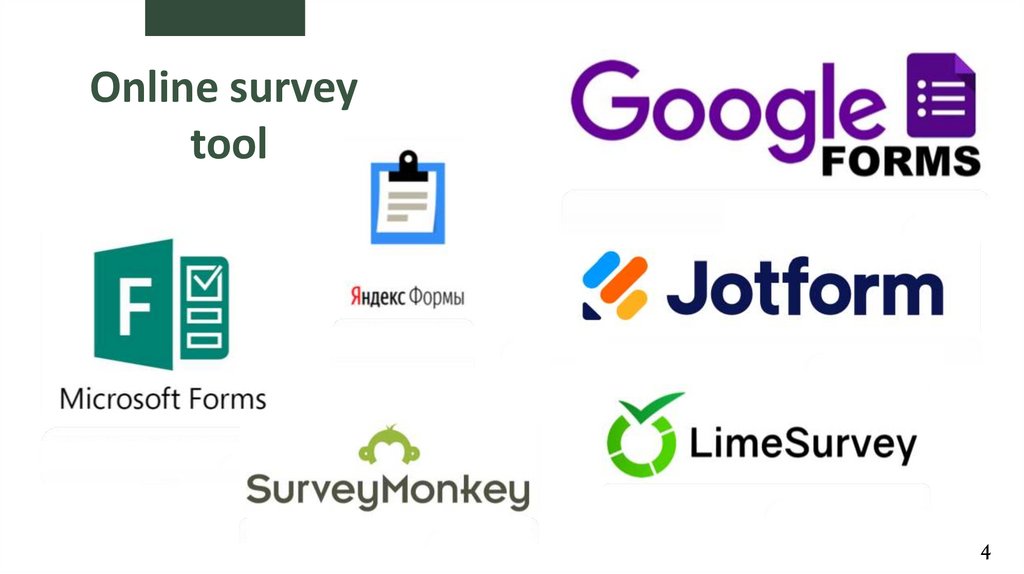
Online surveytool
4
5.
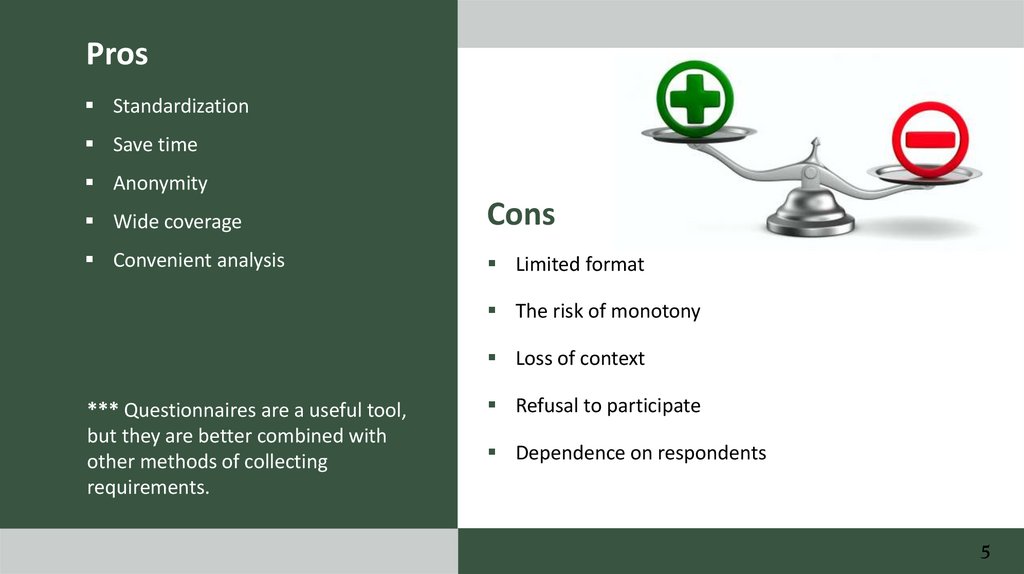
ProsStandardization
Save time
Anonymity
Wide coverage
Cons
Convenient analysis
Limited format
The risk of monotony
Loss of context
*** Questionnaires are a useful tool,
but they are better combined with
other methods of collecting
requirements.
Refusal to participate
Dependence on respondents
5
6.
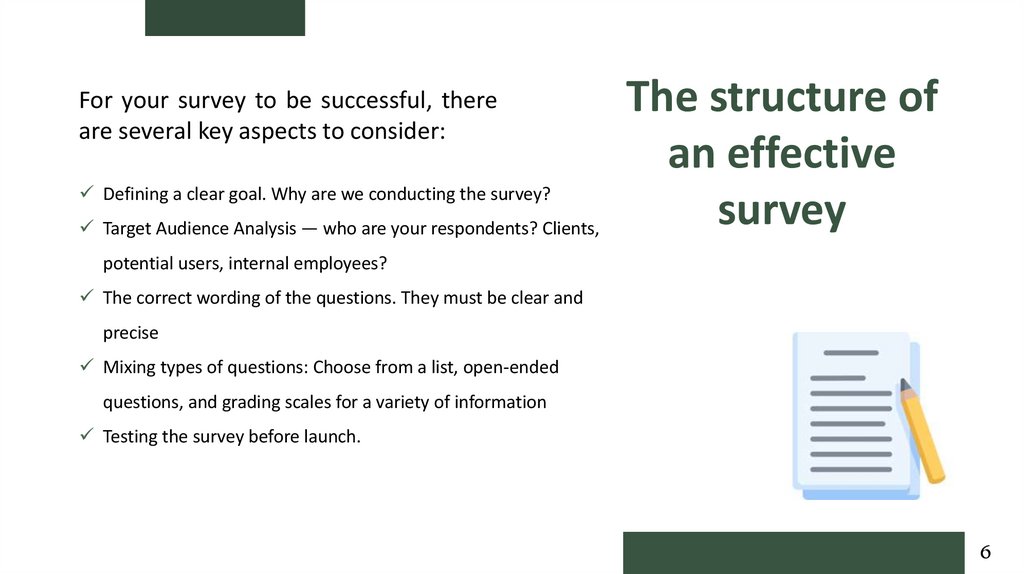
The structure ofan effective
Defining a clear goal. Why are we conducting the survey?
survey
Target Audience Analysis — who are your respondents? Clients,
For your survey to be successful, there
are several key aspects to consider:
potential users, internal employees?
The correct wording of the questions. They must be clear and
precise
Mixing types of questions: Choose from a list, open-ended
questions, and grading scales for a variety of information
Testing the survey before launch.
6
7.
Common mistakes when conductingonline surveys
Avoiding mistakes is very important:
Excessive number of questions — delays the participants and reduces the completion
rate of the survey. Try not to exceed 10-15 questions.
Unclear or ambiguous wording — causes misunderstandings among respondents.
Lack of purposefulness — if the questions are not related to the goal, the data obtained
will be meaningless.
Tracking and analyzing only positive responses — it is important to take into account
opposing opinions for objective conclusions.
Ignoring feedback after the survey — after collecting the data, be sure to analyze it and
inform the participants about the results or the measures taken.
7
8.
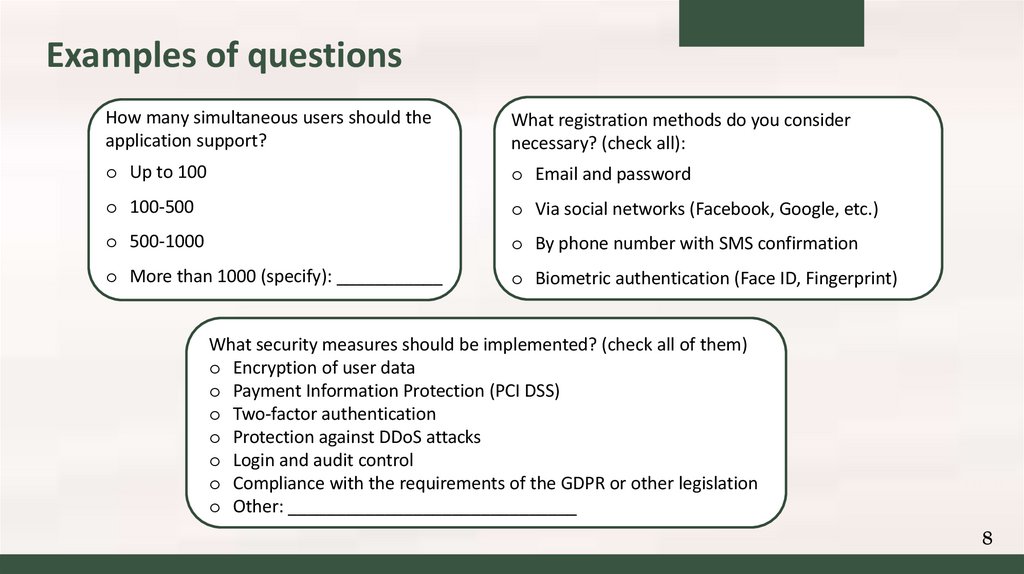
Examples of questionsHow many simultaneous users should the
application support?
What registration methods do you consider
necessary? (check all):
o Up to 100
o Email and password
o 100-500
o Via social networks (Facebook, Google, etc.)
o 500-1000
o By phone number with SMS confirmation
o More than 1000 (specify): ___________
o Biometric authentication (Face ID, Fingerprint)
What security measures should be implemented? (check all of them)
o Encryption of user data
o Payment Information Protection (PCI DSS)
o Two-factor authentication
o Protection against DDoS attacks
o Login and audit control
o Compliance with the requirements of the GDPR or other legislation
o Other: ______________________________
8
9.
Results-
Questionnaires are an important stage in the preparation of
technical specifications
-
They allow you to collect a complete, accurate and structured
set of requirements
-
A professional approach to creating and analyzing surveys
improves the quality of the final product
-
Questionnaires work best in combination with other methods
of identifying requirements (interviews, focus groups)
-
Careful formulation of questions and their adaptation to the
target audience are key to obtaining high-quality and useful
data, avoiding misunderstandings and discrepancies
9