 Английский язык
Похожие презентации:




How english words are made. Word-building
1. HOW ENGLISH WORDS ARE MADE. WORD-BUILDING
Secondary ways of word-building2. What branch of lexicology will give you the answer to the question
what does theword consist of?
what is the origin
of the word?
3. What branch of lexicology will give you the answer to the question
what dictionaryshould I use to
find the answer?
how is the word
formed?
4.
What are theWhat are the
3 types of meaning 3 main characteristics
a word could
a word possess as a
possess?
unit?
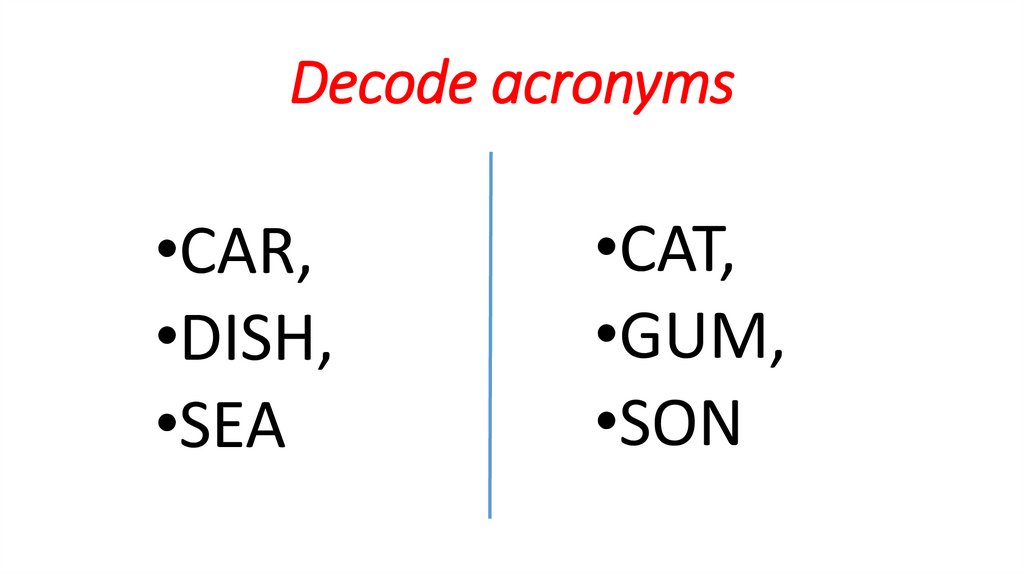
5. Decode acronyms
•CAR,•DISH,
•SEA
•CAT,
•GUM,
•SON
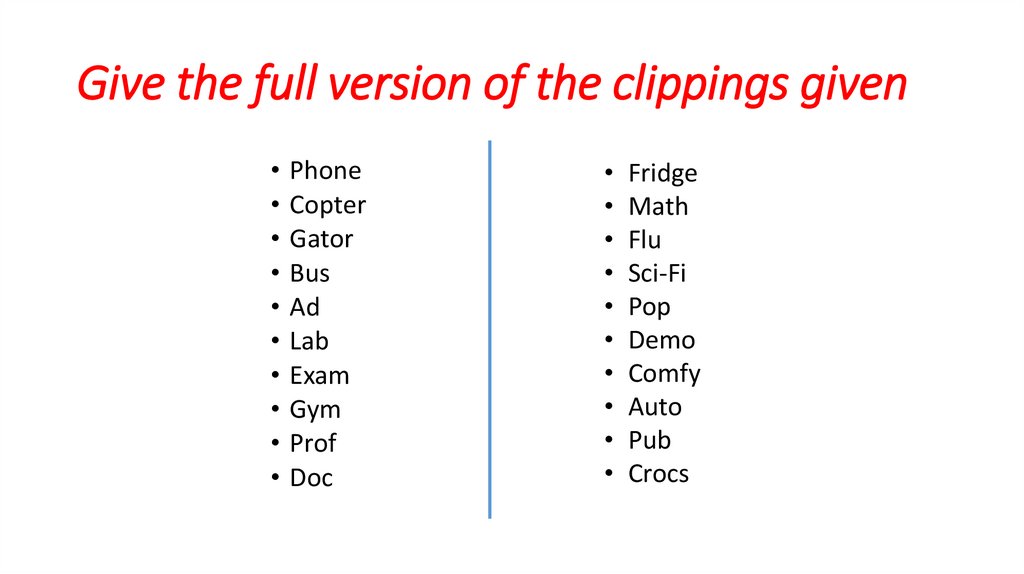
6. Give the full version of the clippings given
• Phone• Copter
• Gator
• Bus
• Ad
• Lab
• Exam
• Gym
• Prof
• Doc
• Fridge
• Math
• Flu
• Sci-Fi
• Pop
• Demo
• Comfy
• Auto
• Pub
• Crocs
7.
Explain in 5 sentencespros and cons
of secondary ways
of word-building
8. SEMASIOLOGY. WORDS AND THEIR MEANING. CHANGE OF MEANING
9.
The branch oflexicology which
deals with the
meaning
is called
SEMASIOLOGY.
The basic unit
of
semasiology is
the sememe
or the
meaning of
the word.
10.
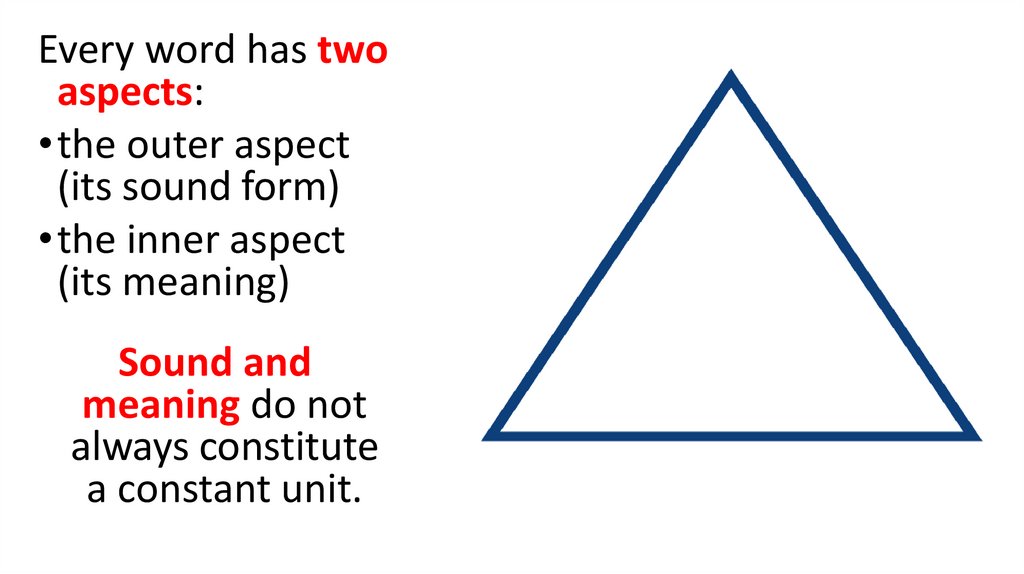
Every word has twoaspects:
•the outer aspect
(its sound form)
•the inner aspect
(its meaning)
Sound and
meaning do not
always constitute
a constant unit.
11.
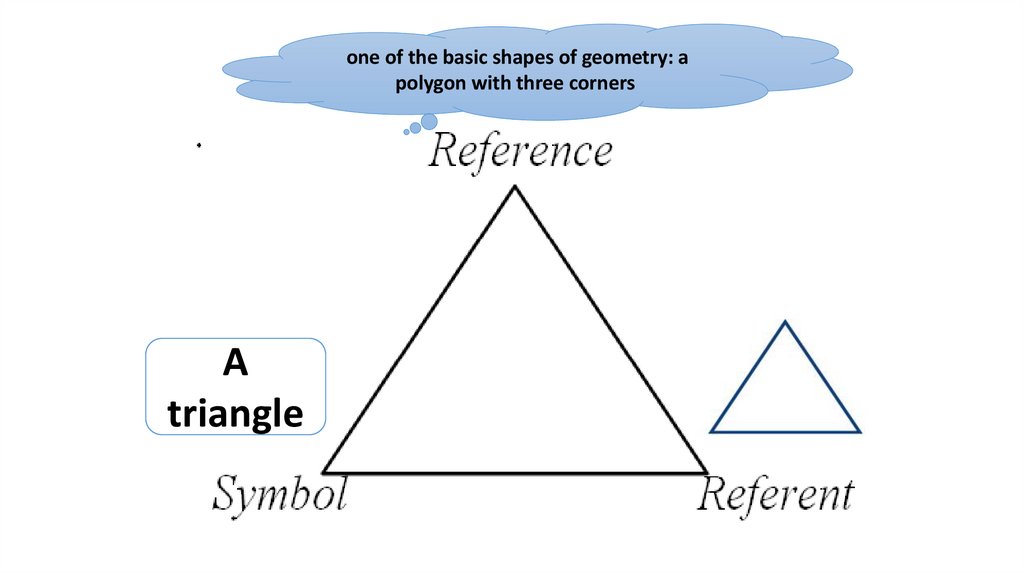
one of the basic shapes of geometry: apolygon with three corners
A
triangle
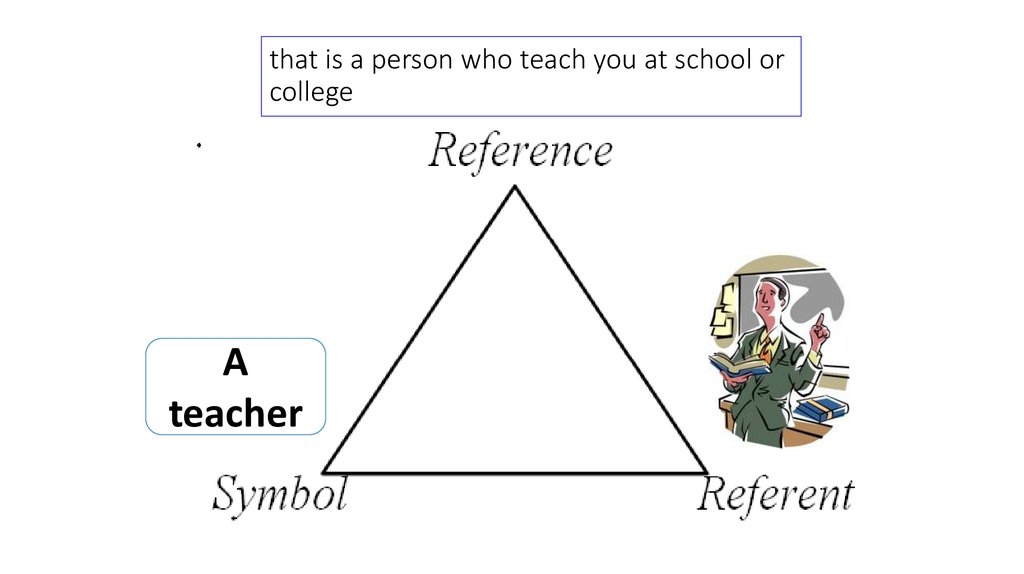
12. that is a person who teach you at school or college
Ateacher
13.
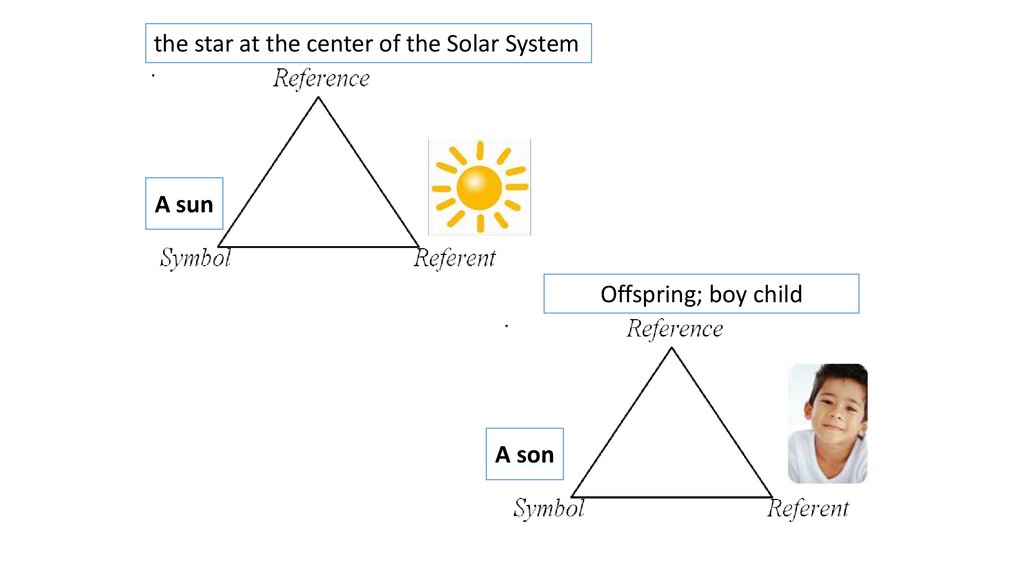
the star at the center of the Solar SystemA sun
Offspring; boy child
A son
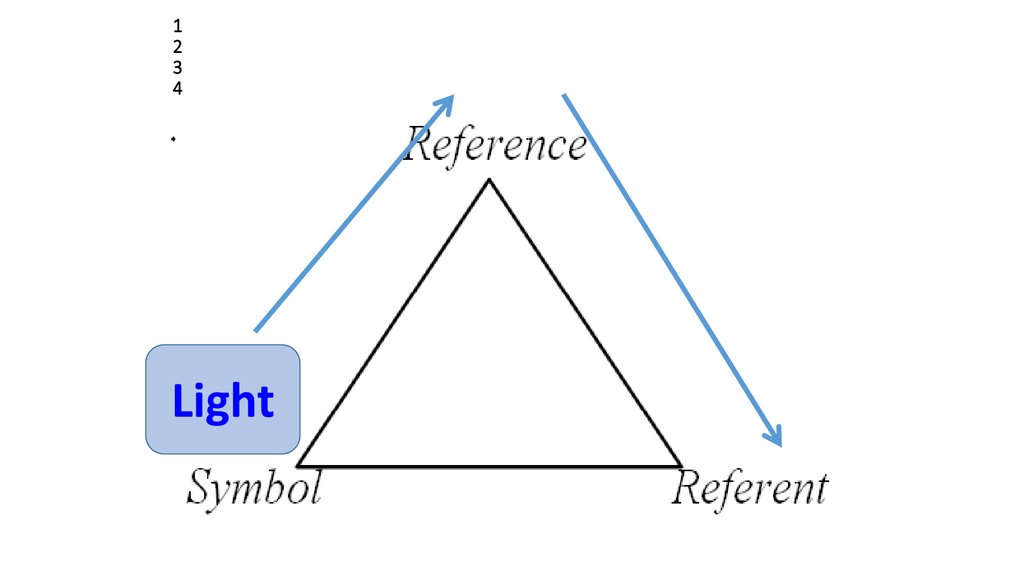
14. 1 2 3 4
Light15.
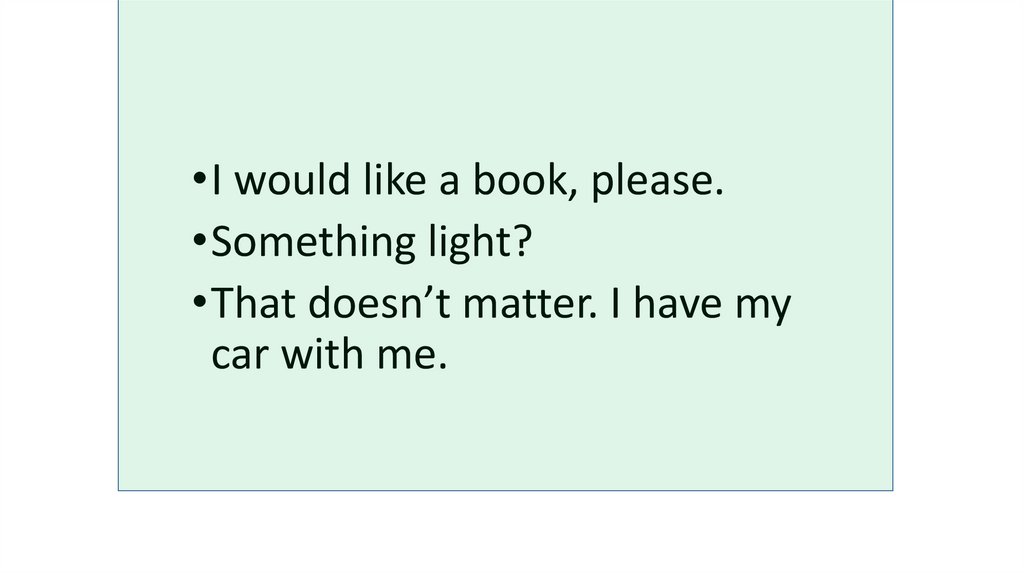
•I would like a book, please.•Something light?
•That doesn’t matter. I have my
car with me.
16.
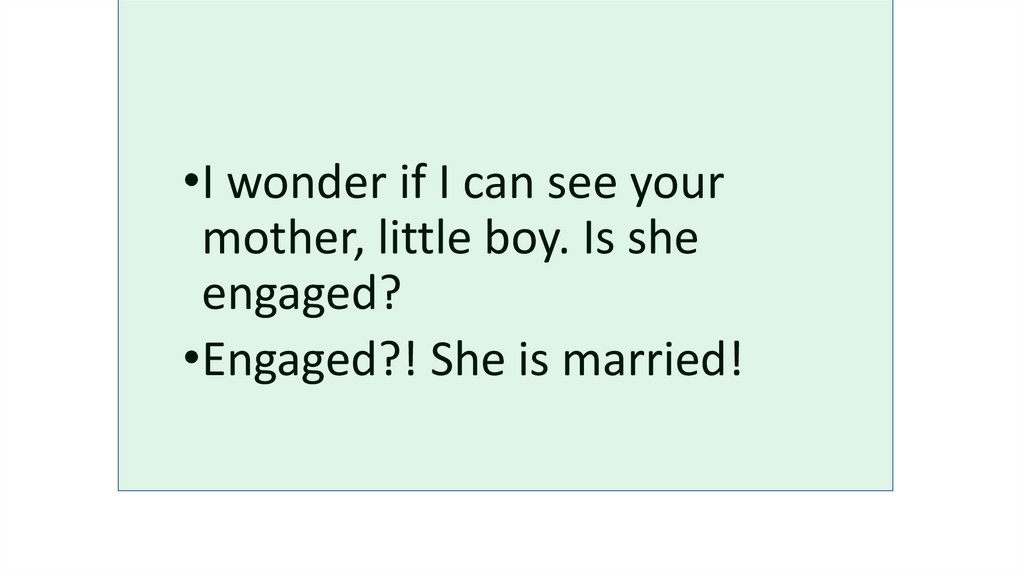
•I wonder if I can see yourmother, little boy. Is she
engaged?
•Engaged?! She is married!
17.
There are cynics who claimthat movies would be better
if they shot less films and
more actors.
18.
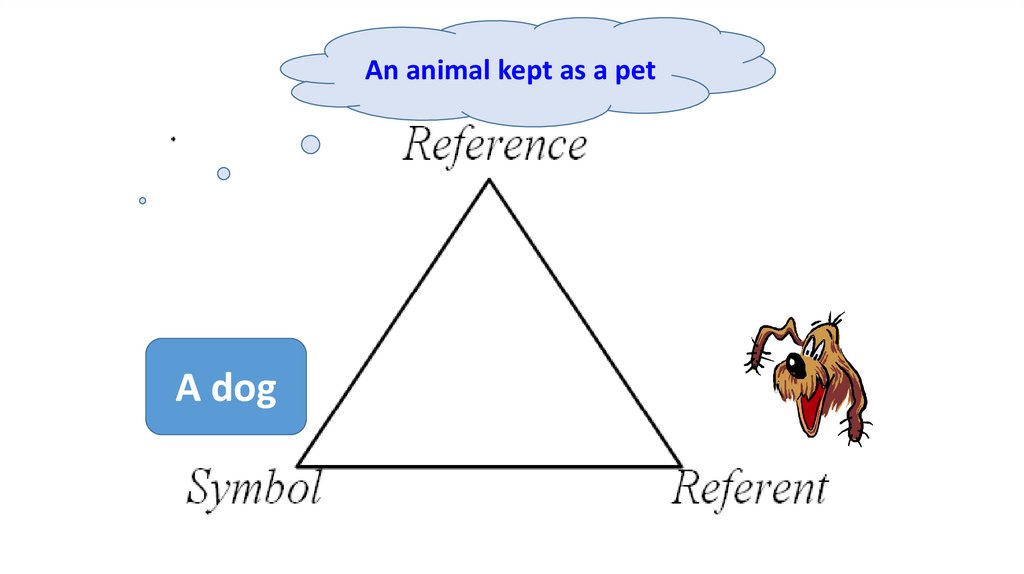
An animal kept as a petA dog
19.
NOTION –A REFERENT OR A REFERENCE??
The lexical meaning of a word is
the realization of a notion by
means of a definite language
system.
A word is a language unit, while
a notion is a unit of thinking.
20. Notions are international
«man»•«мужчина»
•«человек».
«Она хороший человек». - She
is a good person»
21. 3/ Notions are international. People all over the world dream of the same notions. Try to guess what people think of globally
reading the words:family, justice, peace, education,
creativity, love, hope, sustainability,
community, resilience.
22. Polysemy
A word whichhas more than
one meaning is
called
polysemantic.
TEMPLE
1) a part of a
human head
2) a large church
23.
Different meanings of apolysemantic word may
come together due to
the proximity of notions
which they express.
24. «blanket»
• a woolen covering used on beds,• a covering for keeping a horse
warm,
• a covering of any kind /a blanket
of snow/,
• covering all or most cases /used
attributively/, e.g. we can say «a
blanket insurance policy».
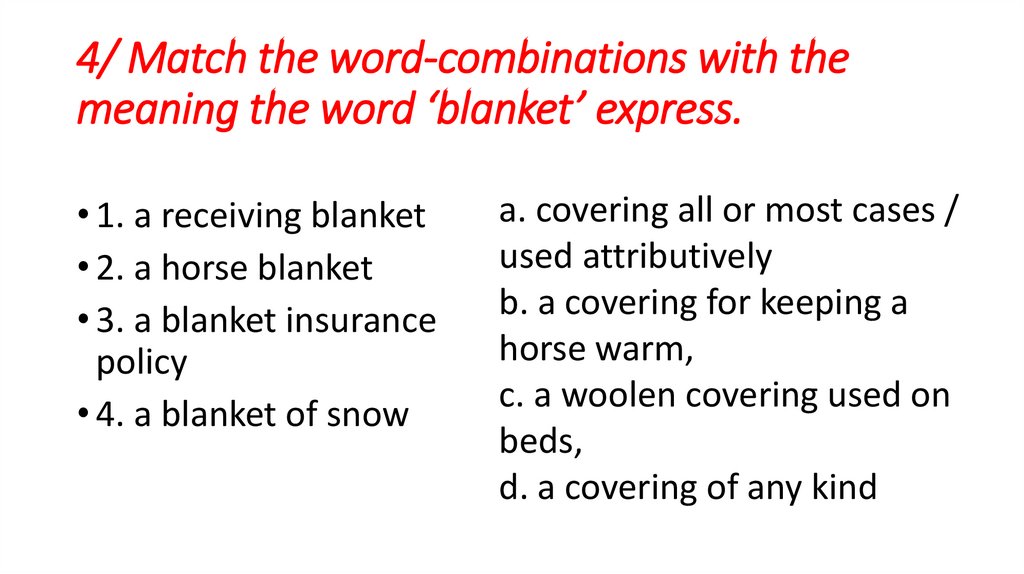
25. 4/ Match the word-combinations with the meaning the word ‘blanket’ express.
• 1. a receiving blanket• 2. a horse blanket
• 3. a blanket insurance
policy
• 4. a blanket of snow
a. covering all or most cases /
used attributively
b. a covering for keeping a
horse warm,
c. a woolen covering used on
beds,
d. a covering of any kind
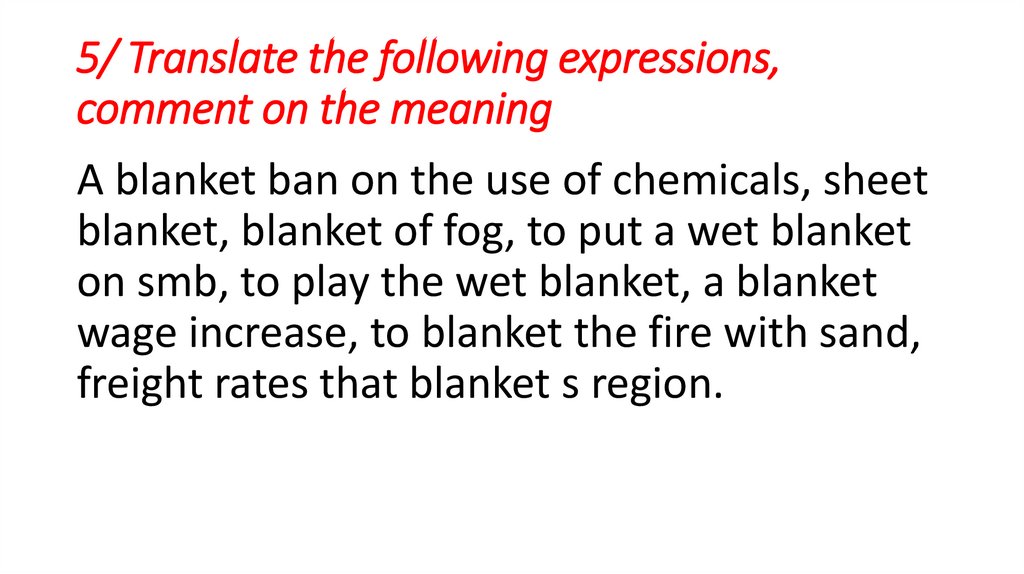
26. 5/ Translate the following expressions, comment on the meaning
A blanket ban on the use of chemicals, sheetblanket, blanket of fog, to put a wet blanket
on smb, to play the wet blanket, a blanket
wage increase, to blanket the fire with sand,
freight rates that blanket s region.
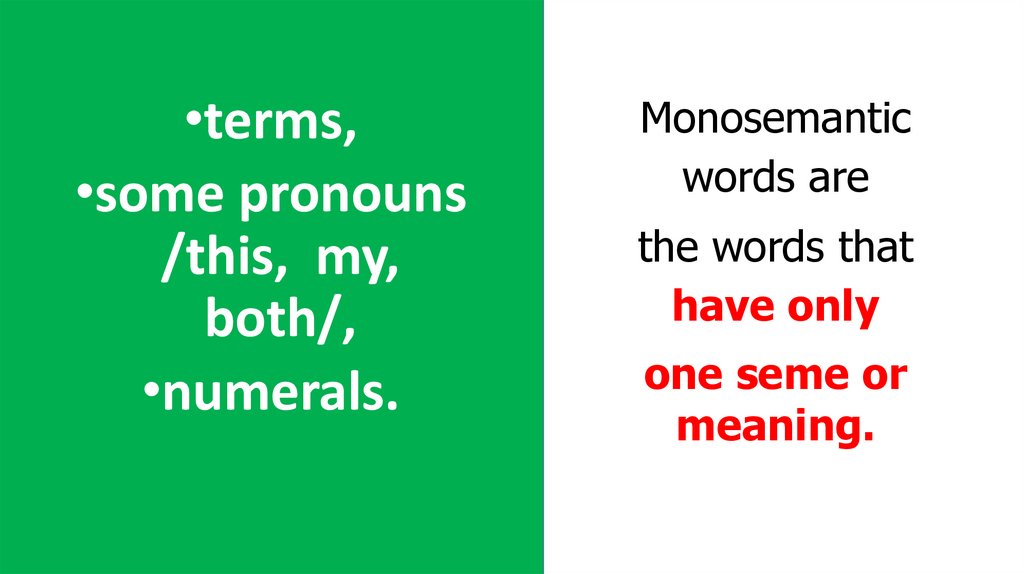
27.
•terms,•some pronouns
/this, my,
both/,
•numerals.
Monosemantic
words are
the words that
have only
one seme or
meaning.
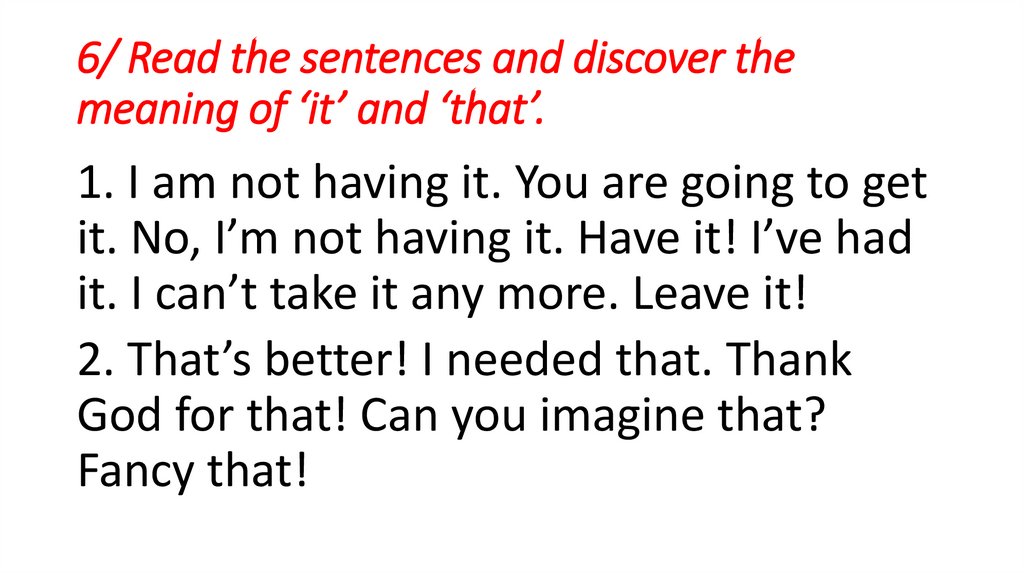
28. 6/ Read the sentences and discover the meaning of ‘it’ and ‘that’.
1. I am not having it. You are going to getit. No, I’m not having it. Have it! I’ve had
it. I can’t take it any more. Leave it!
2. That’s better! I needed that. Thank
God for that! Can you imagine that?
Fancy that!
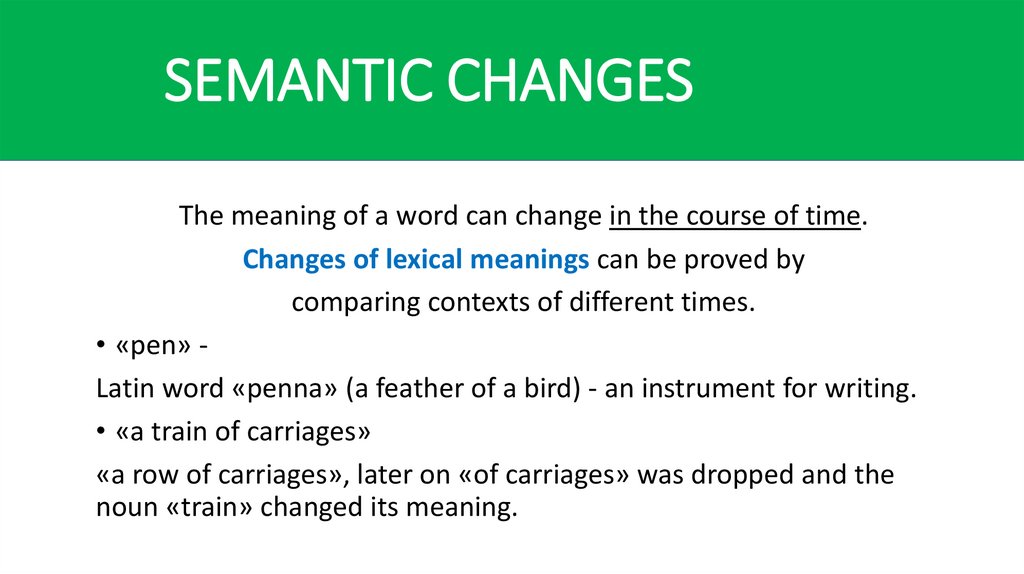
29. SEMANTIC CHANGES
The meaning of a word can change in the course of time.Changes of lexical meanings can be proved by
comparing contexts of different times.
• «pen» Latin word «penna» (a feather of a bird) - an instrument for writing.
• «a train of carriages»
«a row of carriages», later on «of carriages» was dropped and the
noun «train» changed its meaning.
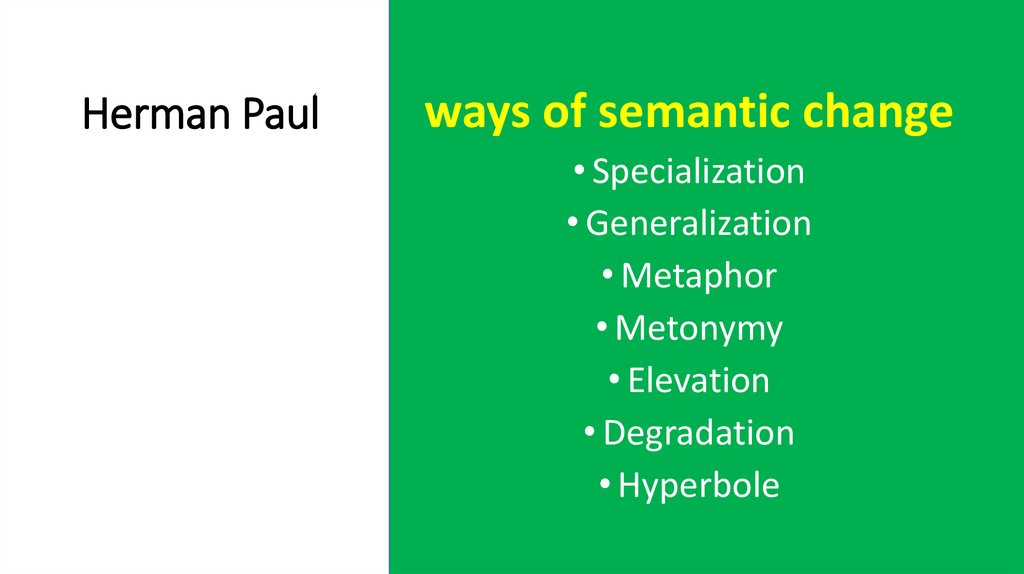
30. Herman Paul
ways of semantic change• Specialization
• Generalization
• Metaphor
• Metonymy
• Elevation
• Degradation
• Hyperbole
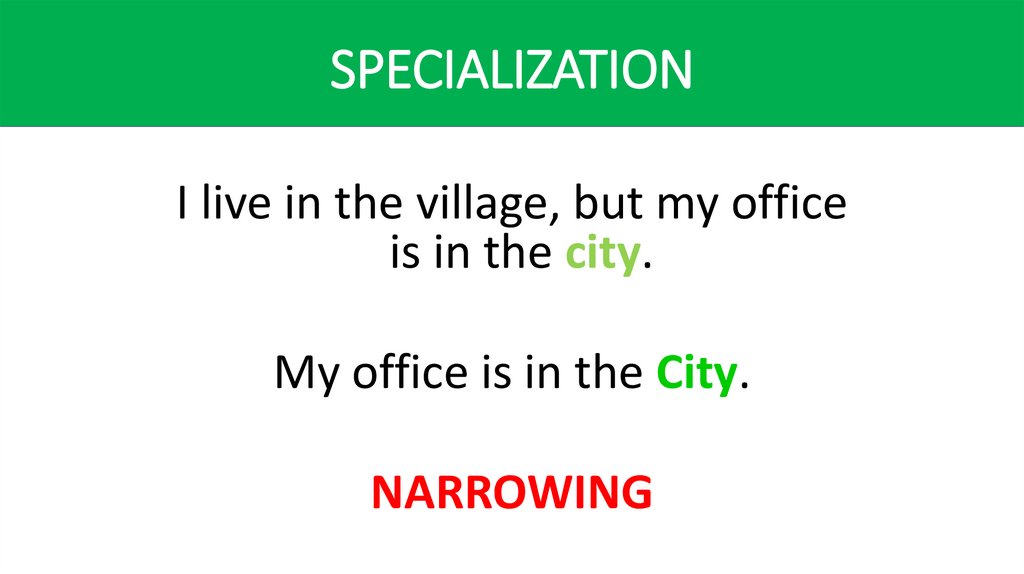
31. SPECIALIZATION
I live in the village, but my officeis in the city.
My office is in the City.
NARROWING
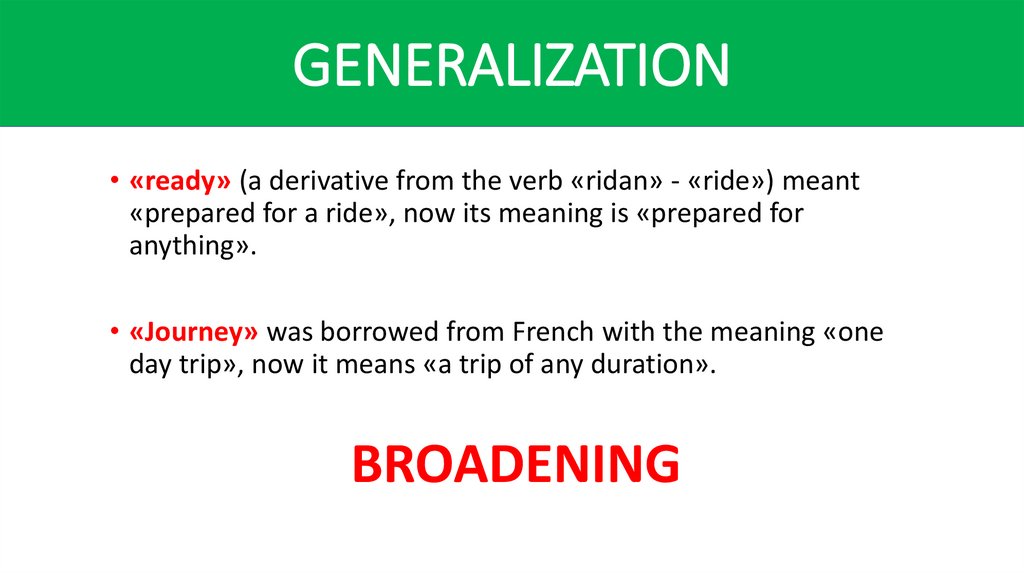
32. GENERALIZATION
• «ready» (a derivative from the verb «ridan» - «ride») meant«prepared for a ride», now its meaning is «prepared for
anything».
• «Journey» was borrowed from French with the meaning «one
day trip», now it means «a trip of any duration».
BROADENING
33.
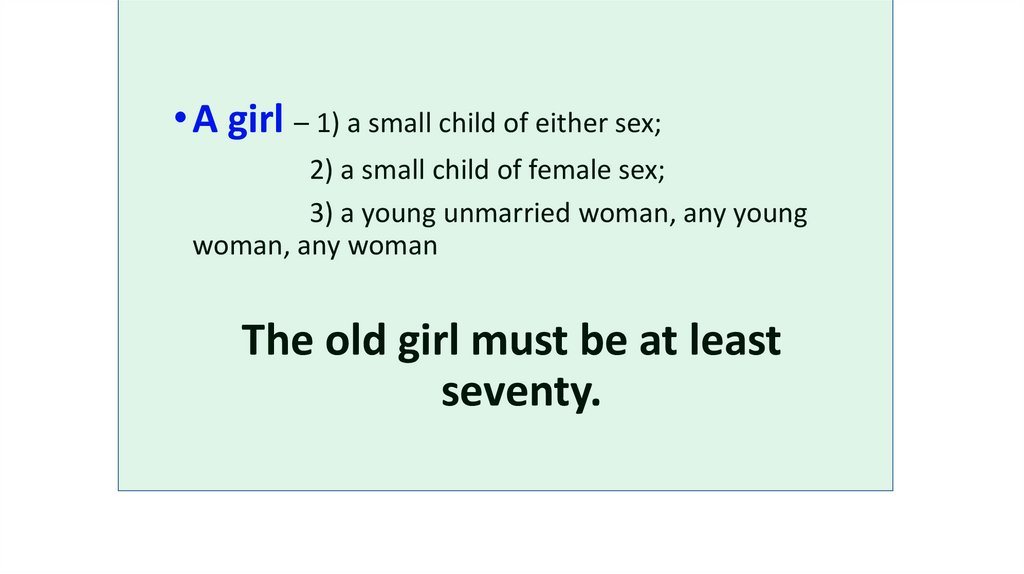
• A girl – 1) a small child of either sex;2) a small child of female sex;
3) a young unmarried woman, any young
woman, any woman
The old girl must be at least
seventy.
34.
What has eyes yetnever sees?
35. METAPHOR
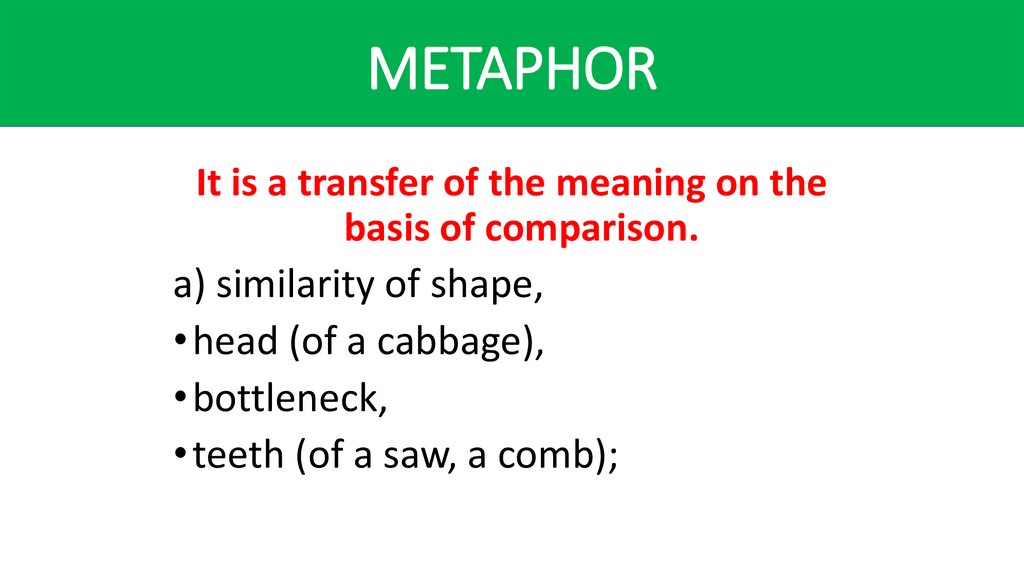
It is a transfer of the meaning on thebasis of comparison.
a) similarity of shape,
• head (of a cabbage),
• bottleneck,
• teeth (of a saw, a comb);
36. METAPHOR
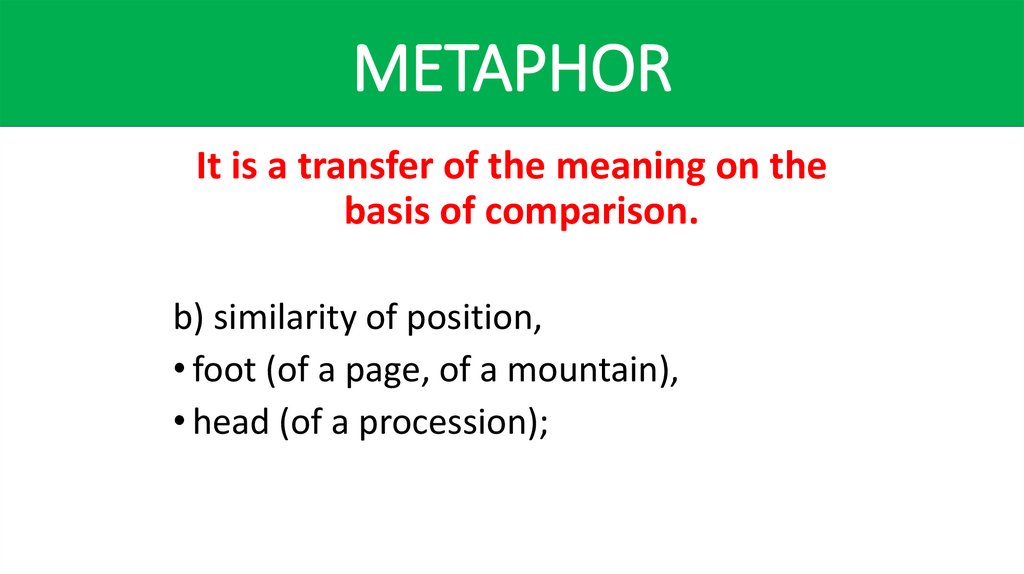
It is a transfer of the meaning on thebasis of comparison.
b) similarity of position,
• foot (of a page, of a mountain),
• head (of a procession);
37. METAPHOR
It is a transfer of the meaning on thebasis of comparison.
c) similarity of function, behaviour
• a whip (an official in the British Parliament whose
duty is to see that members were present at the
voting);
38. METAPHOR
METAPHORIt is a transfer of the meaning on the
basis of comparison.
d) similarity of colour,
• orange,
• hazel,
• chestnut etc.
39.
• I put the letter into the mouth of the box.• Those who had been the head of the lines
paused momentarily …
• They sat on the rag before the fireplace
watching the rising tongues of flame.
• He inspired universal confidence and had
an iron nerve.
• As I walked past … they were already
carrying out the Renoirs.
40. 8/ Complete the phrases with the words given 0 Green tongue eye hand coat wing heart tooth
• The ____ of a bird – the ____ of a building;• The ____ of a man – the ____ of a needle;
• The ____ of a child – the ____ of a clock;
• The ____of a man – the _____of the matter;
• The _____ of a person – the _____ of a bell;
• The _____ of a boy – the _____ of a comb;
• The ______of a girl – the _____ of a dog.
• ______ grass – ______ years;
41.
Father was explaining to his little son thefundamentals of astronomy.
• That’s a comet.
• A what?
• A comet. You know what a comet is?
• No.
• Don’t you know what they call a star with
a tail?
• Sure – Mickey Mouse.
42.
• Pa, what branches did you take whenyou went to school?
• I never went to high school, son, but
when I attended the little log schoolhouse they used mostly hickory and
beech and willow.
• Lug – деревянный, Hickory – орешник, beech – береза,
willow – ива
43.
A telephone conversation•I want a box for two.
•Sorry, but we don’t have boxes for
two.
•But aren’t you the box office of
the theatre?
•No, we are undertakers.
44. METONYMY
It is a transfer of the meaningon the basis of contiguity.
a) the material of which an object is made may become
the name of the object ,
• a glass,
• boards,
• iron, etc;
45. METONYMY
METONYMYIt is a transfer of the meaning
on the basis of contiguity.
b) the name of the place may become the name of the
people or of an object placed there,
• Fleet Street - bourgeois press,
• the White House - the Administration of the USA, etc;
46. METONYMY
METONYMYIt is a transfer of the meaning
on the basis of contiguity.
c) the name of some person may become a common
noun,
• «boycott»,
• «sandwich»;
47. METONYMY
METONYMYIt is a transfer of the meaning
on the basis of contiguity.
e) names of inventors very often become terms to
denote things they invented,
• «watt» ,
• «om»,
• «roentgen» etc
48. METONYMY
METONYMYIt is a transfer of the meaning
on the basis of contiguity.
f) some geographical names can become common
nouns,
Brussels (a special kind of carpets),
china (porcelain) ,
astrakhan (a sheep fur), etc.
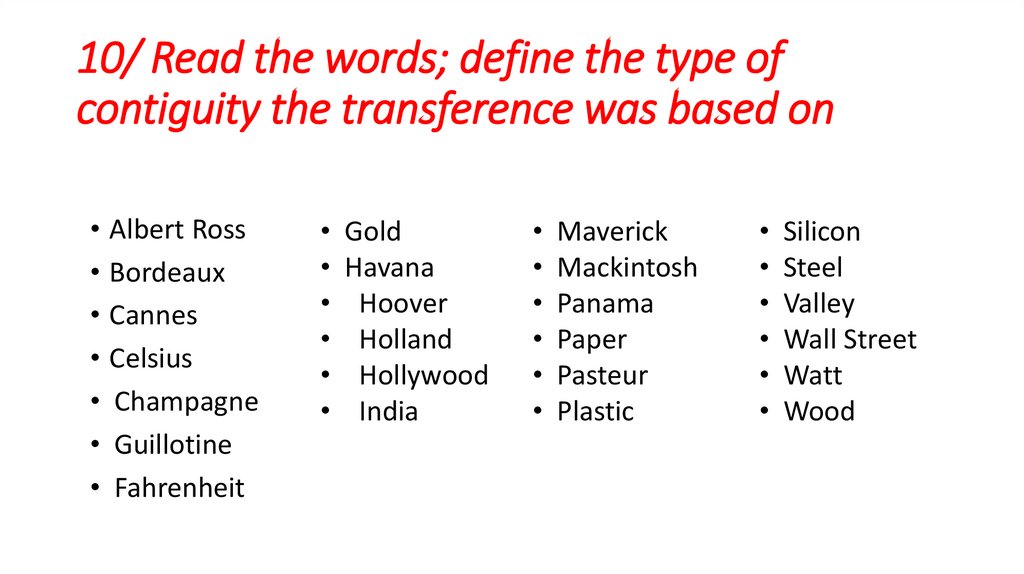
49. 10/ Read the words; define the type of contiguity the transference was based on
• Albert Ross• Bordeaux
• Cannes
• Celsius
• Champagne
• Guillotine
• Fahrenheit
• Gold
• Havana
• Hoover
• Holland
• Hollywood
• India
• Maverick
• Mackintosh
• Panama
• Paper
• Pasteur
• Plastic
• Silicon
• Steel
• Valley
• Wall Street
• Watt
• Wood
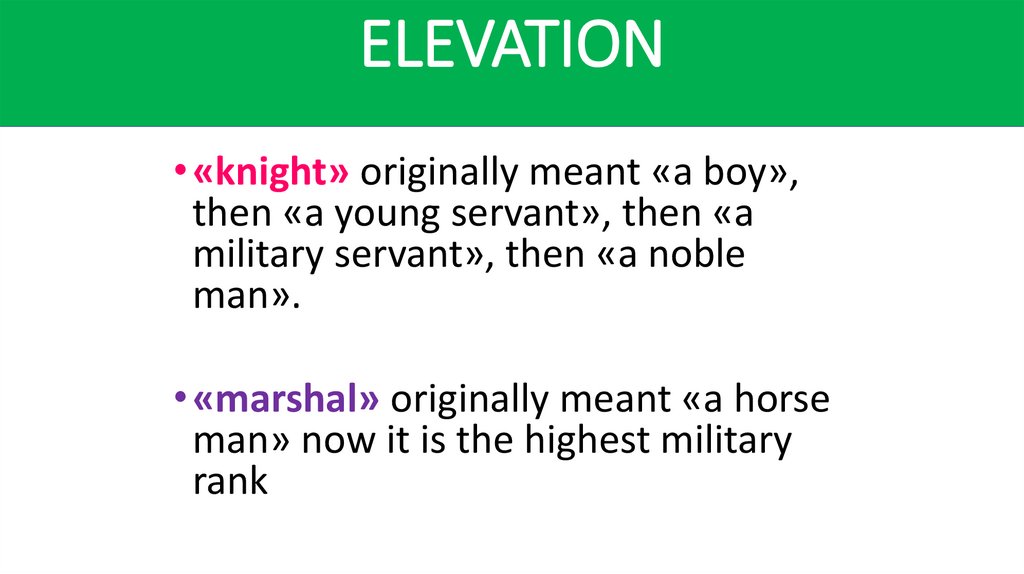
50. ELEVATION
• «knight» originally meant «a boy»,then «a young servant», then «a
military servant», then «a noble
man».
• «marshal» originally meant «a horse
man» now it is the highest military
rank
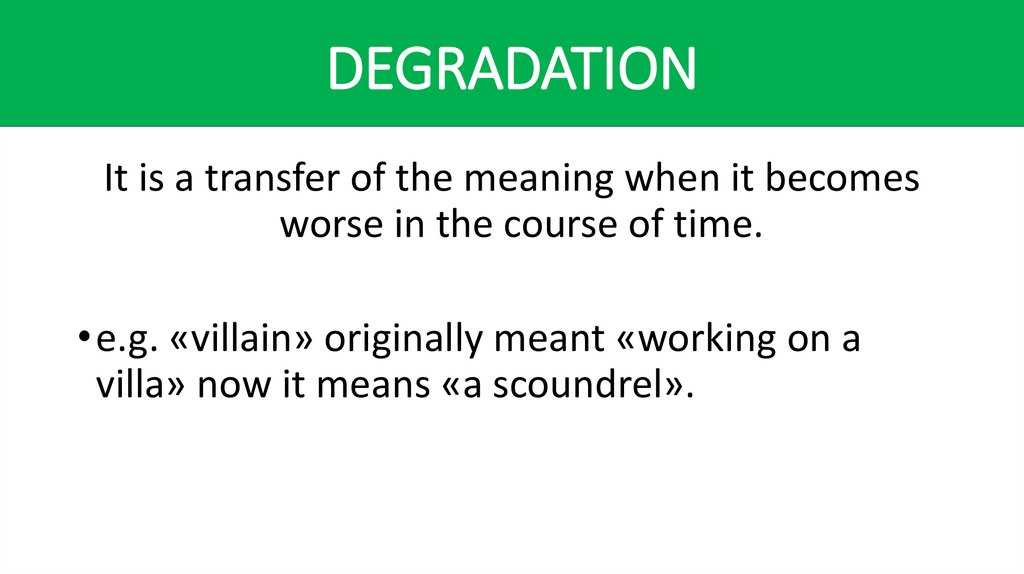
51. DEGRADATION
It is a transfer of the meaning when it becomesworse in the course of time.
• e.g. «villain» originally meant «working on a
villa» now it means «a scoundrel».
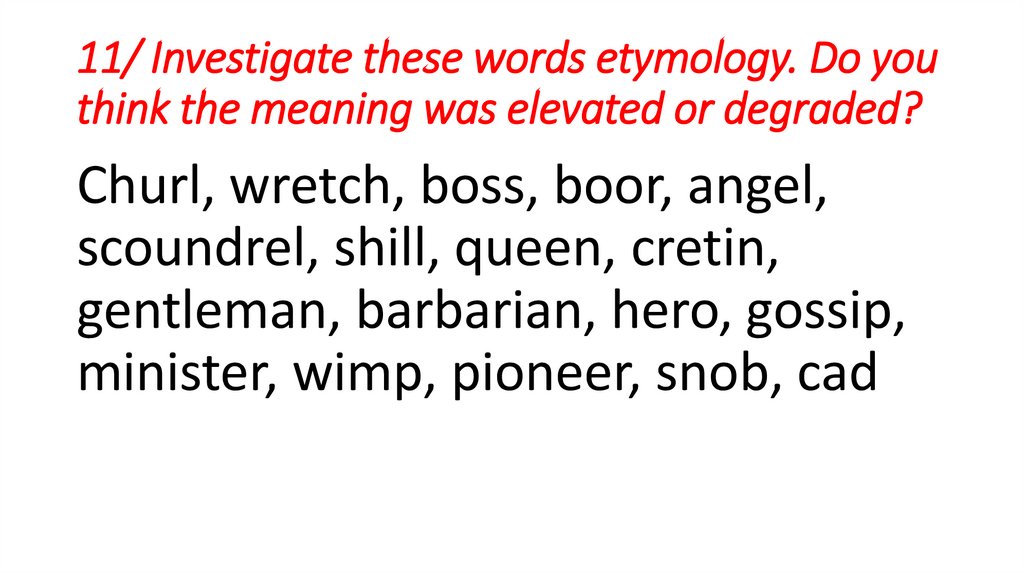
52. 11/ Investigate these words etymology. Do you think the meaning was elevated or degraded?
Churl, wretch, boss, boor, angel,scoundrel, shill, queen, cretin,
gentleman, barbarian, hero, gossip,
minister, wimp, pioneer, snob, cad
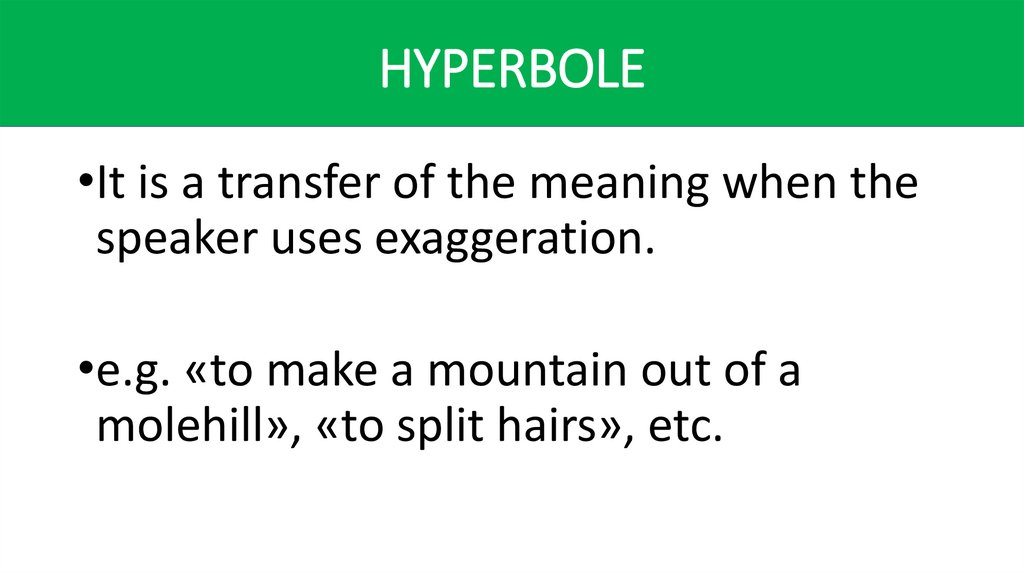
53. HYPERBOLE
•It is a transfer of the meaning when thespeaker uses exaggeration.
•e.g. «to make a mountain out of a
molehill», «to split hairs», etc.
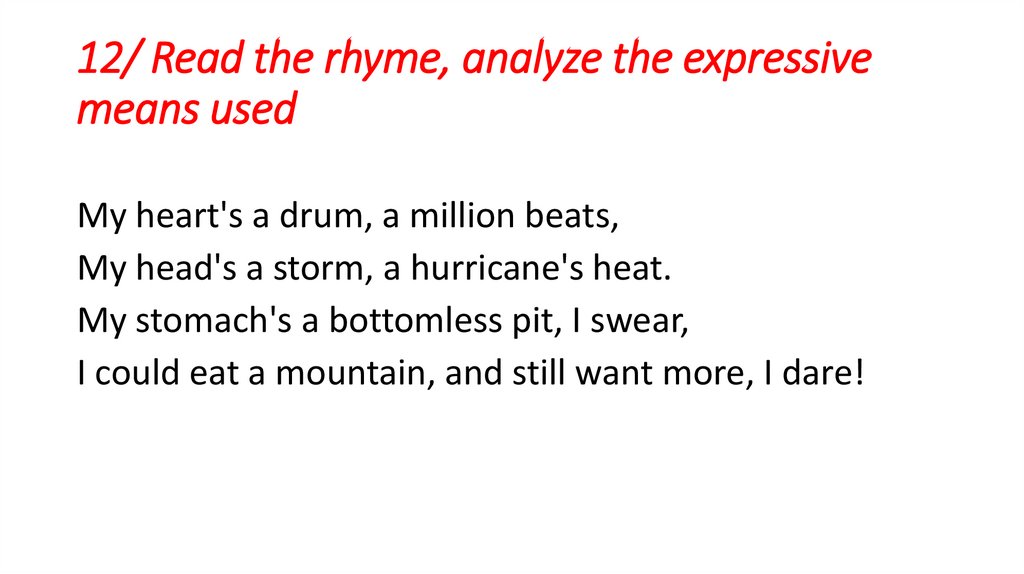
54. 12/ Read the rhyme, analyze the expressive means used
My heart's a drum, a million beats,My head's a storm, a hurricane's heat.
My stomach's a bottomless pit, I swear,
I could eat a mountain, and still want more, I dare!