 Английский язык
Похожие презентации:




Phonetics as a branch of Linguistics
1.
Phonetics as a branch of Linguistics1.1. The subject-matter of phonetics.
1.2. Branches and divisions of phonetics.
1.3. Methods of phonetic investigation.
1.4. Phonetics and other disciplines.
1.5. Practical application and theoretical
significance of phonetics.
2.
The subject-matter of phoneticsThe word “phonetics" is derived from the Greek “φωνη” (sound).
Phonetics is not a separate science. It is a branch of linguistics,
like the other branches, such as grammar, lexicology and
stylistics. It studies the phonetic structure of the language, i.e.
speech sounds, word stress, syllabic structure and intonation.
These four components form the pronunciation of a language.
3.
Phonetics is quite independent and develops according toits own laws. As an independent branch of linguistics, it has
developed branches of its own.
The sphere of phonetics is wide and deep. It deals with
phonemes and their distribution in words, their mutual
adaptation, syllable formation, stress, intonation, the relation
between oral and written speech and a number of other
problems.
4.
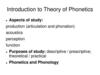
1.2. BRANCHES AND DIVISIONS OF PHONETICSSpeech sounds have four aspects:
- articulatory
-acoustic
-auditory
-functional (social).
According to V.A. Vassilyev, these four aspects cannot be
separated from one another in the actual process of
communication, but each of these four aspects can be singled
out for purposes of linguistic analysis and thus becomes a
separate object of investigation, which necessitates the division
of phonetics as a science into several branches. Each of these
branches of phonetics has its own methods of investigation and
its own terminology.
5.
The branch of phonetics which isconcerned with the study, description and
classification of speech sounds as regards
their production by the human organs of
speech is called articulatory phonetics.
6.
Acoustic phonetics studies the way in which the air vibratesbetween the speaker’s mouth and the listener’s ear, in other
words, the acoustic aspect of speech sounds.
It is sometimes called experimental, instrumental or laboratory
phonetics, because experimental methods and instrumental
techniques are widely used here.
7.
The branch of phonetics investigating thehearing process is auditory phonetics.
8.
The branch of phonetics that studies thefunctional (linguistic, social) aspect of speech
sounds and all the other components of the sound
matter of the language (syllabic structure, word
stress and intonation) is called phonology. It
investigates sounds as units that serve
communicative purposes.
9.
Traditionally phonetics is divided into generalphonetics which studies the nature of phonetic
phenomena and formulates phonetic laws and
principles and special phonetics which is concerned
with the phonetic structure of a particular language.
10.
Special phonetics is subdivided into descriptive and historical.Special descriptive phonetics studies the phonetic structure of
the language synchronically (i.e. it studies its contemporary
phonetic system), while historical phonetics looks at it in its
historical development (diachronically). The study of the
historical development of the phonetic system of a language
helps to understand its present and predict its future.
11.
Closely connected with historical phonetics iscomparative phonetics which studies the correlation
between the phonetic systems of two or more languages.
Another important division of phonetics is into
segmental phonetics, which is concerned with individual
sounds (i.e. “segments” of speech) and suprasegmental
phonetics, which deals with the larger units of connected
speech: syllables, words, phrases and texts.
12.
Practical phonetics studies the material form ofphonetic phenomena in relation to meaning.
Theoretical phonetics is mainly concerned with the
functioning of phonetic units in the language.
13.
Phonostylistics studies phonetic phenomena andprocesses from the stylistic point of view. It studies the
way phonetic means are used in this or that particular
situation.
Phonosemantics investigates the connection between
the sound form and the meaning.
14.
1.3. METHODS OF PHONETIC INVESTIGATIONM.A. Sokolova states that phoneticians
generally distinguish methods of direct
observation and instrumental methods.
15.
The methods of direct observation are the oldest,simplest and most available. They consist in observing the
movements and positions of one’s own or other people’s
organs of speech in pronouncing various speech sounds, as
well as in analysing one’s own muscle sense during the
articulation of speech sounds and comparing them with the
resultant auditory impressions.
16.
Instrumental methods were introduced intophonetics in the second half of the 19th century
in order to supplement the impressions deriving
from the human senses. They are based on the
use of special technical devices, such as hand
mirror, spectrograph, intonograph, oscillograph,
x-ray
photography
and
cinematography,
laryngoscope and others.
17.
1.4. PHONETICS AND OTHER DISCIPLINESPhonetics is one of the basic branches of linguistics
and it is closely connected with the other linguistic
disciplines: lexicology, grammar, stylistics. This
connection is determined by the fact that language is a
system whose component parts are inseparably
connected with one another, and therefore the sciences
that study these component parts must be interconnected
too.
18.
S.F. Leontyeva points out that phonetics formulates therules of pronunciation for separate sounds and sound
combinations. The rules of reading are based on the
relation of sounds to orthography and present certain
difficulties in learning the English language. Thus, vowel
sounds are pronounced not only as we name the letters
corresponding to them: the letter a [ei] can be pronounced
as [æ] – can, [ɑ:] – car, [eə] – care.
19.
Through the system of rules of reading phonetics is connectedwith grammar. It helps to pronounce singular and plural forms of
nouns, the past tense forms and past participles of English regular
verbs correctly (to beg – begged [d], to wish – wished [t]).
Another manifestation of the connection of phonetics with
grammar is sound interchange (or sound alternation). This
connection can be observed in the category of number (the
interchange of [f –v], [s –z], [θ –ð] helps to differentiate singular and
plural forms of such nouns as: calf – calves, leaf – leaves, house –
houses). Vowel interchange is connected with the tense forms of
irregular verbs (see – saw – seen, write – wrote – written).
20.
Phonetics is also connected with lexicology.Due to the accurate presence of stress, or accent, we can
distinguish certain nouns from verbs ('object предмет – to
ob'ject возражать).
Due to the position of word stress we can distinguish
between homonymous words and word groups (`blackbird
дрозд - 'black `bird черная птица). Besides we can
differentiate homographs only due to pronunciation, because
they are identical in spelling (bow [bəʊ] лук – bow поклон).
21.
S.F. Leontyeva also notes that phonetics is connected withstylistics. First of all, through intonation and its components:
speech melody, utterance stress, rhythm, pausation and voice
timbre which serve to express emotions, to distinguish between
different attitudes on the part of the author and speaker.
Phonetics is also connected with stylistics through repetition of
words, phrases and sounds. Repetition of this kind serves the
basis of rhythm, rhyme and alliteration.
22.
1.5. PRACTICAL APPLICATION AND THEORETICALSIGNIFICANCE OF PHONETICS
Phonetics is indispensable to the teaching of the pronunciation of
foreign languages. The teachers have to know the sound system
of the student’s mother tongue and the sound system of the
foreign language to be learnt so that they can help the students to
master its pronunciation. It is necessary to be able to point out
the differences between these two languages and to provide
adequate training exercises. Ear training and articulation training
are both equally important in modern language teaching.
23.
For those who work in speech therapy (logopedics)phonetics forms an essential part of the professional training
syllabus. Phonetics also enters into the training of teachers
of the deaf and dumb people and can be of relevance to a
number of medical and dental problems.
Phonetics is useful in such spheres as investigations in the
historical aspects of languages, in the field of dialectology;
designing or improving systems of writing or spelling, in
questions involving the spelling or pronunciation of personal
or place names borrowed from other languages.
24.
Nowadays phonetics is important in a number oftechnological fields connected with communication. The
results of phonetic investigations are used in
communication engineering. For example, phonetic data is
needed for creating machines converting the printed
symbols or letters into synthetic speech or automatic
typewriters that convert speech directly into printed words
on paper.
25.
According to S.F. Leontyeva, theoretical significance ofphonetics is connected with the further development of the
problem of the synchronic study and description of the phonetic
system of a national language, the comparative analysis and
description of different languages, the study of the
correspondences between them, the diachronic description of
successive changes in the phonetic system of a language or
different languages.
26.
GLOSSARY OF PHONETIC TERMSAcoustic phonetics – a branch of phonetics which deals with physical
properties of speech sounds.
Articulatory phonetics is concerned with the description and
classification of speech sounds articulated by the speech apparatus.
Comparative phonetics – a branch of phonetics which studies the
correlation between the phonetic systems of two or more languages.
Descriptive phonetics studies the contemporary phonetic system of a
language, i.e. the system of its pronunciation, and gives a description
of all the phonetic units of this language.
General phonetics is concerned with the analysis, description, and
comparison of phonetic phenomena in different languages.
Historical phonetics – a branch of phonetics, which studies phonetic
components on the diachronic level; it is a part of the history of
language, which studies the history of the development of the
phonetic laws.
27.
Phonetics – the science that studies the sound matter of the language, itssemantic functions and the lines of development.
Phonology – the science that deals with phonemes and their sequences. It
is functional phonetics since it investigates the functional side of
phonemes, accent, syllable, and intonation.
Phonosemantics investigates the connection between the sound form and
the meaning.
Phonostylistics studies the phonetic phenomena from the stylistic point of
view.
Practical phonetics studies the substance, the material form of phonetic
phenomena in relation to meaning.
Segmental phonetics deals with individual sounds, i.e. segments of
speech.
Supra-segmental phonetics is concerned with the larger units of
connected speech, i.e. syllables, words, phrases, texts.
Theoretical phonetics is mainly concerned with the functioning of
phonetic units in the language.
28.
Questions:1. How do you prove that phonetics is an independent
branch of linguistics?
2. What are the four components of the pronunciation of a
language?
3. What are the aspects of speech sounds?
4. What are the branches and divisions of phonetics?
5. What are the methods and devices of phonetic
investigation?
6. How is phonetics connected with other sciences?
7. What is the practical application of phonetics?
8. What is the theoretical significance of phonetics?