



 Менеджмент
Похожие презентации:








Grand Strategies Chapter 8 Week 7
1. Grand Strategies
Chapter 8Week 7
Dr. Leonidas Efthymiou
McGraw-Hill/Irwin
Copyright © 2009 by the McGraw-Hill Companies, Inc. All rights reserved.
2.
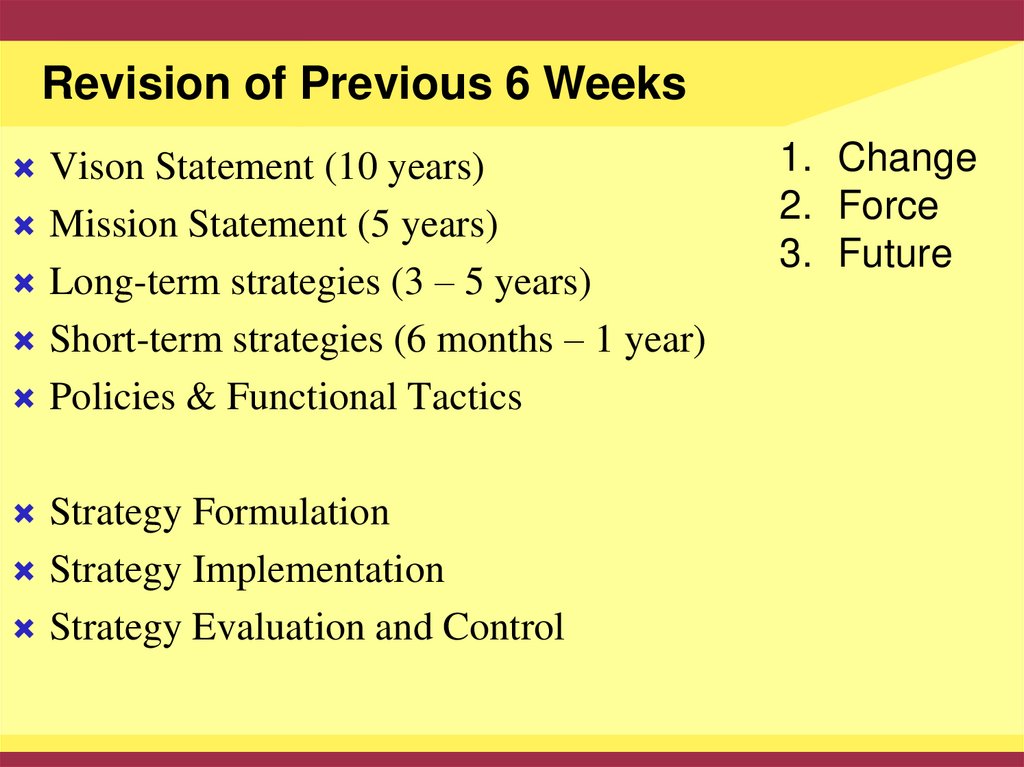
Revision of Previous 6 WeeksVison Statement (10 years)
Mission Statement (5 years)
Long-term strategies (3 – 5 years)
Short-term strategies (6 months – 1 year)
Policies & Functional Tactics
Strategy Formulation
Strategy Implementation
Strategy Evaluation and Control
1. Change
2. Force
3. Future
3. 15 Grand Strategies
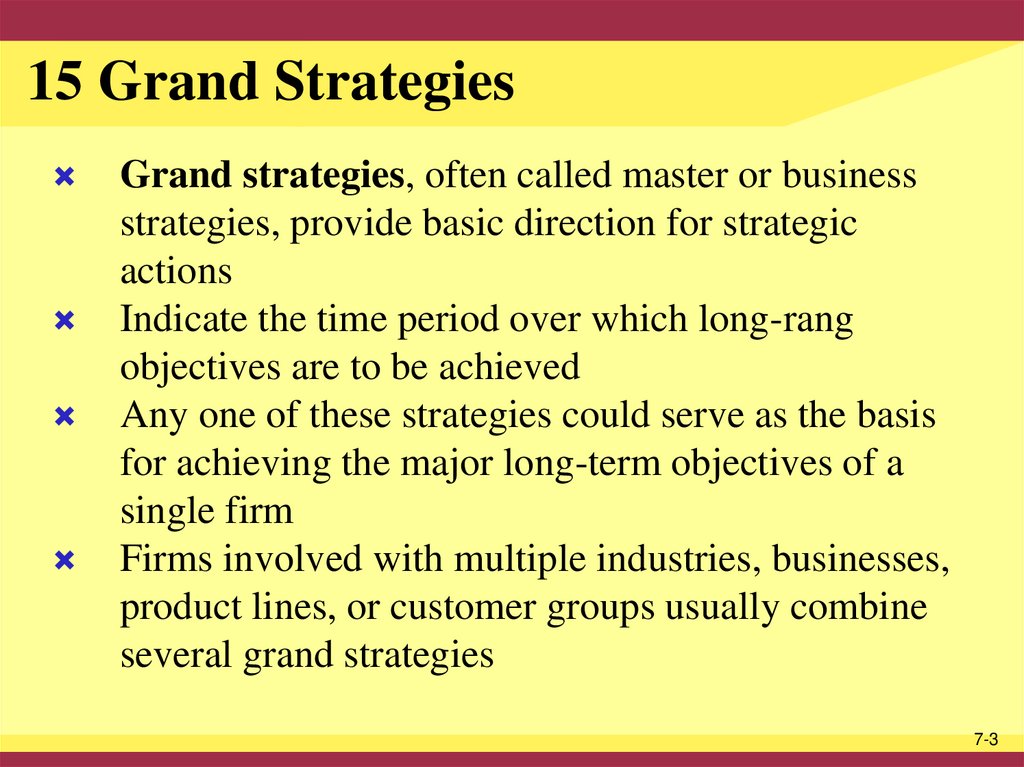
Grand strategies, often called master or businessstrategies, provide basic direction for strategic
actions
Indicate the time period over which long-rang
objectives are to be achieved
Any one of these strategies could serve as the basis
for achieving the major long-term objectives of a
single firm
Firms involved with multiple industries, businesses,
product lines, or customer groups usually combine
several grand strategies
7-3
4. Concentrated Growth
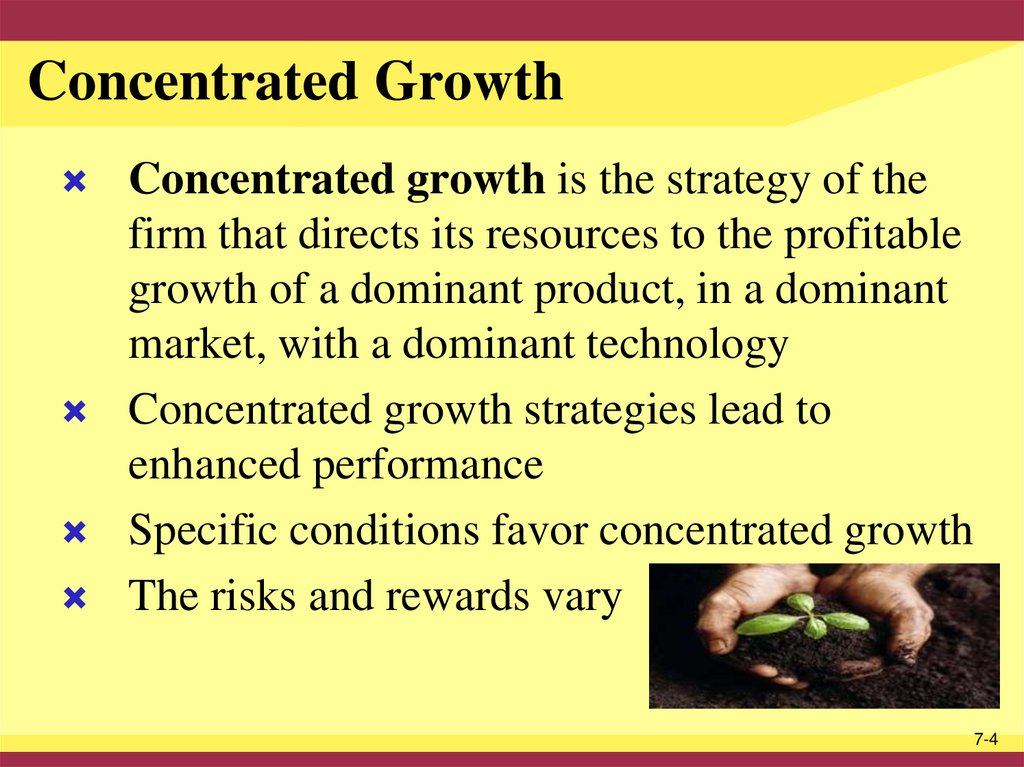
Concentrated growth is the strategy of thefirm that directs its resources to the profitable
growth of a dominant product, in a dominant
market, with a dominant technology
Concentrated growth strategies lead to
enhanced performance
Specific conditions favor concentrated growth
The risks and rewards vary
7-4
5. Market Development
Market development commonly ranks second onlyto concentration as the least costly and least risky of
the 15 grand strategies
It consists of marketing present products, often with
only cosmetic modifications, to customers in related
market areas by adding channels of distribution or by
changing the content of advertising or promotion
Frequently, changes in media selection, promotional
appeals, and distribution are used to initiate this
approach
7-5
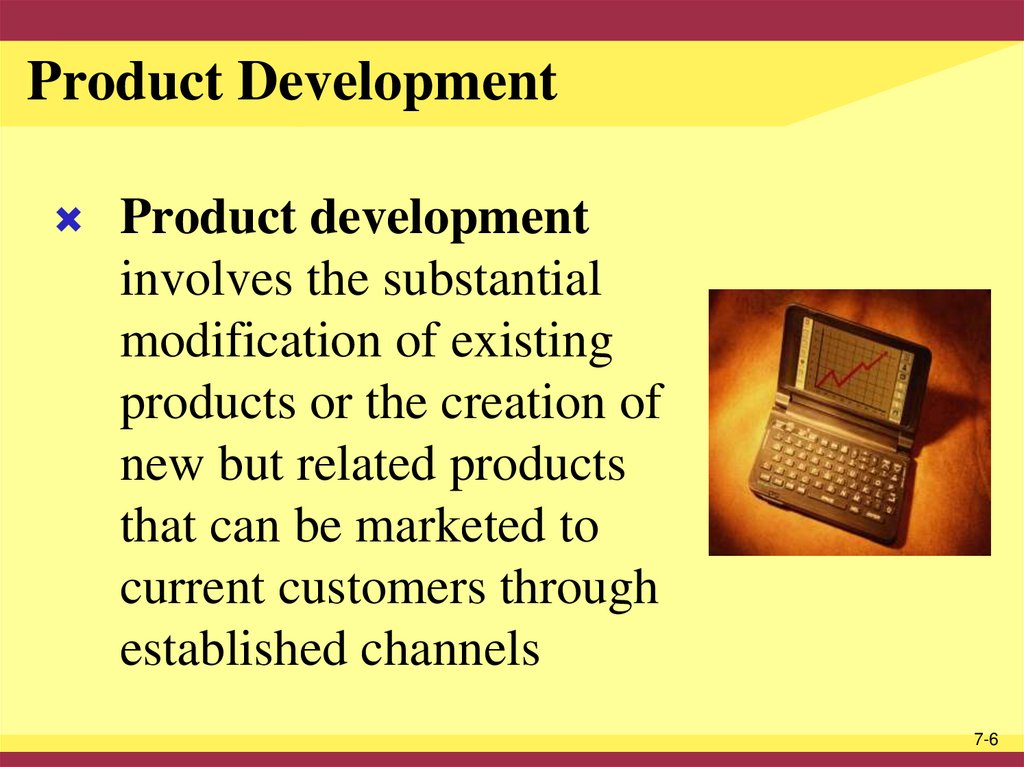
6. Product Development
Product developmentinvolves the substantial
modification of existing
products or the creation of
new but related products
that can be marketed to
current customers through
established channels
7-6
7. Innovation
These companies seek to reap the initially highprofits associated with customer acceptance of a new
or greatly improved product
Then, rather than face stiffening competition as the
basis of profitability shifts from innovation to
production or marketing competence, they search for
other original or novel ideas
The underlying rationale of the grand strategy of
innovation is to create a new product life cycle and
thereby make similar existing products obsolete
7-7
8. Horizontal Integration
When a firm’s long-term strategy is basedon growth through the acquisition of one
or more similar firms operating at the same
stage of the production-marketing chain,
its grand strategy is called horizontal
integration
Such acquisitions eliminate competitors
and provide the acquiring firm with access
to new markets
7-8
9. Vertical Integration
When a firm’s grand strategy is to acquirefirms that supply it with inputs (such as
raw materials) or are customers for its
outputs (such as warehouses for finished
products), vertical integration is involved
The main reason for backward integration
is the desire to increase the dependability
of the supply or quality of the raw
materials used as production inputs
7-9
10. Concentric Diversification
Concentric diversification involves theacquisition of businesses that are related to the
acquiring firm in terms of technology, markets, or
products
With this grand strategy, the selected new
businesses possess a high degree of compatibility
with the firm’s current businesses
The ideal concentric diversification occurs when
the combined company profits increase the
strengths and opportunities and decrease the
weaknesses and exposure to risk
7-10
11. Conglomerate Diversification
Occasionally a firm, particularly a very large one,plans acquire a business because it represents the
most promising investment opportunity available.
This grand strategy is commonly known as
conglomerate diversification.
The principal concern of the acquiring firm is the
profit pattern of the venture
Unlike concentric diversification, conglomerate
diversification gives little concern to creating
product-market synergy with existing businesses
7-11
12. Turnaround
The firm finds itself with declining profitsAmong the reasons are economic recessions,
production inefficiencies, and innovative
breakthroughs by competitors
Strategic managers often believe the firm can
survive and eventually recover if a concerted effort
is made over a period of a few years to fortify its
distinctive competences. This is turnaround.
Two forms of retrenchment:
Cost reduction
Asset reduction
7-12
13. Divestiture
A divestiture strategy involves the sale of afirm or a major component of a firm
When retrenchment fails to accomplish the
desired turnaround, or when a nonintegrated
business activity achieves an unusually high
market value, strategic managers often
decide to sell the firm
Reasons for divestiture vary
7-13
14. Liquidation
When liquidation is the grand strategy, thefirm typically is sold in parts, only
occasionally as a whole—but for its
tangible asset value and not as a going
concern
Planned liquidation can be worthwhile
7-14
15. Bankruptcy
Liquidation bankruptcy—agreeing to acomplete distribution of firm assets to
creditors, most of whom receive a small
fraction of the amount they are owed
Reorganization bankruptcy—the managers
believe the firm can remain viable through
reorganization
Two notable types of bankruptcy
Chapter 7
Chapter 11
7-15
16. Joint Ventures
Occasionally two or more capable firmslack a necessary component for success in a
particular competitive environment
The solution is a set of joint ventures,
which are commercial companies (children)
created and operated for the benefit of the
co-owners (parents)
The joint venture extends the supplierconsumer relationship and has strategic
advantages for both partners
7-16
17. Strategic Alliances
Strategic alliances are distinguished fromjoint ventures because the companies
involved do not take an equity position in
one another
In some instances, strategic alliances are
synonymous with licensing agreements
Outsourcing arrangements vary
7-17
18. Consortia, Keiretsus, and Chaebols
Consortia are defined as large interlockingrelationships between businesses of an
industry
In Japan such consortia are known as
keiretsus, in South Korea as chaebols
Their cooperative nature is growing in
evidence as is their market success
7-18