Похожие презентации:


2_5251308735879480682
1.
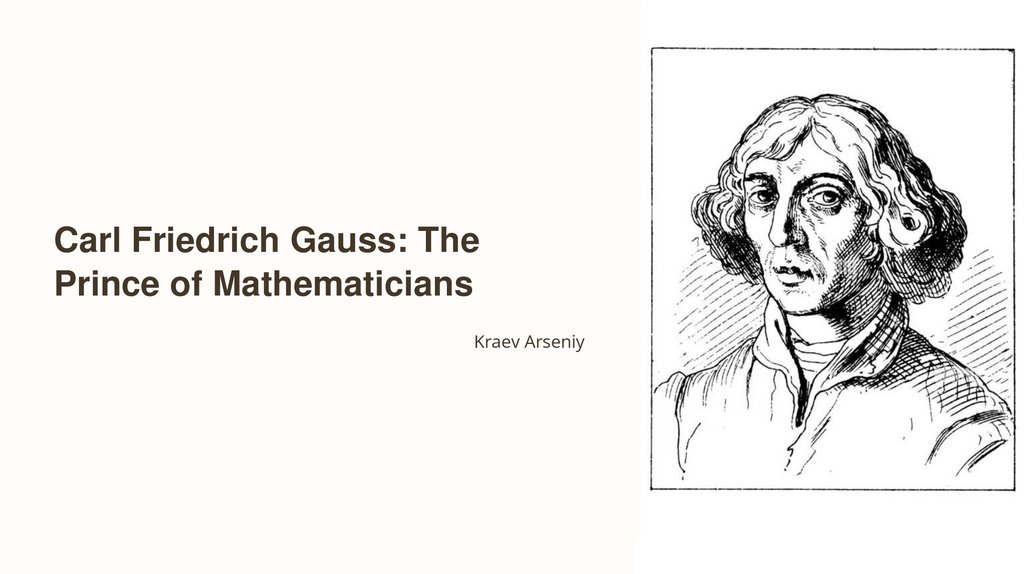
Carl Friedrich Gauss: ThePrince of Mathematicians
Kraev Arseniy
2.
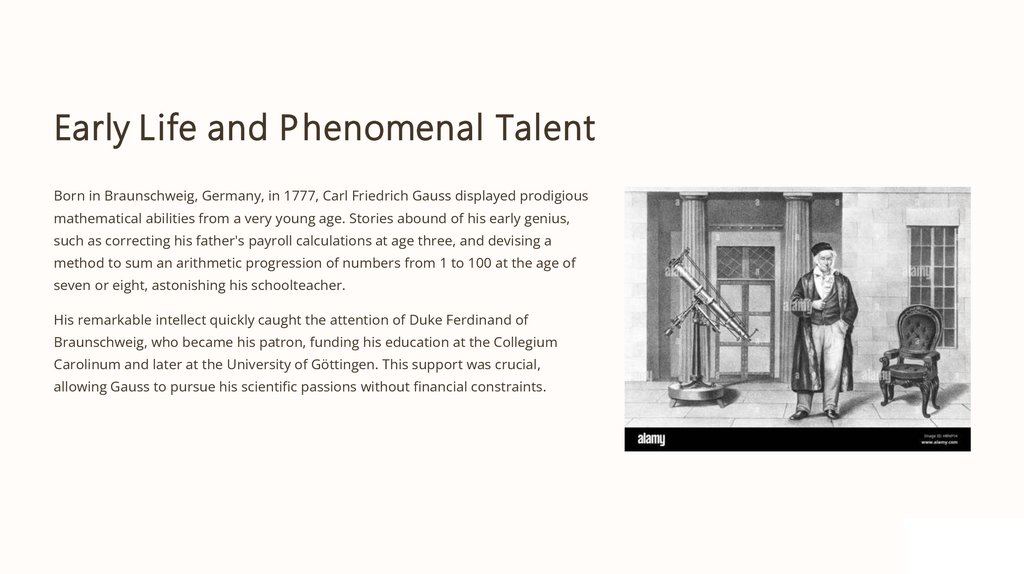
Early Life and P henomenal TalentBorn in Braunschweig, Germany, in 1777, Carl Friedrich Gauss displayed prodigious
mathematical abilities from a very young age. Stories abound of his early genius,
such as correcting his father's payroll calculations at age three, and devising a
method to sum an arithmetic progression of numbers from 1 to 100 at the age of
seven or eight, astonishing his schoolteacher.
His remarkable intellect quickly caught the attention of Duke Ferdinand of
Braunschweig, who became his patron, funding his education at the Collegium
Carolinum and later at the University of Göttingen. This support was crucial,
allowing Gauss to pursue his scientific passions without financial constraints.
3.
Groundbreaking Discoveries in MathematicsGauss's contributions spanned nearly every branch of mathematics and theoretical physics, earning him the title "Prince of Mathematicians".
His work laid foundational stones for future generations.
Number Theory
Astronomy
His seminal work, Disquisitiones Arithmeticae (1801),
In 1801, Gauss famously recalculated the orbit of the asteroid
revolutionised number theory. He introduced modular
Ceres after it was lost to astronomers, using his method of least
arithmetic, proved the law of quadratic reciprocity, and provided
squares. This feat established his reputation and demonstrated
the first rigorous proof of the fundamental theorem of algebra.
the practical power of his mathematical innovations.
Differential Geometry
Geodesy and Magnetism
Gauss developed the theory of curved surfaces, proving his
He made significant advances in geodesy, the science of
Theorema Egregium (Remarkable Theorem), which showed that
measuring the Earth's shape, and conducted extensive research
the Gaussian curvature of a surface could be determined
in magnetism, developing the first absolute measurement of the
intrinsically, without reference to the space in which the surface
Earth's magnetic field.
is embedded.
4.
Gauss's Methods and Approaches to ScienceGauss was known for his rigorous approach, meticulous attention to detail, and a deep desire for perfection. He rarely published incomplete
work, often delaying publication until he was fully satisfied.
Rigorous Proofs
Computational Prowess
Broad Interdisciplinary Scope
He insisted on absolute rigour in his
Gauss possessed extraordinary
His work transcended disciplinary
mathematical proofs, setting a new
computational abilities, often performing
boundaries, demonstrating how abstract
standard for the field. His methods were
complex calculations mentally or with
mathematics could solve real-world
often decades ahead of his time,
minimal aids. This skill was invaluable in
problems in astronomy, physics, and
influencing generations of
his astronomical and geodetic work.
surveying. He saw the interconnectedness
mathematicians.
of scientific fields.
5.
Gaus s Today: Influence on ModernityGauss's legacy is far-reaching, with his concepts and discoveries continuing to shape modern science and technology.
Digital Technology
GPS and Navigation
His work on algorithms, such as the Fast Fourier Transform (though
The method of least squares, developed by Gauss, is fundamental
he didn't publish it), underpins much of modern signal processing,
to global positioning systems (GPS), satellite navigation, and
digital imaging, and data compression.
modern surveying techniques, ensuring accuracy in location data.
Statis tics and Data Science
Space Exploration
The Gaussian distribution, or normal distribution, is a cornerstone
His methods for orbital mechanics and celestial mechanics are still
of statistics, crucial for data analysis, machine learning, and
used in trajectory planning for space missions and satellite
understanding probability in numerous fields.
deployments.
6.
Interesting Facts and Lesser-Known StoriesBeyond his monumental achievements, Gauss's life was also filled with intriguing anecdotes that reveal his character and quirky habits.
The story of Gauss, as a child, quickly summing the numbers from 1 to 100 by pairing them (1+100,
2+99, etc.) is perhaps the most famous anecdote, illustrating his intuitive grasp of mathematical
patterns.
Gauss was notoriously secretive about his discoveries, often delaying publication for years,
sometimes decades. This was due to his perfectionism and his motto: "Few, but Ripe".
Carl Gauss's image appears on the German 10-mark banknote.
Gauss claimed that he began to count before he began to speak.
Carl Gauss found it quite easy not only to study numbers, but also linguistics. He could speak several
languages fluently. For quite a long time, at a young age, the mathematician could not decide which
academic path he should choose: exact sciences, or philology. Eventually choosing mathematics as
his hobby, Gauss later wrote his works in Latin, English, and German.
"I have had my solutions for a long time, but I do not know how I am to arrive at them."
— Carl Friedrich Gauss
7.
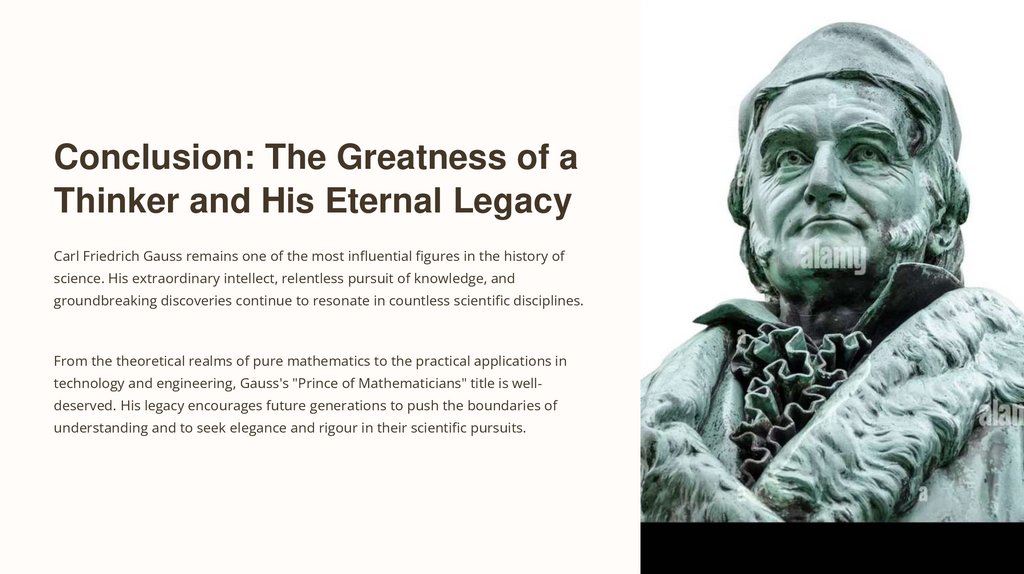
Conclusion: The Greatness of aThinker and His Eternal Legacy
Carl Friedrich Gauss remains one of the most influential figures in the history of
science. His extraordinary intellect, relentless pursuit of knowledge, and
groundbreaking discoveries continue to resonate in countless scientific disciplines.
From the theoretical realms of pure mathematics to the practical applications in
technology and engineering, Gauss's "Prince of Mathematicians" title is welldeserved. His legacy encourages future generations to push the boundaries of
understanding and to seek elegance and rigour in their scientific pursuits.
8.
Ques tionsQues tion 1
Ques tion 2
What was the title of Gauss's seminal work that revolutionised
Which asteroid's orbit did Gauss calculate in 1801 to discover the
number theory?
missing asteroid?