
 Экономика
Похожие презентации:


Economics grade: 12
1. Economics
GRADE: 122. Term 2
Economic stability and macroeconomic indicators(SAU1 Week 3)
International trade and foreign exchange markets
(SAU2 Week 5/6)
3. Lesson objectives
Understand main macroeconomics indicatorsDistinguish real and nominal GDP
Understand how to calculate nominal and real GDP and GDP deflator
4. Macroeconomic indicators
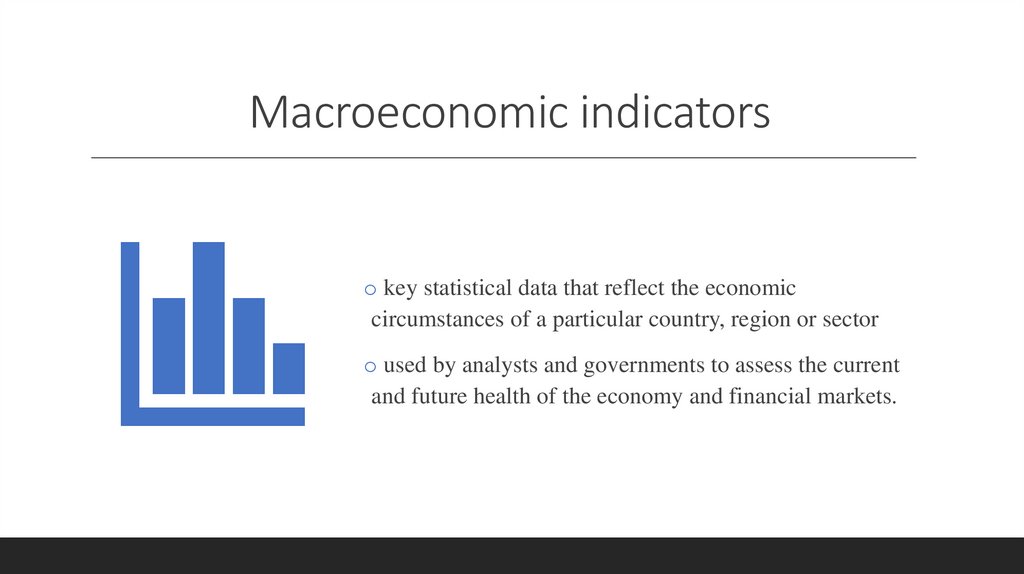
o key statistical data that reflect the economiccircumstances of a particular country, region or sector
o used by analysts and governments to assess the current
and future health of the economy and financial markets.
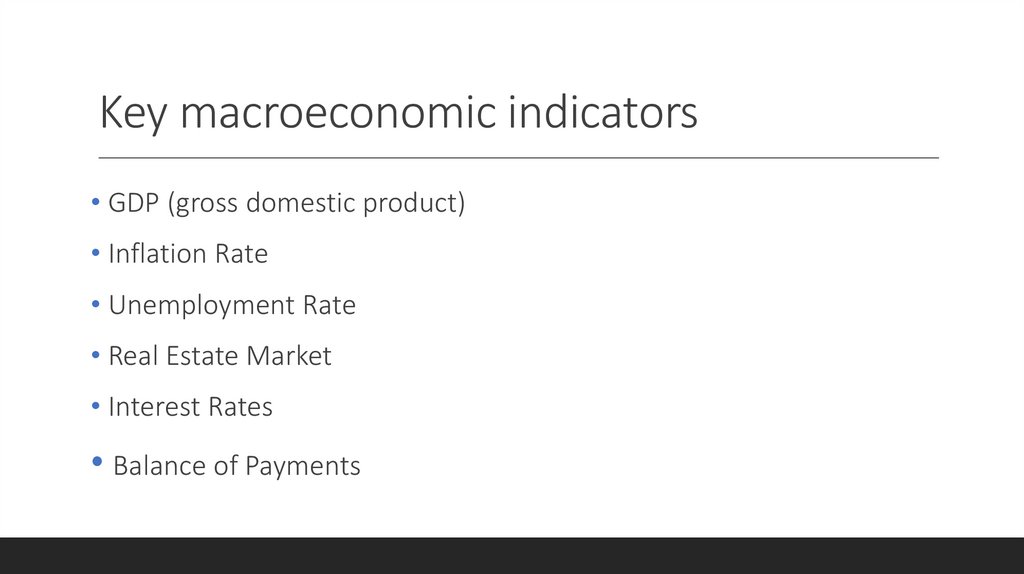
5. Key macroeconomic indicators
• GDP (gross domestic product)• Inflation Rate
• Unemployment Rate
• Real Estate Market
• Interest Rates
• Balance of Payments
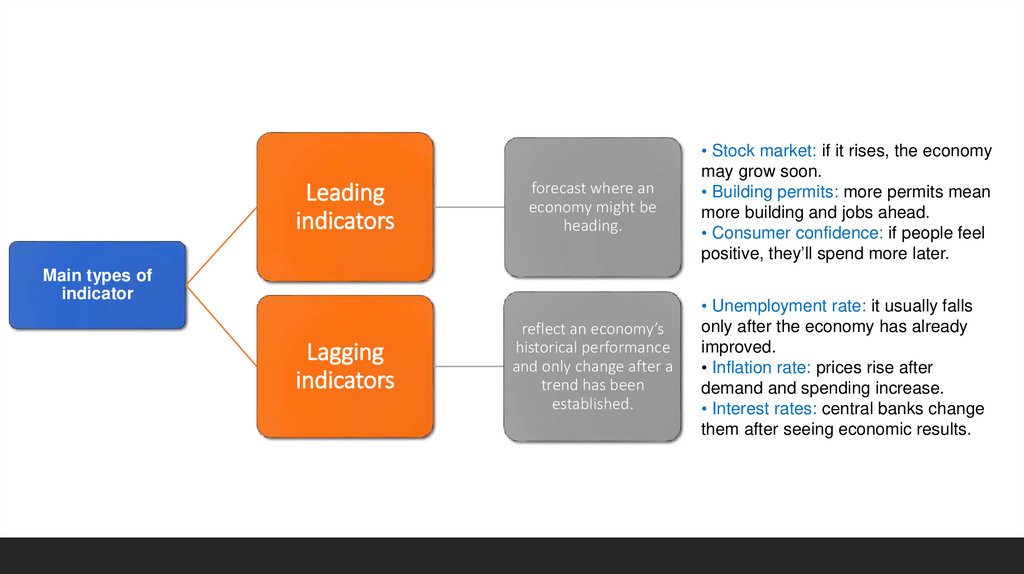
6.
Leadingindicators
forecast where an
economy might be
heading.
• Stock market: if it rises, the economy
may grow soon.
• Building permits: more permits mean
more building and jobs ahead.
• Consumer confidence: if people feel
positive, they’ll spend more later.
reflect an economy’s
historical performance
and only change after a
trend has been
established.
• Unemployment rate: it usually falls
only after the economy has already
improved.
• Inflation rate: prices rise after
demand and spending increase.
• Interest rates: central banks change
them after seeing economic results.
Main types of
indicator
Lagging
indicators
7. Vocabulary
Match the words/phrases with their definitions.Pair check
8.
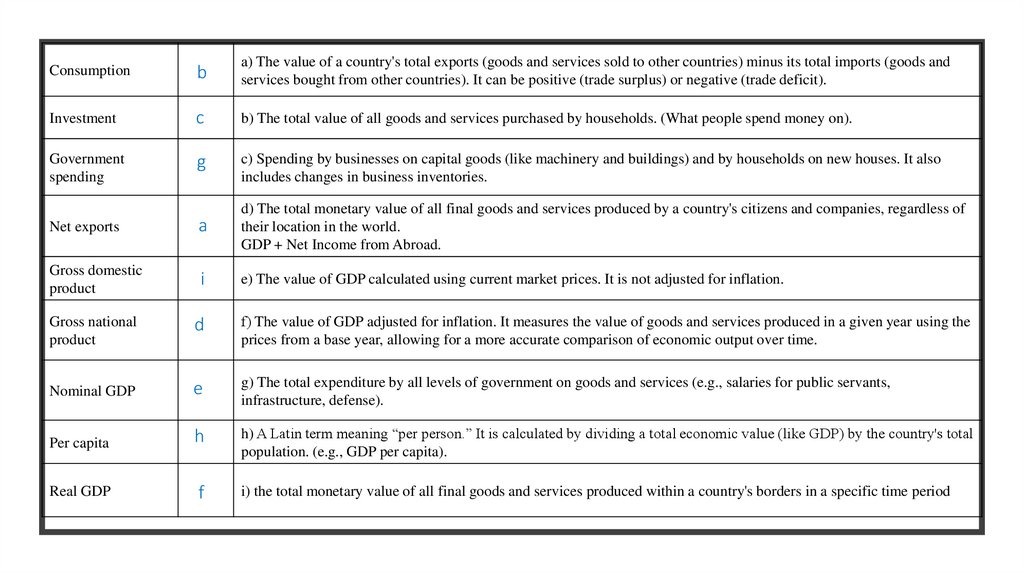
Consumptionb
a) The value of a country's total exports (goods and services sold to other countries) minus its total imports (goods and
services bought from other countries). It can be positive (trade surplus) or negative (trade deficit).
Investment
c
b) The total value of all goods and services purchased by households. (What people spend money on).
Government
spending
g
c) Spending by businesses on capital goods (like machinery and buildings) and by households on new houses. It also
includes changes in business inventories.
Net exports
a
d) The total monetary value of all final goods and services produced by a country's citizens and companies, regardless of
their location in the world.
GDP + Net Income from Abroad.
Gross domestic
product
i
e) The value of GDP calculated using current market prices. It is not adjusted for inflation.
Gross national
product
d
f) The value of GDP adjusted for inflation. It measures the value of goods and services produced in a given year using the
prices from a base year, allowing for a more accurate comparison of economic output over time.
Nominal GDP
e
g) The total expenditure by all levels of government on goods and services (e.g., salaries for public servants,
infrastructure, defense).
Per capita
h
h) A Latin term meaning “per person.” It is calculated by dividing a total economic value (like GDP) by the country's total
population. (e.g., GDP per capita).
Real GDP
f
i) the total monetary value of all final goods and services produced within a country's borders in a specific time period
9. Calculate nominal and real GDP and GDP deflator
Group work (max 3 people in a group)o Read the given material.
o Identify the definition of nominal GDP, real GDP or GDP deflator.
o Identify how to calculate each of them.
o Discuss with your group members.
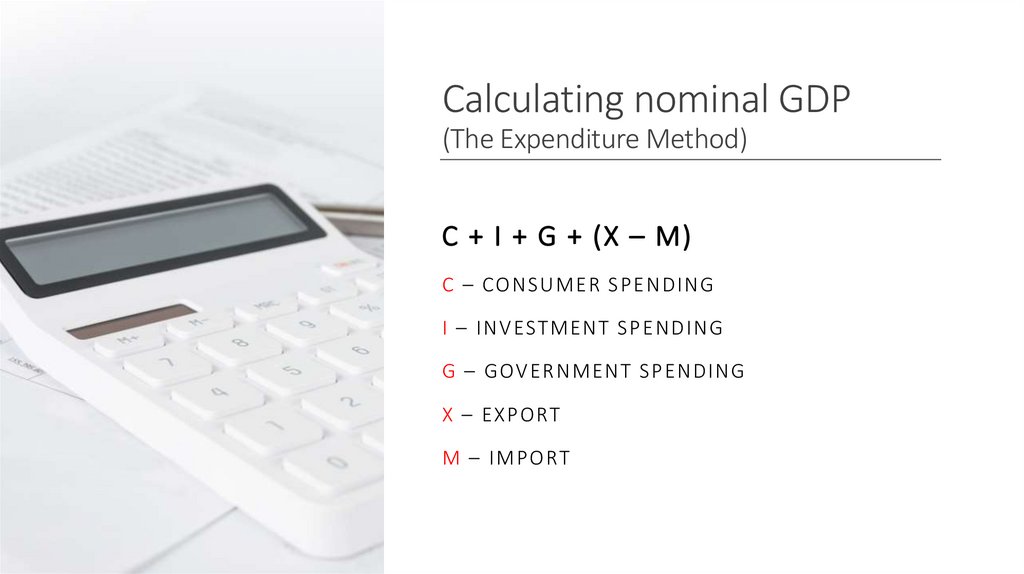
10. Calculating nominal GDP (The Expenditure Method)
C + I + G + (X – M)C – CON S UMER S P E NDING
I – I N V ESTMENT S P E NDING
G – G OV E R NMENT S P E NDING
X – E X P ORT
M – I M P ORT
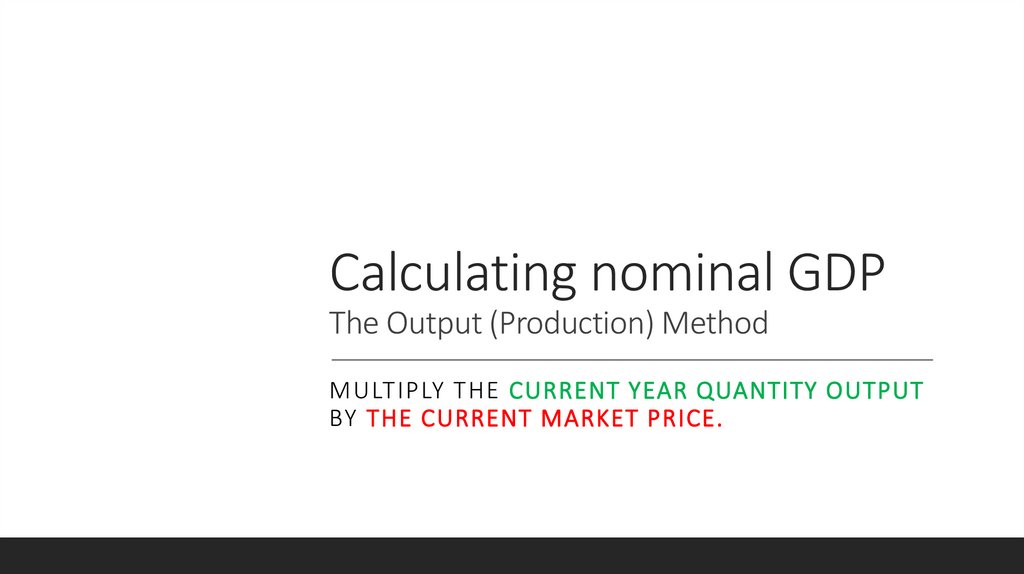
11. Calculating nominal GDP The Output (Production) Method
MULTIPLY THE CURRENT YEAR QUANTITY OUTPUTBY THE CURRENT MARKET PRICE.
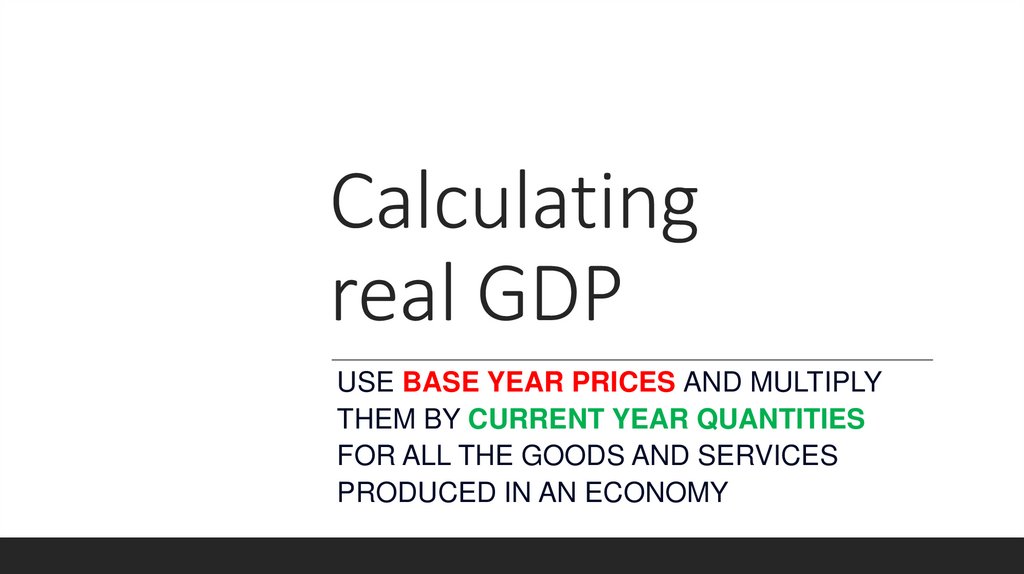
12. Calculating real GDP
USE BASE YEAR PRICES AND MULTIPLYTHEM BY CURRENT YEAR QUANTITIES
FOR ALL THE GOODS AND SERVICES
PRODUCED IN AN ECONOMY
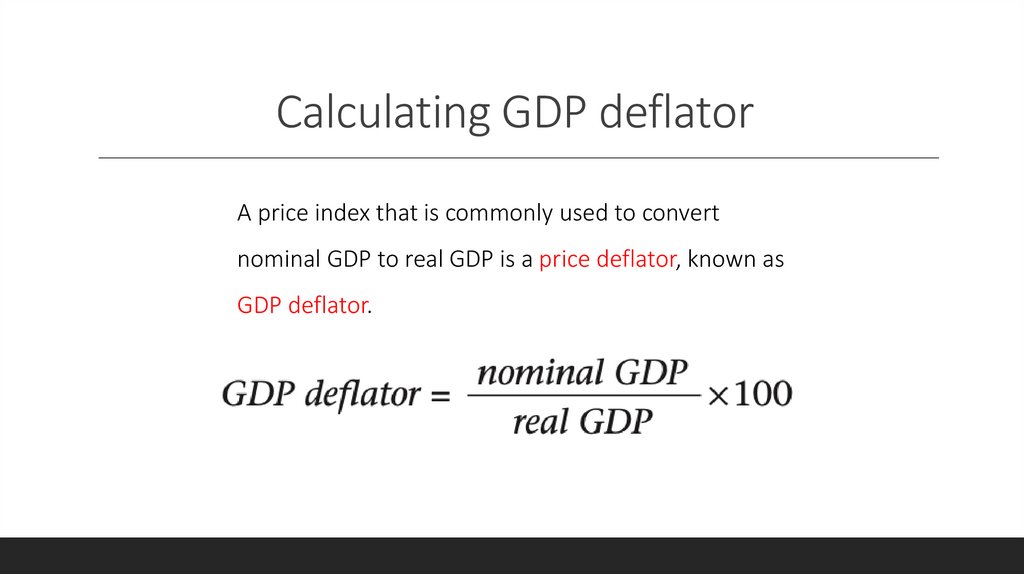
13. Calculating GDP deflator
A price index that is commonly used to convertnominal GDP to real GDP is a price deflator, known as
GDP deflator.
14. Formative assessment
Calculation nominal GDP, real GDP and GDP deflator(individual work).
Assessment criteria
o nominal GDP, real GDP, and the GDP deflator are accurately
calculated using appropriate formulas.
o calculations and explanations are presented clearly and
logically
15. Discussion
• If Real GDP increases, what might that tell us about jobs and production in thecountry?
• Do you think GDP always shows how well people are living? Why or why not?
• Why do governments pay attention to GDP data every year?
16. Additional
17. Inflation
18. Discuss
1. What does inflation mean?2. Is it a good or a bad thing?
3. In what countries has inflation been particularly
prevalent?
4. What evidence of inflation have you seen?
19. Inflation: What It Is, Where It Comes From and How It Can Bite You
Make notes on the following questions:• What are the causes of inflation?
• What can a government do to help restrain the negative e ects of inflation?
• How does inflation a ect everyday people?
20. Degrees of inflation
• Creeping Inflation - the price level increase at a very slow rate over a period of time. The inflation rate islow and steady.
• Hyperinflation - is the worst kind of inflation; it is a situation where inflation is increasing at a rate of
several hundred % per year.
• Accelerating inflation - the general price level is increasing at a more rapid rate.
• Walking inflation - refers to the rise in the price level at a higher rate than the creeping inflation. Price
level will increase by 5% per annum. Unless this is controlled, it will lead to running inflation.
• Running inflation - The rate at which the price level increases in this period is very high, may be even
above 10%.
• Stagflation - an economic situation with a prolonged period of little or no growth and inflation and
unemployment occur at the same time. (stagnation).
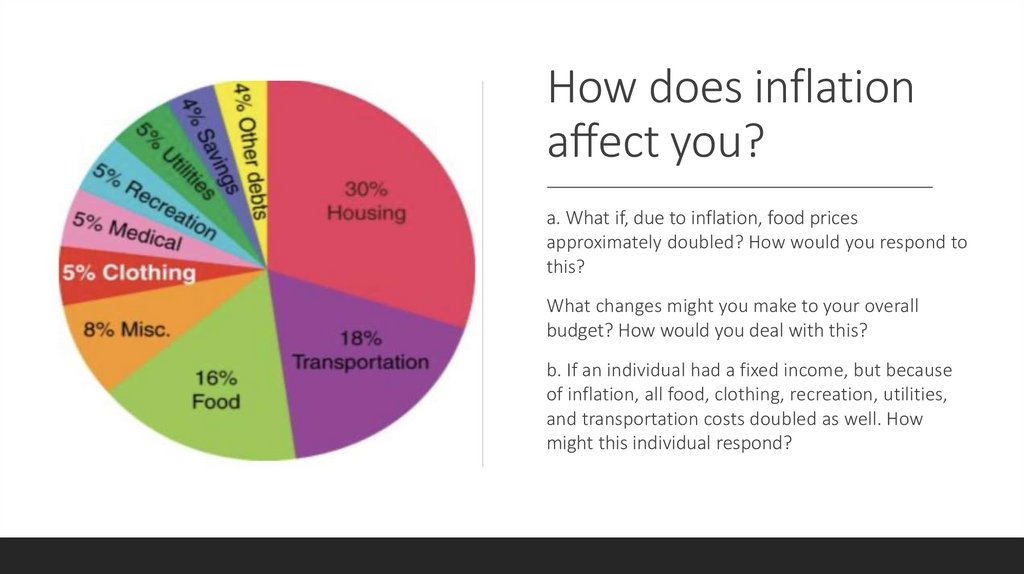
21. How does inflation affect you?
How does inflationa ect you?
a. What if, due to inflation, food prices
approximately doubled? How would you respond to
this?
What changes might you make to your overall
budget? How would you deal with this?
b. If an individual had a fixed income, but because
of inflation, all food, clothing, recreation, utilities,
and transportation costs doubled as well. How
might this individual respond?
22. Group work
Choose one cause and prepare a short presentation focusing on the following key points:Describe the cause.
Give at least one example.
How would this particular event a ect everyday citizens and consumers?
What could governments do to respond to this?
What could individuals do to respond to this?