 Экономика
Похожие презентации:





Economics Grade: 12 Week 2
1. Economics
Grade: 12Week 2
2. Lesson objectives
Understand the types, causesand effects of inflation
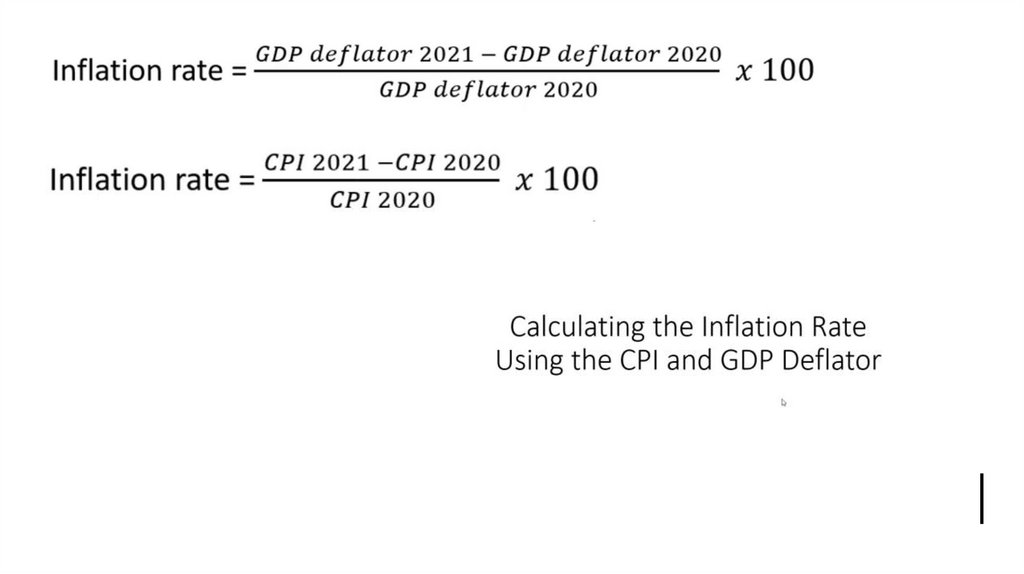
Calculate inflation using CPI and
GDP deflator
3. Measuring Inflation
Measuring Inflation - when economists measure the changes in theaverage price level of goods/services in nation.
The two measuring tools that economists use are:
CPI (Consumer Price Index)
GDP Deflator
4. Measuring Inflation
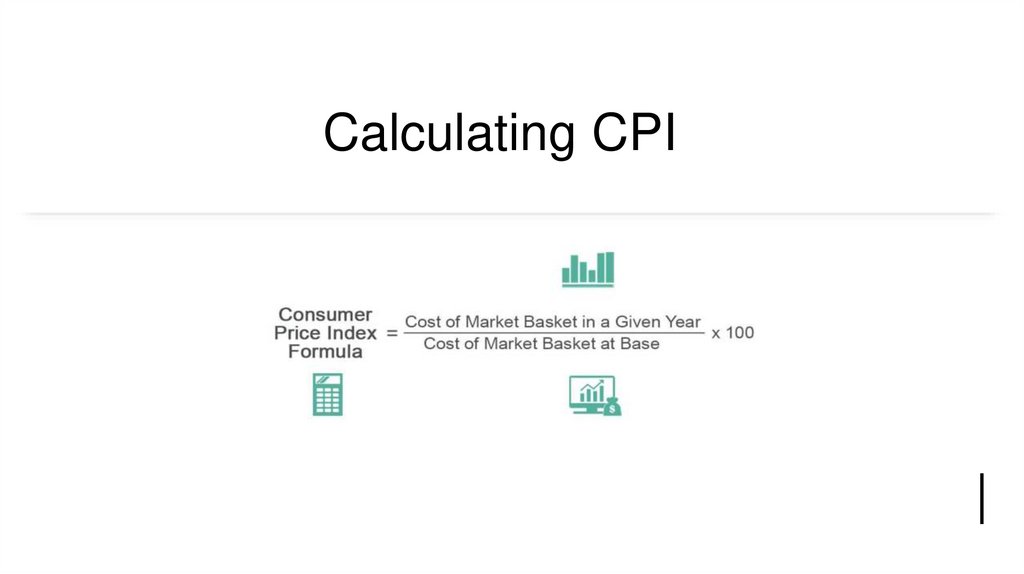
Consumer Price Index (CPI) - is a measure of the average change overtime in the price of a fixed group of products or consumer goods/services.
Market basket - representative sample of consumer goods. Food, clothing,
housing, utilities, entertainment, transportation, health care.
5. Calculating CPI
6.
7. Practice
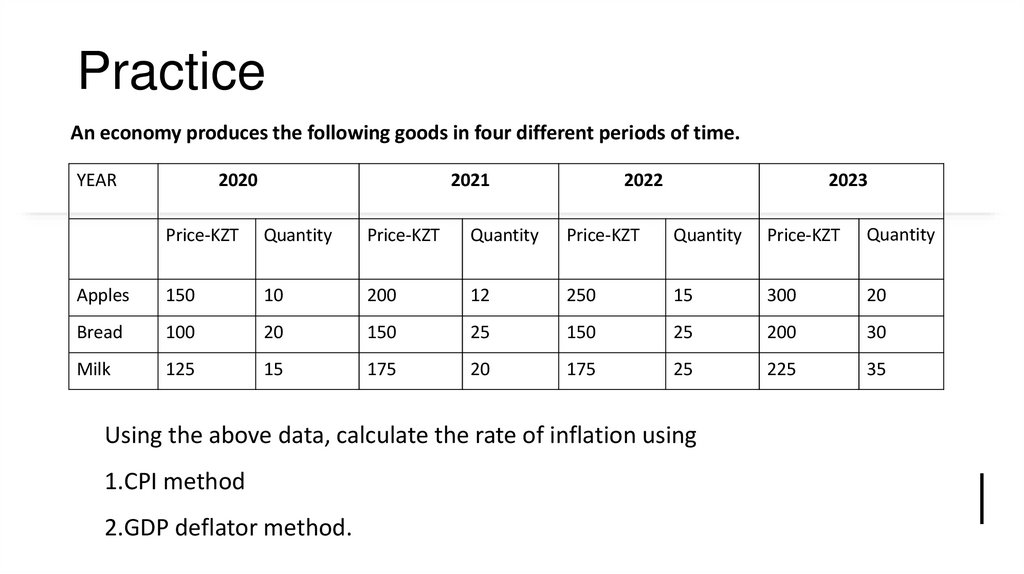
PracticeAn economy produces the following goods in four different periods of time.
YEAR
2020
2021
2022
2023
Price-KZT
Quantity
Price-KZT
Quantity
Price-KZT
Quantity
Price-KZT
Quantity
Apples
150
10
200
12
250
15
300
20
Bread
100
20
150
25
150
25
200
30
Milk
125
15
175
20
175
25
225
35
Using the above data, calculate the rate of inflation using
1.CPI method
2.GDP deflator method.
8. Causes of Inflation
1. Changes in Demand - changes in the total amount of spending byindividuals and businesses throughout the economy.
– Demand Pull Inflation - When demand increases faster than the economy
can produce the goods.
The demand increases and “pulls” along higher prices because demand is
increasing faster than supply!
(More people are chasing the same amount of goods; therefore, people can
charge more for their goods).
9. Causes of Inflation
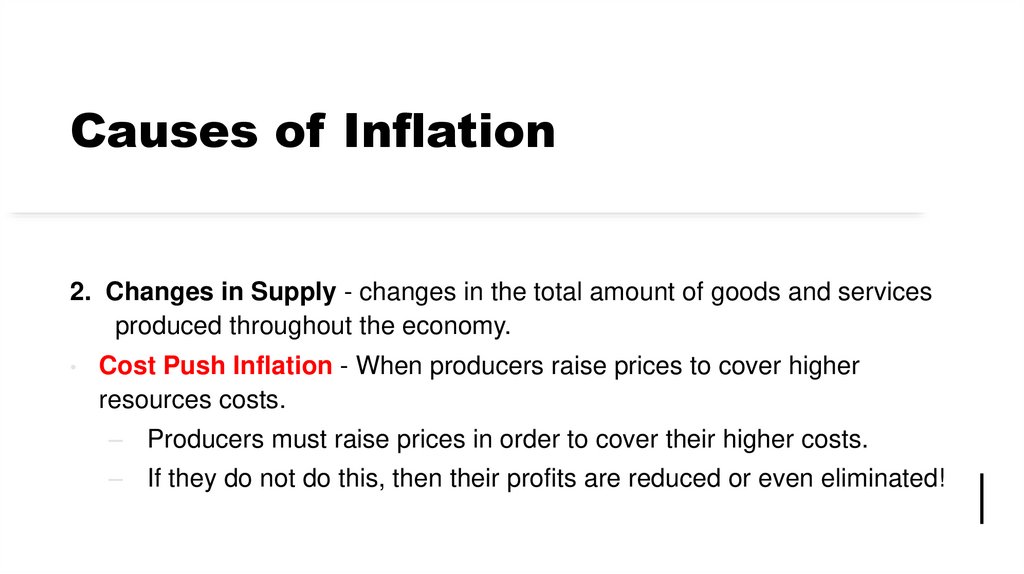
2. Changes in Supply - changes in the total amount of goods and servicesproduced throughout the economy.
Cost Push Inflation - When producers raise prices to cover higher
resources costs.
– Producers must raise prices in order to cover their higher costs.
– If they do not do this, then their profits are reduced or even eliminated!
10. Causes of Inflation
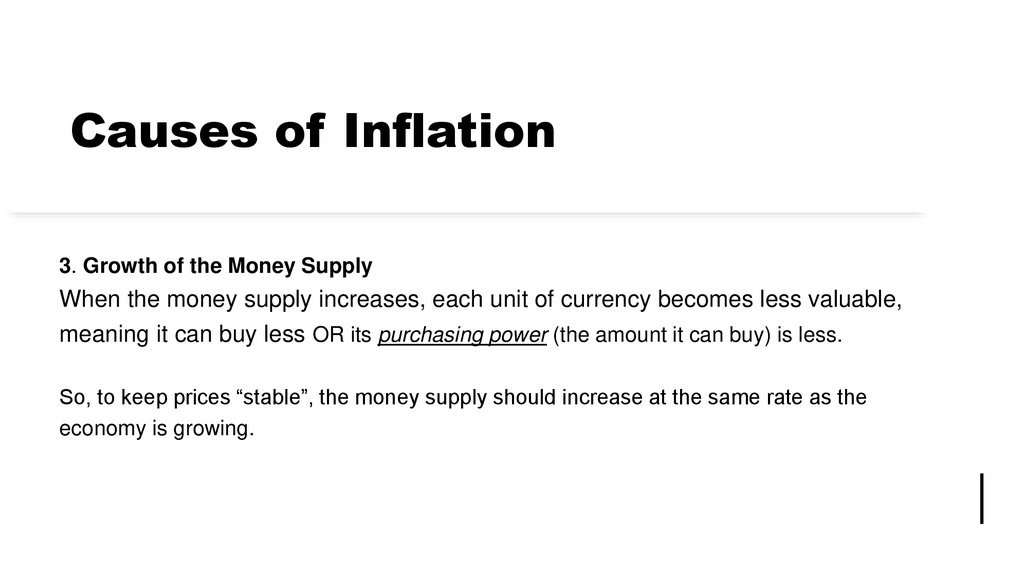
3. Growth of the Money SupplyWhen the money supply increases, each unit of currency becomes less valuable,
meaning it can buy less OR its purchasing power (the amount it can buy) is less.
So, to keep prices “stable”, the money supply should increase at the same rate as the
economy is growing.
11. Lessen objectives
Define unemploymentExplain policies in relation to unemployment
Analyse types and effects of unemployment
12. Unemployment
Unemployment refers topeople of working age who
are actively looking for a job
but who are not employed.
13. Types of unemployment
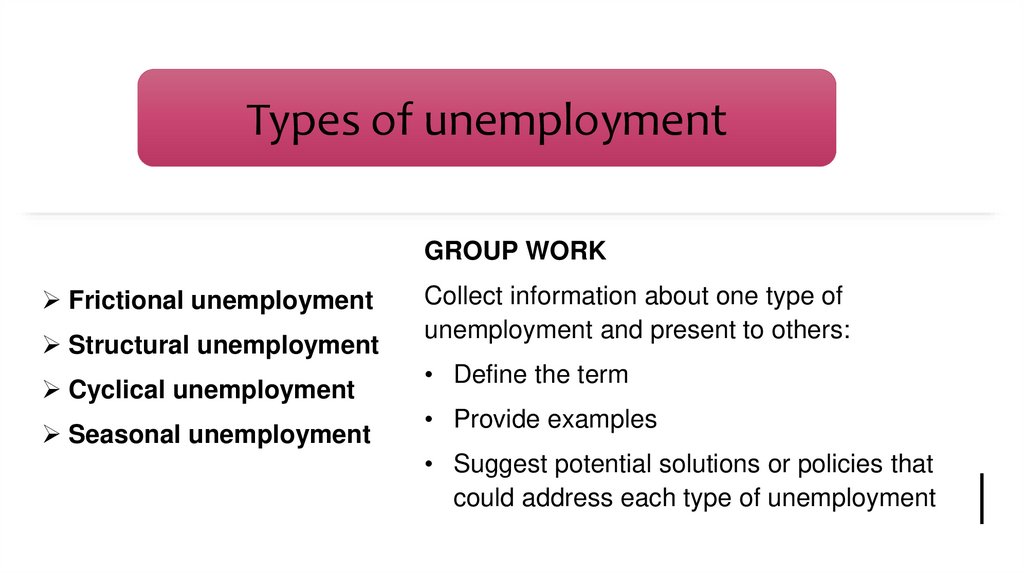
GROUP WORKFrictional unemployment
Structural unemployment
Cyclical unemployment
Seasonal unemployment
Collect information about one type of
unemployment and present to others:
• Define the term
• Provide examples
• Suggest potential solutions or policies that
could address each type of unemployment
14. Frictional unemployment
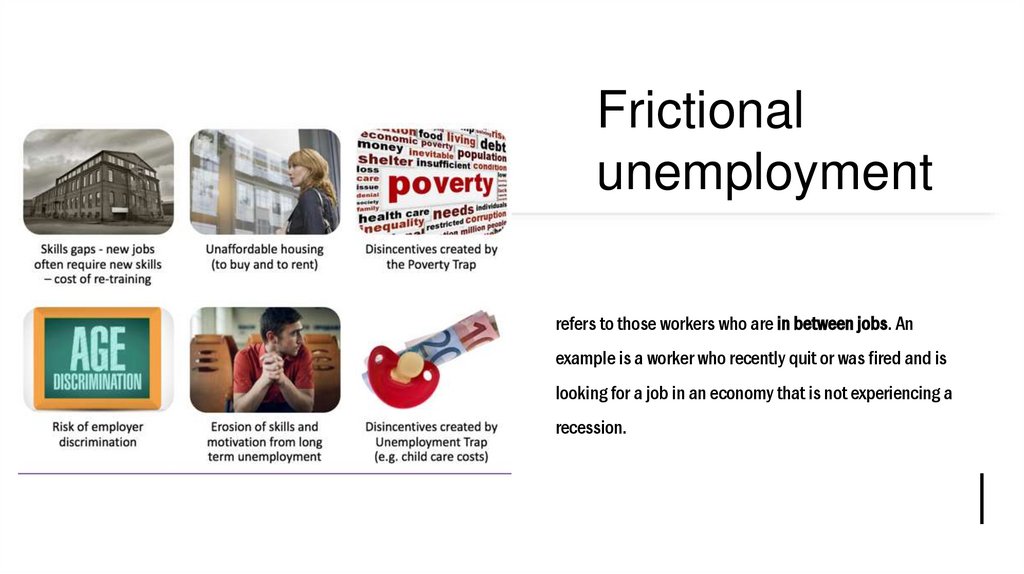
refers to those workers who are in between jobs. Anexample is a worker who recently quit or was fired and is
looking for a job in an economy that is not experiencing a
recession.
15. Structural Unemployment
• happens when the skills set of a worker does not match the skillsdemanded by the jobs available, or alternatively when workers are
available but are unable to reach the geographical location of the jobs.
• Examples:
• Jobs on a production line being replaced by robots e.g. motor
manufacturing, online banking and online retailing
• Unemployment caused by foreign competition
16. Cyclical (demand-deficient) Unemployment
is a lack of employment as a resultof changes to an economy's
business cycle.
An example of cyclical
unemployment is when
construction workers were laid off
during the Great Recession
following the financial crisis of
2008.
17. Seasonal unemployment
arises due to changes in theseasons for productivity and
technological advances.
For example - changing patterns
in farming products can cause
unemployment.
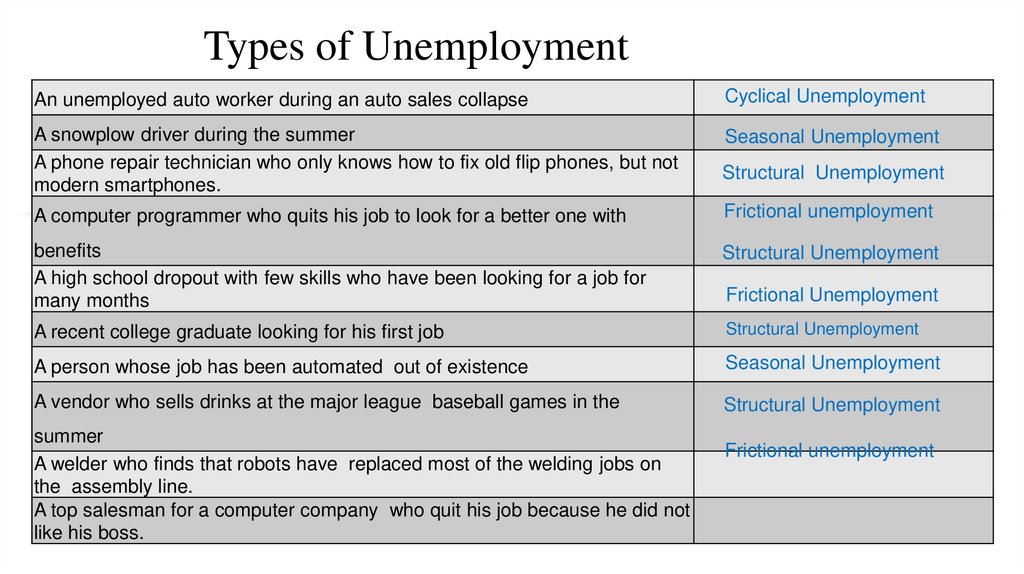
18. Types of Unemployment
An unemployed auto worker during an auto sales collapseCyclical Unemployment
A snowplow driver during the summer
A phone repair technician who only knows how to fix old flip phones, but not
modern smartphones.
Seasonal Unemployment
Structural Unemployment
A computer programmer who quits his job to look for a better one with
Frictional unemployment
benefits
A high school dropout with few skills who have been looking for a job for
many months
Structural Unemployment
A recent college graduate looking for his first job
Structural Unemployment
A person whose job has been automated out of existence
Seasonal Unemployment
A vendor who sells drinks at the major league baseball games in the
Structural Unemployment
summer
A welder who finds that robots have replaced most of the welding jobs on
the assembly line.
A top salesman for a computer company who quit his job because he did not
like his boss.
Frictional Unemployment
Frictional unemployment
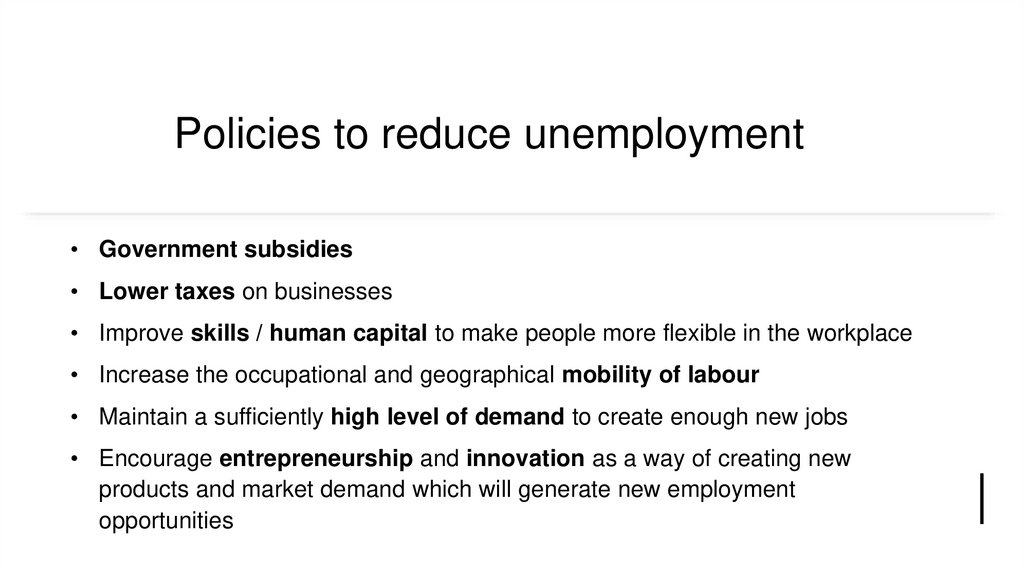
19. Policies to reduce unemployment
• Government subsidies• Lower taxes on businesses
• Improve skills / human capital to make people more flexible in the workplace
• Increase the occupational and geographical mobility of labour
• Maintain a sufficiently high level of demand to create enough new jobs
• Encourage entrepreneurship and innovation as a way of creating new
products and market demand which will generate new employment
opportunities
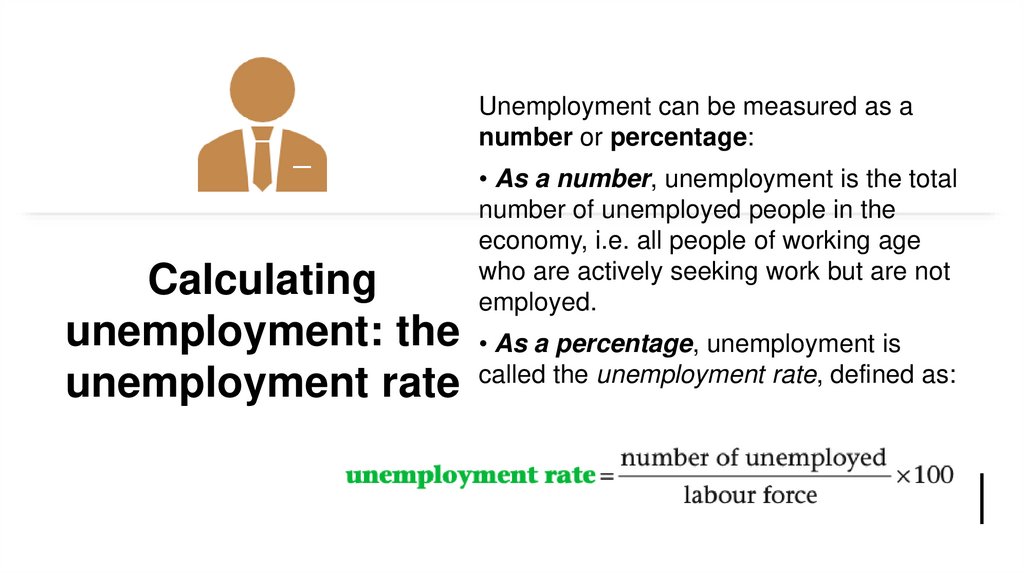
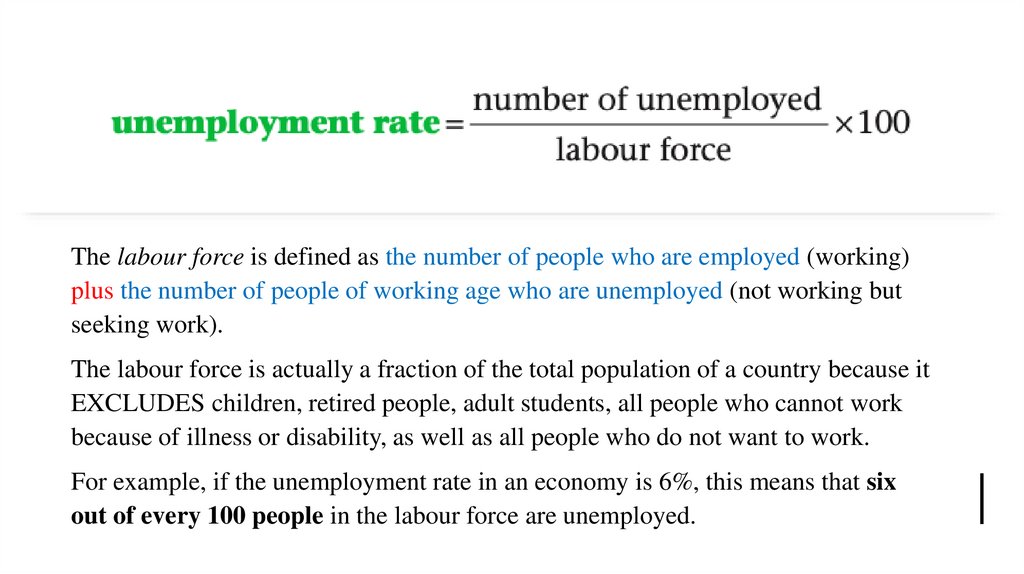
20. Calculating unemployment: the unemployment rate
Unemployment can be measured as anumber or percentage:
• As a number, unemployment is the total
number of unemployed people in the
economy, i.e. all people of working age
who are actively seeking work but are not
employed.
Calculating
unemployment: the • As a percentage, unemployment is
called the unemployment rate, defined as:
unemployment rate
21.
The labour force is defined as the number of people who are employed (working)plus the number of people of working age who are unemployed (not working but
seeking work).
The labour force is actually a fraction of the total population of a country because it
EXCLUDES children, retired people, adult students, all people who cannot work
because of illness or disability, as well as all people who do not want to work.
For example, if the unemployment rate in an economy is 6%, this means that six
out of every 100 people in the labour force are unemployed.
22. Practice
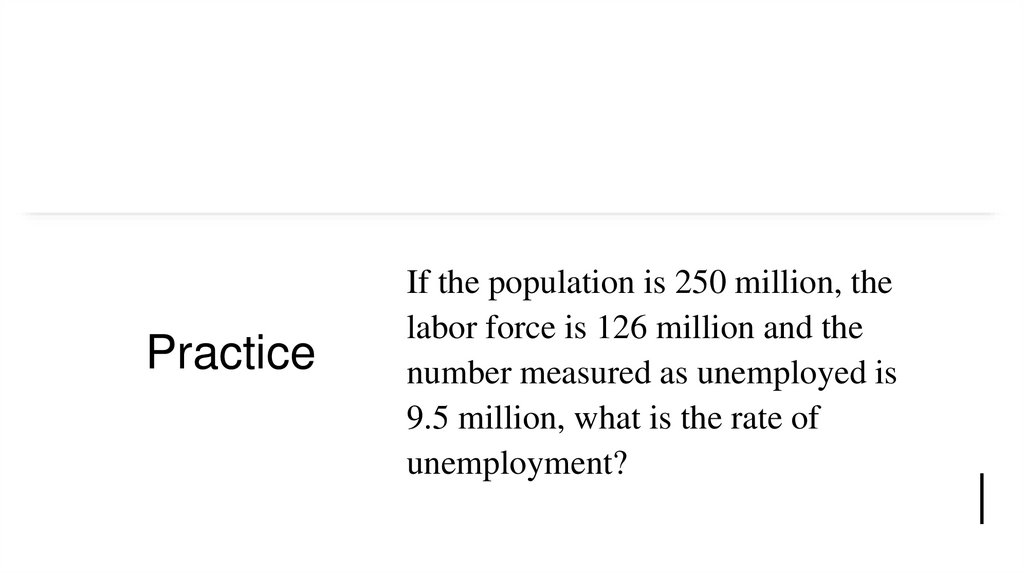
If the population is 250 million, thelabor force is 126 million and the
number measured as unemployed is
9.5 million, what is the rate of
unemployment?
23. Labour Force Participation Rate
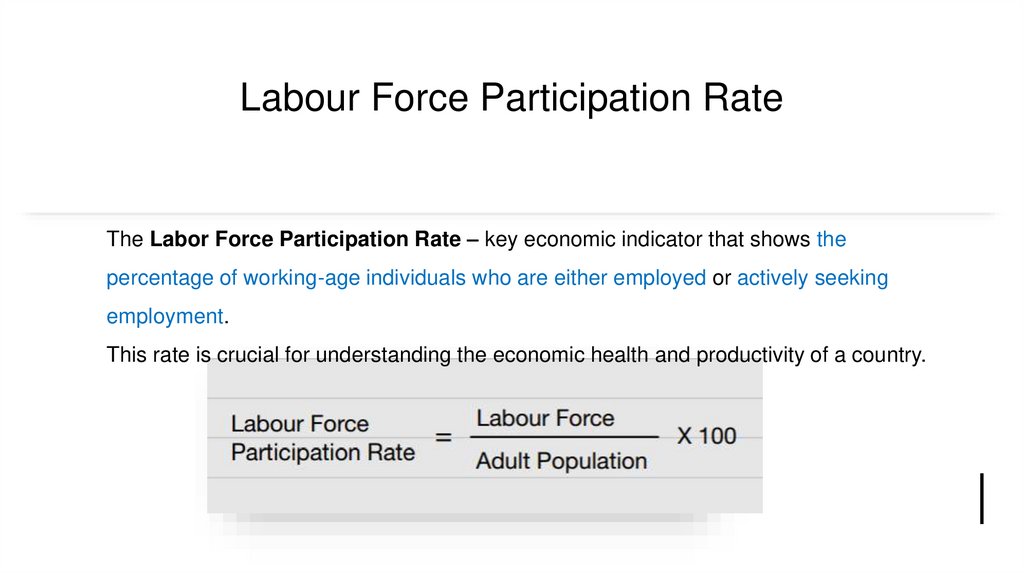
The Labor Force Participation Rate – key economic indicator that shows thepercentage of working-age individuals who are either employed or actively seeking
employment.
This rate is crucial for understanding the economic health and productivity of a country.
24. Practice
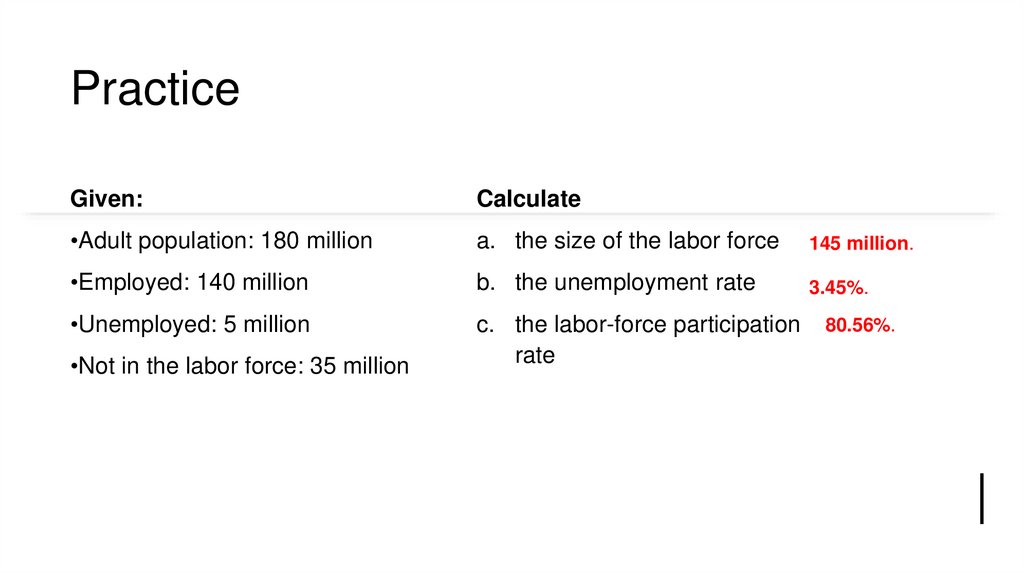
Given:Calculate
•Adult population: 180 million
a. the size of the labor force
145 million.
•Employed: 140 million
b. the unemployment rate
3.45%.
•Unemployed: 5 million
c. the labor-force participation
rate
•Not in the labor force: 35 million
80.56%.
25. Official statistics often underestimate true unemployment because of hidden unemployment
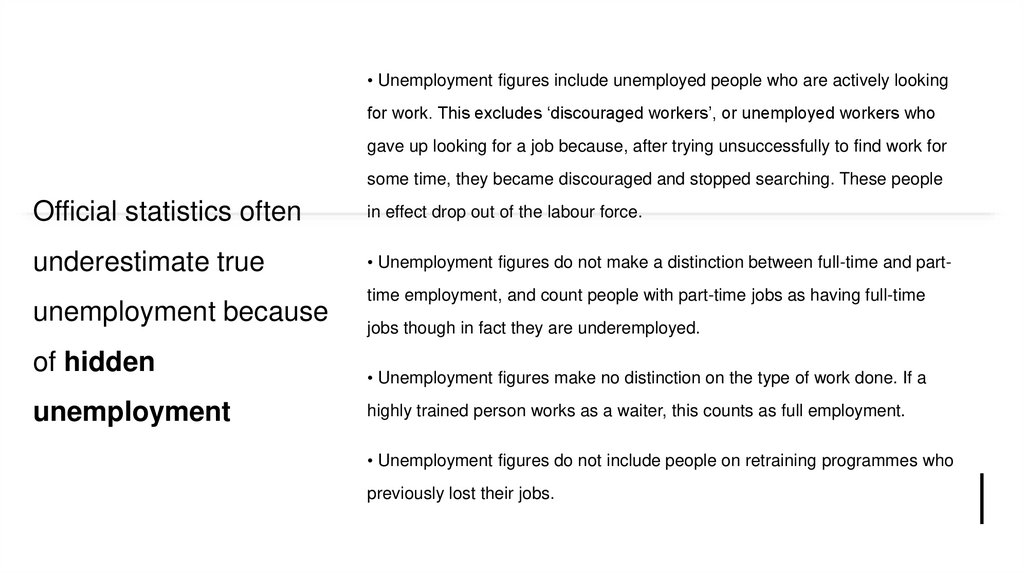
• Unemployment figures include unemployed people who are actively lookingfor work. This excludes ‘discouraged workers’, or unemployed workers who
gave up looking for a job because, after trying unsuccessfully to find work for
some time, they became discouraged and stopped searching. These people
Official statistics often
in effect drop out of the labour force.
underestimate true
• Unemployment figures do not make a distinction between full-time and part-
unemployment because
of hidden
unemployment
time employment, and count people with part-time jobs as having full-time
jobs though in fact they are underemployed.
• Unemployment figures make no distinction on the type of work done. If a
highly trained person works as a waiter, this counts as full employment.
• Unemployment figures do not include people on retraining programmes who
previously lost their jobs.