 Химия
ХимияПохожие презентации:





Transition metals in biological systems
1. Transition metals in biological systems
TRANSITIONMETALS IN
BIOLOGICAL
SYSTEMS
2. Review of previous Lesson
REVIEW OF PREVIOUS LESSONIndividually think about these questions then share your thoughts with the
class.
What are catalysts?
How do homogeneous catalysts differ from heterogeneous catalysts?
Give one example of a homogeneous catalyst and two examples of
heterogeneous catalyst.
3.
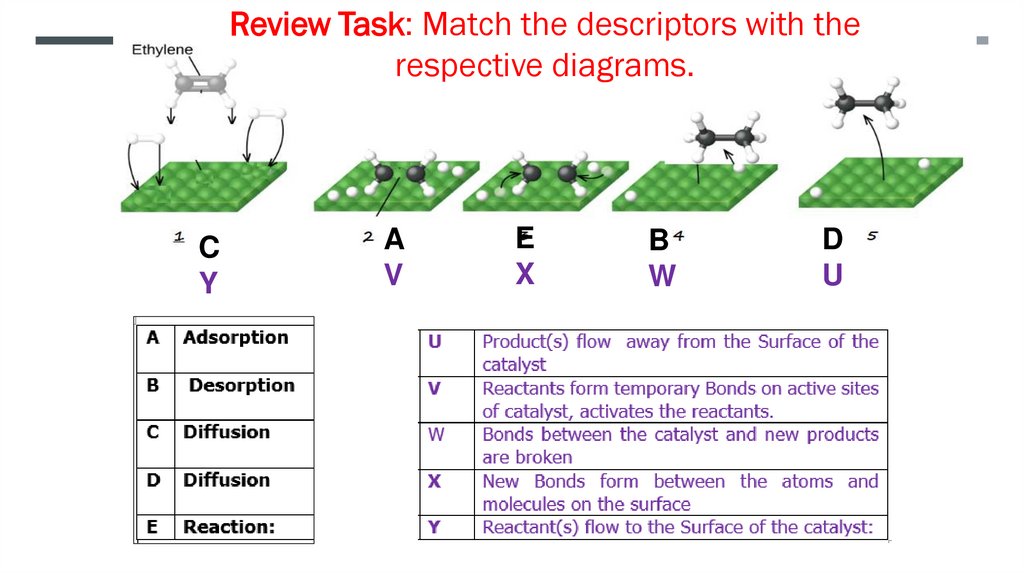
Review Task: Match the descriptors with therespective diagrams.
C
Y
A
V
E
X
B
W
D
U
4. Review activity: mcq
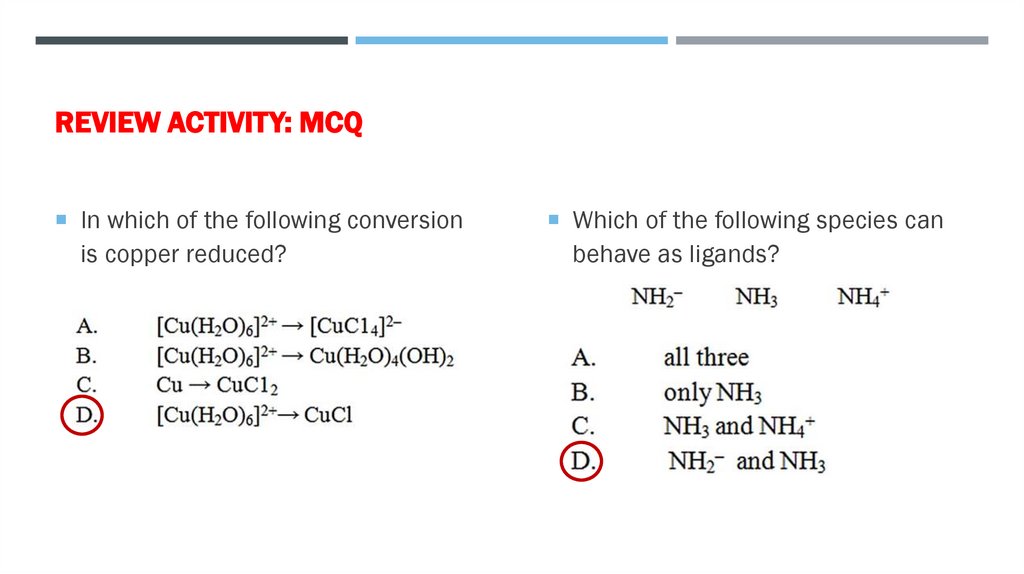
REVIEW ACTIVITY: MCQIn which of the following conversion
is copper reduced?
Which of the following species can
behave as ligands?
5. Review activity: mcq
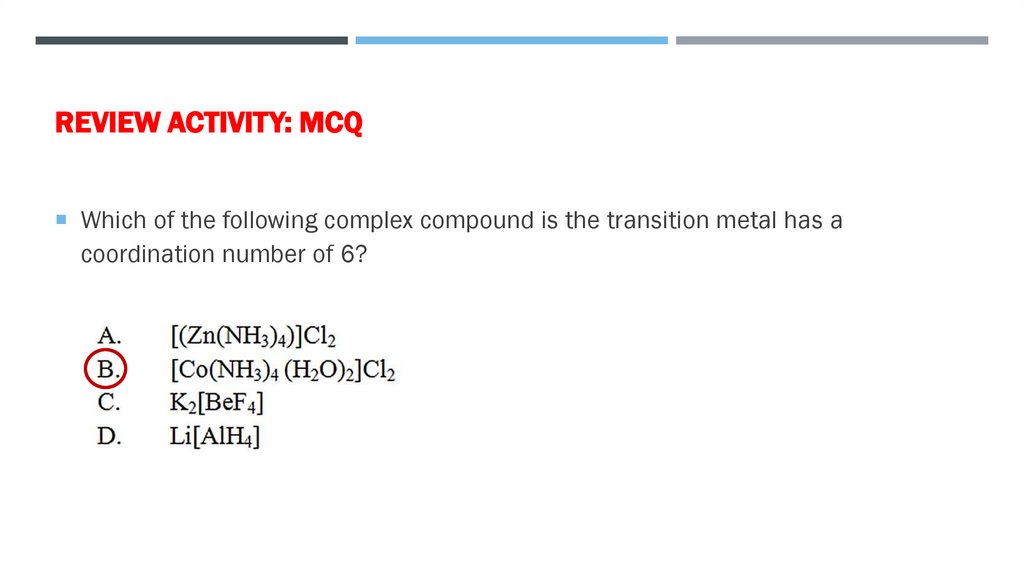
REVIEW ACTIVITY: MCQWhich of the following complex compound is the transition metal has a
coordination number of 6?
6.
Learning ObjectivesKnow that haemoglobin contains iron complexes
and understand its role in oxygen transport,
including carbon monoxide poisoning
Know that transition metal complexes can be used
to treat cancers
7.
Expected OutcomesExplain the importance and role of haemoglobin in
oxygen transport.
Describe how carbon monoxide poisoning happens.
Explain how some transition metal complexes can be
used to treat cancers.
8.
KeywordsHaem or heme
Haemoglobin or hemoglobin
Myoglobin
Ligand
Carbon monoxide poisoning
Platinum complexes
Cis-platin
Chemotherapy
9. Transition Metal Complexes in Biological Molecules
TRANSITION METAL COMPLEXESIN BIOLOGICAL MOLECULES
Metal ion complexes are used in humans for the transport and
storage of oxygen, as electron-transfer agents, as catalysts,
and as drugs.
10. Biological Importance of Iron
BIOLOGICAL IMPORTANCE OF IRONPlays a central role in almost all living cells
Component of hemoglobin and myoglobin
Involved in the electron-transport chain
11. Activity: web search Investigating SOME BIOLOGICAL APPLICATIONS OF TRANSITION METALS
ACTIVITY: WEB SEARCHINVESTIGATING SOME BIOLOGICAL APPLICATIONS OF TRANSITION METALS
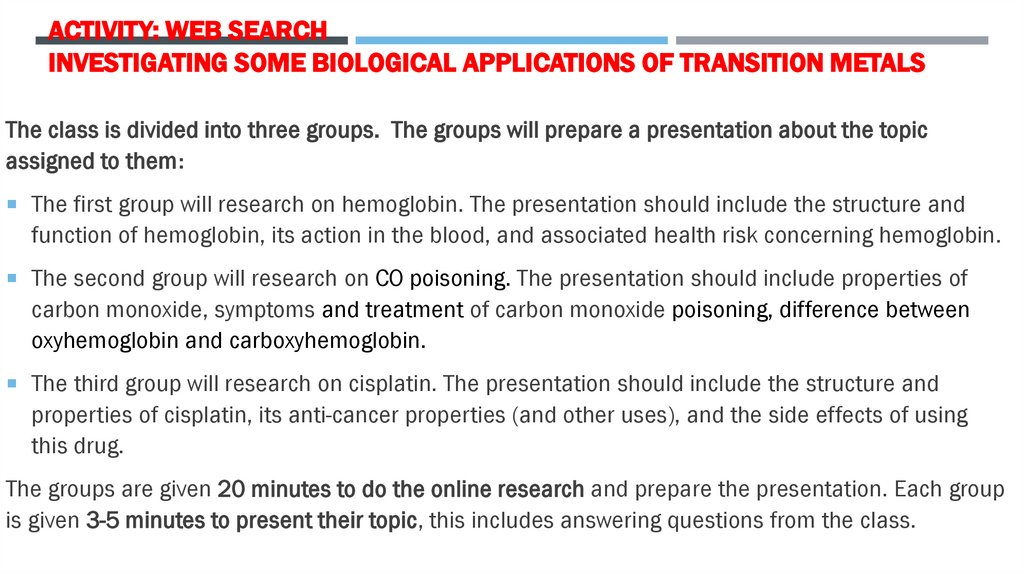
The class is divided into three groups. The groups will prepare a presentation about the topic
assigned to them:
The first group will research on hemoglobin. The presentation should include the structure and
function of hemoglobin, its action in the blood, and associated health risk concerning hemoglobin.
The second group will research on CO poisoning. The presentation should include properties of
carbon monoxide, symptoms and treatment of carbon monoxide poisoning, difference between
oxyhemoglobin and carboxyhemoglobin.
The third group will research on cisplatin. The presentation should include the structure and
properties of cisplatin, its anti-cancer properties (and other uses), and the side effects of using
this drug.
The groups are given 20 minutes to do the online research and prepare the presentation. Each group
is given 3-5 minutes to present their topic, this includes answering questions from the class.
12. Discussion: HAemoglobin
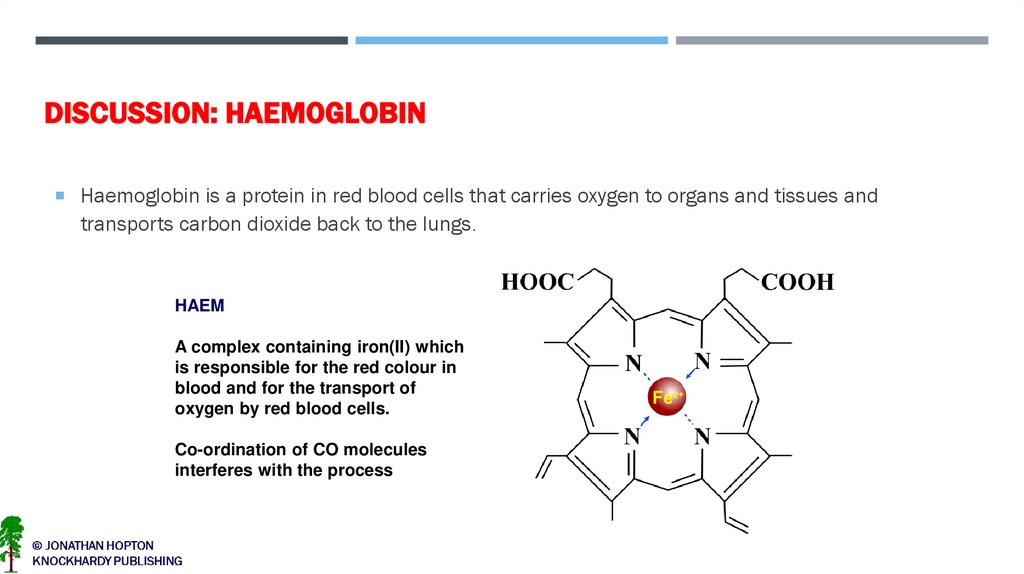
DISCUSSION: HAEMOGLOBINHaemoglobin is a protein in red blood cells that carries oxygen to organs and tissues and
transports carbon dioxide back to the lungs.
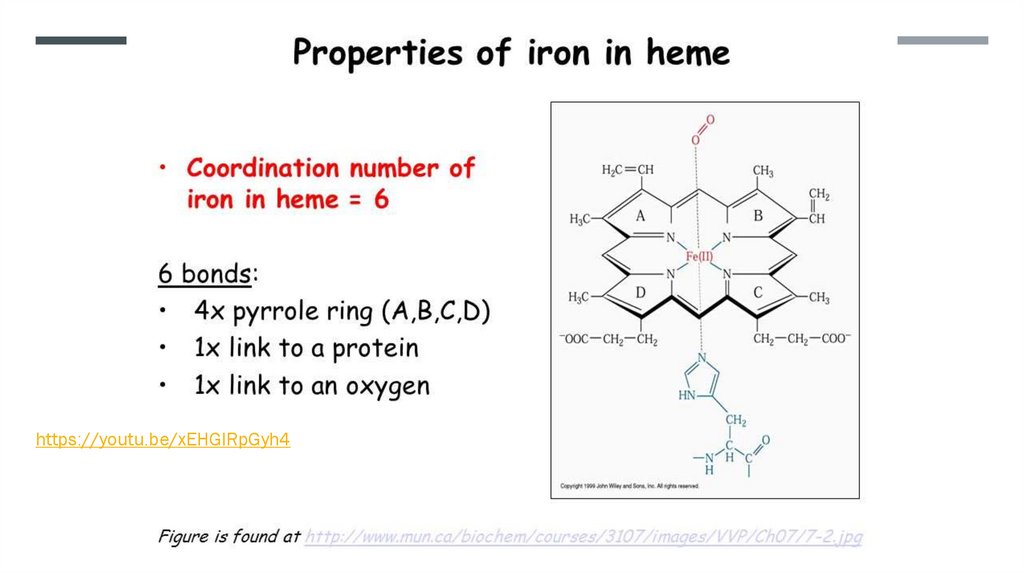
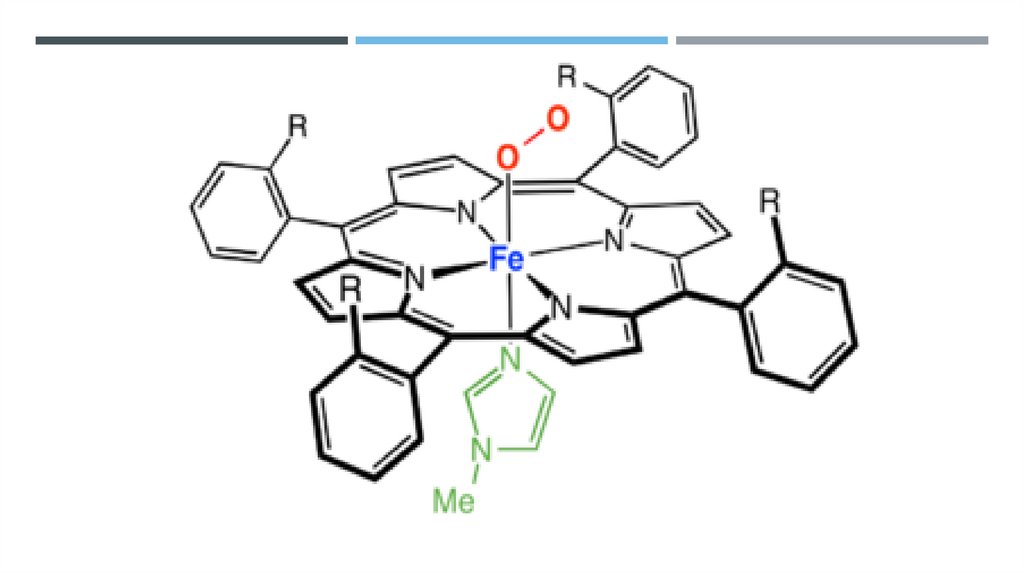
HAEM
A complex containing iron(II) which
is responsible for the red colour in
blood and for the transport of
oxygen by red blood cells.
Co-ordination of CO molecules
interferes with the process
13.
https://youtu.be/xEHGIRpGyh414. Hemoglobin
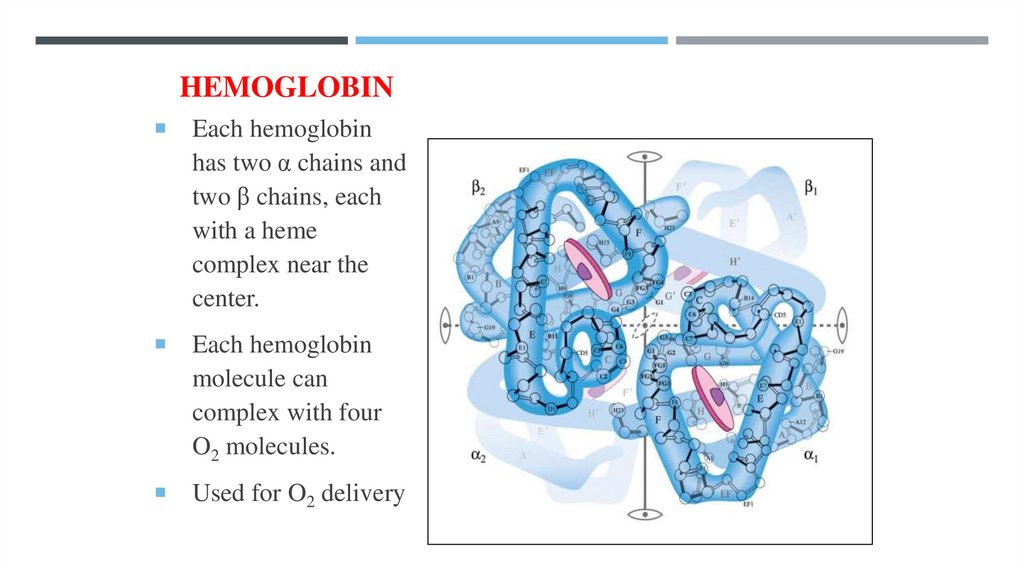
HEMOGLOBINEach hemoglobin
has two α chains and
two β chains, each
with a heme
complex near the
center.
Each hemoglobin
molecule can
complex with four
O2 molecules.
Used for O2 delivery
15.
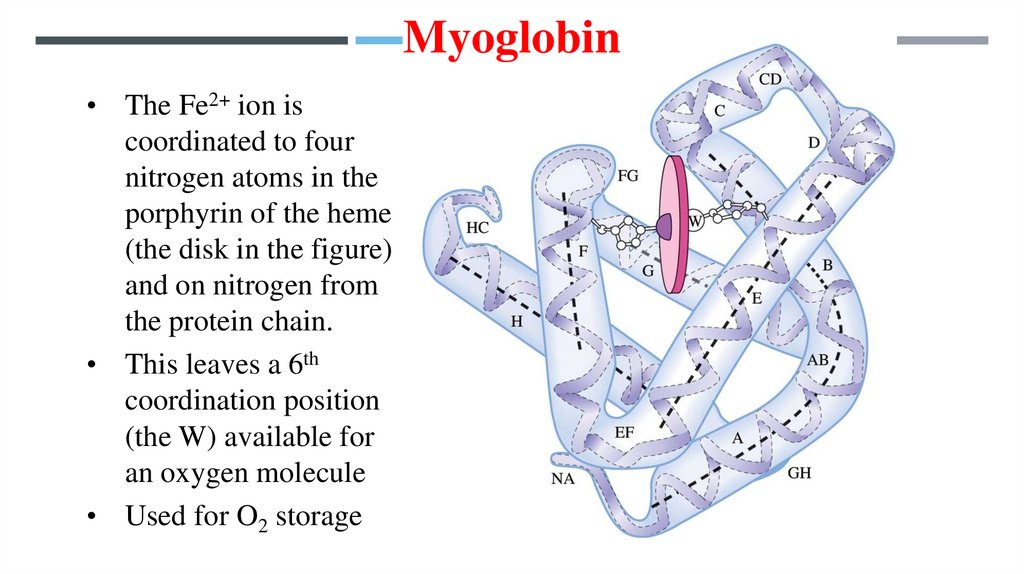
Myoglobin• The Fe2+ ion is
coordinated to four
nitrogen atoms in the
porphyrin of the heme
(the disk in the figure)
and on nitrogen from
the protein chain.
• This leaves a 6th
coordination position
(the W) available for
an oxygen molecule
• Used for O2 storage
16.
17. Discussion: Carbon monoxide poisoning
DISCUSSION: CARBON MONOXIDE POISONINGMonoxide (CO) is a colourless, odourless gas that can be released
from faulty boilers or combustion engines.
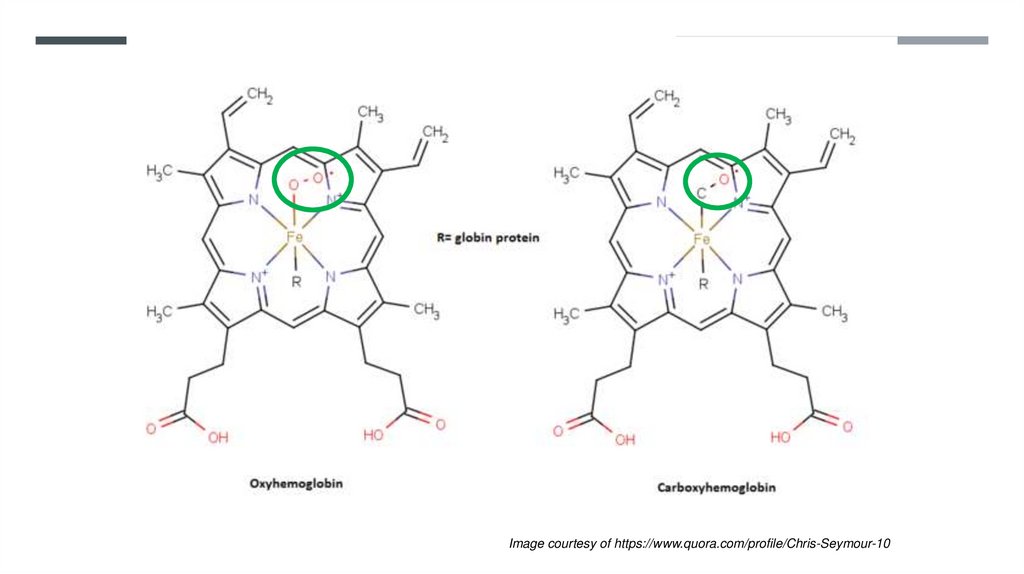
Carbon monoxide combines with hemoglobin at the same point on
the hemoglobin molecule as does oxygen.
So it can displace oxygen from the hemoglobin, thereby decreasing
the oxygen-carrying capacity of blood.
18. Carbon monoxide poisoning
CARBON MONOXIDE POISONINGHaemoglobin has an affinity for CO that is 210x greater than its affinity
for oxygen
This means that once carbon monoxide binds to haemoglobin, it
is irreversible.
19.
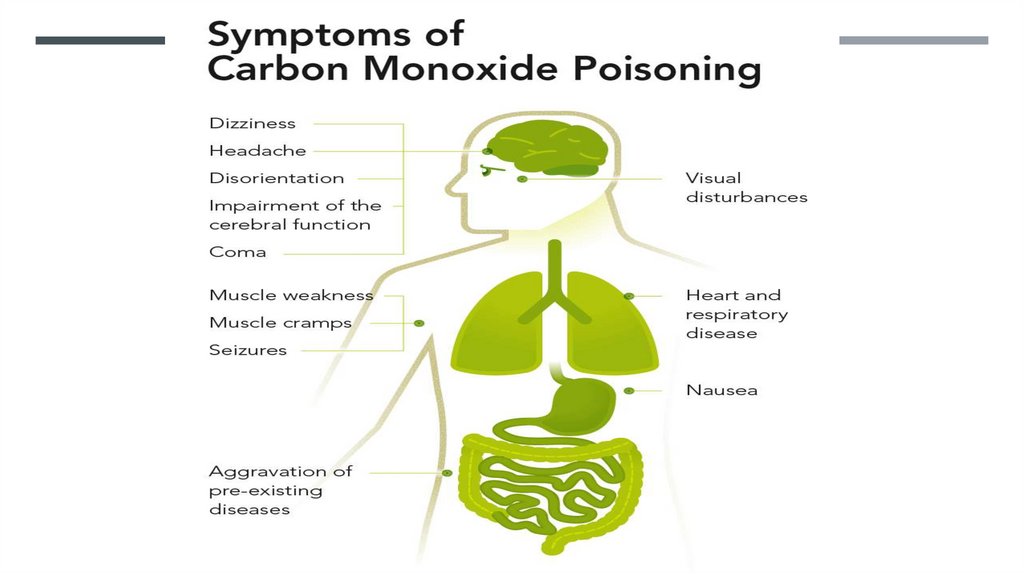
Image courtesy of https://www.quora.com/profile/Chris-Seymour-1020. Symptoms and treatment of carbon dioxide poisoning
SYMPTOMS AND TREATMENT OF CARBON DIOXIDE POISONINGHeadache
Nausea
Tiredness
Treatment
Treatment is with 100% oxygen and referral for hyperbaric
oxygen treatment
21.
22.
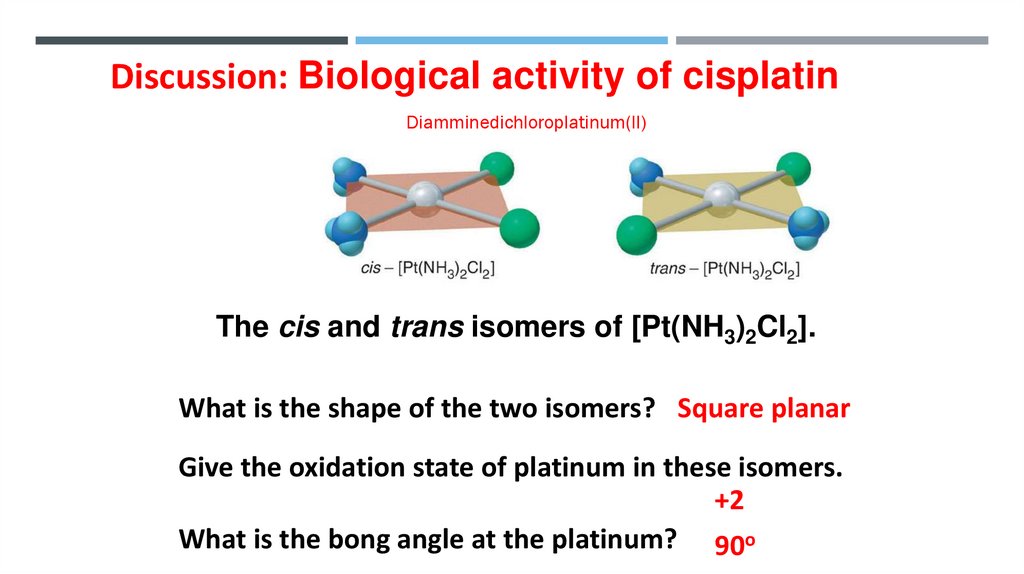
Discussion: Biological activity of cisplatinDiamminedichloroplatinum(II)
The cis and trans isomers of [Pt(NH3)2Cl2].
What is the shape of the two isomers? Square planar
Give the oxidation state of platinum in these isomers.
+2
What is the bong angle at the platinum? 90o
23.
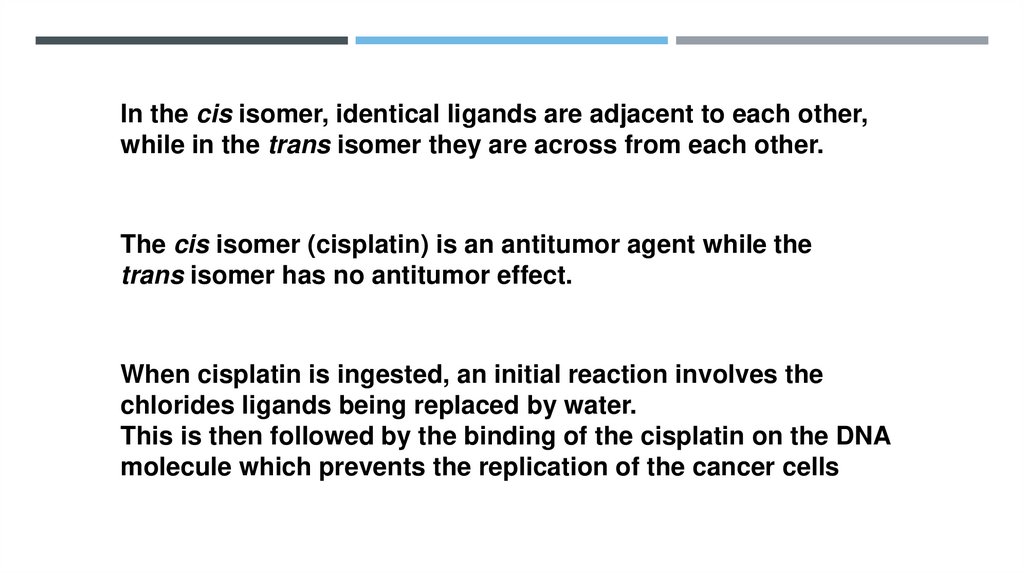
In the cis isomer, identical ligands are adjacent to each other,while in the trans isomer they are across from each other.
The cis isomer (cisplatin) is an antitumor agent while the
trans isomer has no antitumor effect.
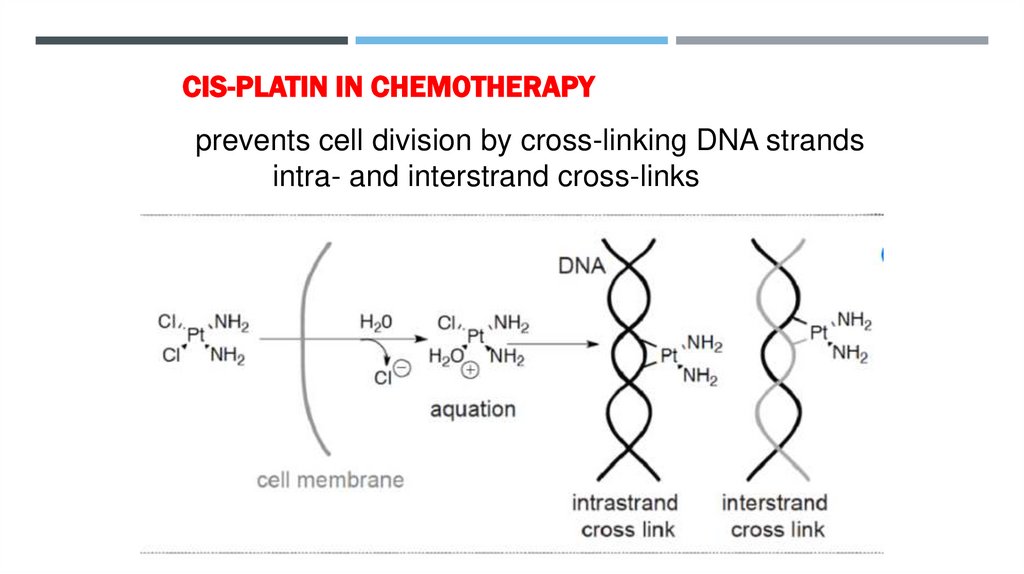
When cisplatin is ingested, an initial reaction involves the
chlorides ligands being replaced by water.
This is then followed by the binding of the cisplatin on the DNA
molecule which prevents the replication of the cancer cells
24.
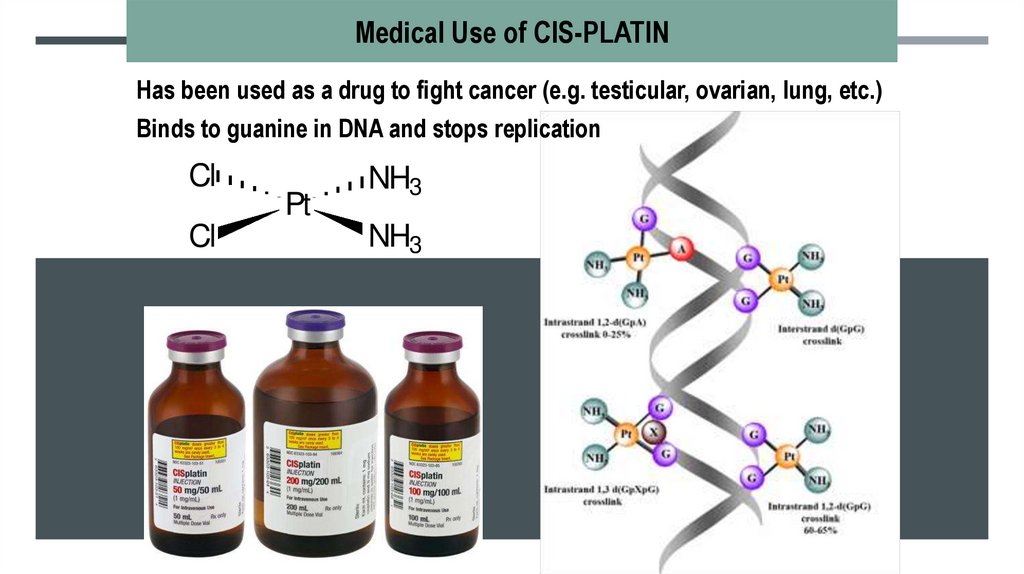
Medical Use of CIS-PLATINHas been used as a drug to fight cancer (e.g. testicular, ovarian, lung, etc.)
Binds to guanine in DNA and stops replication
Cl
Pt
Cl
NH3
NH3
25. Cis-platin in Chemotherapy
CIS-PLATIN IN CHEMOTHERAPYprevents cell division by cross-linking DNA strands
intra- and interstrand cross-links
26. Side effects of cisplatin
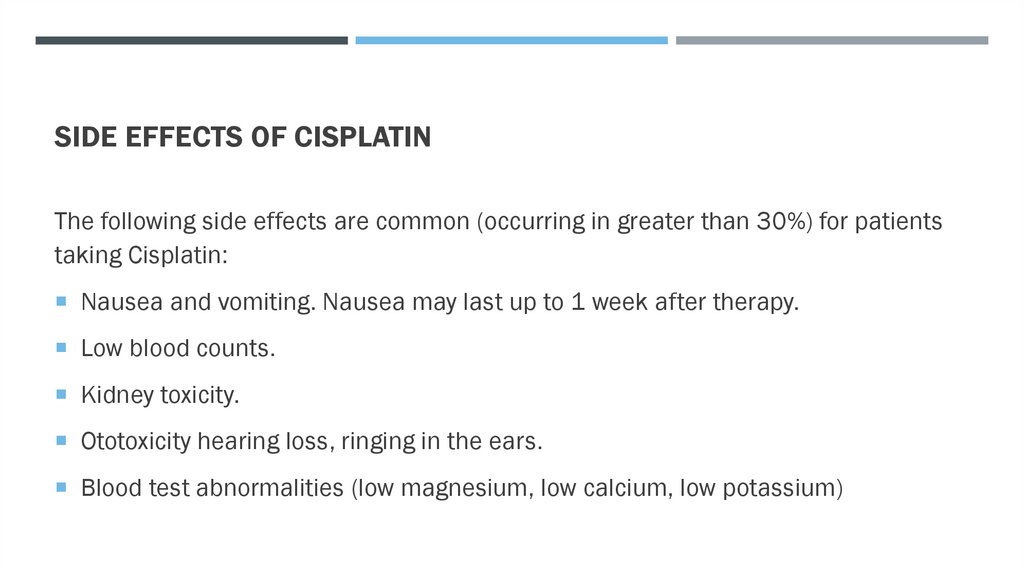
SIDE EFFECTS OF CISPLATINThe following side effects are common (occurring in greater than 30%) for patients
taking Cisplatin:
Nausea and vomiting. Nausea may last up to 1 week after therapy.
Low blood counts.
Kidney toxicity.
Ototoxicity hearing loss, ringing in the ears.
Blood test abnormalities (low magnesium, low calcium, low potassium)
27. Video demonstration
VIDEO DEMONSTRATIONHow cisplatin works
https://youtu.be/RHZjnJCcvYg
Mechanism of cisplatin
https://youtu.be/Wq_up2uQRDo
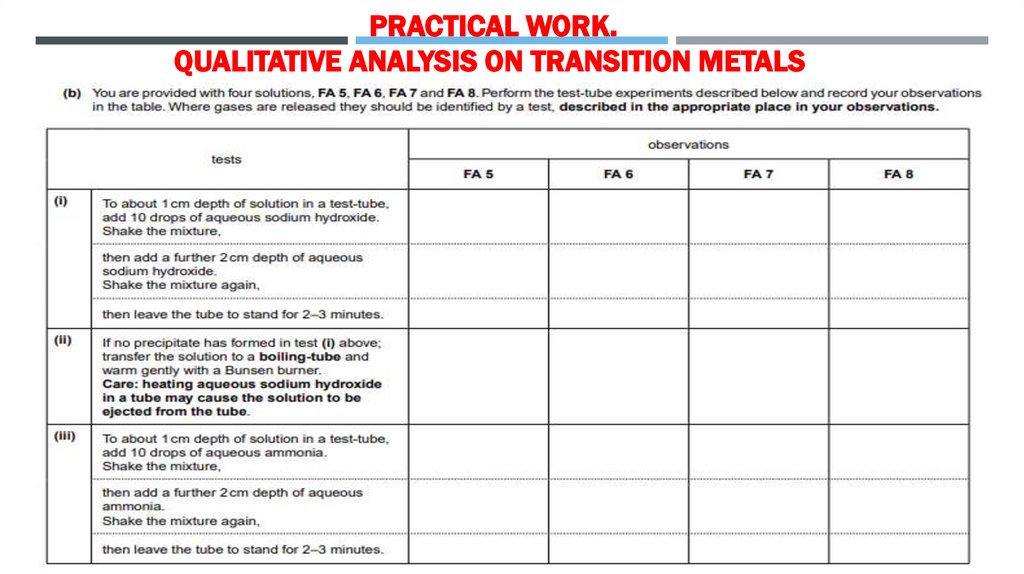
28. Practical work. qualitative analysis on transition metals
PRACTICAL WORK.QUALITATIVE ANALYSIS ON TRANSITION METALS
29.
ReflectionWhat has been learned
What remained unclear
What is necessary to work on