
 Лингвистика
Похожие презентации:



Stylistic Devices
1. Stylistic Devices
2. Adnomination
Repetition of words with the same root. The difference lies inone sound or letter. A nice euphony can be achieved by using
this poetic device.
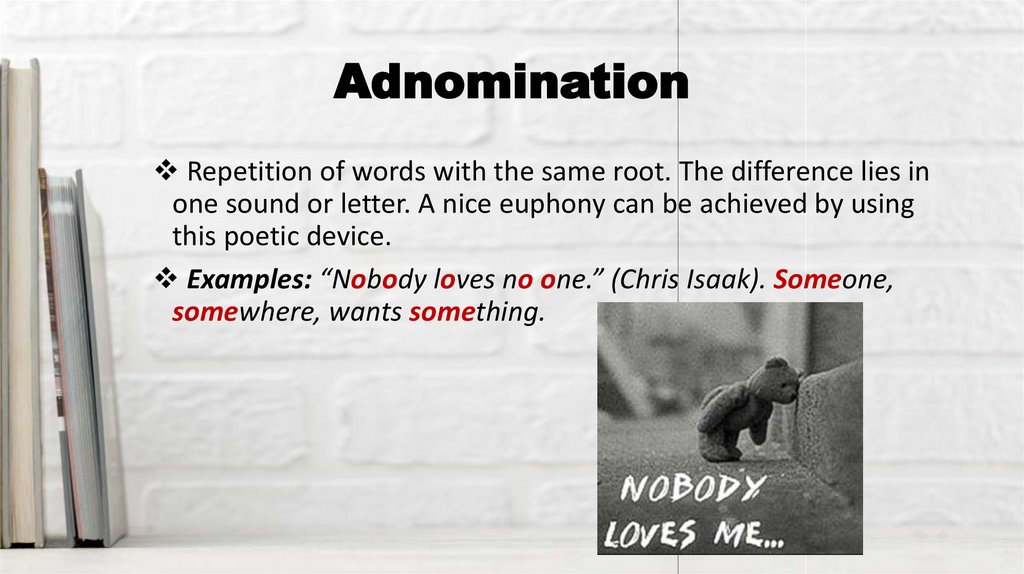
Examples: “Nobody loves no one.” (Chris Isaak). Someone,
somewhere, wants something.
3. Allegory
Representation of ideas through acertain form (character, event, etc.).
Allegory can convey hidden meanings
through symbolic figures, actions, and
imagery.
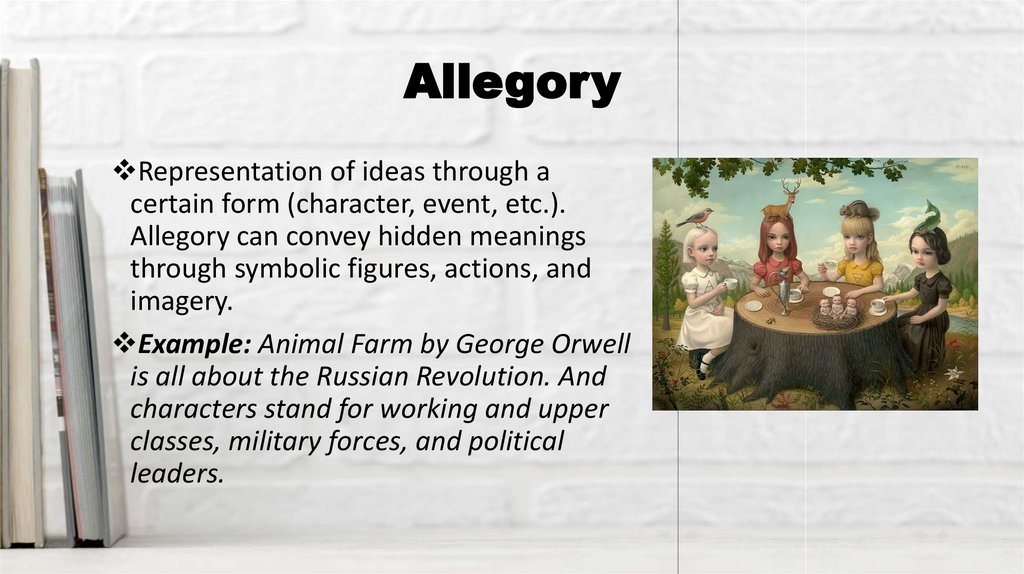
Example: Animal Farm by George Orwell
is all about the Russian Revolution. And
characters stand for working and upper
classes, military forces, and political
leaders.
4. Alliteration
The repeated sound of the first consonant in aseries of words, or the repetition of the same
sounds of the same kind at the beginning of
words or in stressed syllables of a phrase.
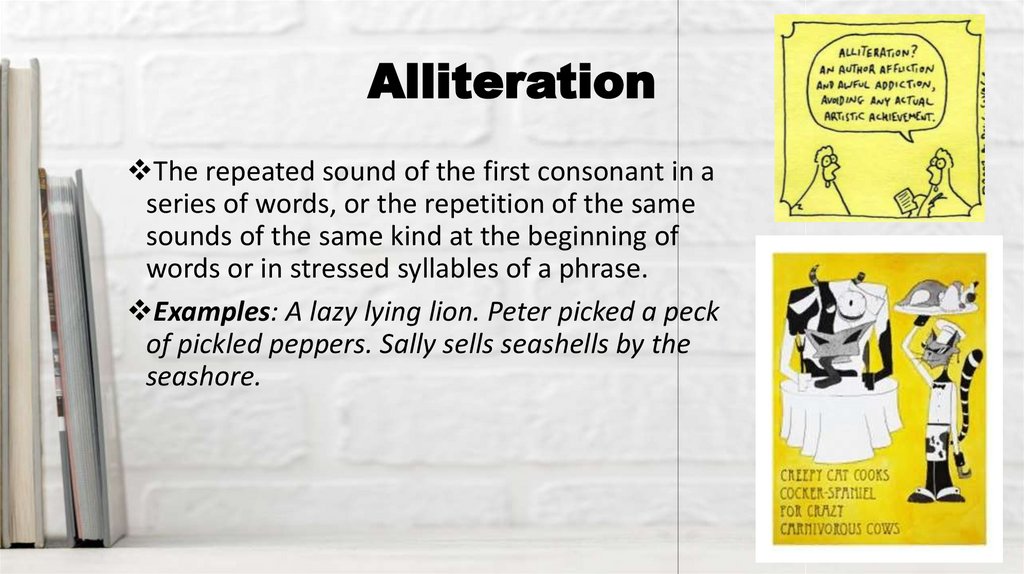
Examples: A lazy lying lion. Peter picked a peck
of pickled peppers. Sally sells seashells by the
seashore.
5. Allusion
Reference to a myth, character, literary work, work of art, or anevent.
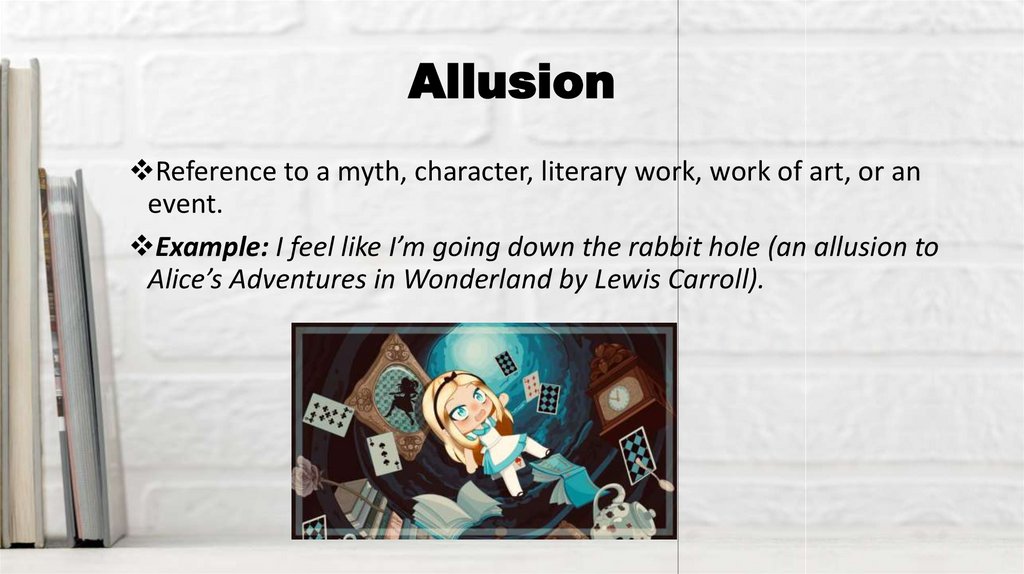
Example: I feel like I’m going down the rabbit hole (an allusion to
Alice’s Adventures in Wonderland by Lewis Carroll).
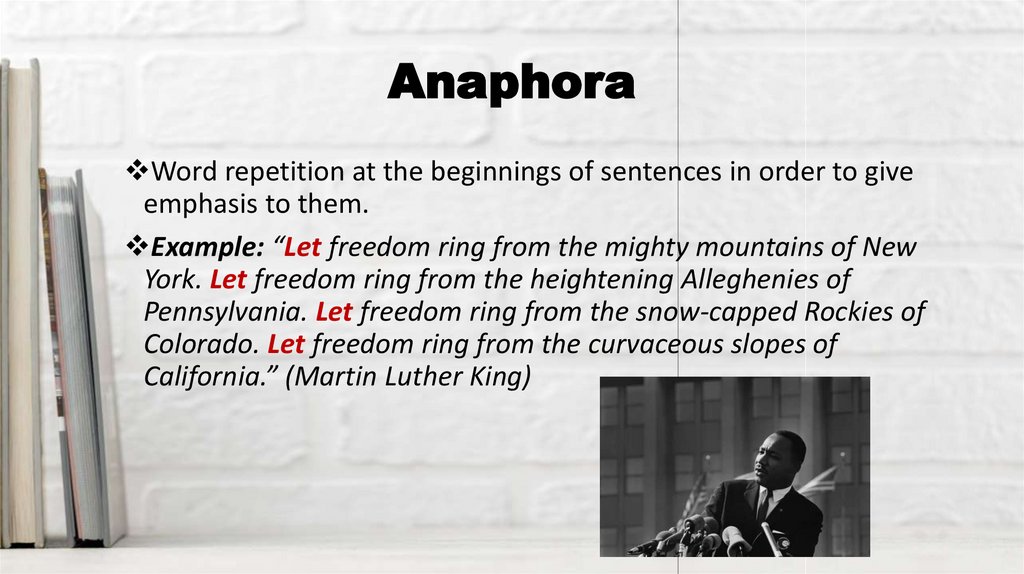
6. Anaphora
Word repetition at the beginnings of sentences in order to giveemphasis to them.
Example: “Let freedom ring from the mighty mountains of New
York. Let freedom ring from the heightening Alleghenies of
Pennsylvania. Let freedom ring from the snow-capped Rockies of
Colorado. Let freedom ring from the curvaceous slopes of
California.” (Martin Luther King)
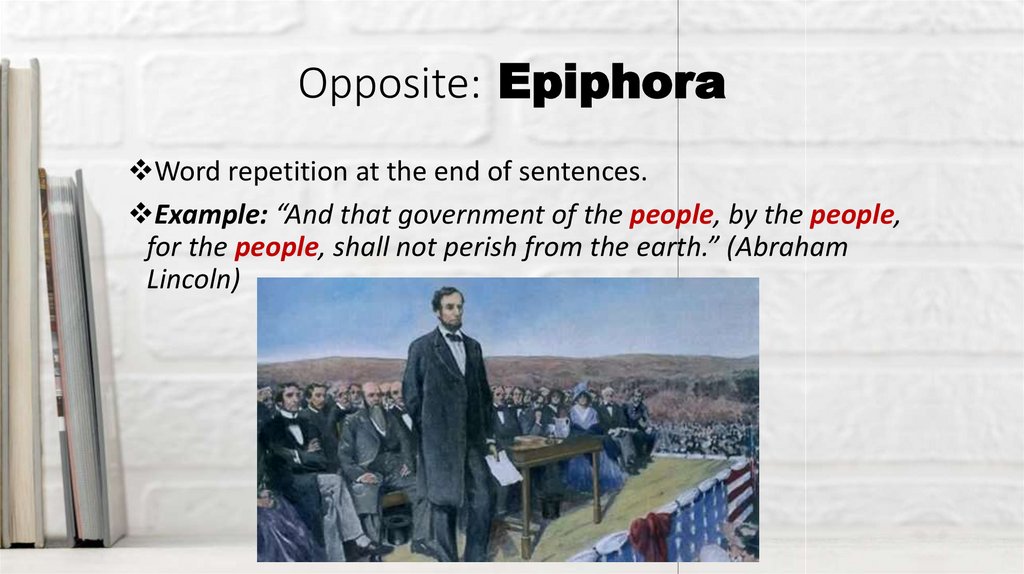
7. Opposite: Epiphora
Opposite: EpiphoraWord repetition at the end of sentences.
Example: “And that government of the people, by the people,
for the people, shall not perish from the earth.” (Abraham
Lincoln)
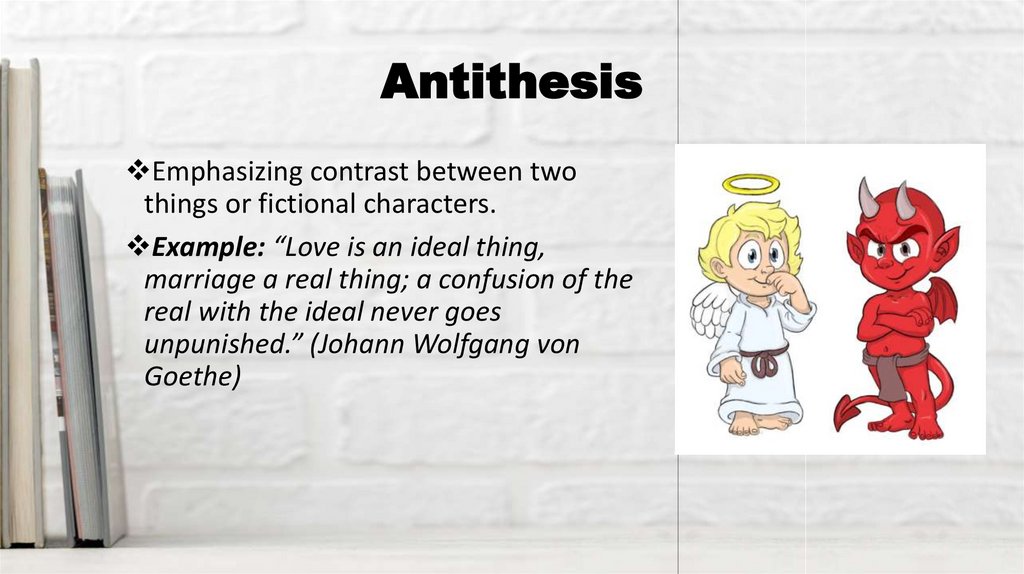
8. Antithesis
Emphasizing contrast between twothings or fictional characters.
Example: “Love is an ideal thing,
marriage a real thing; a confusion of the
real with the ideal never goes
unpunished.” (Johann Wolfgang von
Goethe)
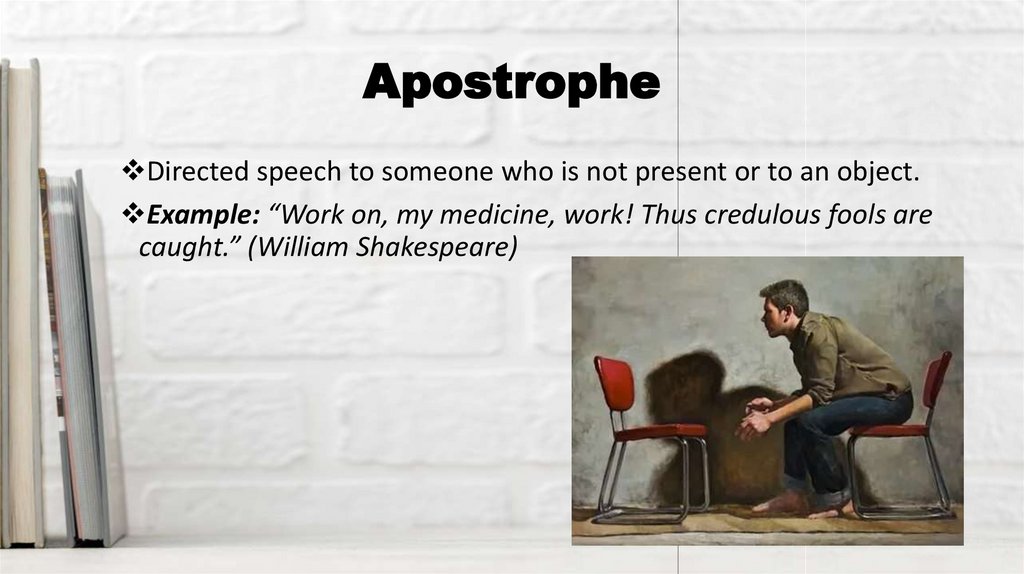
9. Apostrophe
Directed speech to someone who is not present or to an object.Example: “Work on, my medicine, work! Thus credulous fools are
caught.” (William Shakespeare)
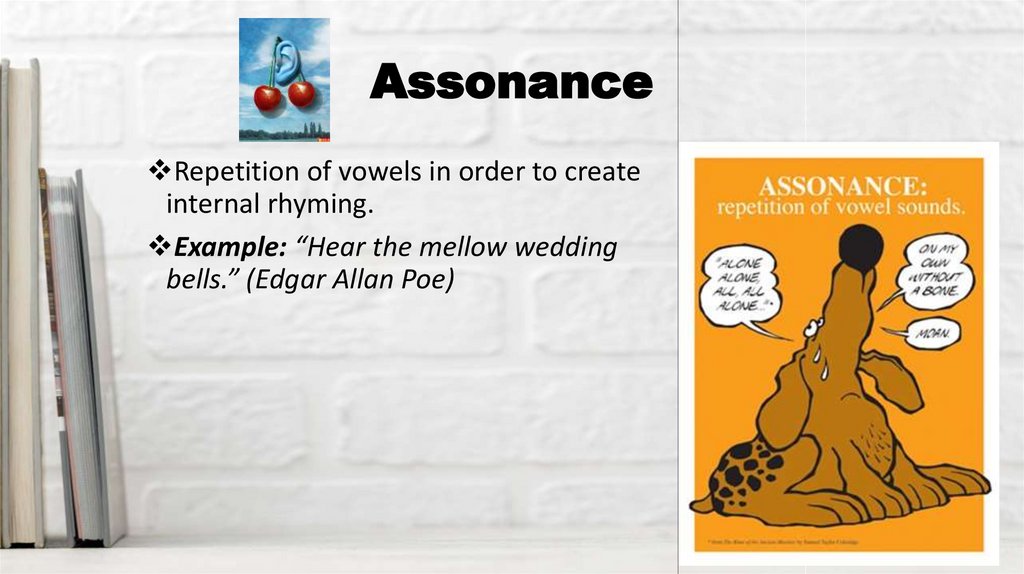
10. Assonance
Repetition of vowels in order to createinternal rhyming.
Example: “Hear the mellow wedding
bells.” (Edgar Allan Poe)
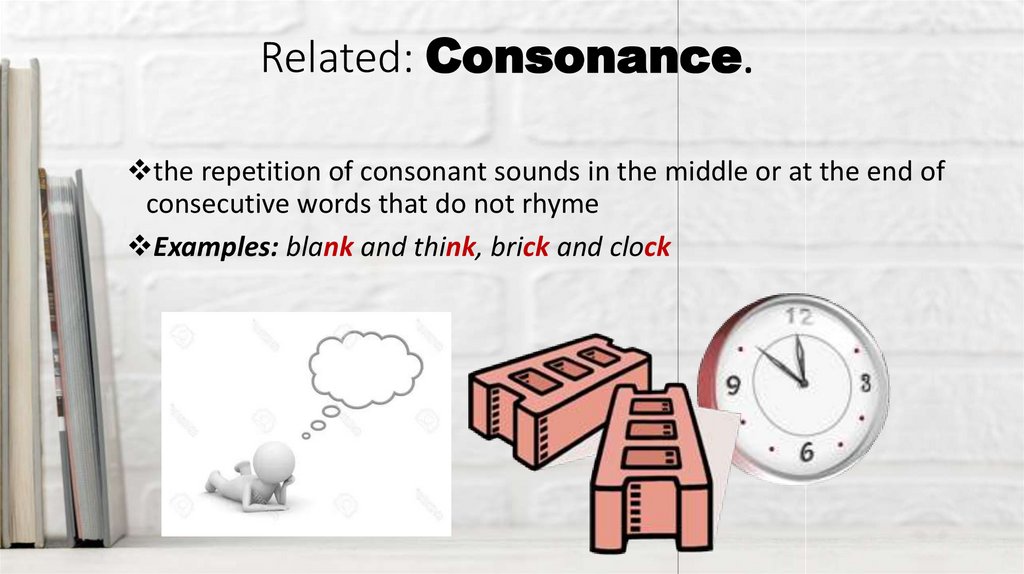
11. Related: Consonance.
Related: Consonance.the repetition of consonant sounds in the middle or at the end of
consecutive words that do not rhyme
Examples: blank and think, brick and clock
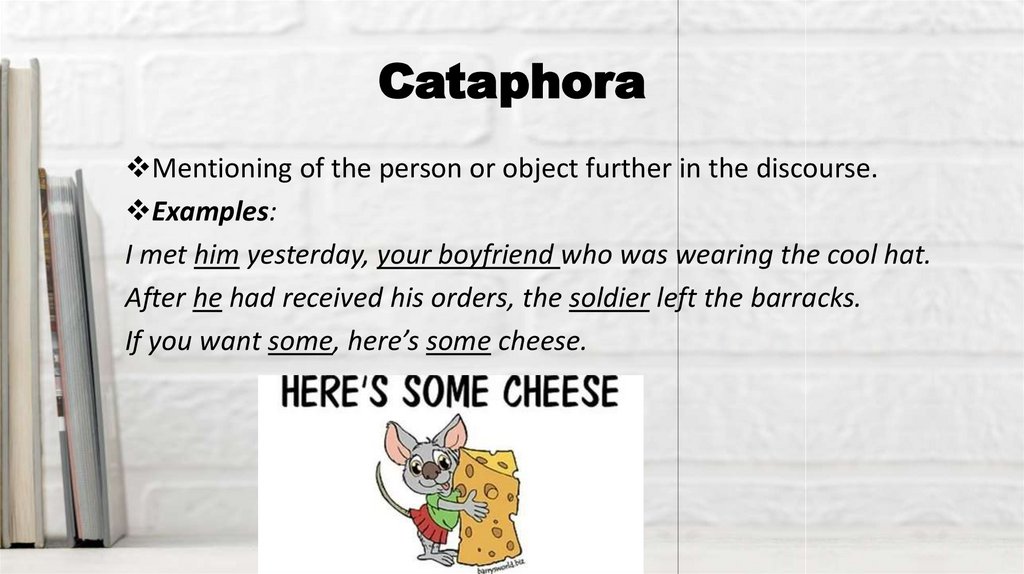
12. Cataphora
Mentioning of the person or object further in the discourse.Examples:
I met him yesterday, your boyfriend who was wearing the cool hat.
After he had received his orders, the soldier left the barracks.
If you want some, here’s some cheese.
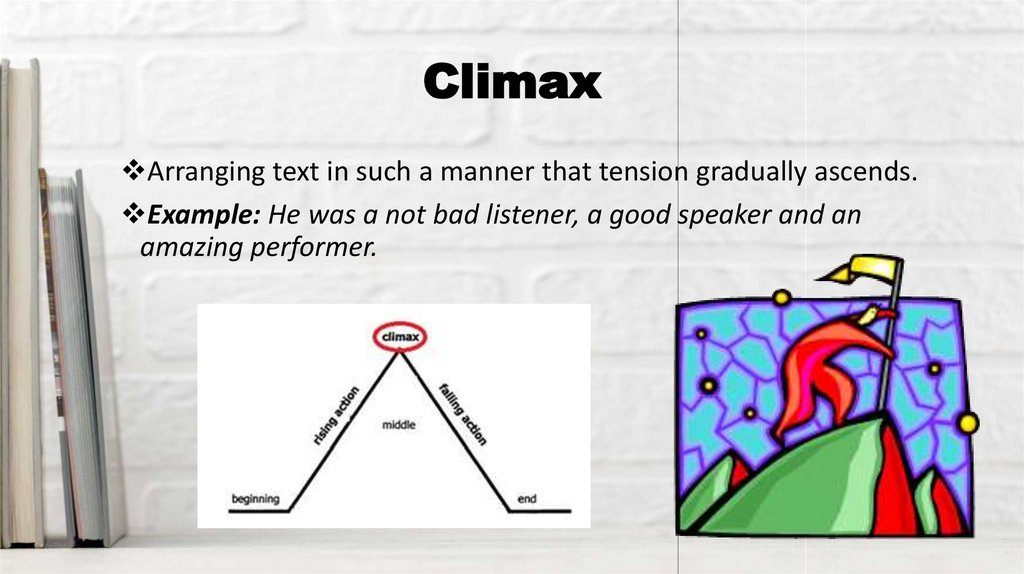
13. Climax
Arranging text in such a manner that tension gradually ascends.Example: He was a not bad listener, a good speaker and an
amazing performer.
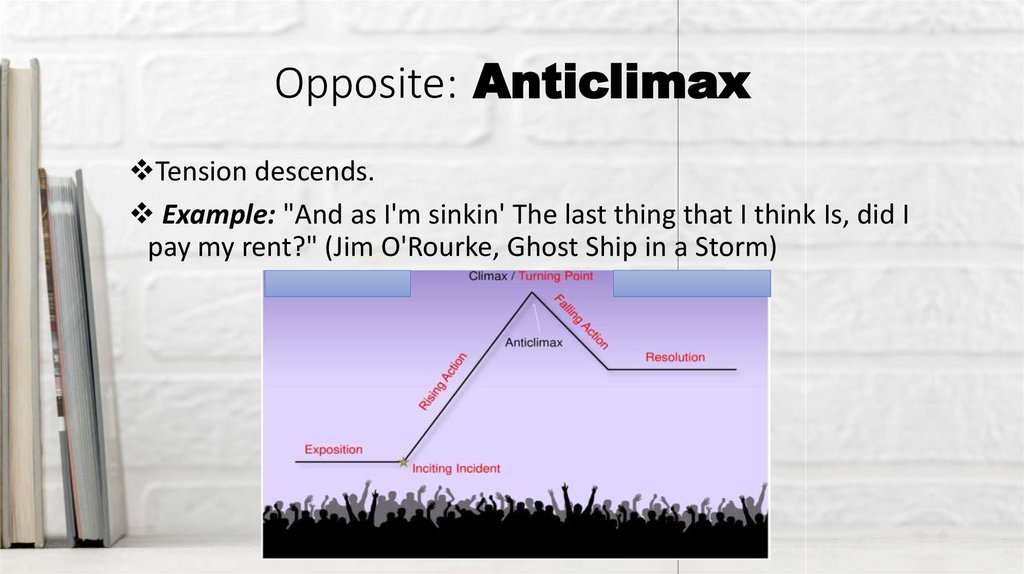
14. Opposite: Anticlimax
Opposite: AnticlimaxTension descends.
Example: "And as I'm sinkin' The last thing that I think Is, did I
pay my rent?" (Jim O'Rourke, Ghost Ship in a Storm)
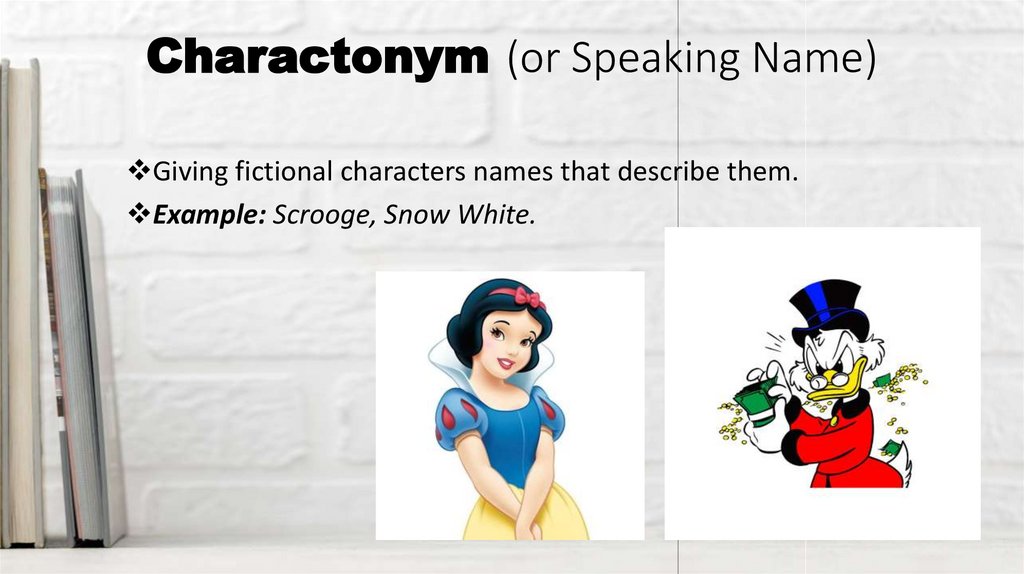
15. Charactonym (or Speaking Name)
Charactonym (or Speaking Name)Giving fictional characters names that describe them.
Example: Scrooge, Snow White.
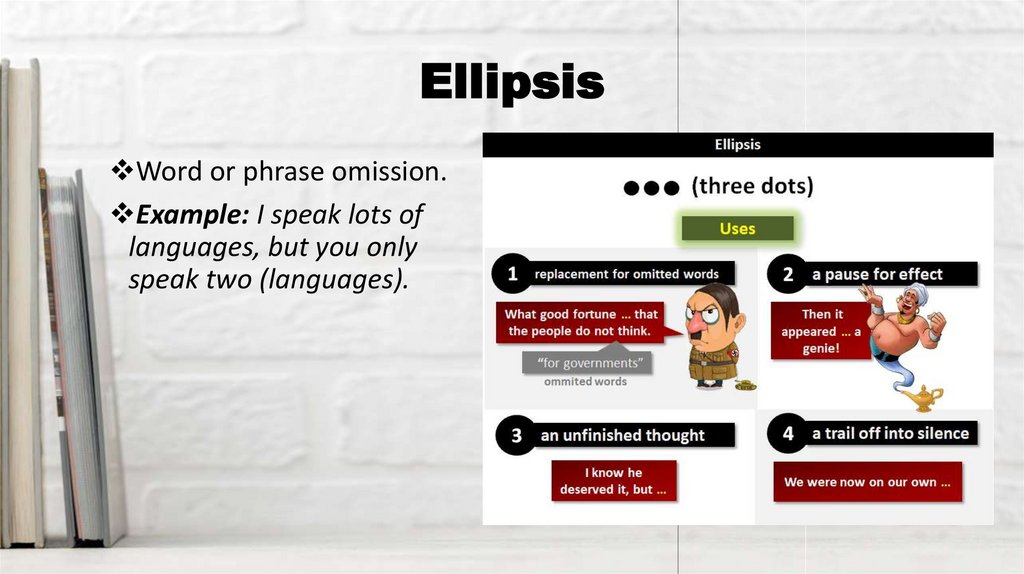
16. Ellipsis
Word or phrase omission.Example: I speak lots of
languages, but you only
speak two (languages).
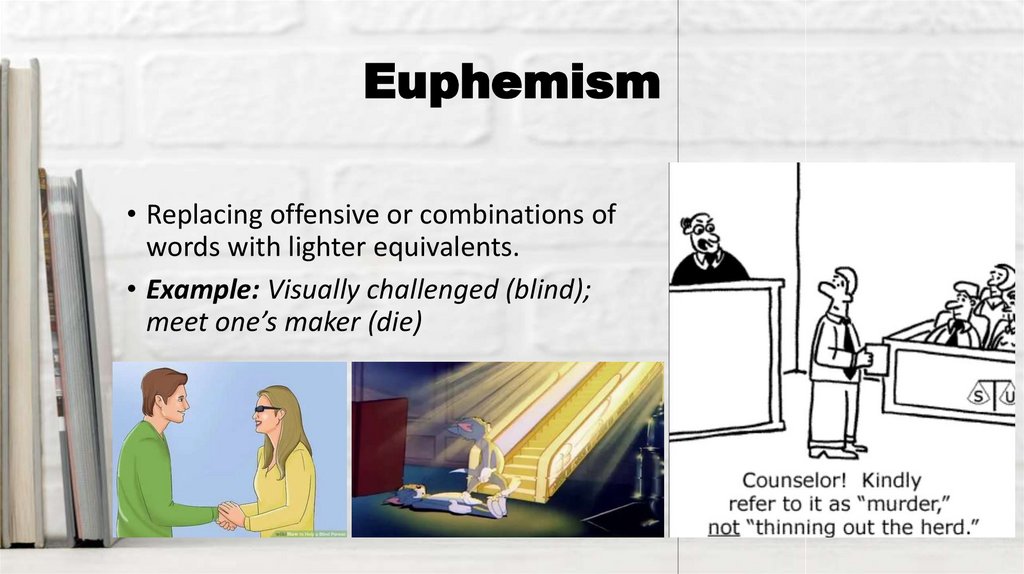
17. Euphemism
• Replacing offensive or combinations ofwords with lighter equivalents.
• Example: Visually challenged (blind);
meet one’s maker (die)
18. Opposite: Dysphemism
Opposite: DysphemismReplacing a neutral word with a harsher word.
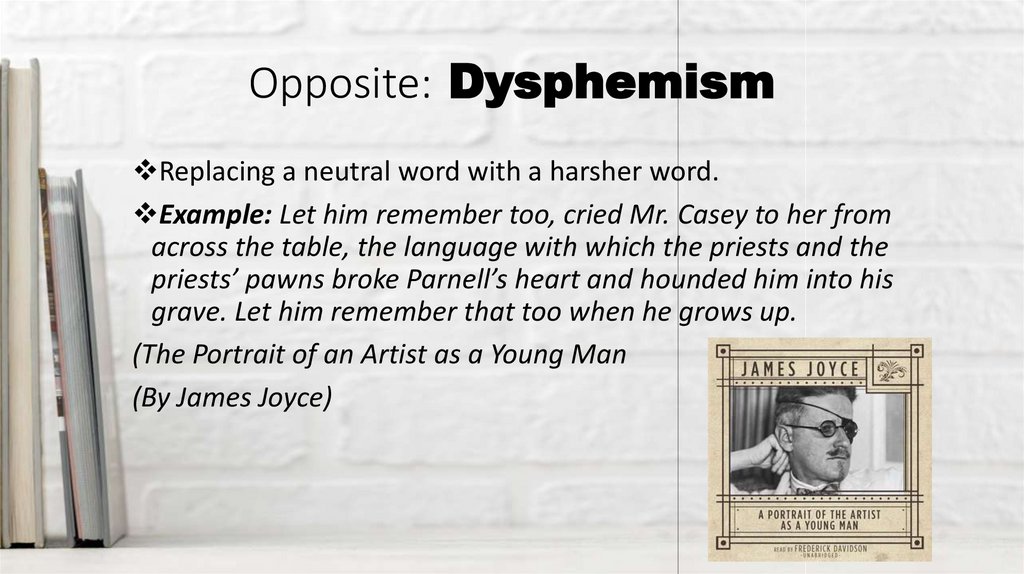
Example: Let him remember too, cried Mr. Casey to her from
across the table, the language with which the priests and the
priests’ pawns broke Parnell’s heart and hounded him into his
grave. Let him remember that too when he grows up.
(The Portrait of an Artist as a Young Man
(By James Joyce)
19. Epigram
Memorable and brief saying,usually satirical.
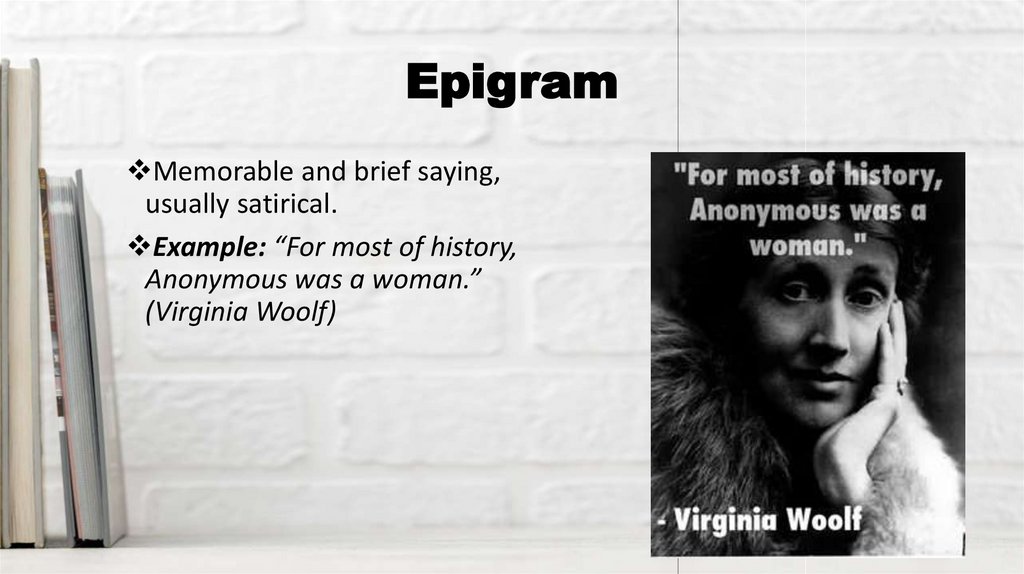
Example: “For most of history,
Anonymous was a woman.”
(Virginia Woolf)
20. Hyperbole
Exaggeration of the statement.Example: If I’ve told you once, I’ve told you a thousand times.
21. Opposite: Litotes
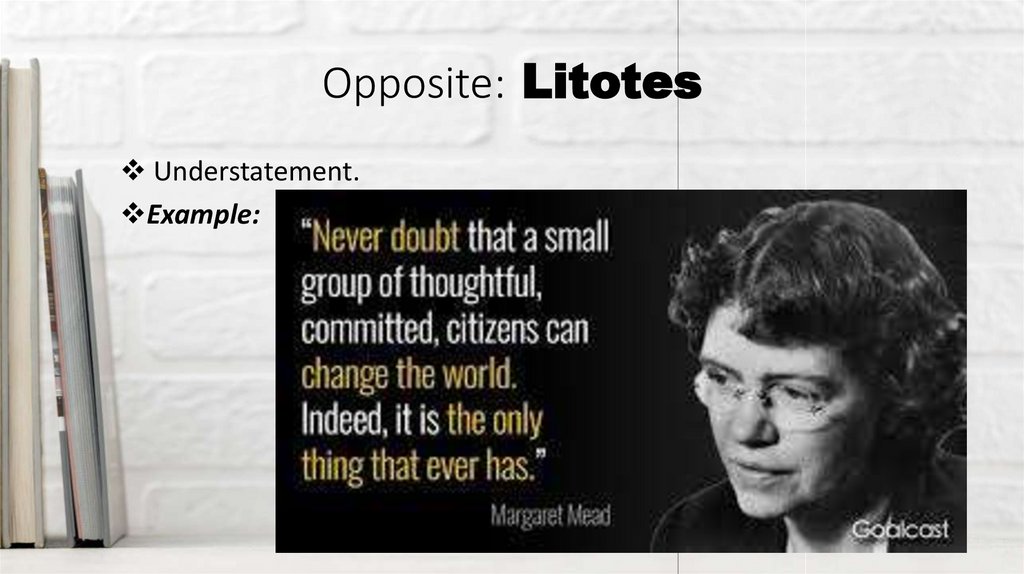
Opposite: LitotesUnderstatement.
Example:
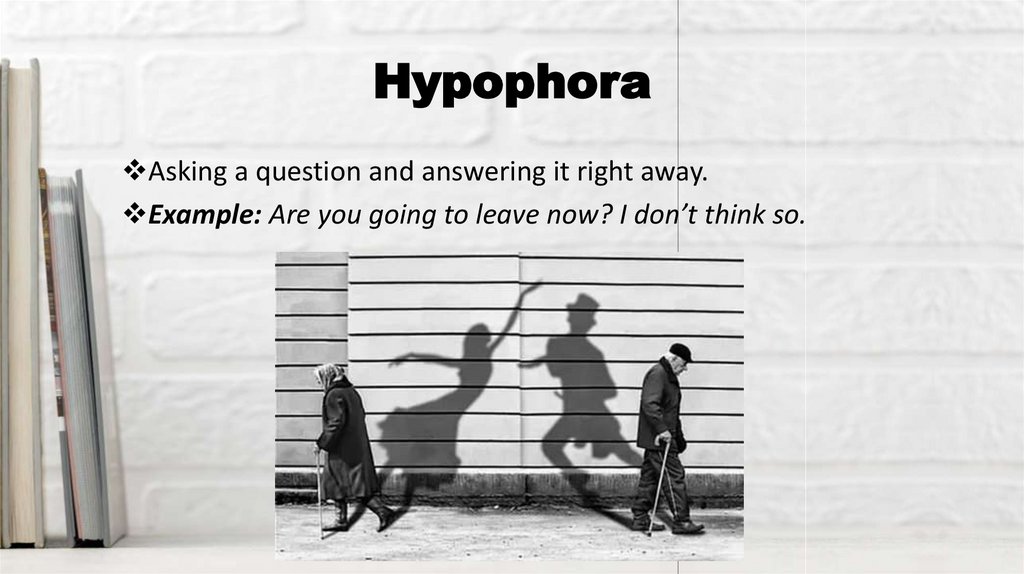
22. Hypophora
Asking a question and answering it right away.Example: Are you going to leave now? I don’t think so.
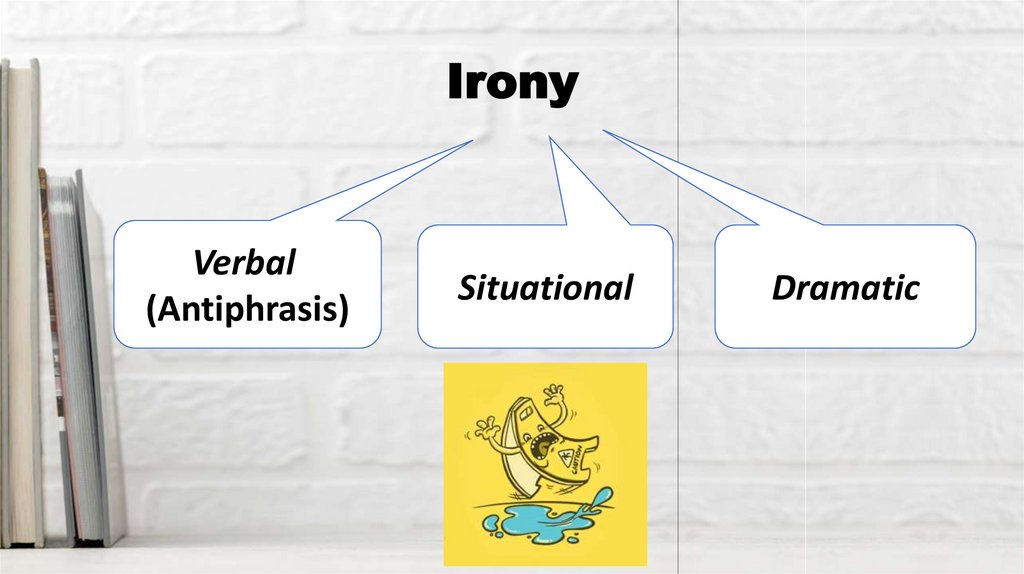
23. Irony
Verbal(Antiphrasis)
Situational
Dramatic
24. There are three types of irony:
• Verbal (Antiphrasis) – using words to express something differentfrom their literal meaning for ironic effect (”I’m so excited to burn
the midnight oil and write my academic paper all week long”).
• Situational – result differs from the expectation (Bruce Robertson,
a character of Filth, is a policeman. Nonetheless, he does drugs,
resorts to violence and abuse, and so on).
• Dramatic – situation is understandable for the audience but not
the fictional character/actor (audience sees that the fictional
characters/actors will be killed now, though the characters don’t
expect it).
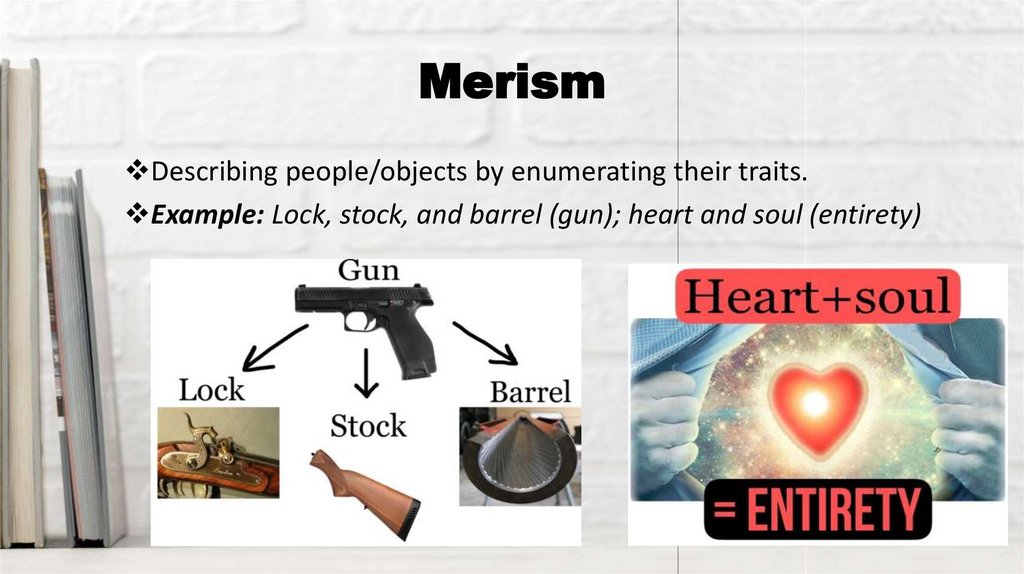
25. Merism
Describing people/objects by enumerating their traits.Example: Lock, stock, and barrel (gun); heart and soul (entirety)
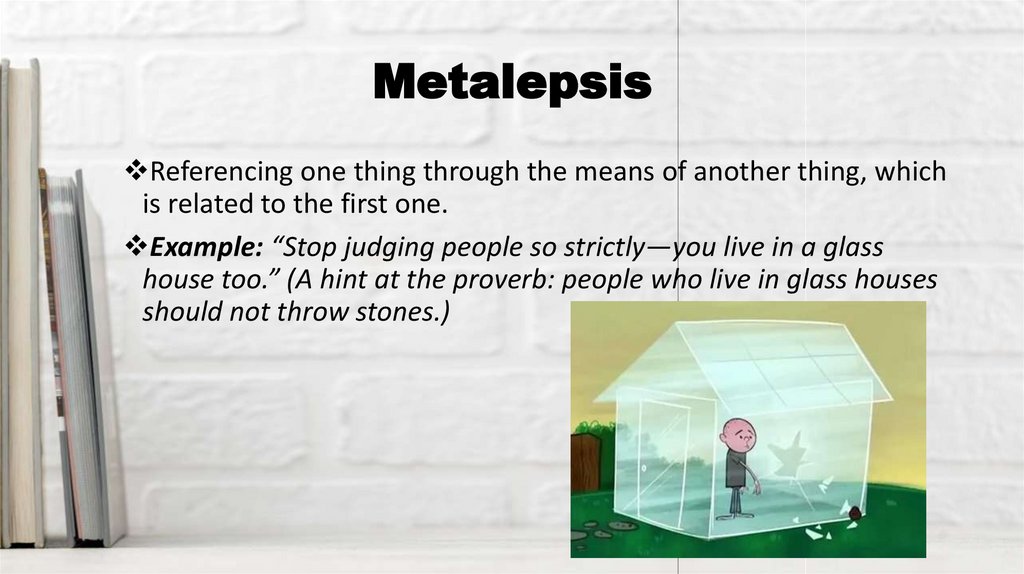
26. Metalepsis
Referencing one thing through the means of another thing, whichis related to the first one.
Example: “Stop judging people so strictly—you live in a glass
house too.” (A hint at the proverb: people who live in glass houses
should not throw stones.)
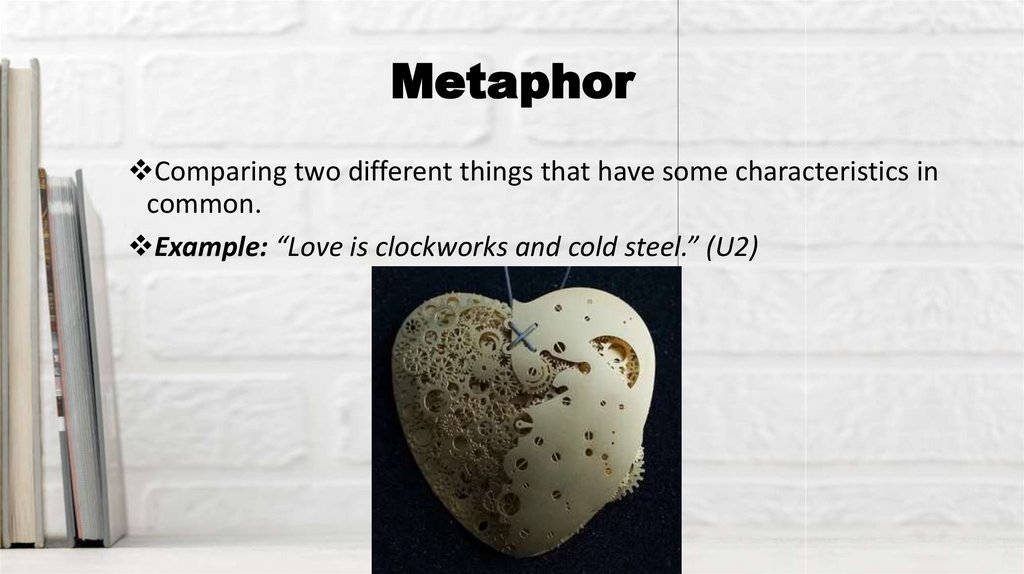
27. Metaphor
Comparing two different things that have some characteristics incommon.
Example: “Love is clockworks and cold steel.” (U2)
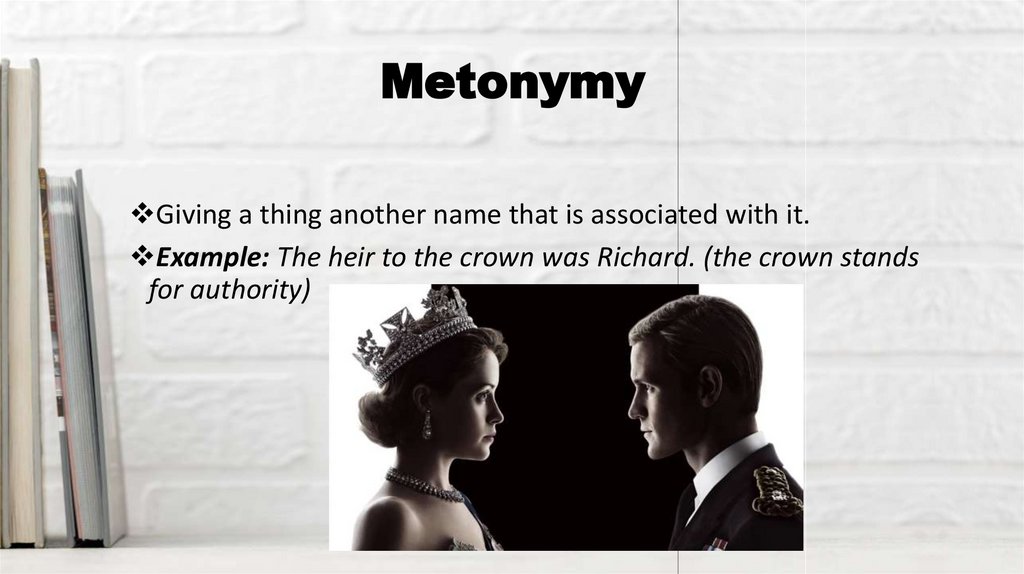
28. Metonymy
Giving a thing another name that is associated with it.Example: The heir to the crown was Richard. (the crown stands
for authority)
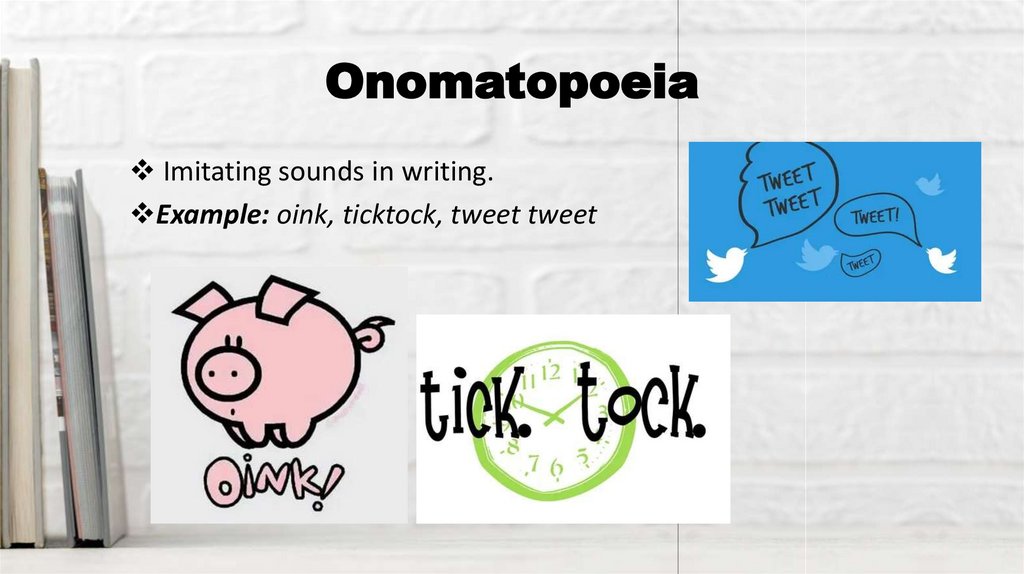
29. Onomatopoeia
Imitating sounds in writing.Example: oink, ticktock, tweet tweet
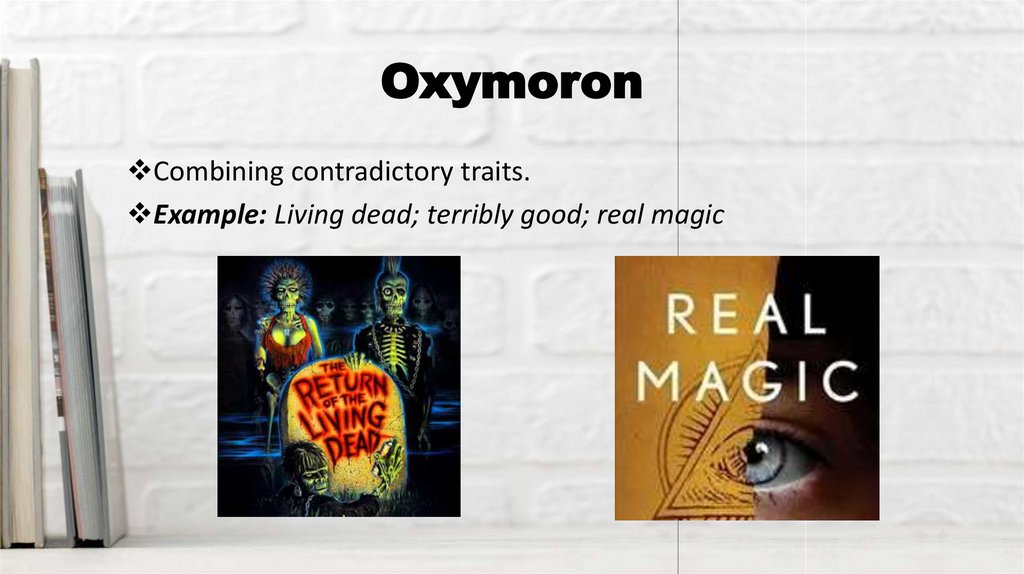
30. Oxymoron
Combining contradictory traits.Example: Living dead; terribly good; real magic
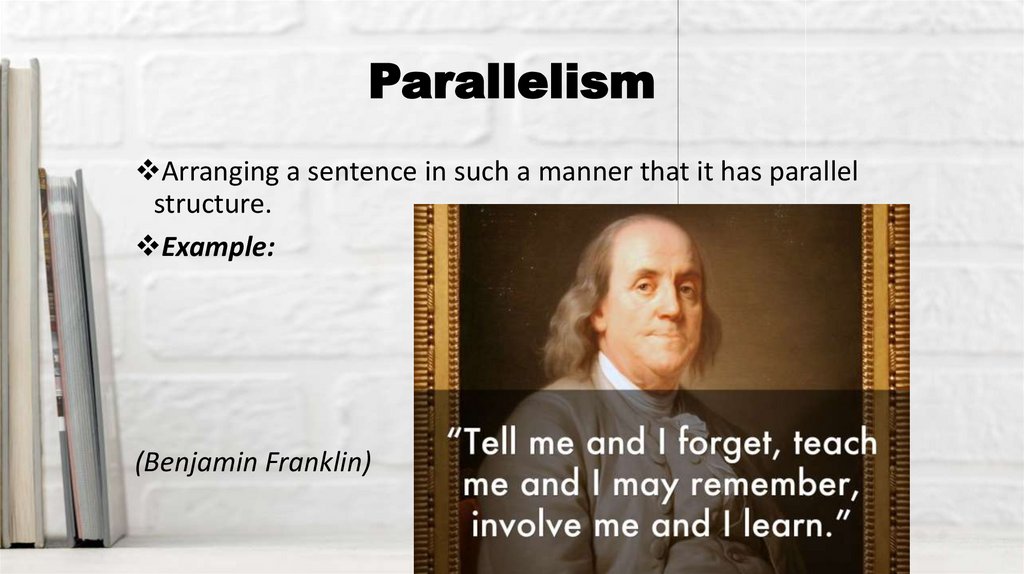
31. Parallelism
Arranging a sentence in such a manner that it has parallelstructure.
Example:
(Benjamin Franklin)
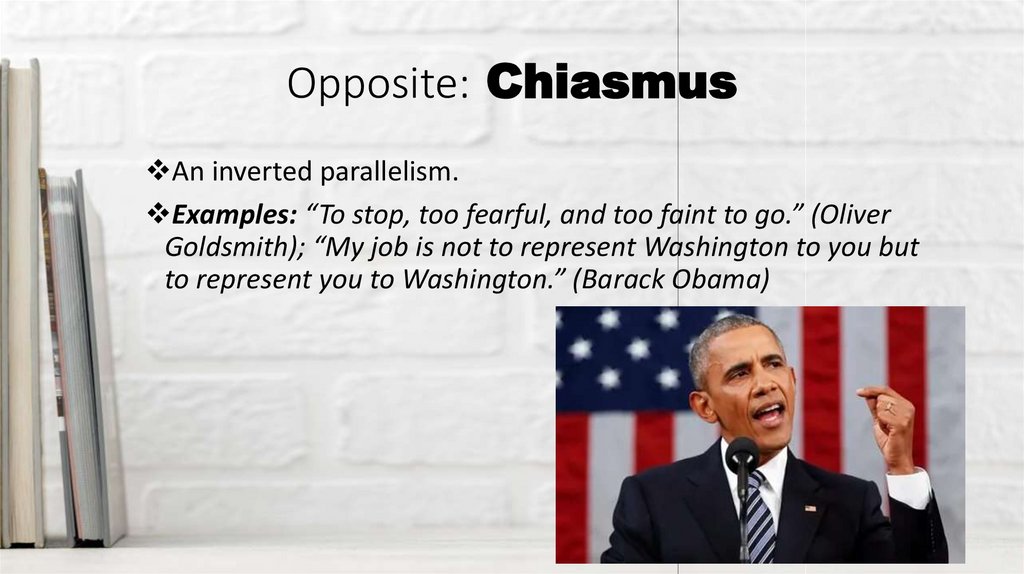
32. Opposite: Chiasmus
Opposite: ChiasmusAn inverted parallelism.
Examples: “To stop, too fearful, and too faint to go.” (Oliver
Goldsmith); “My job is not to represent Washington to you but
to represent you to Washington.” (Barack Obama)
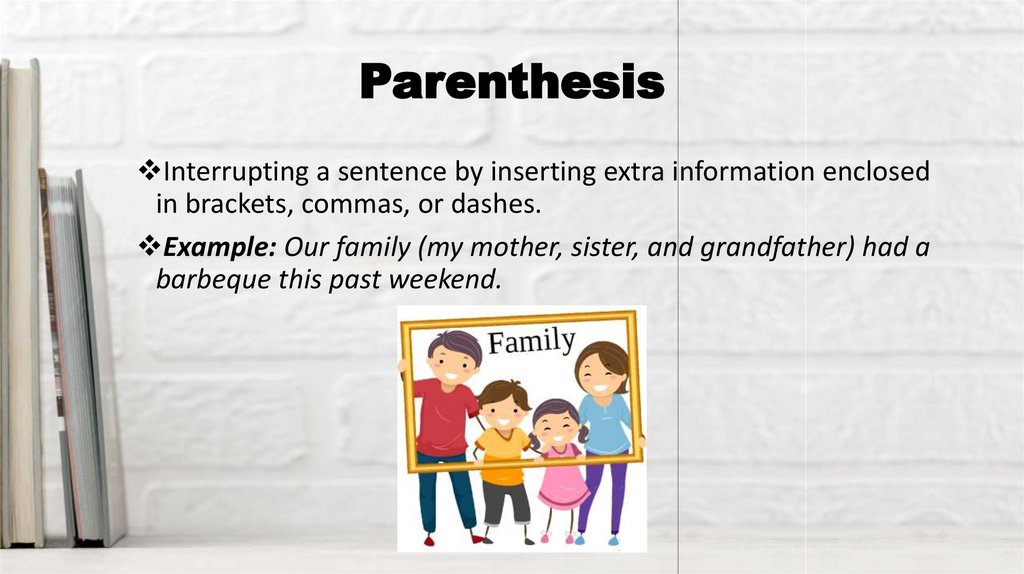
33. Parenthesis
Interrupting a sentence by inserting extra information enclosedin brackets, commas, or dashes.
Example: Our family (my mother, sister, and grandfather) had a
barbeque this past weekend.
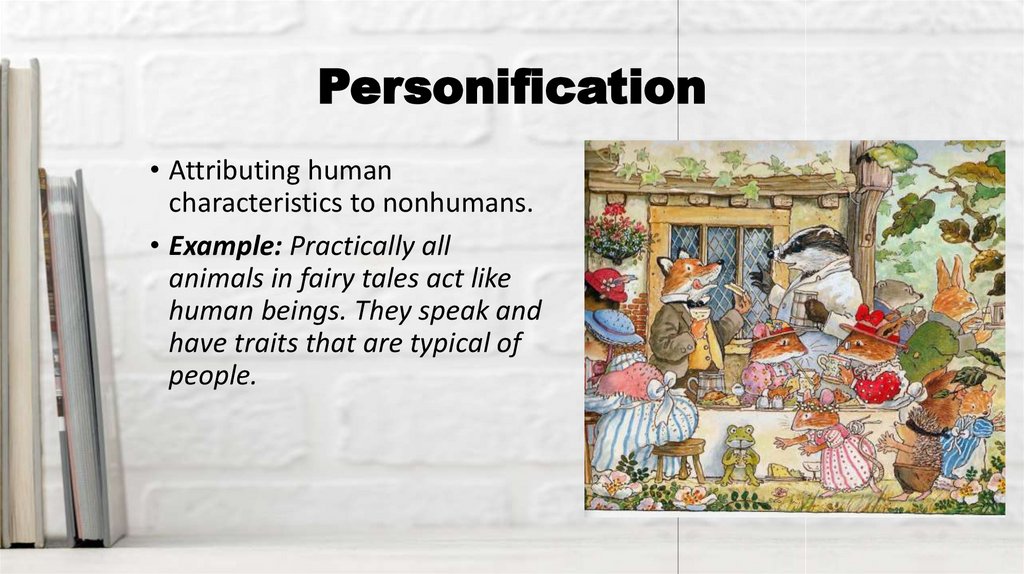
34. Personification
• Attributing humancharacteristics to nonhumans.
• Example: Practically all
animals in fairy tales act like
human beings. They speak and
have traits that are typical of
people.
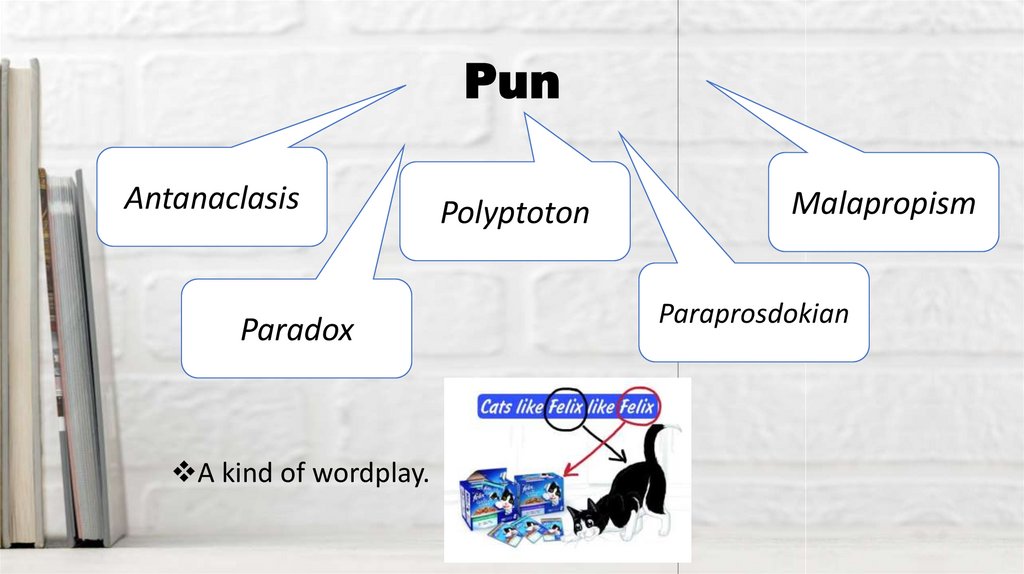
35. Pun
AntanaclasisParadox
A kind of wordplay.
Polyptoton
Malapropism
Paraprosdokian
36. Here are a few types of puns:
Antanaclasis – repetition of the same word or phrase, but with adifferent meaning (“Cats like Felix like Felix.”—“Felix” catfood slogan).
Malapropism – usage of the incorrect word instead of the word with
a similar sound (“optical delusion” instead of “optical illusion”).
Paradox – self-contradictory fact; however, it can be partially true (“I
can resist anything but temptation.”—Oscar Wilde).
Paraprosdokian – arranging a sentence in such a manner so the last
part is unexpected (You’re never too old to learn something stupid).
Polyptoton – repetition of the words with the same root (“The things
you own end up owning you.”—Chuck Palahniuk).
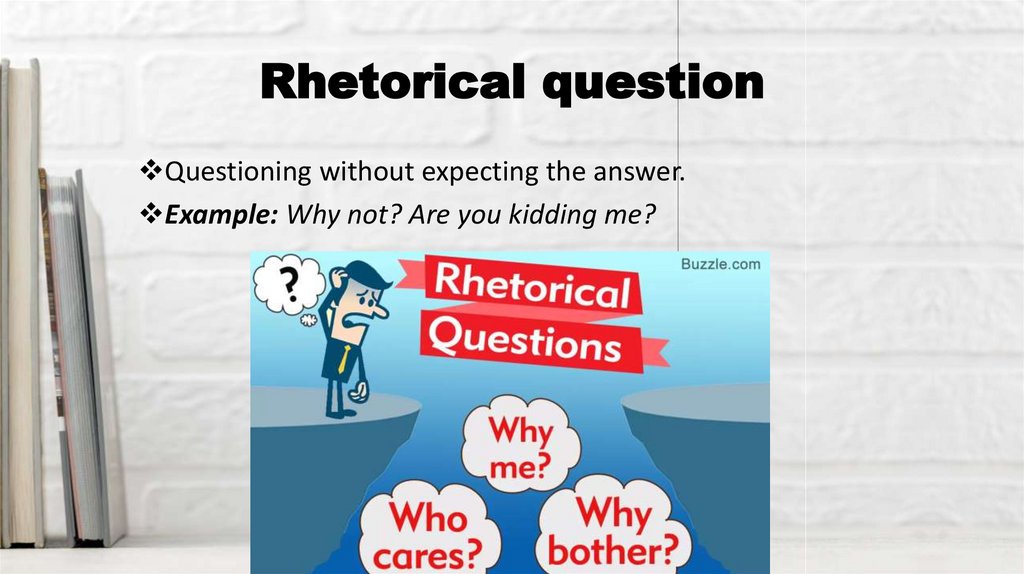
37. Rhetorical question
Questioning without expecting the answer.Example: Why not? Are you kidding me?
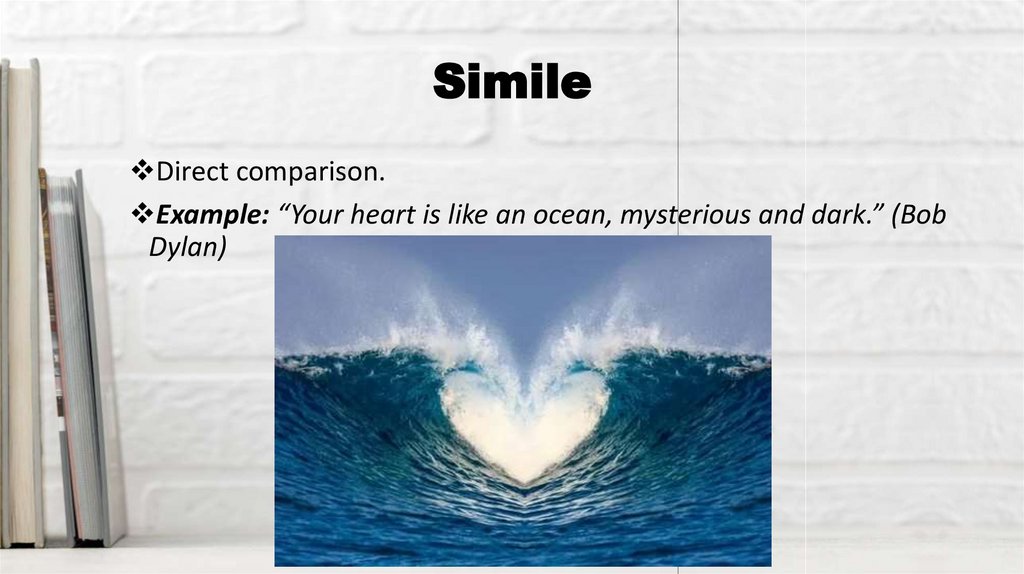
38. Simile
Direct comparison.Example: “Your heart is like an ocean, mysterious and dark.” (Bob
Dylan)
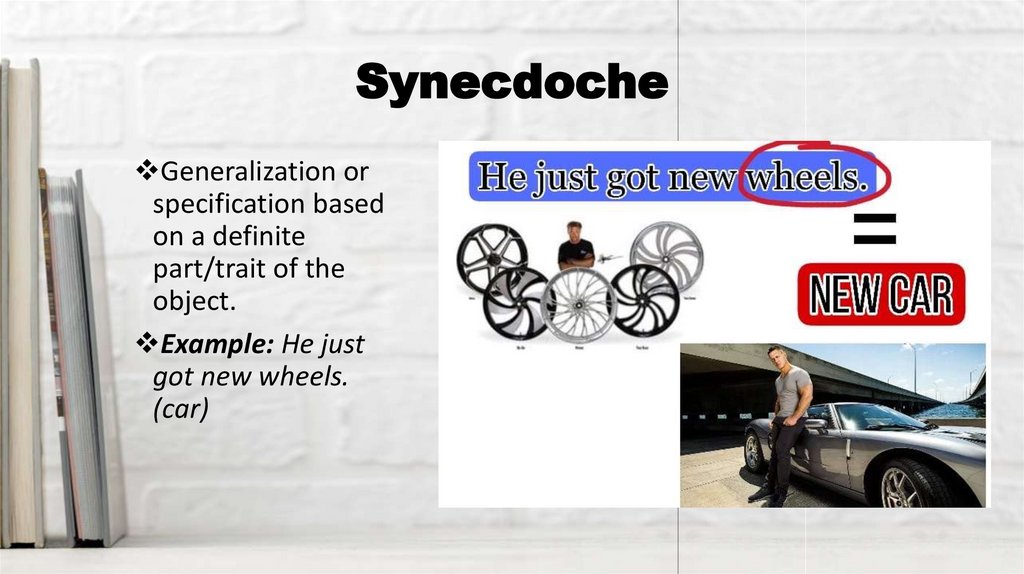
39. Synecdoche
Generalization orspecification based
on a definite
part/trait of the
object.
Example: He just
got new wheels.
(car)
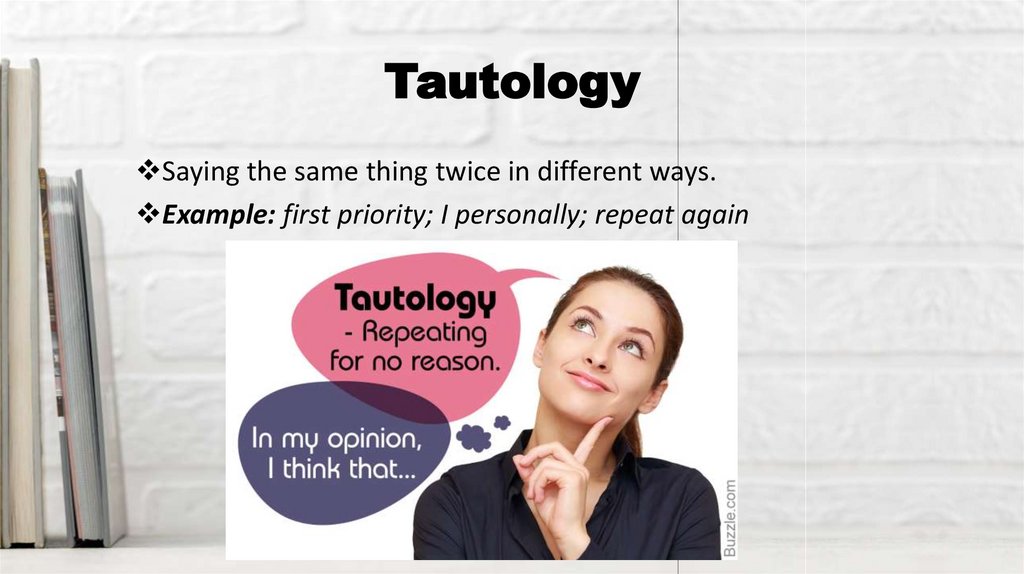
40. Tautology
Saying the same thing twice in different ways.Example: first priority; I personally; repeat again
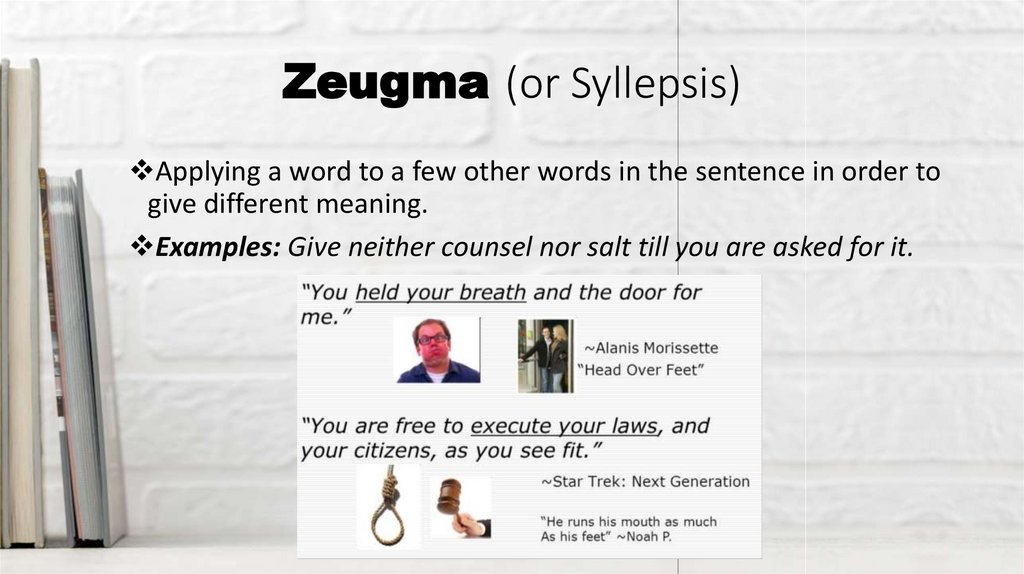
41. Zeugma (or Syllepsis)
Zeugma (or Syllepsis)Applying a word to a few other words in the sentence in order to
give different meaning.
Examples: Give neither counsel nor salt till you are asked for it.