 Биографии
 Педагогика
Похожие презентации:




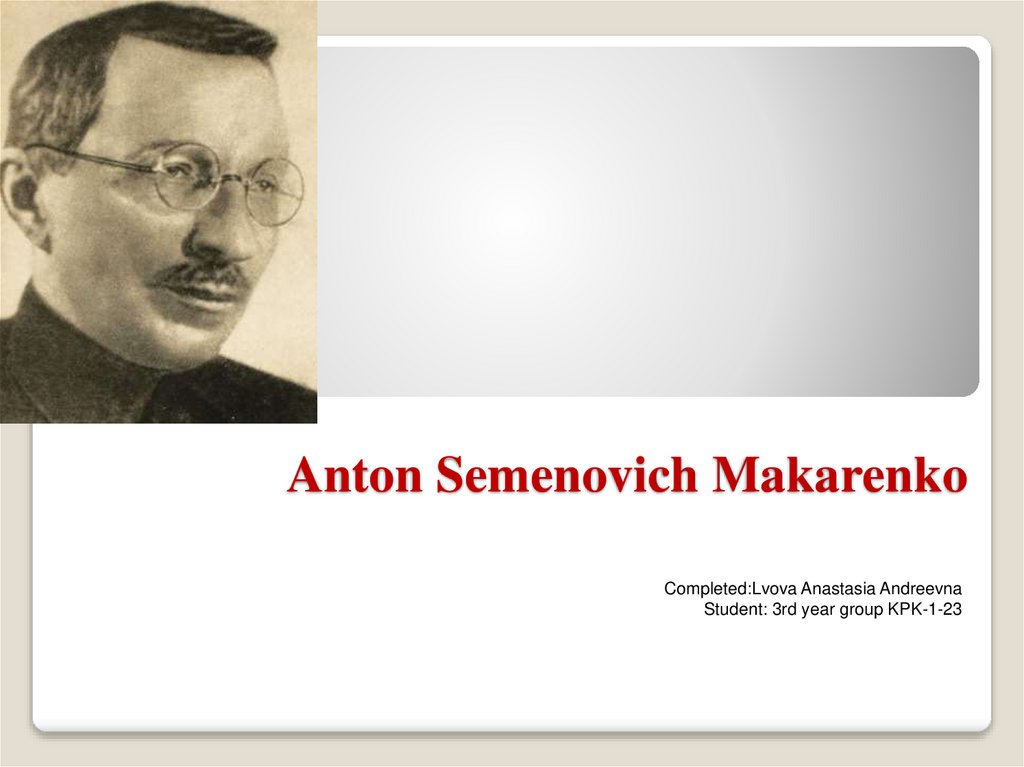
Anton Semenovich Makarenko
1. Anton Semenovich Makarenko
Completed:Lvova Anastasia AndreevnaStudent: 3rd year group KPK-1-23
2.
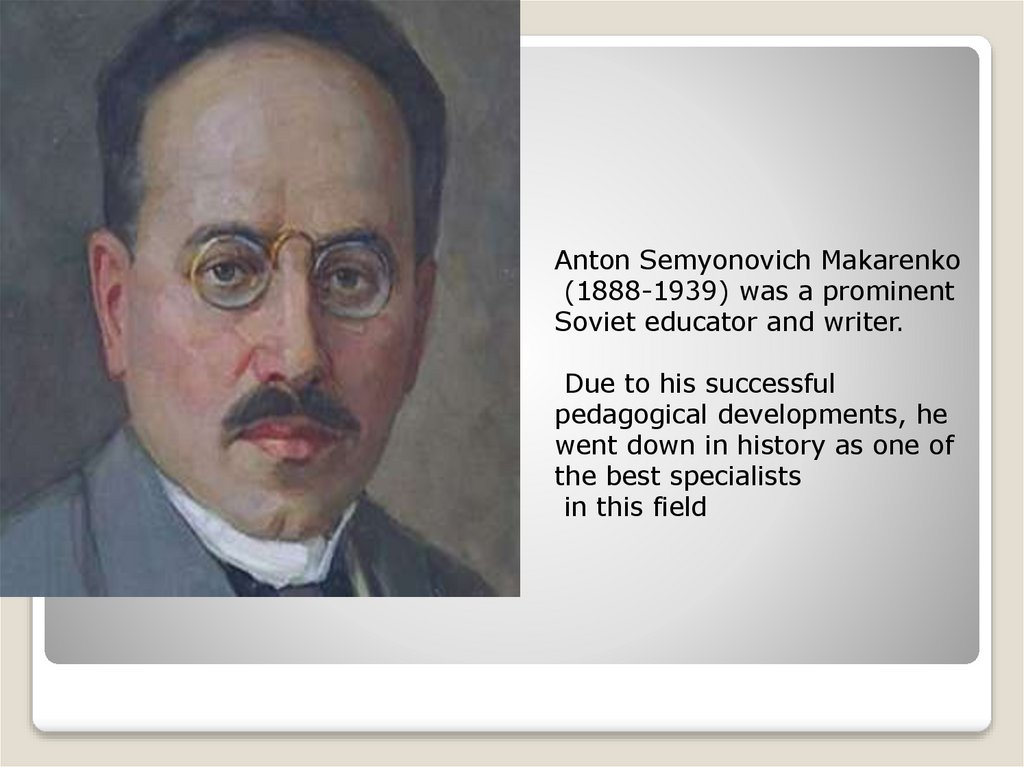
Anton Semyonovich Makarenko(1888-1939) was a prominent
Soviet educator and writer.
Due to his successful
pedagogical developments, he
went down in history as one of
the best specialists
in this field
3.
Soviet teacher and writer Anton SemyonovichMakarenko is recognized as one of the four
outstanding educators in the world, along
with John Dewey, Georg Kerschensteiner, and
Maria Montessori. He was awarded this honor
by UNESCO in 1988.
Makarenko's main contribution was his
unique educational methodology, which had a
remarkable impact. In the 1920s, he
successfully rehabilitated street children and
juvenile delinquents, transforming them into
exceptional individuals.
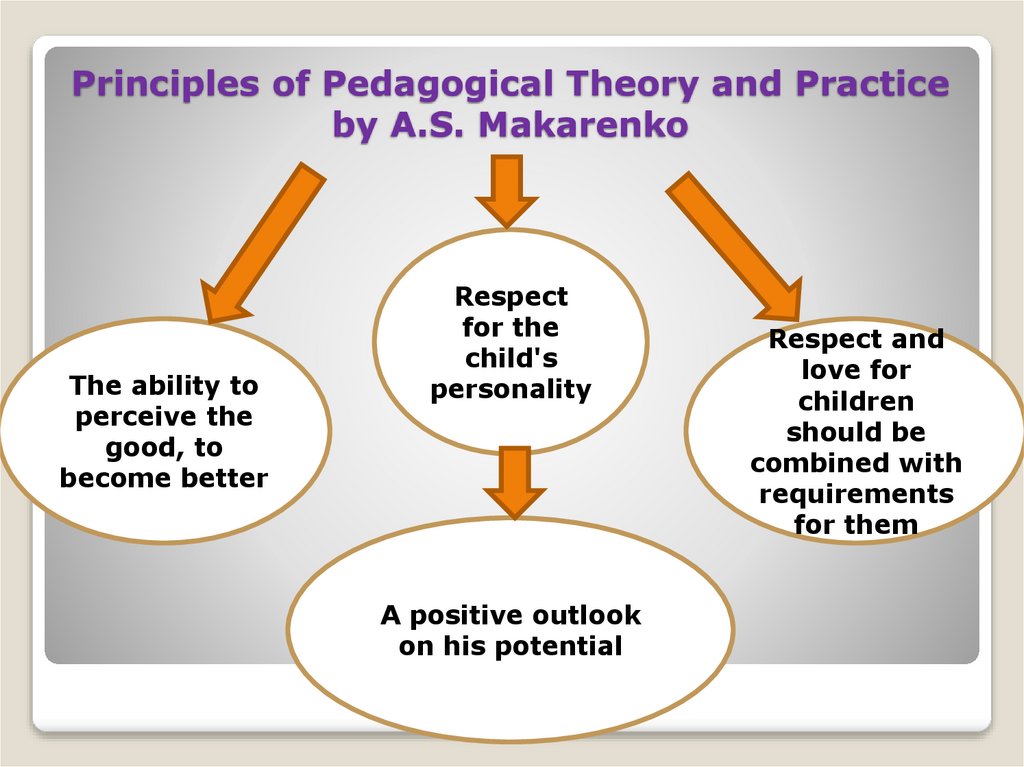
4. Principles of Pedagogical Theory and Practice by A.S. Makarenko
The ability toperceive the
good, to
become better
Respect
for the
child's
personality
A positive outlook
on his potential
Respect and
love for
children
should be
combined with
requirements
for them
5.
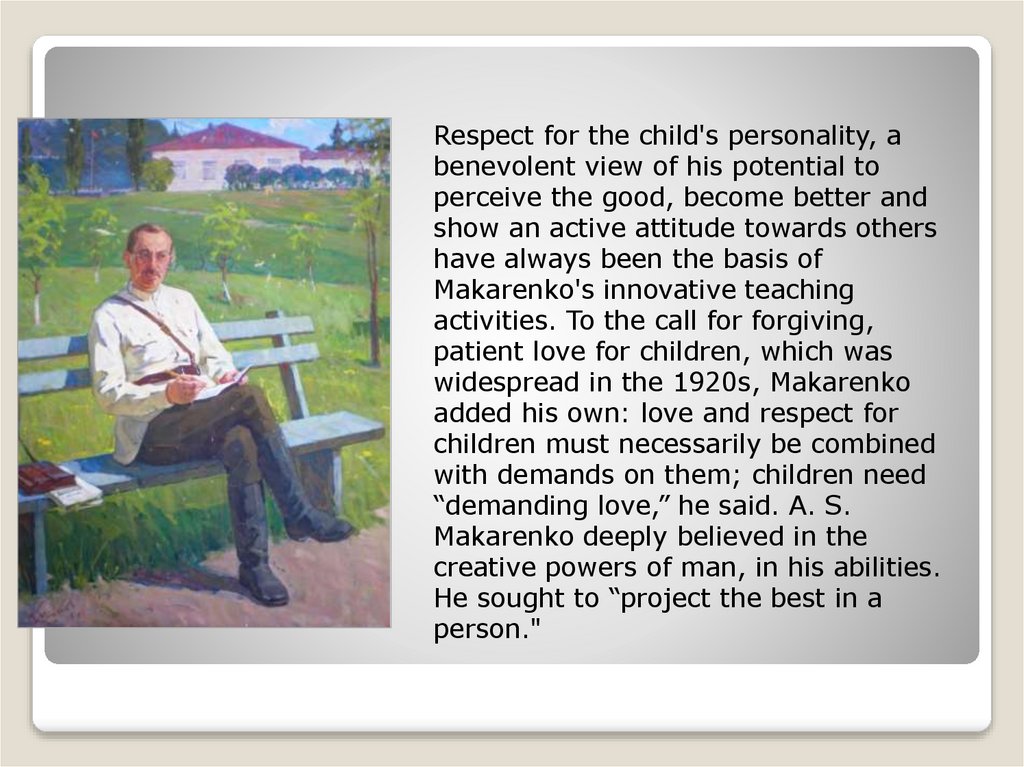
Respect for the child's personality, abenevolent view of his potential to
perceive the good, become better and
show an active attitude towards others
have always been the basis of
Makarenko's innovative teaching
activities. To the call for forgiving,
patient love for children, which was
widespread in the 1920s, Makarenko
added his own: love and respect for
children must necessarily be combined
with demands on them; children need
“demanding love,” he said. A. S.
Makarenko deeply believed in the
creative powers of man, in his abilities.
He sought to “project the best in a
person."
6. Fundamentals of pedagogy by A.S. Makarenko
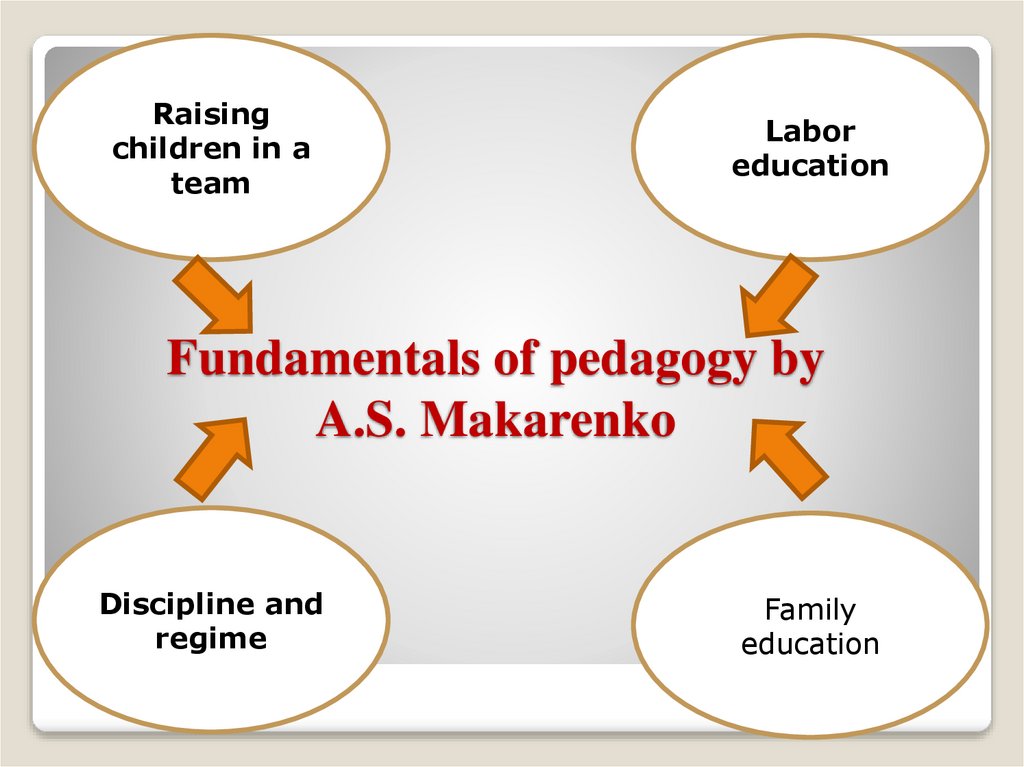
Raisingchildren in a
team
Labor
education
Fundamentals of pedagogy by
A.S. Makarenko
Discipline and
regime
Family
education
7.
Raisingchildren in a
team
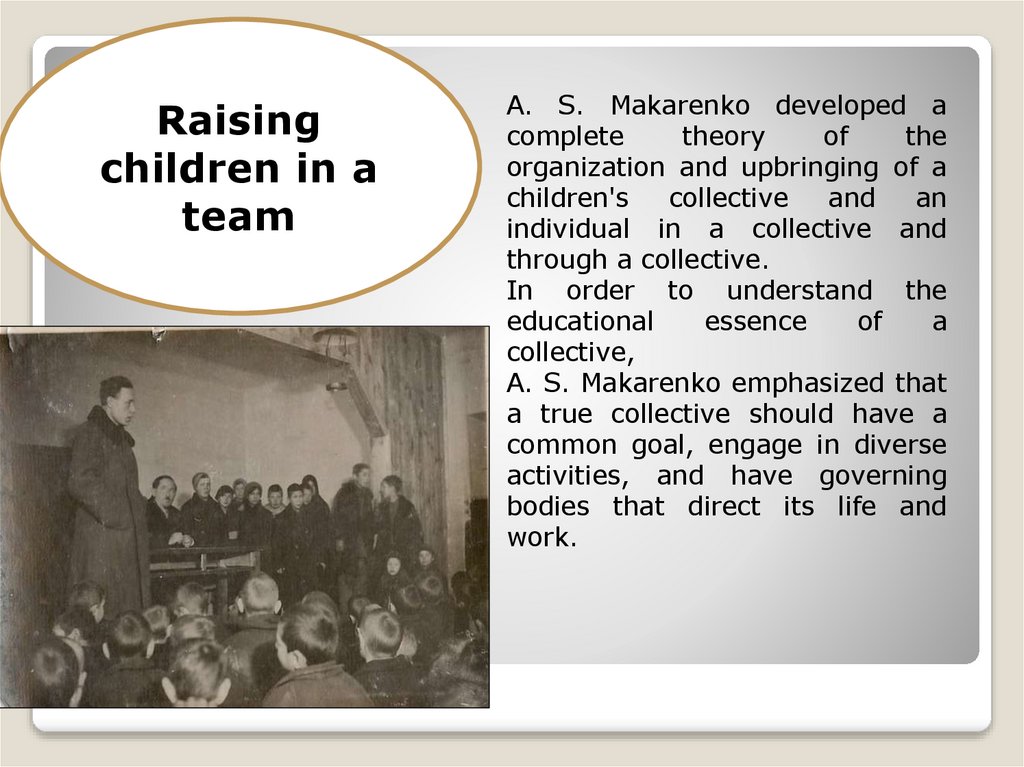
A. S. Makarenko developed a
complete
theory
of
the
organization and upbringing of a
children's
collective
and
an
individual in a collective and
through a collective.
In order to understand the
educational
essence
of
a
collective,
A. S. Makarenko emphasized that
a true collective should have a
common goal, engage in diverse
activities, and have governing
bodies that direct its life and
work.
8.
.Labor
education
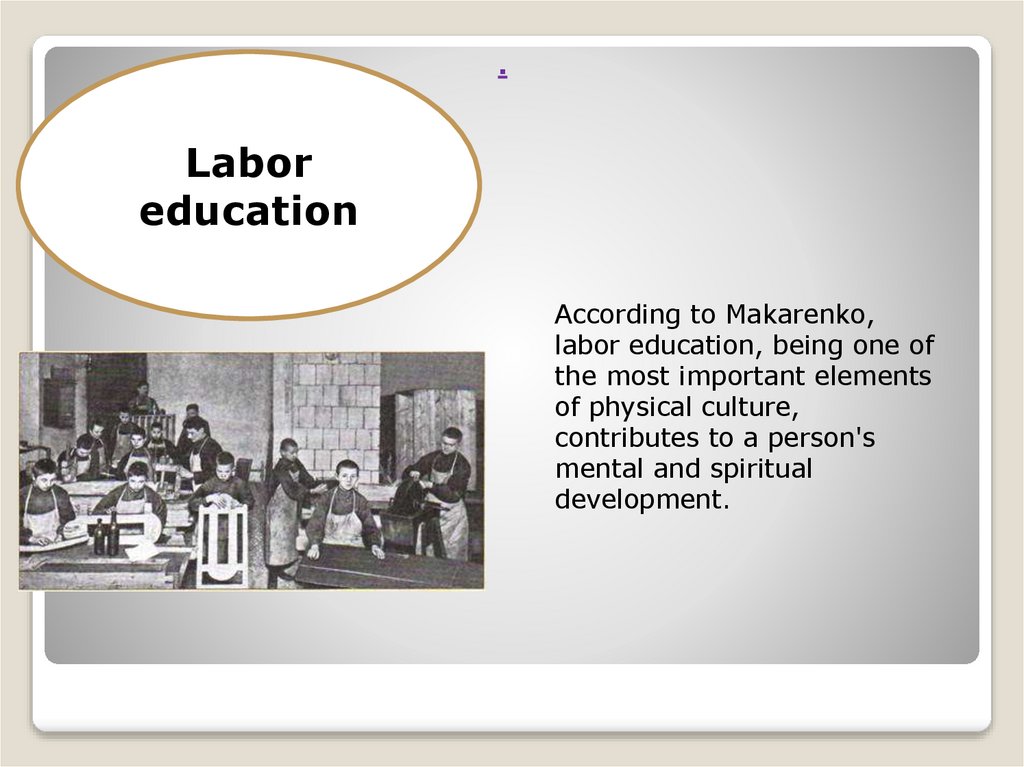
According to Makarenko,
labor education, being one of
the most important elements
of physical culture,
contributes to a person's
mental and spiritual
development.
9.
Familyeducation
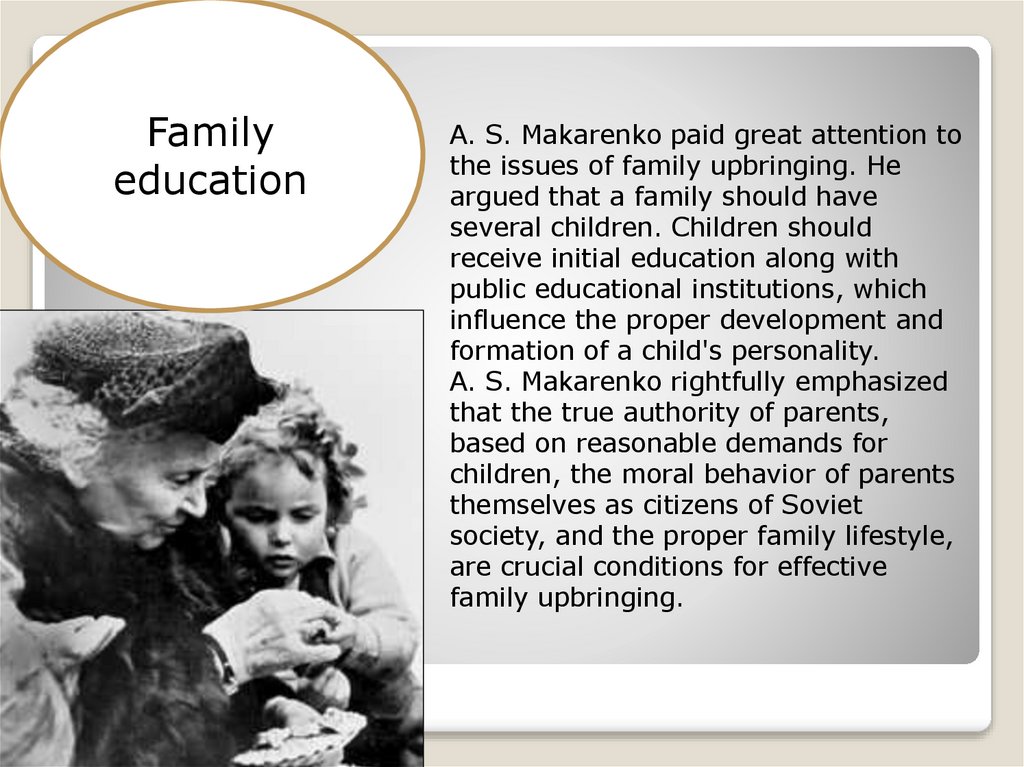
A. S. Makarenko paid great attention to
the issues of family upbringing. He
argued that a family should have
several children. Children should
receive initial education along with
public educational institutions, which
influence the proper development and
formation of a child's personality.
A. S. Makarenko rightfully emphasized
that the true authority of parents,
based on reasonable demands for
children, the moral behavior of parents
themselves as citizens of Soviet
society, and the proper family lifestyle,
are crucial conditions for effective
family upbringing.
10.
Disciplineand regime
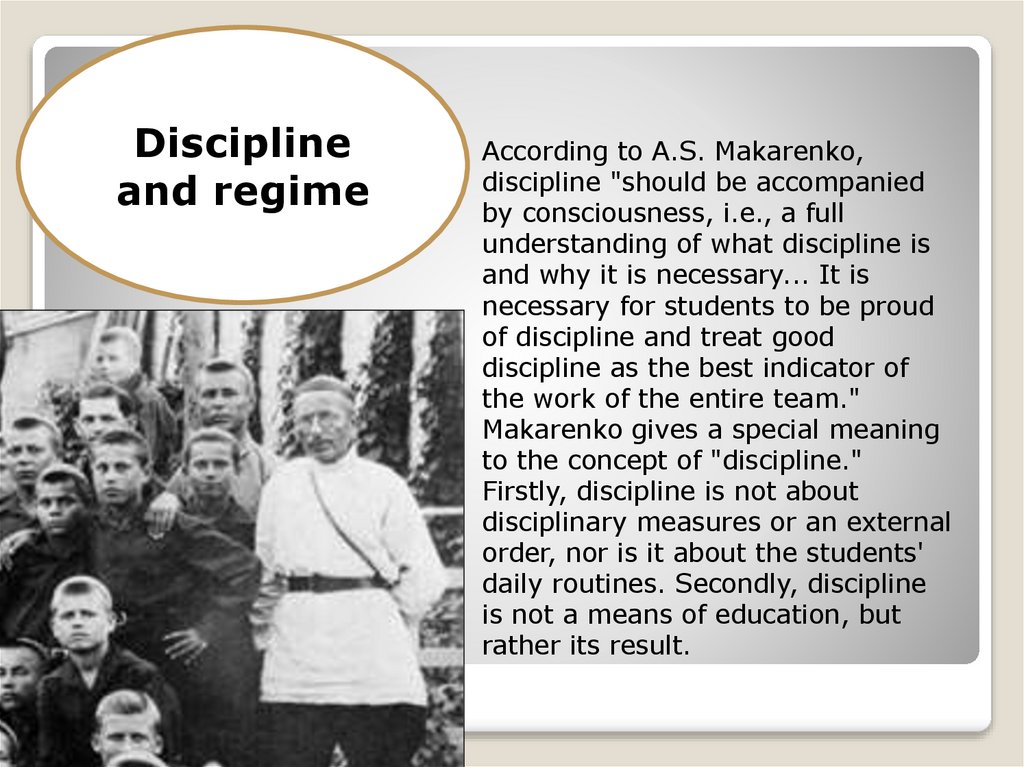
According to A.S. Makarenko,
discipline "should be accompanied
by consciousness, i.e., a full
understanding of what discipline is
and why it is necessary... It is
necessary for students to be proud
of discipline and treat good
discipline as the best indicator of
the work of the entire team."
Makarenko gives a special meaning
to the concept of "discipline."
Firstly, discipline is not about
disciplinary measures or an external
order, nor is it about the students'
daily routines. Secondly, discipline
is not a means of education, but
rather its result.
11.
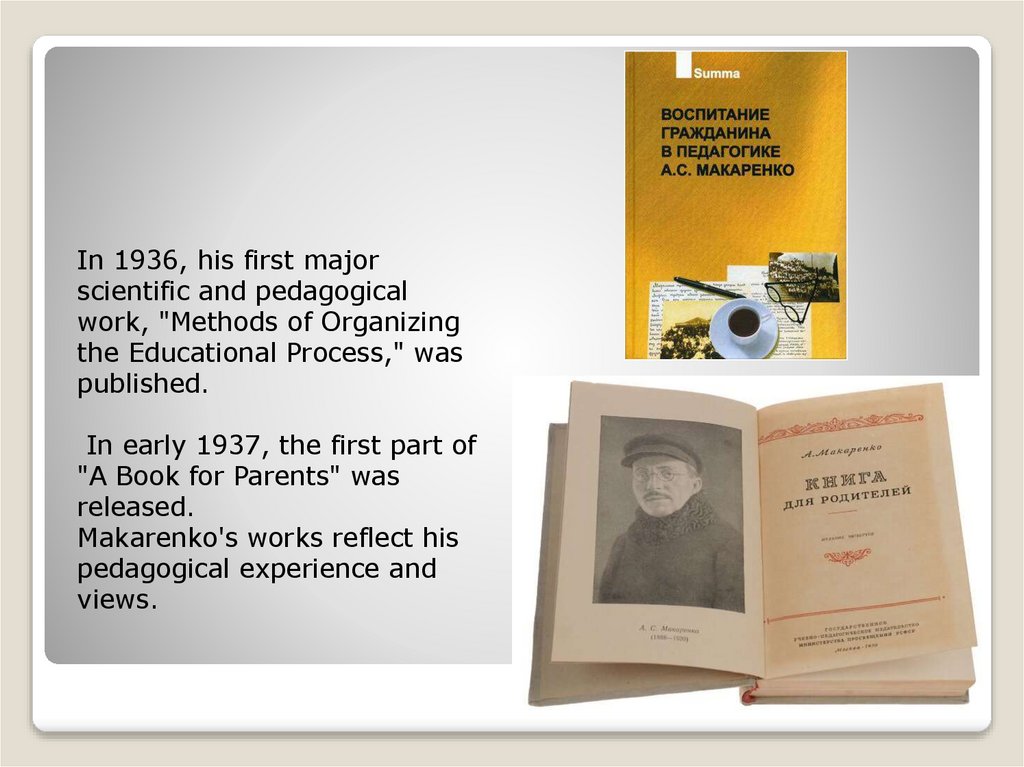
In 1936, his first majorscientific and pedagogical
work, "Methods of Organizing
the Educational Process," was
published.
In early 1937, the first part of
"A Book for Parents" was
released.
Makarenko's works reflect his
pedagogical experience and
views.
12.
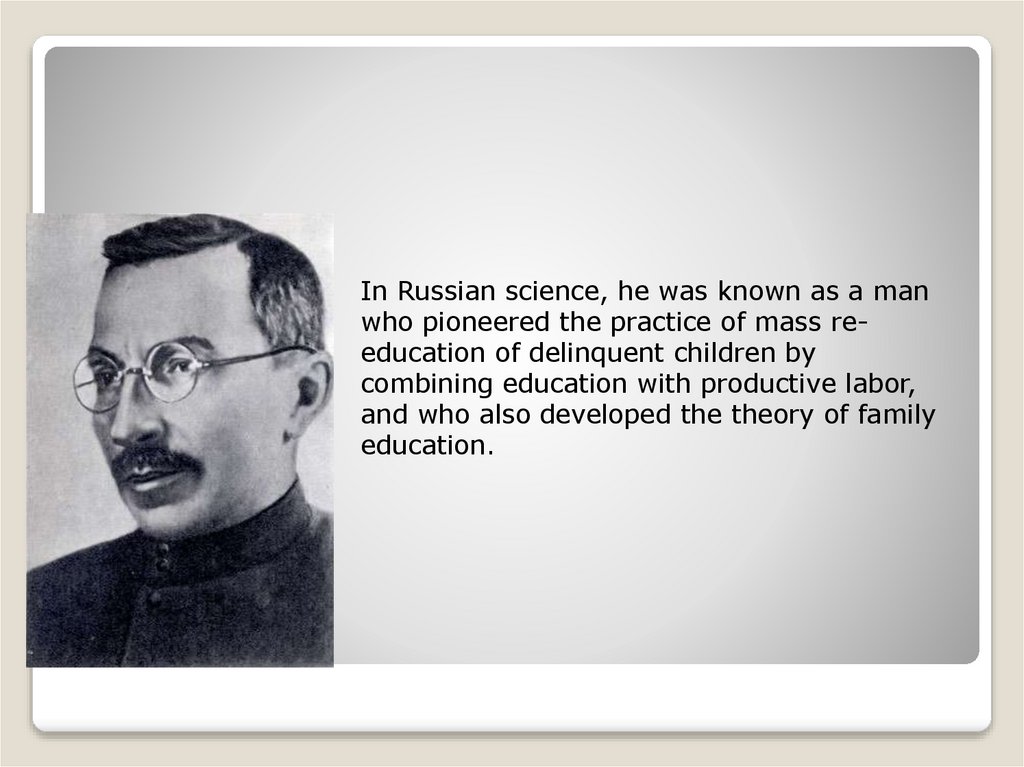
In Russian science, he was known as a manwho pioneered the practice of mass reeducation of delinquent children by
combining education with productive labor,
and who also developed the theory of family
education.