Похожие презентации:







биология
1.
The Internet: Connecting theWorld
Welcome to a journey exploring the vast and transformative landscape of the
Internet. From its humble beginnings as a defense project to its current status as a
global nervous system, the Internet has redefined communication, commerce, and
daily life. This presentation will delve into its origins, core functionalities, everyday
applications, and glimpse into its exciting future, including the rise of the Internet of
Things.
2.
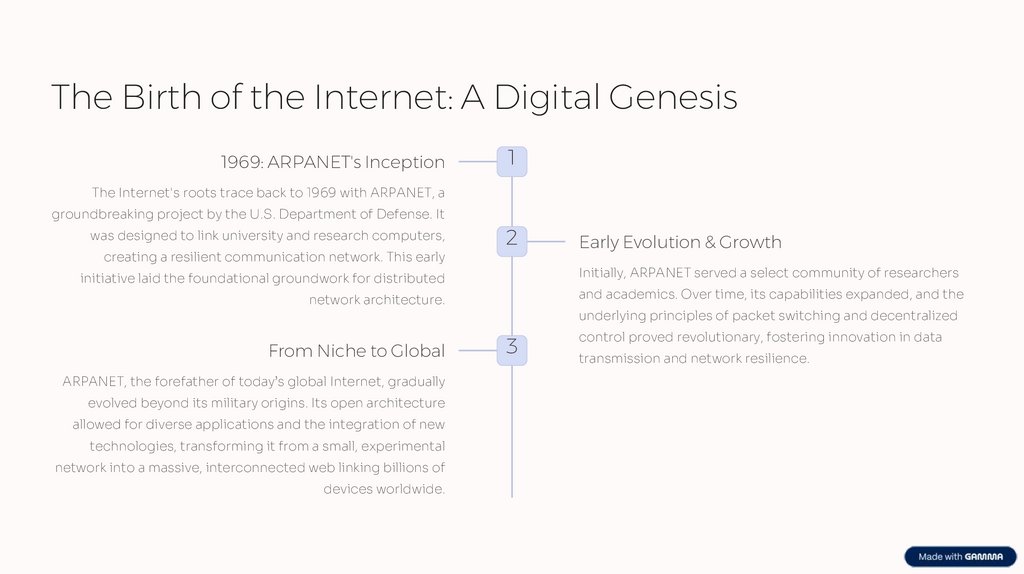
The Birth of the Internet: A Digital Genesis1969: ARPANET's Inception
1
The Internet's roots trace back to 1969 with ARPANET, a
groundbreaking project by the U.S. Department of Defense. It
was designed to link university and research computers,
creating a resilient communication network. This early
2
Initially, ARPANET served a select community of researchers
initiative laid the foundational groundwork for distributed
and academics. Over time, its capabilities expanded, and the
network architecture.
From Niche to Global
ARPANET, the forefather of today’s global Internet, gradually
evolved beyond its military origins. Its open architecture
allowed for diverse applications and the integration of new
technologies, transforming it from a small, experimental
network into a massive, interconnected web linking billions of
devices worldwide.
Early Evolution & Growth
underlying principles of packet switching and decentralized
3
control proved revolutionary, fostering innovation in data
transmission and network resilience.
3.
Defining the Internet: A Global WebThe Internet is more than just a collection of computers; it's a vast global network, an
intricate web of interconnected devices and systems. At its core, it facilitates
seamless communication and data exchange through a standardized set of rules
known as protocols, primarily TCP/IP.
This colossal infrastructure utilizes diverse technologies—including fiber optic
cables, wireless connections, and satellite links—to span continents and oceans. It
serves as the digital backbone connecting homes, businesses, educational
institutions, and governments across the planet, enabling instantaneous access to
information and interaction on an unprecedented scale.
The Internet is not just a technology; it's a medium that shapes our perception of time and distance, connecting humanity in ways previously
unimaginable.
4.
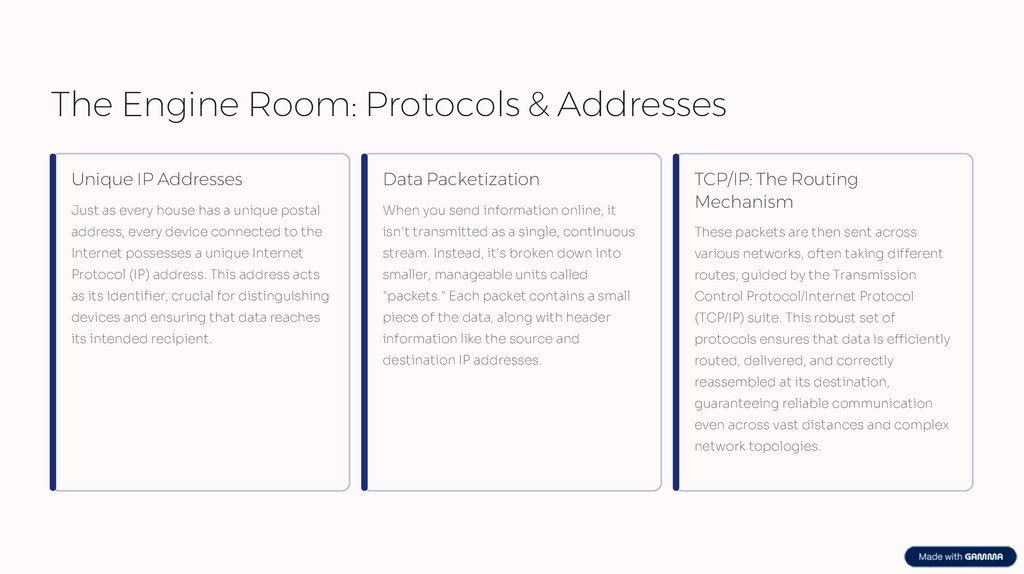
The Engine Room: Protocols & AddressesUnique IP Addresses
Data Packetization
Just as every house has a unique postal
When you send information online, it
TCP/IP: The Routing
Mechanism
address, every device connected to the
isn't transmitted as a single, continuous
These packets are then sent across
Internet possesses a unique Internet
stream. Instead, it's broken down into
various networks, often taking different
Protocol (IP) address. This address acts
smaller, manageable units called
routes, guided by the Transmission
as its identifier, crucial for distinguishing
"packets." Each packet contains a small
Control Protocol/Internet Protocol
devices and ensuring that data reaches
piece of the data, along with header
(TCP/IP) suite. This robust set of
its intended recipient.
information like the source and
protocols ensures that data is efficiently
destination IP addresses.
routed, delivered, and correctly
reassembled at its destination,
guaranteeing reliable communication
even across vast distances and complex
network topologies.
5.
Pioneering the Digital Frontier: Core Internet Services1
Revolutionized correspondence, offering fast, multimedia messaging that largely replaced traditional postal services and telephone calls for many communication needs. It enables instant global communication
with attachments and rich formatting.
2
File Transfer Protocol (FTP)
A fundamental service for moving digital files—be it documents, images, software, or large datasets—securely and efficiently between different computers over the network. FTP facilitated early collaboration and
content distribution.
3
Telnet
Provided the ability to remotely log into and interact with computing resources on distant machines, allowing users to execute commands as if they were directly in front of the server. It was crucial for remote
access and system administration.
4
Usenet News
An early distributed discussion system, functioning as a precursor to modern online forums and social media. It allowed users to post and read messages in thematic discussion groups, sharing ideas and
information across diverse communities.
5
World Wide Web
Invented by Tim Berners-Lee in 1991, the Web transformed the Internet by introducing hyperlinked multimedia documents. Accessed via browsers, it made information vastly more navigable and accessible,
democratizing content and creating a platform for unprecedented growth.
6.
The Fabric of Daily Life: Everyday Uses of the InternetCommunication &
Connection
Information &
Education
Commerce &
Economy
Support & Services
The Internet has reshaped how we
It serves as humanity's largest
The digital marketplace thrives on
provides extensive support
connect. Email, video calls, instant
repository of knowledge. From
the Internet. Online shopping,
infrastructure. Customer service
messaging, and social media
digital libraries and academic
banking, investment platforms, and
portals, online consultations, and
platforms facilitate real-time
databases to news outlets and
extensive product promotion
feedback channels enable
interactions, fostering global
instructional tutorials, the Internet
channels have transformed
businesses to engage with clients
friendships, professional networks,
offers unparalleled access to
consumer behavior and business
and offer timely assistance,
and family bonds, bringing billions
information, enabling continuous
models, creating new industries
enhancing overall service quality
closer together regardless of
learning and keeping us informed
and expanding global trade
geographical distance.
about global events.
opportunities.
Beyond transactions, the Internet
and accessibility worldwide.
7.
The Internet of Things (IoT): The Next FrontierThe Internet of Things (IoT) represents the next wave of internet evolution, extending connectivity beyond traditional computers and
smartphones to everyday physical objects. This paradigm involves billions of "smart" devices—from cars and home appliances to industrial
sensors and wearable tech—all embedded with sensors, software, and other technologies.
These devices are interconnected, constantly collecting and exchanging data over the internet without human-to-human or human-tocomputer interaction. This seamless flow of information enables intelligent automation, real-time decision-making, and unprecedented levels of
efficiency across various sectors. From smart homes that anticipate your needs to connected factories optimizing production and smart cities
managing resources, IoT is transforming our environment into an interconnected, intelligent ecosystem.
8.
A Connected Future: Impact & Continuous InnovationContinuous Innovation
The Internet is a dynamic entity, constantly
evolving through relentless innovation. Advances
in connectivity (like 5G and satellite internet),
5 Billion+ Users
As of 2025, the Internet proudly serves over 5
billion users globally, a testament to its universal
appeal and indispensable role in contemporary
society. This immense user base has
fundamentally transformed how we live, work,
learn, and interact, creating a truly global village.
enhanced cybersecurity measures, and the
development of cutting-edge applications
promise an even more connected, secure, and
intelligent future.
Humanity's Powerful Tool
More than just a network, the Internet remains
humanity’s most powerful tool. It fosters
unprecedented access to knowledge, facilitates
global communication, and drives continuous
progress across scientific, social, and economic
spheres, shaping the destiny of our
interconnected world.
The Internet's journey is far from over, with ongoing research into quantum networking and AI-driven connectivity promising even more revolutionary
changes ahead.