





 Программное обеспечение
Похожие презентации:







Lecture 1. Intro Software architecture
1. Software architecture 2024-2025
Daniyar BaizhaksynovGulnur Smagulova,
Major: Software Engineering
Zhuldyz Basheyeva,
Term: 2 , third year
Olzhas Aitmukhambetov
Credits: 5
2. General and specific competences
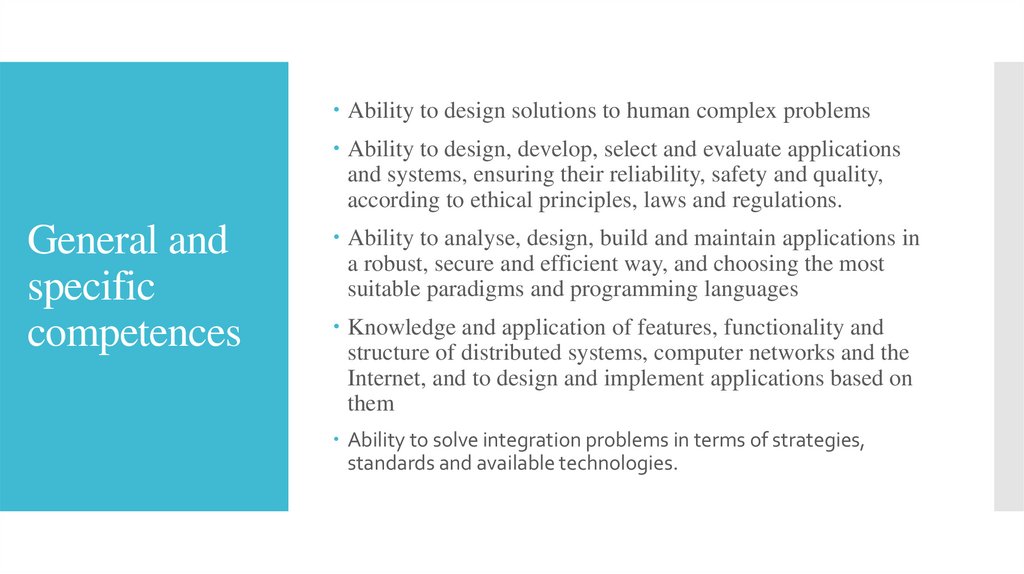
Ability to design solutions to human complex problemsAbility to design, develop, select and evaluate applications
and systems, ensuring their reliability, safety and quality,
according to ethical principles, laws and regulations.
General and
specific
competences
Ability to analyse, design, build and maintain applications in
a robust, secure and efficient way, and choosing the most
suitable paradigms and programming languages
Knowledge and application of features, functionality and
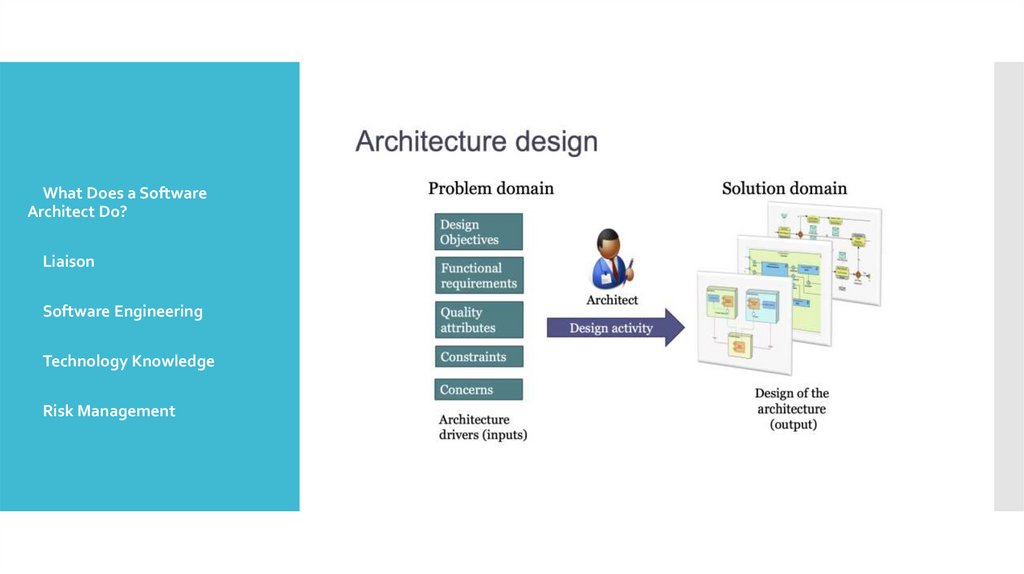
structure of distributed systems, computer networks and the
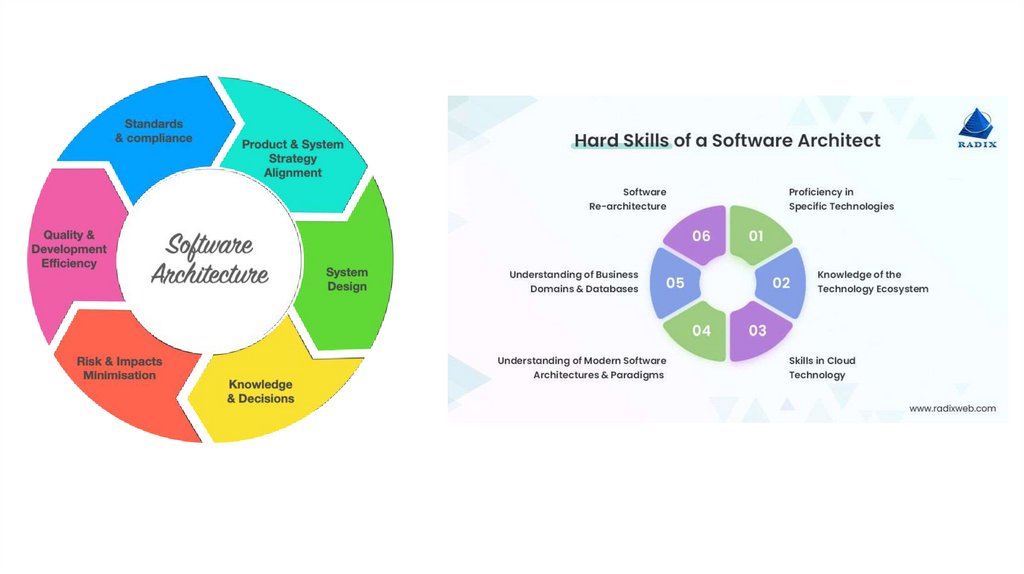
Internet, and to design and implement applications based on
them
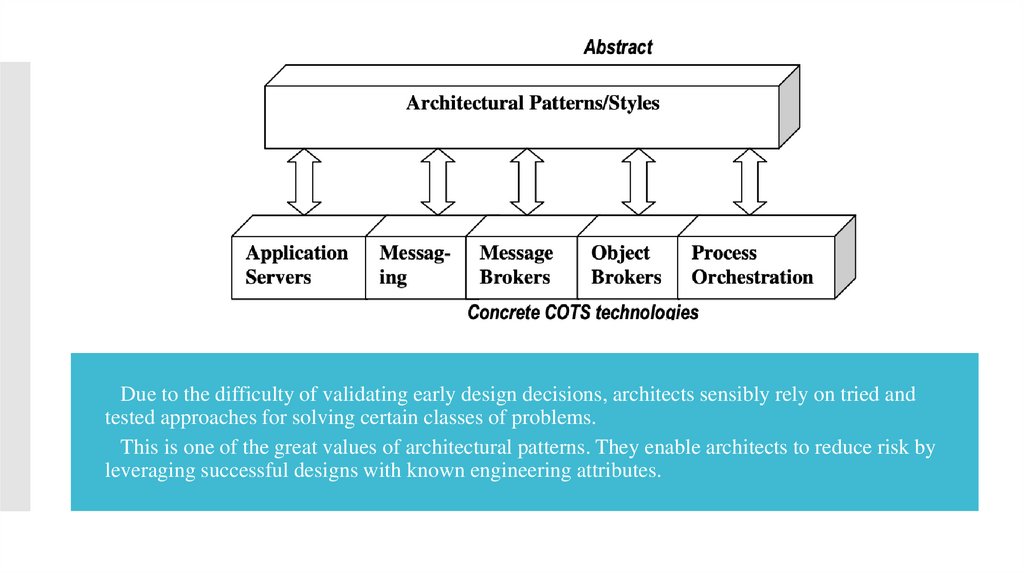
Ability to solve integration problems in terms of strategies,
standards and available technologies.
3. Outline
Definitions Software ArchitectureArchitecture Defines Structure
Outline
What Does a Software Architect Do?
Architectures and Technologies
4.
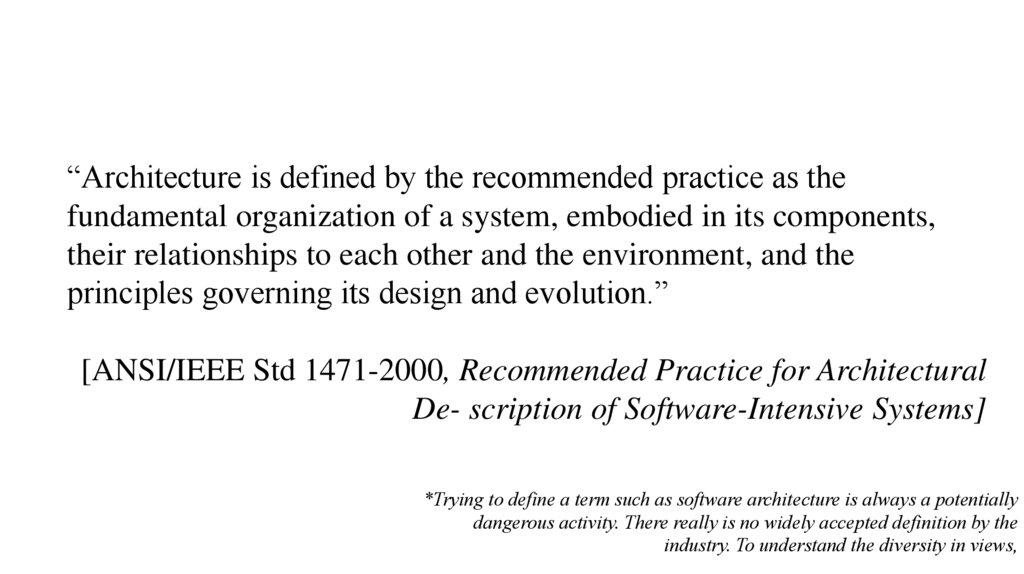
“Architecture is defined by the recommended practice as thefundamental organization of a system, embodied in its components,
their relationships to each other and the environment, and the
principles governing its design and evolution.”
[ANSI/IEEE Std 1471-2000, Recommended Practice for Architectural
De- scription of Software-Intensive Systems]
*Trying to define a term such as software architecture is always a potentially
dangerous activity. There really is no widely accepted definition by the
industry. To understand the diversity in views,
5.
This lays the foundations for an understanding of thediscipline. Architecture captures system structure in
terms of components and how they interact. It also
defines system-wide design rules and considers how a
system may change.
6. Architecture Defines Structure
Much of an architect’s time is concerned with how tosensibly partition an application into a set of inter-related
components, modules, objects or whatever unit of
software partitioning works for you3. Different
application requirements and constraints will define the
precise meaning of “sensibly” in the previous sentence –
an architecture must be designed to meet the specific
requirements and constraints of the application it is
intended for.
7.
CASE 1: Requirement for an information management system may bethat the application is distributed across multiple sites, and a constraint is
that certain functionality and data must reside at each site or an
application’s functionality must be accessible from a web browser. Both
these impose some structural constraints (site-specific, web server
hosted) and simultaneously open up avenues for considerable design
creativity in partitioning functionality across a collection of related
components.
In partitioning an application, the architect assigns responsibilities to each constituent component.
These responsibilities define the tasks a com- ponent can be relied upon to perform within the
application. In this manner, each component plays a specific role in the application, and the overall component ensemble that comprises the architecture collaborates to provide the required
functionality.
8.
Responsibility-driven design is a technique from object-orientation that can be used effectively to helpde- fine the key components in an architecture. It provides a method based on informal tools and
techniques that emphasize behavioral modeling using objects, responsibilities and collaborations.
9. Architecture Specifies Component Communication
When an application is divided into a set of components, itbecomes neces- sary to think about how these components
communicate data and control information.
Each pattern has well-known characteristics that make it
appropriate to use to satisfy particular types of requirements.
For examle: synchronous request-reply communications
from client to server, and servers supporting one or more
clients through a published interface.
10.
Large systems tend to use multiple patterns, combined in waysthat satisfy the architecture requirements. When an
architecture is based around patterns, it also becomes easy for
team members to understand a design, as the pattern infers
component structure, communications and abstract
mechanisms that must be provided.
11. Architecture Addresses Non-functional Requirements
ArchitectureAddresses Nonfunctional
Requirements
Non-functional requirements are the ones
that don’t appear in use cases. Rather than
define what the application does, they are
concerned with how the application
provides the required functionality.
12.
There are three distinct areas of non-functional requirements:• Technical constraints: These will be familiar to everyone. They con- strain design options
by specifying certain technologies that the application must use. “We only have Java
developers, so we must develop in Java.” “The existing database runs on Windows XP only.”
These are usually non-negotiable.
• Business constraints: These too constraint design options, but for business, not technical
reasons. For example, “In order to widen our potential customer base, we must interface with
XYZ tools.” Another ex- ample is “The supplier of our middleware has raised prices
prohibitively, so we’re moving to an open source version.” Most of the time, these too are
non-negotiable.
• Quality attributes These define an application’s requirements in terms of scalability,
availability, ease of change, portability, usability, performance, and so on. Quality attributes
address issues of concern to ap- plication users, as well as other stakeholders like the project
team itself or the project sponsor. Chapter 3 discusses quality attributes in some detail.
13. Architecture is an Abstraction
One of the most useful, but often non-existent,descriptions from an architectural perspective is
something that is colloquially known as a marketecture.
Architecture is
an Abstraction
This is one page, typically informal depiction of the
system’s structure and interactions. It shows the major
components, their relationships and has a few well
chosen labels and text boxes that portray the design
philosophies embodied in the architecture.
14.
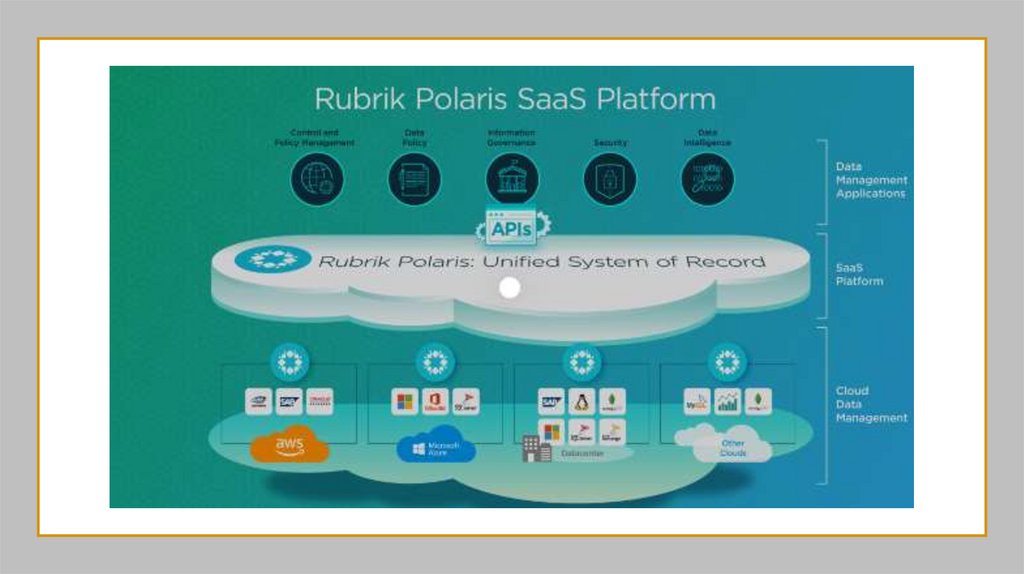
A marketecture is an excellent vehicle for facilitating discussionby stakeholders during design, build, review, and of course the
sales process. It’s easy to understand and explain and serves as a
starting point for deeper analysis.
This is typically done by describing the components in the
architecture as black boxes, specifying only their externally
visible properties. Example add
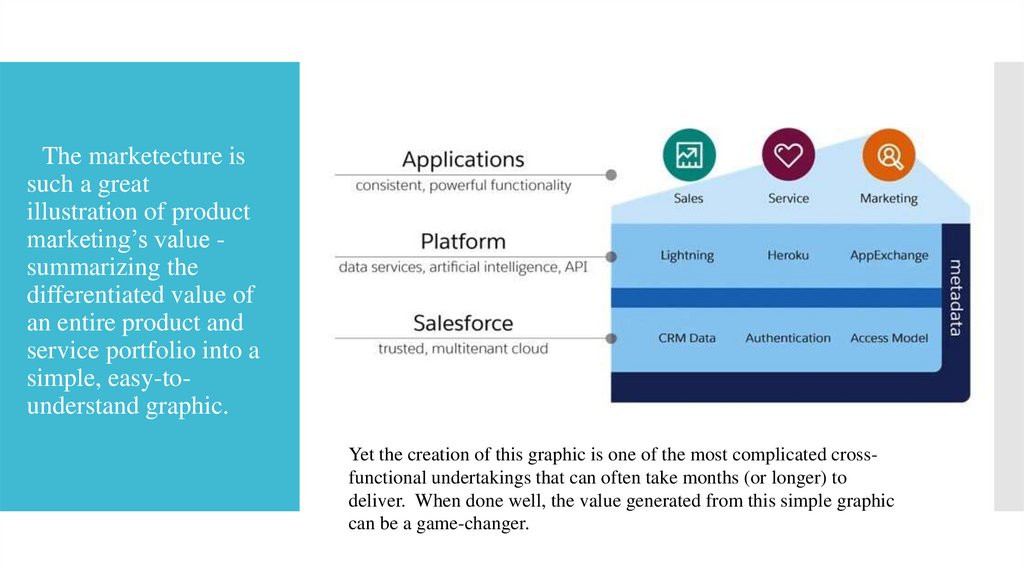
15.
The marketecture issuch a great
illustration of product
marketing’s value summarizing the
differentiated value of
an entire product and
service portfolio into a
simple, easy-tounderstand graphic.
Yet the creation of this graphic is one of the most complicated crossfunctional undertakings that can often take months (or longer) to
deliver. When done well, the value generated from this simple graphic
can be a game-changer.
16.
17.
18.
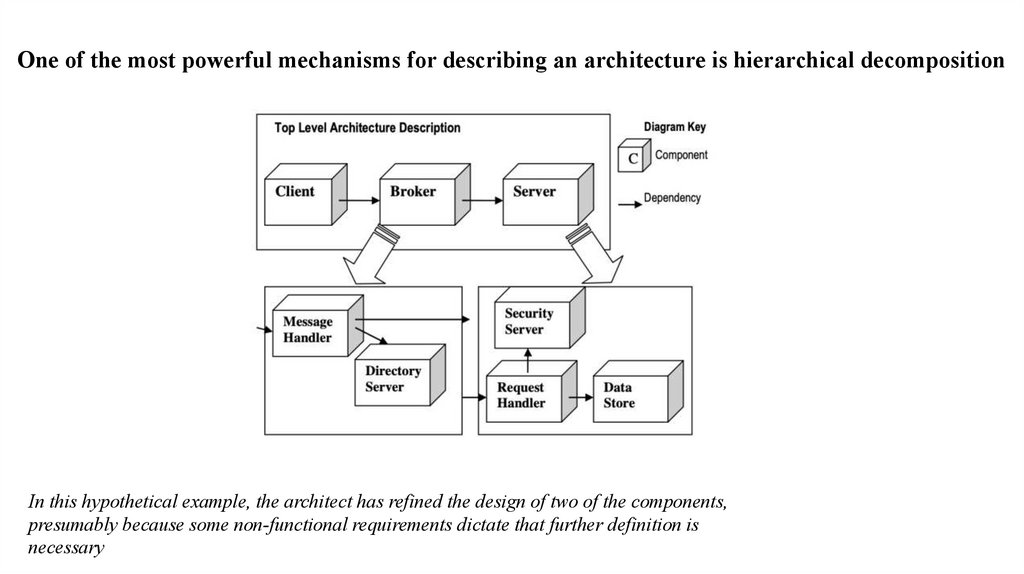
One of the most powerful mechanisms for describing an architecture is hierarchical decompositionIn this hypothetical example, the architect has refined the design of two of the components,
presumably because some non-functional requirements dictate that further definition is
necessary
19.
Architecture ViewsLogical view: This describes the architecturally significant elements of the architecture and the
relationships between them. The logical view essentially captures the structure of the application
using class diagrams or equivalents.
Process view: This focuses on describing the concurrency and communications elements of an
architecture. In IT applications, the main concerns are describing multi-threaded or replicated
components, and the synchronous or asynchronous communication mechanisms used.
Physical view: This depicts how the major processes and components are mapped on to the
applications hardware. It might show, for example, how the database and web servers for an
application are distributed across a number of server machines.
Development view: This captures the internal organization of the soft- ware components,
typically as they are held in a development environment or configuration management tool. For
example, the depiction of a nested package and class hierarchy for a Java application would
represent the development view of an architecture.
20.
This recommends capturing an architecture model using three different views:•Module: This is a structural view of the architecture, comprising the code modules
such as classes, packages and subsystems in the design. It also captures module
decomposition, inheritance, associations and aggregations.
•Component and Connector: This view describes the behavioral aspects of the
architecture. Components are typically objects, threads or processes, and the connectors
describe how the components interact. Common connectors are sockets, middleware
like CORBA or shared memory.
•Allocation: This view shows how the processes in the architecture are mapped to
hardware, and how they communicate using networks and/or databases. It also captures
a view of the source code in the configuration management systems, and who in the
development group has responsibility for each modules.
21.
What Does a SoftwareArchitect Do?
Liaison
Software Engineering
Technology Knowledge
Risk Management
22.
23. Architectures and Technologies
Architects must make design decisions early in aproject lifecycle. Many of these are difficult, if not
impossible, to validate and test until parts of the
system are actually built. Judicious prototyping of
key architectural components can help increase
confidence in a design approach, but sometimes it’s
still hard to be certain of the success of a particular
design choice in a given application context.
24.
Due to the difficulty of validating early design decisions, architects sensibly rely on tried andtested approaches for solving certain classes of problems.
This is one of the great values of architectural patterns. They enable architects to reduce risk by
leveraging successful designs with known engineering attributes.
25.
Fortunately, software products vendors have come to the rescue. Widelyutilized architectural patterns are supported in a variety of commercial offthe-shelf (COTS) technologies. If a design calls for publish-subscribe
messaging, or a message broker, or a three-tier architecture, then the choices
of available technology are many and varied indeed. This is an example of
software technologies providing reusable, application-independent soft- ware
infrastructures that implement proven architectural approaches.
26. Summary
Software architecture is a fairly well defined and understooddesign discipline. However, just because we know what it is
and more or less what needs doing, this doesn’t mean it’s
mechanical or easy.
Summary
Designing and validating an architecture for a complex
system is a creative exercise, re- quiring considerable
knowledge, experience and discipline. The difficulties are
exacerbated by the early lifecycle nature of much of the
work of an architect.