
 Английский язык
Похожие презентации:




Academic Writing
1.
2.
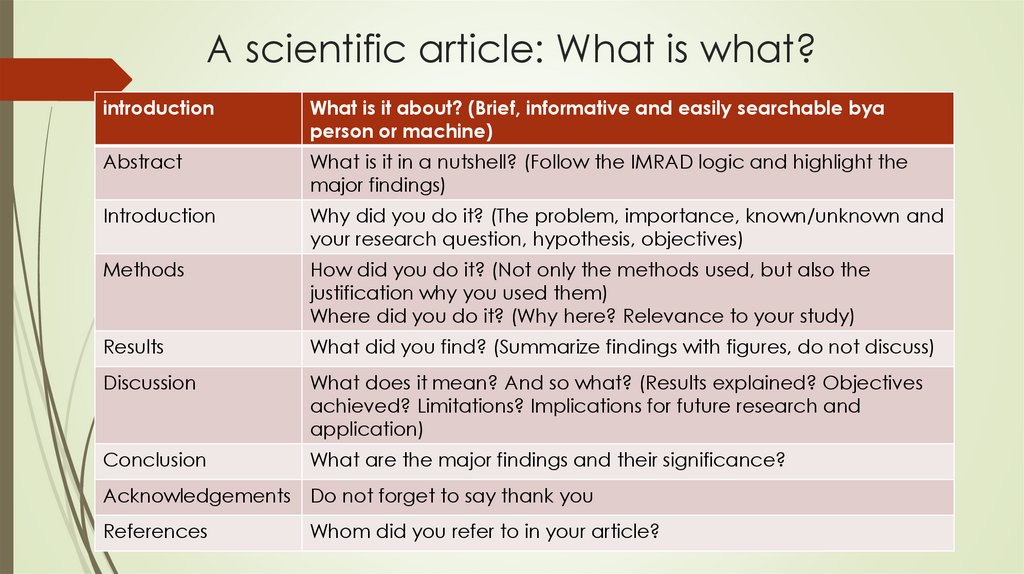
3. A scientific article: What is what?
introductionWhat is it about? (Brief, informative and easily searchable bya
person or machine)
Abstract
What is it in a nutshell? (Follow the IMRAD logic and highlight the
major findings)
Introduction
Why did you do it? (The problem, importance, known/unknown and
your research question, hypothesis, objectives)
Methods
How did you do it? (Not only the methods used, but also the
justification why you used them)
Where did you do it? (Why here? Relevance to your study)
Results
What did you find? (Summarize findings with figures, do not discuss)
Discussion
What does it mean? And so what? (Results explained? Objectives
achieved? Limitations? Implications for future research and
application)
Conclusion
What are the major findings and their significance?
Acknowledgements Do not forget to say thank you
References
Whom did you refer to in your article?
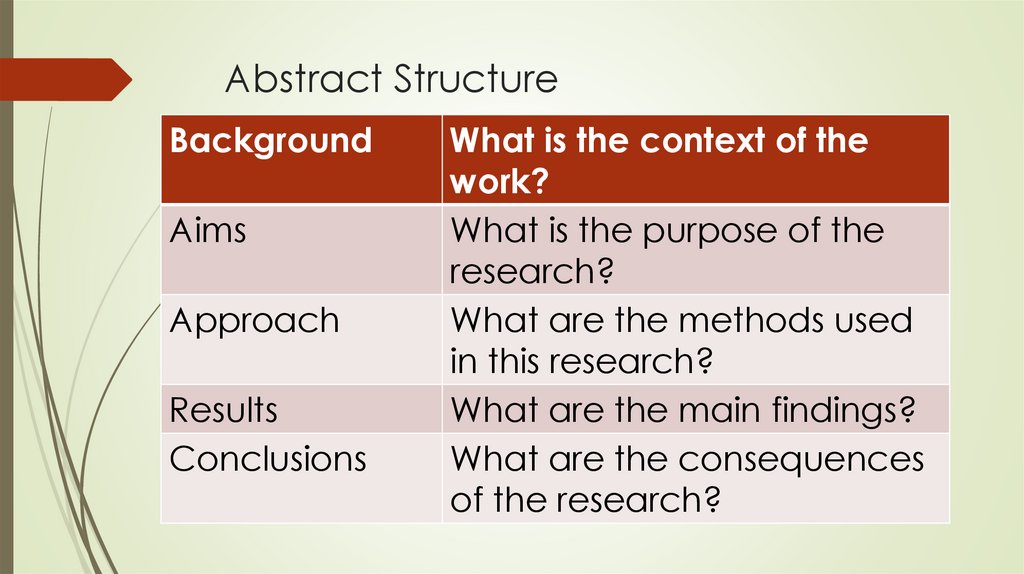
4. Abstract Structure
BackgroundAims
Approach
Results
Conclusions
What is the context of the
work?
What is the purpose of the
research?
What are the methods used
in this research?
What are the main findings?
What are the consequences
of the research?
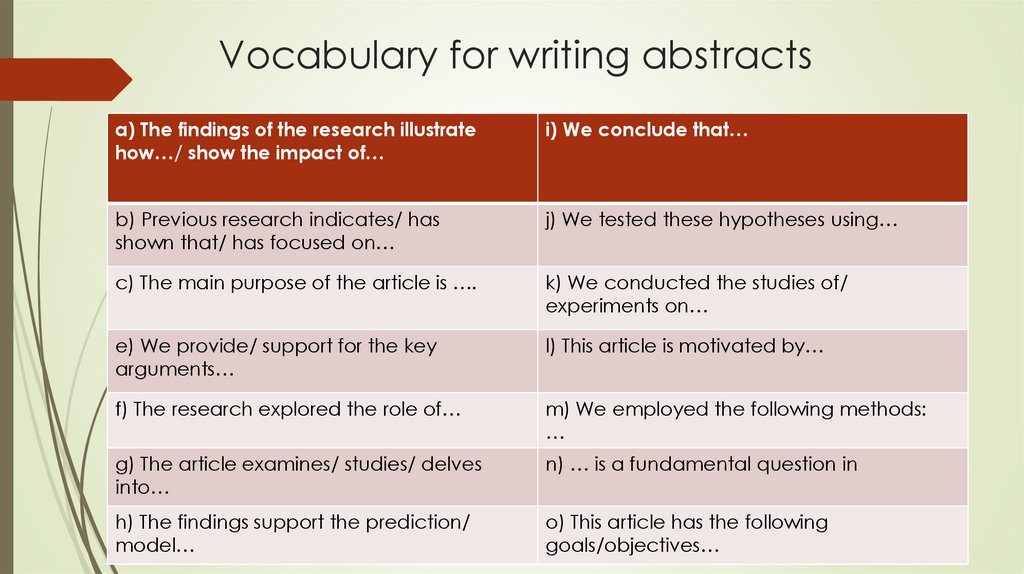
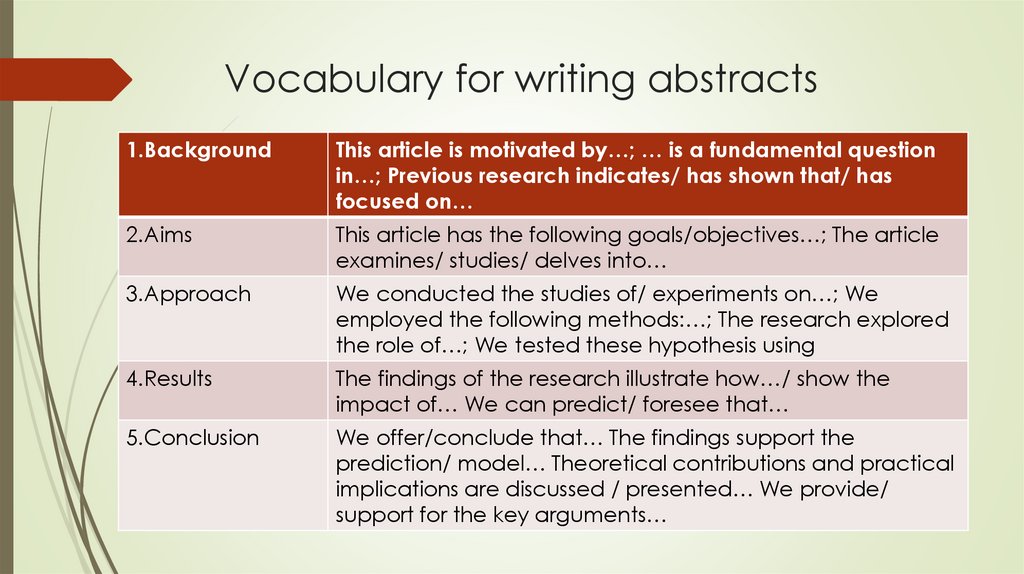
5. Vocabulary for writing abstracts
a) The findings of the research illustratehow…/ show the impact of…
i) We conclude that…
b) Previous research indicates/ has
shown that/ has focused on…
j) We tested these hypotheses using…
c) The main purpose of the article is ….
k) We conducted the studies of/
experiments on…
e) We provide/ support for the key
arguments…
l) This article is motivated by…
f) The research explored the role of…
m) We employed the following methods:
…
g) The article examines/ studies/ delves
into…
n) … is a fundamental question in
h) The findings support the prediction/
model…
o) This article has the following
goals/objectives…
6. Vocabulary for writing abstracts
1.BackgroundThis article is motivated by…; … is a fundamental question
in…; Previous research indicates/ has shown that/ has
focused on…
2.Aims
This article has the following goals/objectives…; The article
examines/ studies/ delves into…
3.Approach
We conducted the studies of/ experiments on…; We
employed the following methods:…; The research explored
the role of…; We tested these hypothesis using
4.Results
The findings of the research illustrate how…/ show the
impact of… We can predict/ foresee that…
5.Conclusion
We offer/conclude that… The findings support the
prediction/ model… Theoretical contributions and practical
implications are discussed / presented… We provide/
support for the key arguments…
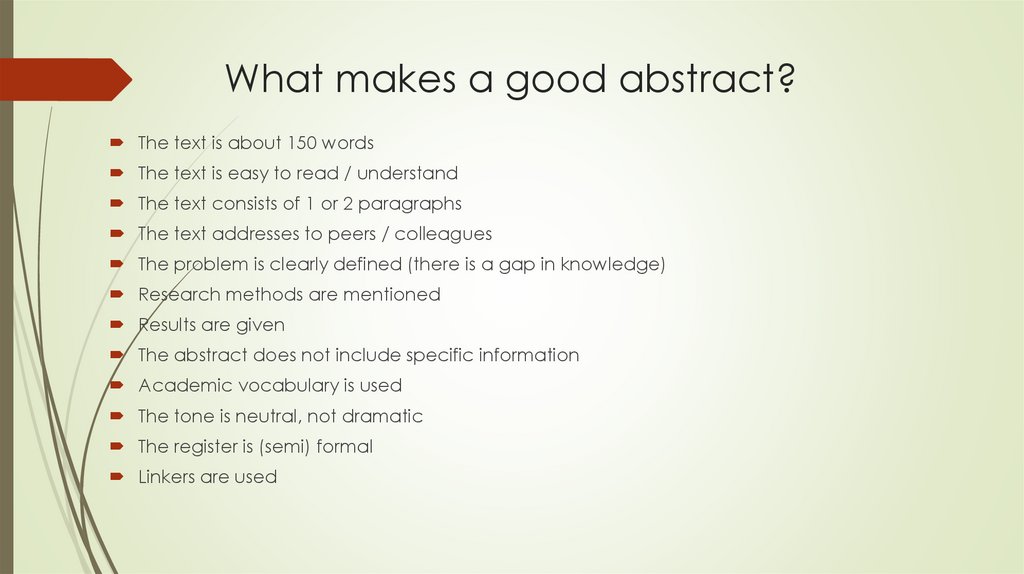
7. What makes a good abstract?
The text is about 150 wordsThe text is easy to read / understand
The text consists of 1 or 2 paragraphs
The text addresses to peers / colleagues
The problem is clearly defined (there is a gap in knowledge)
Research methods are mentioned
Results are given
The abstract does not include specific information
Academic vocabulary is used
The tone is neutral, not dramatic
The register is (semi) formal
Linkers are used