 География
Похожие презентации:







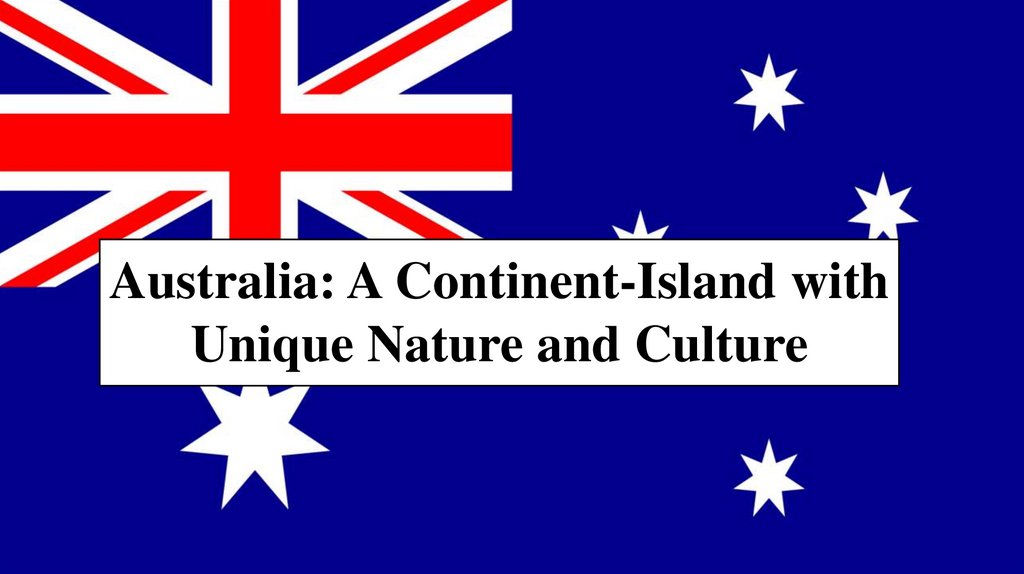
Australia: A Continent-Island with Unique Nature and Culture
1. Australia: A Continent-Island with Unique Nature and Culture
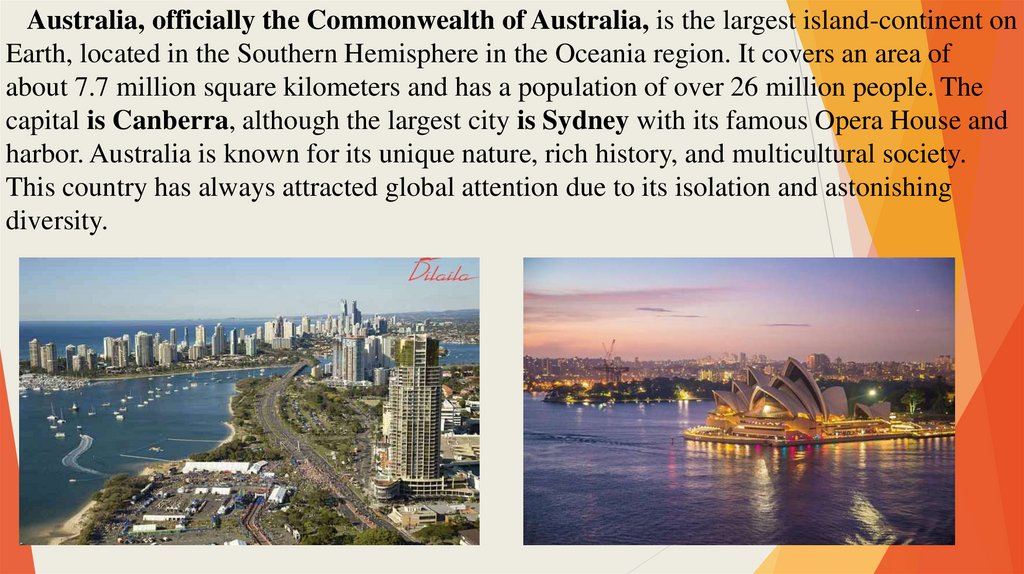
2. Australia, officially the Commonwealth of Australia, is the largest island-continent on Earth, located in the Southern
Hemisphere in the Oceania region. It covers an area ofabout 7.7 million square kilometers and has a population of over 26 million people. The
capital is Canberra, although the largest city is Sydney with its famous Opera House and
harbor. Australia is known for its unique nature, rich history, and multicultural society.
This country has always attracted global attention due to its isolation and astonishing
diversity.
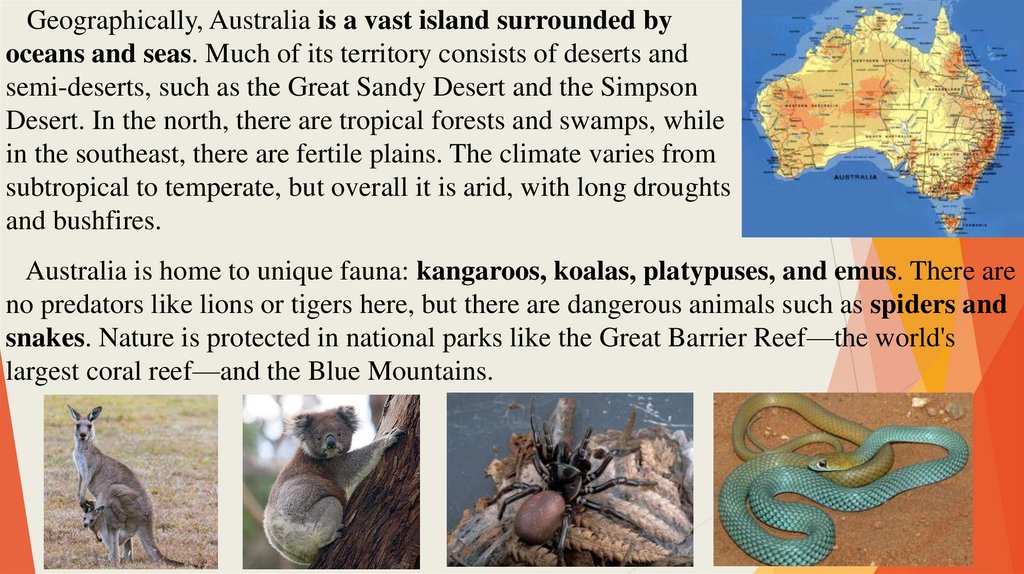
3. Geographically, Australia is a vast island surrounded by oceans and seas. Much of its territory consists of deserts and
semi-deserts, such as the Great Sandy Desert and the SimpsonDesert. In the north, there are tropical forests and swamps, while
in the southeast, there are fertile plains. The climate varies from
subtropical to temperate, but overall it is arid, with long droughts
and bushfires.
Australia is home to unique fauna: kangaroos, koalas, platypuses, and emus. There are
no predators like lions or tigers here, but there are dangerous animals such as spiders and
snakes. Nature is protected in national parks like the Great Barrier Reef—the world's
largest coral reef—and the Blue Mountains.
4. Australia's history spans thousands of years. The Aboriginal people, the indigenous inhabitants, have populated the continent
Australia's history spans thousands of years. The Aboriginal people, the indigenousinhabitants, have populated the continent for over 50,000 years, developing a rich culture
with myths and art. European colonization began in 1788 when the British established a
colony in Sydney for convicts. The 19th century brought gold rushes and immigration,
leading to population growth. In 1901, six British colonies united into the Federation of
Australia. The country participated in both world wars as an ally of Britain, and after
World War II, it became an independent republic with the British monarch as a ceremonial
head. Today, Australia is a democratic state led by a prime minister.
Australia's economy is one of the strongest in the world, thanks to natural resources. The
country leads in coal, gold, gas, and iron ore mining. Agriculture thrives: exports of wheat,
wool, and wine. Tourism brings in billions, attracting visitors to reefs, beaches, and cities.
The financial sector is developed, especially in Sydney. Despite global crises, Australia
adapts by focusing on green technologies.
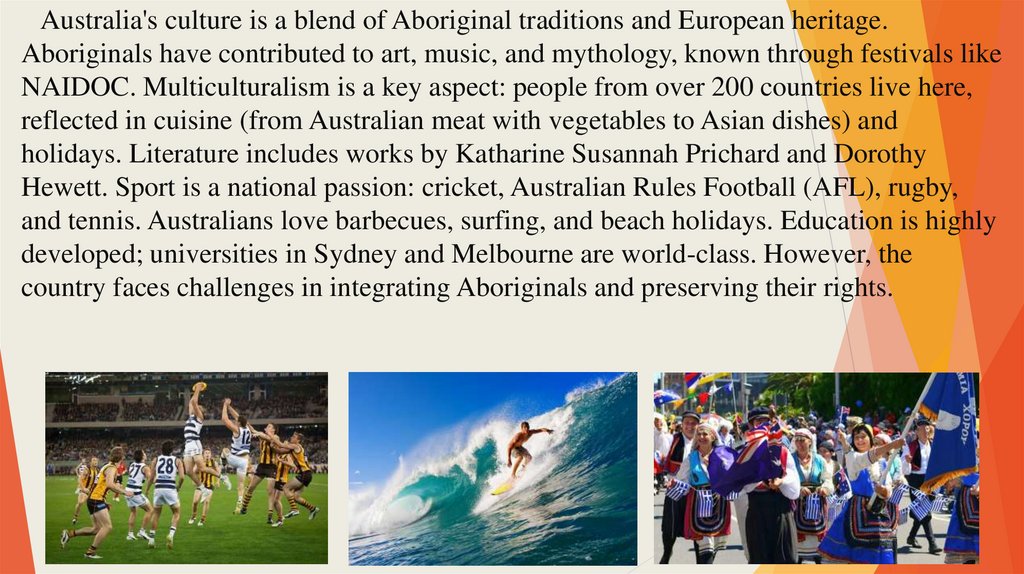
5. Australia's culture is a blend of Aboriginal traditions and European heritage. Aboriginals have contributed to art, music, and
Australia's culture is a blend of Aboriginal traditions and European heritage.Aboriginals have contributed to art, music, and mythology, known through festivals like
NAIDOC. Multiculturalism is a key aspect: people from over 200 countries live here,
reflected in cuisine (from Australian meat with vegetables to Asian dishes) and
holidays. Literature includes works by Katharine Susannah Prichard and Dorothy
Hewett. Sport is a national passion: cricket, Australian Rules Football (AFL), rugby,
and tennis. Australians love barbecues, surfing, and beach holidays. Education is highly
developed; universities in Sydney and Melbourne are world-class. However, the
country faces challenges in integrating Aboriginals and preserving their rights.