 Биографии
Похожие презентации:


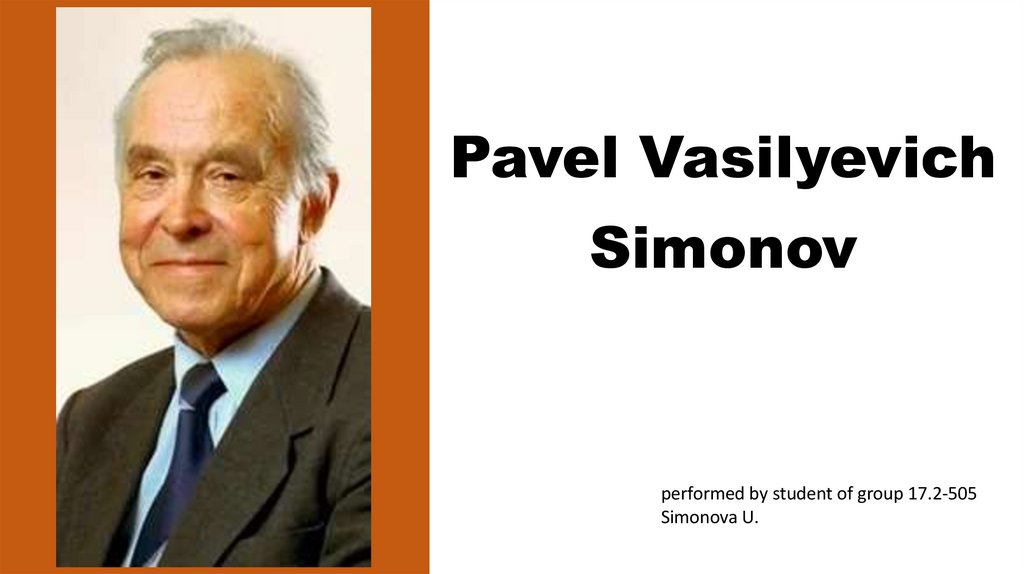
Pavel Vasilyevich Simonov: Motivation, Emotions and Brain Basis of Behavior
1.
Pavel VasilyevichSimonov
performed by student of group 17.2-505
Simonova U.
2.
Pavel Vasilyevich Simonov (born Pavel Stanislavovich Stankevich)is a Soviet and Russian psychophysiologist, biophysicist, and
psychologist. He is known for his research on motivation,
emotions, and the neurophysiological basis of behavior.
He was born on April 20, 1926 in Leningrad.
He died on June 6, 2002 in Moscow.
He graduated from the Military Medical Academy (1951).
In 1951-1960— he was a researcher and head of the laboratory at the N. N. Burdenko Main Military Hospital.
Since 1962, he has been working at the Institute of Higher Nervous Activity and Neurophysiology of the Russian Academy of Sciences as a
head of a laboratory, then as a deputy director, and since 1982, as the director of this institute.
He has been a professor at the Department of Higher Nervous Activity at the Faculty of Biology at Moscow State University since 1996.
3.
TheoriesInformation theory of emotions-emotions arise as a result of the actualization of
human needs and depend on the necessary and available information related to the
satisfaction of needs.
Simonov's model "Triad of Instincts and Sociality" - needs are divided into three
groups, emphasizing their innate nature: vital (biological), social (zoosocial), and
ideal.
Research
Dedicated to the physiology of higher nervous activity - the study of the brain basis of behavior.
Created and experimentally substantiated the need-information approach to the analysis of behavior and higher
mental functions of humans and animals. This made it possible to provide a natural science substantiation of such
key concepts of general psychology as need, emotion, will, consciousness.
He developed a classification of needs, which, along with the three basic needs (vital, social, and ideal), includes the
need for armament (knowledge, skills, and abilities) and the need to overcome obstacles on the way to a goal (will).
4.
Awards and AchievementsLaureate of the USSR State Prize (1987, in the
team) for the creation and development of
methods for diagnosing and predicting the
state of the human brain.
Awarded the I. M. Sechenov Gold Medal (RAS,
1999) for a set of works on the needinformation theory of higher nervous activity
(behavior) in humans and animals.
Distinguished
Professor at
Moscow
University