 Английский язык
Похожие презентации:



The Auxiliary Verbs: To Have and To Have Got
1.
The Auxiliary Verbs: To Have and To Have Got2.
Introduction to Auxiliary Verbs● Auxiliary verbs help form different tenses and moods in English.
● "To have" and "to have got" are commonly used auxiliary verbs.
● Let's explore how to use them in the present and past tenses!
3.
Using "To Have" in the Present Tense● "To have" is used to indicate possession or relationships.
● Example: I have a dog.
● Questions: Do you have any siblings?
4.
Using "To Have Got" in the Present Tense● "To have got" is often used in informal contexts to show
possession.
● Example: I have got a new bike.
● Questions: Have you got your homework?
5.
Present Tense Summary● "To have" is more formal; "to have got" is informal.
● Both forms indicate possession.
● Which form do you prefer to use? Why?
6.
Using "To Have" in the Past Tense● "To have" in the past tense is "had."
● Example: I had a cat when I was younger.
● Questions: What did you have for breakfast?
7.
Using "To Have Got" in the Past Tense● "To have got" in the past is usually expressed as "had got."
● Example: I had got a ticket before the concert.
● Questions: Had you got your phone before leaving?
8.
Past Tense Summary● "Had" is used for both "to have" and "to have got" in the past.
● Both forms indicate past possession.
● Can you think of a time when you had something special?
9.
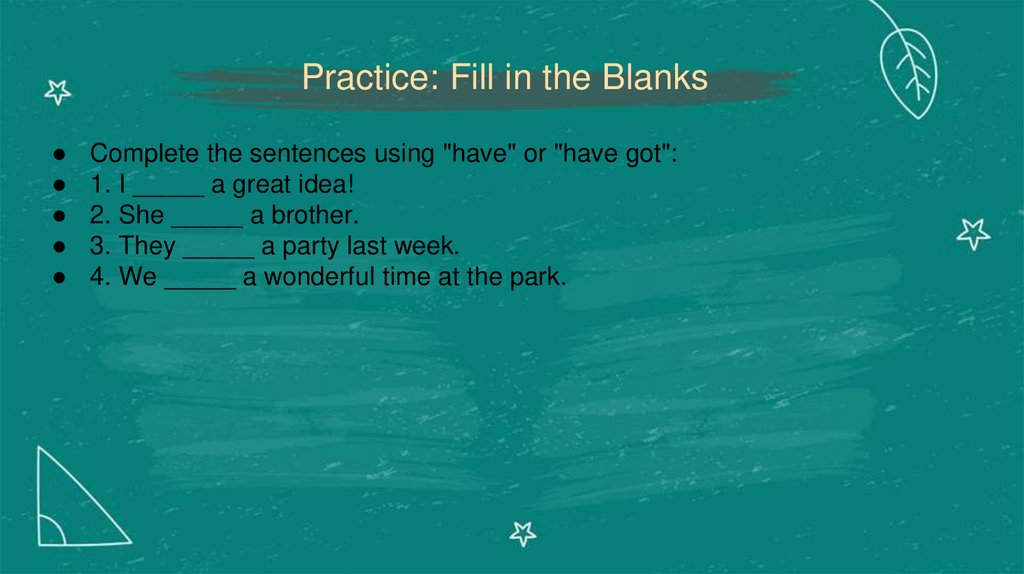
Practice: Fill in the BlanksComplete the sentences using "have" or "have got":
1. I _____ a great idea!
2. She _____ a brother.
3. They _____ a party last week.
4. We _____ a wonderful time at the park.
10.
Discussion: Your Experiences● Share with the class:
● What do you have or have got that is important to you?
● How do you use these verbs in your daily conversations?
11.
Conclusion: Key Takeaways● "To have" and "to have got" are essential for expressing
possession.
● Remember the differences in formality and tense.
● Keep practicing to master their use!
12.
Understanding "To Have"● "To have" is a versatile verb in English.
● It can express possession, experiences, and obligations.
● Let's explore different expressions using "to have"!
13.
Expressions of Possession● Use "to have" to show ownership.
● Example: I have a car.
● What do you have that you really like?
14.
Expressions of Experience● "To have" can describe experiences.
● Example: I have had a great vacation.
● What is something you have had that was memorable?
15.
Expressions of Obligation● Use "to have" to express obligations.
● Example: I have to finish my homework.
● What do you have to do today?
16.
Common Phrases with "To Have""Have a good time"
"Have a snack"
"Have a conversation"
Can you think of other phrases with "to have"?
17.
Using "To Have" in Questions● Form questions with "to have" easily.
● Example: Do you have any pets?
● What questions can you create using "to have"?
18.
Negative Forms of "To Have"● Use "not" to make negative sentences.
● Example: I do not have a bicycle.
● Can you create a negative sentence using "to have"?
19.
Practice: Fill in the BlanksComplete the sentences using "have":
1. I _____ a favorite book.
2. She _____ to study for the test.
3. They _____ a lot of fun at the party.
4. We _____ a meeting tomorrow.
20.
Discussion: Your Experiences● Share with the class:
● What do you have that makes you happy?
● How do you use "to have" in your daily life?
21.
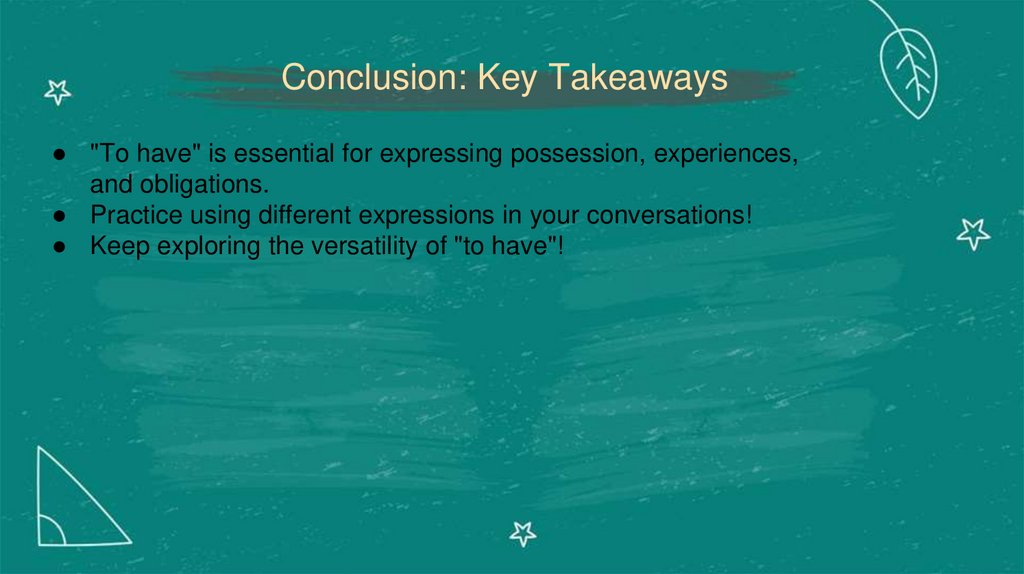
Conclusion: Key Takeaways● "To have" is essential for expressing possession, experiences,
and obligations.
● Practice using different expressions in your conversations!
● Keep exploring the versatility of "to have"!