Похожие презентации:



БПЛА
1.
UNMANNED AERIALVEHICLES IN THE CONTEXT
OF THE SPECIAL MILITARY
OPERATION
Tactical and strategic analysis of the use of UAVs, which have changed
the nature of modern combat and become a key element for achieving
success on the battlefield.
2.
Introduction: A Revolution in WarfareThe Special Military Operation (SMO) has become the first large-scale conflict where unmanned aerial vehicles (UAVs) have
transformed from an auxiliary tool into a key element. A qualitative leap has occurred: drones now shape a new combat
environment, where dominance in low-altitude airspace ensures success on the ground. Our analysis reveals their crucial
role.
3.
Relevance of the Study: A New Era of WarfareThe study of UAV application in the Special Military Operation (SMO) is relevant due to several factors shaping a new military
reality.
Revolution in Military Affairs
High Pace of Technological Competition
The SMO as a testing ground for new technologies.
The field of UAVs is developing at an unprecedented
Drones have changed tactics, making positional defence
rate. The conflict is a continuous "sword and shield" race:
vulnerable, increasing artillery effectiveness to 80%,
the improvement of drones stimulates the development
and initiating massive swarm attacks.
of countermeasures, and vice versa. What was relevant
six months ago is often outdated today.
4.
Strategic Dimensions of Unmanned SystemsThe impact of UAVs extends to the strategic level, stimulating innovation and rethinking military doctrine.
1
Technological Sovereignty
and Decentralisation
2
Broad Interdisciplinary
Scope
3
Strategic Significance
Massive infrastructure attacks
Both sides are actively
UAVs stimulate the development
are a tool of pressure. Round-
developing their own UAV
of AI, machine vision,
the-clock surveillance
production, from serial to
telecommunications and light
fundamentally changes the
artisanal. This is critical for
aviation, with a significant
concept of "control over
import substitution, supply
impact on the defence industry
territory".
flexibility and the transition to
economy.
network-centric warfare models.
5.
UAV Classification in the Special MilitaryOperation
UAVs in the SMO can be conditionally divided according to their main purpose, which makes it possible to clearly define their
role on the battlefield.
Reconnaissance
Loitering Munitions
Heavy Multirotors
The "eyes" of artillery, fire adjustment.
High-precision target engagement.
Night attacks, dropping ammunition.
FPV Drones
Commercial Quadcopters
Mass tactical use.
Immediate tactical reconnaissance.
6.
Artillery Eyes and Precision StrikeTactical reconnaissance UAVs and loitering munitions play a critical role in modern warfare.
Tactical Reconnaissance UAVs
Loitering Munitions
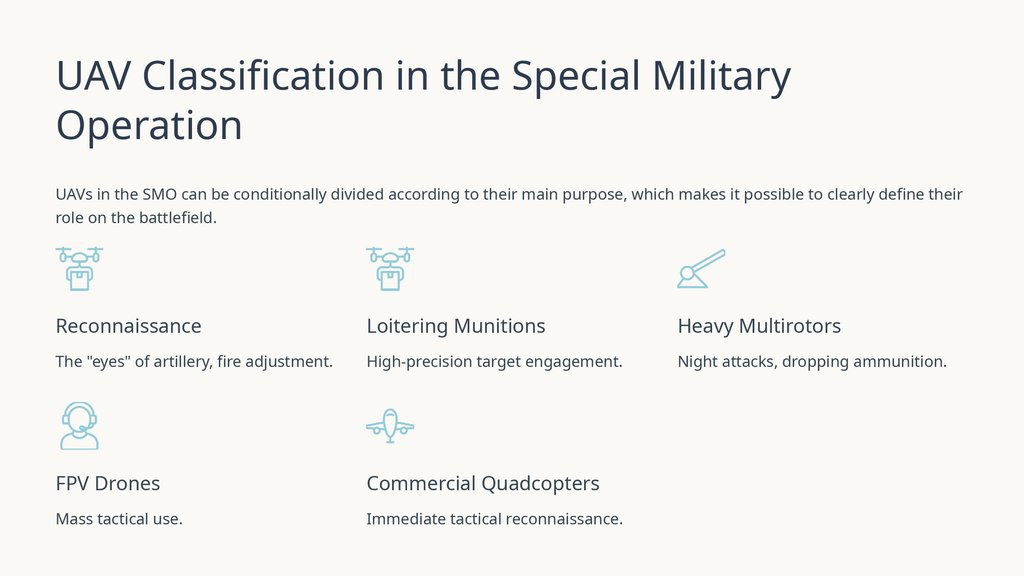
These drones are the true "eyes" of the artillery. These include the Russian "Orlan-10", "Supercam"
and "Eleron". Their tasks include reconnaissance, fire correction and damage assessment. They are
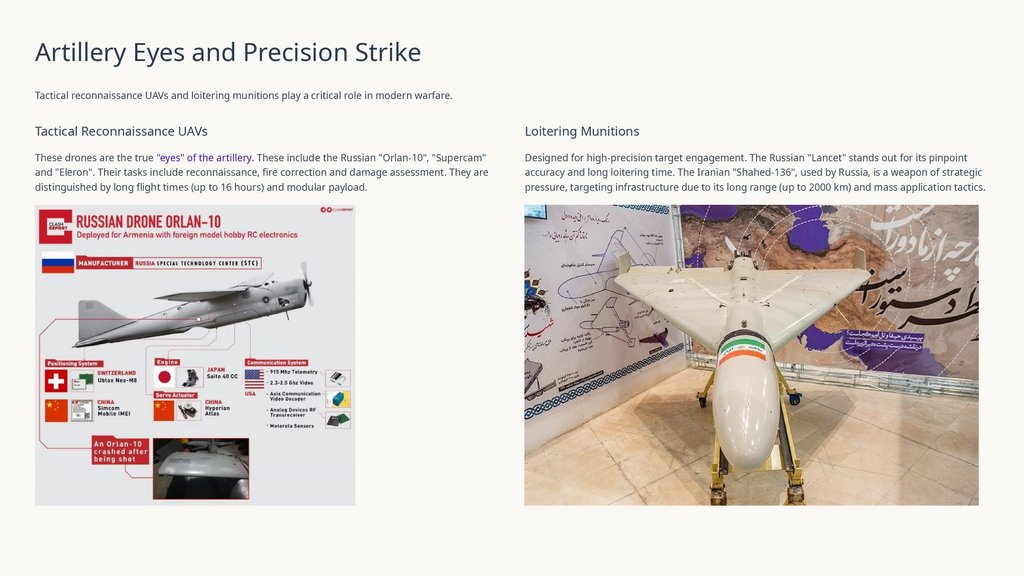
Designed for high-precision target engagement. The Russian "Lancet" stands out for its pinpoint
accuracy and long loitering time. The Iranian "Shahed-136", used by Russia, is a weapon of strategic
distinguished by long flight times (up to 16 hours) and modular payload.
pressure, targeting infrastructure due to its long range (up to 2000 km) and mass application tactics.
7.
Heavy Lift Multirotors and FPV Drones: New TacticsThese UAV classes demonstrate adaptability and new tactical capabilities on the battlefield.
Heavy Lift Multirotors ("Baba Yaga")
FPV Drones
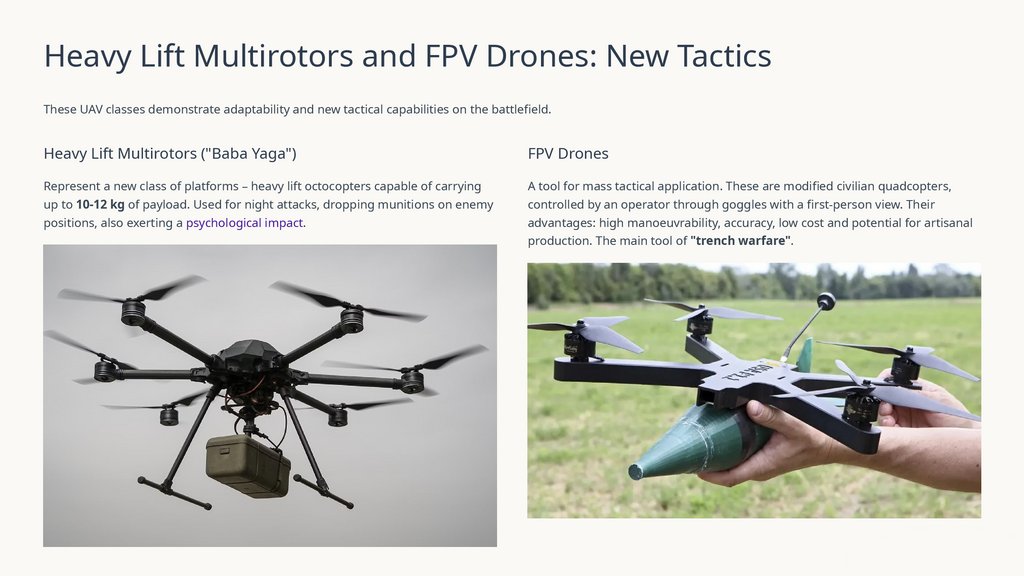
Represent a new class of platforms – heavy lift octocopters capable of carrying
A tool for mass tactical application. These are modified civilian quadcopters,
up to 10-12 kg of payload. Used for night attacks, dropping munitions on enemy
controlled by an operator through goggles with a first-person view. Their
positions, also exerting a psychological impact.
advantages: high manoeuvrability, accuracy, low cost and potential for artisanal
production. The main tool of "trench warfare".
8.
Commercial UAVs and the Constant StruggleCommercial quadcopters have become ubiquitous on the front lines, and their use is creating a continuous "war" in the radio
spectrum.
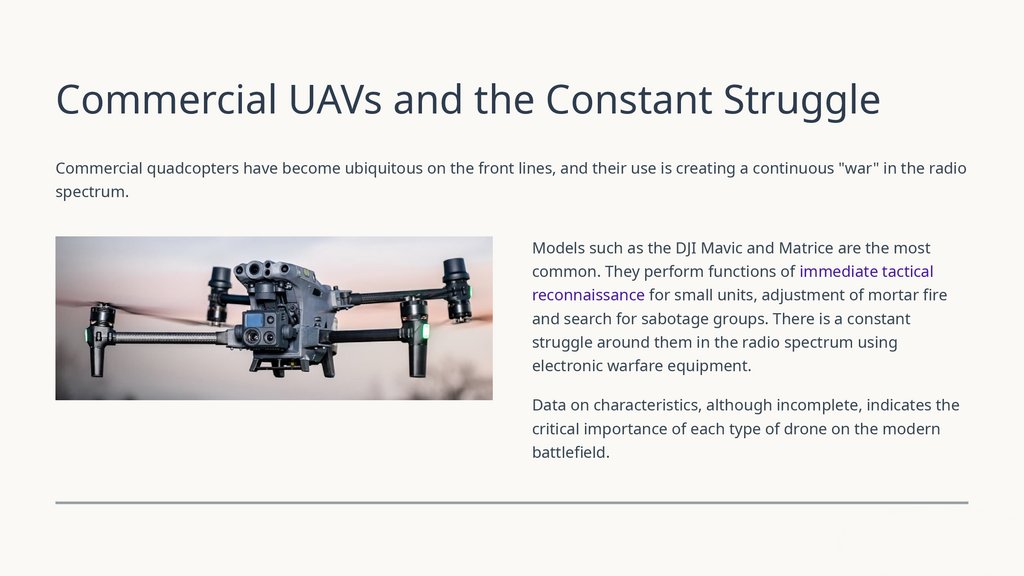
Models such as the DJI Mavic and Matrice are the most
common. They perform functions of immediate tactical
reconnaissance for small units, adjustment of mortar fire
and search for sabotage groups. There is a constant
struggle around them in the radio spectrum using
electronic warfare equipment.
Data on characteristics, although incomplete, indicates the
critical importance of each type of drone on the modern
battlefield.
9.
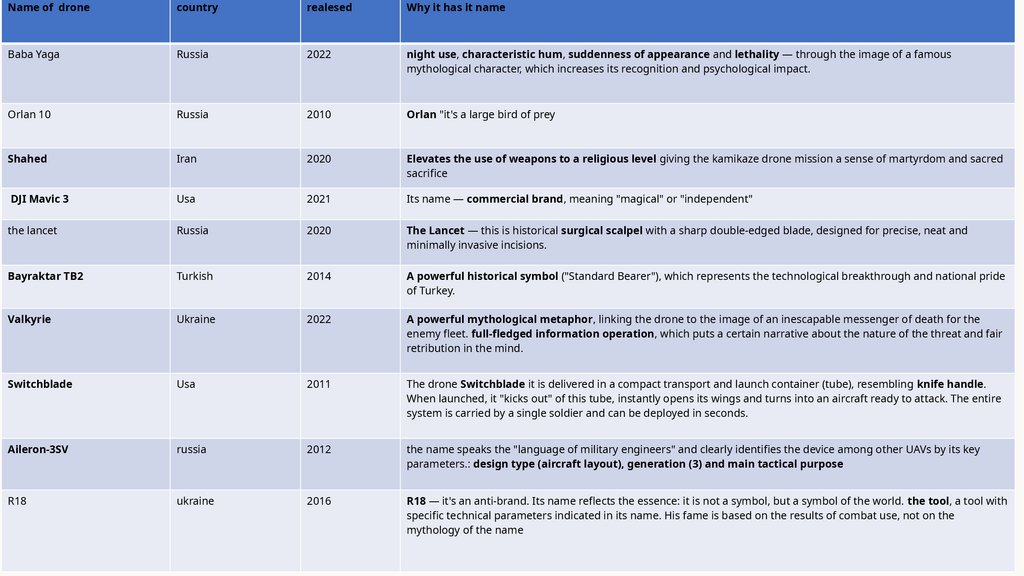
Name of dronecountry
realesed
Why it has it name
Baba Yaga
Russia
2022
night use, characteristic hum, suddenness of appearance and lethality — through the image of a famous
mythological character, which increases its recognition and psychological impact.
Orlan 10
Russia
2010
Orlan "it's a large bird of prey
Shahed
Iran
2020
Elevates the use of weapons to a religious level giving the kamikaze drone mission a sense of martyrdom and sacred
sacrifice
DJI Mavic 3
Usa
2021
Its name — commercial brand, meaning "magical" or "independent"
the lancet
Russia
2020
The Lancet — this is historical surgical scalpel with a sharp double-edged blade, designed for precise, neat and
minimally invasive incisions.
Bayraktar TB2
Turkish
2014
A powerful historical symbol ("Standard Bearer"), which represents the technological breakthrough and national pride
of Turkey.
Valkyrie
Ukraine
2022
A powerful mythological metaphor, linking the drone to the image of an inescapable messenger of death for the
enemy fleet. full-fledged information operation, which puts a certain narrative about the nature of the threat and fair
retribution in the mind.
Switchblade
Usa
2011
The drone Switchblade it is delivered in a compact transport and launch container (tube), resembling knife handle.
When launched, it "kicks out" of this tube, instantly opens its wings and turns into an aircraft ready to attack. The entire
system is carried by a single soldier and can be deployed in seconds.
Aileron-3SV
russia
2012
the name speaks the "language of military engineers" and clearly identifies the device among other UAVs by its key
parameters.: design type (aircraft layout), generation (3) and main tactical purpose
R18
ukraine
2016
R18 — it's an anti-brand. Its name reflects the essence: it is not a symbol, but a symbol of the world. the tool, a tool with
specific technical parameters indicated in its name. His fame is based on the results of combat use, not on the
mythology of the name
10.
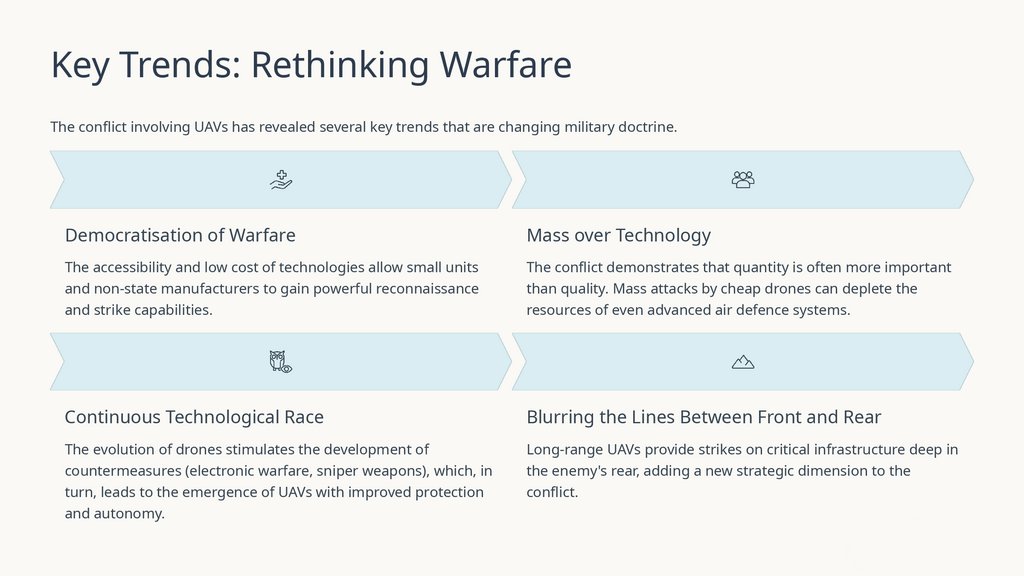
Key Trends: Rethinking WarfareThe conflict involving UAVs has revealed several key trends that are changing military doctrine.
Democratisation of Warfare
Mass over Technology
The accessibility and low cost of technologies allow small units
The conflict demonstrates that quantity is often more important
and non-state manufacturers to gain powerful reconnaissance
than quality. Mass attacks by cheap drones can deplete the
and strike capabilities.
resources of even advanced air defence systems.
Continuous Technological Race
Blurring the Lines Between Front and Rear
The evolution of drones stimulates the development of
Long-range UAVs provide strikes on critical infrastructure deep in
countermeasures (electronic warfare, sniper weapons), which, in
the enemy's rear, adding a new strategic dimension to the
turn, leads to the emergence of UAVs with improved protection
conflict.
and autonomy.
11.
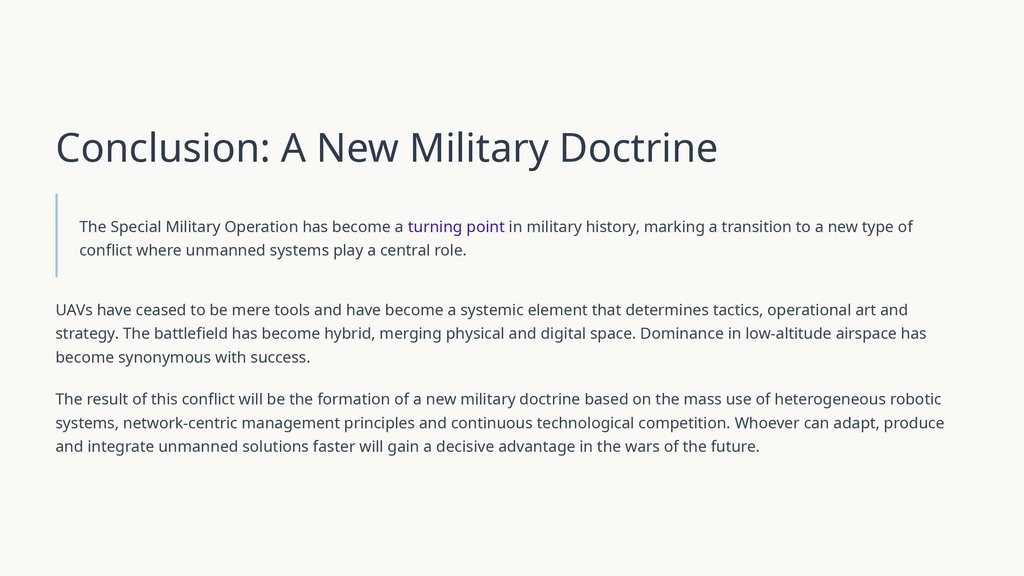
Conclusion: A New Military DoctrineThe Special Military Operation has become a turning point in military history, marking a transition to a new type of
conflict where unmanned systems play a central role.
UAVs have ceased to be mere tools and have become a systemic element that determines tactics, operational art and
strategy. The battlefield has become hybrid, merging physical and digital space. Dominance in low-altitude airspace has
become synonymous with success.
The result of this conflict will be the formation of a new military doctrine based on the mass use of heterogeneous robotic
systems, network-centric management principles and continuous technological competition. Whoever can adapt, produce
and integrate unmanned solutions faster will gain a decisive advantage in the wars of the future.