
 Физика
Похожие презентации:




Laser: History and Applications
1. TUPOLEV KAZAN NATIONAL RESEARCH TECHNICAL UNIVERSITY
INVENTORS ANDTHEIR INVENTIONS
Made by
KRYLOVA ALLA SERGEEVNA
2. LASER
A WONDER CHILD OFQUANTUM PHYSICS
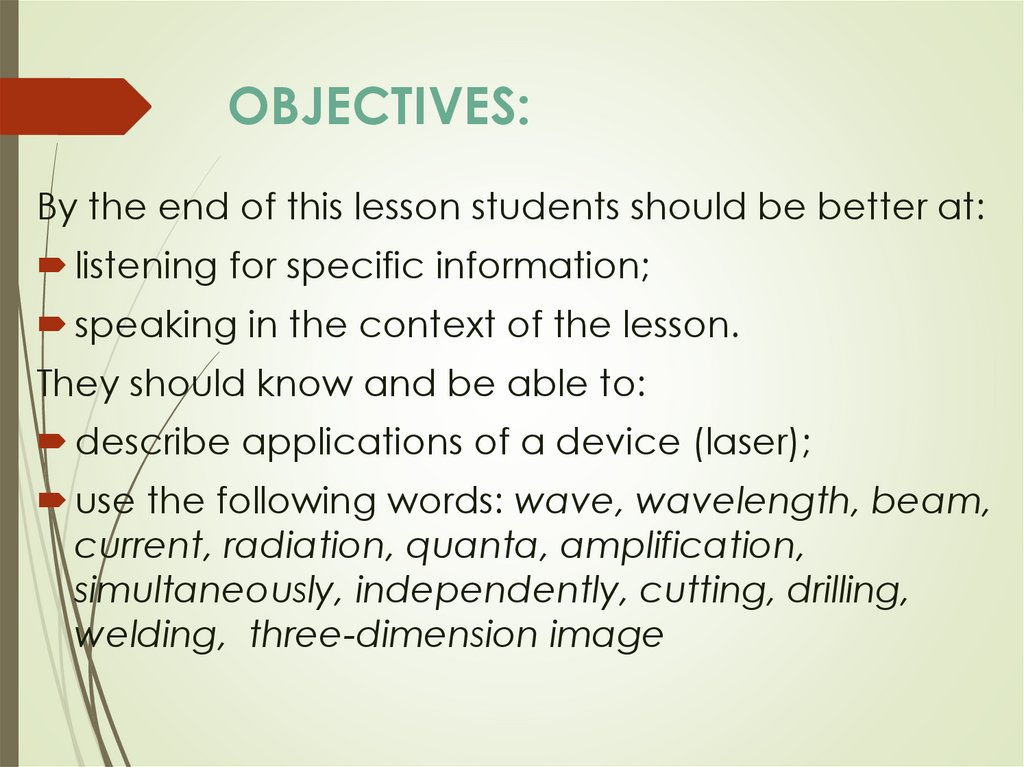
3. OBJECTIVES:
By the end of this lesson students should be better at:listening for specific information;
speaking in the context of the lesson.
They should know and be able to:
describe applications of a device (laser);
use the following words: wave, wavelength, beam,
current, radiation, quanta, amplification,
simultaneously, independently, cutting, drilling,
welding, three-dimension image
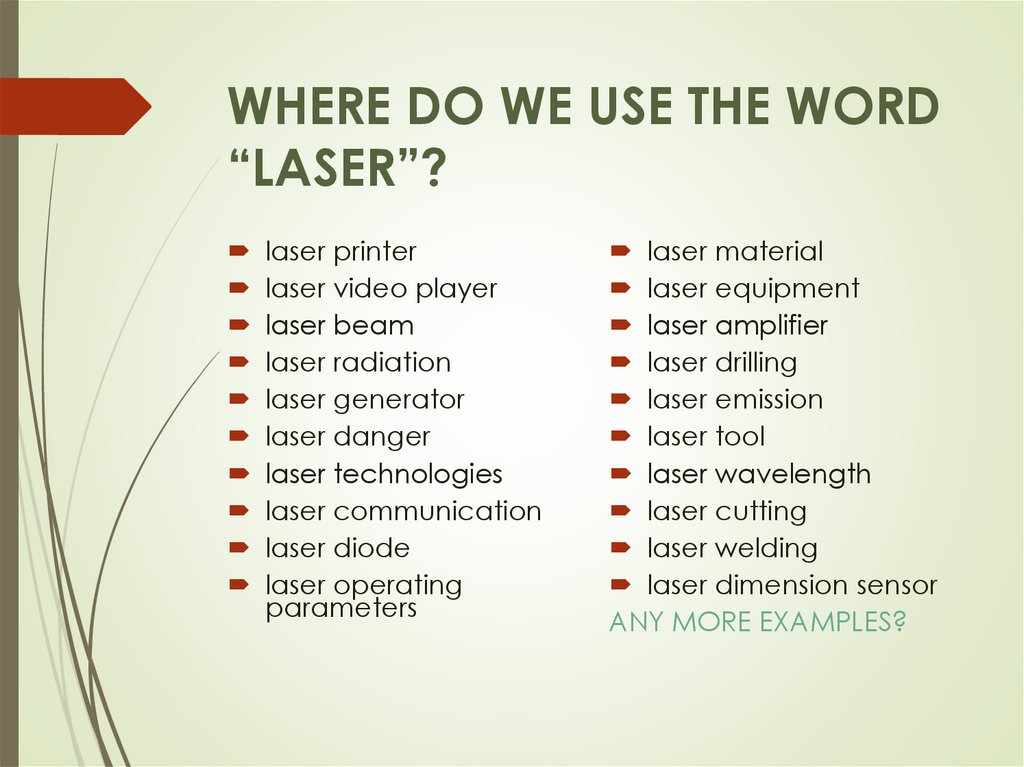
4. WHERE DO WE USE THE WORD “LASER”?
laser printerlaser video player
laser beam
laser radiation
laser generator
laser danger
laser technologies
laser communication
laser diode
laser operating
parameters
laser material
laser equipment
laser amplifier
laser drilling
laser emission
laser tool
laser wavelength
laser cutting
laser welding
laser dimension sensor
ANY MORE EXAMPLES?
5. FROM THE HISTORY OF LASERS
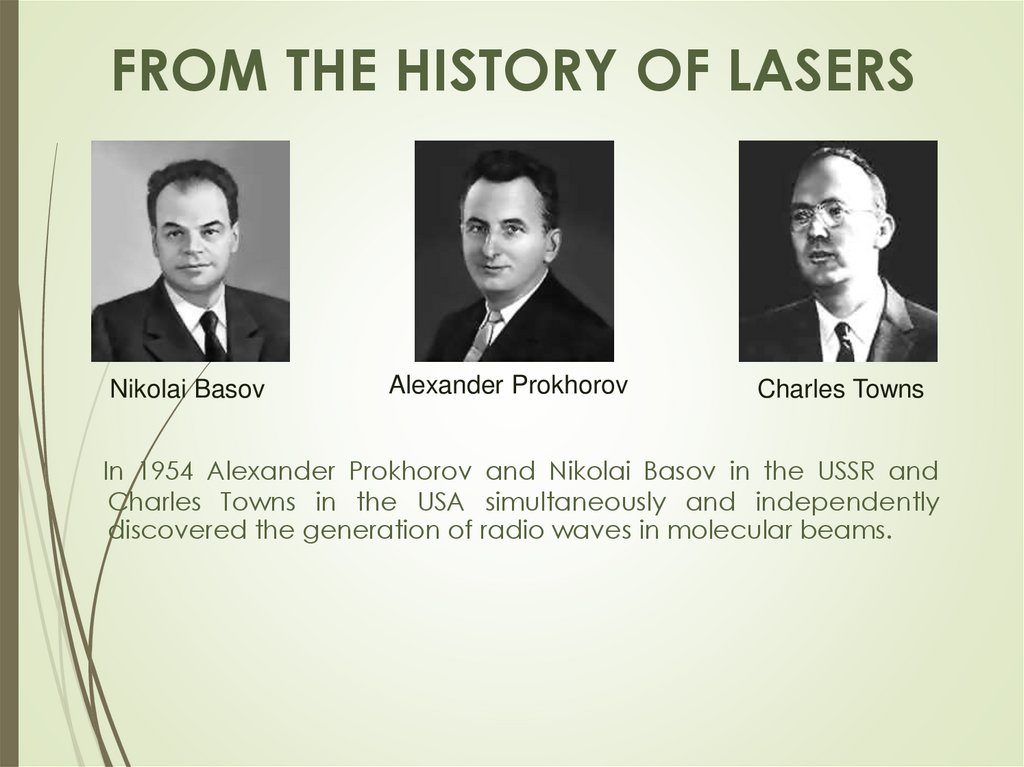
Nikolai BasovAlexander Prokhorov
Charles Towns
In 1954 Alexander Prokhorov and Nikolai Basov in the USSR and
Charles Towns in the USA simultaneously and independently
discovered the generation of radio waves in molecular beams.
6. FROM THE HISTORY OF LASERS
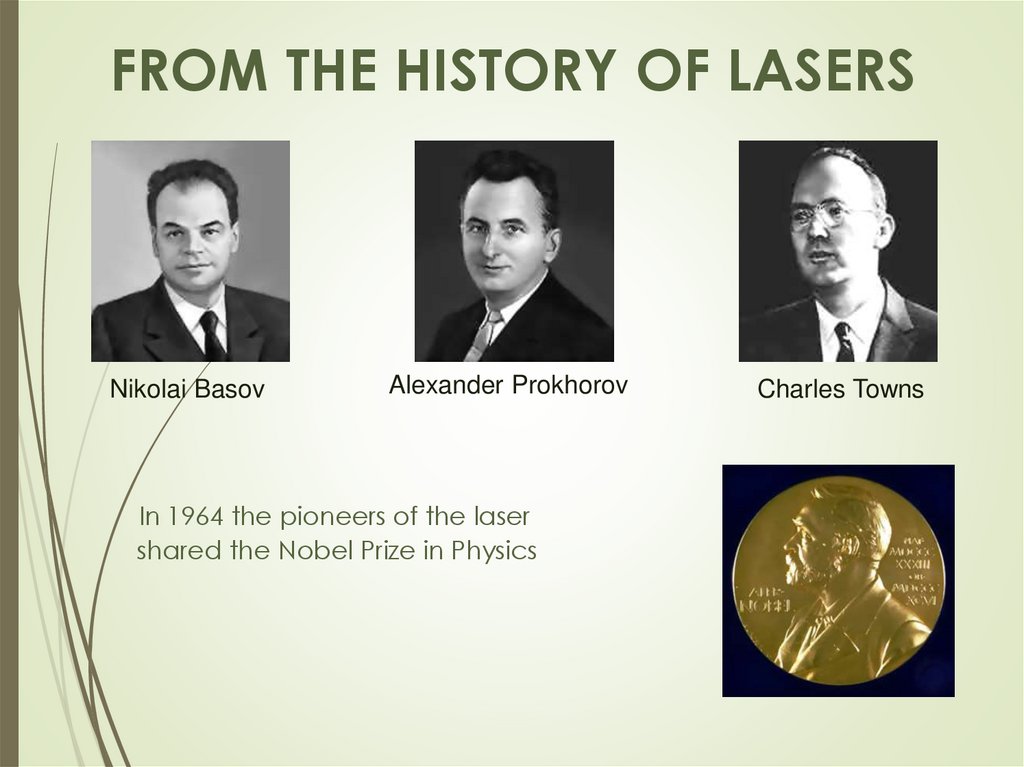
Nikolai BasovAlexander Prokhorov
In 1964 the pioneers of the laser
shared the Nobel Prize in Physics
Charles Towns
7. WHAT IS A LASER?
LISTENING:Listen to the text and fill in
the gaps
8. WHAT IS A LASER?
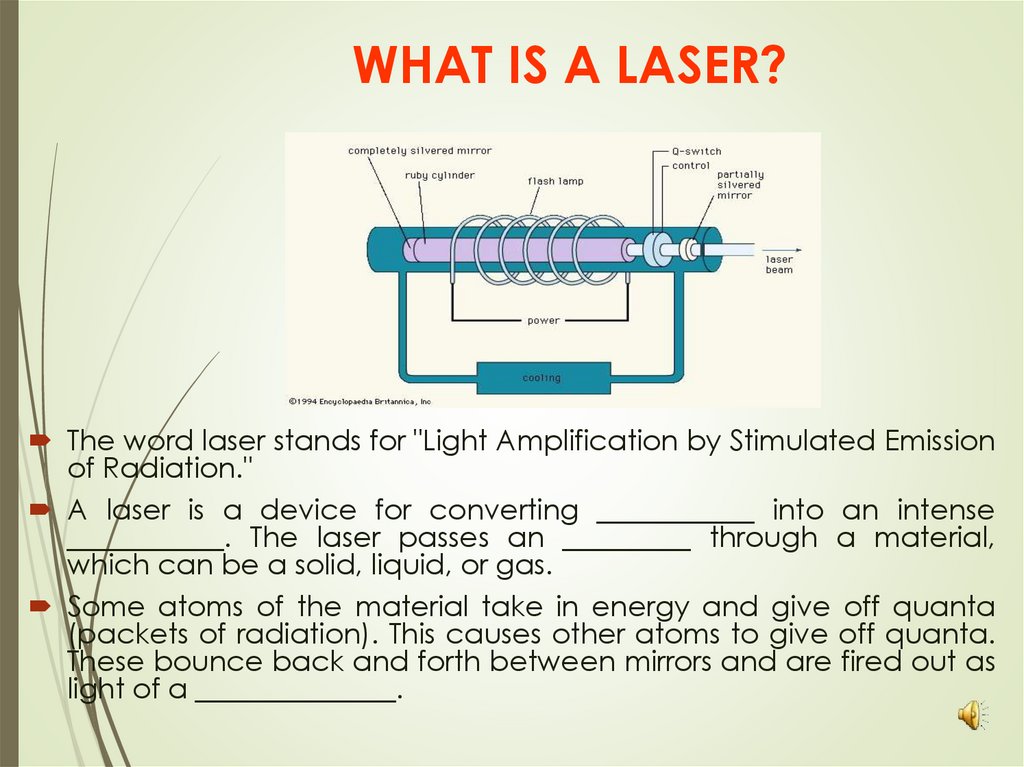
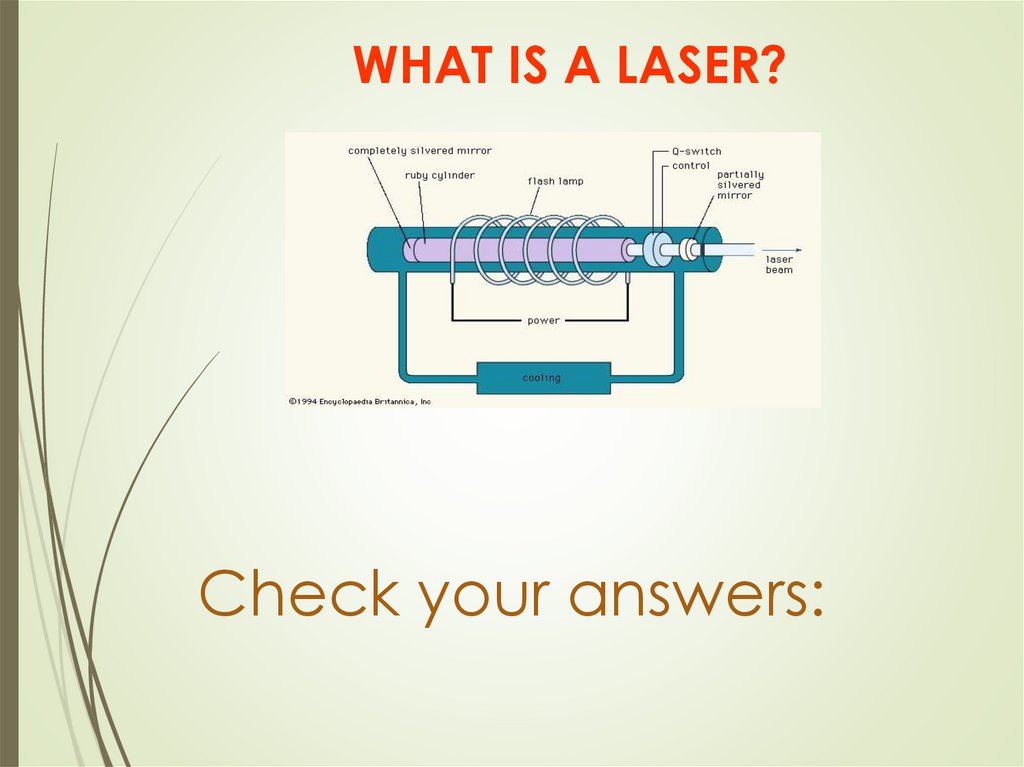
The word laser stands for "Light Amplification by Stimulated Emissionof Radiation."
A laser is a device for converting ___________ into an intense
___________. The laser passes an _________ through a material,
which can be a solid, liquid, or gas.
Some atoms of the material take in energy and give off quanta
(packets of radiation). This causes other atoms to give off quanta.
These bounce back and forth between mirrors and are fired out as
light of a ______________.
9. WHAT IS A LASER?
Check your answers:10. WHAT IS A LASER?
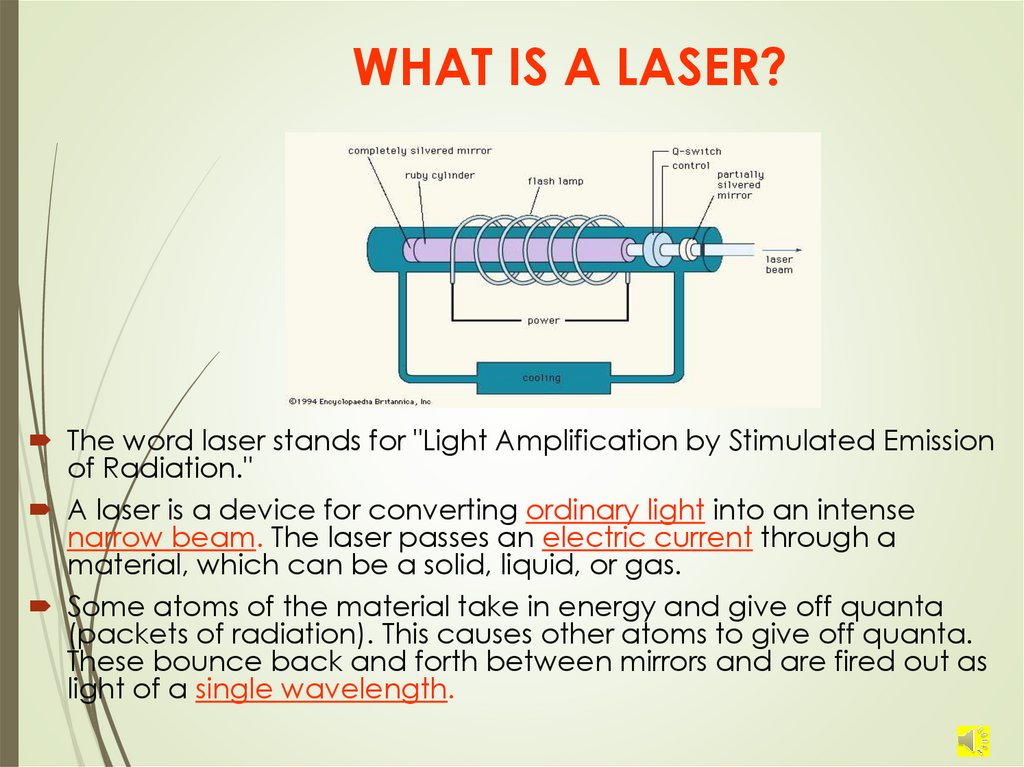
The word laser stands for "Light Amplification by Stimulated Emissionof Radiation."
A laser is a device for converting ordinary light into an intense
narrow beam. The laser passes an electric current through a
material, which can be a solid, liquid, or gas.
Some atoms of the material take in energy and give off quanta
(packets of radiation). This causes other atoms to give off quanta.
These bounce back and forth between mirrors and are fired out as
light of a single wavelength.
11. WHERE DO PEOPLE USE LASERS?
Video12. WHERE DO PEOPLE USE LASERS?
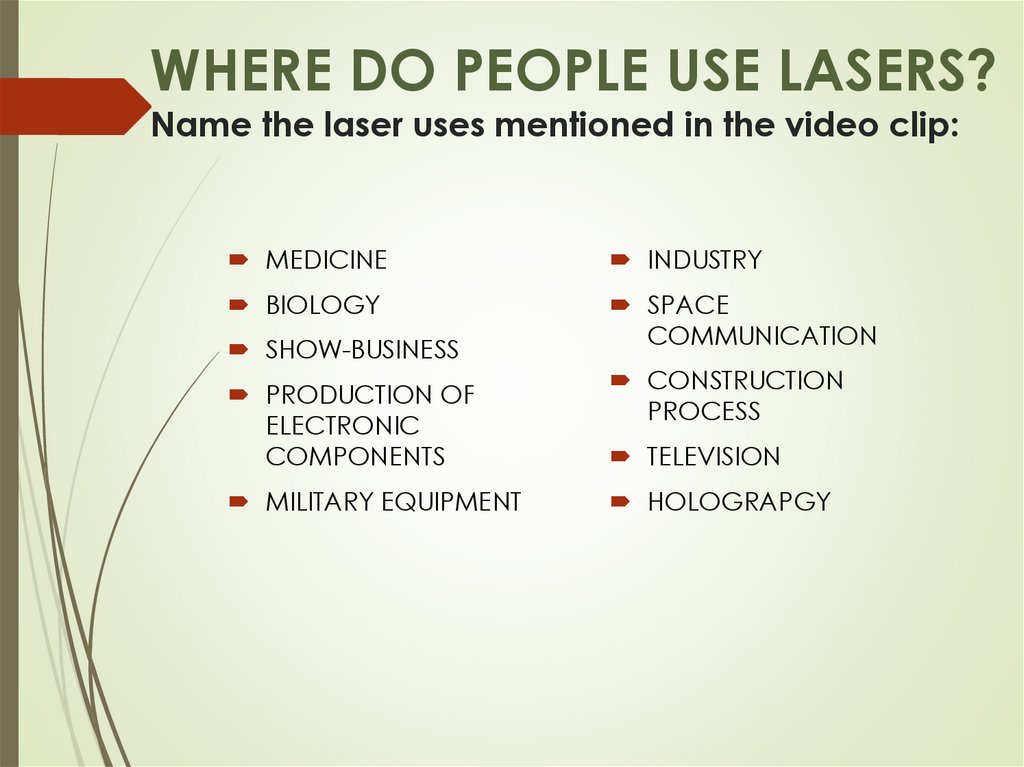
13. WHERE DO PEOPLE USE LASERS? Name the laser uses mentioned in the video clip:
MEDICINEINDUSTRY
BIOLOGY
SPACE
COMMUNICATION
SHOW-BUSINESS
PRODUCTION OF
ELECTRONIC
COMPONENTS
MILITARY EQUIPMENT
CONSTRUCTION
PROCESS
TELEVISION
HOLOGRAPGY
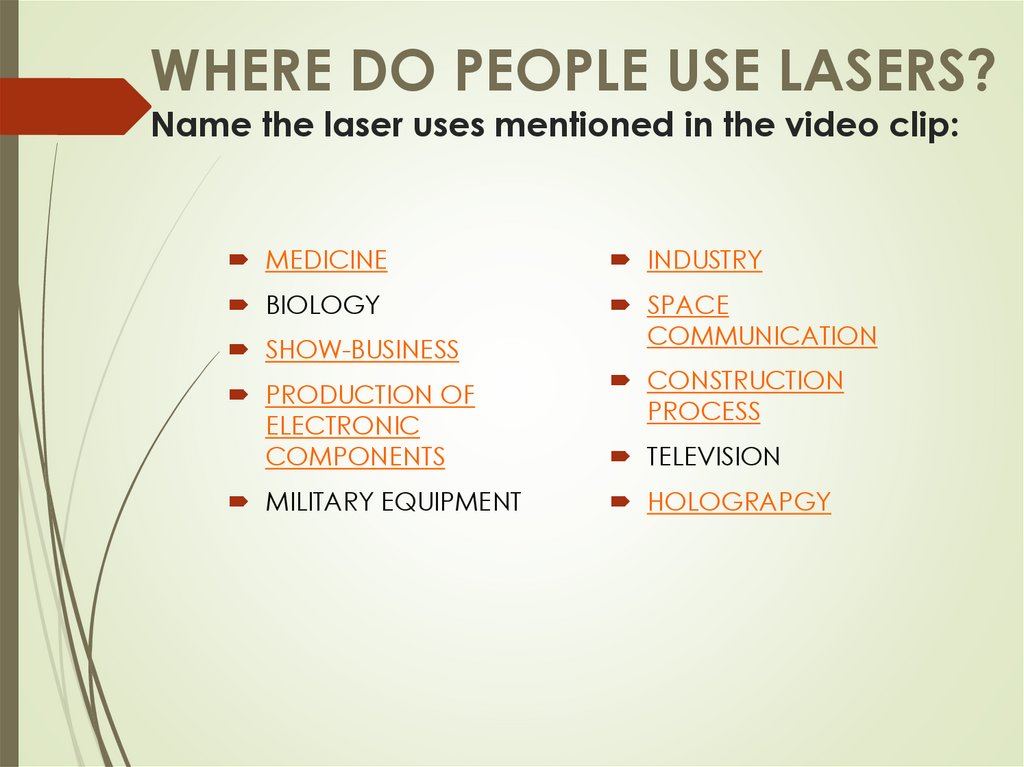
14. WHERE DO PEOPLE USE LASERS? Name the laser uses mentioned in the video clip:
MEDICINEINDUSTRY
BIOLOGY
SPACE
COMMUNICATION
SHOW-BUSINESS
PRODUCTION OF
ELECTRONIC
COMPONENTS
MILITARY EQUIPMENT
CONSTRUCTION
PROCESS
TELEVISION
HOLOGRAPGY
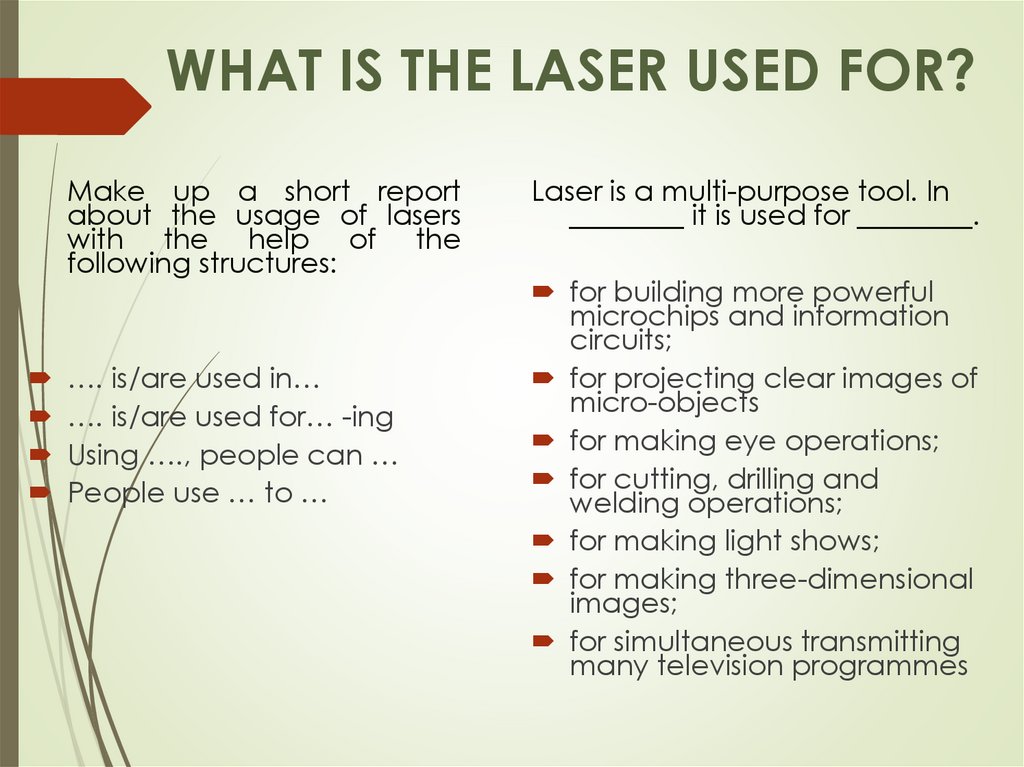
15. WHAT IS THE LASER USED FOR?
Make up a short reportabout the usage of lasers
with the help of the
following structures:
…. is/are used in…
…. is/are used for… -ing
Using …., people can …
People use … to …
Laser is a multi-purpose tool. In
________ it is used for ________.
for building more powerful
microchips and information
circuits;
for projecting clear images of
micro-objects
for making eye operations;
for cutting, drilling and
welding operations;
for making light shows;
for making three-dimensional
images;
for simultaneous transmitting
many television programmes
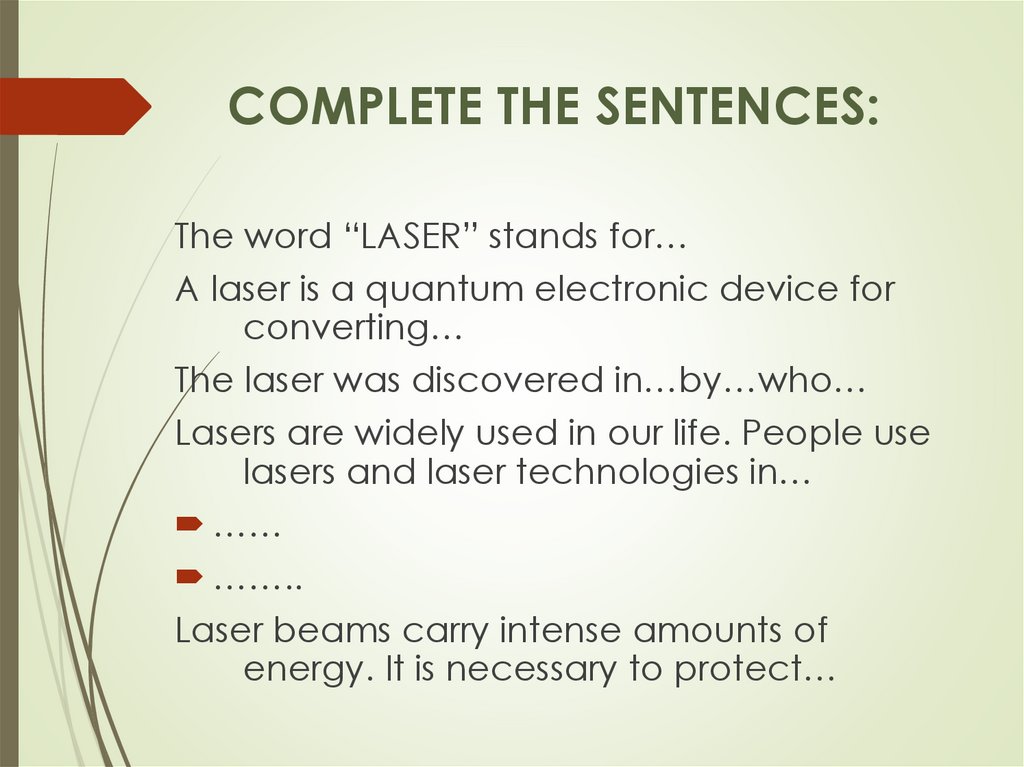
16. COMPLETE THE SENTENCES:
The word “LASER” stands for…A laser is a quantum electronic device for
converting…
The laser was discovered in…by…who…
Lasers are widely used in our life. People use
lasers and laser technologies in…
……
……..
Laser beams carry intense amounts of
energy. It is necessary to protect…
17. HOME ASSIGNMENT:
Make a report about any great inventionof mankind on the basis of this plan:
an invention you consider to be one of
the greatest in the world;
the name of the inventor;
the country this invention was made in;
what the thing was made for;
how it is used now;
how it influenced our life.