
 Лингвистика
Похожие презентации:






Theory of conceptual metonymy and frame semantics
1. LECTURE 7
THEORY OF CONCEPTUAL METONYMY2. Plan
• Introduction• Theory of conceptual metonymy
• Frame semantics
• Conclusion
3. Metonymy
Metonymy as “a figure of speech that consists in usingthe name of one thing for that of something else with
which it is associated” (Webster’s Third New
International Dictionary).
These kinds of definition thus claim that metonymy
operates on names of things, involves the substitution of
the name of one thing for that of another thing and
assumes that the two things are somehow associated.
4. Metonomy in cognitive aspect
(i) Metonymy is a conceptual phenomenon;(ii)Metonymy is a cognitive process;
(iii) Metonymy operates within an idealized cognitive
model.
5. Metonymy is a conceptual phenomenon
As already pointed out by Lakoff and Johnson (1980: Ch. 8),metonymy, like metaphor, is part of our everyday way of
thinking, is grounded in our experience, is subject to general
and systematic principles, and structures our thoughts and
actions.
6.
• Lakoff and Johnson’s example of the metonymy in She’s justa pretty face illustrates the conceptual nature of metonymy.
• We derive the basic information about a person from the
person’s face. The conceptual metonymy THE FACE FOR
THE PERSON is part of our everyday way of thinking about
people.
7. Metonymy is a cognitive process
The traditional view defines metonymy as a relationship involvingsubstitution.
This view is reflected in the notation generally used for stating metonymic
relationships, namely X STANDS FOR Y.
Metonymy does, however, not simply substitute one entity for another entity,
but interrelates them to form a new, complex meaning. To use Warren’s
(1999: 128) example: “We do not refer to music in I like Mozart, but to
music composed by Mozart; we do not refer to water in The bathtub is
running over, but to the water in the bathtub.”
Metonymic relationships should therefore more adequately be represented by
using an additive notation such as X PLUS Y. For the sake of simplicity we
will keep the traditional formula X FOR Y, with the proviso, however, that
the metonymic process is not understood to be one of substitution.
8.
Following Langacker (1993: 30), we will think of metonymyas a cognitive process in which one conceptual entity is
mentally accessed via another entity.
The metonymic entity serves as a “reference point” that affords
mental access to another conceptual entity, the intended target.
We will refer to the reference-point entity as the ‘vehicle’ and
to the intended entity as the ‘target’.
In the example of She’s just a pretty face, the ‘pretty face’
serves as the vehicle for accessing the ‘person’ as the target.
9. Metonymy operates within an idealized cognitive model
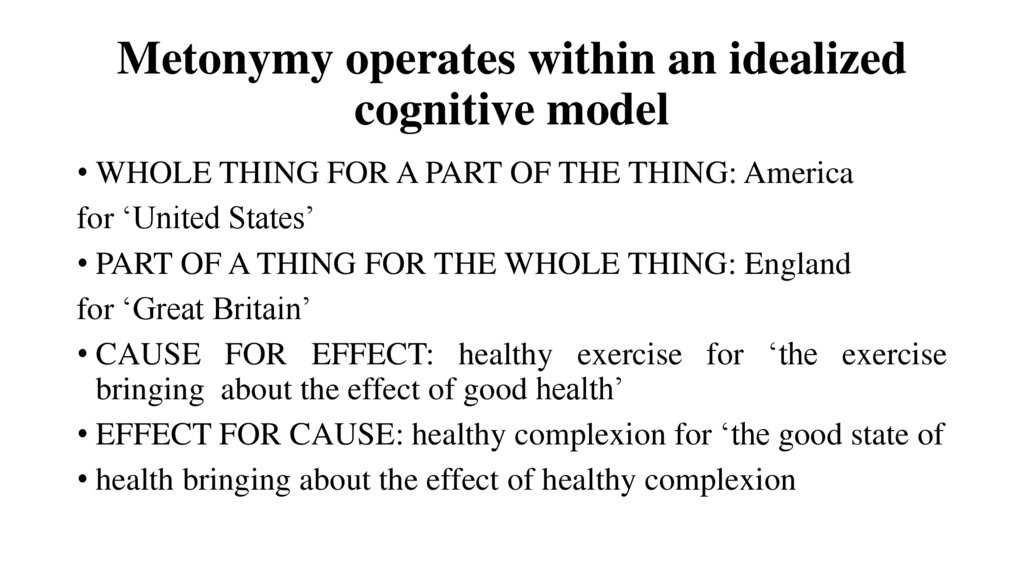
• WHOLE THING FOR A PART OF THE THING: Americafor ‘United States’
• PART OF A THING FOR THE WHOLE THING: England
for ‘Great Britain’
• CAUSE FOR EFFECT: healthy exercise for ‘the exercise
bringing about the effect of good health’
• EFFECT FOR CAUSE: healthy complexion for ‘the good state of
• health bringing about the effect of healthy complexion
10.
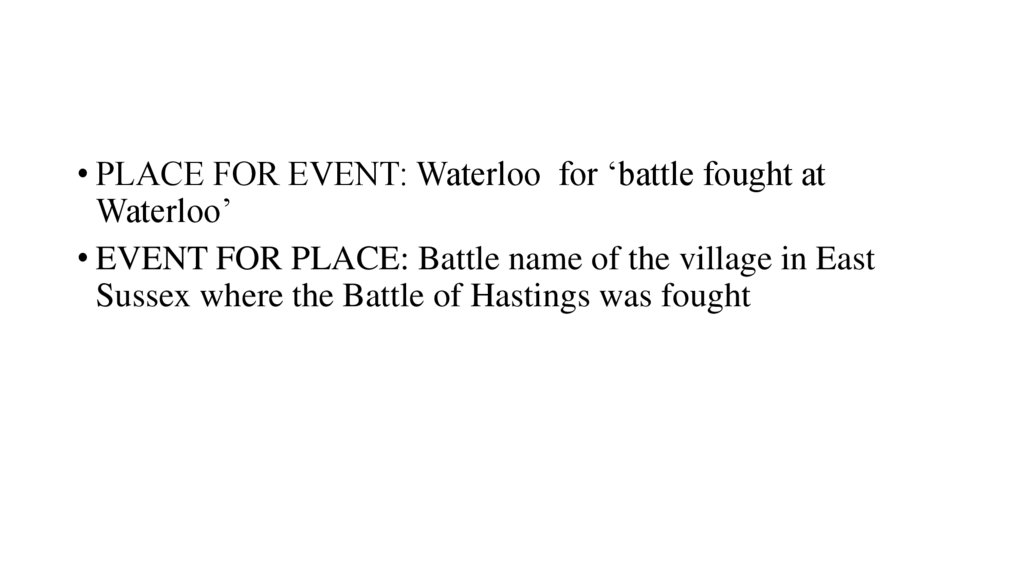
• PLACE FOR EVENT: Waterloo for ‘battle fought atWaterloo’
• EVENT FOR PLACE: Battle name of the village in East
Sussex where the Battle of Hastings was fought
11.
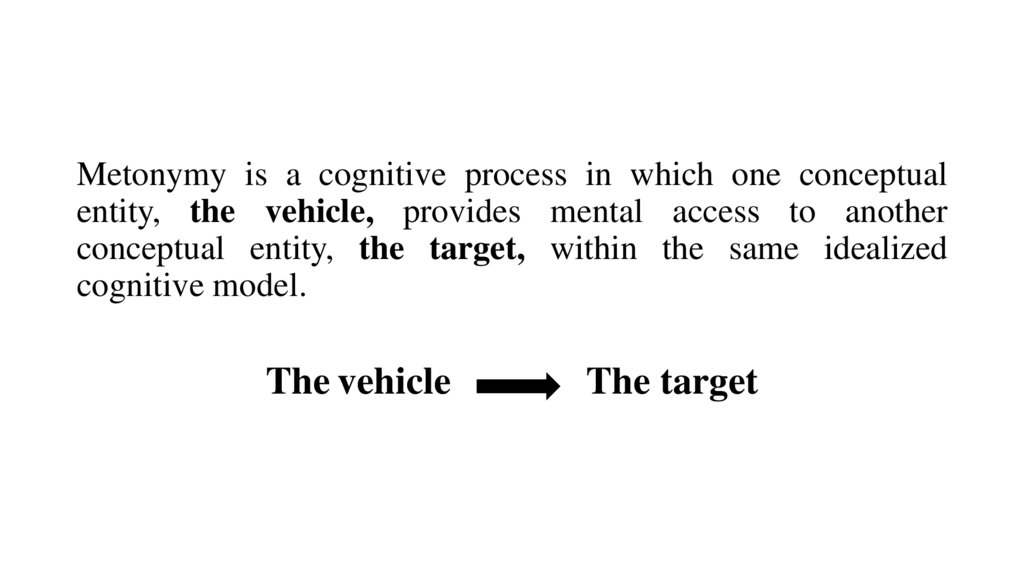
Metonymy is a cognitive process in which one conceptualentity, the vehicle, provides mental access to another
conceptual entity, the target, within the same idealized
cognitive model.
The vehicle
The target
12. Watch the video about conceptual metonomy
• https://www.youtube.com/watch?v=290hCFarmvY13.
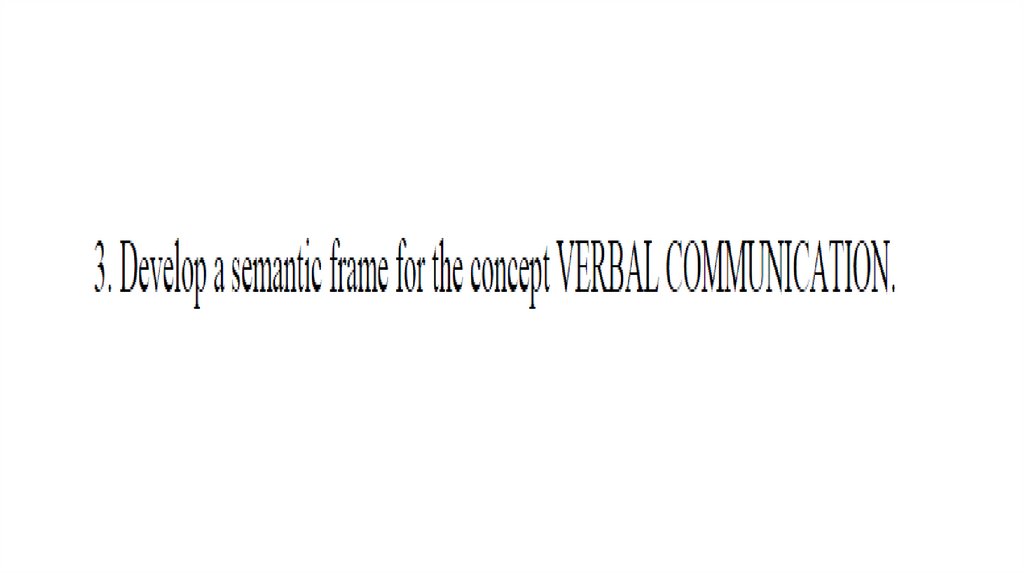
FRAME SEMANTICS14. Frame semantics
The term frame semantics refers to a wide variety of approaches to thesystematic description of natural language meanings. The one common
feature of all these approaches is the following slogan due to Charles
Fillmore (1977a):
• Meanings are relativized to scenes.
According to this slogan meanings have internal structure which is
determined relative to a background frame or a scene. The easiest
way to understand this thesis is by way of example. The following one
is from Fillmore (1977c):
15.
Suppose that two identical twins Mark and Mike are both in a hospitalsitting on the edge of their beds in exactly the same position.
When a nurse walks by Mark’s room, she says:
I see that Mark is able to sit up now,
and when she walks by Mike’s room she remarks:
I see that Mike is able to sit down now.
Drawing on what we know about hospitals – our hospital background
scenes or frames – we will interpret the two remarks of the nurse
rather differently, thereby relativizing the meanings of her remarks to
the relevant scenes.
16.
Another often cited example of Fillmore (1977c) clearly demonstrating theabove thesis is the difference in meaning between the following two
sentences:
(1) I spent three hours on land this afternoon.
(2) I spent three hours on the ground this afternoon.
The background scene for the first sentence is a sea voyage while the second
sentence refers to an interruption of an air travel.
This illustrates Fillmore’s use of the term frame as an idealization of a
coherent individuatable perception, memory, experience, action, or object
.
17. Watch the video
• https://www.youtube.com/watch?v=YNPKgbc41ic18.
19.
The list of recommended literatureБолдырев Н.Н. Когнитивная семантика. Изд.4-е испр. и доп. – Тамбов: Издательский дом ТГУ им. Г.Р. Державина, 2014. – 236 с.
Болдырев Н.Н. Язык и система знаний: Когнитивная теория языка. – М.: Издательский Дом ЯСК, 2019. – 480 с.
Корнилов О.А. Языковые картины мира как производные национальных менталитетов.- М.: ЧеРо, 2003, 349 с.
Маслова В.А. Введение в когнитивную лингвистику. –М.: Флинта: Наука, 2004. – 294 с.
Additional literature:
Croft William, Cruse Alan D. Cognitive Linguistics/ New York : Cambridge University Press, 2004. Cognitive Linguistics: Basic Readings Edited by Dirk
Geeraerts Mouton de Gruyter Berlin, New York – 2006 . – 496 с
Cognitive Linguistics: Current Applications and Future Perspectives. Edited by Dirk Geeraerts.- Mouton de Gruyter Berlin · New York – 2006 . – 513 p.
Скребцова Т. Г. Когнитивная лингвистика: Курс лекций. — СПб.:Филологический факультет СПбГУ, 2011. — 256 с.
Коннова М. Н. Введение в когнитивную лингвистику : учебное пособие. Изд. 2-е, перераб. — Калининград : Изд-во БФУим. И. Канта, 2012. —
313 с.
Дзюба Е. В. Когнитивная лингвистика. – Екатеринбург, 2018. – 280 с.
https://articlekz.com/article/12236
https://ulagat.com/2020/11/27/%D0%BA%D0%BB%D1%8E%D1%87%D0%B5%D0%B2%D1%8B%D0%B5%D0%BF%D0%BE%D0%BD%D1%8F%D1%82%D0%B8%D1%8F%D0%BB%D0%B8%D0%BD%D0%B3%D0%B2%D0%BE%D0%BA%D0%BE%D0%BD%D1%86%D0%B5%D0%BF%D1%82%D0%BE%D0%BB%D0%BE%D0%B
3%D0%B8/
https://dereksiz.org/alimjanova-g-m-sopostavitelenaya-lingvokuleturologiya.html?page=7