 Культурология
Похожие презентации:



10 Most Famous Places in St. Petersburg
1. The 10 Most Famous Places in St. Petersburg
Work by student of 01.25.СИСА.ОФ11 Maxim Sarsatsky2. #10 Nevsky Prospekt
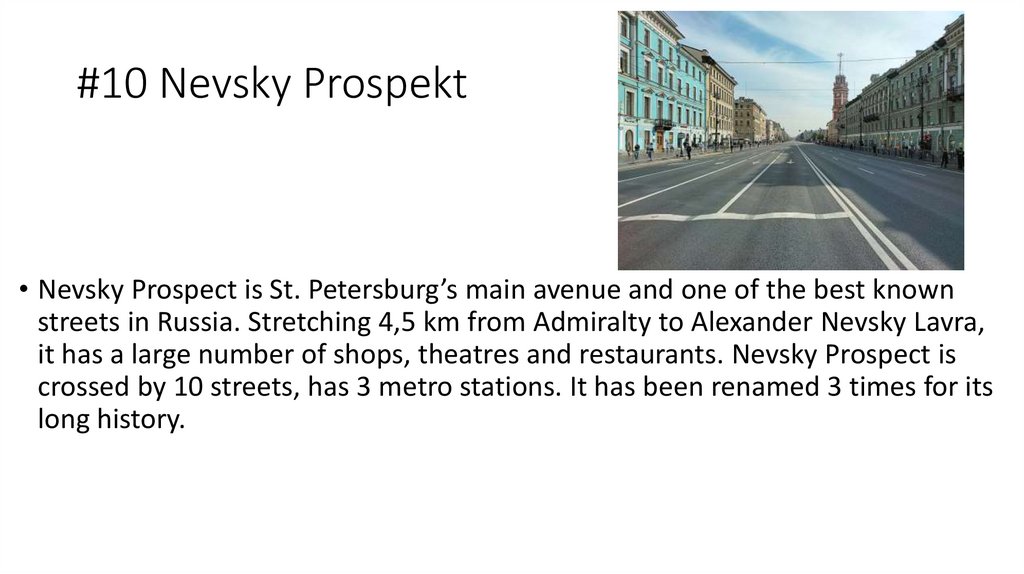
• Nevsky Prospect is St. Petersburg’s main avenue and one of the best knownstreets in Russia. Stretching 4,5 km from Admiralty to Alexander Nevsky Lavra,
it has a large number of shops, theatres and restaurants. Nevsky Prospect is
crossed by 10 streets, has 3 metro stations. It has been renamed 3 times for its
long history.
3. #9 Mikhailovsky Castle
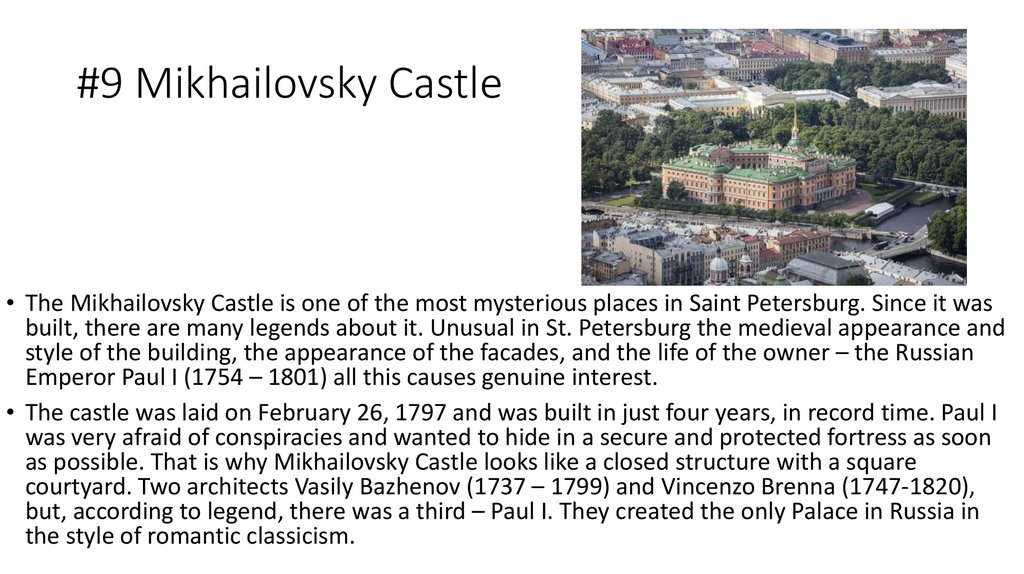
• The Mikhailovsky Castle is one of the most mysterious places in Saint Petersburg. Since it wasbuilt, there are many legends about it. Unusual in St. Petersburg the medieval appearance and
style of the building, the appearance of the facades, and the life of the owner – the Russian
Emperor Paul I (1754 – 1801) all this causes genuine interest.
• The castle was laid on February 26, 1797 and was built in just four years, in record time. Paul I
was very afraid of conspiracies and wanted to hide in a secure and protected fortress as soon
as possible. That is why Mikhailovsky Castle looks like a closed structure with a square
courtyard. Two architects Vasily Bazhenov (1737 – 1799) and Vincenzo Brenna (1747-1820),
but, according to legend, there was a third – Paul I. They created the only Palace in Russia in
the style of romantic classicism.
4. #8 Catherine Palace
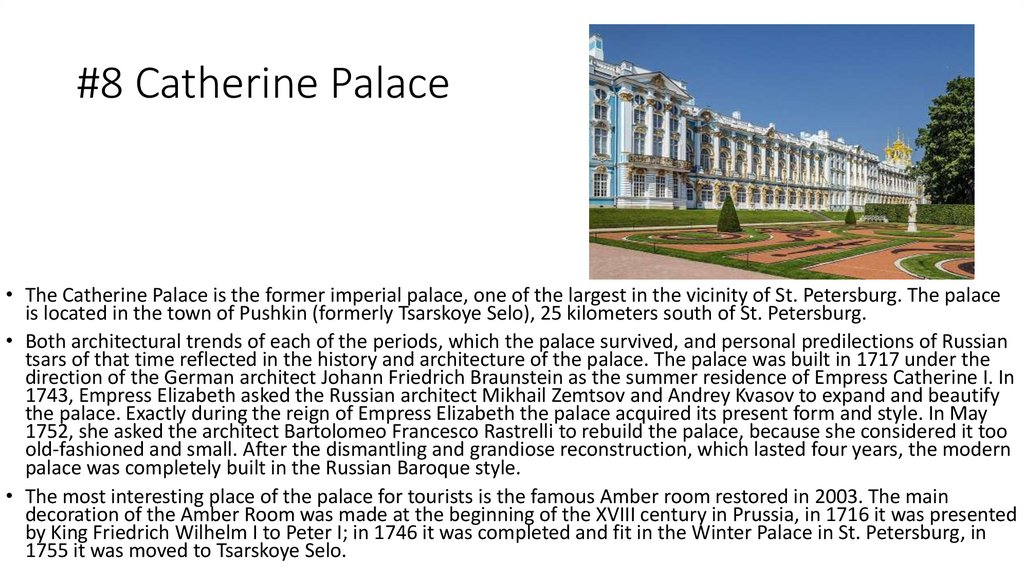
• The Catherine Palace is the former imperial palace, one of the largest in the vicinity of St. Petersburg. The palaceis located in the town of Pushkin (formerly Tsarskoye Selo), 25 kilometers south of St. Petersburg.
• Both architectural trends of each of the periods, which the palace survived, and personal predilections of Russian
tsars of that time reflected in the history and architecture of the palace. The palace was built in 1717 under the
direction of the German architect Johann Friedrich Braunstein as the summer residence of Empress Catherine I. In
1743, Empress Elizabeth asked the Russian architect Mikhail Zemtsov and Andrey Kvasov to expand and beautify
the palace. Exactly during the reign of Empress Elizabeth the palace acquired its present form and style. In May
1752, she asked the architect Bartolomeo Francesco Rastrelli to rebuild the palace, because she considered it too
old-fashioned and small. After the dismantling and grandiose reconstruction, which lasted four years, the modern
palace was completely built in the Russian Baroque style.
• The most interesting place of the palace for tourists is the famous Amber room restored in 2003. The main
decoration of the Amber Room was made at the beginning of the XVIII century in Prussia, in 1716 it was presented
by King Friedrich Wilhelm I to Peter I; in 1746 it was completed and fit in the Winter Palace in St. Petersburg, in
1755 it was moved to Tsarskoye Selo.
5. #7 Volkovskoe Cemetery and Writers Footways
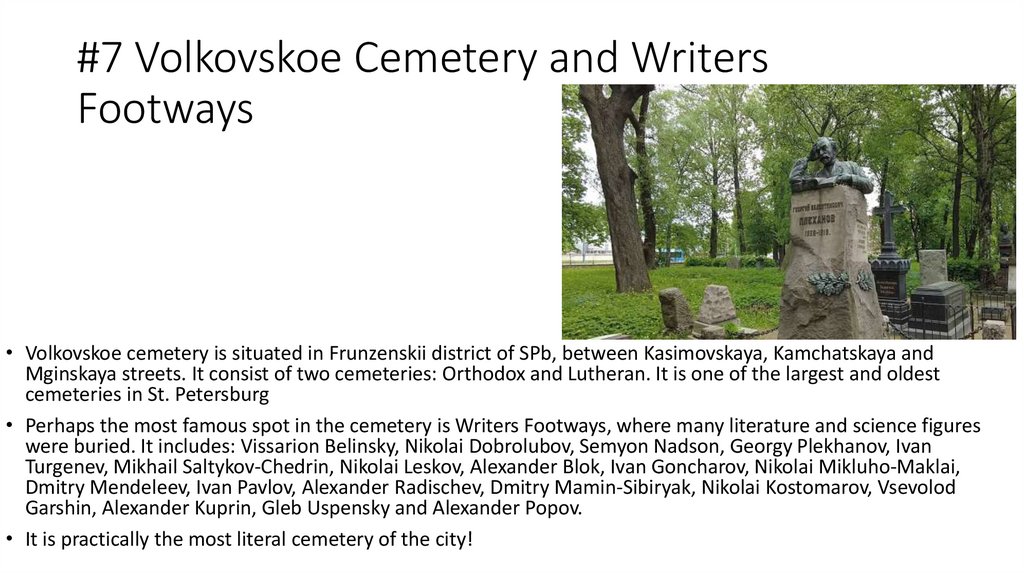
• Volkovskoe cemetery is situated in Frunzenskii district of SPb, between Kasimovskaya, Kamchatskaya andMginskaya streets. It consist of two cemeteries: Orthodox and Lutheran. It is one of the largest and oldest
cemeteries in St. Petersburg
• Perhaps the most famous spot in the cemetery is Writers Footways, where many literature and science figures
were buried. It includes: Vissarion Belinsky, Nikolai Dobrolubov, Semyon Nadson, Georgy Plekhanov, Ivan
Turgenev, Mikhail Saltykov-Chedrin, Nikolai Leskov, Alexander Blok, Ivan Goncharov, Nikolai Mikluho-Maklai,
Dmitry Mendeleev, Ivan Pavlov, Alexander Radischev, Dmitry Mamin-Sibiryak, Nikolai Kostomarov, Vsevolod
Garshin, Alexander Kuprin, Gleb Uspensky and Alexander Popov.
• It is practically the most literal cemetery of the city!
6. #6 Kazan Cathedral
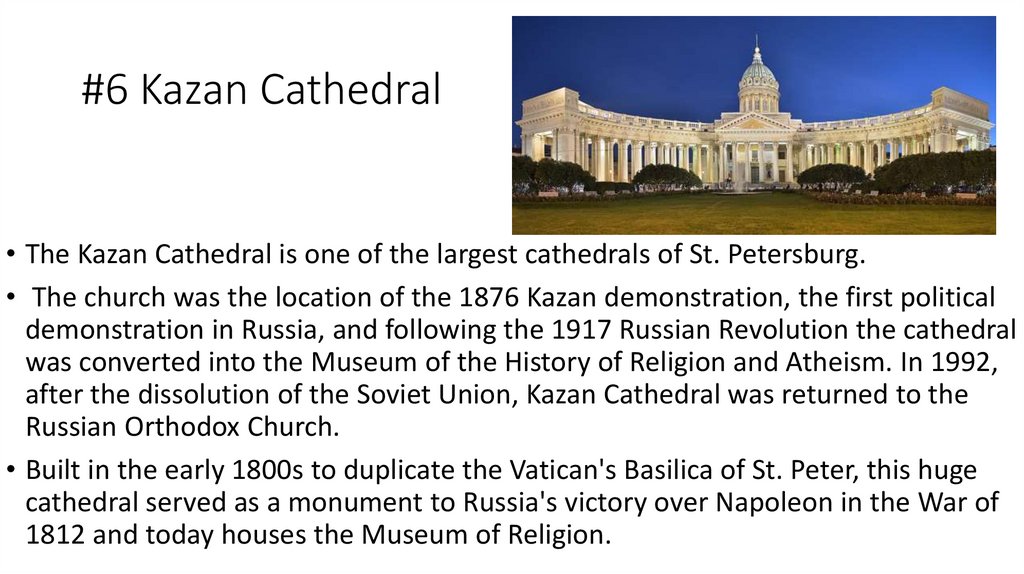
• The Kazan Cathedral is one of the largest cathedrals of St. Petersburg.• The church was the location of the 1876 Kazan demonstration, the first political
demonstration in Russia, and following the 1917 Russian Revolution the cathedral
was converted into the Museum of the History of Religion and Atheism. In 1992,
after the dissolution of the Soviet Union, Kazan Cathedral was returned to the
Russian Orthodox Church.
• Built in the early 1800s to duplicate the Vatican's Basilica of St. Peter, this huge
cathedral served as a monument to Russia's victory over Napoleon in the War of
1812 and today houses the Museum of Religion.
7. #5 Peter and Paul Fortress
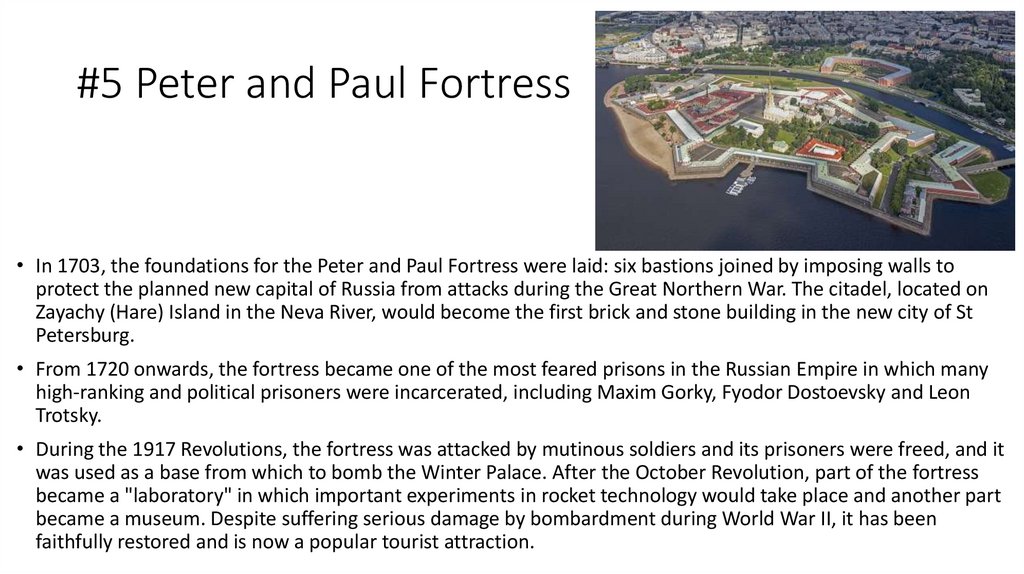
• In 1703, the foundations for the Peter and Paul Fortress were laid: six bastions joined by imposing walls toprotect the planned new capital of Russia from attacks during the Great Northern War. The citadel, located on
Zayachy (Hare) Island in the Neva River, would become the first brick and stone building in the new city of St
Petersburg.
• From 1720 onwards, the fortress became one of the most feared prisons in the Russian Empire in which many
high-ranking and political prisoners were incarcerated, including Maxim Gorky, Fyodor Dostoevsky and Leon
Trotsky.
• During the 1917 Revolutions, the fortress was attacked by mutinous soldiers and its prisoners were freed, and it
was used as a base from which to bomb the Winter Palace. After the October Revolution, part of the fortress
became a "laboratory" in which important experiments in rocket technology would take place and another part
became a museum. Despite suffering serious damage by bombardment during World War II, it has been
faithfully restored and is now a popular tourist attraction.
8. #4 Bronze Horseman
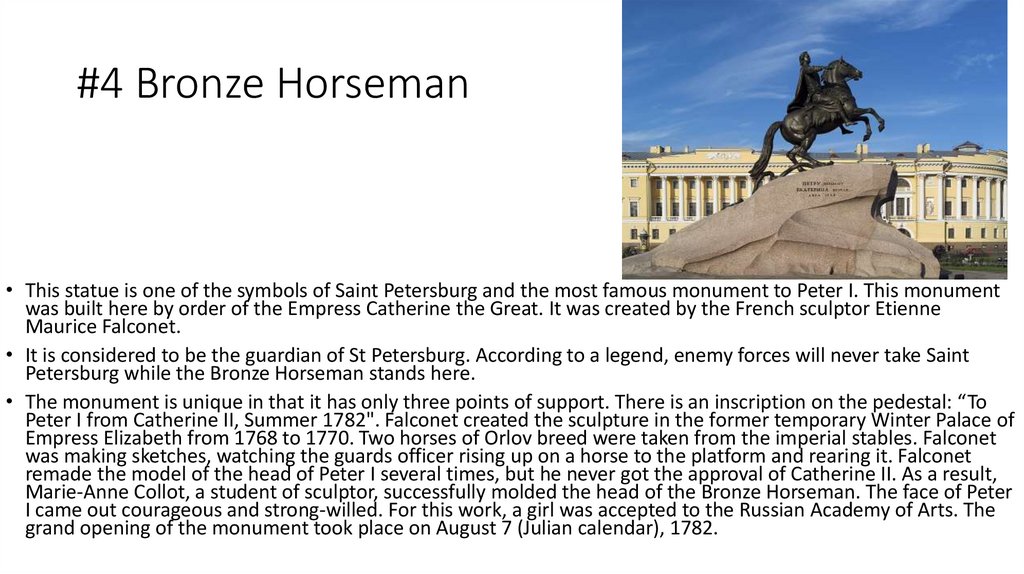
• This statue is one of the symbols of Saint Petersburg and the most famous monument to Peter I. This monumentwas built here by order of the Empress Catherine the Great. It was created by the French sculptor Etienne
Maurice Falconet.
• It is considered to be the guardian of St Petersburg. According to a legend, enemy forces will never take Saint
Petersburg while the Bronze Horseman stands here.
• The monument is unique in that it has only three points of support. There is an inscription on the pedestal: “To
Peter I from Catherine II, Summer 1782". Falconet created the sculpture in the former temporary Winter Palace of
Empress Elizabeth from 1768 to 1770. Two horses of Orlov breed were taken from the imperial stables. Falconet
was making sketches, watching the guards officer rising up on a horse to the platform and rearing it. Falconet
remade the model of the head of Peter I several times, but he never got the approval of Catherine II. As a result,
Marie-Anne Collot, a student of sculptor, successfully molded the head of the Bronze Horseman. The face of Peter
I came out courageous and strong-willed. For this work, a girl was accepted to the Russian Academy of Arts. The
grand opening of the monument took place on August 7 (Julian calendar), 1782.
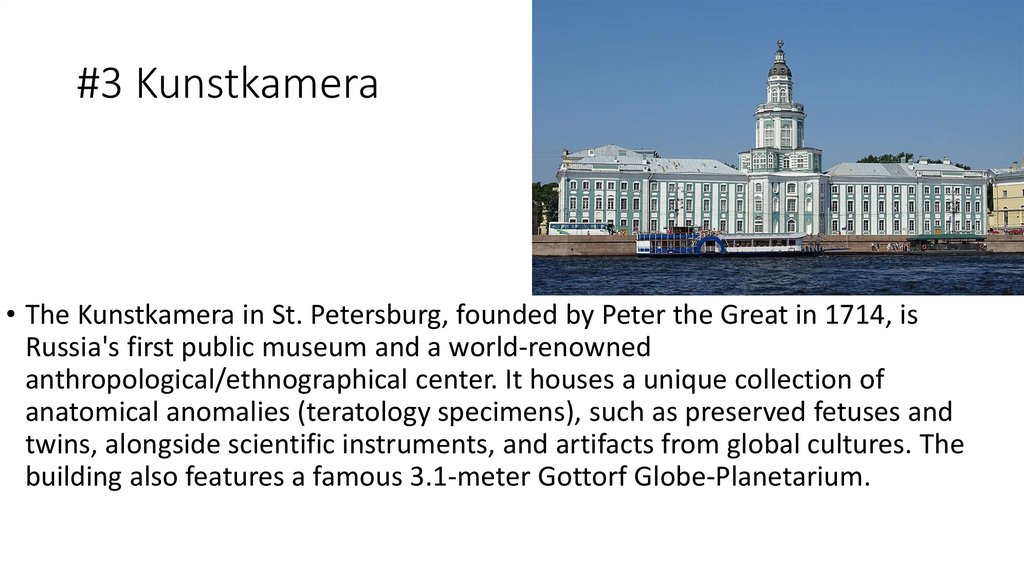
9. #3 Kunstkamera
• The Kunstkamera in St. Petersburg, founded by Peter the Great in 1714, isRussia's first public museum and a world-renowned
anthropological/ethnographical center. It houses a unique collection of
anatomical anomalies (teratology specimens), such as preserved fetuses and
twins, alongside scientific instruments, and artifacts from global cultures. The
building also features a famous 3.1-meter Gottorf Globe-Planetarium.
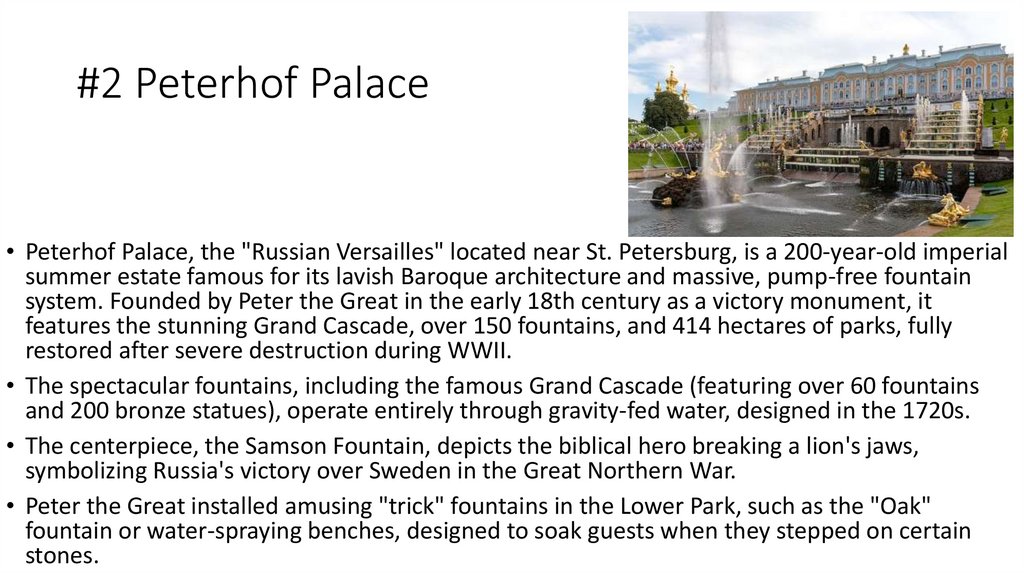
10. #2 Peterhof Palace
• Peterhof Palace, the "Russian Versailles" located near St. Petersburg, is a 200-year-old imperialsummer estate famous for its lavish Baroque architecture and massive, pump-free fountain
system. Founded by Peter the Great in the early 18th century as a victory monument, it
features the stunning Grand Cascade, over 150 fountains, and 414 hectares of parks, fully
restored after severe destruction during WWII.
• The spectacular fountains, including the famous Grand Cascade (featuring over 60 fountains
and 200 bronze statues), operate entirely through gravity-fed water, designed in the 1720s.
• The centerpiece, the Samson Fountain, depicts the biblical hero breaking a lion's jaws,
symbolizing Russia's victory over Sweden in the Great Northern War.
• Peter the Great installed amusing "trick" fountains in the Lower Park, such as the "Oak"
fountain or water-spraying benches, designed to soak guests when they stepped on certain
stones.
11. Honorable mentions
• St. Isaac’s Cathedral• Mariinsky Theatre
• Russkiy Museum
• Palace Square
• Alexandrovsky Park
• Tikhvin and Nikolskoye Cemeteries
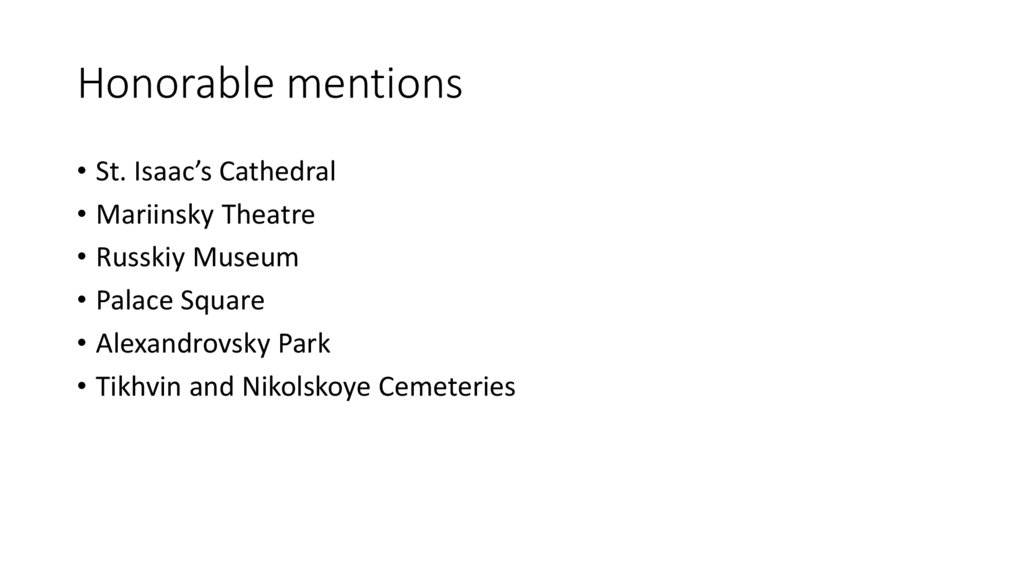
12. #1 Hermitage
• One of the most famous art museums in the world, this museum is housed in theWinter Palace, and contains over 2.7 million exhibits including some of the
world's greatest works of art and is the second largest art museum in the world.
• It served as official residence of the Romanov dynasty from 1732 to 1917. After
the Russian Revolution of 1917, the palace served as the seat of the Russian
Provisional Government led by Kerensky.
• The Hermitage is the legal home for more than 50 cats. This cat population traces
its history from the 18th century when people needed to protect the residence
from mice and rats. Today, it is believed that the Hermitage cats still take care of
the masterpieces of art.
• The air conditions are used in the Hermitage from the year 1912; they worked
more like the air humidifiers but it was still a progressive idea of that time.