Похожие презентации:



Belarus
1.
BelarusA Journey Through Eastern Europe
2.
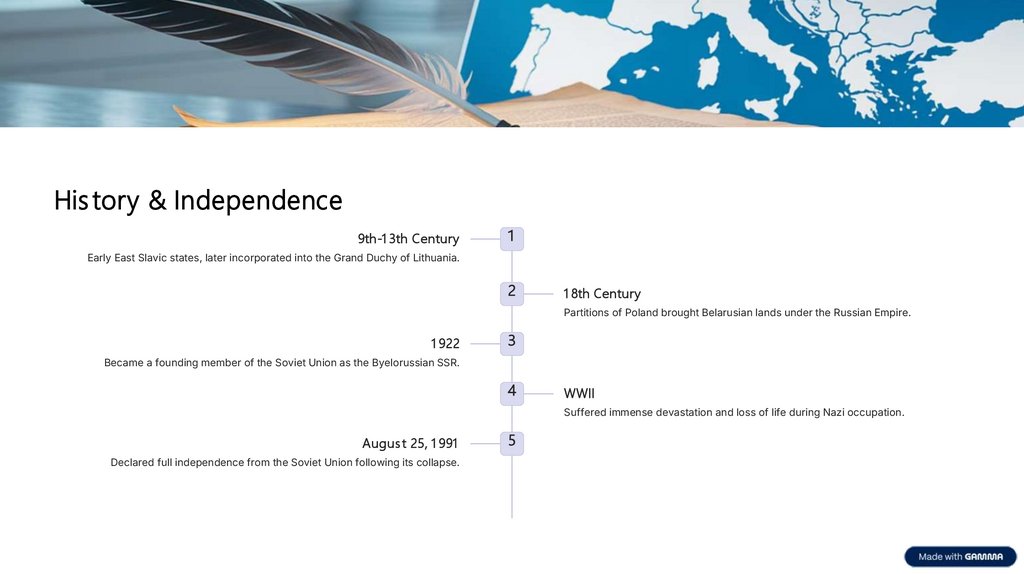
His tory & Independence9th-1 3th Century
1
Early East Slavic states, later incorporated into the Grand Duchy of Lithuania.
2
1 8th Century
Partitions of Poland brought Belarusian lands under the Russian Empire.
1 922
3
Became a founding member of the Soviet Union as the Byelorussian SSR.
4
WWII
Suffered immense devastation and loss of life during Nazi occupation.
Augus t 25, 1 991
Declared full independence from the Soviet Union following its collapse.
5
3.
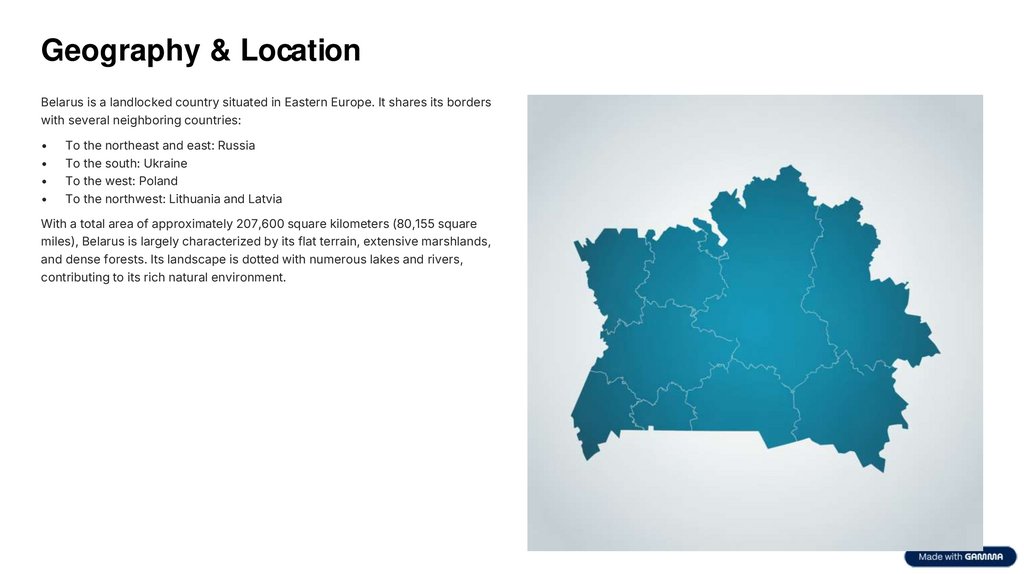
Geography & LocationBelarus is a landlocked country situated in Eastern Europe. It shares its borders
with several neighboring countries:
To the northeast and east: Russia
To the south: Ukraine
To the west: Poland
To the northwest: Lithuania and Latvia
With a total area of approximately 207,600 square kilometers (80,155 square
miles), Belarus is largely characterized by its flat terrain, extensive marshlands,
and dense forests. Its landscape is dotted with numerous lakes and rivers,
contributing to its rich natural environment.
4.
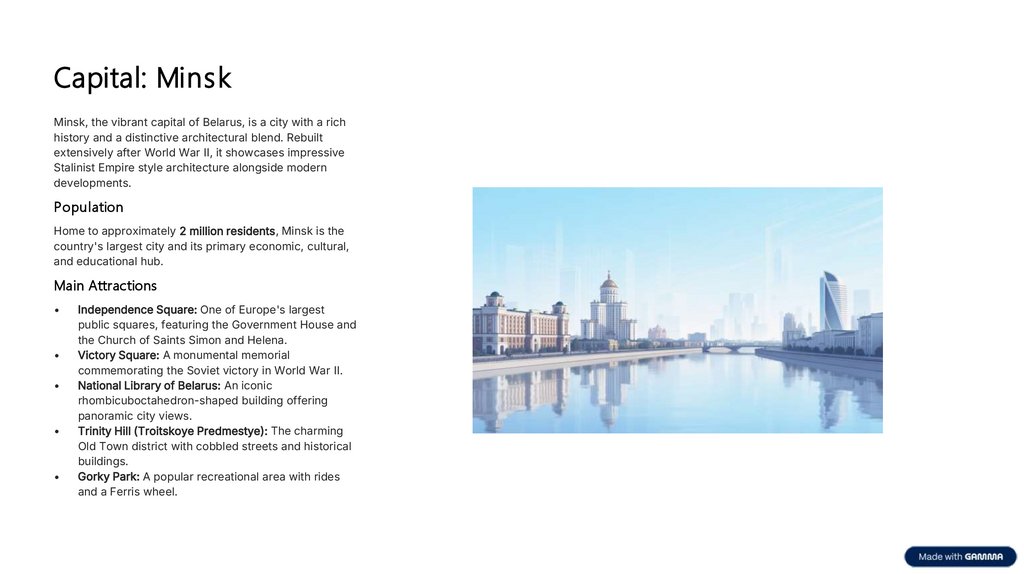
Capital: Mins kMinsk, the vibrant capital of Belarus, is a city with a rich
history and a distinctive architectural blend. Rebuilt
extensively after World War II, it showcases impressive
Stalinist Empire style architecture alongside modern
developments.
Population
Home to approximately 2 million residents, Minsk is the
country's largest city and its primary economic, cultural,
and educational hub.
Main Attractions
Independence Square: One of Europe's largest
public squares, featuring the Government House and
the Church of Saints Simon and Helena.
Victory Square: A monumental memorial
commemorating the Soviet victory in World War II.
National Library of Belarus: An iconic
rhombicuboctahedron-shaped building offering
panoramic city views.
Trinity Hill (Troitskoye Predmestye): The charming
Old Town district with cobbled streets and historical
buildings.
Gorky Park: A popular recreational area with rides
and a Ferris wheel.
5.
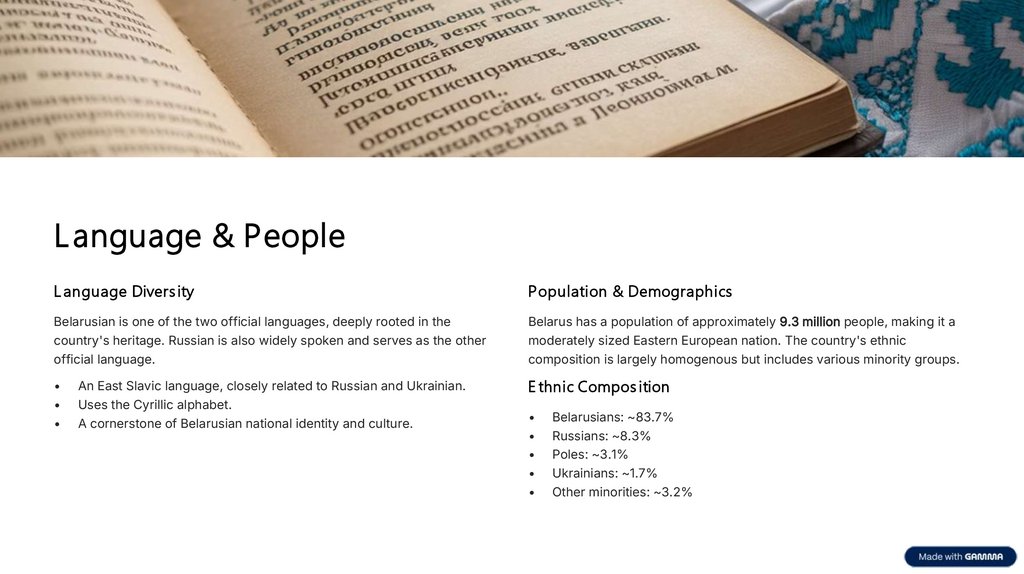
L anguage & PeopleL anguage Divers ity
Population & Demographics
Belarusian is one of the two official languages, deeply rooted in the
country's heritage. Russian is also widely spoken and serves as the other
official language.
Belarus has a population of approximately 9.3 million people, making it a
moderately sized Eastern European nation. The country's ethnic
composition is largely homogenous but includes various minority groups.
E thnic Compos ition
An East Slavic language, closely related to Russian and Ukrainian.
Uses the Cyrillic alphabet.
A cornerstone of Belarusian national identity and culture.
Belarusians: ~83.7%
Russians: ~8.3%
Poles: ~3.1%
Ukrainians: ~1.7%
Other minorities: ~3.2%
6.
Nature & EnvironmentBelarus boasts a diverse natural landscape, characterized by vast forests, intricate river systems, and unique
wetlands. The country is dedicated to preserving its rich biodiversity through numerous national parks and
protected areas.
Forests & Waters
Over 40% of Belarus is covered by forests, primarily coniferous and mixed. The landscape is also
dotted with more than 10,000 lakes and numerous rivers like the Dnieper, Berezina, and Pripyat,
forming vital ecosystems.
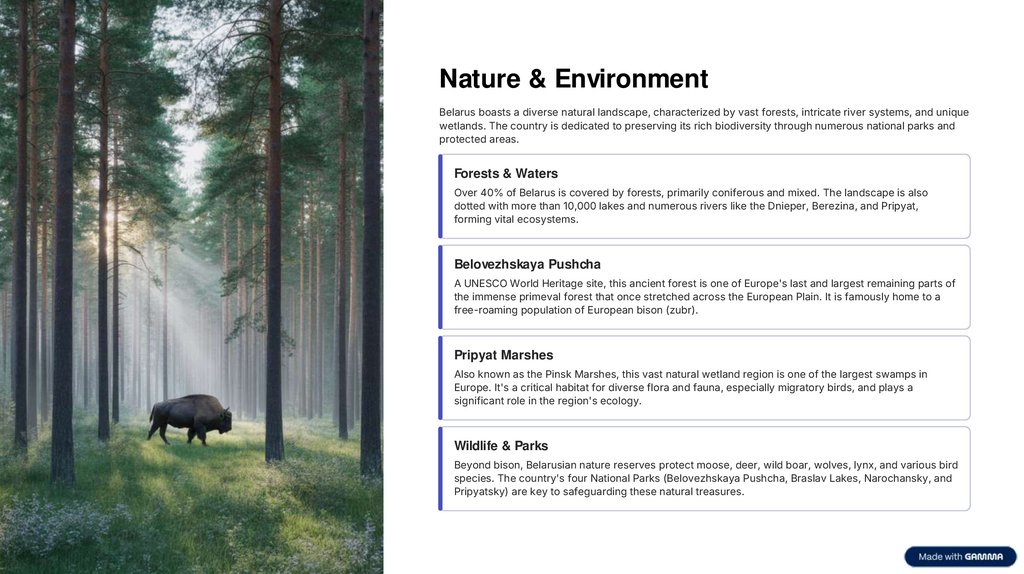
Belovezhskaya Pushcha
A UNESCO World Heritage site, this ancient forest is one of Europe's last and largest remaining parts of
the immense primeval forest that once stretched across the European Plain. It is famously home to a
free-roaming population of European bison (zubr).
Pripyat Marshes
Also known as the Pinsk Marshes, this vast natural wetland region is one of the largest swamps in
Europe. It's a critical habitat for diverse flora and fauna, especially migratory birds, and plays a
significant role in the region's ecology.
Wildlife & Parks
Beyond bison, Belarusian nature reserves protect moose, deer, wild boar, wolves, lynx, and various bird
species. The country's four National Parks (Belovezhskaya Pushcha, Braslav Lakes, Narochansky, and
Pripyatsky) are key to safeguarding these natural treasures.
7.
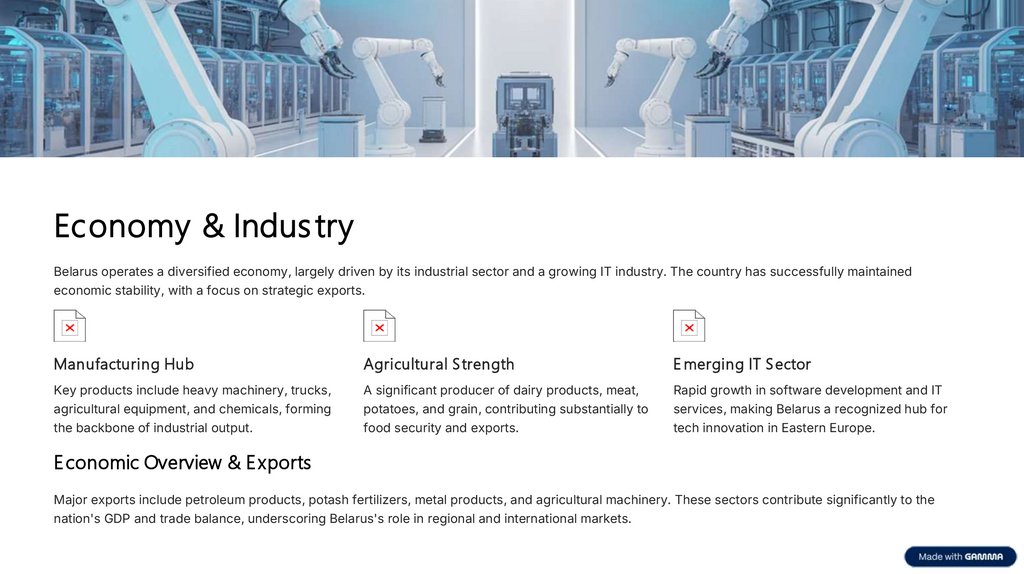
Economy & Indus tryBelarus operates a diversified economy, largely driven by its industrial sector and a growing IT industry. The country has successfully maintained
economic stability, with a focus on strategic exports.
Manufacturing Hub
Agricultural Strength
E merging IT Sector
Key products include heavy machinery, trucks,
agricultural equipment, and chemicals, forming
the backbone of industrial output.
A significant producer of dairy products, meat,
potatoes, and grain, contributing substantially to
food security and exports.
Rapid growth in software development and IT
services, making Belarus a recognized hub for
tech innovation in Eastern Europe.
E conomic Overview & E xports
Major exports include petroleum products, potash fertilizers, metal products, and agricultural machinery. These sectors contribute significantly to the
nation's GDP and trade balance, underscoring Belarus's role in regional and international markets.
8.
Touris m & AttractionsBelarus offers a wealth of historical, cultural, and natural sites, drawing visitors to its ancient castles, solemn memorials,
and beautiful landscapes.
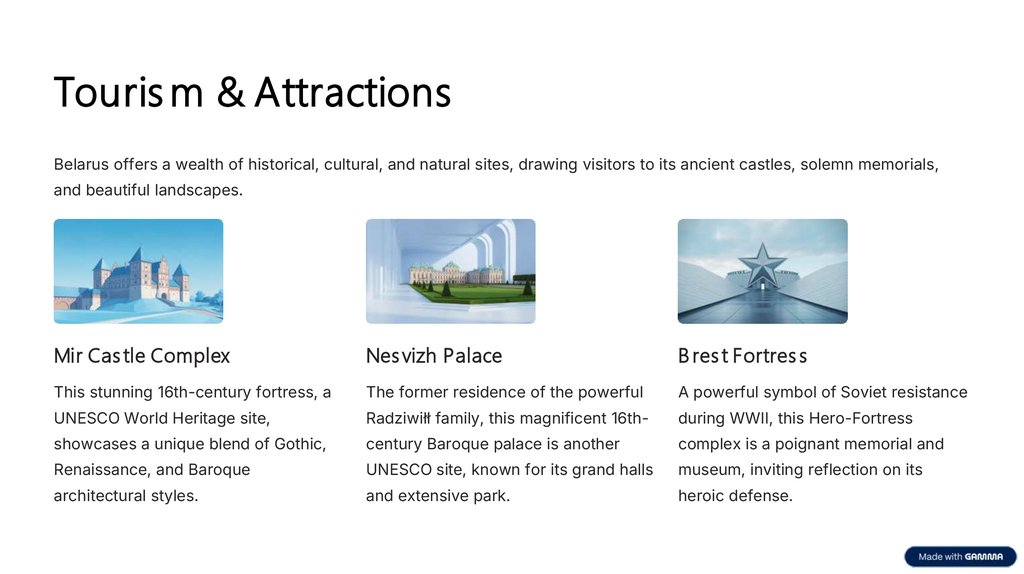
Mir Cas tle Complex
Nes vizh Palace
B res t Fortres s
This stunning 16th-century fortress, a
The former residence of the powerful
A powerful symbol of Soviet resistance
UNESCO World Heritage site,
Radziwiłł family, this magnificent 16th-
during WWII, this Hero-Fortress
showcases a unique blend of Gothic,
century Baroque palace is another
complex is a poignant memorial and
Renaissance, and Baroque
UNESCO site, known for its grand halls
museum, inviting reflection on its
architectural styles.
and extensive park.
heroic defense.
9.
Culture & TraditionsFolk Attire & Customs
Traditional Crafts
Music & Dance
Festivals & Celebrations
Belarusian folk culture is rich
Handicrafts like straw weaving,
Folk music and dance are
Belarus celebrates numerous
with traditions. Traditional
pottery, and wood carving are
vibrant aspects of Belarusian
traditional festivals. Kupala
clothing often features intricate
integral to Belarusian heritage.
culture. Traditional instruments
Night, marking the summer
embroidery, especially on linen
Skilled artisans create beautiful,
like the cymbals (tsymbaly) and
solstice, involves bonfires,
shirts and dresses, reflecting
functional items, passing down
dulcimer accompany lively
flower wreaths, and ancient
regional patterns and
techniques through
dances, telling stories of daily
rituals. Dazhynki (harvest
symbolism. Customs are deeply
generations. Embroidery
life, love, and nature. Choral
festival) and Kalyady (winter
rooted in agrarian life and
remains a prominent art, often
singing is also a cherished
solstice) are also important,
ancient Slavic beliefs.
seen on textiles for homes and
tradition.
showcasing community spirit
celebrations.
and age-old customs.
10.
Modern B elarus & FuturePost-independence, Belarus has embarked on a path of development, focusing on its human capital
and strategic positioning to forge a modern identity and promising future.
Sus tained Development
Since gaining independence, Belarus has steadily invested in infrastructure and key industries.
Modern cities, efficient transport networks, and a focus on economic stability mark its recent
growth trajectory.
Strong E ducation Sys tem
The country boasts a high literacy rate and a well-regarded education system, particularly in
technical and scientific fields. This commitment to learning fosters a skilled workforce ready
for future challenges.
Technological Advancement
Belarus has seen a significant rise in its IT sector, becoming a notable Eastern European hub
for software development and innovation. This focus on technology is a cornerstone of its
modern economy.
Future Pros pects
Leveraging its strategic location, educated population, and growing tech industry, Belarus aims
to continue its development in high-tech sectors, sustainable practices, and international
partnerships.