


 Социология
Похожие презентации:









Social Media in the Lives of Young People: Uniting or Developing Digital Addiction?
1.
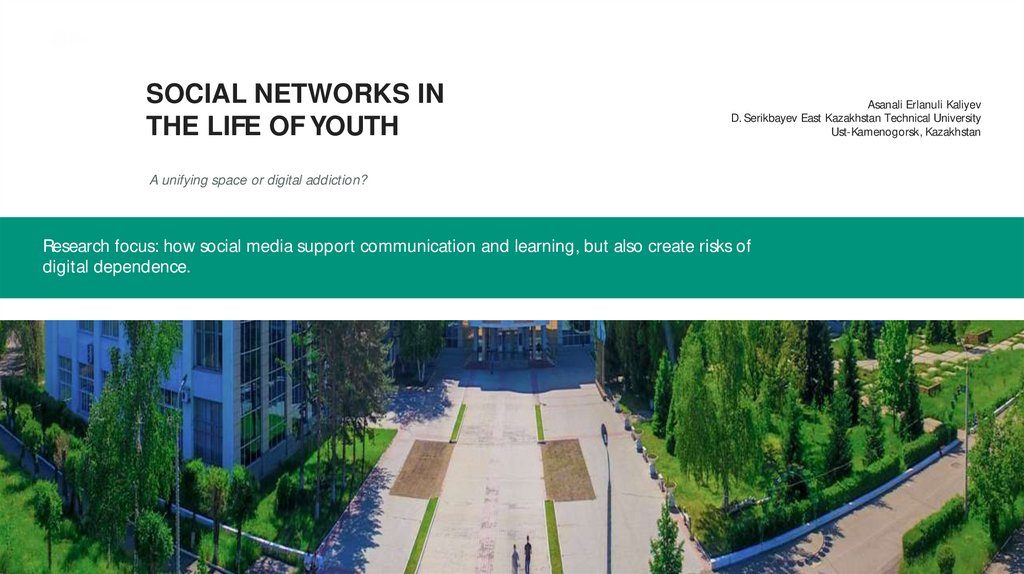
SOCIAL NETWORKS INTHE LIFE OF YOUTH
Asanali Erlanuli Kaliyev
D. Serikbayev East Kazakhstan Technical University
Ust-Kamenogorsk, Kazakhstan
A unifying space or digital addiction?
Research focus: how social media support communication and learning, but also create risks of
digital dependence.
2.
Digital communication is now part of daily youth lifeWhy this topic matters
Context and research problem
Social networks influence not only communication, but also
study habits, entertainment, self-image, and emotional wellbeing.
• Young people use social media every day for news, study, and
contact with others.
• These platforms create fast access to information and
communities.
• At the same time, long screen time can replace real-life
interaction.
Main question: do social networks unite young people, or do
they gradually lead to digital addiction?
2
3.
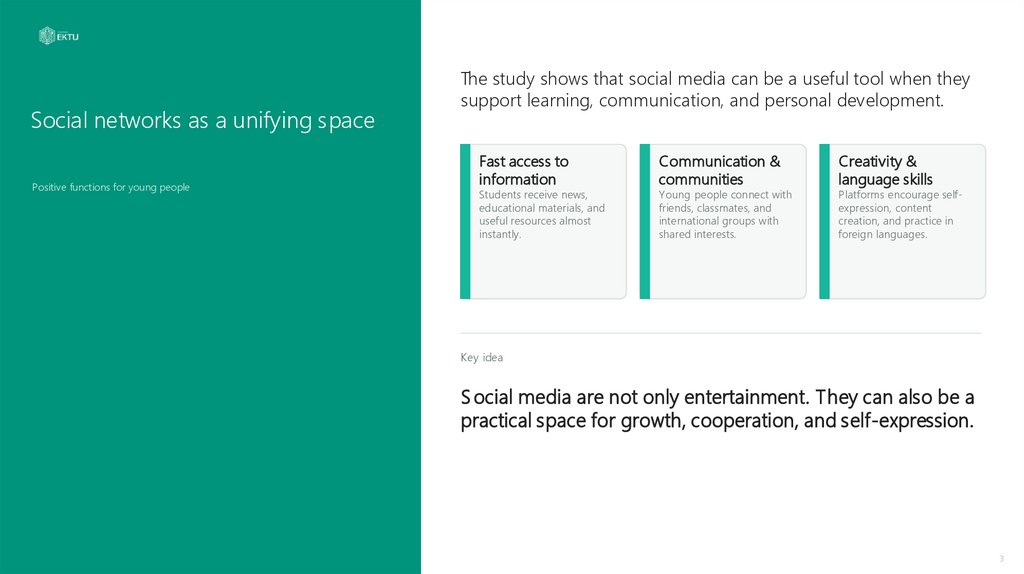
Social networks as a unifying spacePositive functions for young people
The study shows that social media can be a useful tool when they
support learning, communication, and personal development.
Fast access to
information
Students receive news,
educational materials, and
useful resources almost
instantly.
Communication &
communities
Young people connect with
friends, classmates, and
international groups with
shared interests.
Creativity &
language skills
Platforms encourage selfexpression, content
creation, and practice in
foreign languages.
Key idea
S ocial media are not only entertainment. They can also be a
practical space for growth, cooperation, and self-expression.
3
4.
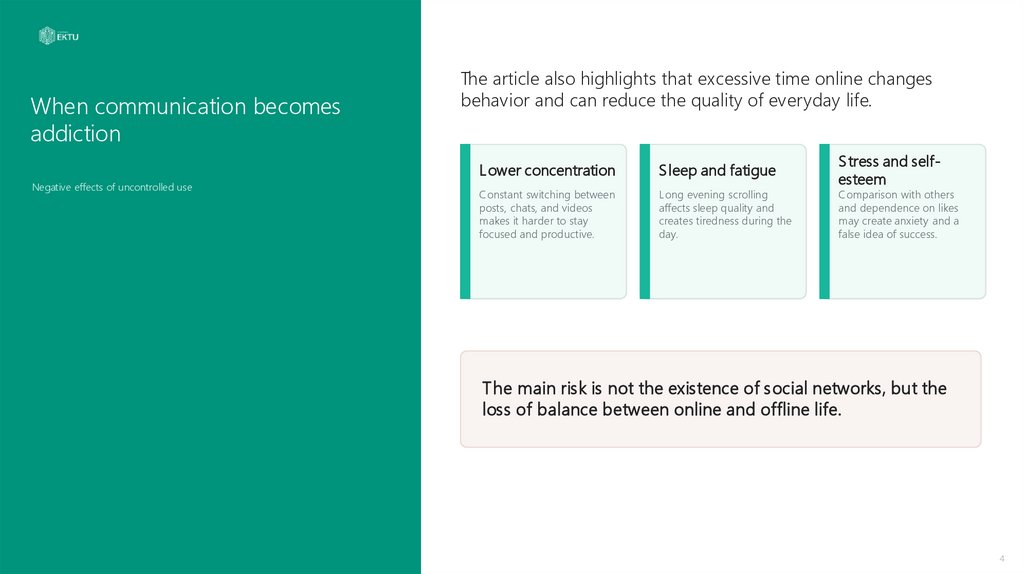
When communication becomesaddiction
Negative effects of uncontrolled use
The article also highlights that excessive time online changes
behavior and can reduce the quality of everyday life.
L ower concentration
S leep and fatigue
Constant switching between
posts, chats, and videos
makes it harder to stay
focused and productive.
Long evening scrolling
affects sleep quality and
creates tiredness during the
day.
S tress and selfesteem
Comparison with others
and dependence on likes
may create anxiety and a
false idea of success.
The main risk is not the existence of social networks, but the
loss of balance between online and offline life.
4
5.
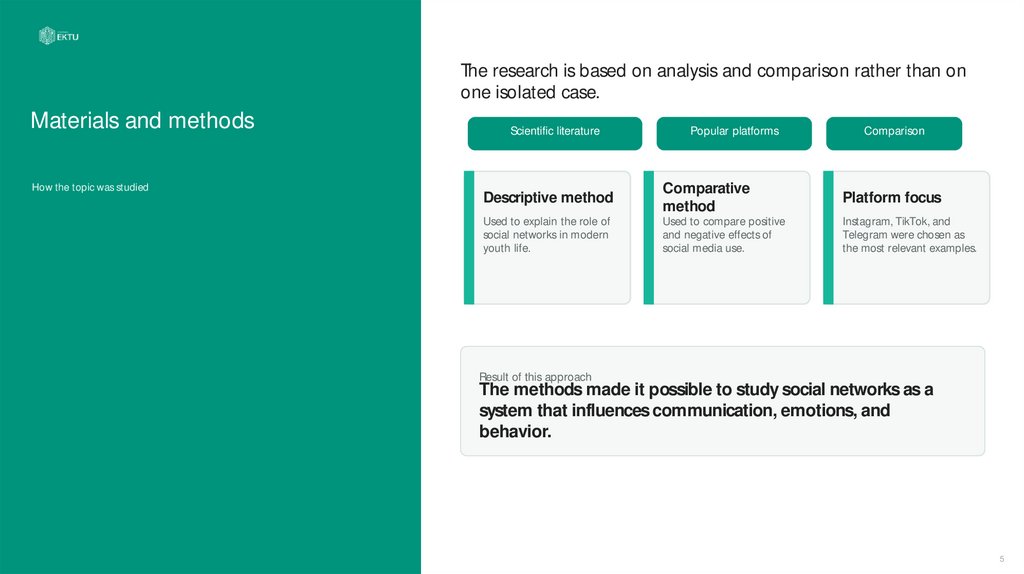
The research is based on analysis and comparison rather than onone isolated case.
Materials and methods
How the topic was studied
Scientific literature
Popular platforms
Comparison
Descriptive method
Comparative
method
Platform focus
Used to explain the role of
social networks in modern
youth life.
Used to compare positive
and negative effects of
social media use.
Instagram, TikTok, and
Telegram were chosen as
the most relevant examples.
Result of this approach
The methods made it possible to study social networks as a
system that influences communication, emotions, and
behavior.
5
6.
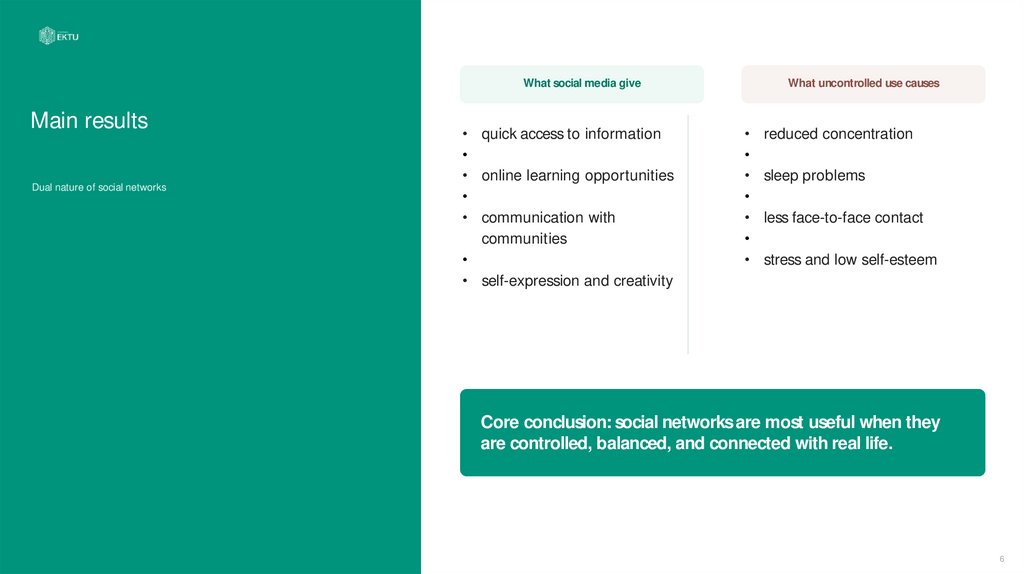
What social media giveMain results
Dual nature of social networks
• quick access to information
• online learning opportunities
• communication with
communities
• self-expression and creativity
What uncontrolled use causes
reduced concentration
sleep problems
less face-to-face contact
stress and low self-esteem
Core conclusion: social networks are most useful when they
are controlled, balanced, and connected with real life.
6
7.
How the effect changes with daily screen timeConceptual overview based on the categories in the article
Best zone
balanced use
under 3 hours
Main message
The problem is not
social media
themselves, but
excessive use.
Less than
1 hour
1–3
hours
3–5
hours
More than
5 hours
Quick communication
Almost no visible risk
Information and study
Reduced concentration
Content watching
Sleep problems
Scrolling and chatting
Addiction and stress
7
8.
THANK YOU FORYOUR ATTE NTION
Questions and discussion
Social networks should connect people,
not replace real life.