 Интернет
 Социология
Похожие презентации:






The Impact of Social Media and Artificial Intelligence on Human Behavior
1. The Impact of Social Media and Artificial Intelligence on Human Behavior
Egor Sigov3.2
2. Actuality
• Global Digital Integration• Over 4.9 billion people use social media (DataReportal, 2024), making algorithmic
influence a mass-scale phenomenon.
• Rapid Technological Advances
• Generative AI (e.g., deepfakes, LLMs like GPT-4) blurs the line between human and
machine-generated content, raising ethical concerns.
• Global Crises and Manipulation Risks
• Disinformation: AI-generated fake news influences elections (e.g., 2016 U.S. election,
2024 global polls).
• Regulatory and Ethical Debates
• Open questions: Who controls algorithms? Can transparency (e.g., OpenAI’s
disclosures) mitigate harm?
3. Fields of research
• Sociology• Focus: How algorithms reshape social norms, inequality, and collective
action (e.g., Arab Spring, Black Lives Matter).
• Political Science
• Focus: AI in governance (e.g., China’s Social Credit System)
and microtargeting in elections.
• Beside academic fields:
• Policy: Shaping laws to protect privacy/democracy.
• Business: Ethical AI design (e.g., Apple’s "Screen Time" features).
4. Research Methods
• Digital Ethnography – Observing behavior on platforms (how peopleinteract on TikTok).
• Big Data Analysis – Studying millions of posts to detect patterns
(disinformation spread).
• Experiments – A/B testing (how different algorithms affect behavior).
• In-Depth Interviews – Understanding how users perceive algorithmic
influence.
5. Key Studies
• The Facebook Experiment (2014) – Facebook secretly manipulated users’feeds to measure "emotional contagion." Result: Moods can be artificially
altered.
• "Algorithmic Extremism?" (Ribeiro, 2020) – YouTube’s algorithm was
found to steer users from moderate to radical content.
Study:
Ribeiro, M. H., Ottoni, R., West, R., Almeida, V. A. F., & Meira, W. (2020). Auditing radicalization
pathways on YouTube. Proceedings of the 2020 Conference on Fairness, Accountability, and
Transparency (FAT '20),* 131–141.
• "Digital Wellbeing" (Google, 2018) – Screen-time controls were introduced
after researcher pressure.
6. Conclusions based on previous researches
✅ Social media and algorithms reshape behavior – from politicalviews to mental health.
✅ People underestimate their influence – algorithms operate at a
subconscious level.
✅ Technology exacerbates inequality – some gain opportunities,
others get trapped in "digital loops."
✅ Regulation lags behind – Laws like GDPR and the EU’s Digital
Services Act aim to curb manipulation, but tech evolves faster.
7. Future Questions
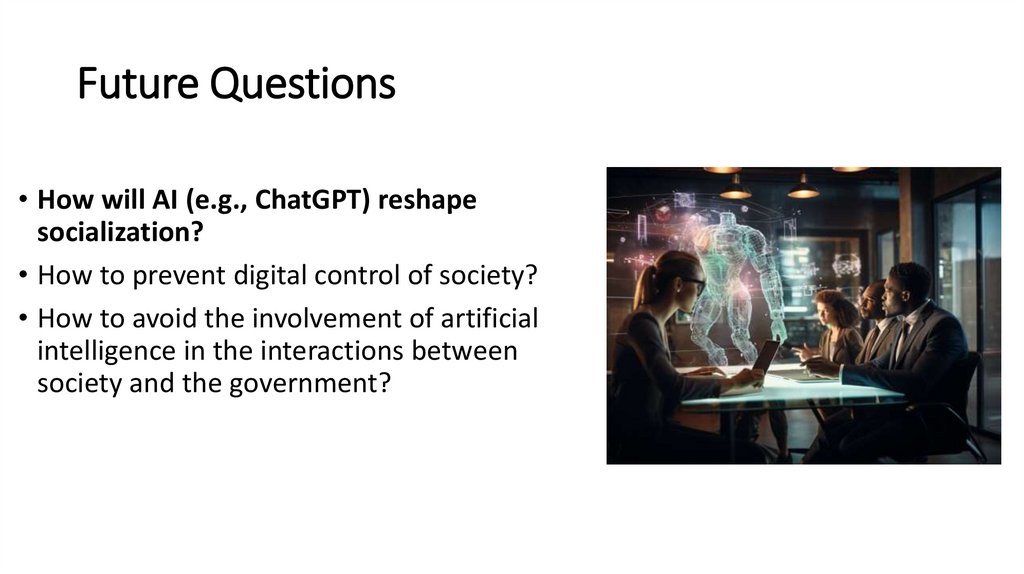
• How will AI (e.g., ChatGPT) reshapesocialization?
• How to prevent digital control of society?
• How to avoid the involvement of artificial
intelligence in the interactions between
society and the government?
8. Hypothesis
• How will AI reshape socialization?• Generative AI (like ChatGPT) will fundamentally alter human
socialization by: 1) reducing face-to-face interactions; 2) introducing
AI-mediated communication as a new norm; 3) reshaping identity
formation through personalized AI interactions—leading to both
increased efficiency in social exchanges and a potential decline in
deep emotional connections.
9.
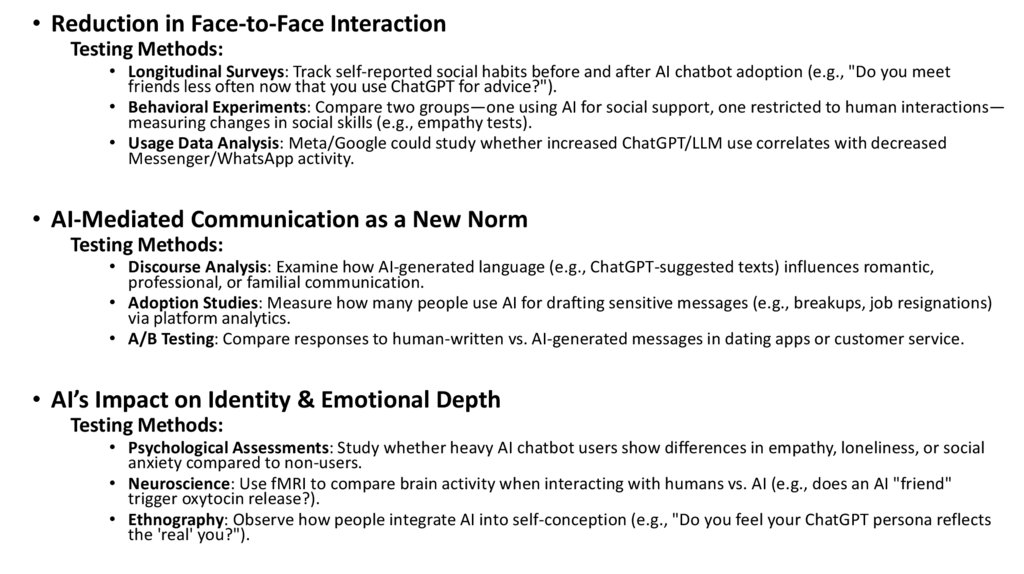
• Reduction in Face-to-Face InteractionTesting Methods:
• Longitudinal Surveys: Track self-reported social habits before and after AI chatbot adoption (e.g., "Do you meet
friends less often now that you use ChatGPT for advice?").
• Behavioral Experiments: Compare two groups—one using AI for social support, one restricted to human interactions—
measuring changes in social skills (e.g., empathy tests).
• Usage Data Analysis: Meta/Google could study whether increased ChatGPT/LLM use correlates with decreased
Messenger/WhatsApp activity.
• AI-Mediated Communication as a New Norm
Testing Methods:
• Discourse Analysis: Examine how AI-generated language (e.g., ChatGPT-suggested texts) influences romantic,
professional, or familial communication.
• Adoption Studies: Measure how many people use AI for drafting sensitive messages (e.g., breakups, job resignations)
via platform analytics.
• A/B Testing: Compare responses to human-written vs. AI-generated messages in dating apps or customer service.
• AI’s Impact on Identity & Emotional Depth
Testing Methods:
• Psychological Assessments: Study whether heavy AI chatbot users show differences in empathy, loneliness, or social
anxiety compared to non-users.
• Neuroscience: Use fMRI to compare brain activity when interacting with humans vs. AI (e.g., does an AI "friend"
trigger oxytocin release?).
• Ethnography: Observe how people integrate AI into self-conception (e.g., "Do you feel your ChatGPT persona reflects
the 'real' you?").
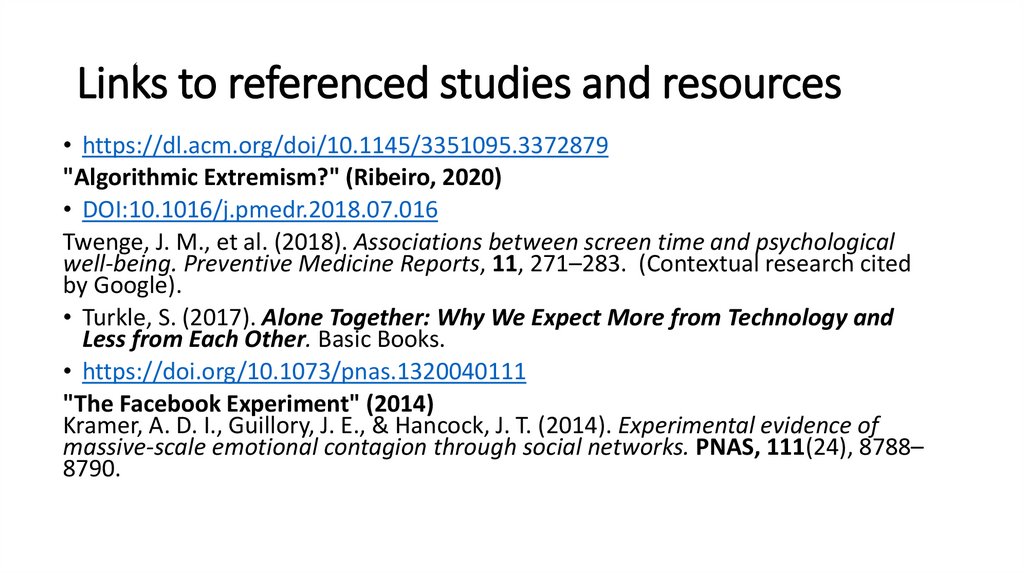
10. Links to referenced studies and resources
• https://dl.acm.org/doi/10.1145/3351095.3372879"Algorithmic Extremism?" (Ribeiro, 2020)
• DOI:10.1016/j.pmedr.2018.07.016
Twenge, J. M., et al. (2018). Associations between screen time and psychological
well-being. Preventive Medicine Reports, 11, 271–283. (Contextual research cited
by Google).
• Turkle, S. (2017). Alone Together: Why We Expect More from Technology and
Less from Each Other. Basic Books.
• https://doi.org/10.1073/pnas.1320040111
"The Facebook Experiment" (2014)
Kramer, A. D. I., Guillory, J. E., & Hancock, J. T. (2014). Experimental evidence of
massive-scale emotional contagion through social networks. PNAS, 111(24), 8788–
8790.