




 Педагогика
Похожие презентации:







Musicals: their history and potential for teaching English
1. Musicals Their history And potential for teaching
Author: Lapshova Alisa Evgenievna,student from 10 L class
Project director: Turik Victoria
Sergeevna,
english teacher
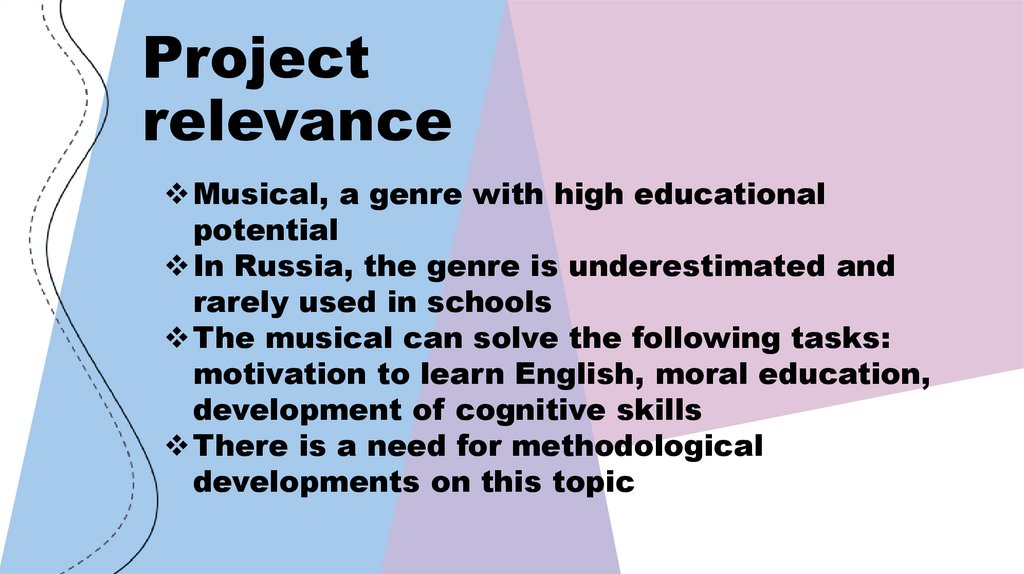
2. Project relevance
Musical, a genre with high educationalpotential
In Russia, the genre is underestimated and
rarely used in schools
The musical can solve the following tasks:
motivation to learn English, moral education,
development of cognitive skills
There is a need for methodological
developments on this topic
3. Tasks and goals
Goals:Explore the history of the
musical
Identify the reasons for
his unpopularity in Russia
Substantiate its potential
for teaching English and
educating students
Tasks:
1. Analyze the history of the origin and
development of the musical
2. Identify the reasons for the limited
distribution of the genre in Russia
3. Identify the pedagogical, sociological and
educational potential of the musical
4. Explain the concept of a school musical in
English
5. Prepare methodological recommendations
4. Contents
Project relevanceTasks and goals
Contents
Appearance of musical and development
Differences
Classics of the genre
How are things in Russia
Opportunities to teach something
A chance to understand others
Hear out every opinion
The main problems in the realization
Conclusion
5. First appearance
Ancestors:Greek tragedies and comedies
Liturgical dramas
Operas and operettas
Vaudeville and burlesque
The Minstrel Show
6. Development:
At the end of the 19th century• Jerome Kern and Oscar
Hammerstein
«Showboat»
During the Golden Age of
Broadway(1940-1960)
• Richard Rodgers and Oscar
Hammerstein
«Oklahoma!»
«Carousel»
«The King and I»
«The Sound of Music»
Frederick Lowe and Alan Jay
Lerner
«My fair lady»
• Leonard Bernstein and
Stephen Sondheim
«West Side Story»
The era of the Conceptual Musicaland
rock influences(1970-1990)
• Stephen Sondheim
«The Sweeney Todd»
«Company»
• Novelties
«Hair»
«Jesus Christ is a superstar»
«Les Miserables»
Mega-musical and
commercialization(1980-2000)
• Andrew Lloyd Webber and
Cameron Mackintosh
«The Phantom of the Opera»
«Cats»
«Miss Saigon»
7. Development:
8. Differences
Innovation:• Disneyization
• The social agenda
• Genre synthesis
Differences:
• Conventionality, "brilliance" –
Realism
• Fabulousness - Relevance
9. Classics of the genre
Vocal, dance and dramatic actingThe songs work to develop the plot and characters
Dominance of pop vocals over academic ones
End-to-end dramatic development
Simplicity of melodies for memorization
Targeting a mass audience
The stage convention of the «singing world»
Presence of hits that exist separately from the
performance
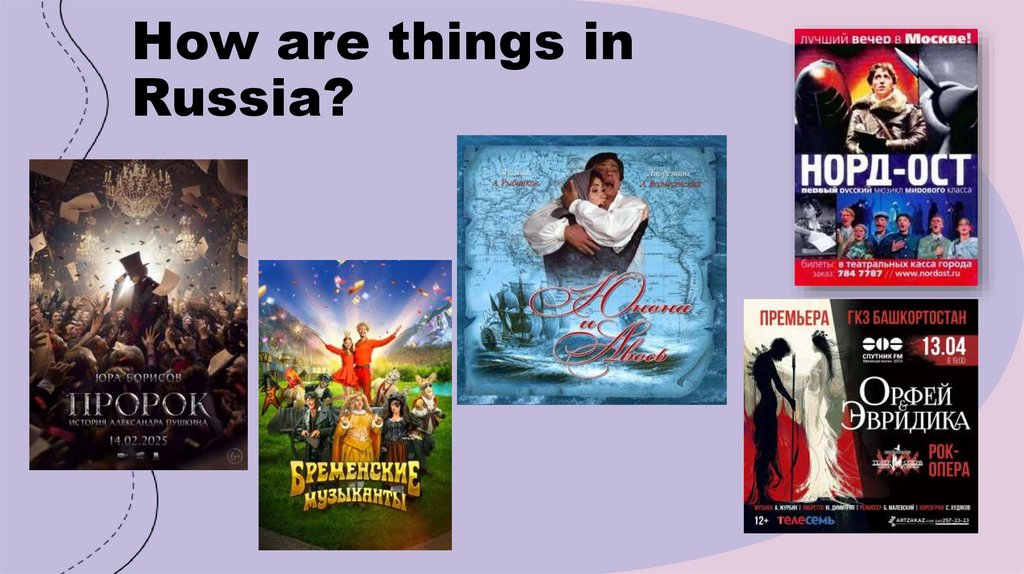
10. How are things in Russia?
11. Reasons of unpopularity
Economic reasons: high cost of productions,shortage of universal artists
Cultural and historical: long-term appearance as
an "alien" genre, disguised as an operetta or movie
Educational: Absence in school, lack of teaching
materials
12. Opportunities to teach something
SkillHow the musical works
Listening
Real speech of native speakers (tempo, accents,
intonation), visual assistance, subtitles
Vocabulary
The words are remembered in context, through
emotions and repeated repetition in the choruses
Grammar
Rhythm and melody combine the whole structure,
absorption goes through patterns
Pronunciation
Singing requires clear articulation, and the choir
relieves embarrassment
13. A chance to understand others
Social potential (for society and theindividual)
Builds teamwork skills
Develops emotional intelligence and
empathy
Creates a common cultural space for
people of different ages, wealth, and
education
Helps to overcome social barriers
Raises socially significant topics
Through art, you can talk about things that
are difficult to talk about directly
The teenager feels that his problems are
not unique and understandable to others.
International potential (for understanding
the world and cultures)
Introduces you to the history, culture,
and traditions of different countries
Builds respect for cultural diversity
Gives a common language (literally and
figuratively) to people from different
countries
Cross-cultural competence is being
formed
14. Hear out every opinion
The musical does not impose morality, butoffers to make your own choice
The viewer hears the inner world of the character
through the song — something that is hidden from other
characters, due to this, the habit of understanding the
motives and feelings of another person is formed
The viewer encounters universal moral problems: Mercy
and redemption, loyalty to oneself in the face of danger,
and what remains after a person?
The viewer, through the main characters, puts himself in
the place of one of the characters and can see how he
copes with his problem.
15. The main problems in the realization
ProblemSolution
The lack of sources in Russian on the topic
of using the musical in teaching English
Access to English-language scientific
articles and pedagogical blogs
(Google Scholar, ERIC)
The difficulty of selecting musicals for
analysis — which ones are really useful for
the school?
Clear criteria: language level, subtitles,
educational value
The risk of a superficial analysis is a
description instead of a deep study
Detailed structure: identify specific
linguistic phenomena, comparative
analysis
The unreasonableness of methodological
recommendations (there is no testing in
practice)
Relying on successful examples described
in the literature, honest indication of
limitations
The difficulty with the final product is how
to make the concept of the musical useful
and realistic
Using ready-made templates, consulting
with an English teacher
16. Conclusion
The genre has a history of almost 200 years,but its pedagogical potential is still poorly
used in Russia