 География
Похожие презентации:



Russia: Geography and Natural Wonders
1.
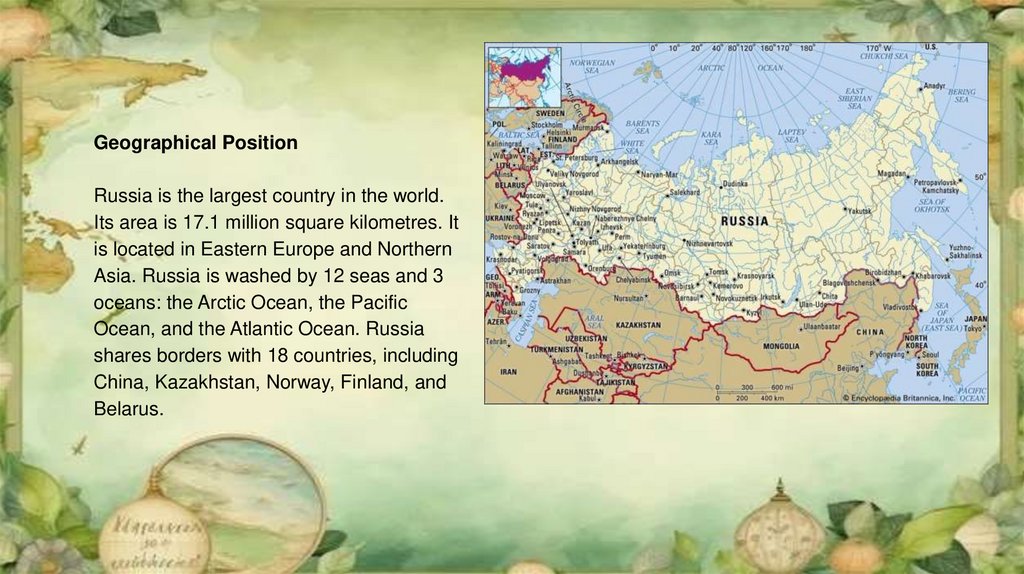
Geographical PositionRussia is the largest country in the world.
Its area is 17.1 million square kilometres. It
is located in Eastern Europe and Northern
Asia. Russia is washed by 12 seas and 3
oceans: the Arctic Ocean, the Pacific
Ocean, and the Atlantic Ocean. Russia
shares borders with 18 countries, including
China, Kazakhstan, Norway, Finland, and
Belarus.
2.
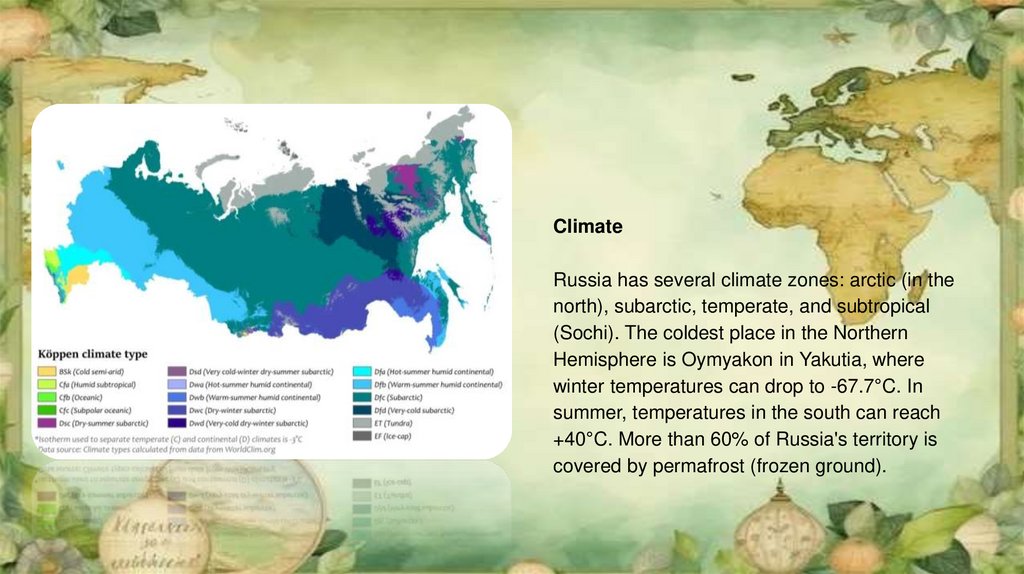
ClimateRussia has several climate zones: arctic (in the
north), subarctic, temperate, and subtropical
(Sochi). The coldest place in the Northern
Hemisphere is Oymyakon in Yakutia, where
winter temperatures can drop to -67.7°C. In
summer, temperatures in the south can reach
+40°C. More than 60% of Russia's territory is
covered by permafrost (frozen ground).
3.
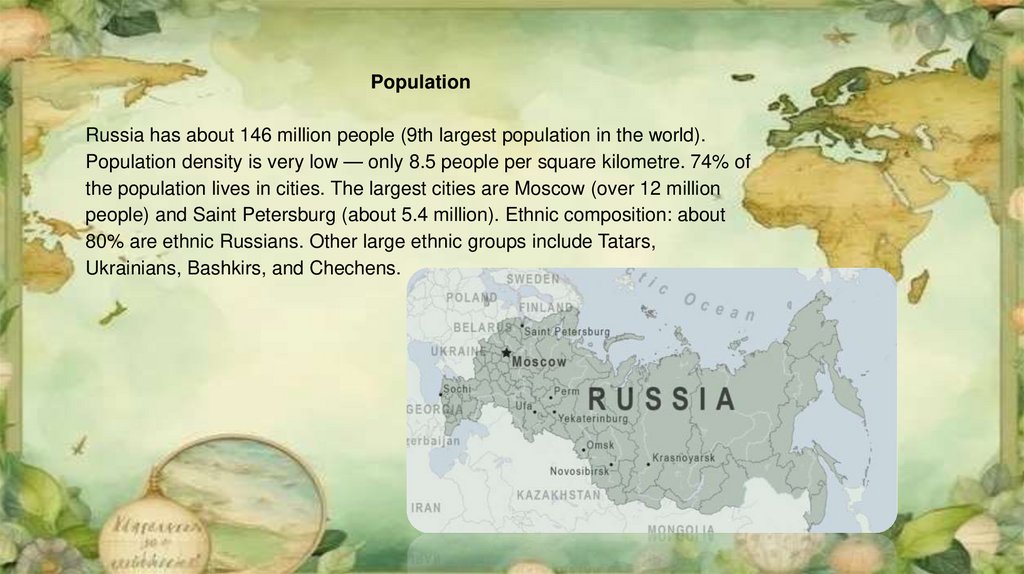
PopulationRussia has about 146 million people (9th largest population in the world).
Population density is very low — only 8.5 people per square kilometre. 74% of
the population lives in cities. The largest cities are Moscow (over 12 million
people) and Saint Petersburg (about 5.4 million). Ethnic composition: about
80% are ethnic Russians. Other large ethnic groups include Tatars,
Ukrainians, Bashkirs, and Chechens.
4.
Task 1. Fill in the gapsWord bank: 17.1, 18, Oymyakon, -67.7, 60, 146, Moscow,
Saint Petersburg
1. Russia's area is ________ million square kilometres.
2. Russia borders ________ countries.
3. The coldest place in the Northern Hemisphere is
________.
4. The lowest winter temperature there is ________ °C.
5. More than ________% of Russian territory is permafrost.
6. Russia's population is about ________ million people.
7. The two largest cities are ________ and ________.
5.
Task 2. True / FalseWrite TRUE or FALSE. If FALSE, write the correct
statement.
1 Russia is the second largest country in the world.
2 Russia is washed by 12 seas and 3 oceans.
3 Russia has only one climate zone — arctic.
4 Oymyakon is the hottest place in Russia.
5 More than 60% of Russia is covered by
permafrost.
6 Russia has about 300 million people.
7 74% of Russia's population lives in cities.
8 About 80% of the population are ethnic Russians.
6.
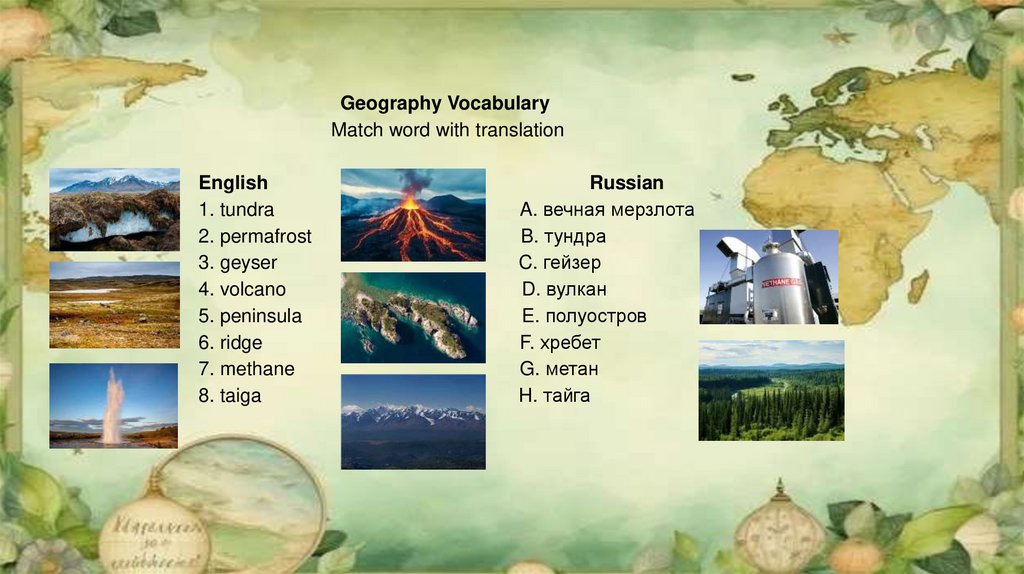
Geography VocabularyMatch word with translation
English
1. tundra
2. permafrost
3. geyser
4. volcano
5. peninsula
6. ridge
7. methane
8. taiga
Russian
A. вечная мерзлота
B. тундра
C. гейзер
D. вулкан
E. полуостров
F. хребет
G. метан
H. тайга
7.
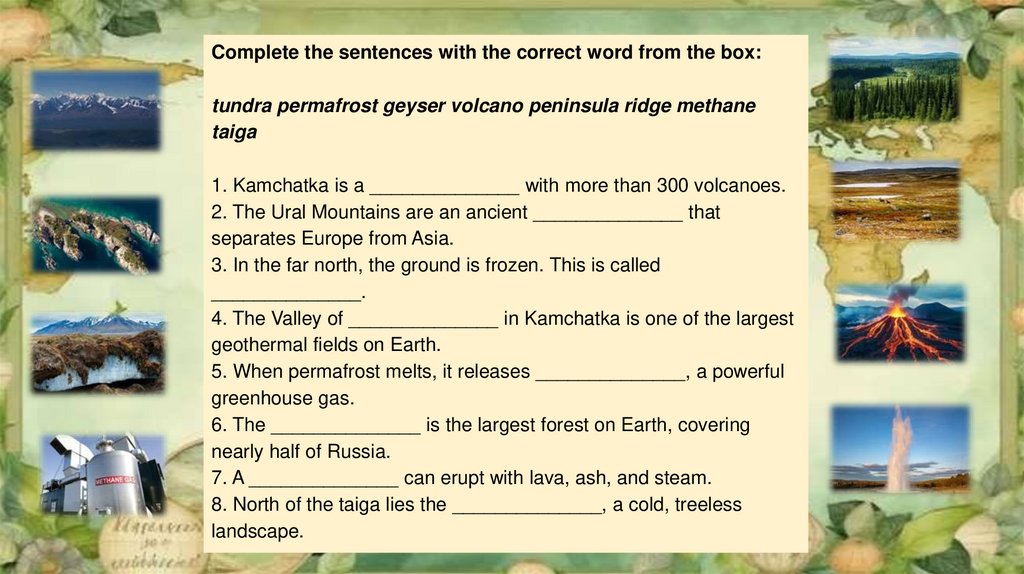
Complete the sentences with the correct word from the box:tundra permafrost geyser volcano peninsula ridge methane
taiga
1. Kamchatka is a ______________ with more than 300 volcanoes.
2. The Ural Mountains are an ancient ______________ that
separates Europe from Asia.
3. In the far north, the ground is frozen. This is called
______________.
4. The Valley of ______________ in Kamchatka is one of the largest
geothermal fields on Earth.
5. When permafrost melts, it releases ______________, a powerful
greenhouse gas.
6. The ______________ is the largest forest on Earth, covering
nearly half of Russia.
7. A ______________ can erupt with lava, ash, and steam.
8. North of the taiga lies the ______________, a cold, treeless
landscape.
8.
Translate into EnglishTranslate the sentences using the new words.
1. Тайга покрывает почти половину территории России.
2. Вечная мерзлота занимает более 60% России.
3. Камчатка — это полуостров с действующими
вулканами.
4. При таянии вечной мерзлоты выделяется метан.
5. Уральские горы — это древний хребет.
6. В долине гейзеров земля постоянно движется.
9.
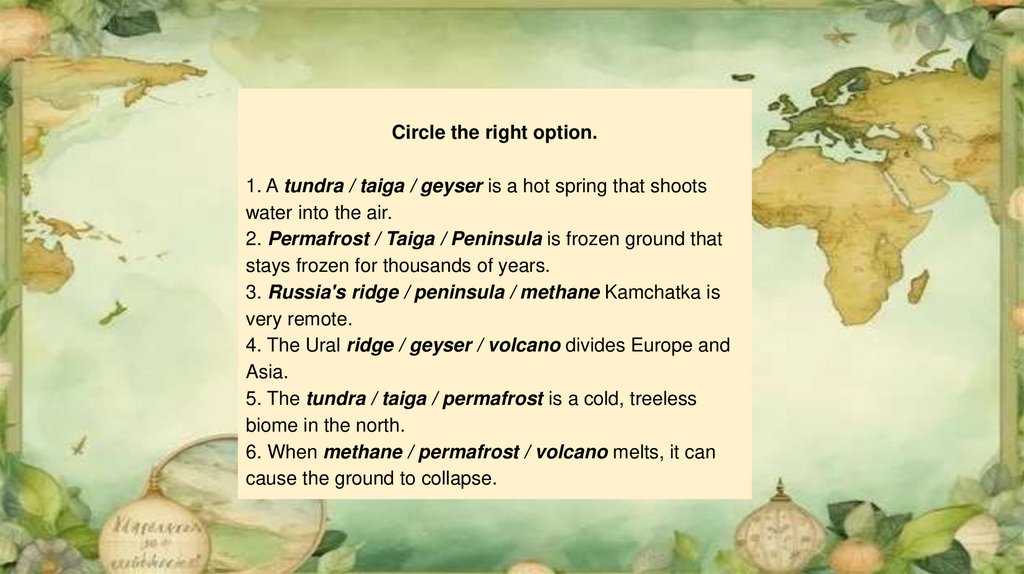
Circle the right option.1. A tundra / taiga / geyser is a hot spring that shoots
water into the air.
2. Permafrost / Taiga / Peninsula is frozen ground that
stays frozen for thousands of years.
3. Russia's ridge / peninsula / methane Kamchatka is
very remote.
4. The Ural ridge / geyser / volcano divides Europe and
Asia.
5. The tundra / taiga / permafrost is a cold, treeless
biome in the north.
6. When methane / permafrost / volcano melts, it can
cause the ground to collapse.
10.
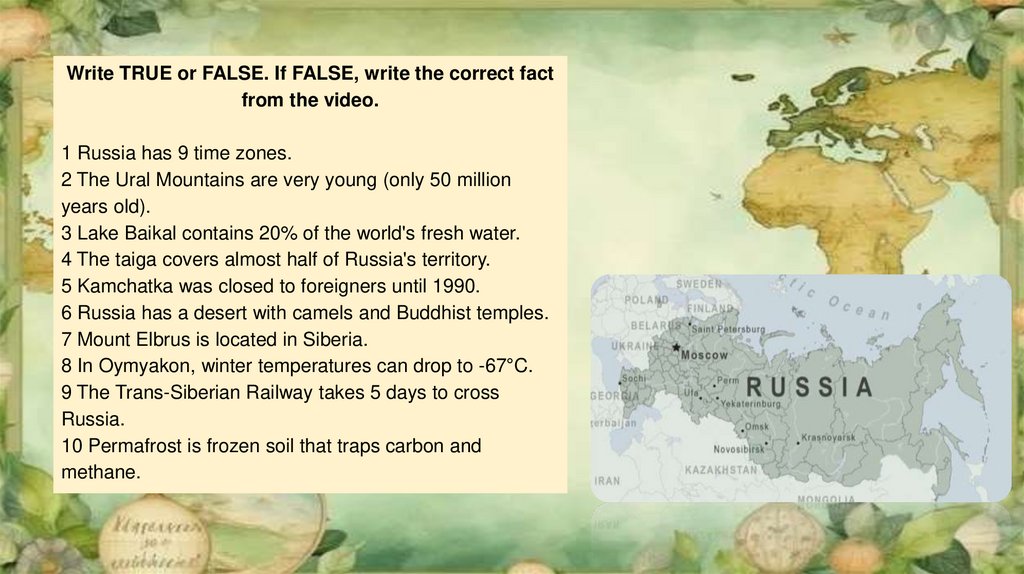
Write TRUE or FALSE. If FALSE, write the correct factfrom the video.
1 Russia has 9 time zones.
2 The Ural Mountains are very young (only 50 million
years old).
3 Lake Baikal contains 20% of the world's fresh water.
4 The taiga covers almost half of Russia's territory.
5 Kamchatka was closed to foreigners until 1990.
6 Russia has a desert with camels and Buddhist temples.
7 Mount Elbrus is located in Siberia.
8 In Oymyakon, winter temperatures can drop to -67°C.
9 The Trans-Siberian Railway takes 5 days to cross
Russia.
10 Permafrost is frozen soil that traps carbon and
methane.
11.
Complete the sentences with the correct numbers or words fromthe video.
Word bank: 17, 9, 400, 77, -67, turquoise, 7, 300, 29, 11
1. Russia covers ________ million square kilometres.
2. The time difference between Vladivostok and Moscow is ________
hours.
3. The Ural Mountains are over ________ million years old.
4. ________ % of Russia's territory lies beyond the Ural Mountains.
5. The coldest temperature recorded in Oymyakon is ________ °C.
6. In winter, Lake Baikal freezes into ________ glass.
7. Kamchatka has more than ________ volcanoes, ________ of them
still active.
8. Russia spans ________ time zones.
9. The Trans-Siberian Railway takes ________ days.
12.
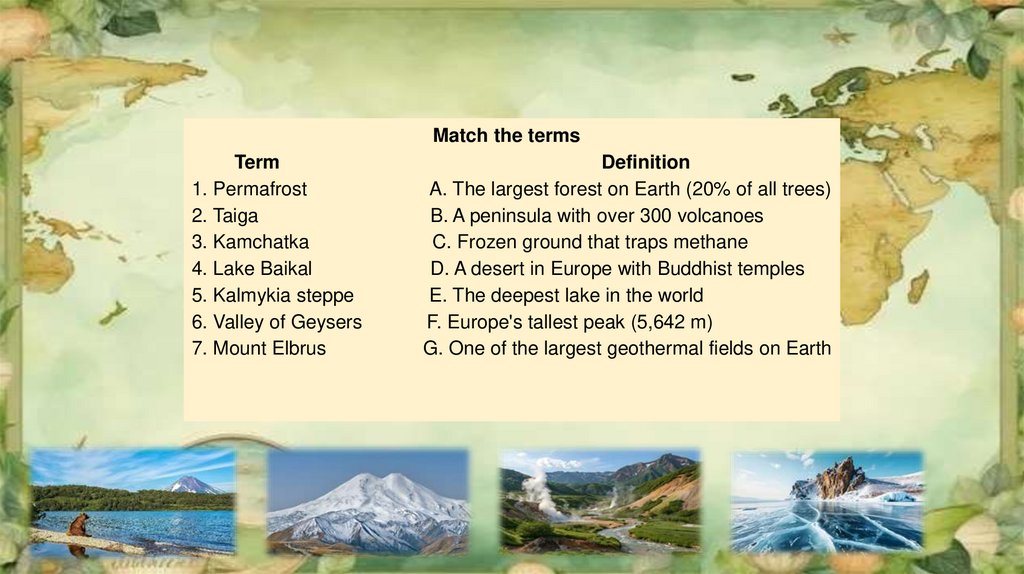
Match the termsTerm
1. Permafrost
2. Taiga
3. Kamchatka
4. Lake Baikal
5. Kalmykia steppe
6. Valley of Geysers
7. Mount Elbrus
Definition
A. The largest forest on Earth (20% of all trees)
B. A peninsula with over 300 volcanoes
C. Frozen ground that traps methane
D. A desert in Europe with Buddhist temples
E. The deepest lake in the world
F. Europe's tallest peak (5,642 m)
G. One of the largest geothermal fields on Earth
13.
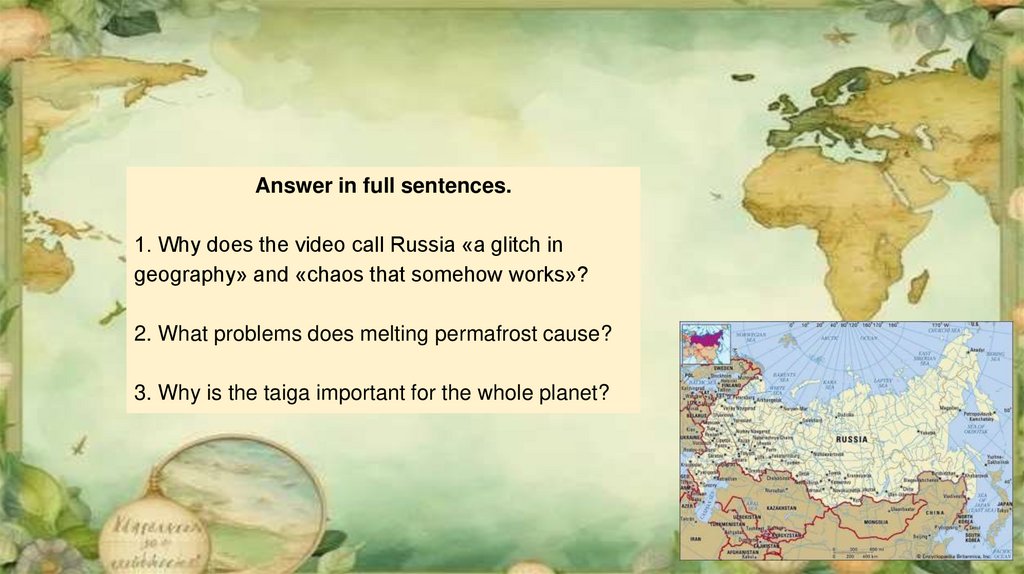
Answer in full sentences.1. Why does the video call Russia «a glitch in
geography» and «chaos that somehow works»?
2. What problems does melting permafrost cause?
3. Why is the taiga important for the whole planet?