
 Английский язык
Похожие презентации:


The Simple Sentence
1. T H E S E N T E N C E. THE SIMPLE SENTENCE.
THES E N T E N C E.
THE SIMPLE SENTENCE.
2.
The sentence is the smallest unit of communicationbuilt up according to a definite syntactic pattern.
Every sentence is characterized by its syntactic
structure,
predication.
special
intonation
contour,
modality
and
3.
There are two principles of classification. Applyingone of them, we obtain a classification into declarative,
interrogative, and imperative sentences. This principle can
be called "types of communication".
The other classification is according to structure.
Here there are two main types: simple sentences and
composite sentences.
4.
Types of Sentences According to Types ofCommunication
(1) Declarative
(2) Interrogative
(3) Imperative
Sentences belonging to the several types differ from
each other in some grammatical points.
5.
The notion of exclamatory sentences and theirrelation to the three established types of declarative,
interrogative, and imperative sentences present some
difficulty. On the one hand, every sentence, whether
narrative, interrogative or imperative, may be exclamatory at
the same time, that is, it may convey the speaker's feelings
and be characterized by emphatic intonation and by an
exclamation mark in writing.
But, he can't do anything to you!
What can he possibly do to you!
Scarlett, spare me!
6.
On the other hand, a sentence may be purelyexclamatory, that is, it may not belong to any of the three
types classed above.
“Well, fiddle-dee-dee!" said Scarlett.
Oh, for God's sake, Henry!
However, it would perhaps be better to use different
terms for sentences which are purely exclamatory, and thus
constitute a special type, and those which add an emotional
element to their basic quality, which is either declarative, or
interrogative, or imperative.
7.
If this view is endorsed, Prof. Ilyish proposes tomodify the classification of sentences according to type of
communication in the following way:
(1) Declarative (including emotional ones)
(2) Interrogative (including emotional ones)
(3) Imperative (including emotional ones)
(4) Exclamatory
8.
Types of Sentences According to Structure(1) Simple
(2) Composite
9.
Types of Simple SentencesSimple sentences are usually classified into twomember and one-member sentences. This distinction is
based on a difference in the main parts of a sentence.
10.
In a sentence like Helen sighed there are obviouslytwo main parts: Helen, which denotes the doer of the action
and is called (grammatical) subject, and sighed, which
denotes the action performed by the subject and is called
(grammatical) predicate. Sentences having this basic
structure, namely the subject and the predicate, are termed
two-member sentences.
11.
However, there are sentences which do not containtwo separate parts; in these sentences there is only one main
part: the other main part is not there; and it could not even
be supplied, at least not without a violent change in the
structure of the sentence. They are termed one-member
sentences:
Fire!
Come on!
Dusk - of a summer night.
12.
One-member sentences should be kept apart fromtwo-member sentences with either the subject or the
predicate omitted, i.e. from elliptical sentences, which can
be easily restored.
13.
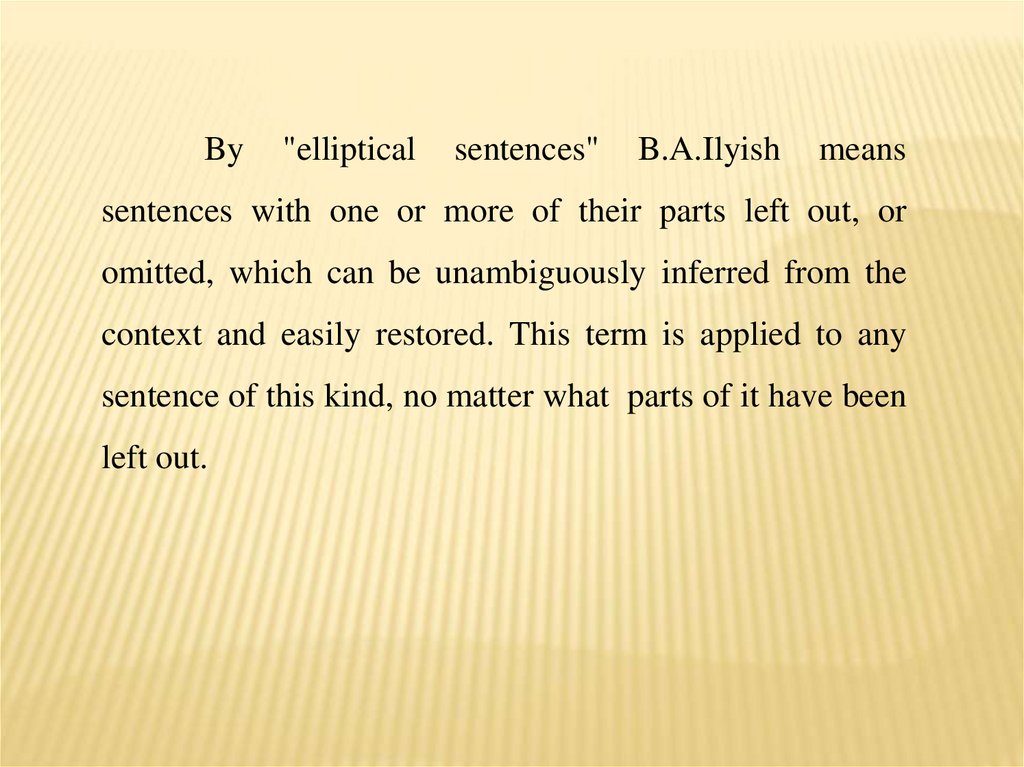
By"elliptical
sentences"
B.A.Ilyish
means
sentences with one or more of their parts left out, or
omitted, which can be unambiguously inferred from the
context and easily restored. This term is applied to any
sentence of this kind, no matter what parts of it have been
left out.
14.
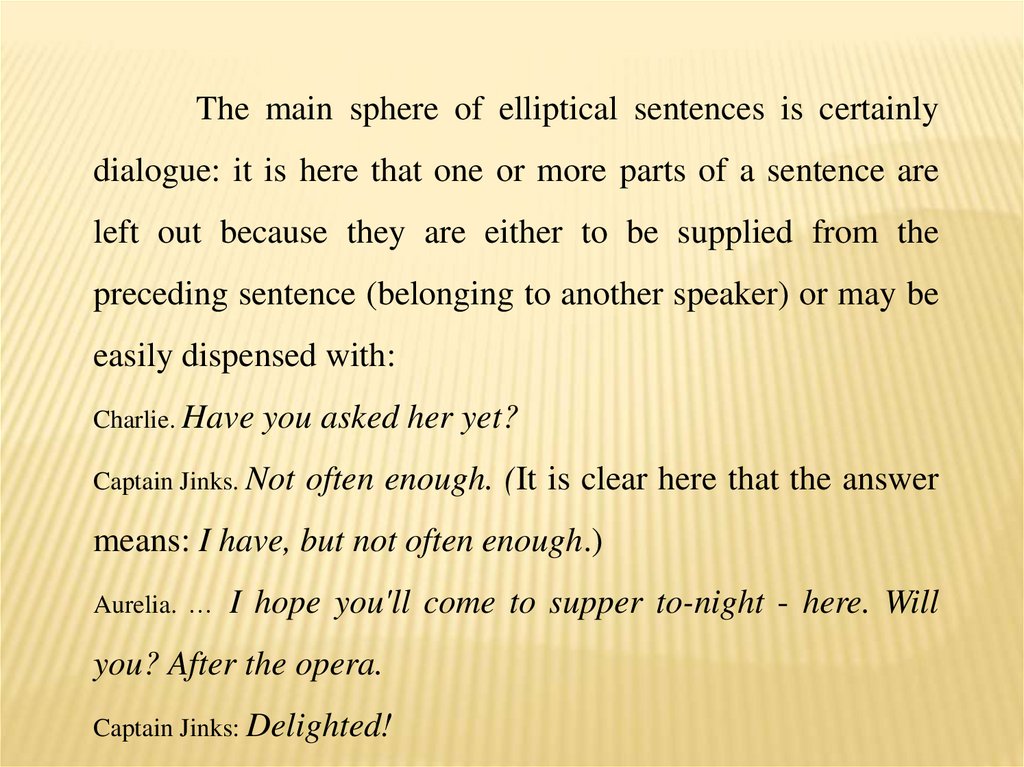
The main sphere of elliptical sentences is certainlydialogue: it is here that one or more parts of a sentence are
left out because they are either to be supplied from the
preceding sentence (belonging to another speaker) or may be
easily dispensed with:
Charlie. Have you asked her yet?
Captain Jinks. Not often enough. (It is clear here that the answer
means: I have, but not often enough.)
Aurelia. … I hope you'll come to supper to-night - here. Will
you? After the opera.
Captain Jinks: Delighted!
15.
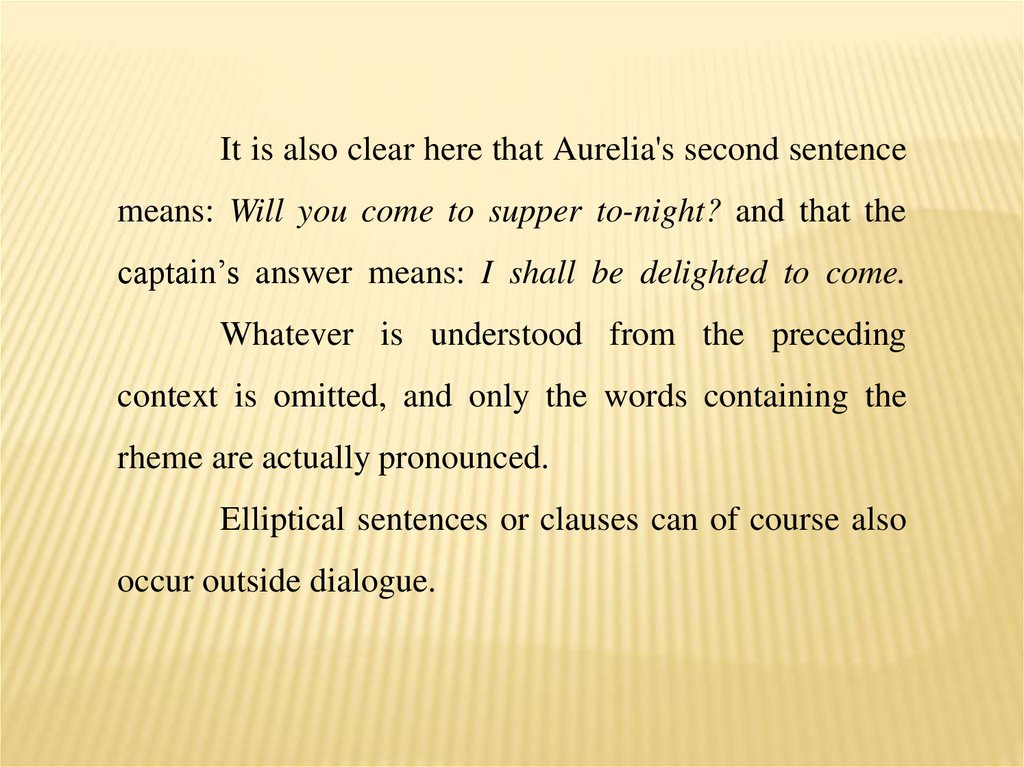
It is also clear here that Aurelia's second sentencemeans: Will you come to supper to-night? and that the
captain’s answer means: I shall be delighted to come.
Whatever is understood from the preceding
context is omitted, and only the words containing the
rheme are actually pronounced.
Elliptical sentences or clauses can of course also
occur outside dialogue.