



 Английский язык
Похожие презентации:





Syntax. Lecture 8
1. SYNTAX
LECTURE 82.
• What is syntax?• What is it for?
3. Syntax
Syntax is the branch of linguistics concerned with the arrangement ofwords into sentences to convey meaning. Unlike morphology, which
examines word formation, syntax governs the structure of phrases and
sentences. Its significance lies in:
Establishing sentence structure and grammatical relationships.
Ensuring clarity and precision in communication (The cat chased the mouse vs. The
mouse chased the cat).
Enabling infinite sentence formation from a finite lexicon.
4. Syntax
• "Syntax skills help us understand how sentences work—themeanings behind word order, structure, and punctuation.
• Sentence
• The constituent level… clause
phrase
• Word
5. Characteristics of Syntactic Units
• Formal• Semantic
• Pragmatic
6. Sentence
Sentence is the main integral unit of speech built up of wordsaccording to a definite syntactic pattern and distinguished by a
contextually relevant communicative purpose.
The sentence, being composed of words, may in certain cases
include only one word of various lexico-grammatical standing.
Cf.: Night. Congratulations. Away! Why? Certainly.
7. Sentence Characteristics
• Has high pragmatic potential.• Can be a text.
• Is a text chunk.
• Has a communicative function.
• Is intonationally delimited.
• Is characterised by its specific category of predication which establishes
the relation of the named phenomena to actual life.
• Consists of phrases and clauses.
• Has a certain word-order.
8. Communicative Types of Sentences
• Declarative• Interrogative
• Imperative
• Exclamatory
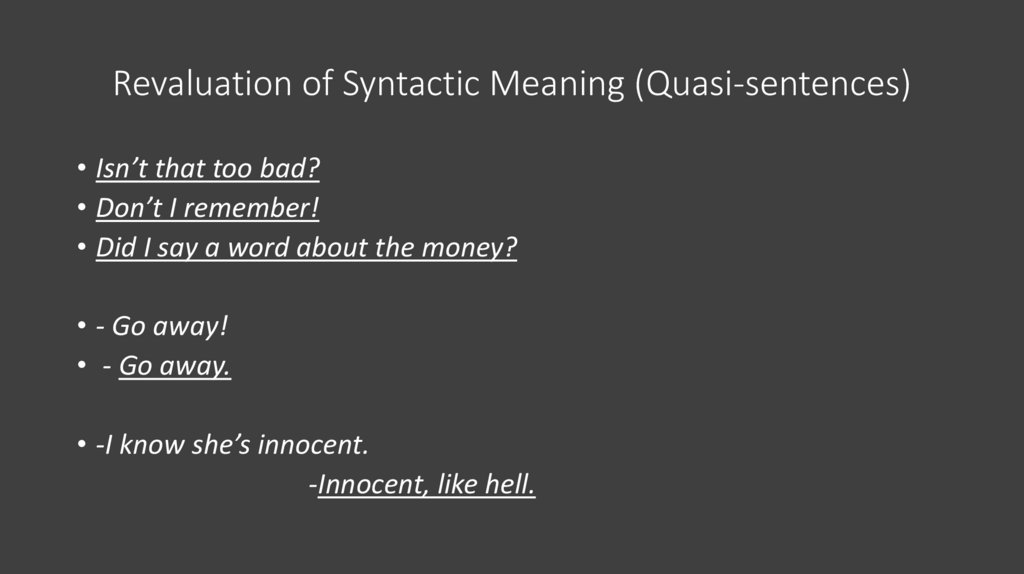
9. Revaluation of Syntactic Meaning (Quasi-sentences)
• Isn’t that too bad?• Don’t I remember!
• Did I say a word about the money?
• - Go away!
• - Go away.
• -I know she’s innocent.
-Innocent, like hell.
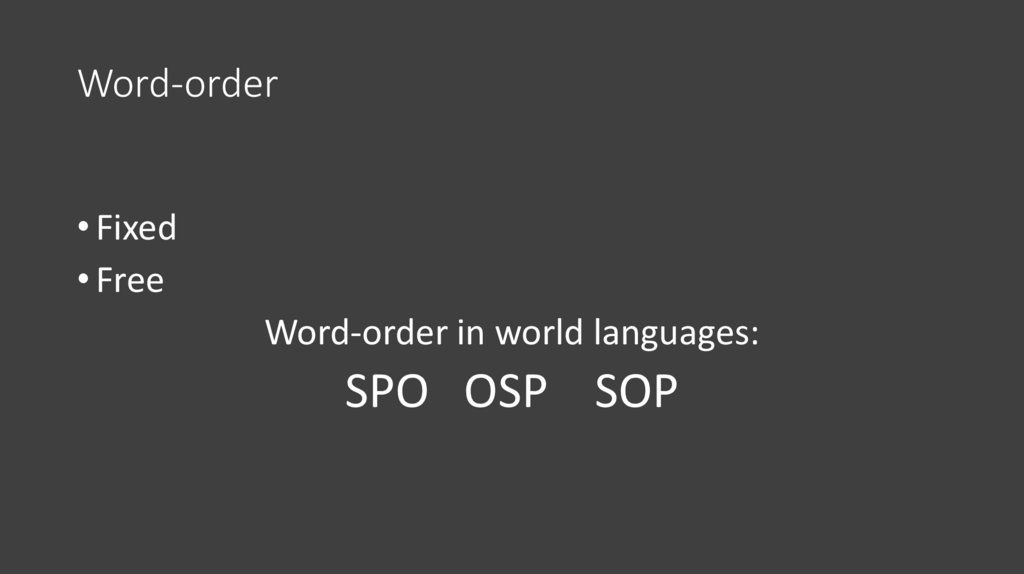
10. Word-order
• Fixed• Free
Word-order in world languages:
SPO OSP SOP
11. English Syntax Compared to Other Languages
Fixed Word Order (SVO): English adheres to a Subject-Verb-Objectsequence (e.g., The student reads a book), unlike Russian, where
case endings permit flexibility (Студент книгу читает).
Reliance on Function Words: Prepositions and auxiliary verbs (in the
house) substitute for inflectional endings (в доме in Russian).
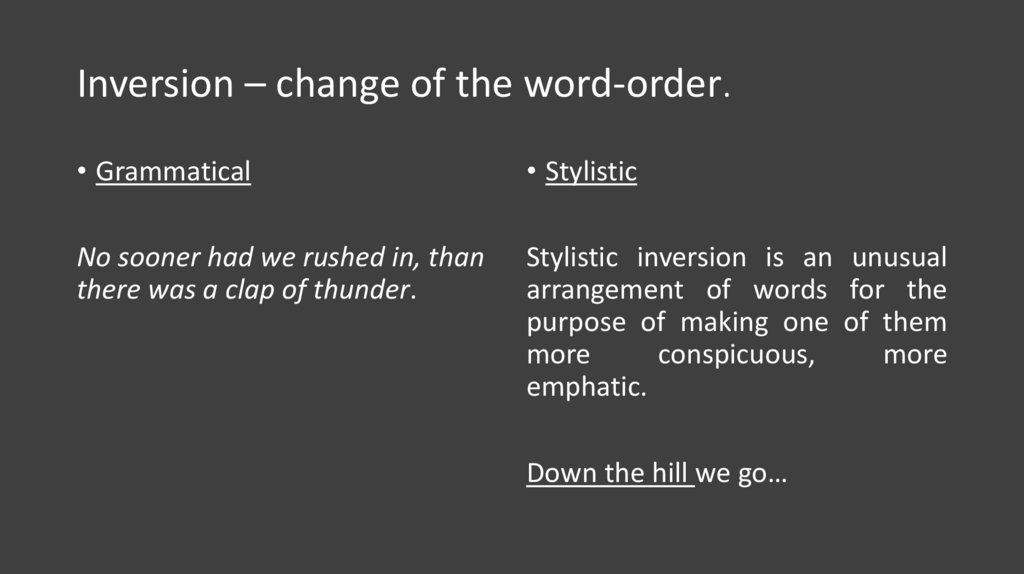
12. Inversion – change of the word-order.
• Grammatical• Stylistic
No sooner had we rushed in, than
there was a clap of thunder.
Stylistic inversion is an unusual
arrangement of words for the
purpose of making one of them
more
conspicuous,
more
emphatic.
Down the hill we go…
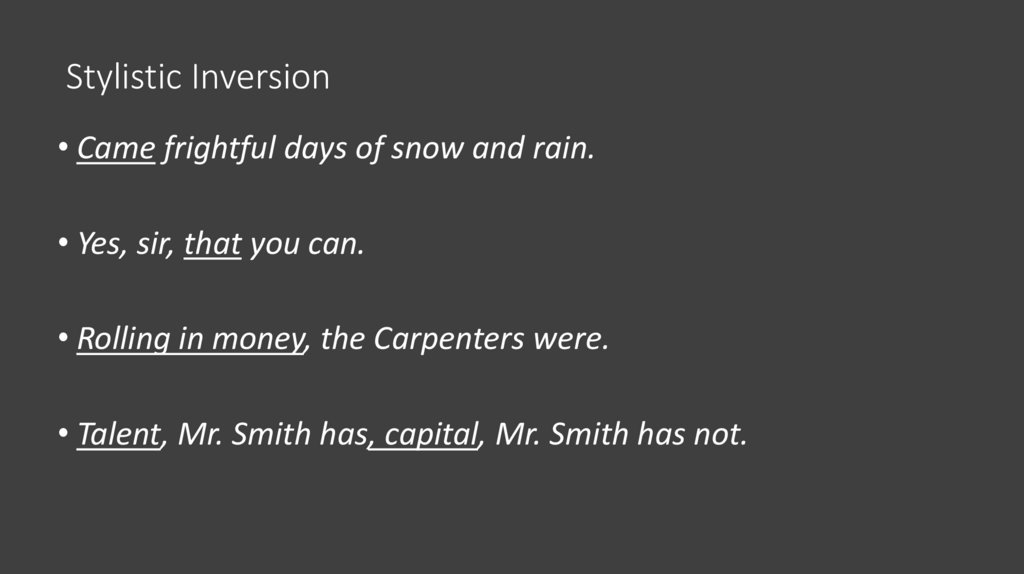
13. Stylistic Inversion
• Came frightful days of snow and rain.• Yes, sir, that you can.
• Rolling in money, the Carpenters were.
• Talent, Mr. Smith has, capital, Mr. Smith has not.
14. Predicativity & Predication
Predicativity & Predication• Predicativity is the correlation of the thought expressed in the
sentence with the situation of speech.
• Predication is grammatical manifestation of predicativity.
• The sentence as a main syntactic unit performs the function of
predication. The basic predicative meanings are expressed by the
finite verb which is connected with the subject of the sentence. This
predicative connection is referred to as the predicative line of the
sentence.
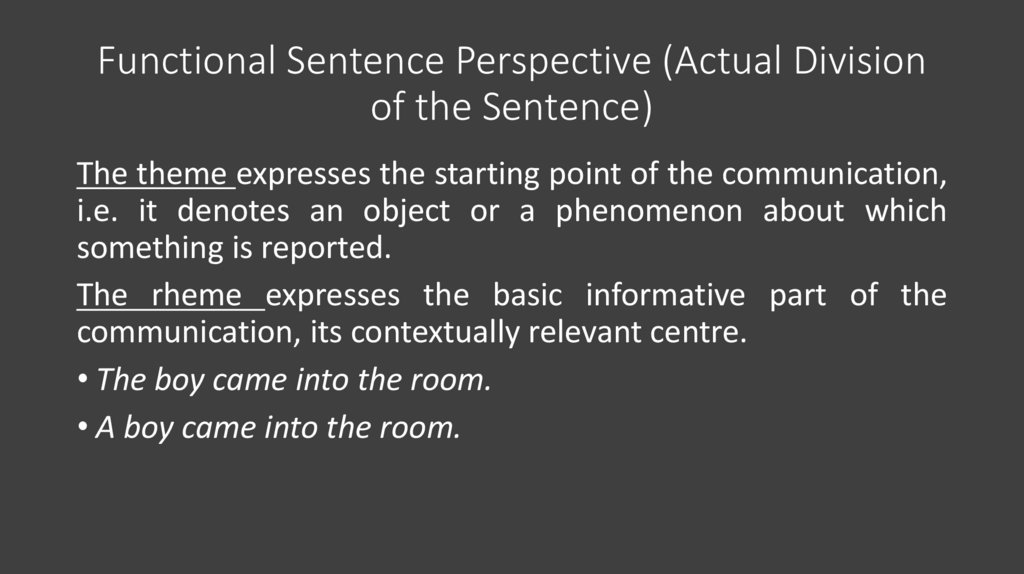
15. Functional Sentence Perspective (Actual Division of the Sentence)
The theme expresses the starting point of the communication,i.e. it denotes an object or a phenomenon about which
something is reported.
The rheme expresses the basic informative part of the
communication, its contextually relevant centre.
• The boy came into the room.
• A boy came into the room.
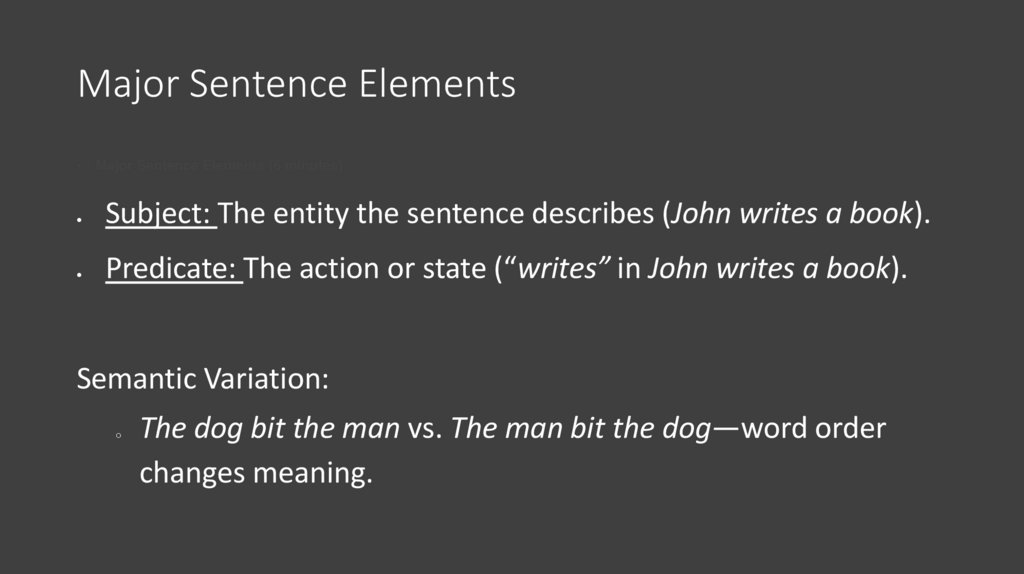
16. Major Sentence Elements
Major Sentence Elements (6 minutes)
Subject: The entity the sentence describes (John writes a book).
Predicate: The action or state (“writes” in John writes a book).
Semantic Variation:
o
The dog bit the man vs. The man bit the dog—word order
changes meaning.
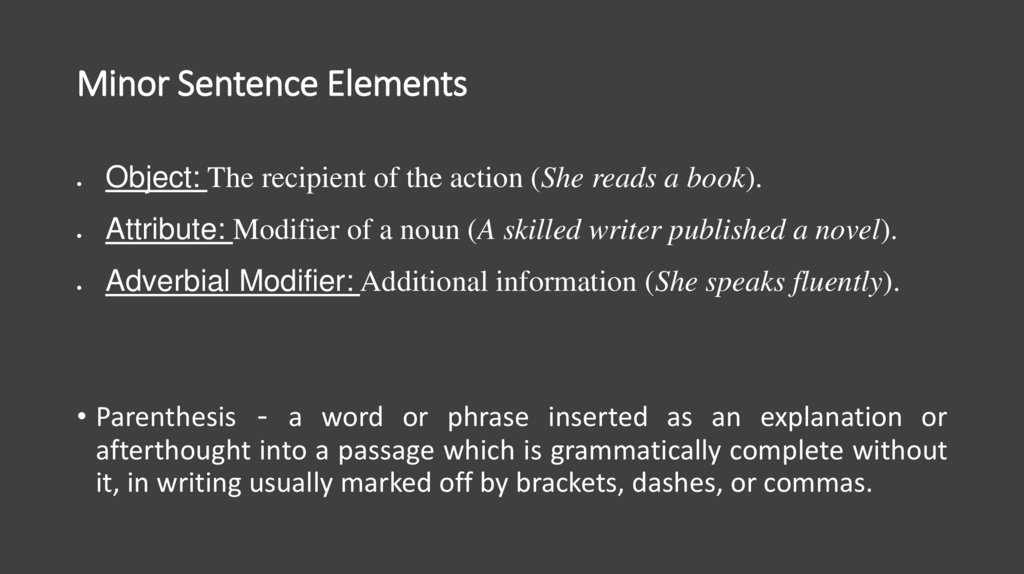
17. Minor Sentence Elements
Object: The recipient of the action (She reads a book).Attribute: Modifier of a noun (A skilled writer published a novel).
Adverbial Modifier: Additional information (She speaks fluently).
• Parenthesis - a word or phrase inserted as an explanation or
afterthought into a passage which is grammatically complete without
it, in writing usually marked off by brackets, dashes, or commas.
18. Sentence Types
• simple sentences• compound sentences
• complex sentences
• compound-complex sentences
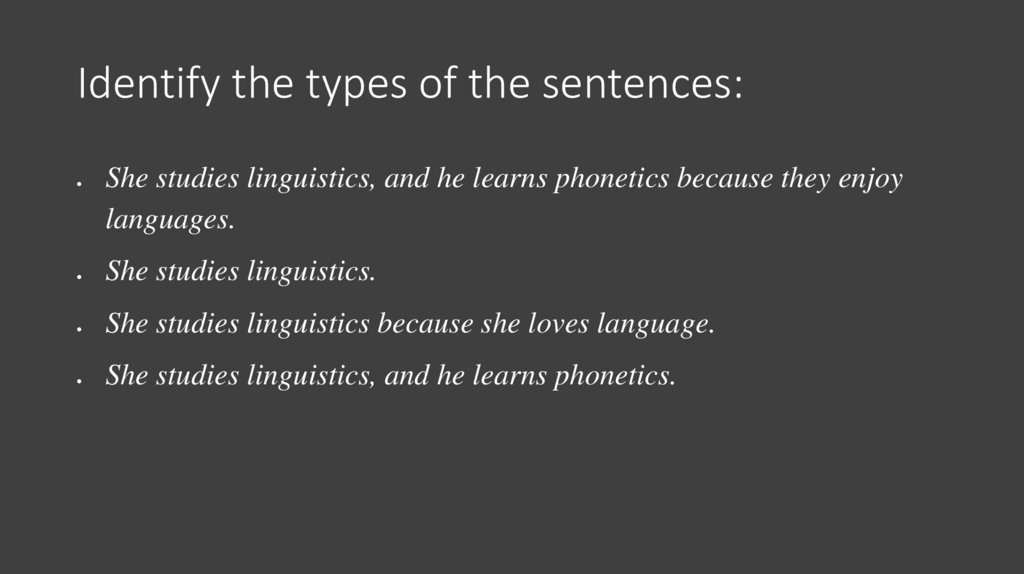
19. Identify the types of the sentences:
She studies linguistics, and he learns phonetics because they enjoylanguages.
She studies linguistics.
She studies linguistics because she loves language.
She studies linguistics, and he learns phonetics.
20. Coordination and Subordination
• Coordination means combining two sentences or ideas thatare of equal value.
• Subordination means combining two sentences or ideas in a
way that makes one more important than the other.
21. Coordinating Conjunctions
Cumulative: and, as well as, both...and (She sings and plays thepiano).
Adversative: but, yet, however, nevertheless (He wanted to go,
but he was too tired).
Disjunctive: or, either...or, neither...nor (You can take a bus or a
taxi).
Causal/resultative: for, so (He was late, so we left without him).
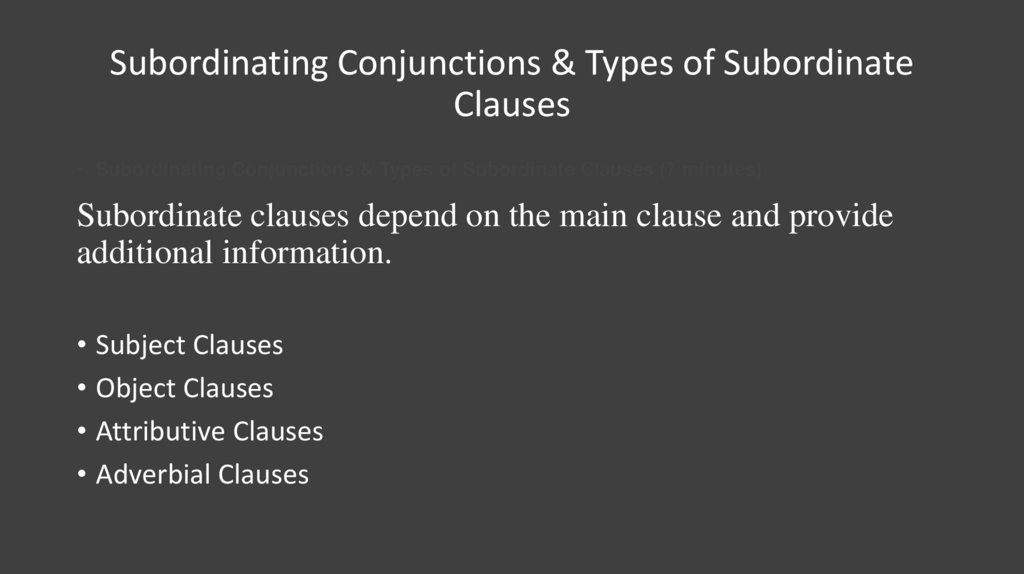
22. Subordinating Conjunctions & Types of Subordinate Clauses
Subordinating Conjunctions & Types of SubordinateClauses
• Subordinating Conjunctions & Types of Subordinate Clauses (7 minutes)
Subordinate clauses depend on the main clause and provide
additional information.
• Subject Clauses
• Object Clauses
• Attributive Clauses
• Adverbial Clauses
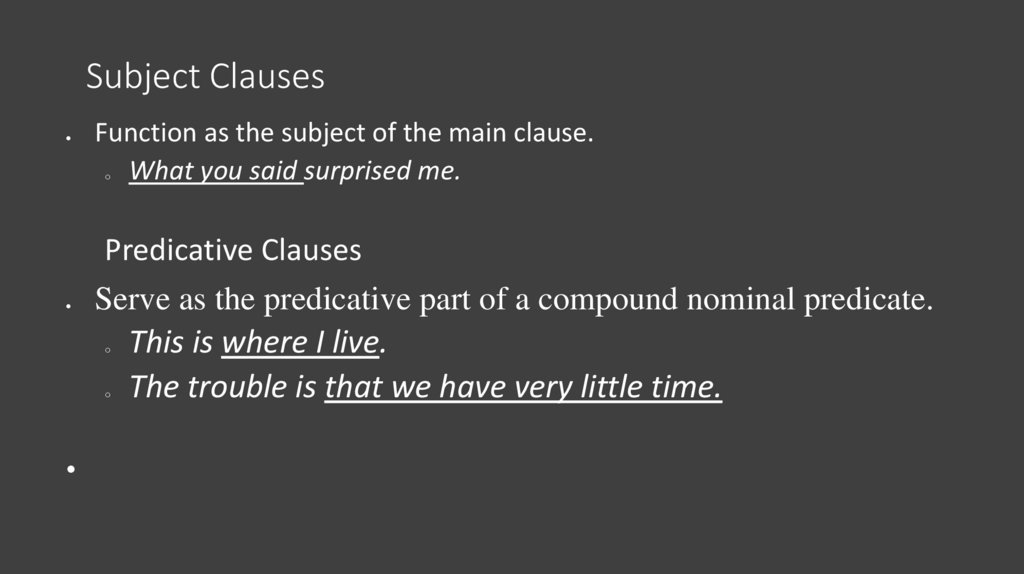
23. Subject Clauses
Function as the subject of the main clause.What you said surprised me.
o
Predicative Clauses
Serve as the predicative part of a compound nominal predicate.
This is where I live.
The trouble is that we have very little time.
o
o
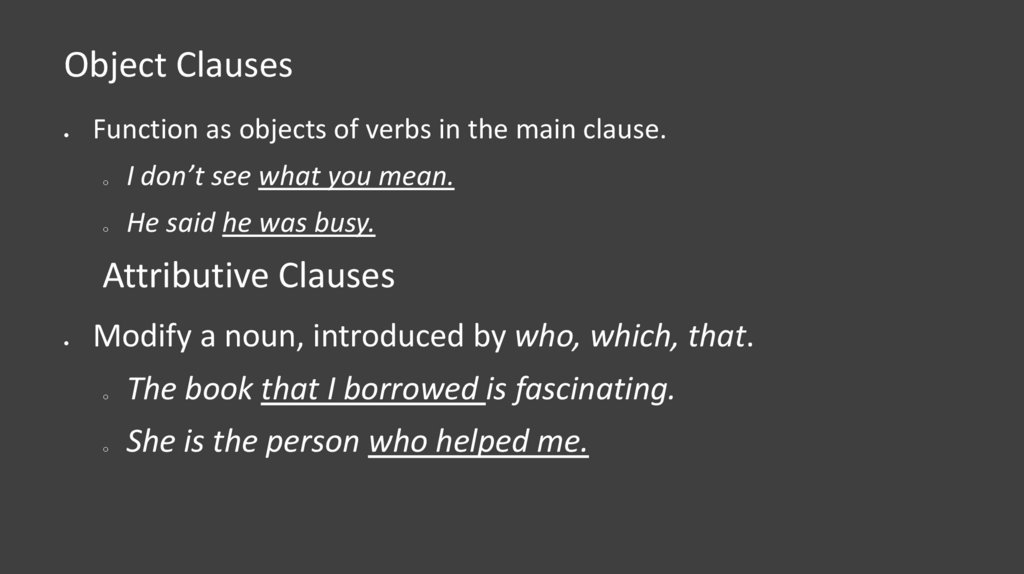
24. Object Clauses
Function as objects of verbs in the main clause.o
I don’t see what you mean.
o
He said he was busy.
Attributive Clauses
Modify a noun, introduced by who, which, that.
o
The book that I borrowed is fascinating.
o
She is the person who helped me.
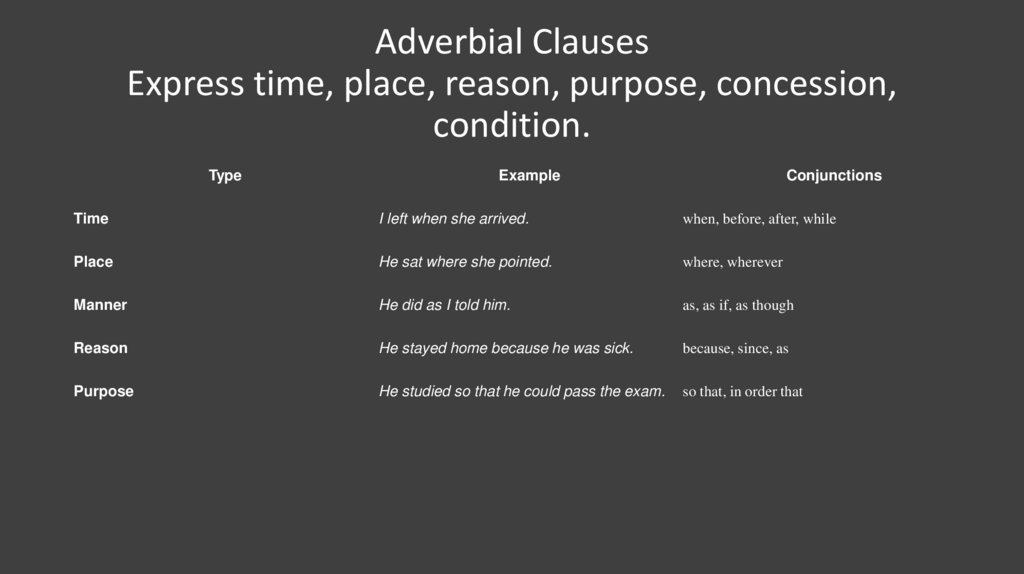
25. Adverbial Clauses Express time, place, reason, purpose, concession, condition.
TypeExample
Conjunctions
Time
I left when she arrived.
when, before, after, while
Place
He sat where she pointed.
where, wherever
Manner
He did as I told him.
as, as if, as though
Reason
He stayed home because he was sick.
because, since, as
Purpose
He studied so that he could pass the exam.
so that, in order that
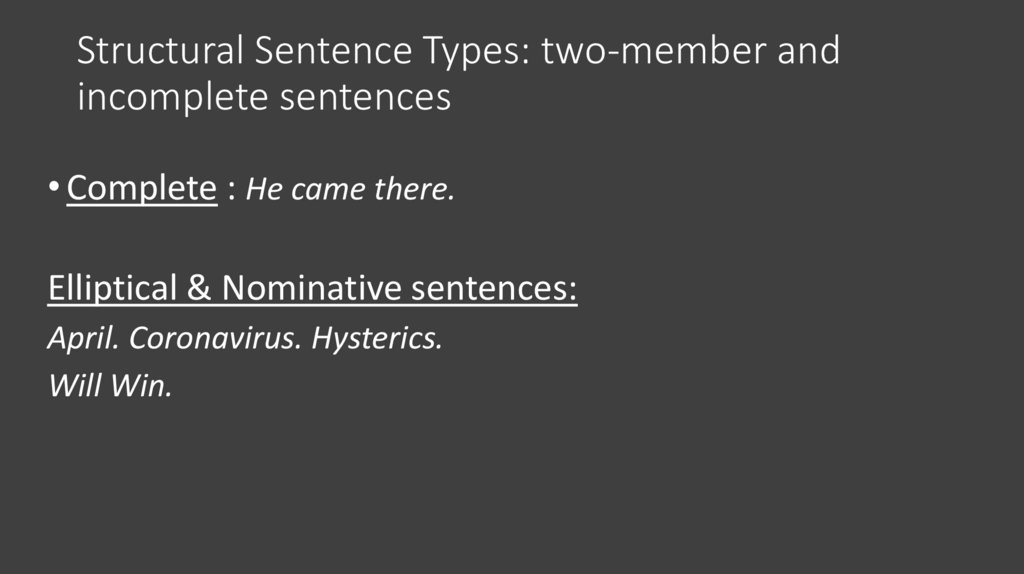
26. Structural Sentence Types: two-member and incomplete sentences
• Complete : He came there.Elliptical & Nominative sentences:
April. Coronavirus. Hysterics.
Will Win.
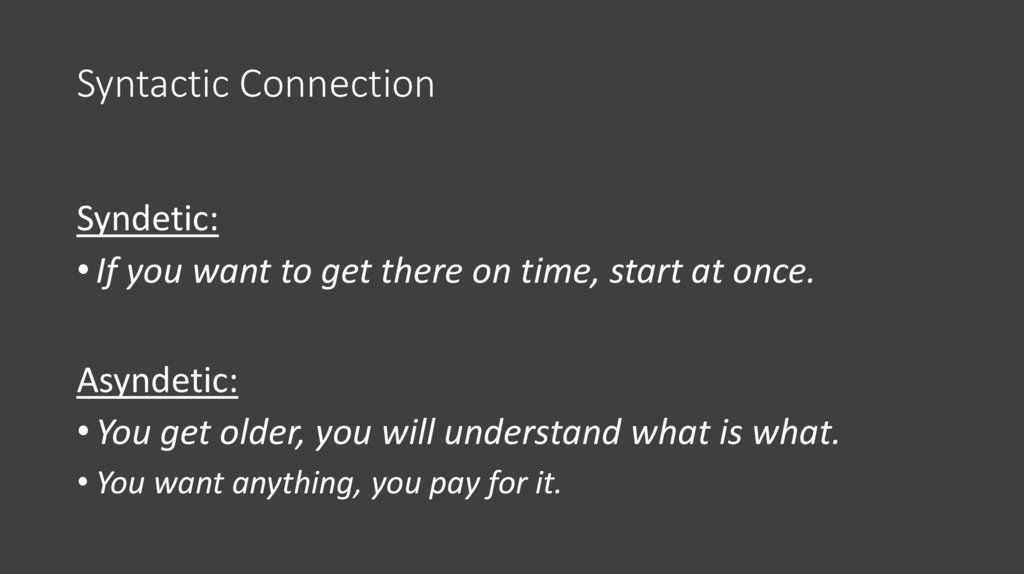
27. Syntactic Connection
Syndetic:• If you want to get there on time, start at once.
Asyndetic:
• You get older, you will understand what is what.
• You want anything, you pay for it.
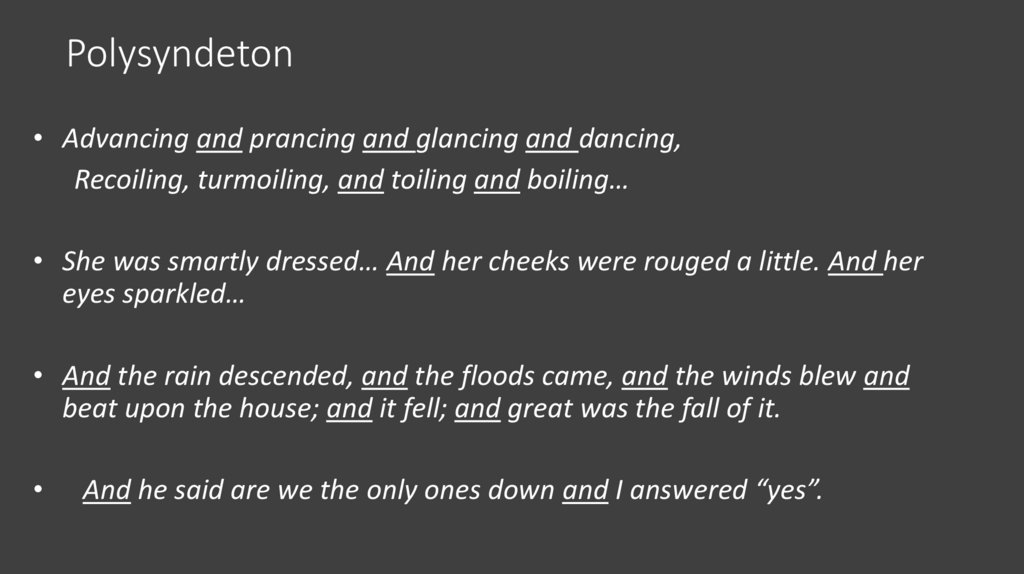
28. Polysyndeton
• Advancing and prancing and glancing and dancing,Recoiling, turmoiling, and toiling and boiling…
• She was smartly dressed… And her cheeks were rouged a little. And her
eyes sparkled…
• And the rain descended, and the floods came, and the winds blew and
beat upon the house; and it fell; and great was the fall of it.
And he said are we the only ones down and I answered “yes”.
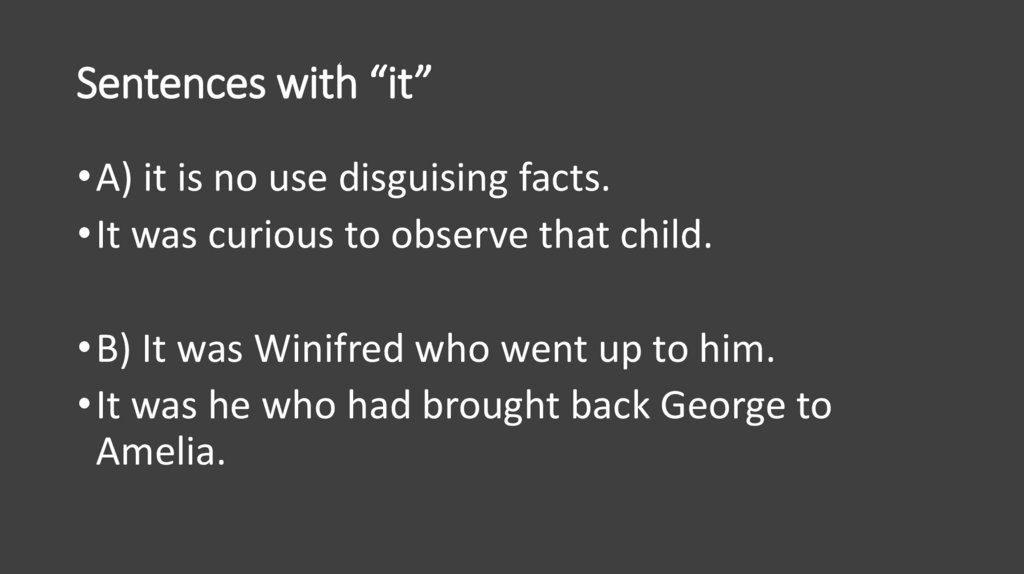
29. Sentences with “it”
• A) it is no use disguising facts.• It was curious to observe that child.
• B) It was Winifred who went up to him.
• It was he who had brought back George to
Amelia.
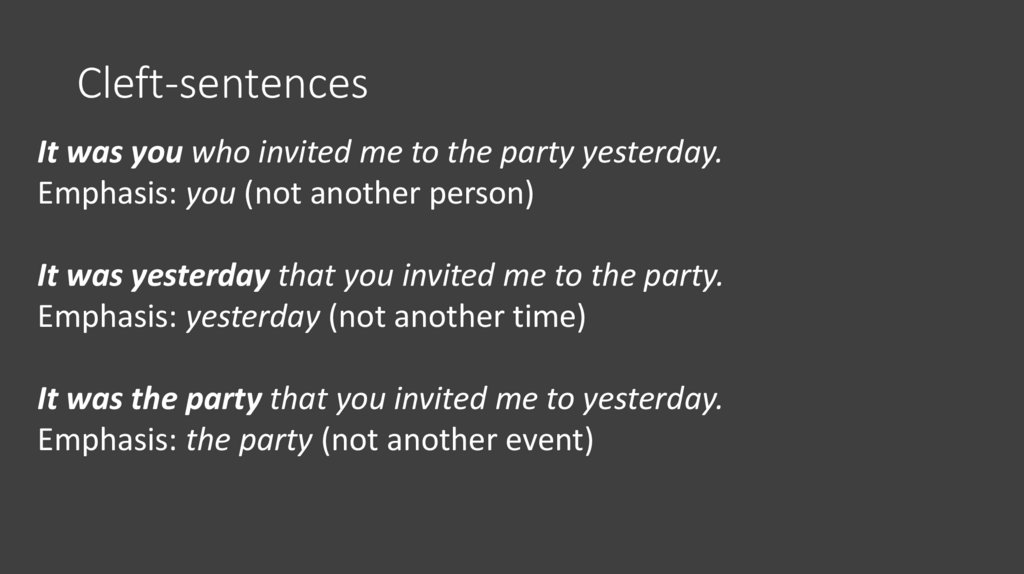
30. Cleft-sentences
It was you who invited me to the party yesterday.Emphasis: you (not another person)
It was yesterday that you invited me to the party.
Emphasis: yesterday (not another time)
It was the party that you invited me to yesterday.
Emphasis: the party (not another event)
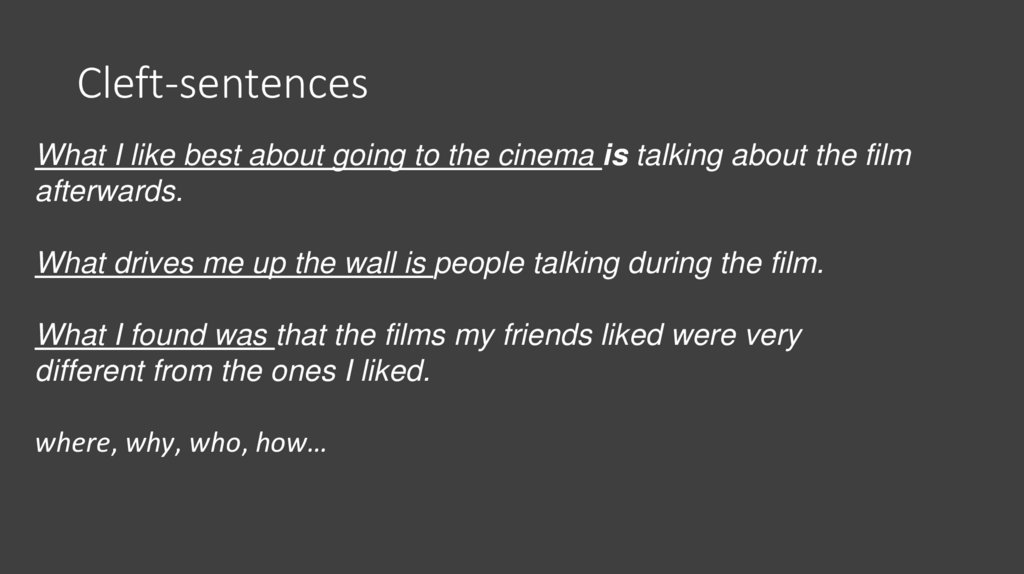
31. Cleft-sentences
What I like best about going to the cinema is talking about the filmafterwards.
What drives me up the wall is people talking during the film.
What I found was that the films my friends liked were very
different from the ones I liked.
where, why, who, how…
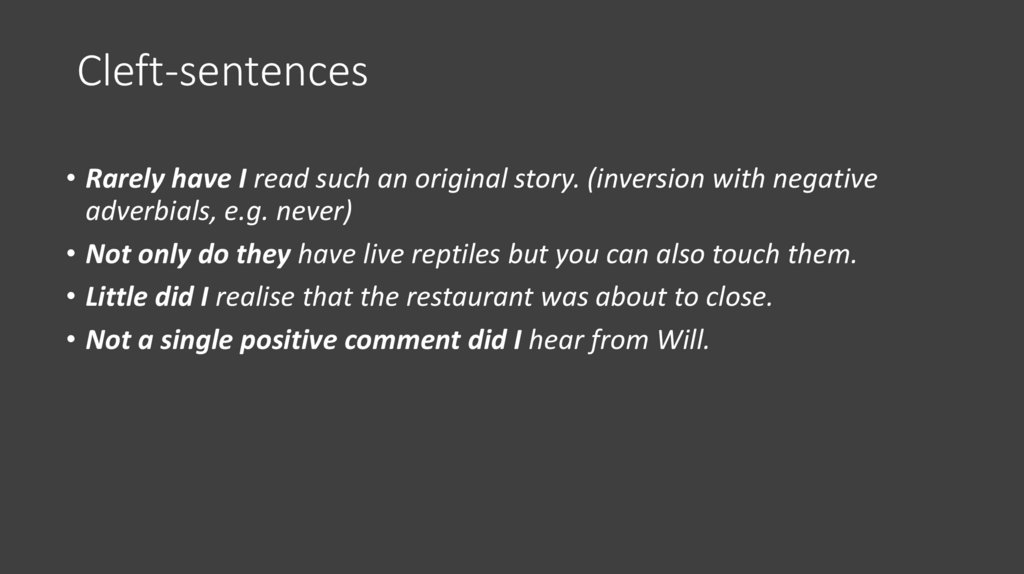
32. Cleft-sentences
• Rarely have I read such an original story. (inversion with negativeadverbials, e.g. never)
• Not only do they have live reptiles but you can also touch them.
• Little did I realise that the restaurant was about to close.
• Not a single positive comment did I hear from Will.