 История
Похожие презентации:








Kazakhstan in ancient, medieval and modern times
1.
Kazakhstan inancient, medieval
and modern times.
2.
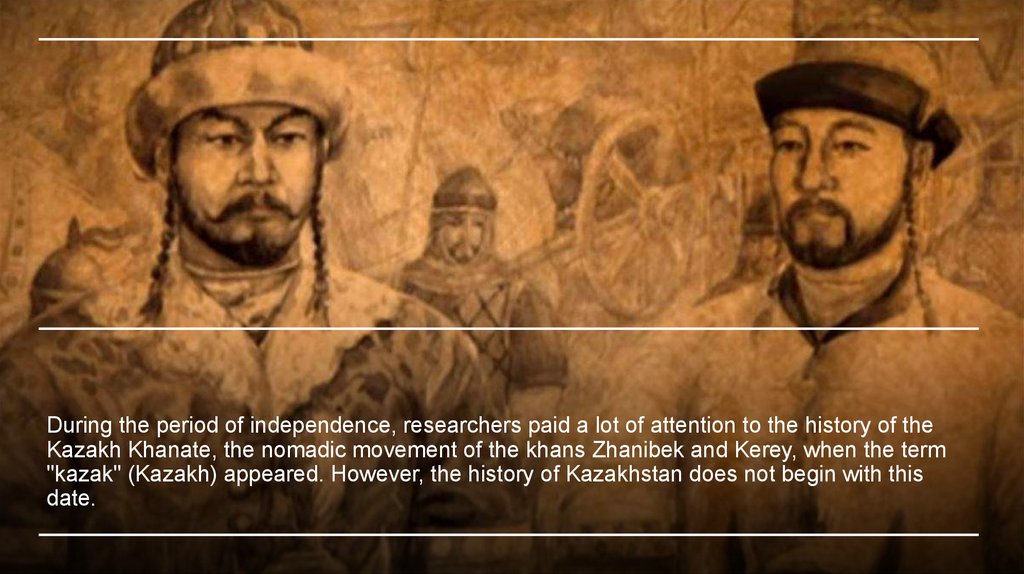
During the period of independence, researchers paid a lot of attention to the history of theKazakh Khanate, the nomadic movement of the khans Zhanibek and Kerey, when the term
"kazak" (Kazakh) appeared. However, the history of Kazakhstan does not begin with this
date.
3.
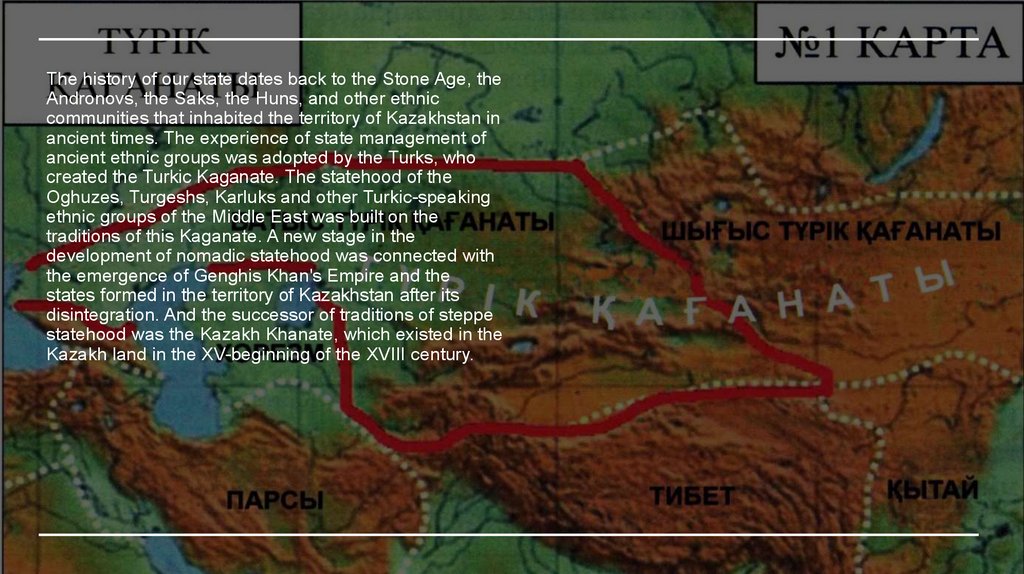
The history of our state dates back to the Stone Age, theAndronovs, the Saks, the Huns, and other ethnic
communities that inhabited the territory of Kazakhstan in
ancient times. The experience of state management of
ancient ethnic groups was adopted by the Turks, who
created the Turkic Kaganate. The statehood of the
Oghuzes, Turgeshs, Karluks and other Turkic-speaking
ethnic groups of the Middle East was built on the
traditions of this Kaganate. A new stage in the
development of nomadic statehood was connected with
the emergence of Genghis Khan's Empire and the
states formed in the territory of Kazakhstan after its
disintegration. And the successor of traditions of steppe
statehood was the Kazakh Khanate, which existed in the
Kazakh land in the XV-beginning of the XVIII century.
4.
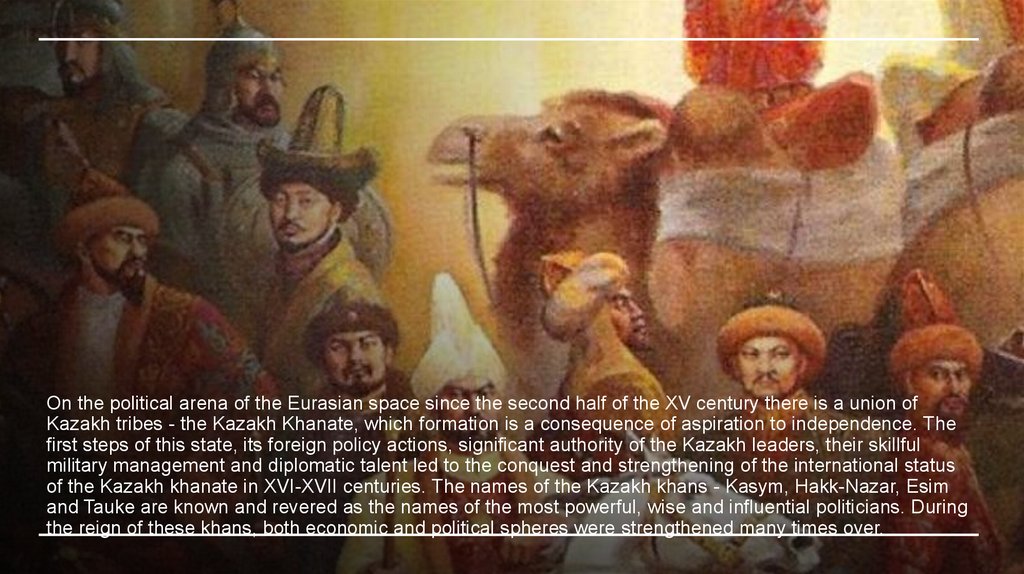
On the political arena of the Eurasian space since the second half of the XV century there is a union ofKazakh tribes - the Kazakh Khanate, which formation is a consequence of aspiration to independence. The
first steps of this state, its foreign policy actions, significant authority of the Kazakh leaders, their skillful
military management and diplomatic talent led to the conquest and strengthening of the international status
of the Kazakh khanate in XVI-XVII centuries. The names of the Kazakh khans - Kasym, Hakk-Nazar, Esim
and Tauke are known and revered as the names of the most powerful, wise and influential politicians. During
the reign of these khans, both economic and political spheres were strengthened many times over.
5.
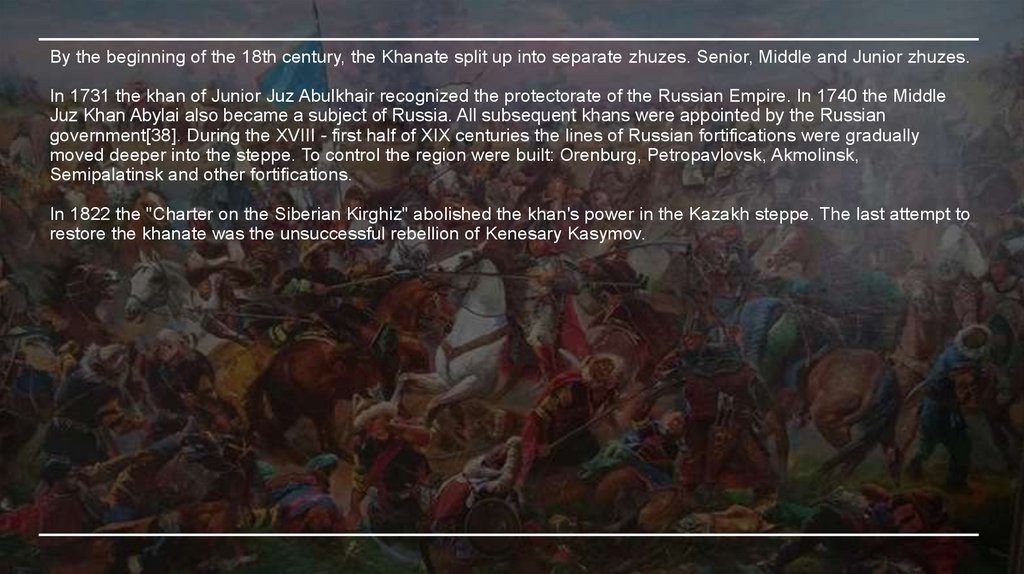
By the beginning of the 18th century, the Khanate split up into separate zhuzes. Senior, Middle and Junior zhuzes.In 1731 the khan of Junior Juz Abulkhair recognized the protectorate of the Russian Empire. In 1740 the Middle
Juz Khan Abylai also became a subject of Russia. All subsequent khans were appointed by the Russian
government[38]. During the XVIII - first half of XIX centuries the lines of Russian fortifications were gradually
moved deeper into the steppe. To control the region were built: Orenburg, Petropavlovsk, Akmolinsk,
Semipalatinsk and other fortifications.
In 1822 the "Charter on the Siberian Kirghiz" abolished the khan's power in the Kazakh steppe. The last attempt to
restore the khanate was the unsuccessful rebellion of Kenesary Kasymov.
6.
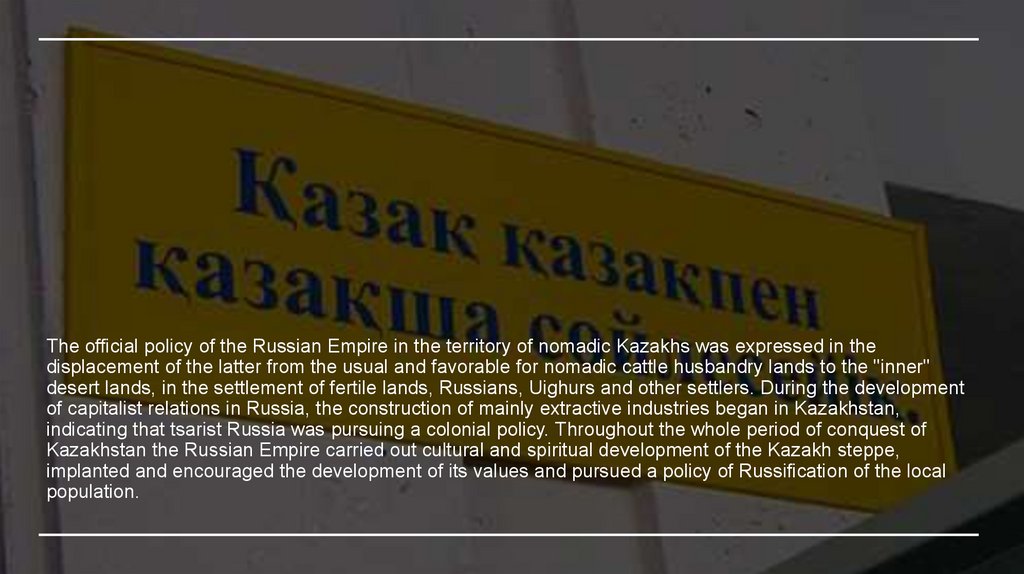
The official policy of the Russian Empire in the territory of nomadic Kazakhs was expressed in thedisplacement of the latter from the usual and favorable for nomadic cattle husbandry lands to the "inner"
desert lands, in the settlement of fertile lands, Russians, Uighurs and other settlers. During the development
of capitalist relations in Russia, the construction of mainly extractive industries began in Kazakhstan,
indicating that tsarist Russia was pursuing a colonial policy. Throughout the whole period of conquest of
Kazakhstan the Russian Empire carried out cultural and spiritual development of the Kazakh steppe,
implanted and encouraged the development of its values and pursued a policy of Russification of the local
population.
7.
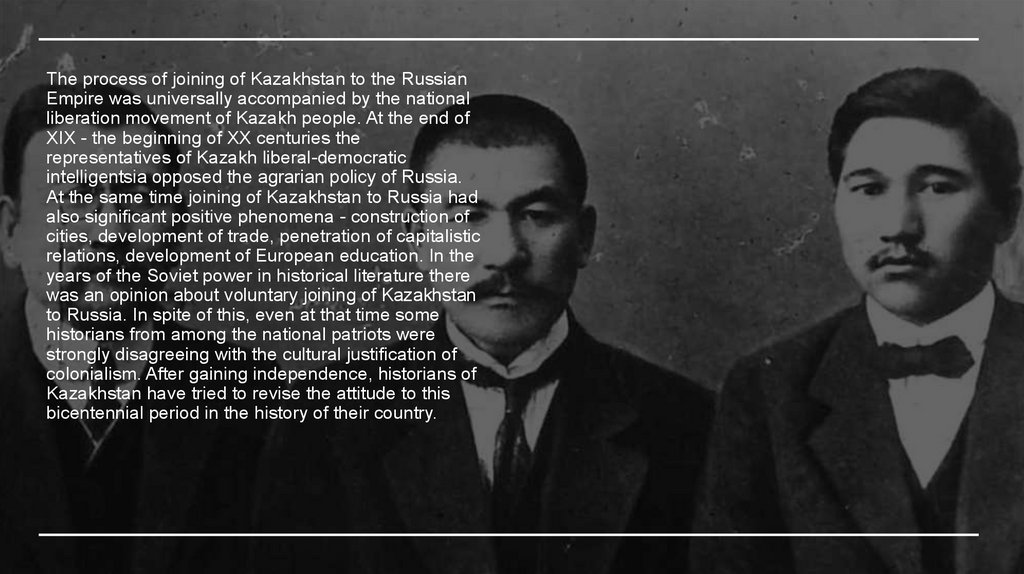
The process of joining of Kazakhstan to the RussianEmpire was universally accompanied by the national
liberation movement of Kazakh people. At the end of
XIX - the beginning of XX centuries the
representatives of Kazakh liberal-democratic
intelligentsia opposed the agrarian policy of Russia.
At the same time joining of Kazakhstan to Russia had
also significant positive phenomena - construction of
cities, development of trade, penetration of capitalistic
relations, development of European education. In the
years of the Soviet power in historical literature there
was an opinion about voluntary joining of Kazakhstan
to Russia. In spite of this, even at that time some
historians from among the national patriots were
strongly disagreeing with the cultural justification of
colonialism. After gaining independence, historians of
Kazakhstan have tried to revise the attitude to this
bicentennial period in the history of their country.
8.
The President of the Republic of Kazakhstan is thehead of state, the highest official and commander-inchief of the Armed Forces of the Republic of
Kazakhstan. His powers are determined by a
special section of the Constitution of the Republic of
Kazakhstan.
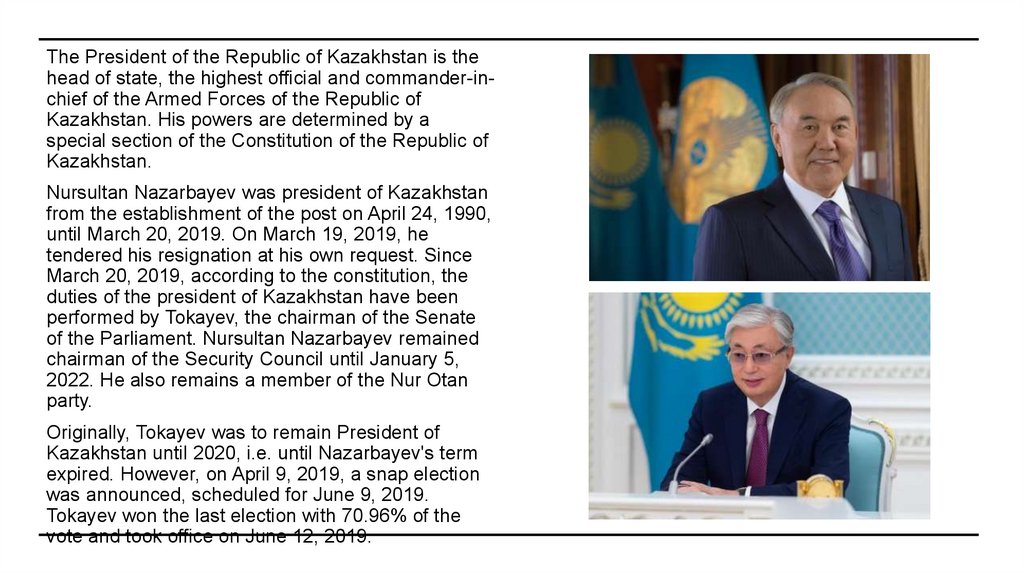
Nursultan Nazarbayev was president of Kazakhstan
from the establishment of the post on April 24, 1990,
until March 20, 2019. On March 19, 2019, he
tendered his resignation at his own request. Since
March 20, 2019, according to the constitution, the
duties of the president of Kazakhstan have been
performed by Tokayev, the chairman of the Senate
of the Parliament. Nursultan Nazarbayev remained
chairman of the Security Council until January 5,
2022. He also remains a member of the Nur Otan
party.
Originally, Tokayev was to remain President of
Kazakhstan until 2020, i.e. until Nazarbayev's term
expired. However, on April 9, 2019, a snap election
was announced, scheduled for June 9, 2019.
Tokayev won the last election with 70.96% of the
vote and took office on June 12, 2019.
9.
Sources:Исторические пути формирования
Казахстанской государственности
(articlekz.com)
Президент Республики Казахстан —
Википедия (wikipedia.org)
Истоки и преемственность казахской
государственности: древность,
средневековье и новое время. (poisk-ru.ru)