



Похожие презентации:




Abo and rh isoimmunisation
1. ABO and Rh ISOIMMUNISATION
Professor. Surendra Nath Panda, M.SDept. of Obstetrics & Gynaecology
M.K.C.G.Medical College
Berhampur-760004, Orissa, India
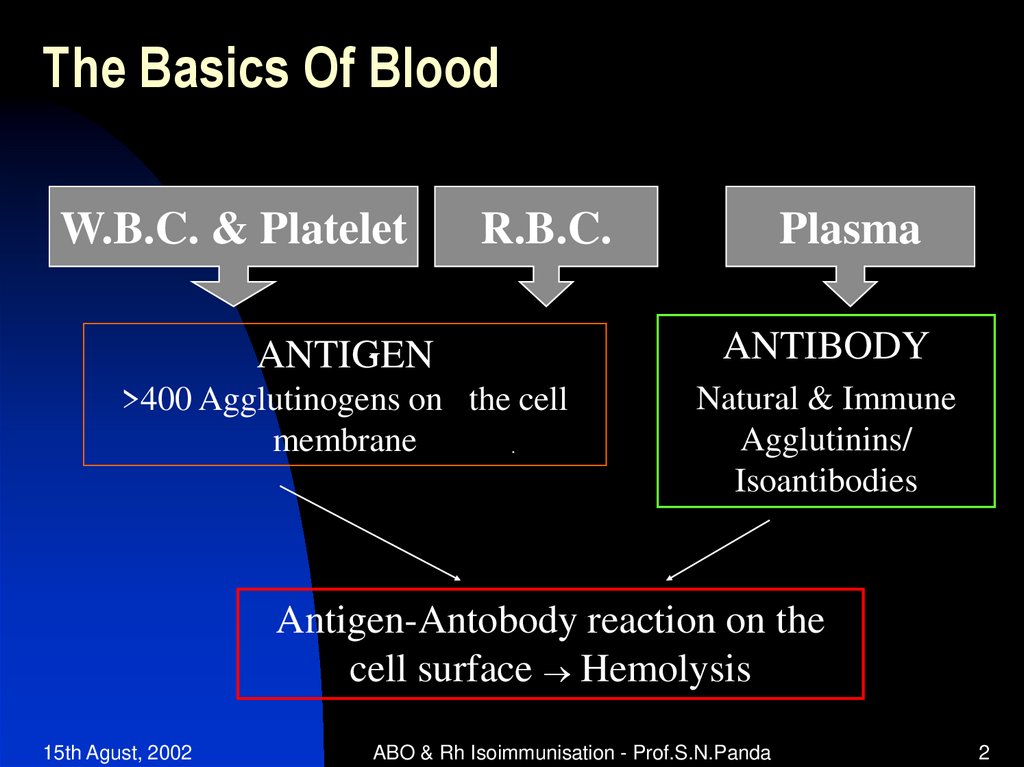
2. The Basics Of Blood
W.B.C. & PlateletR.B.C.
Plasma
ANTIGEN
ANTIBODY
>400 Agglutinogens on the cell
membrane
Natural & Immune
Agglutinins/
Isoantibodies
Antigen-Antobody reaction on the
cell surface Hemolysis
15th Agust, 2002
ABO & Rh Isoimmunisation - Prof.S.N.Panda
2
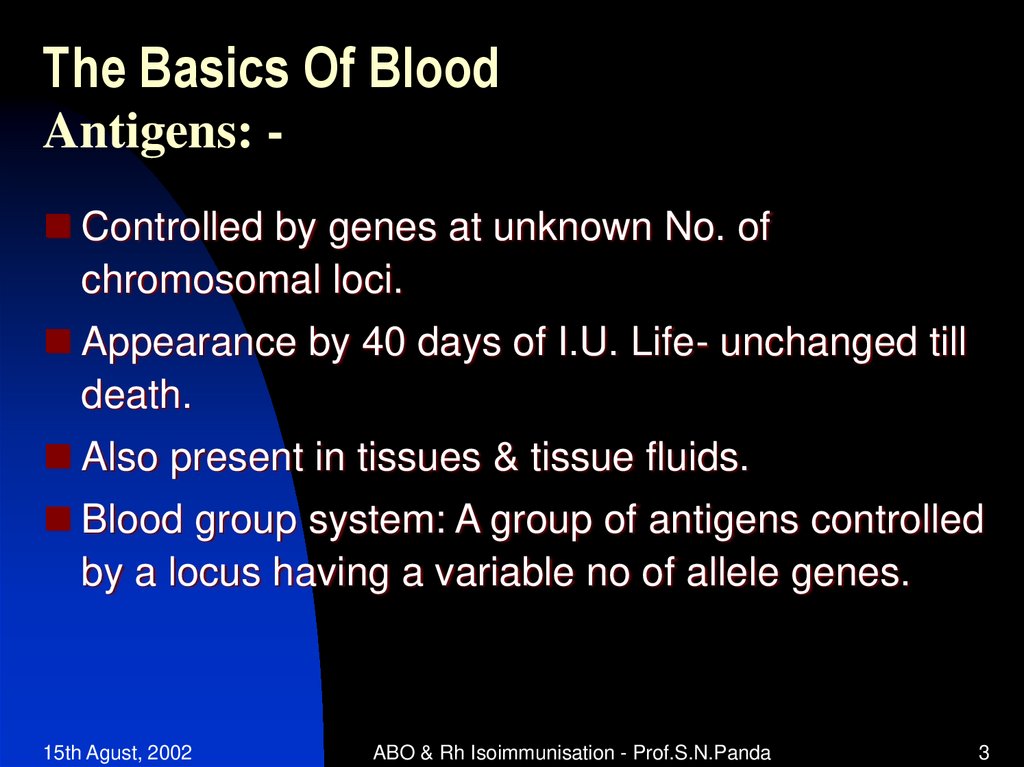
3. The Basics Of Blood
Antigens: Controlled by genes at unknown No. ofchromosomal loci.
Appearance by 40 days of I.U. Life- unchanged till
death.
Also present in tissues & tissue fluids.
Blood group system: A group of antigens controlled
by a locus having a variable no of allele genes.
15th Agust, 2002
ABO & Rh Isoimmunisation - Prof.S.N.Panda
3
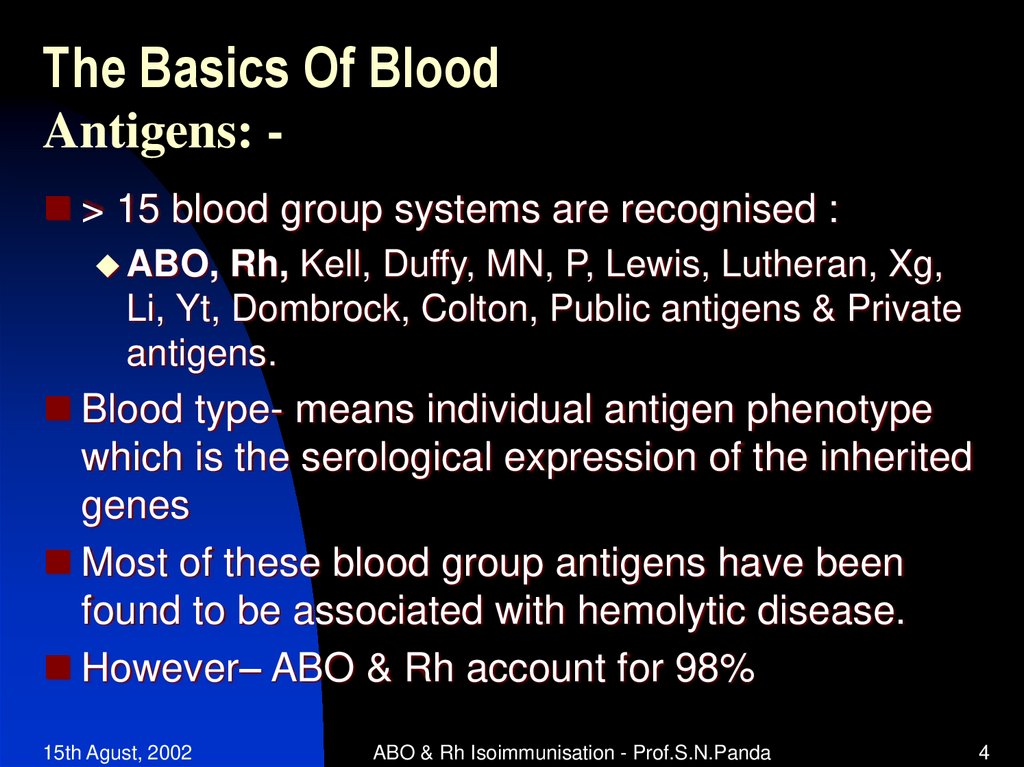
4. The Basics Of Blood
Antigens: > 15 blood group systems are recognised :ABO,
Rh, Kell, Duffy, MN, P, Lewis, Lutheran, Xg,
Li, Yt, Dombrock, Colton, Public antigens & Private
antigens.
Blood type- means individual antigen phenotype
which is the serological expression of the inherited
genes
Most of these blood group antigens have been
found to be associated with hemolytic disease.
However– ABO & Rh account for 98%
15th Agust, 2002
ABO & Rh Isoimmunisation - Prof.S.N.Panda
4
5. The Basics Of Blood
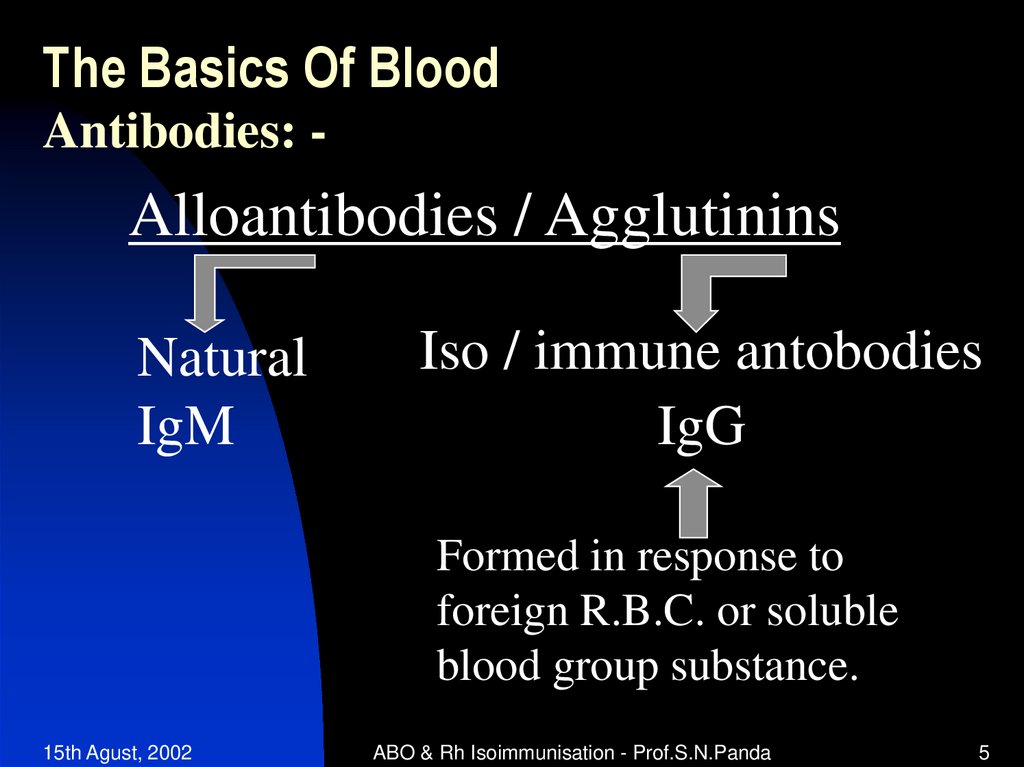
Antibodies: -Alloantibodies / Agglutinins
Natural
IgM
Iso / immune antobodies
IgG
Formed in response to
foreign R.B.C. or soluble
blood group substance.
15th Agust, 2002
ABO & Rh Isoimmunisation - Prof.S.N.Panda
5
6. The Basics Of Blood
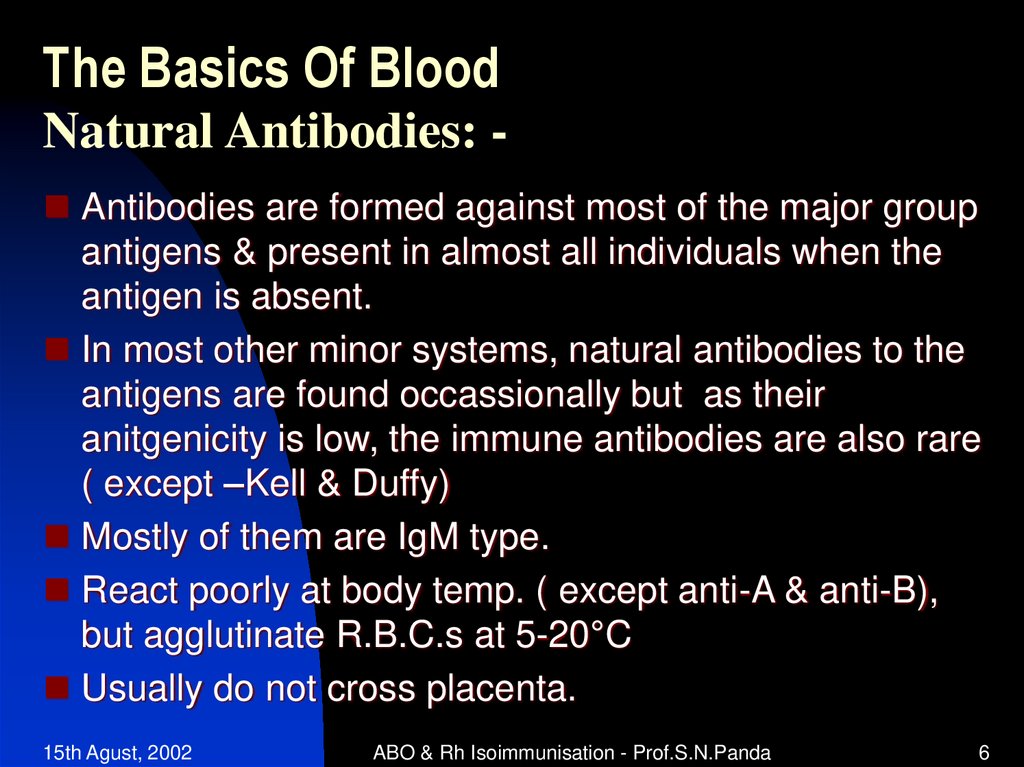
Natural Antibodies: Antibodies are formed against most of the major groupantigens & present in almost all individuals when the
antigen is absent.
In most other minor systems, natural antibodies to the
antigens are found occassionally but as their
anitgenicity is low, the immune antibodies are also rare
( except –Kell & Duffy)
Mostly of them are IgM type.
React poorly at body temp. ( except anti-A & anti-B),
but agglutinate R.B.C.s at 5-20°C
Usually do not cross placenta.
15th Agust, 2002
ABO & Rh Isoimmunisation - Prof.S.N.Panda
6
7. The Basics Of Blood
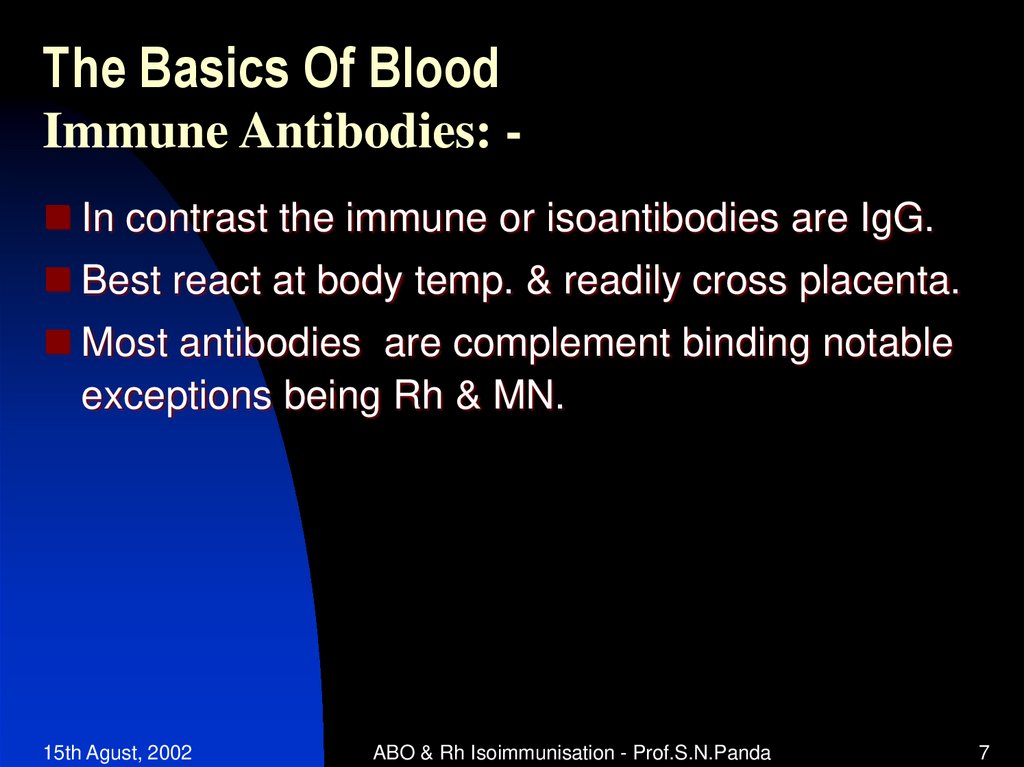
Immune Antibodies: In contrast the immune or isoantibodies are IgG.Best react at body temp. & readily cross placenta.
Most antibodies are complement binding notable
exceptions being Rh & MN.
15th Agust, 2002
ABO & Rh Isoimmunisation - Prof.S.N.Panda
7
8. Antibodies Can Be Detected by: -
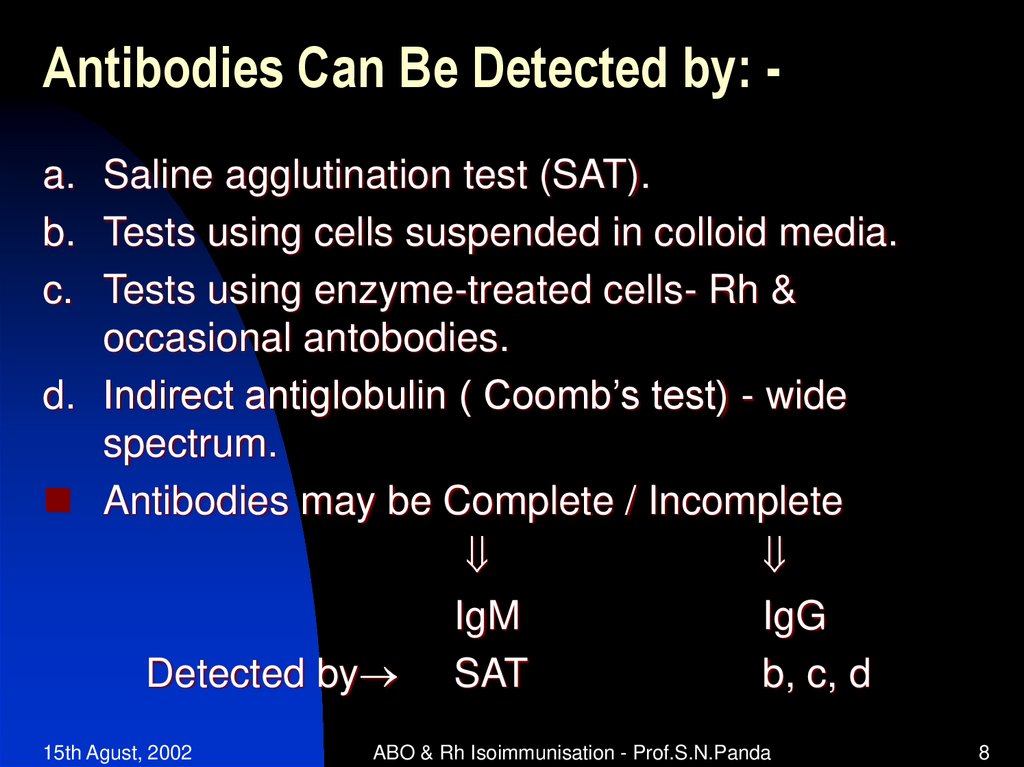
Antibodies Can Be Detected by: a. Saline agglutination test (SAT).b. Tests using cells suspended in colloid media.
c. Tests using enzyme-treated cells- Rh &
occasional antobodies.
d. Indirect antiglobulin ( Coomb’s test) - wide
spectrum.
Antibodies may be Complete / Incomplete
IgM
IgG
Detected by SAT
b, c, d
15th Agust, 2002
ABO & Rh Isoimmunisation - Prof.S.N.Panda
8
9. ABO Blood Group System
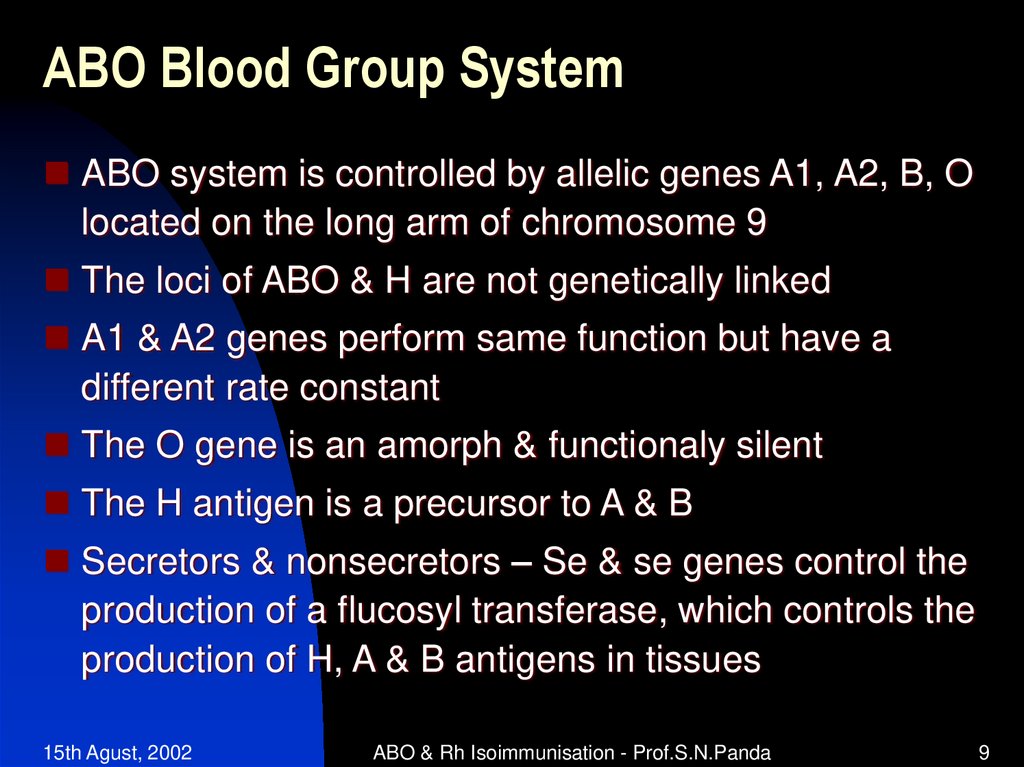
ABO system is controlled by allelic genes A1, A2, B, Olocated on the long arm of chromosome 9
The loci of ABO & H are not genetically linked
A1 & A2 genes perform same function but have a
different rate constant
The O gene is an amorph & functionaly silent
The H antigen is a precursor to A & B
Secretors & nonsecretors – Se & se genes control the
production of a flucosyl transferase, which controls the
production of H, A & B antigens in tissues
15th Agust, 2002
ABO & Rh Isoimmunisation - Prof.S.N.Panda
9
10. ABO Blood Group System
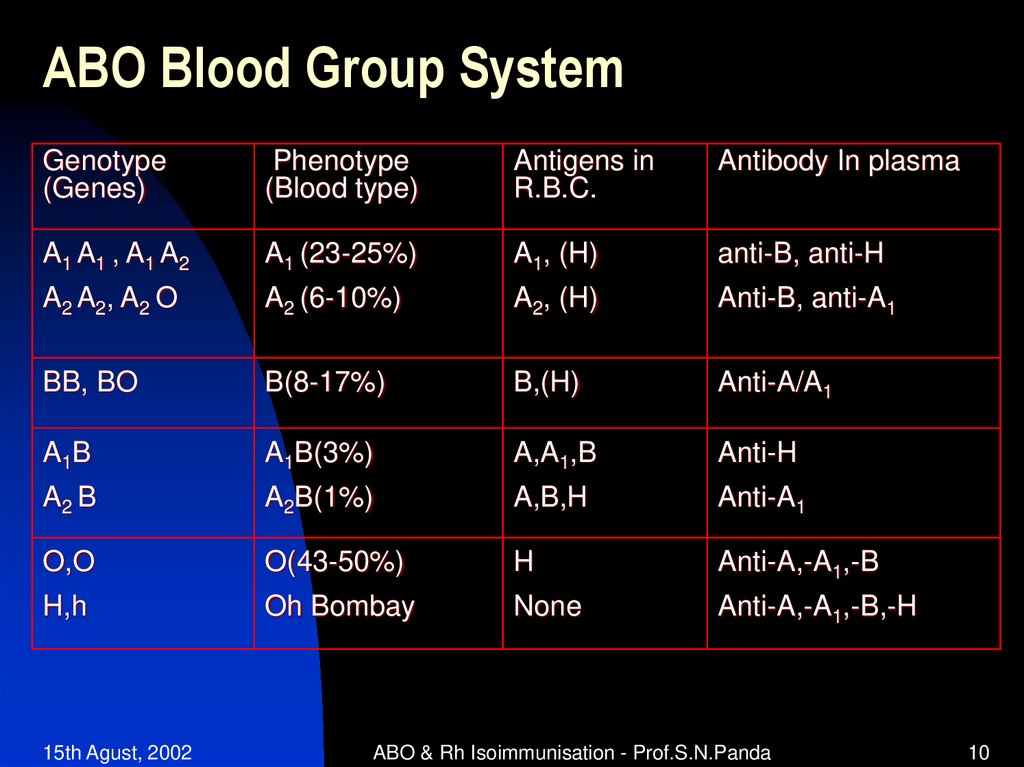
Genotype(Genes)
Phenotype
(Blood type)
Antigens in
R.B.C.
Antibody In plasma
A1 A1 , A1 A2
A1 (23-25%)
A1, (H)
anti-B, anti-H
A2 A2, A2 O
A2 (6-10%)
A2, (H)
Anti-B, anti-A1
BB, BO
B(8-17%)
B,(H)
Anti-A/A1
A1B
A1B(3%)
A,A1,B
Anti-H
A2 B
A2B(1%)
A,B,H
Anti-A1
O,O
O(43-50%)
H
Anti-A,-A1,-B
H,h
Oh Bombay
None
Anti-A,-A1,-B,-H
15th Agust, 2002
ABO & Rh Isoimmunisation - Prof.S.N.Panda
10
11. ABO System & Pregnancy
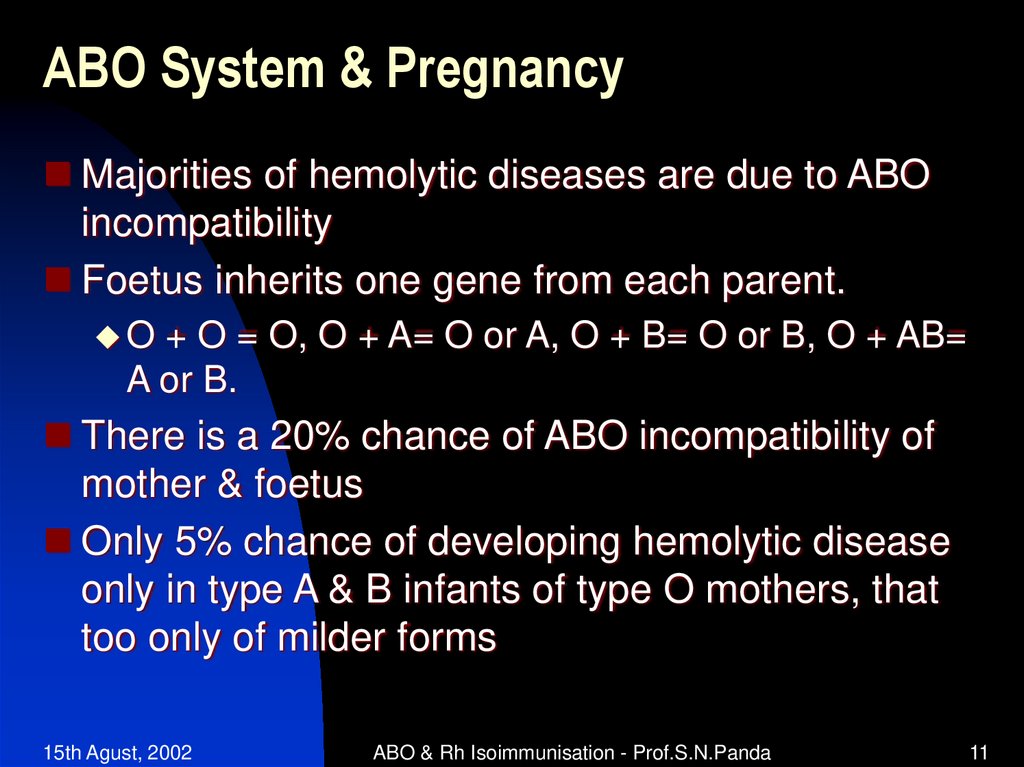
ABO System & PregnancyMajorities of hemolytic diseases are due to ABO
incompatibility
Foetus inherits one gene from each parent.
O
+ O = O, O + A= O or A, O + B= O or B, O + AB=
A or B.
There is a 20% chance of ABO incompatibility of
mother & foetus
Only 5% chance of developing hemolytic disease
only in type A & B infants of type O mothers, that
too only of milder forms
15th Agust, 2002
ABO & Rh Isoimmunisation - Prof.S.N.Panda
11
12. ABO System & Pregnancy
ABO System & PregnancyIn foetus & newborn, RBCs have a decreased No.
of H, A & B reactive sites
The foetal immunoglobulin production is low, so the
plasma contains very little of anti-A & B agglutinins
Anti-A & B produced in the mother being natural
are IgM molecules & so do not cross placenta.
In some type O adults, much of the anti-A & B and
anti-AB (a cross reacting antibody, also called antiC) isoagglutinins are of IgG class.
15th Agust, 2002
ABO & Rh Isoimmunisation - Prof.S.N.Panda
12
13. ABO System & Pregnancy
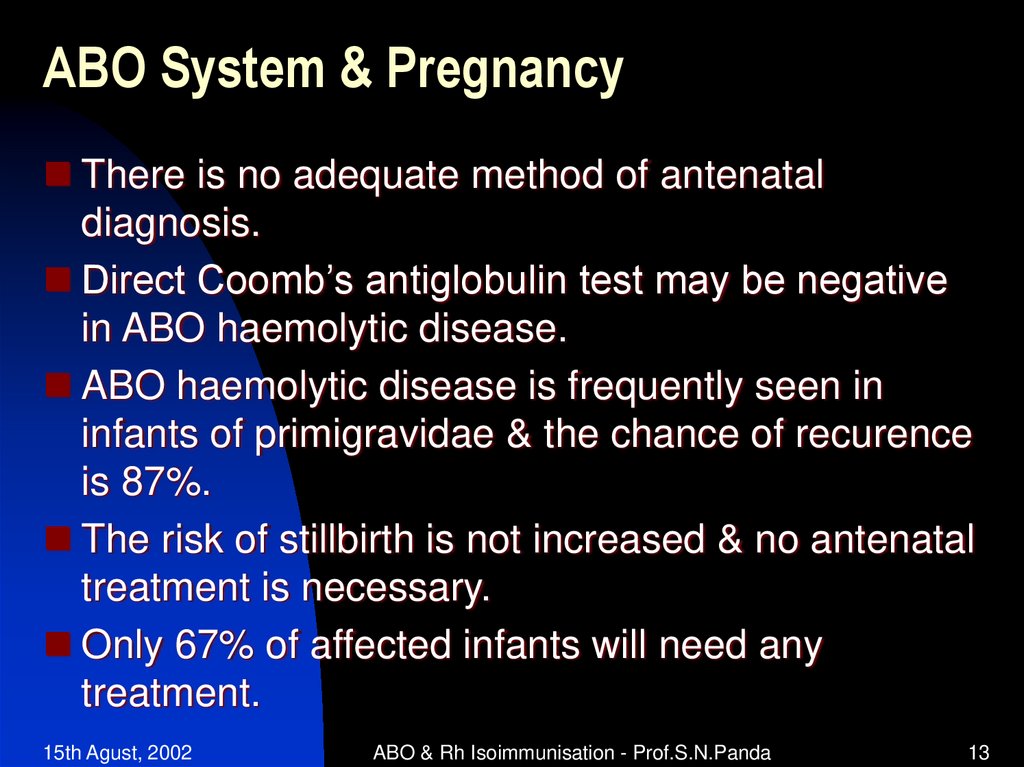
ABO System & PregnancyThere is no adequate method of antenatal
diagnosis.
Direct Coomb’s antiglobulin test may be negative
in ABO haemolytic disease.
ABO haemolytic disease is frequently seen in
infants of primigravidae & the chance of recurence
is 87%.
The risk of stillbirth is not increased & no antenatal
treatment is necessary.
Only 67% of affected infants will need any
treatment.
15th Agust, 2002
ABO & Rh Isoimmunisation - Prof.S.N.Panda
13
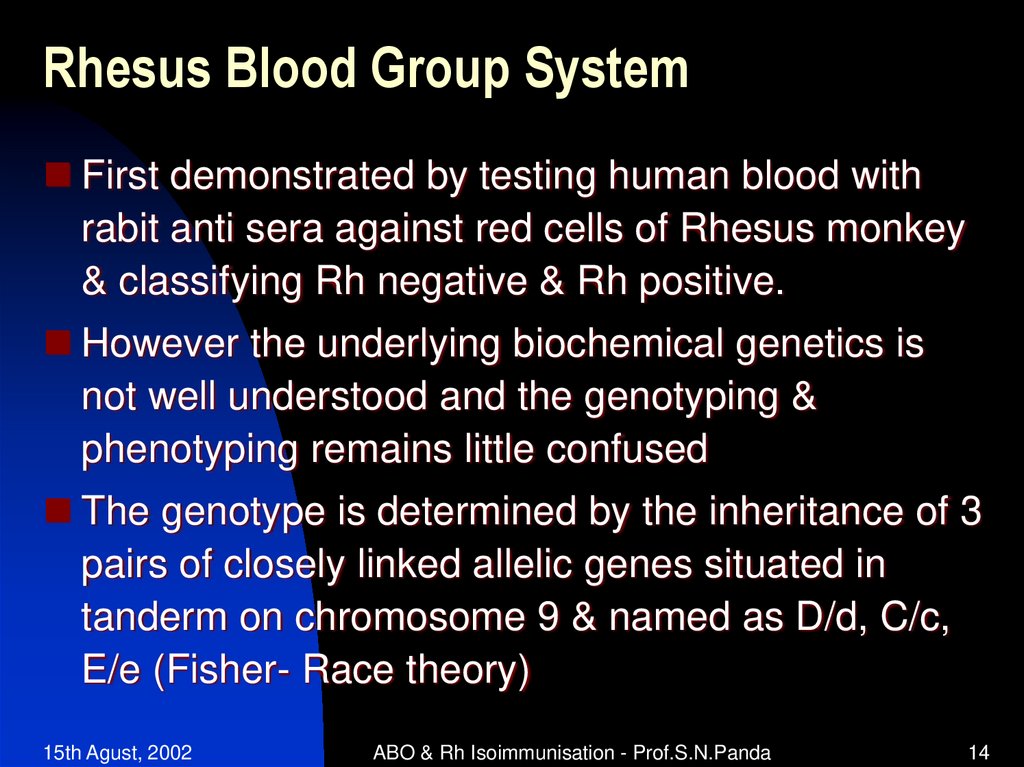
14. Rhesus Blood Group System
First demonstrated by testing human blood withrabit anti sera against red cells of Rhesus monkey
& classifying Rh negative & Rh positive.
However the underlying biochemical genetics is
not well understood and the genotyping &
phenotyping remains little confused
The genotype is determined by the inheritance of 3
pairs of closely linked allelic genes situated in
tanderm on chromosome 9 & named as D/d, C/c,
E/e (Fisher- Race theory)
15th Agust, 2002
ABO & Rh Isoimmunisation - Prof.S.N.Panda
14
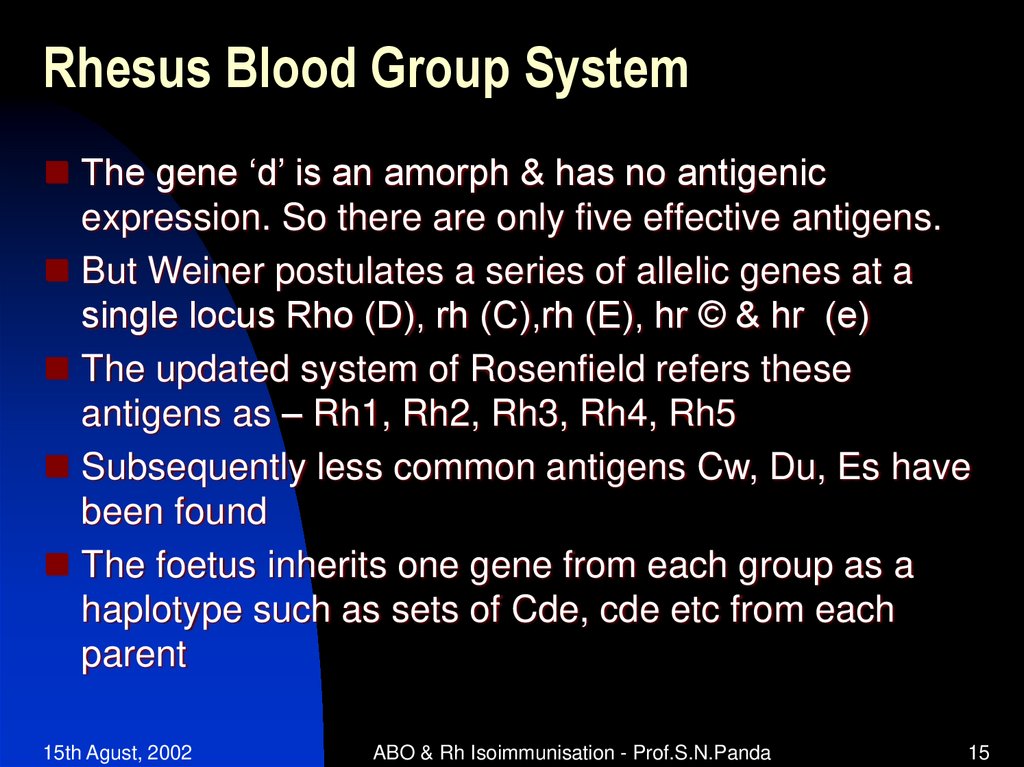
15. Rhesus Blood Group System
The gene ‘d’ is an amorph & has no antigenicexpression. So there are only five effective antigens.
But Weiner postulates a series of allelic genes at a
single locus Rho (D), rh (C),rh (E), hr © & hr (e)
The updated system of Rosenfield refers these
antigens as – Rh1, Rh2, Rh3, Rh4, Rh5
Subsequently less common antigens Cw, Du, Es have
been found
The foetus inherits one gene from each group as a
haplotype such as sets of Cde, cde etc from each
parent
15th Agust, 2002
ABO & Rh Isoimmunisation - Prof.S.N.Panda
15
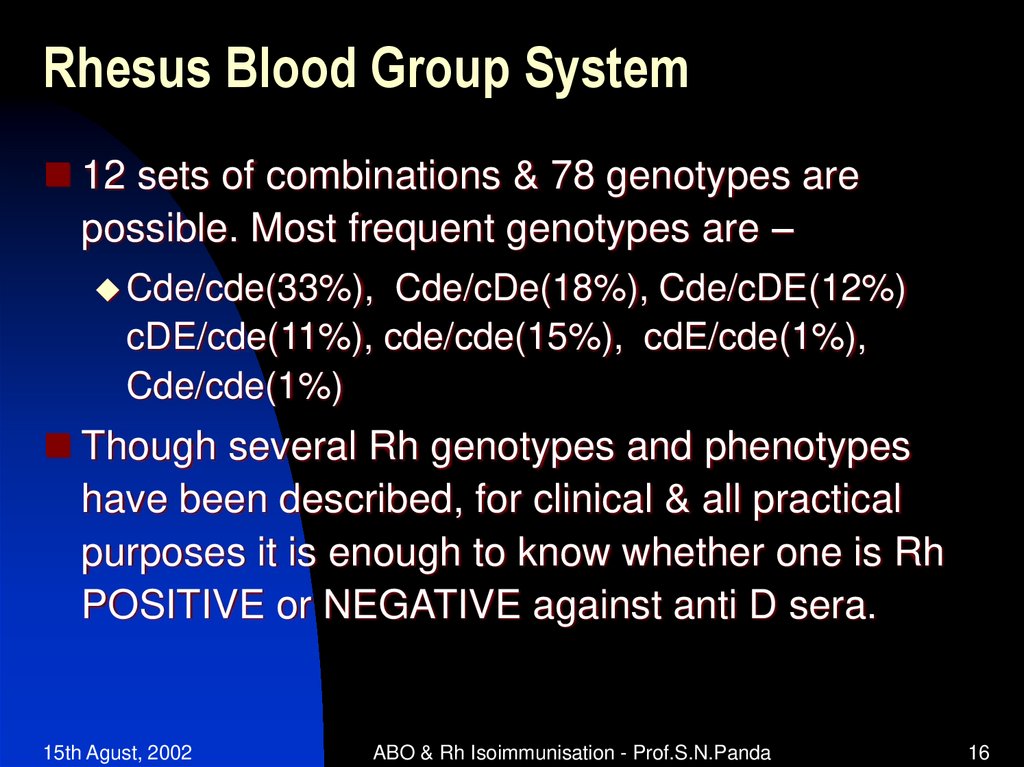
16. Rhesus Blood Group System
12 sets of combinations & 78 genotypes arepossible. Most frequent genotypes are –
Cde/cde(33%),
Cde/cDe(18%), Cde/cDE(12%)
cDE/cde(11%), cde/cde(15%), cdE/cde(1%),
Cde/cde(1%)
Though several Rh genotypes and phenotypes
have been described, for clinical & all practical
purposes it is enough to know whether one is Rh
POSITIVE or NEGATIVE against anti D sera.
15th Agust, 2002
ABO & Rh Isoimmunisation - Prof.S.N.Panda
16
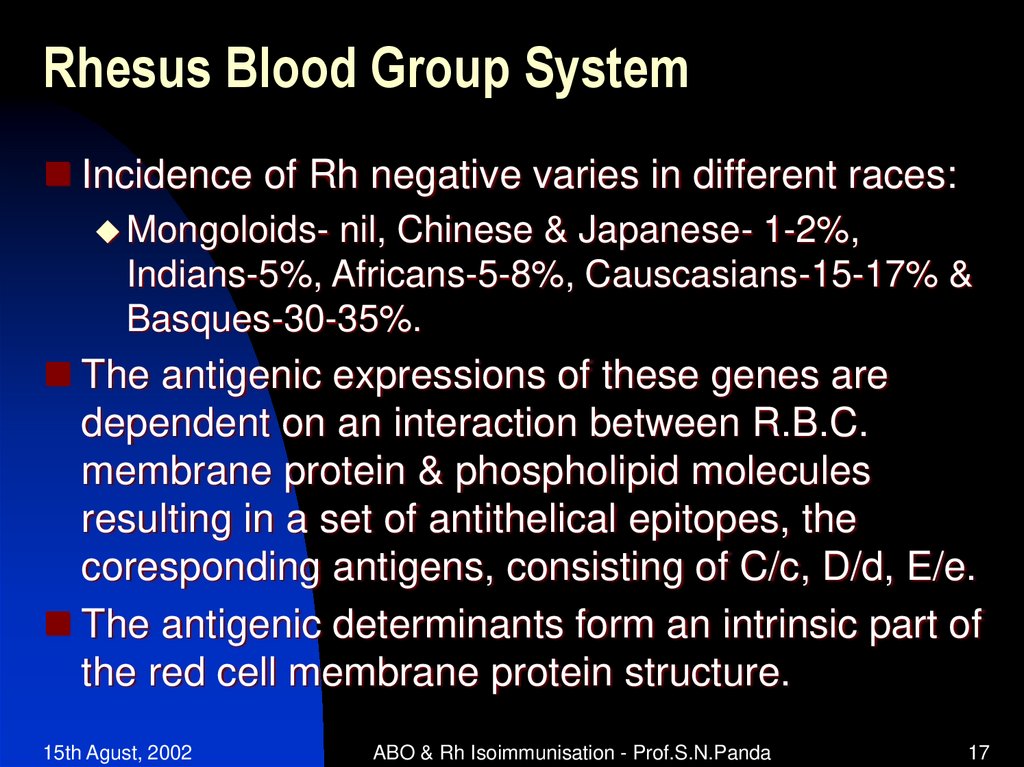
17. Rhesus Blood Group System
Incidence of Rh negative varies in different races:Mongoloids-
nil, Chinese & Japanese- 1-2%,
Indians-5%, Africans-5-8%, Causcasians-15-17% &
Basques-30-35%.
The antigenic expressions of these genes are
dependent on an interaction between R.B.C.
membrane protein & phospholipid molecules
resulting in a set of antithelical epitopes, the
coresponding antigens, consisting of C/c, D/d, E/e.
The antigenic determinants form an intrinsic part of
the red cell membrane protein structure.
15th Agust, 2002
ABO & Rh Isoimmunisation - Prof.S.N.Panda
17
18. Rhesus Blood Group System
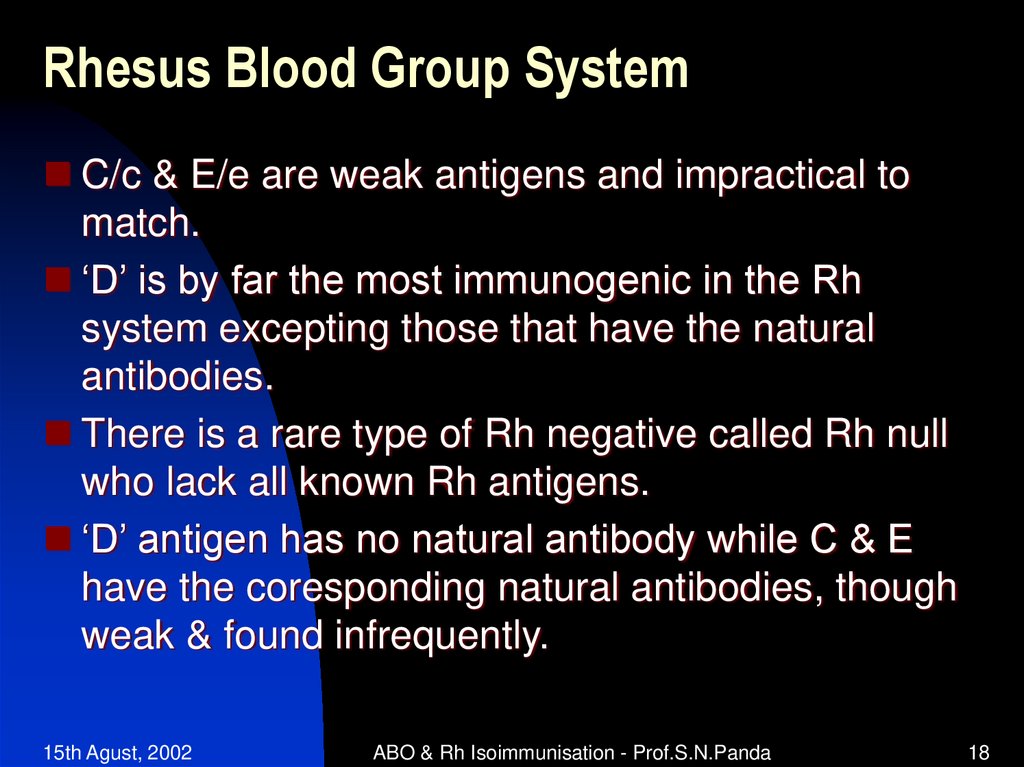
C/c & E/e are weak antigens and impractical tomatch.
‘D’ is by far the most immunogenic in the Rh
system excepting those that have the natural
antibodies.
There is a rare type of Rh negative called Rh null
who lack all known Rh antigens.
‘D’ antigen has no natural antibody while C & E
have the coresponding natural antibodies, though
weak & found infrequently.
15th Agust, 2002
ABO & Rh Isoimmunisation - Prof.S.N.Panda
18
19. Rhesus Blood Group System
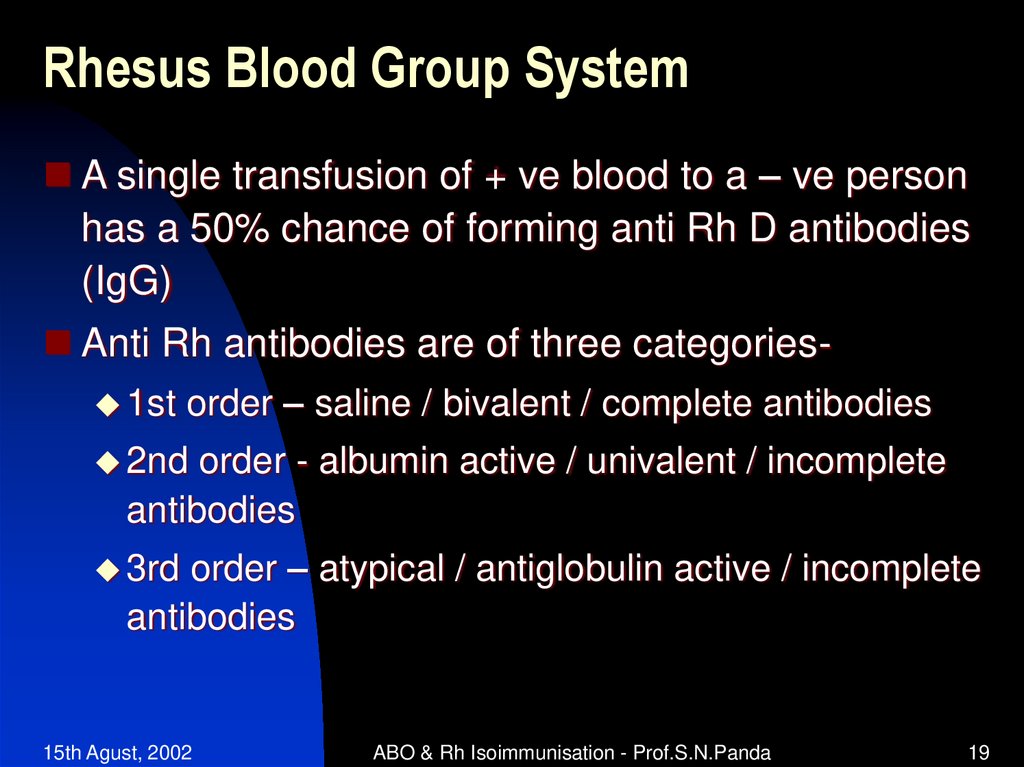
A single transfusion of + ve blood to a – ve personhas a 50% chance of forming anti Rh D antibodies
(IgG)
Anti Rh antibodies are of three categories 1st
order – saline / bivalent / complete antibodies
2nd
order - albumin active / univalent / incomplete
antibodies
order – atypical / antiglobulin active / incomplete
antibodies
3rd
15th Agust, 2002
ABO & Rh Isoimmunisation - Prof.S.N.Panda
19
20. Pathogenesis Of Rh Iso-immunisation
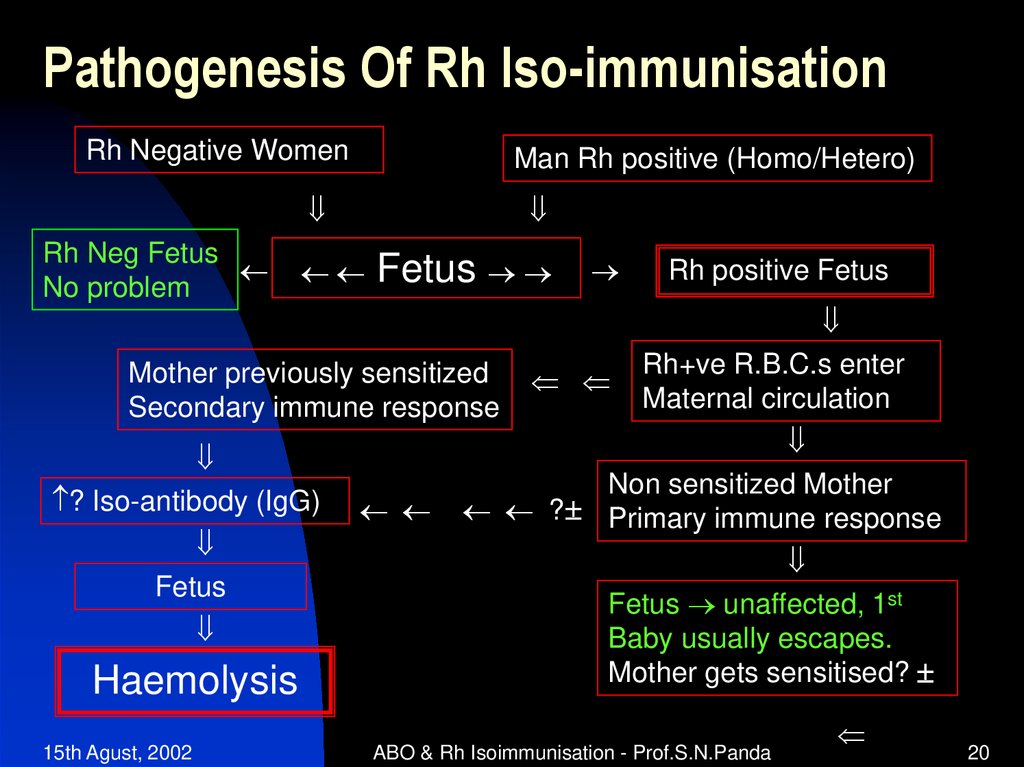
Rh Negative WomenMan Rh positive (Homo/Hetero)
Rh Neg Fetus
No problem
Fetus
Mother previously sensitized
Secondary immune response
? Iso-antibody (IgG)
Fetus
Haemolysis
15th Agust, 2002
Rh positive Fetus
Rh+ve R.B.C.s enter
Maternal circulation
Non sensitized Mother
? Primary immune response
Fetus unaffected, 1st
Baby usually escapes.
Mother gets sensitised?
ABO & Rh Isoimmunisation - Prof.S.N.Panda
20
21. Pathogenesis Of Rh Iso-immunisation
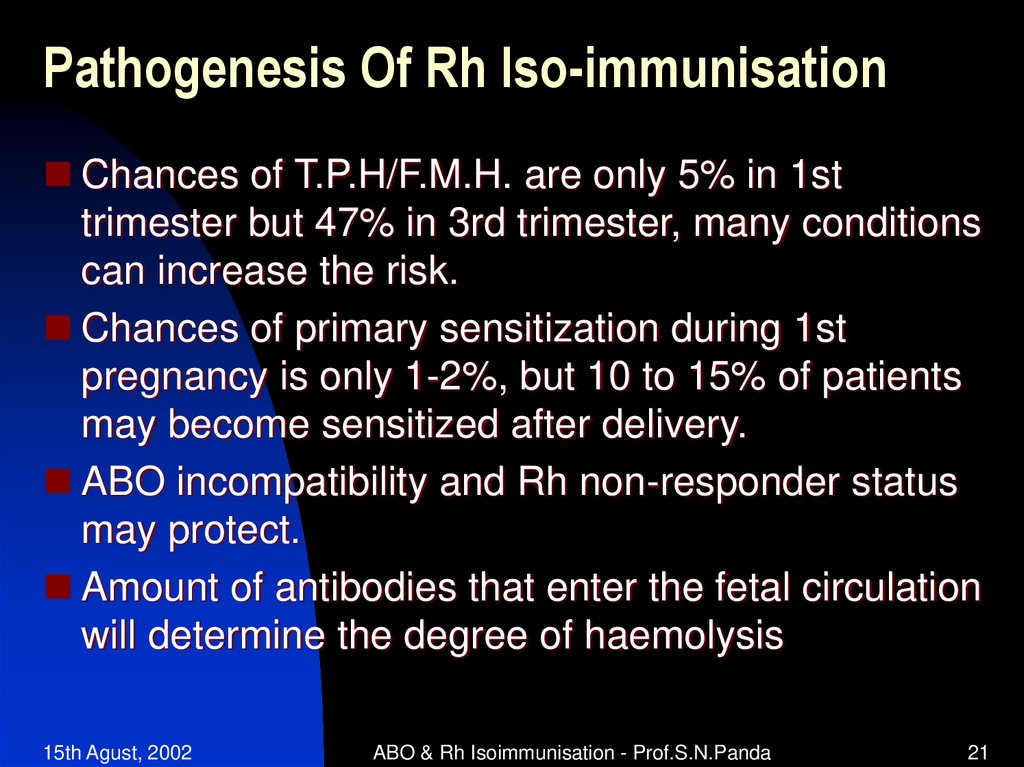
Chances of T.P.H/F.M.H. are only 5% in 1sttrimester but 47% in 3rd trimester, many conditions
can increase the risk.
Chances of primary sensitization during 1st
pregnancy is only 1-2%, but 10 to 15% of patients
may become sensitized after delivery.
ABO incompatibility and Rh non-responder status
may protect.
Amount of antibodies that enter the fetal circulation
will determine the degree of haemolysis
15th Agust, 2002
ABO & Rh Isoimmunisation - Prof.S.N.Panda
21
22. Pathology Of Iso-immunisation
AFTER BIRTHHAEMOLYSIS
Jaundice
Kernicterus
Hepatic Failure
DEATH
ANAEMIA
IUD
ERYTHROBLASTOSIS
FETALIS
IN UTERO
BILLIRUBIN
HEPATIC
ERYTHROPOESIS
& DYSFUNCTION
MAT. LIV NO
EFFECT
PORTAL & UMBILICAL VEIN
HYPERTNSION, HEART FAILURE
BIRTH OF AN AFFECTED INFANT - Wide spectrum of presentations. Rapid
deterioration of the infant after birth. May contiune for few days to few months.
Chance of delayed anaemia at 6-8 weeks probably due to persistance of anti Rh
antibodies.
15th Agust, 2002
ABO & Rh Isoimmunisation - Prof.S.N.Panda
22
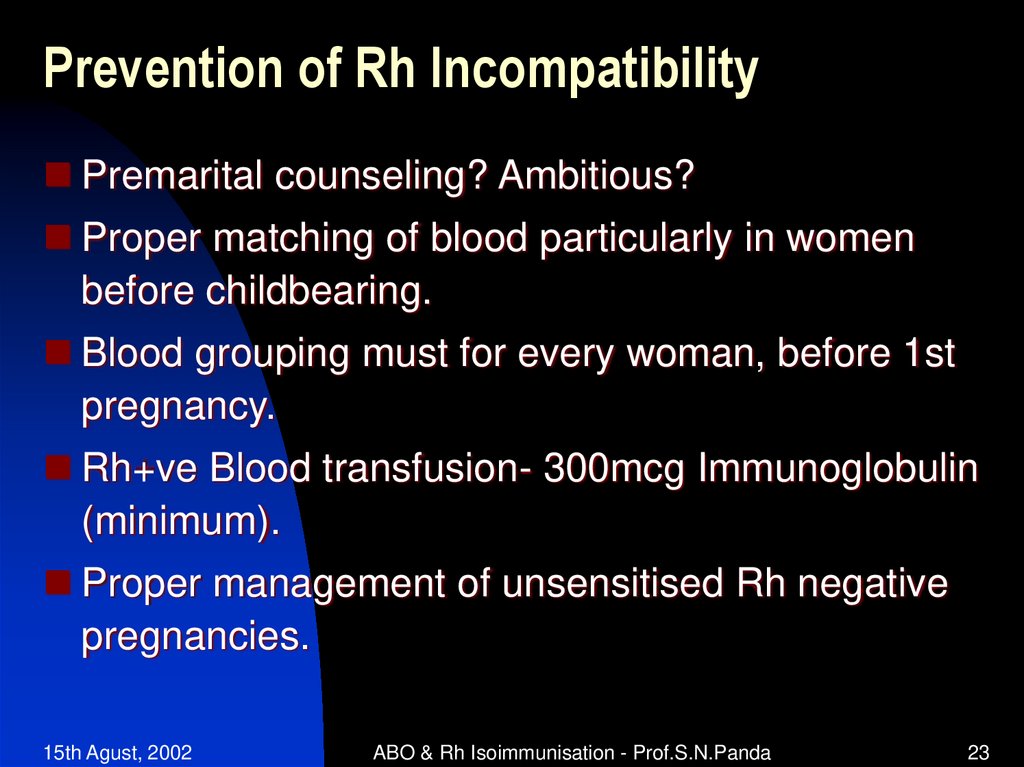
23. Prevention of Rh Incompatibility
Premarital counseling? Ambitious?Proper matching of blood particularly in women
before childbearing.
Blood grouping must for every woman, before 1st
pregnancy.
Rh+ve Blood transfusion- 300mcg Immunoglobulin
(minimum).
Proper management of unsensitised Rh negative
pregnancies.
15th Agust, 2002
ABO & Rh Isoimmunisation - Prof.S.N.Panda
23
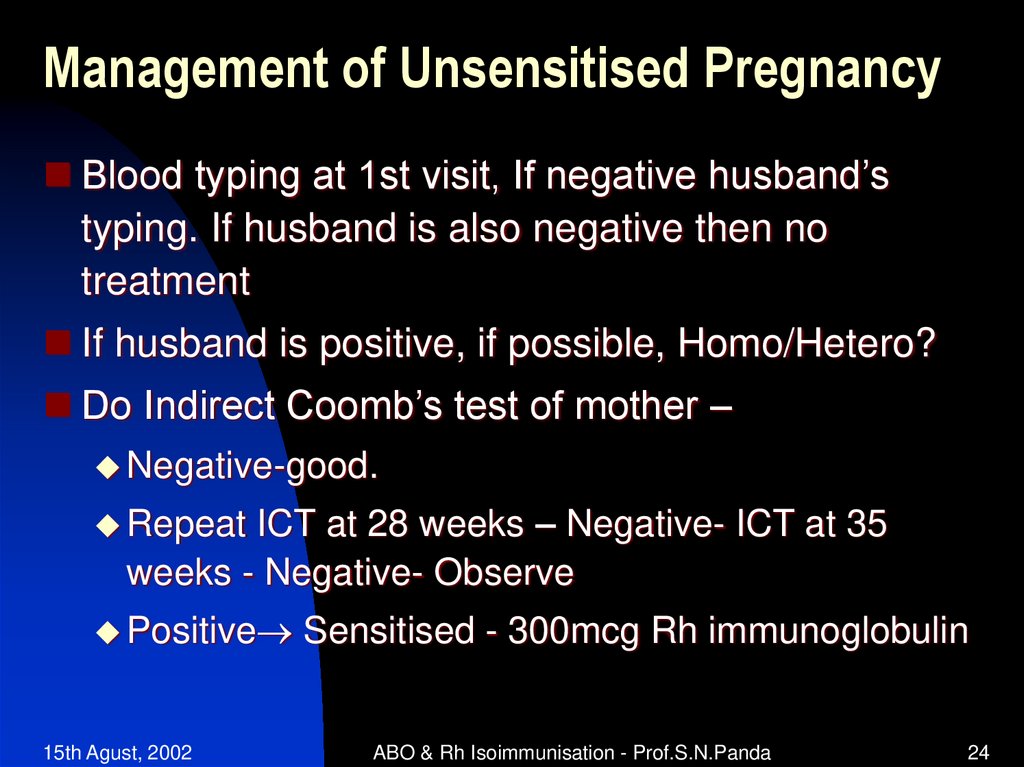
24. Management of Unsensitised Pregnancy
Blood typing at 1st visit, If negative husband’styping. If husband is also negative then no
treatment
If husband is positive, if possible, Homo/Hetero?
Do Indirect Coomb’s test of mother –
Negative-good.
ICT at 28 weeks – Negative- ICT at 35
weeks - Negative- Observe
Repeat
Positive
15th Agust, 2002
Sensitised - 300mcg Rh immunoglobulin
ABO & Rh Isoimmunisation - Prof.S.N.Panda
24
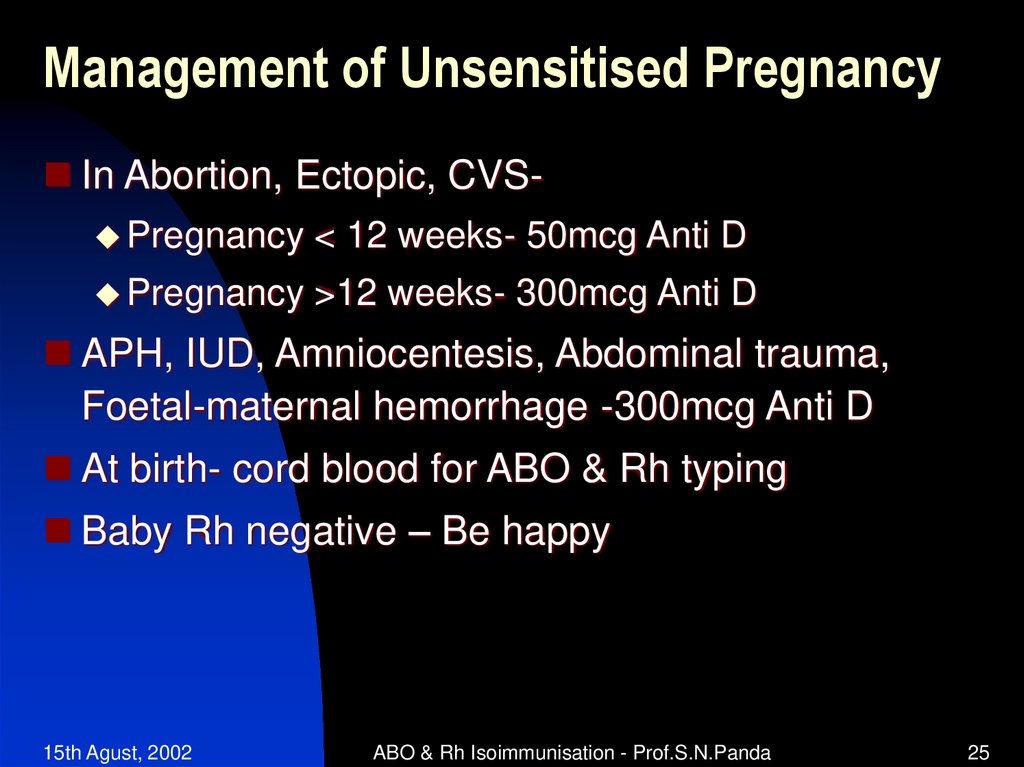
25. Management of Unsensitised Pregnancy
In Abortion, Ectopic, CVS Pregnancy< 12 weeks- 50mcg Anti D
Pregnancy
>12 weeks- 300mcg Anti D
APH, IUD, Amniocentesis, Abdominal trauma,
Foetal-maternal hemorrhage -300mcg Anti D
At birth- cord blood for ABO & Rh typing
Baby Rh negative – Be happy
15th Agust, 2002
ABO & Rh Isoimmunisation - Prof.S.N.Panda
25
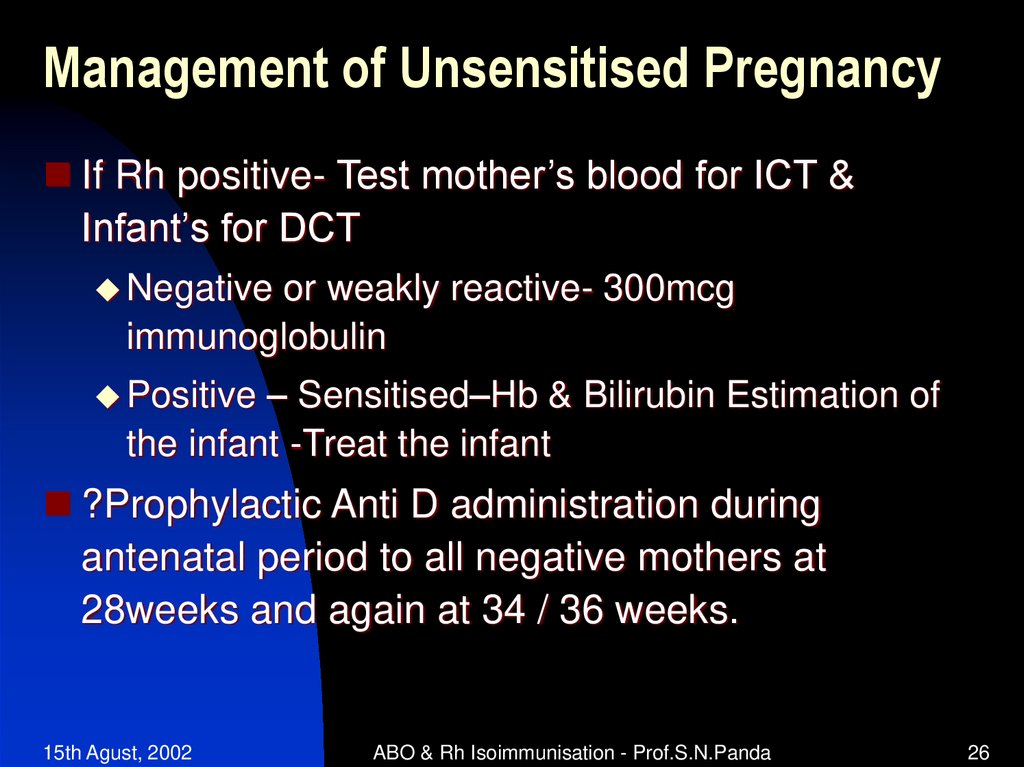
26. Management of Unsensitised Pregnancy
If Rh positive- Test mother’s blood for ICT &Infant’s for DCT
Negative
or weakly reactive- 300mcg
immunoglobulin
– Sensitised–Hb & Bilirubin Estimation of
the infant -Treat the infant
Positive
?Prophylactic Anti D administration during
antenatal period to all negative mothers at
28weeks and again at 34 / 36 weeks.
15th Agust, 2002
ABO & Rh Isoimmunisation - Prof.S.N.Panda
26
27. Management of Sensitized Pregnancy
Causes of sensitization MisinterpretationRh
of maternal Rh type
+ve blood transfusion
Unprotected
preg. & labour
Inadequate
dose / improper use of IgG on
previous occasions
Immunization
15th Agust, 2002
to cross-reacting antigen
ABO & Rh Isoimmunisation - Prof.S.N.Panda
27
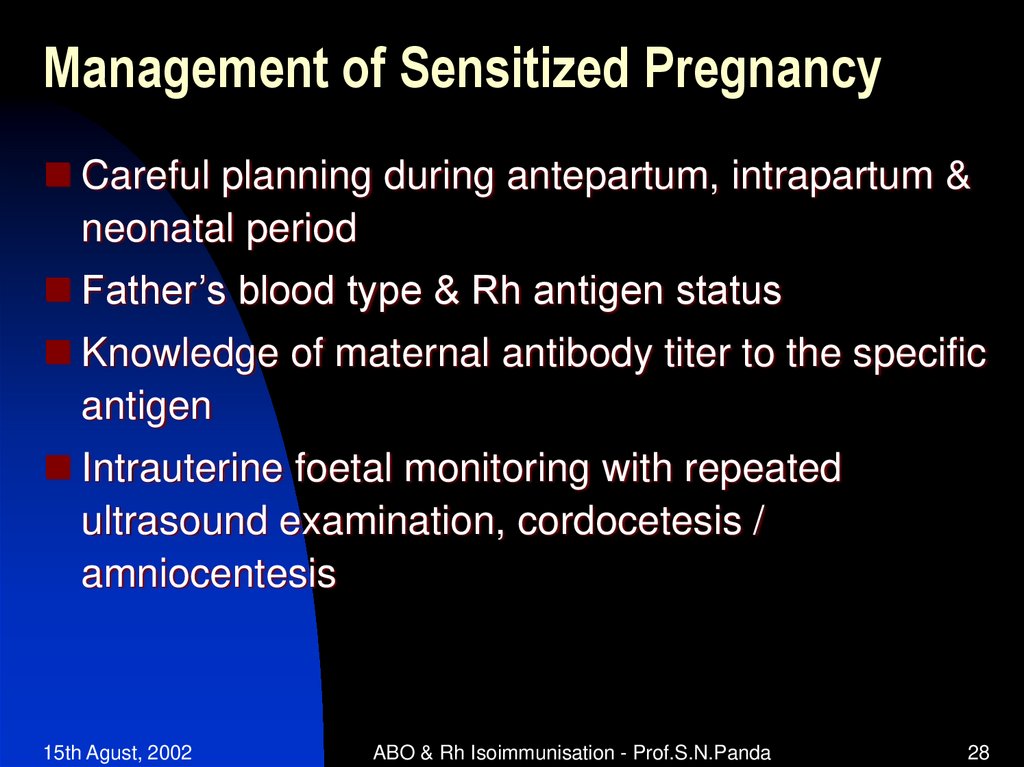
28. Management of Sensitized Pregnancy
Careful planning during antepartum, intrapartum &neonatal period
Father’s blood type & Rh antigen status
Knowledge of maternal antibody titer to the specific
antigen
Intrauterine foetal monitoring with repeated
ultrasound examination, cordocetesis /
amniocentesis
15th Agust, 2002
ABO & Rh Isoimmunisation - Prof.S.N.Panda
28
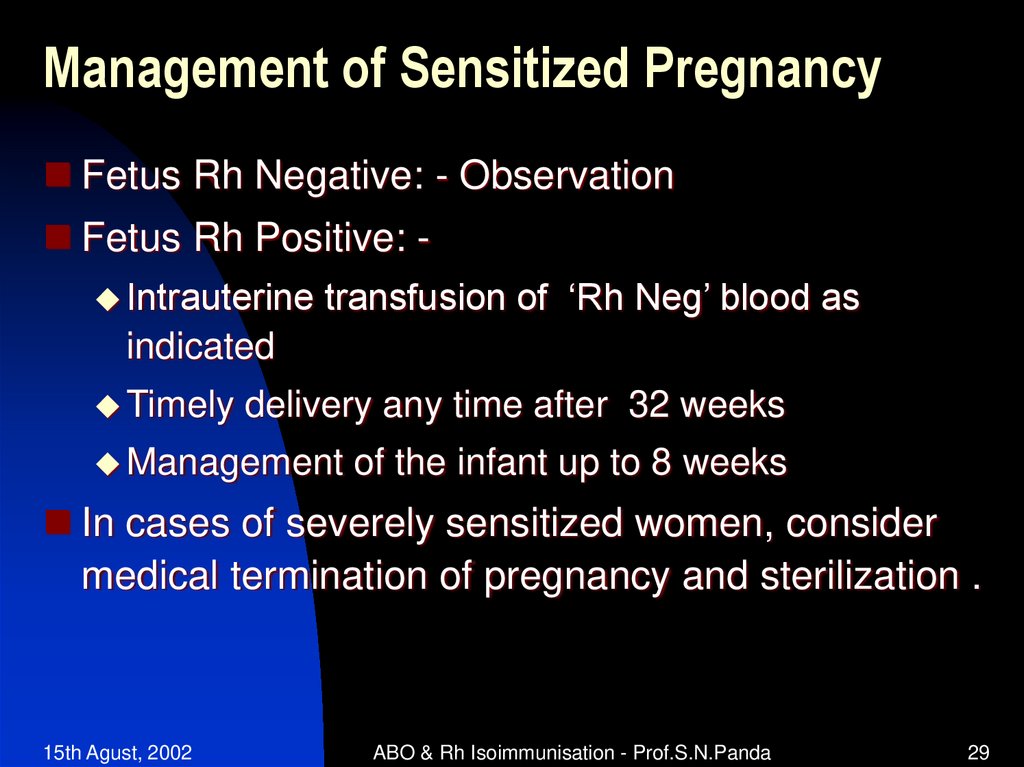
29. Management of Sensitized Pregnancy
Fetus Rh Negative: - ObservationFetus Rh Positive: Intrauterine
transfusion of ‘Rh Neg’ blood as
indicated
Timely
delivery any time after 32 weeks
Management
of the infant up to 8 weeks
In cases of severely sensitized women, consider
medical termination of pregnancy and sterilization .
15th Agust, 2002
ABO & Rh Isoimmunisation - Prof.S.N.Panda
29
30.
THANK YOU15th Agust, 2002
ABO & Rh Isoimmunisation - Prof.S.N.Panda
30