




 Экономика
Похожие презентации:








The Basics of Supply and Demand
1. Chapter 2
The Basics of Supplyand Demand
2. Introduction
What are supply and demand?What is the market mechanism?
What are the effects of changes in
market equilibrium?
What are elasticities of supply and
demand?
©2005 Pearson Education, Inc.
Chapter 2
2
3. Topics to Be Discussed
How do short-run and long-runelasticities differ?
How do we understand and predict the
effects of changing market conditions?
What are the effects of government
intervention – price controls?
©2005 Pearson Education, Inc.
Chapter 2
3
4. Supply and Demand
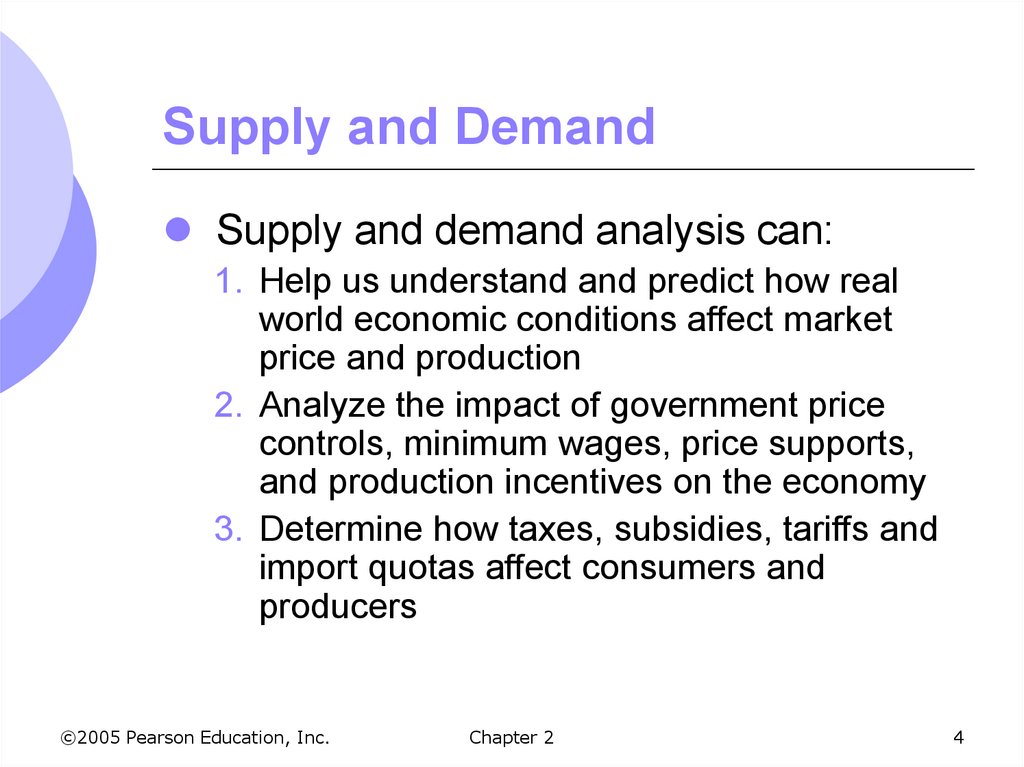
Supply and demand analysis can:1. Help us understand and predict how real
world economic conditions affect market
price and production
2. Analyze the impact of government price
controls, minimum wages, price supports,
and production incentives on the economy
3. Determine how taxes, subsidies, tariffs and
import quotas affect consumers and
producers
©2005 Pearson Education, Inc.
Chapter 2
4
5. Supply and Demand
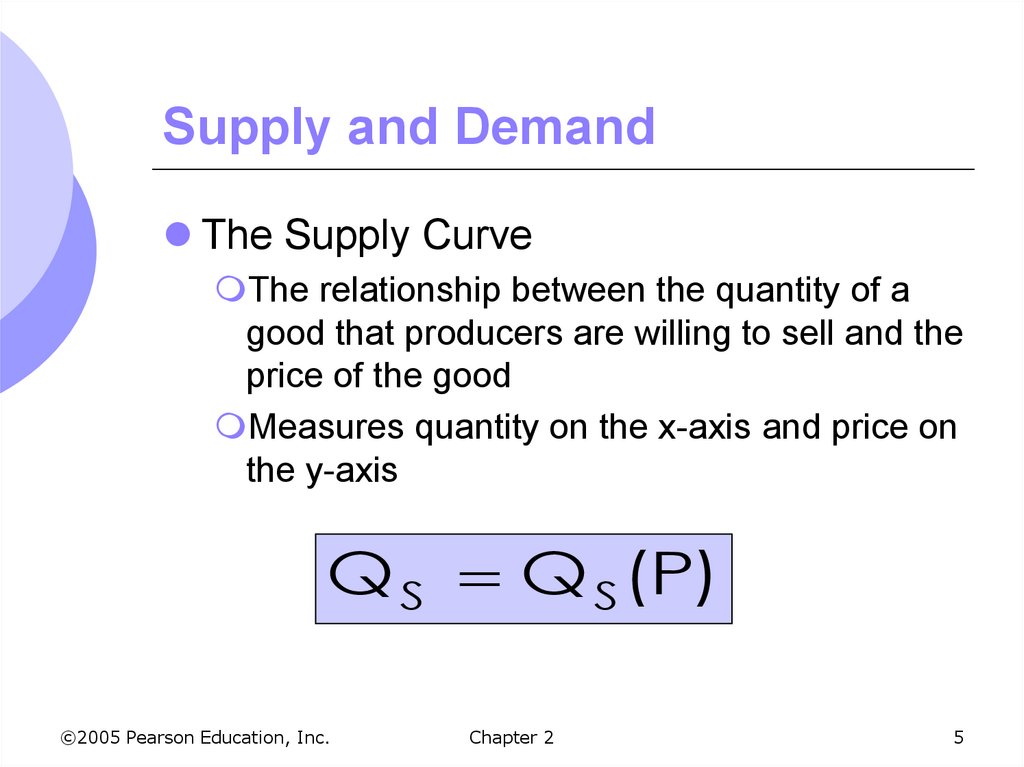
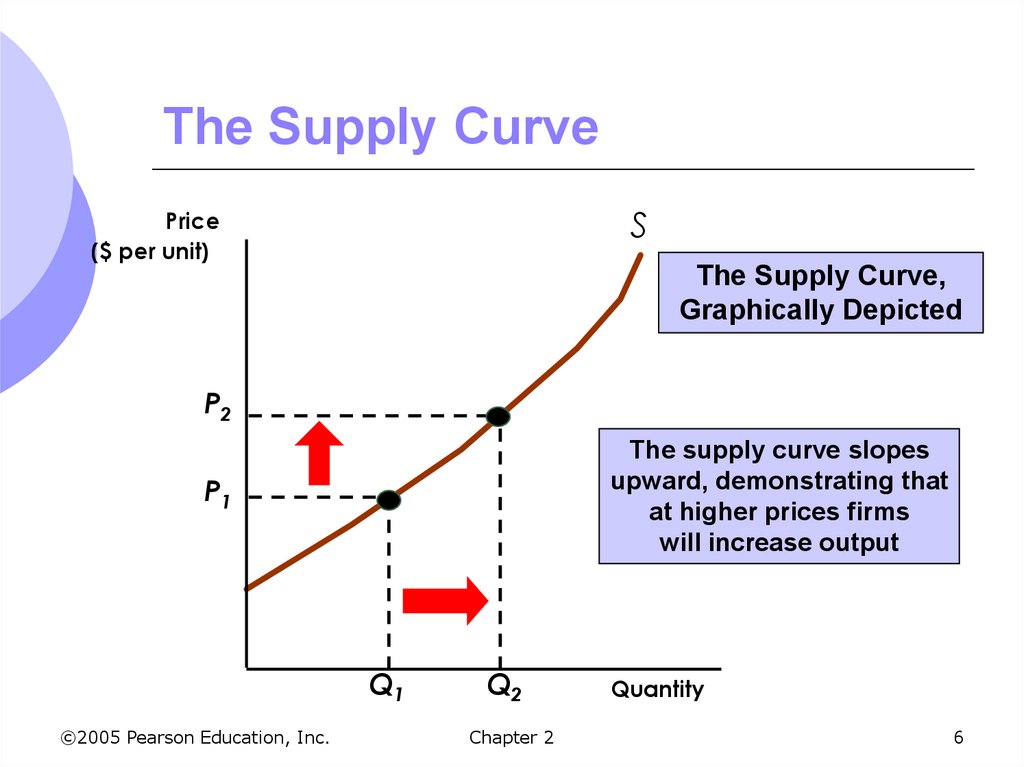
The Supply CurveThe relationship between the quantity of a
good that producers are willing to sell and the
price of the good
Measures quantity on the x-axis and price on
the y-axis
Q S Q S (P)
©2005 Pearson Education, Inc.
Chapter 2
5
6. The Supply Curve
SPrice
($ per unit)
The Supply Curve,
Graphically Depicted
P2
The supply curve slopes
upward, demonstrating that
at higher prices firms
will increase output
P1
Q1
©2005 Pearson Education, Inc.
Q2
Chapter 2
Quantity
6
7. The Supply Curve
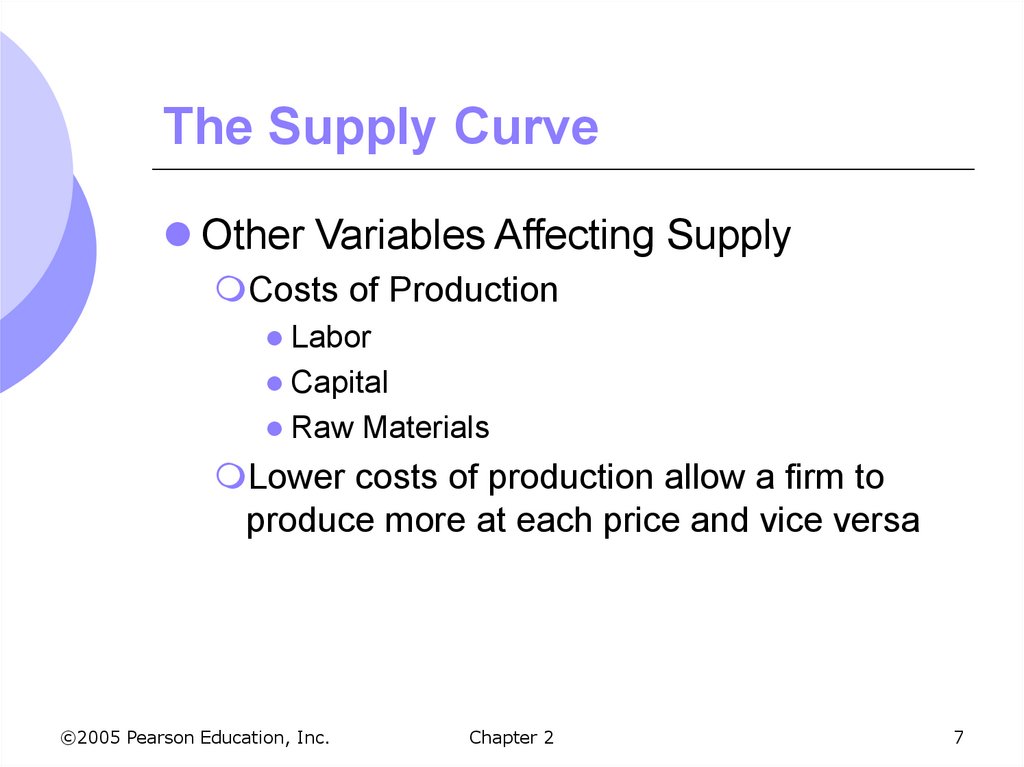
Other Variables Affecting SupplyCosts of Production
Labor
Capital
Raw Materials
Lower costs of production allow a firm to
produce more at each price and vice versa
©2005 Pearson Education, Inc.
Chapter 2
7
8. Change in Supply
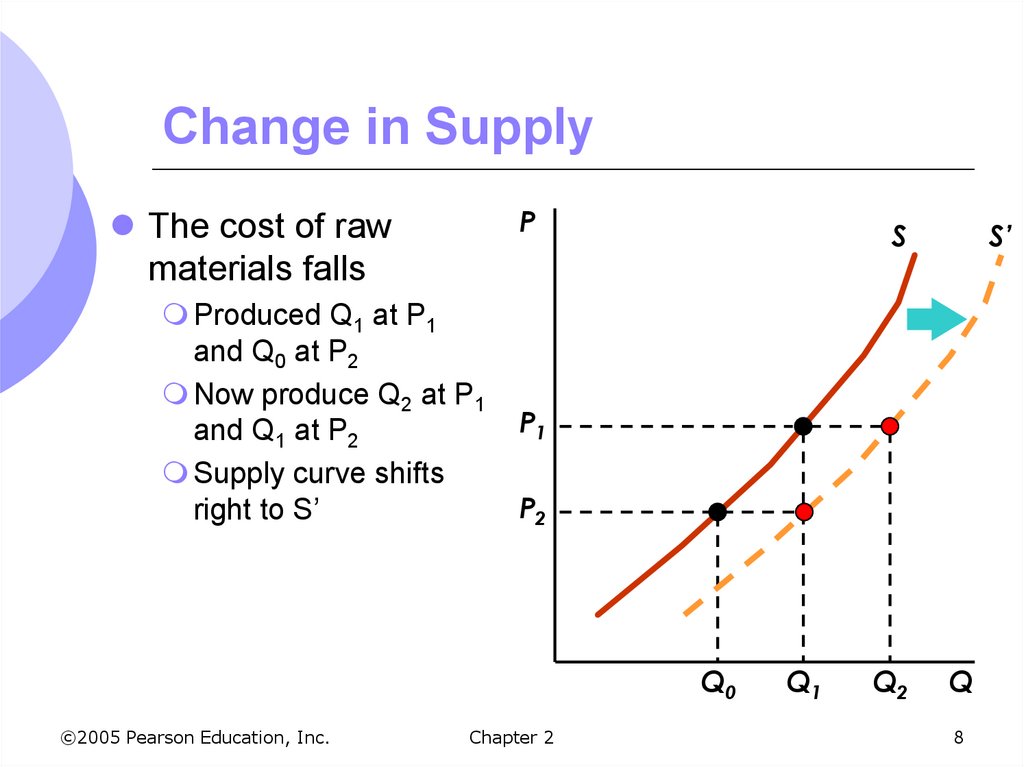
PThe cost of raw
materials falls
Produced Q1 at P1
and Q0 at P2
Now produce Q2 at P1
and Q1 at P2
Supply curve shifts
right to S’
S
P1
P2
Q0
©2005 Pearson Education, Inc.
S’
Chapter 2
Q1
Q2
Q
8
9. The Supply Curve
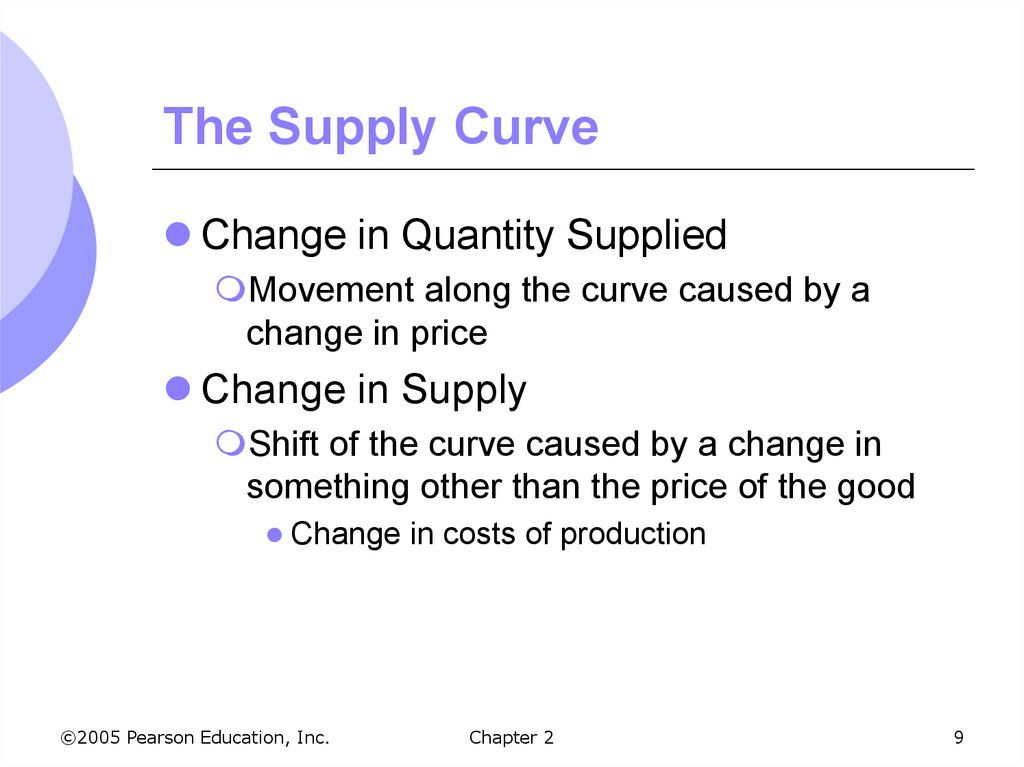
Change in Quantity SuppliedMovement along the curve caused by a
change in price
Change in Supply
Shift of the curve caused by a change in
something other than the price of the good
Change in costs of production
©2005 Pearson Education, Inc.
Chapter 2
9
10. Supply and Demand
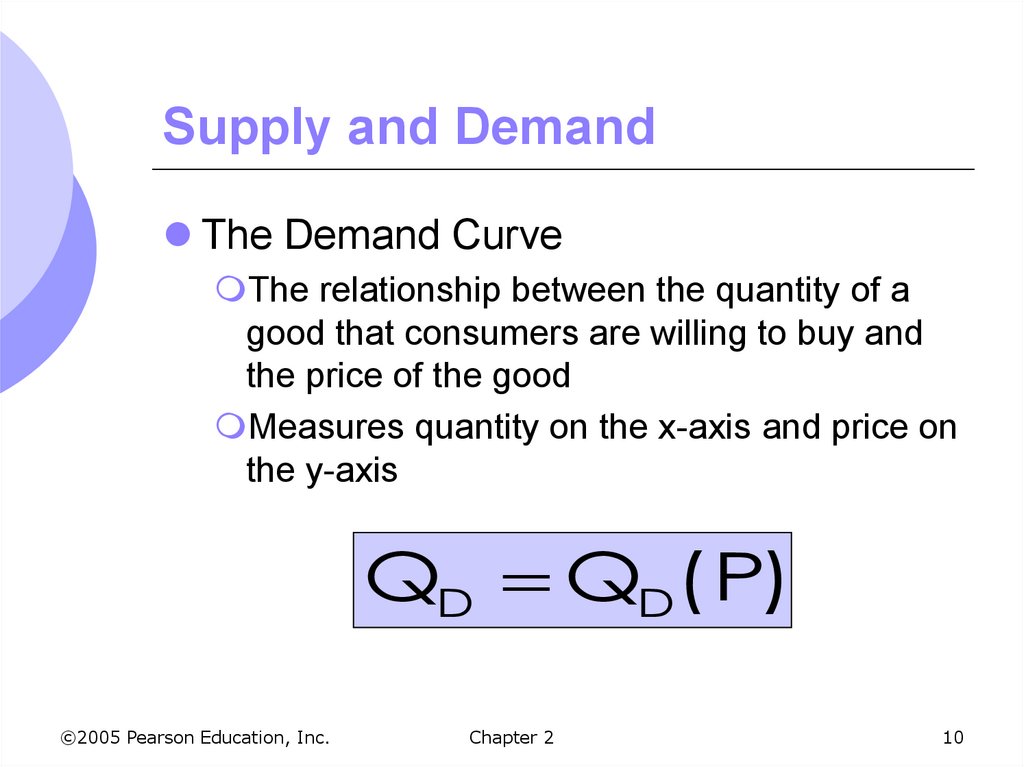
The Demand CurveThe relationship between the quantity of a
good that consumers are willing to buy and
the price of the good
Measures quantity on the x-axis and price on
the y-axis
QD QD(P)
©2005 Pearson Education, Inc.
Chapter 2
10
11. The Demand Curve
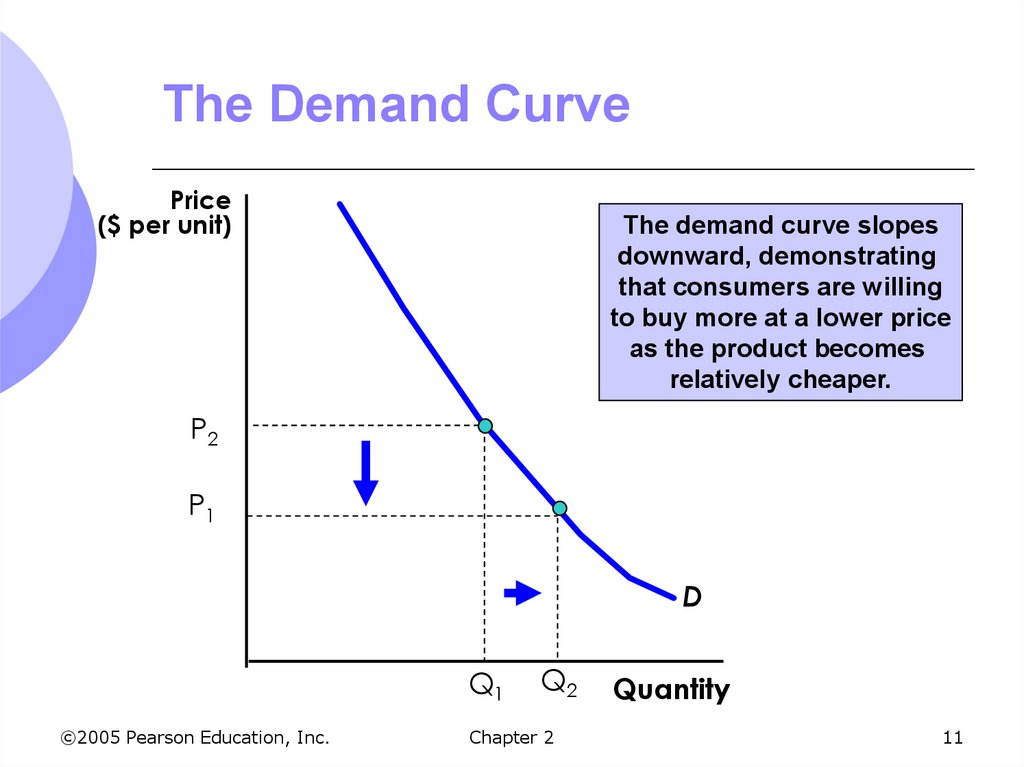
Price($ per unit)
The demand curve slopes
downward, demonstrating
that consumers are willing
to buy more at a lower price
as the product becomes
relatively cheaper.
P2
P1
D
Q1
©2005 Pearson Education, Inc.
Q2
Chapter 2
Quantity
11
12. The Demand Curve
Other Variables Affecting DemandIncome
Increases in income allow consumers to
purchase more at all prices
Consumer Tastes
Price of Related Goods
Substitutes
Complements
©2005 Pearson Education, Inc.
Chapter 2
12
13. Change in Demand
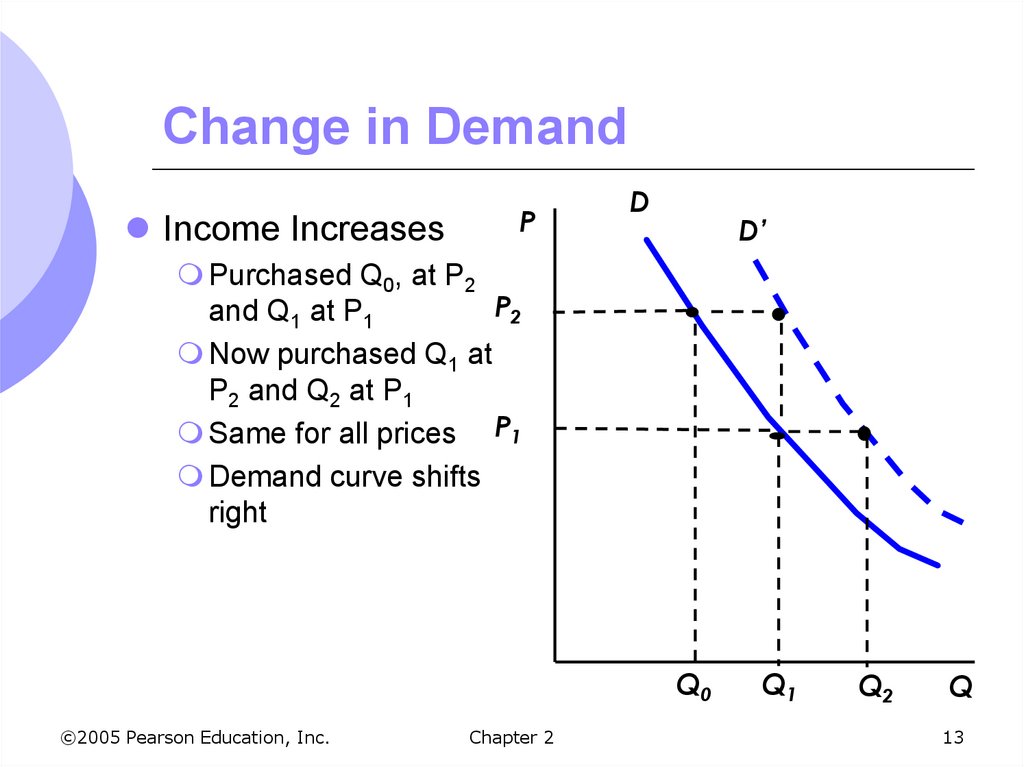
Income IncreasesP
D
D’
Purchased Q0, at P2
P2
and Q1 at P1
Now purchased Q1 at
P2 and Q2 at P1
Same for all prices P1
Demand curve shifts
right
Q0
©2005 Pearson Education, Inc.
Chapter 2
Q1
Q2
Q
13
14. The Demand Curve
Changes in quantity demandedMovements along the demand curve caused
by a change in price
Changes in demand
A shift of the entire demand curve caused by
something other than price
Income
Preferences
©2005 Pearson Education, Inc.
Chapter 2
14
15. The Market Mechanism
The market mechanism is the tendencyin a free market for price to change until
the market clears
Markets clear when quantity demanded
equals quantity supplied at the prevailing
price
Market clearing price – price at which
markets clear
©2005 Pearson Education, Inc.
Chapter 2
15
16. The Market Mechanism
SPrice
($ per unit)
The curves intersect at
equilibrium, or marketclearing, price.
Quantity demanded
equals quantity
supplied at P0
P0
D
Q0
©2005 Pearson Education, Inc.
Chapter 2
Quantity
16
17. The Market Mechanism
In equilibriumThere is no shortage or excess demand
There is no surplus or excess supply
Quantity supplied equals quantity demanded
Anyone who wants to buy at the current price
can and all producers who want to sell at that
price can
©2005 Pearson Education, Inc.
Chapter 2
17
18. Market Surplus1
The market price is above equilibriumThere is excess supply - surplus
Downward pressure on price
Quantity demanded increases and quantity
supplied decreases
The market adjusts until new equilibrium is
reached
©2005 Pearson Education, Inc.
Chapter 2
18
19. The Market Mechanism
Price($ per unit)
S
1.
Surplus
P1
2.
3.
P0
4.
D
Q
©2005 Pearson Education, Inc.
D
Q0
Chapter 2
QS
At P1, price is
above the
market clearing
price
Qs > QD
Price falls to
the marketclearing price
Market adjusts
to equilibrium
Quantity
19
20. The Market Mechanism
The market price is below equilibrium:There is excess demand - shortage
Upward pressure on prices
Quantity demanded decreases and quantity
supplied increases
The market adjusts until the new equilibrium
is reached
©2005 Pearson Education, Inc.
Chapter 2
20
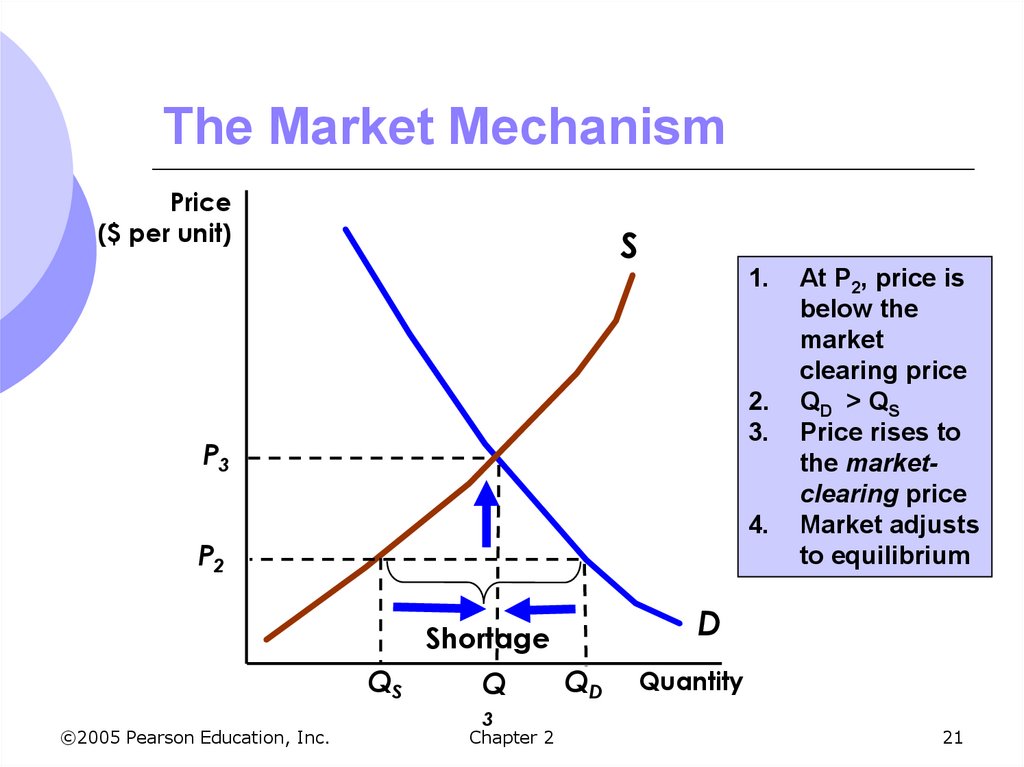
21. The Market Mechanism
Price($ per unit)
1.
2.
3.
P3
4.
P2
D
Shortage
QS
©2005 Pearson Education, Inc.
Q
3
Chapter 2
At P2, price is
below the
market
clearing price
Q D > QS
Price rises to
the marketclearing price
Market adjusts
to equilibrium
QD
Quantity
21
22. The Market Mechanism
Supply and demand interact to determinethe market-clearing price
When not in equilibrium, the market will
adjust to alleviate a shortage or surplus
and return the market to equilibrium
Markets must be competitive for the
mechanism to be efficient
©2005 Pearson Education, Inc.
Chapter 2
22
23. Changes in Market Equilibrium
Equilibrium prices are determined by therelative level of supply and demand
Changes in supply and/or demand will
cause change in the equilibrium price
and/or quantity in a free market
©2005 Pearson Education, Inc.
Chapter 2
23
24. Changes in Market Equilibrium
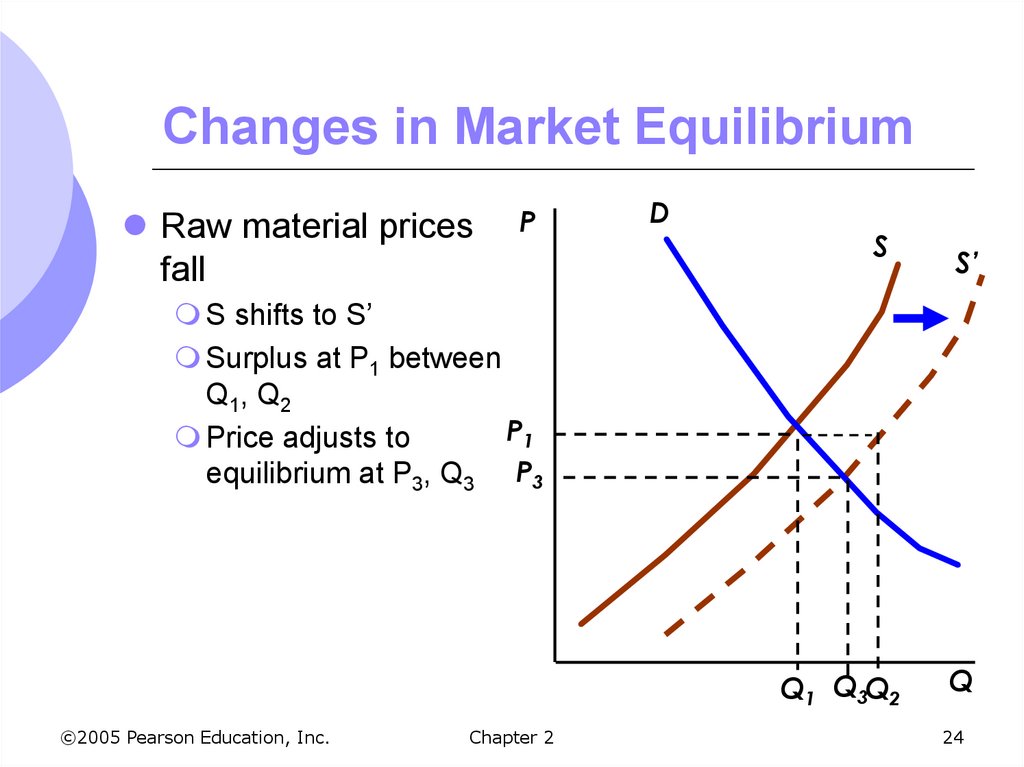
Raw material pricesfall
P
D
S
S’
S shifts to S’
Surplus at P1 between
Q1, Q2
P1
Price adjusts to
equilibrium at P3, Q3 P3
Q1 Q3Q2
©2005 Pearson Education, Inc.
Chapter 2
Q
24
25. Changes in Market Equilibrium
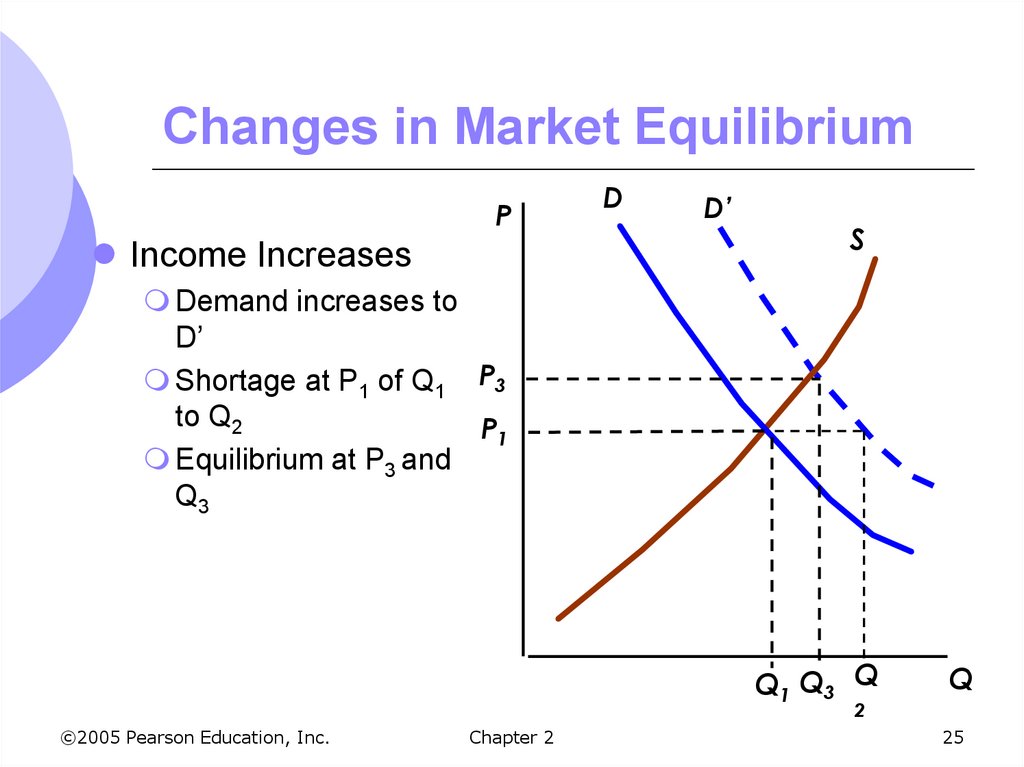
PIncome Increases
D
D’
S
Demand increases to
D’
Shortage at P1 of Q1 P3
to Q2
P1
Equilibrium at P3 and
Q3
Q1 Q3 Q
Q
2
©2005 Pearson Education, Inc.
Chapter 2
25
26. Changes in Market Equilibrium
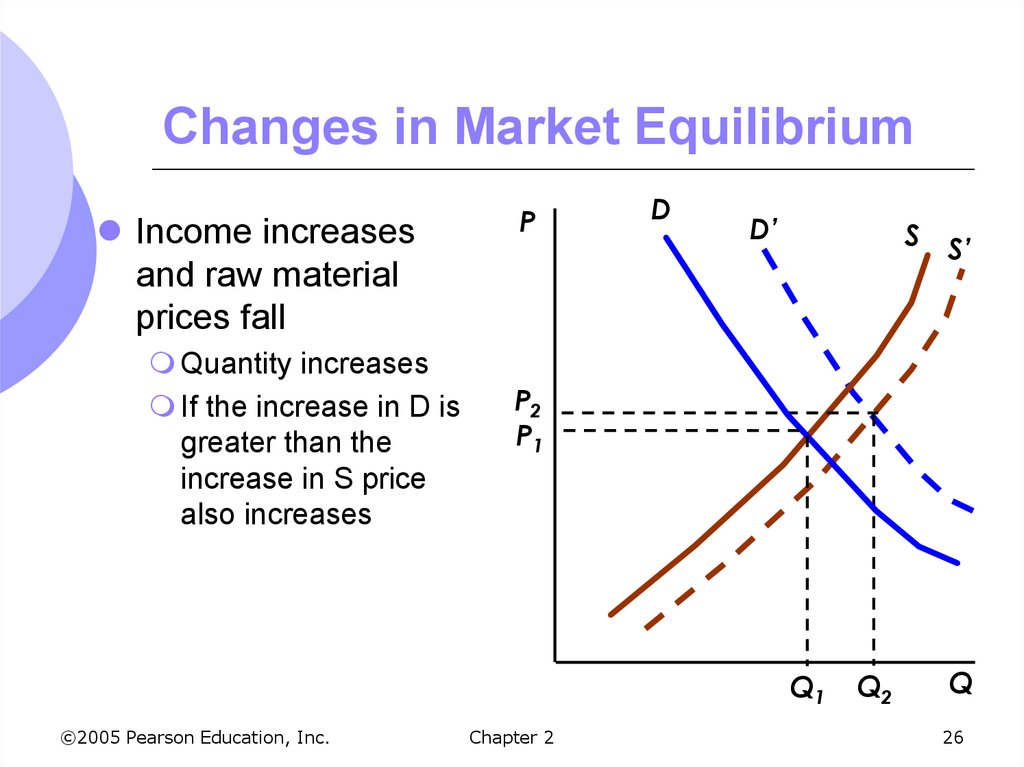
Income increasesand raw material
prices fall
Quantity increases
If the increase in D is
greater than the
increase in S price
also increases
P
D
D’
S S’
P2
P1
Q1
©2005 Pearson Education, Inc.
Chapter 2
Q2
Q
26
27. Shifts in Supply and Demand
When supply and demand changesimultaneously, the impact on the
equilibrium price and quantity is
determined by:
1. The relative size and direction of the
change
2. The shape of the supply and demand
models
©2005 Pearson Education, Inc.
Chapter 2
27
28. The Price of a College Education
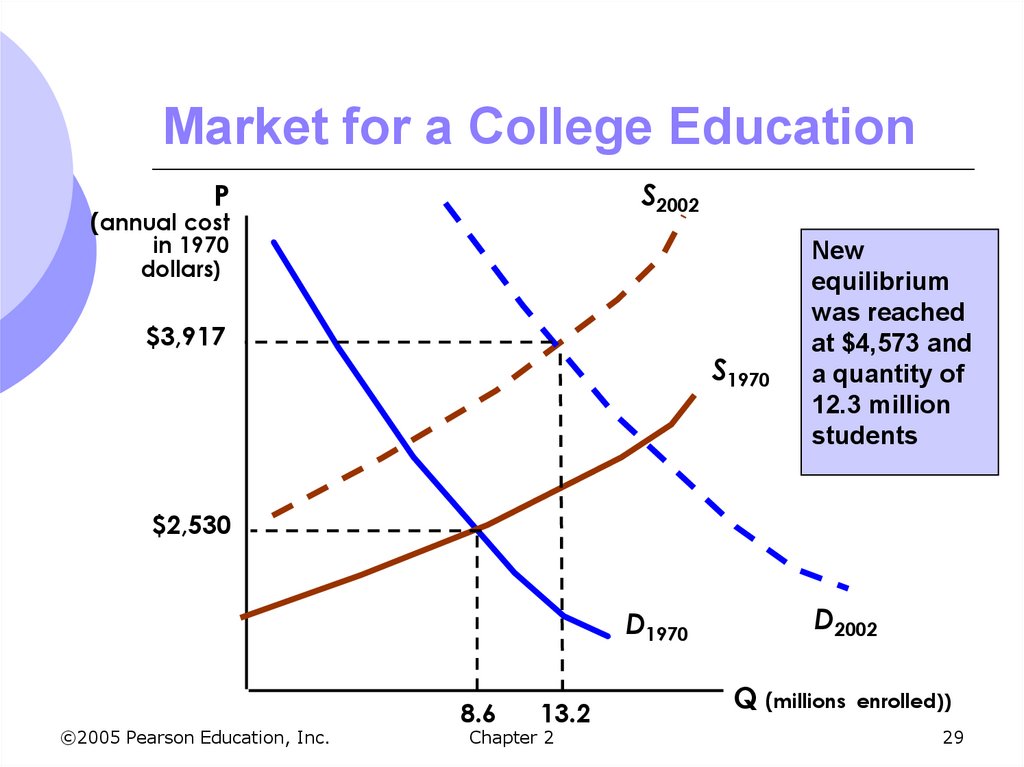
The real price of a college education rose55 percent from 1970 to 2002
Increases in costs of modern classrooms
and wages increased costs of production
– decrease in supply
Due to a larger percentage of high school
graduates attending college, demand
increased
©2005 Pearson Education, Inc.
Chapter 2
28
29. Market for a College Education
S2002P
(annual cost
in 1970
dollars)
$3,917
S1970
New
equilibrium
was reached
at $4,573 and
a quantity of
12.3 million
students
$2,530
D1970
©2005 Pearson Education, Inc.
8.6
13.2
Chapter 2
D2002
Q (millions enrolled))
29
30. The Long-Run Behavior of Natural Resource Prices
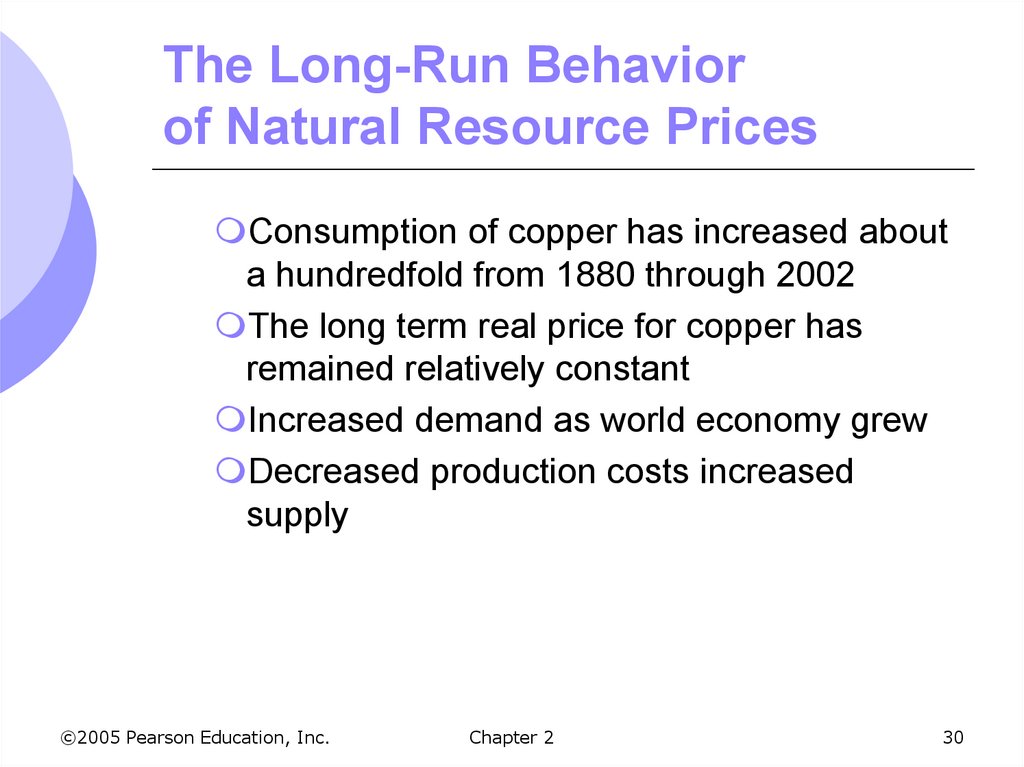
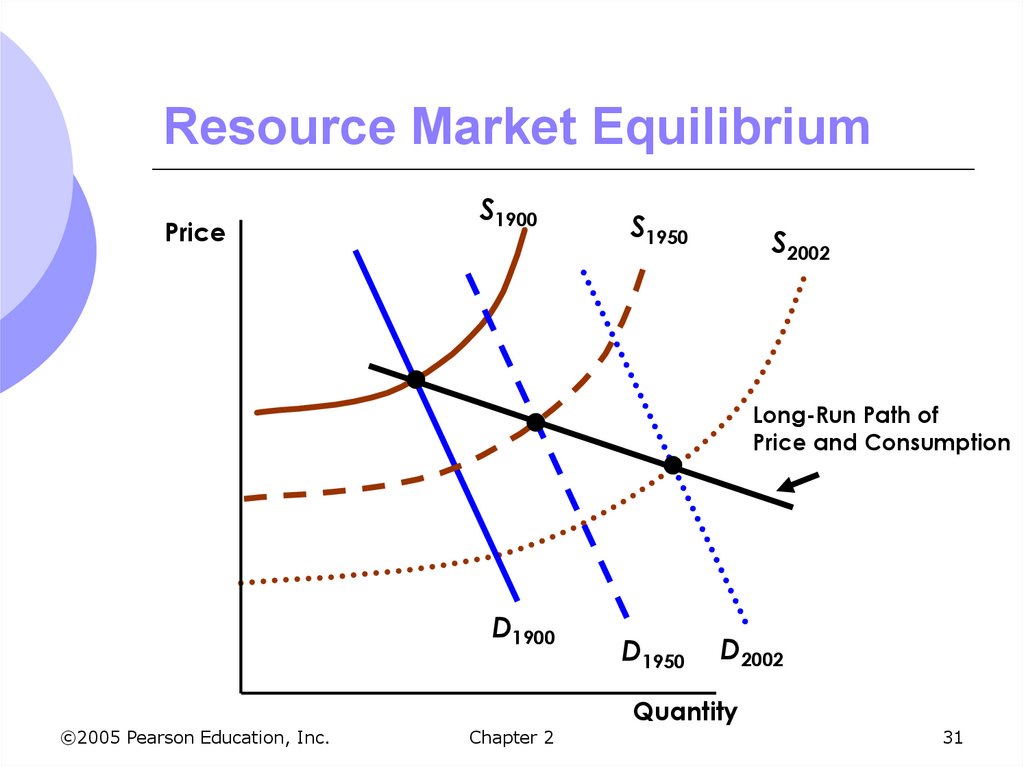
Consumption of copper has increased abouta hundredfold from 1880 through 2002
The long term real price for copper has
remained relatively constant
Increased demand as world economy grew
Decreased production costs increased
supply
©2005 Pearson Education, Inc.
Chapter 2
30
31. Resource Market Equilibrium
PriceS1900
S1950
S2002
Long-Run Path of
Price and Consumption
D1900
D1950
D2002
Quantity
©2005 Pearson Education, Inc.
Chapter 2
31
32. Resource Market
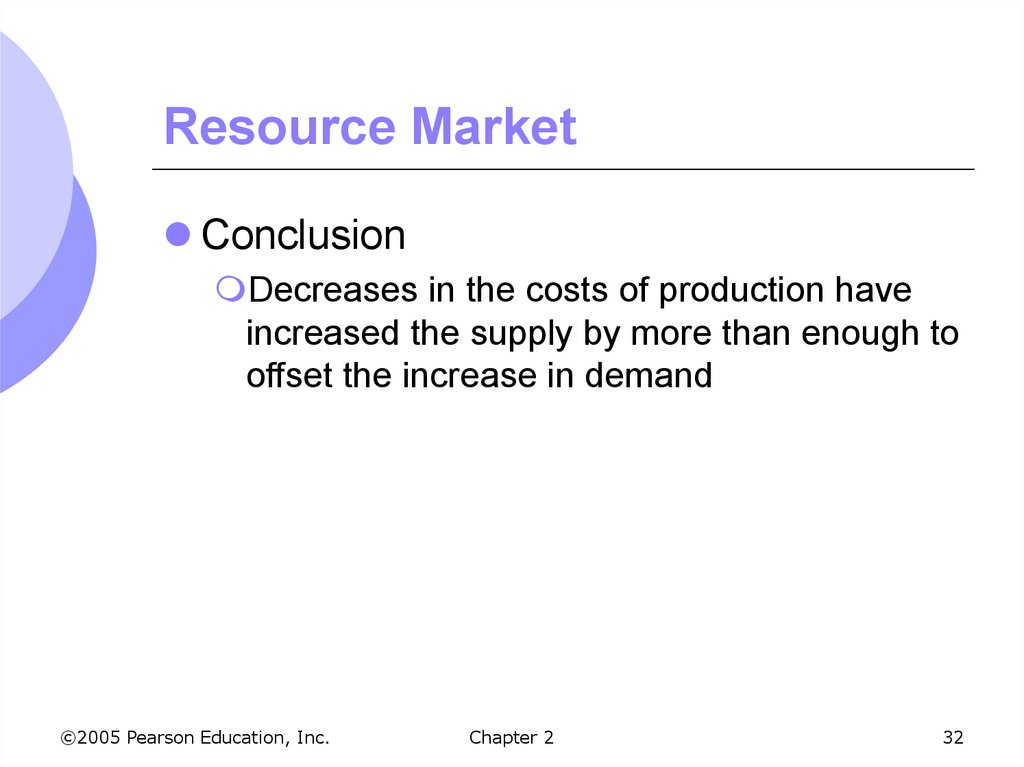
ConclusionDecreases in the costs of production have
increased the supply by more than enough to
offset the increase in demand
©2005 Pearson Education, Inc.
Chapter 2
32
33. Elasticities of Supply and Demand
Not only are we concerned with what directionprice and quantity will move when the market
changes, but we are concerned about how
much they change
Elasticity gives a way to measure by how much
a variable will change with the change in
another variable
Specifically, it gives the percentage change in
one variable resulting from a one percent
change in another
©2005 Pearson Education, Inc.
Chapter 2
33
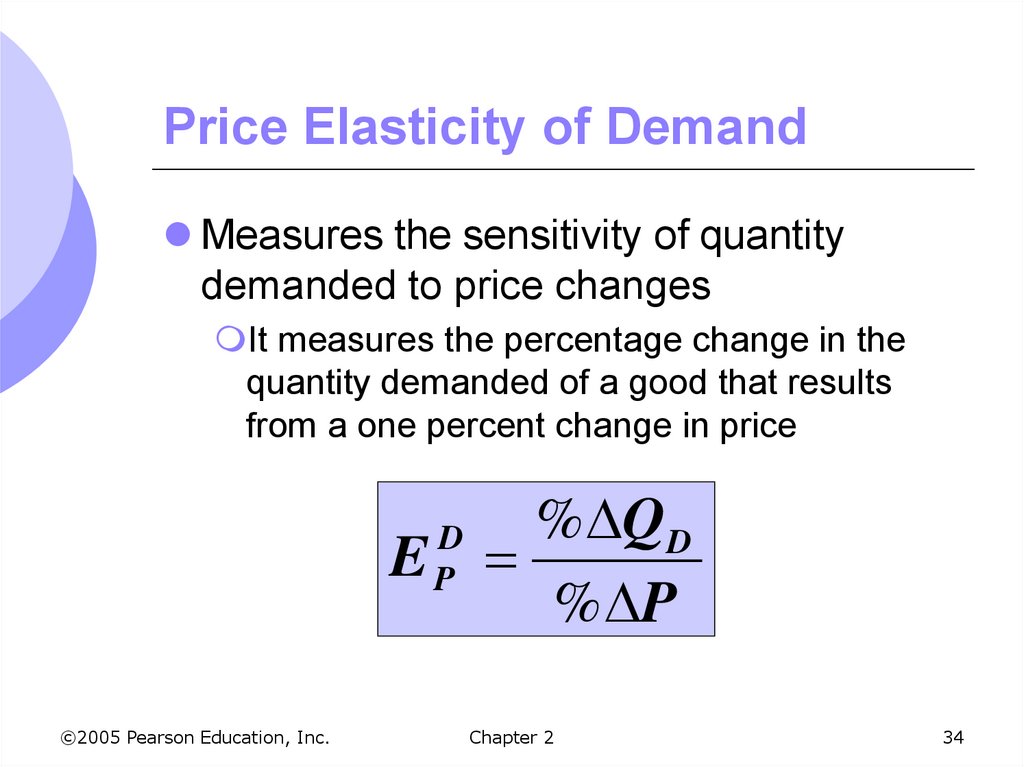
34. Price Elasticity of Demand
Measures the sensitivity of quantitydemanded to price changes
It measures the percentage change in the
quantity demanded of a good that results
from a one percent change in price
% Q D
E
% P
D
P
©2005 Pearson Education, Inc.
Chapter 2
34
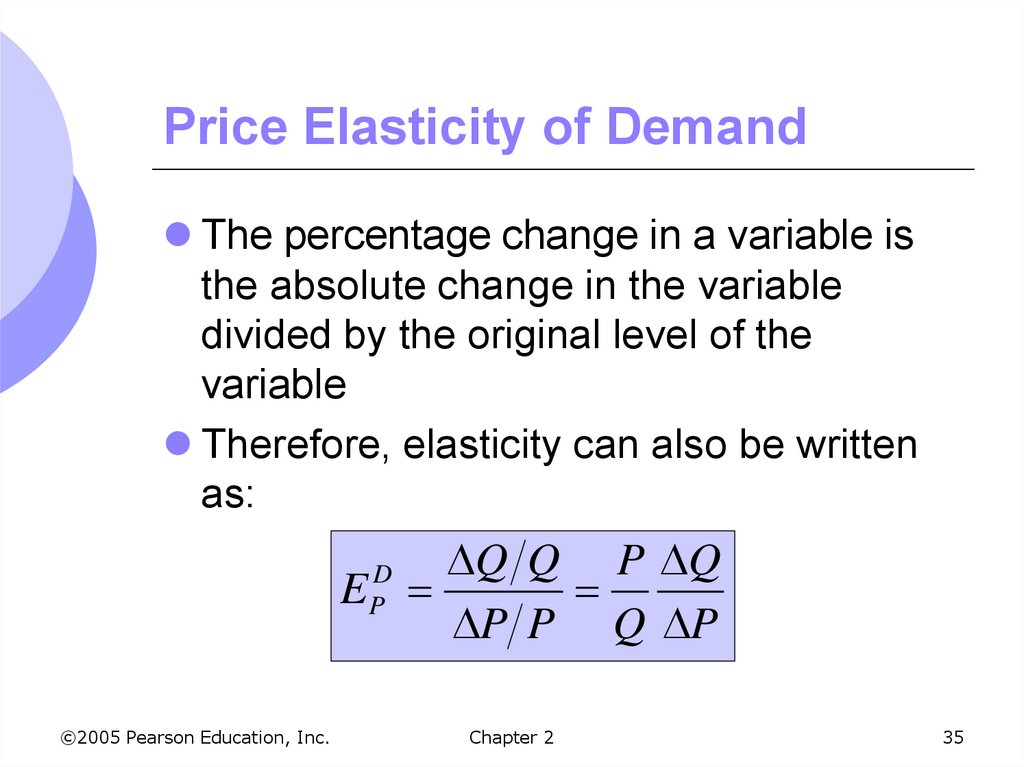
35. Price Elasticity of Demand
The percentage change in a variable isthe absolute change in the variable
divided by the original level of the
variable
Therefore, elasticity can also be written
as:
Q Q P Q
E
P P Q P
D
P
©2005 Pearson Education, Inc.
Chapter 2
35
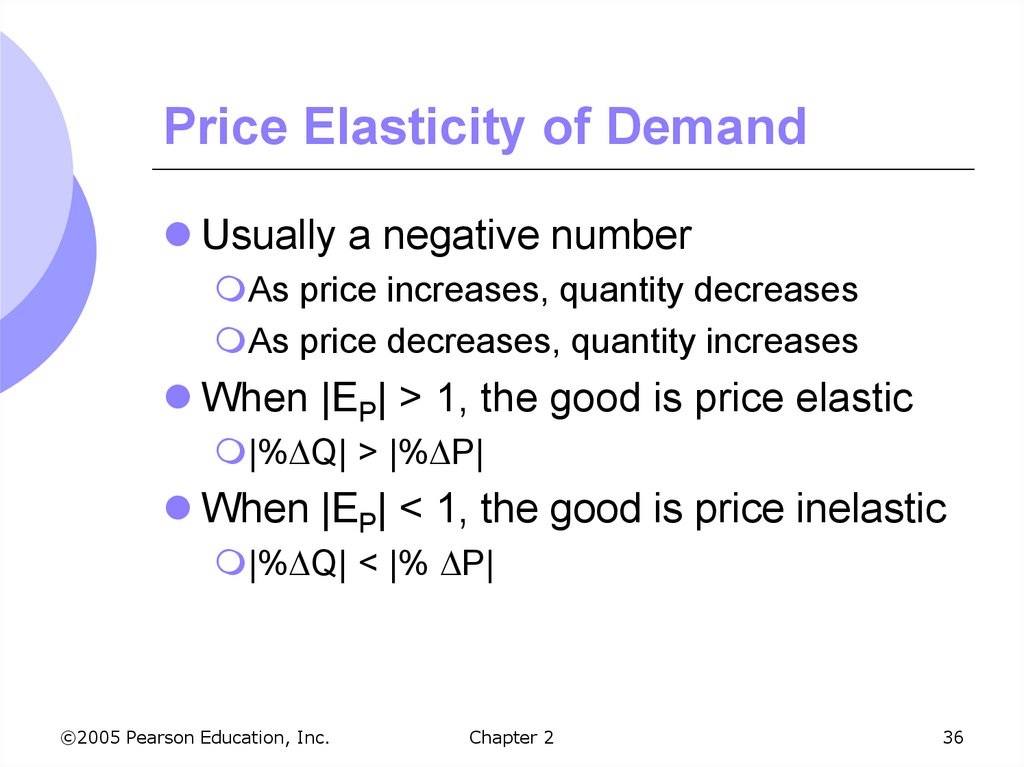
36. Price Elasticity of Demand
Usually a negative numberAs price increases, quantity decreases
As price decreases, quantity increases
When |EP| > 1, the good is price elastic
|% Q| > |% P|
When |EP| < 1, the good is price inelastic
|% Q| < |% P|
©2005 Pearson Education, Inc.
Chapter 2
36
37. Price Elasticity of Demand
The primary determinant of priceelasticity of demand is the availability of
substitutes
Many substitutes, demand is price elastic
Can easily move to another good with price
increases
Few substitutes, demand is price inelastic
©2005 Pearson Education, Inc.
Chapter 2
37
38. Price Elasticity of Demand
Looking at a linear demand curve, as wemove along the curve Q/ P is constant,
but P and Q will change
Price elasticity of demand must therefore
be measured at a particular point on the
demand curve
Elasticity will change along the demand
curve in a particular way
©2005 Pearson Education, Inc.
Chapter 2
38
39. Price Elasticity of Demand
Given a linear demand curveElasticity depends on slope and on the
values of P and Q
The top portion of demand curve is elastic
Price is high and quantity small
The bottom portion of demand curve is
inelastic
Price is low and quantity high
©2005 Pearson Education, Inc.
Chapter 2
39
40. Price Elasticity of Demand
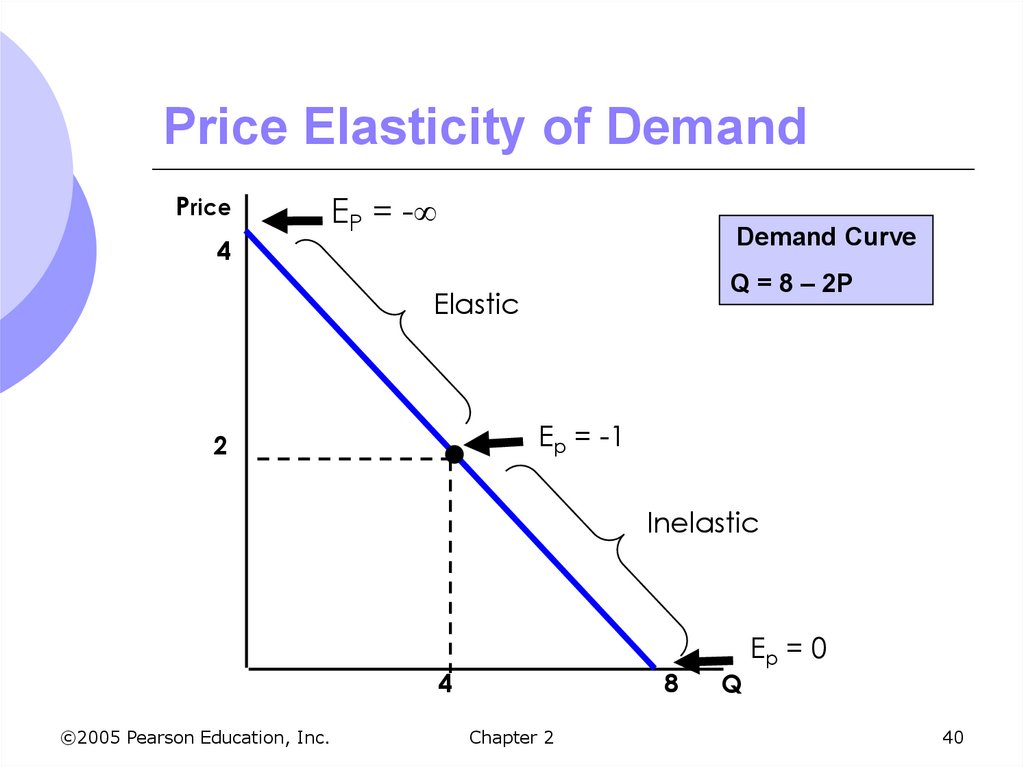
Price4
EP = -
Demand Curve
Q = 8 – 2P
Elastic
Ep = -1
2
Inelastic
4
©2005 Pearson Education, Inc.
8
Chapter 2
Q
Ep = 0
40
41. Price Elasticity of Demand
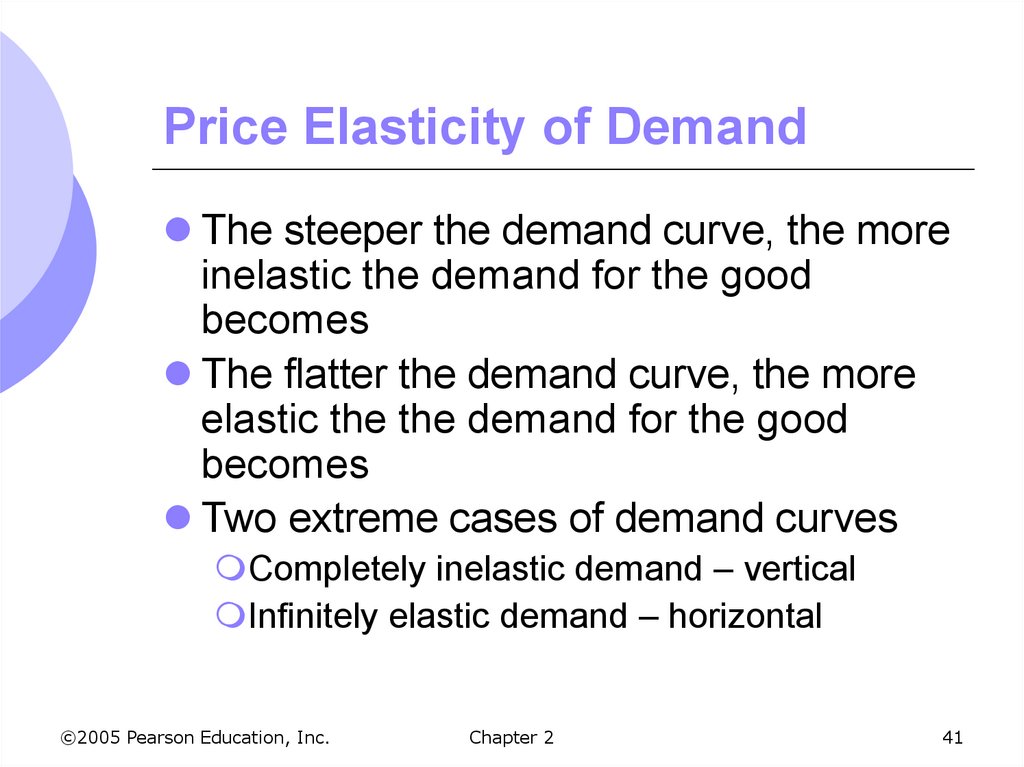
The steeper the demand curve, the moreinelastic the demand for the good
becomes
The flatter the demand curve, the more
elastic the the demand for the good
becomes
Two extreme cases of demand curves
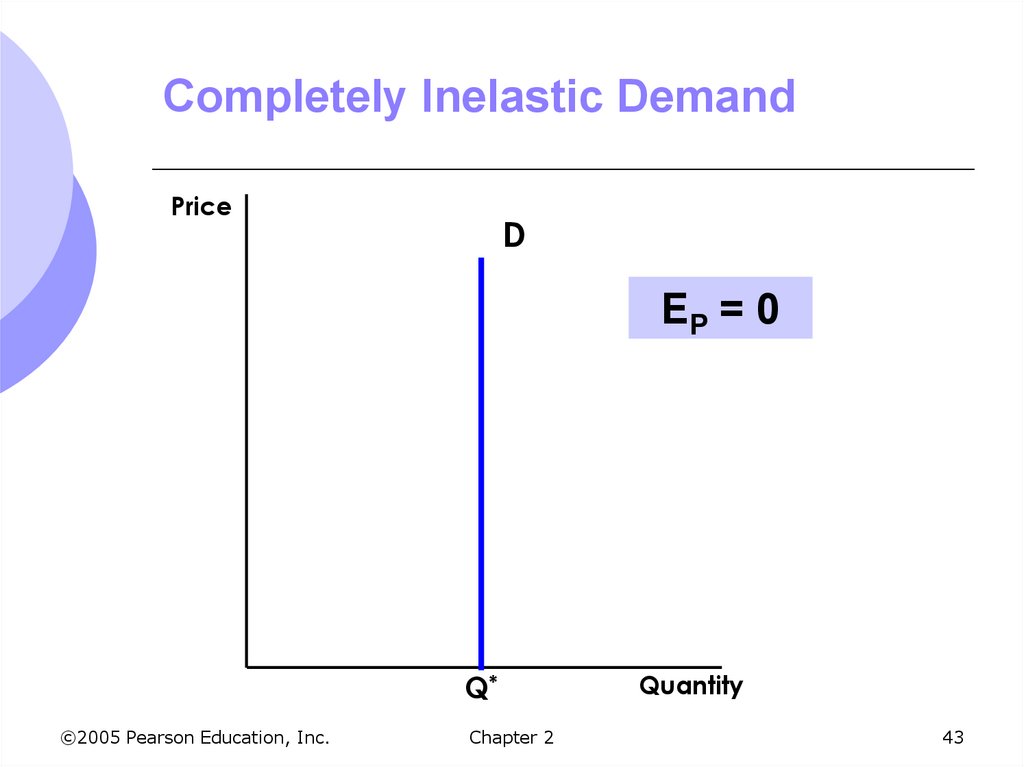
Completely inelastic demand – vertical
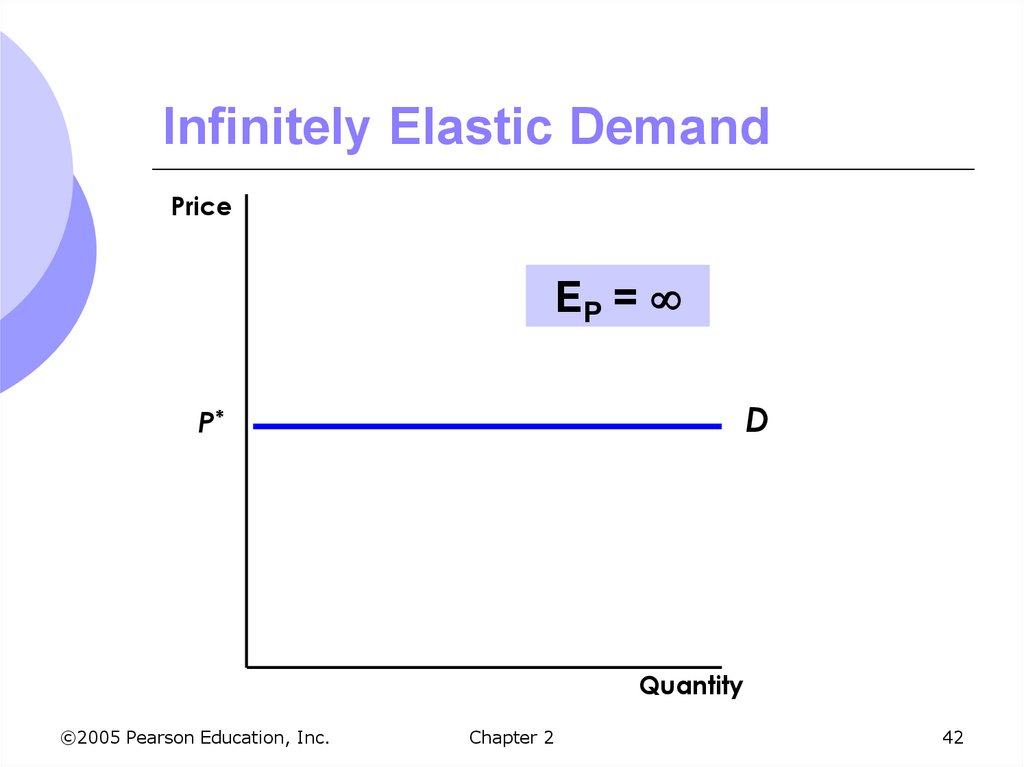
Infinitely elastic demand – horizontal
©2005 Pearson Education, Inc.
Chapter 2
41
42. Infinitely Elastic Demand
PriceEP =
D
P*
Quantity
©2005 Pearson Education, Inc.
Chapter 2
42
43. Completely Inelastic Demand
PriceD
EP = 0
Q*
©2005 Pearson Education, Inc.
Chapter 2
Quantity
43
44. Other Demand Elasticities
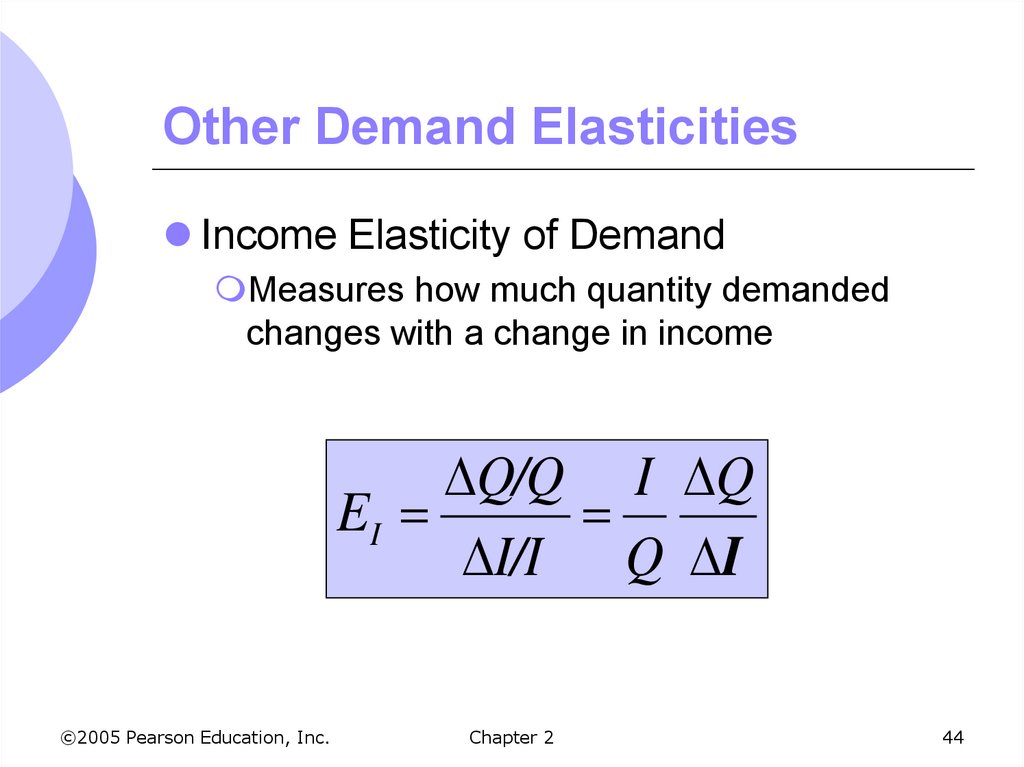
Income Elasticity of DemandMeasures how much quantity demanded
changes with a change in income
Q/Q I Q
EI
I/I Q I
©2005 Pearson Education, Inc.
Chapter 2
44
45. Other Demand Elasticities
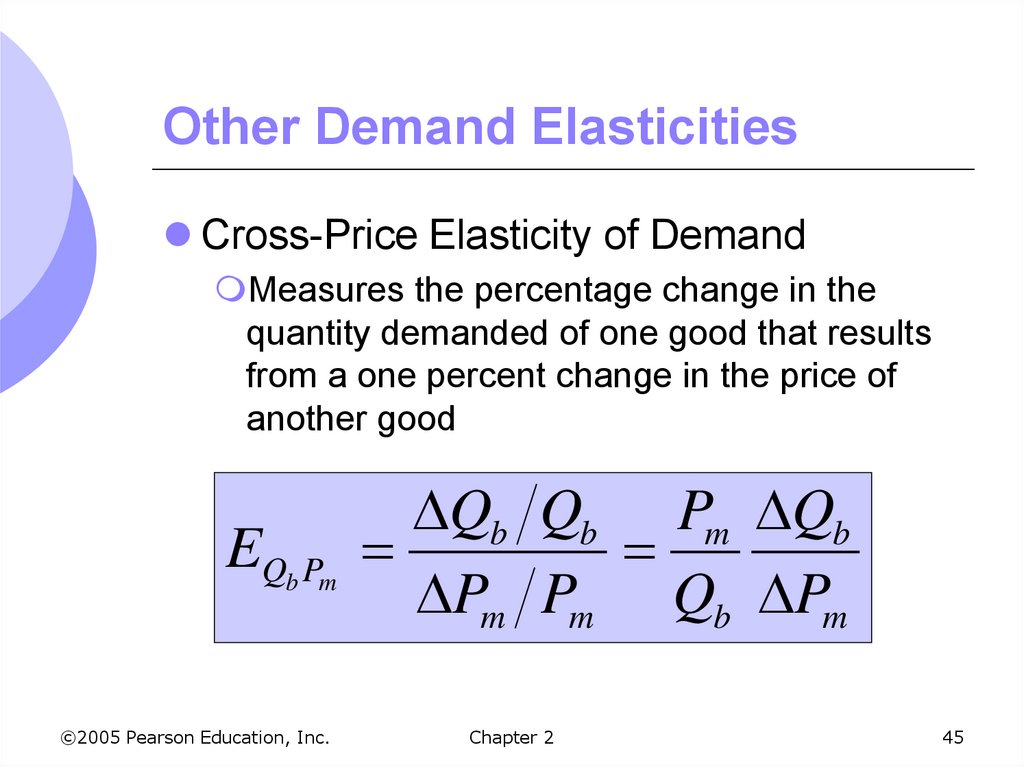
Cross-Price Elasticity of DemandMeasures the percentage change in the
quantity demanded of one good that results
from a one percent change in the price of
another good
Qb Qb Pm Qb
EQb Pm
Pm Pm Qb Pm
©2005 Pearson Education, Inc.
Chapter 2
45
46. Other Demand Elasticities
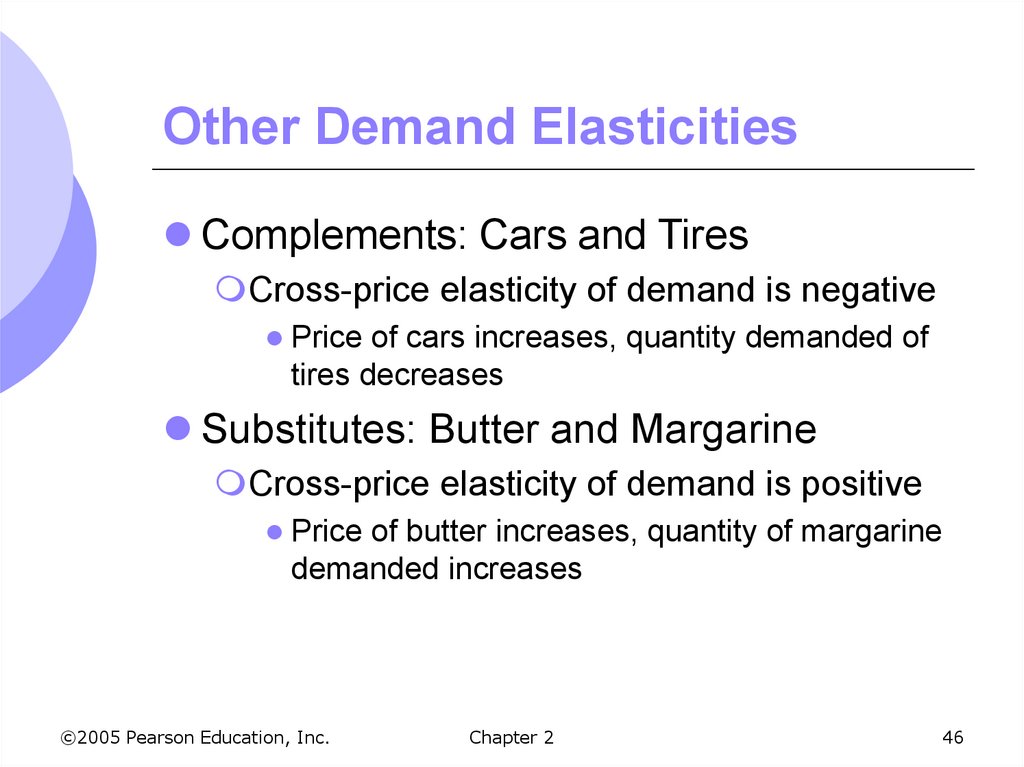
Complements: Cars and TiresCross-price elasticity of demand is negative
Price of cars increases, quantity demanded of
tires decreases
Substitutes: Butter and Margarine
Cross-price elasticity of demand is positive
Price of butter increases, quantity of margarine
demanded increases
©2005 Pearson Education, Inc.
Chapter 2
46
47. Price Elasticity of Supply
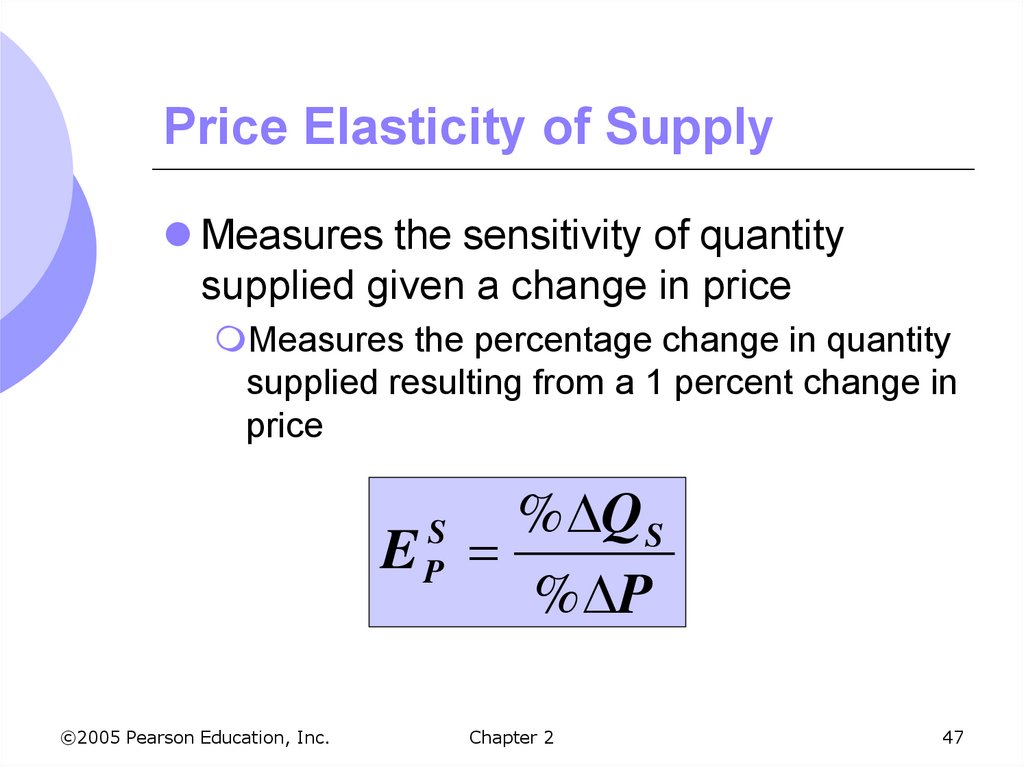
Measures the sensitivity of quantitysupplied given a change in price
Measures the percentage change in quantity
supplied resulting from a 1 percent change in
price
% Q S
E
% P
S
P
©2005 Pearson Education, Inc.
Chapter 2
47
48. Point vs. Arc Elasticities
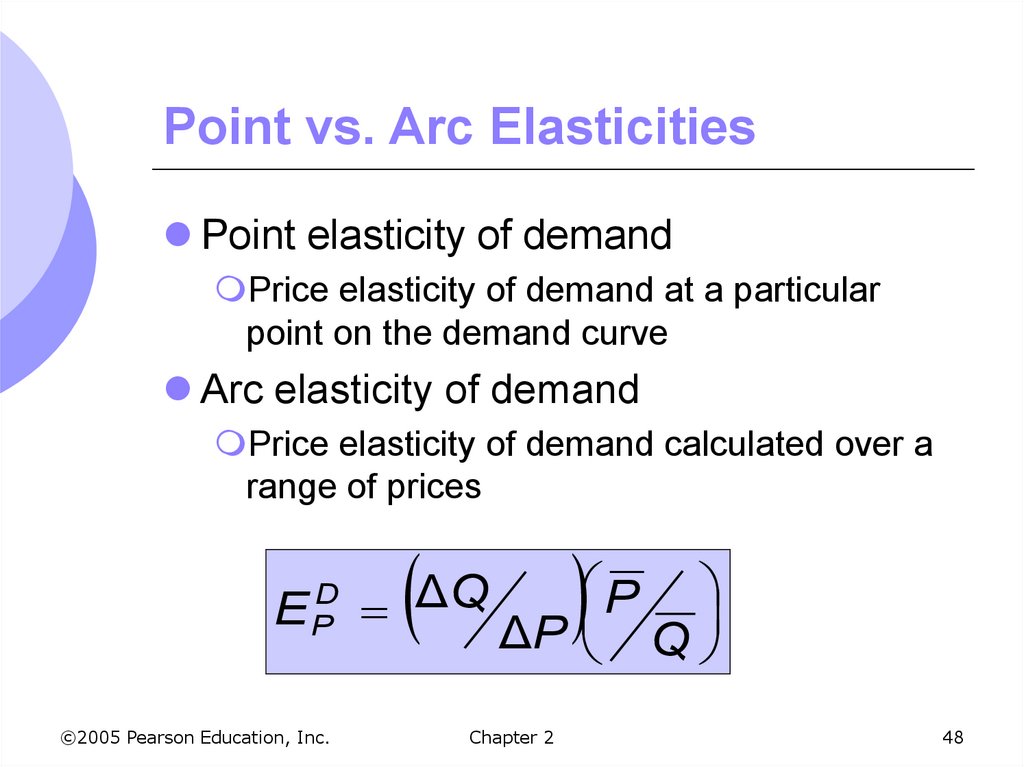
Point elasticity of demandPrice elasticity of demand at a particular
point on the demand curve
Arc elasticity of demand
Price elasticity of demand calculated over a
range of prices
E PD
©2005 Pearson Education, Inc.
ΔQ
P
ΔP Q
Chapter 2
48
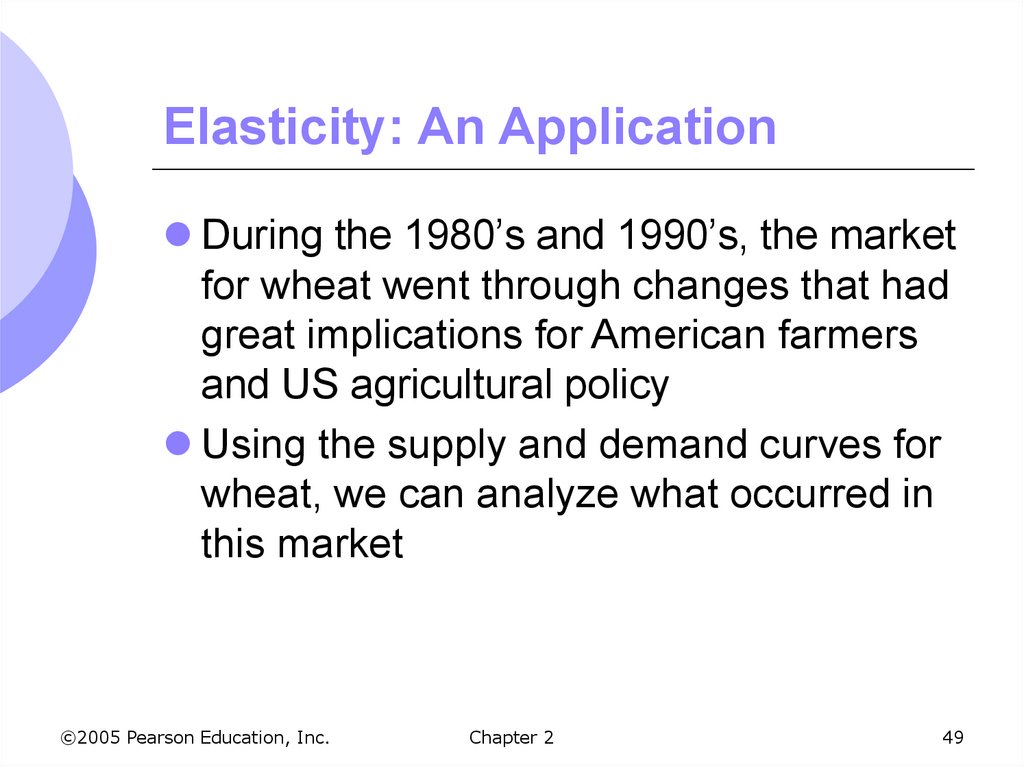
49. Elasticity: An Application
During the 1980’s and 1990’s, the marketfor wheat went through changes that had
great implications for American farmers
and US agricultural policy
Using the supply and demand curves for
wheat, we can analyze what occurred in
this market
©2005 Pearson Education, Inc.
Chapter 2
49
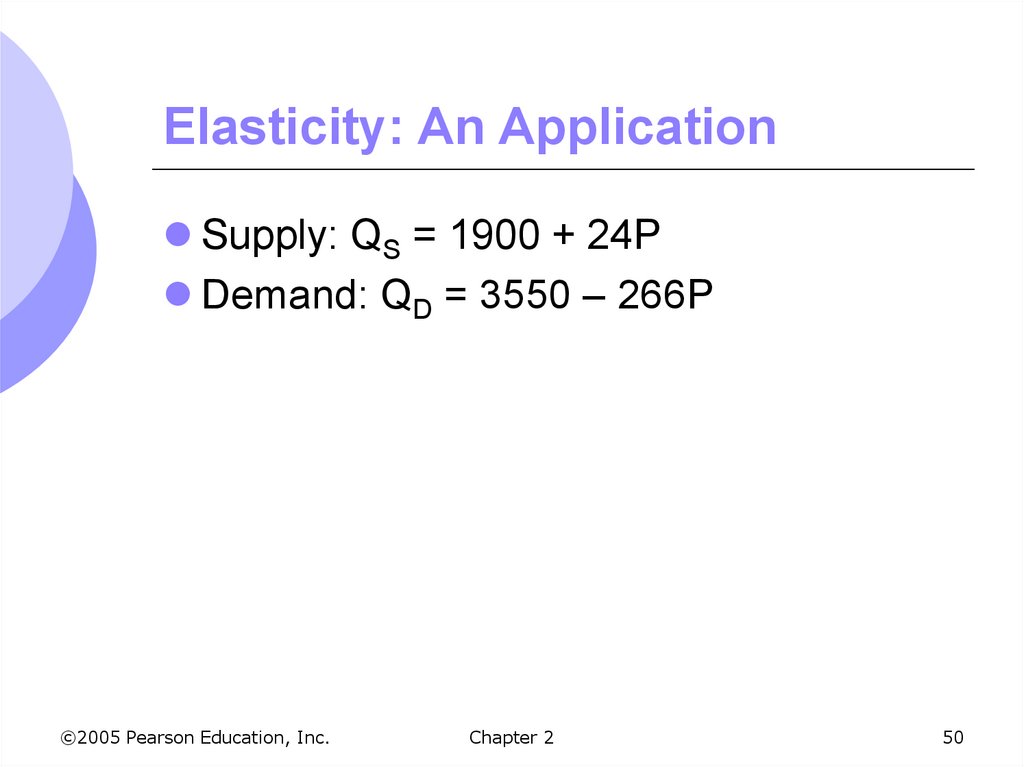
50. Elasticity: An Application
Supply: QS = 1900 + 24PDemand: QD = 3550 – 266P
©2005 Pearson Education, Inc.
Chapter 2
50
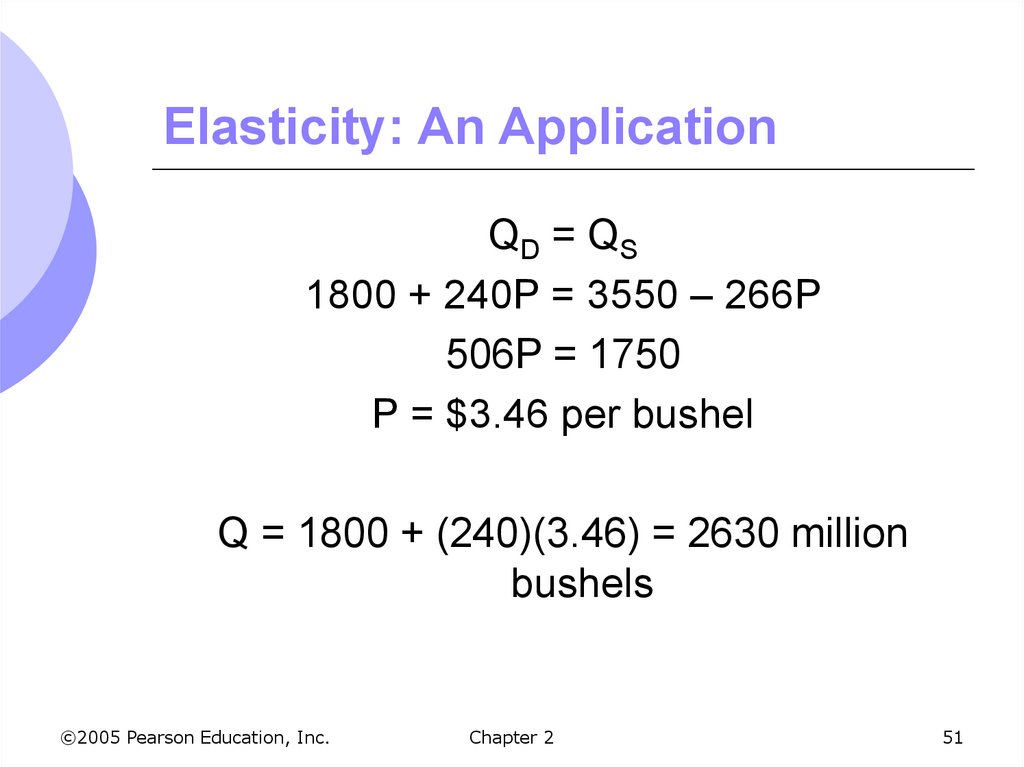
51. Elasticity: An Application
QD = QS1800 + 240P = 3550 – 266P
506P = 1750
P = $3.46 per bushel
Q = 1800 + (240)(3.46) = 2630 million
bushels
©2005 Pearson Education, Inc.
Chapter 2
51
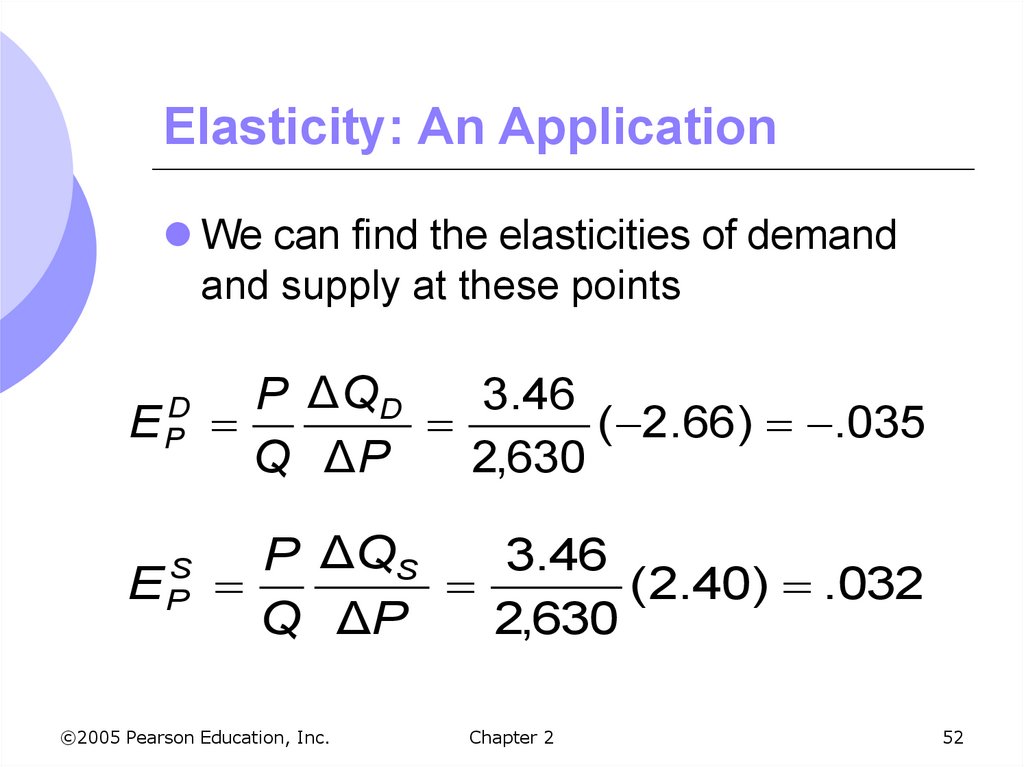
52. Elasticity: An Application
We can find the elasticities of demandand supply at these points
E PD
P ΔQ D
3.46
( 2.66 ) .035
Q ΔP
2,630
S
EP
P ΔQS
3.46
(2.40) .032
Q ΔP
2,630
©2005 Pearson Education, Inc.
Chapter 2
52
53. Elasticity: An Application
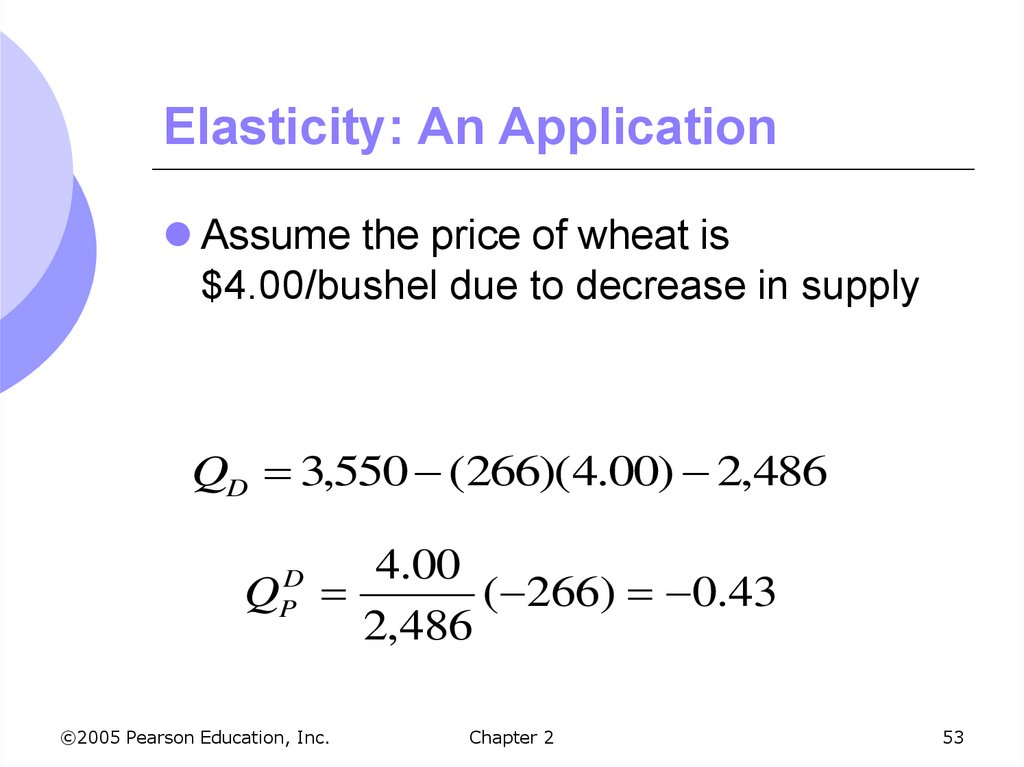
Assume the price of wheat is$4.00/bushel due to decrease in supply
QD 3,550 (266)(4.00) 2,486
4.00
Q
( 266) 0.43
2,486
D
P
©2005 Pearson Education, Inc.
Chapter 2
53
54. Elasticity: An Application
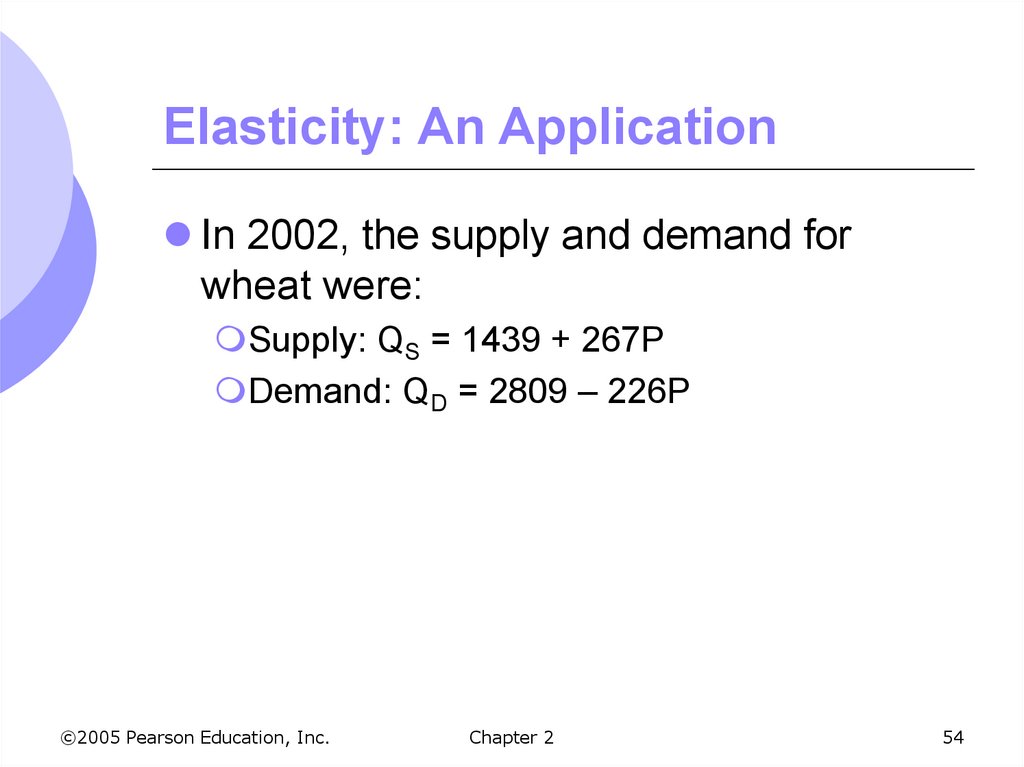
In 2002, the supply and demand forwheat were:
Supply: QS = 1439 + 267P
Demand: QD = 2809 – 226P
©2005 Pearson Education, Inc.
Chapter 2
54
55. Elasticity: An Application
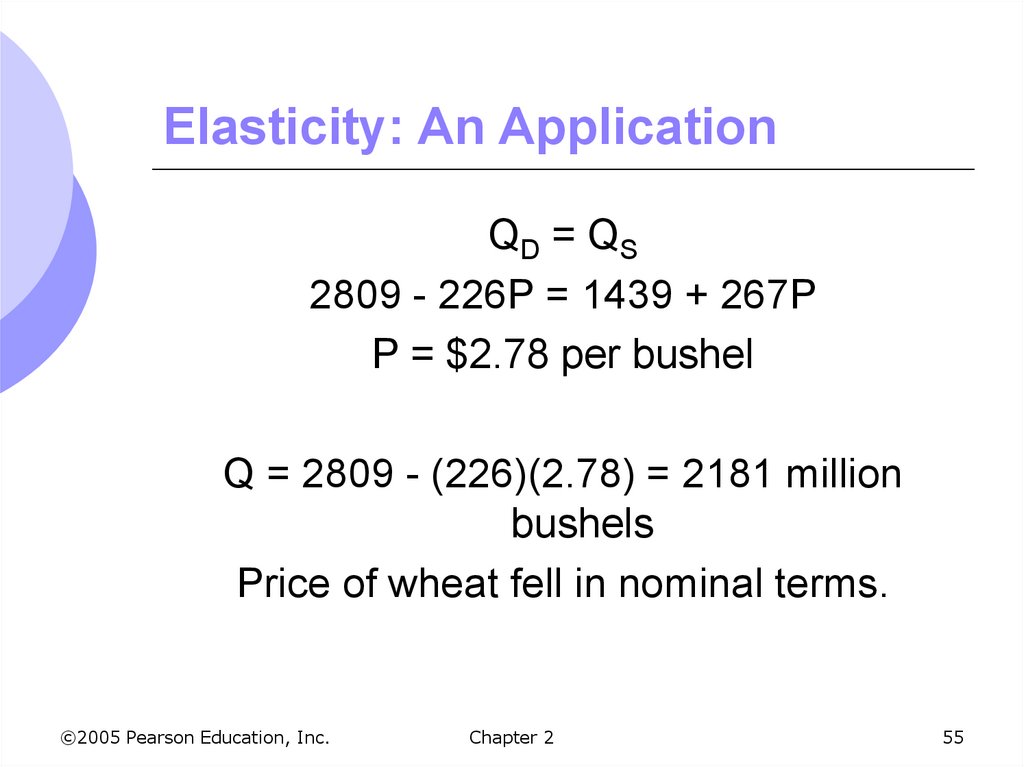
QD = QS2809 - 226P = 1439 + 267P
P = $2.78 per bushel
Q = 2809 - (226)(2.78) = 2181 million
bushels
Price of wheat fell in nominal terms.
©2005 Pearson Education, Inc.
Chapter 2
55
56. Short-Run Versus Long-Run Elasticity
Price elasticity varies with the amount oftime consumers have to respond to a
price
Short-run demand and supply curves
often look very different from their longrun counterparts
©2005 Pearson Education, Inc.
Chapter 2
56
57. Short-Run Versus Long-Run Elasticity
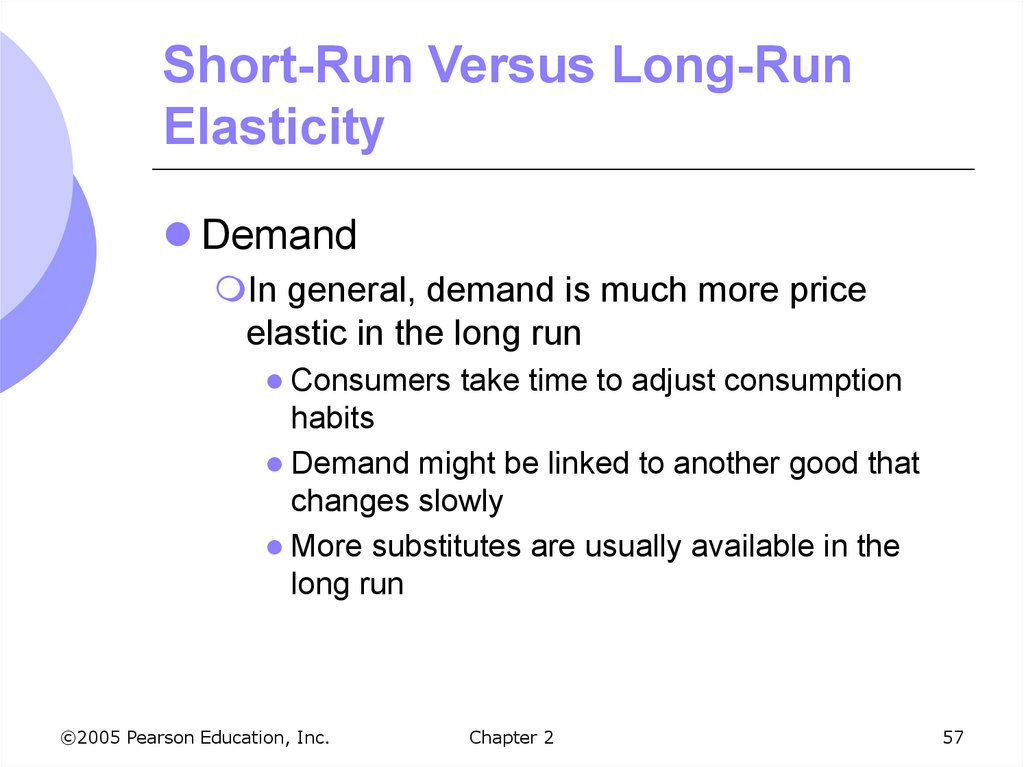
DemandIn general, demand is much more price
elastic in the long run
Consumers take time to adjust consumption
habits
Demand might be linked to another good that
changes slowly
More substitutes are usually available in the
long run
©2005 Pearson Education, Inc.
Chapter 2
57
58. Gasoline: Short-Run and Long-Run Demand Curves
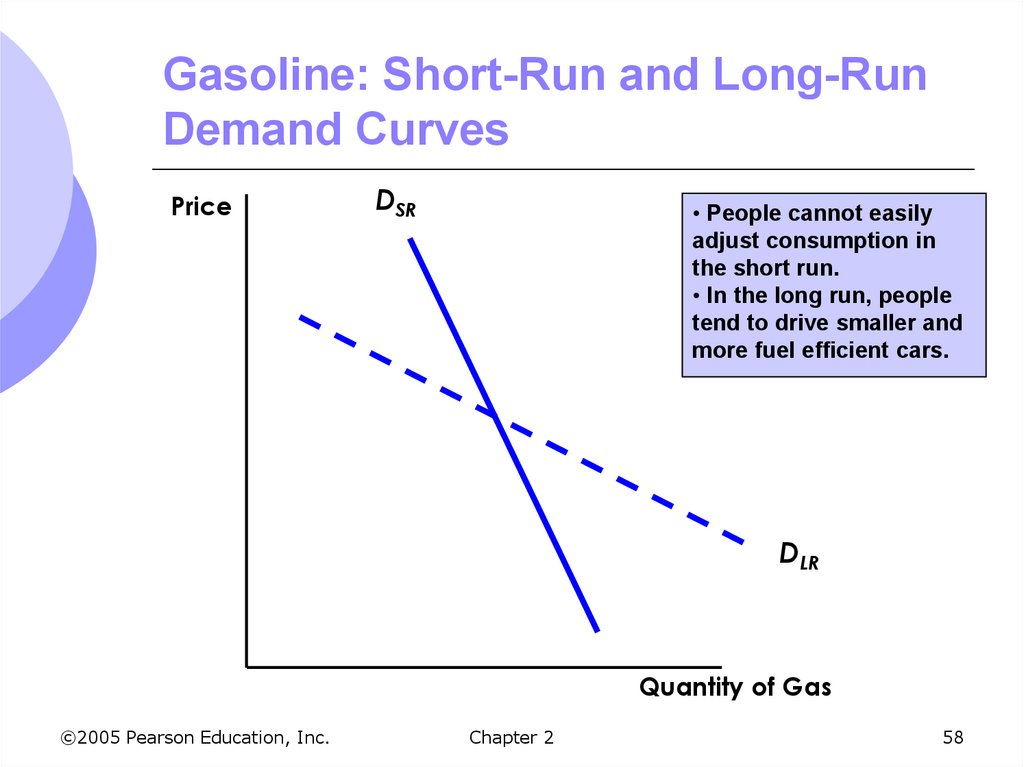
PriceDSR
• People cannot easily
adjust consumption in
the short run.
• In the long run, people
tend to drive smaller and
more fuel efficient cars.
DLR
Quantity of Gas
©2005 Pearson Education, Inc.
Chapter 2
58
59. Short-Run Versus Long-Run Elasticity
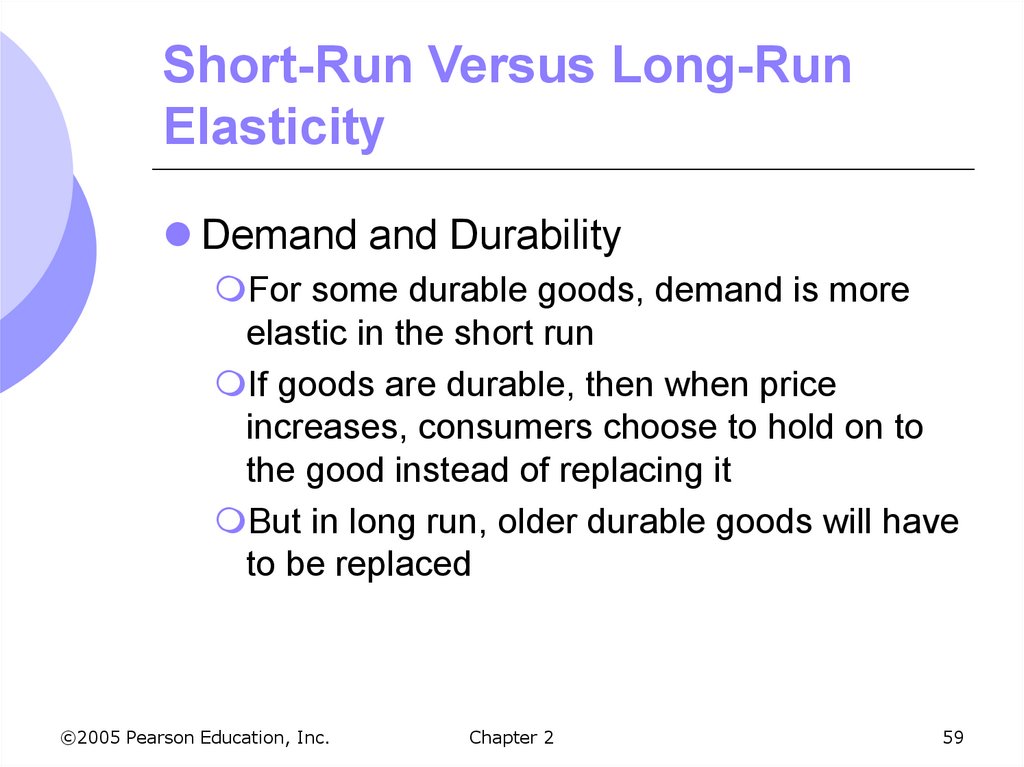
Demand and DurabilityFor some durable goods, demand is more
elastic in the short run
If goods are durable, then when price
increases, consumers choose to hold on to
the good instead of replacing it
But in long run, older durable goods will have
to be replaced
©2005 Pearson Education, Inc.
Chapter 2
59
60. Cars: Short-Run and Long-Run Demand Curves
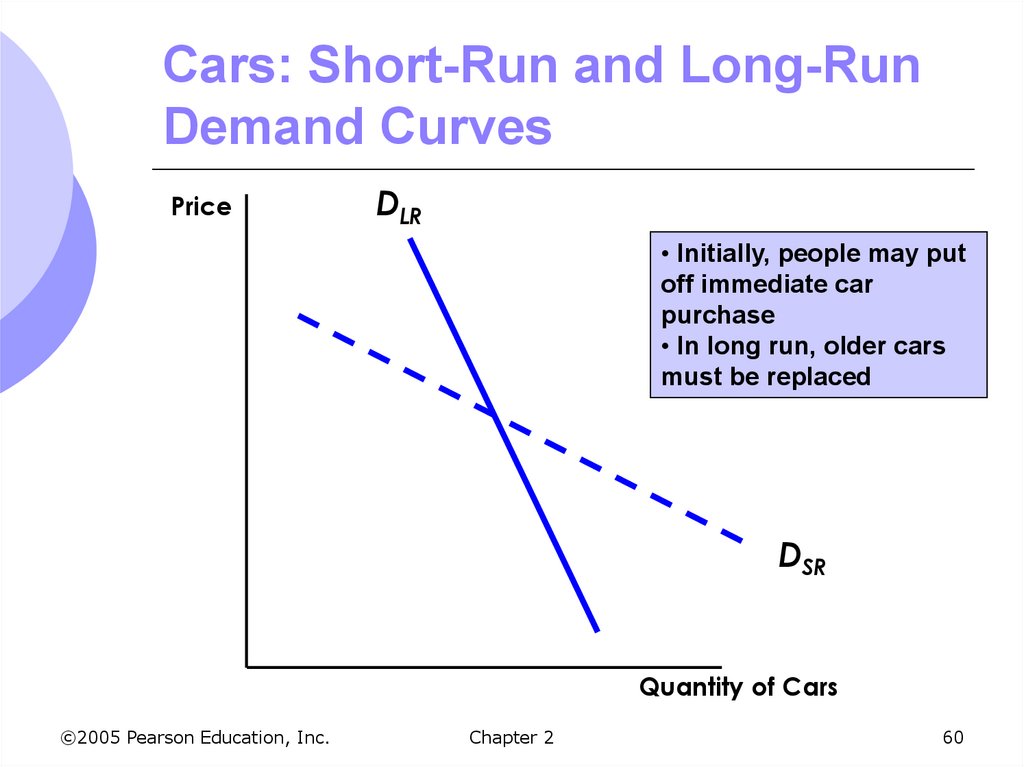
PriceDLR
• Initially, people may put
off immediate car
purchase
• In long run, older cars
must be replaced
DSR
Quantity of Cars
©2005 Pearson Education, Inc.
Chapter 2
60
61. Short-Run Versus Long-Run Elasticity
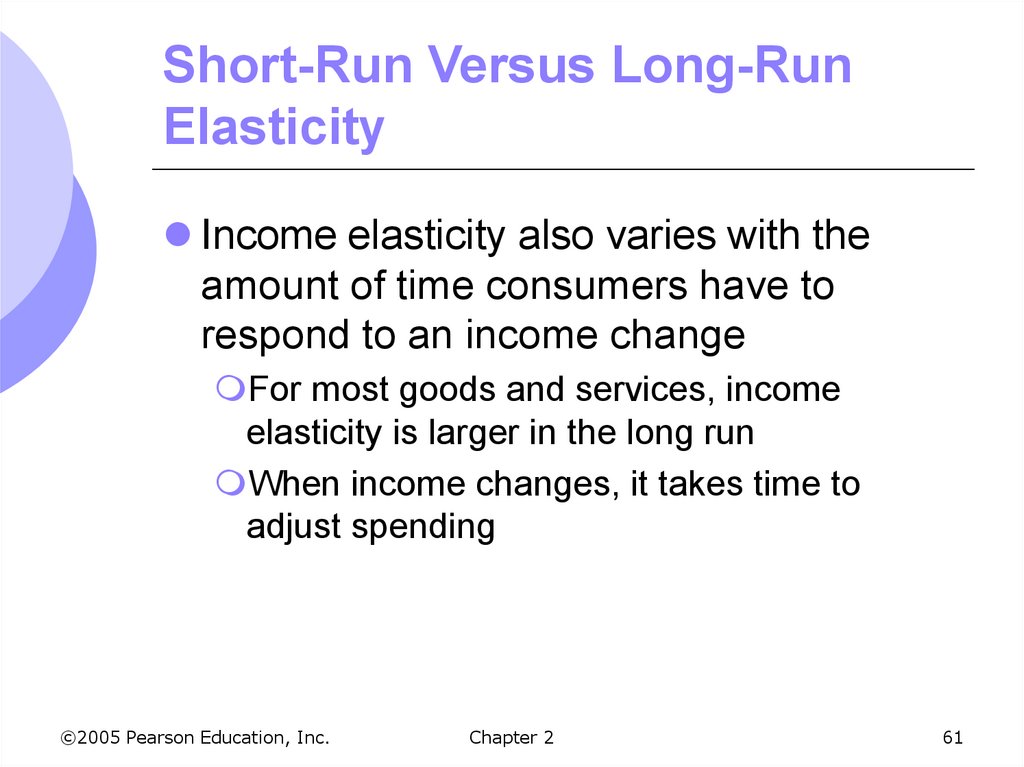
Income elasticity also varies with theamount of time consumers have to
respond to an income change
For most goods and services, income
elasticity is larger in the long run
When income changes, it takes time to
adjust spending
©2005 Pearson Education, Inc.
Chapter 2
61
62. Short-Run Versus Long-Run Elasticity
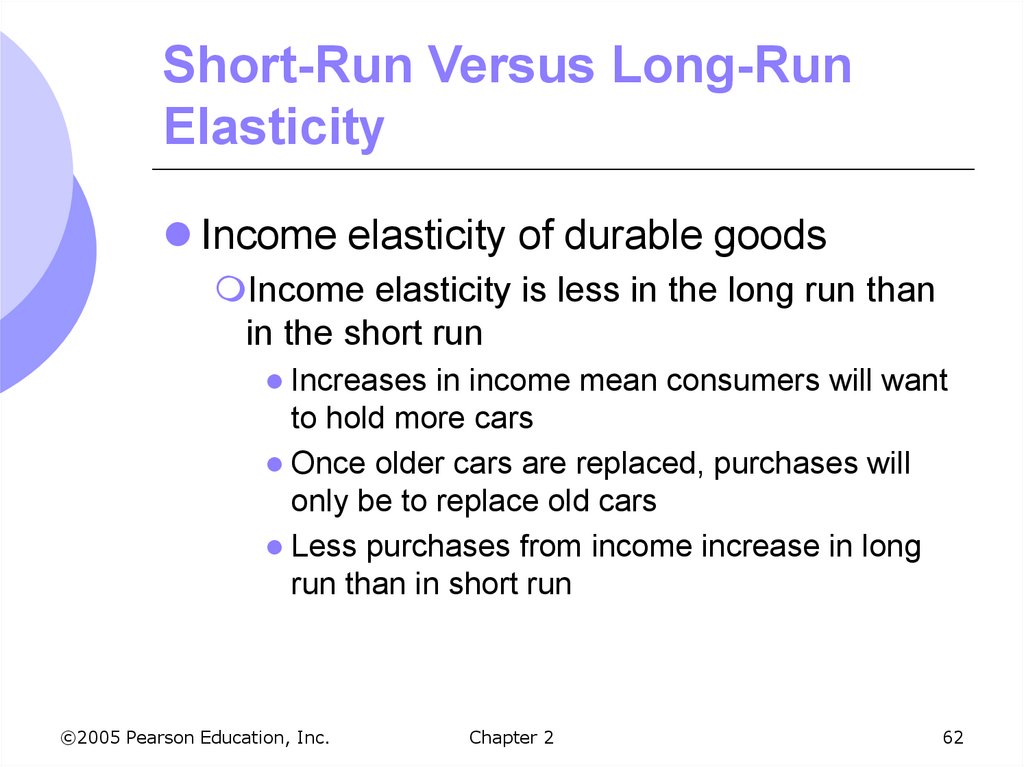
Income elasticity of durable goodsIncome elasticity is less in the long run than
in the short run
Increases in income mean consumers will want
to hold more cars
Once older cars are replaced, purchases will
only be to replace old cars
Less purchases from income increase in long
run than in short run
©2005 Pearson Education, Inc.
Chapter 2
62
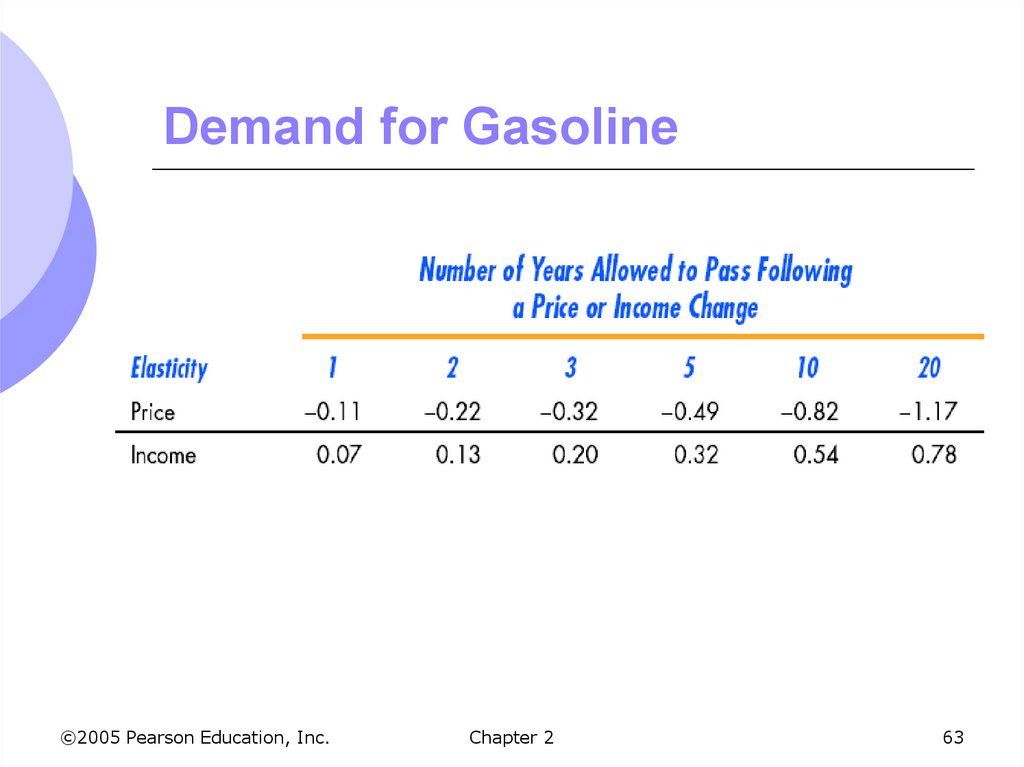
63. Demand for Gasoline
©2005 Pearson Education, Inc.Chapter 2
63
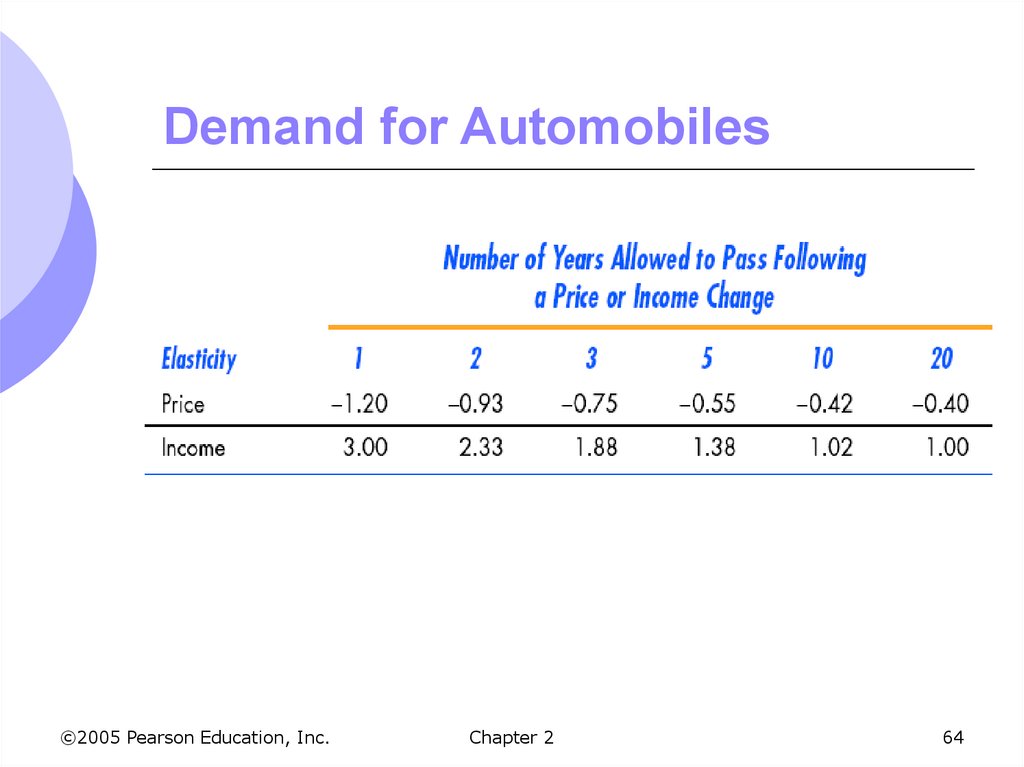
64. Demand for Automobiles
©2005 Pearson Education, Inc.Chapter 2
64
65. Short-Run Versus Long-Run Elasticity
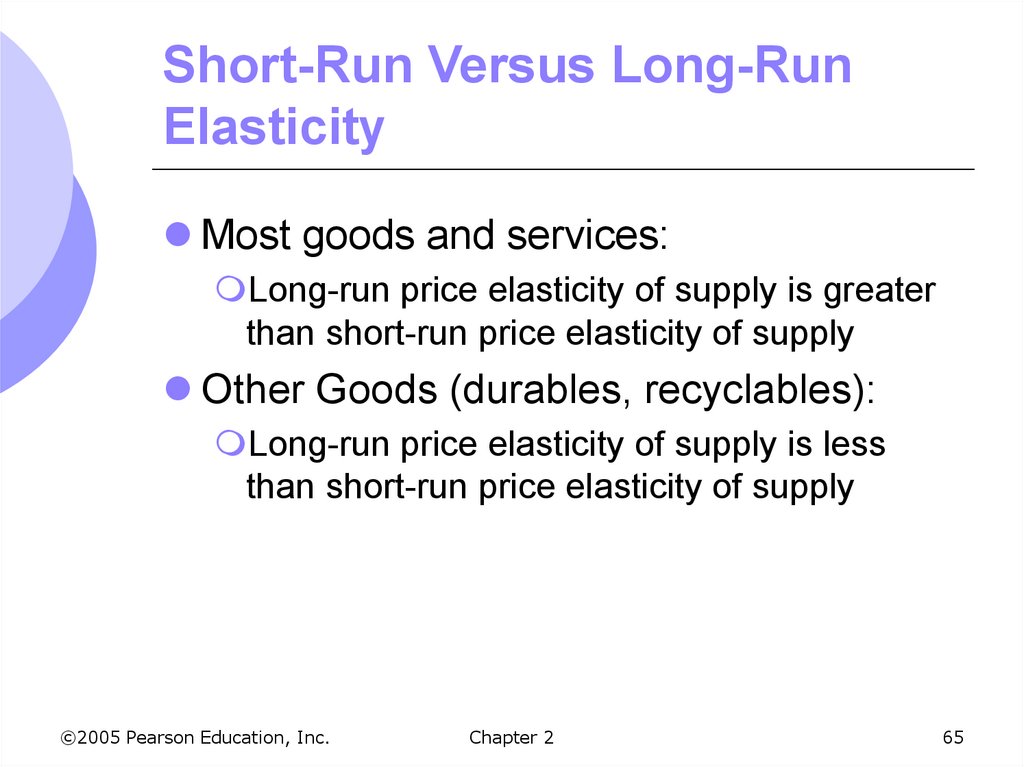
Most goods and services:Long-run price elasticity of supply is greater
than short-run price elasticity of supply
Other Goods (durables, recyclables):
Long-run price elasticity of supply is less
than short-run price elasticity of supply
©2005 Pearson Education, Inc.
Chapter 2
65
66. Short-Run Versus Long-Run Elasticity
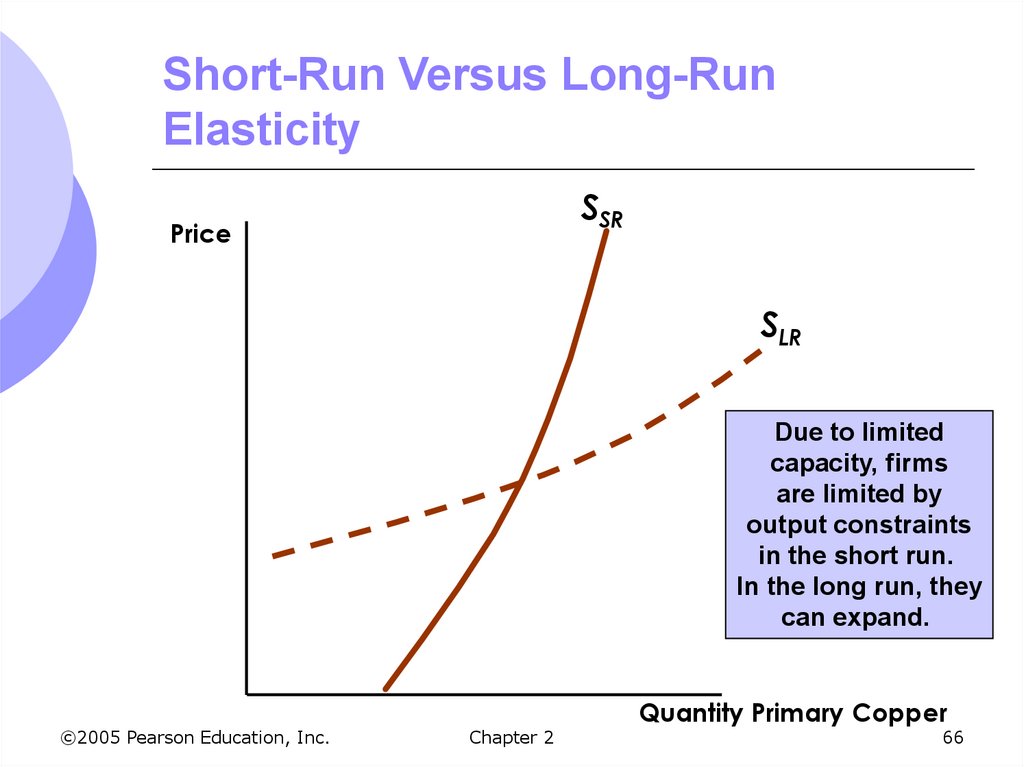
SSRPrice
SLR
Due to limited
capacity, firms
are limited by
output constraints
in the short run.
In the long run, they
can expand.
©2005 Pearson Education, Inc.
Chapter 2
Quantity Primary Copper
66
67. Short-Run Versus Long-Run Elasticity
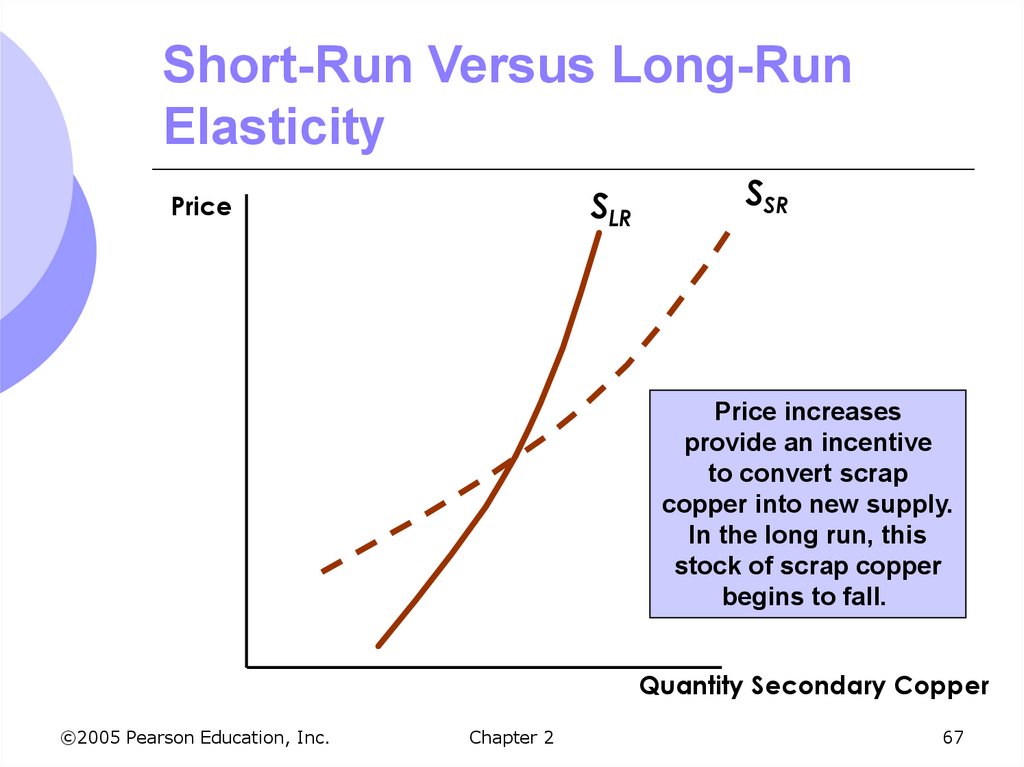
SLRPrice
SSR
Price increases
provide an incentive
to convert scrap
copper into new supply.
In the long run, this
stock of scrap copper
begins to fall.
Quantity Secondary Copper
©2005 Pearson Education, Inc.
Chapter 2
67
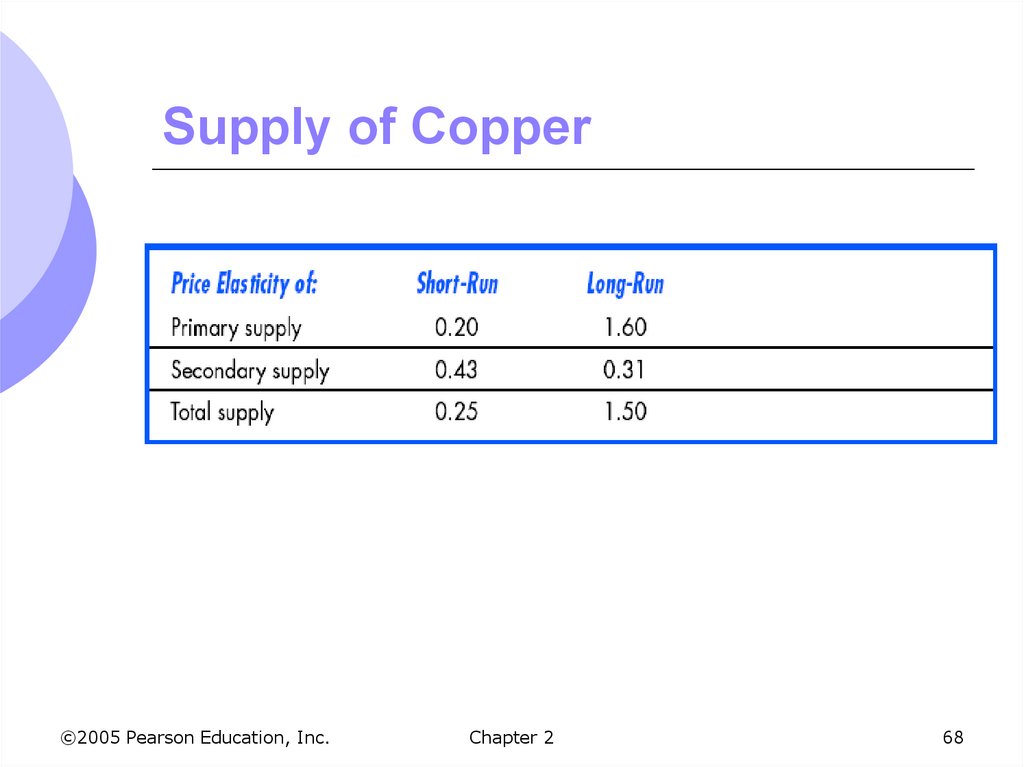
68. Supply of Copper
©2005 Pearson Education, Inc.Chapter 2
68
69. Short-Run vs. Long-Run Elasticity – An Application
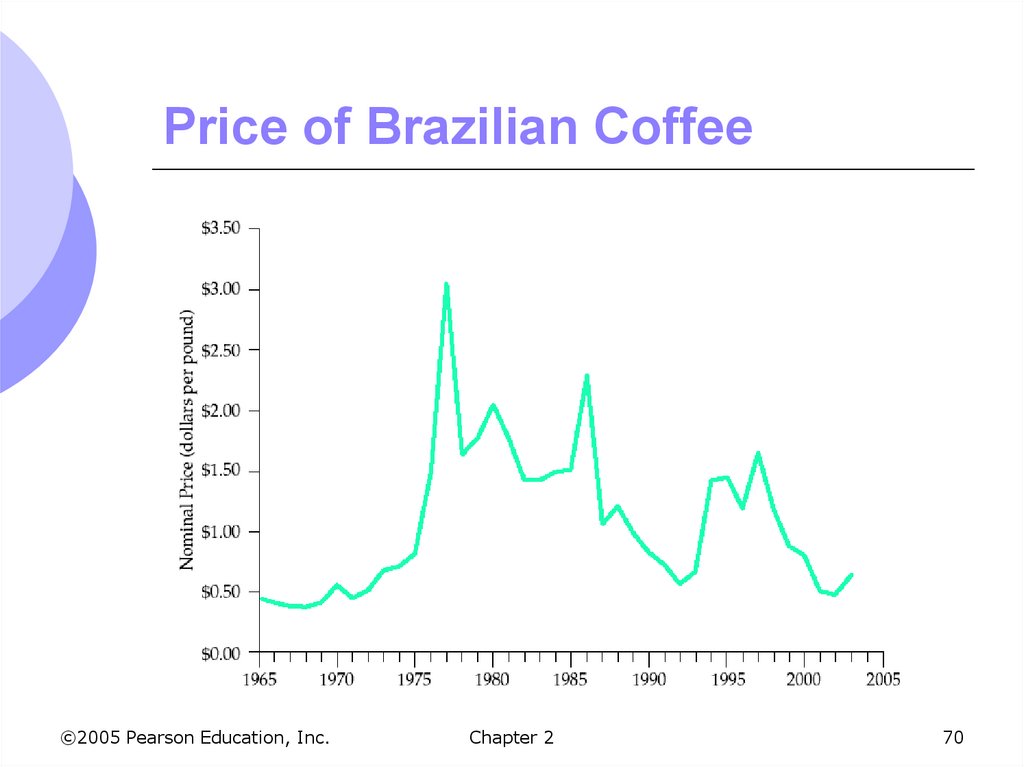
Why are coffee prices very volatile?Most of the world’s coffee is produced in
Brazil
Many changing weather conditions affect the
crop of coffee, thereby affecting price
Price following bad weather conditions is
usually short-lived
In long run, prices come back to original
levels, all else equal
©2005 Pearson Education, Inc.
Chapter 2
69
70. Price of Brazilian Coffee
©2005 Pearson Education, Inc.Chapter 2
70
71. Short-Run vs. Long-Run Elasticity – An Application
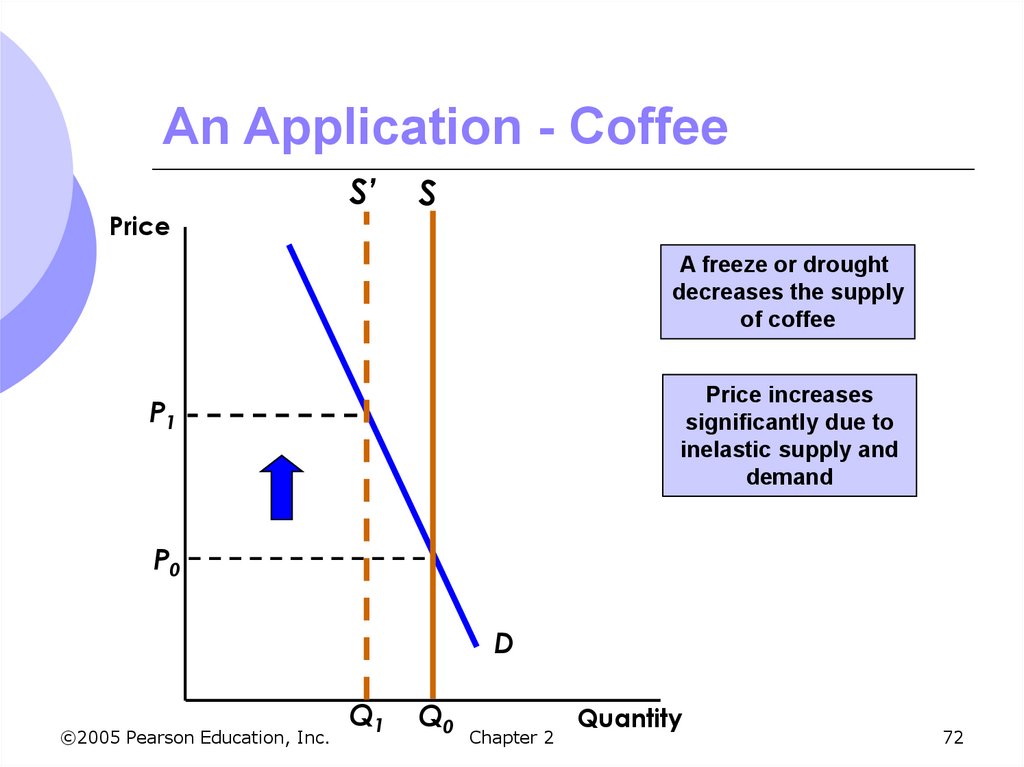
Demand and supply are more elastic inthe long run
In the short run, supply is completely
inelastic
Weather may destroy part of the fixed supply,
decreasing supply
Demand is relatively inelastic as well
Price increases significantly
©2005 Pearson Education, Inc.
Chapter 2
71
72. An Application - Coffee
PriceS’
S
A freeze or drought
decreases the supply
of coffee
Price increases
significantly due to
inelastic supply and
demand
P1
P0
D
©2005 Pearson Education, Inc.
Q1
Q0
Chapter 2
Quantity
72
73. An Application - Coffee
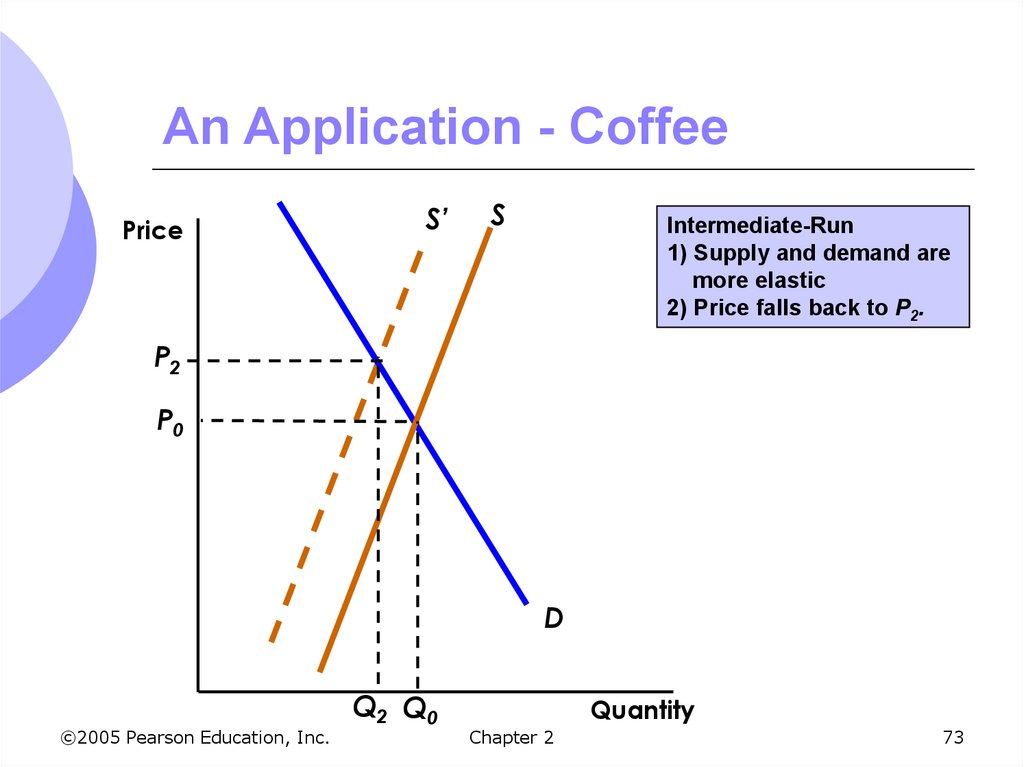
PriceS’
S
Intermediate-Run
1) Supply and demand are
more elastic
2) Price falls back to P2.
P2
P0
D
©2005 Pearson Education, Inc.
Q2 Q0
Quantity
Chapter 2
73
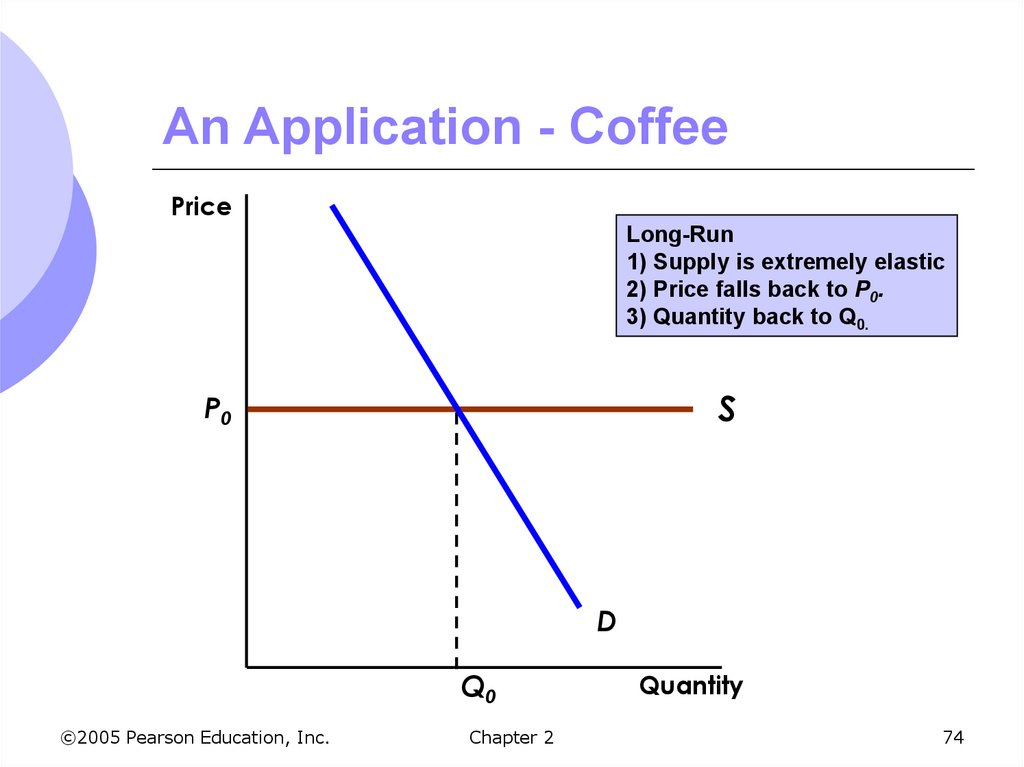
74. An Application - Coffee
PriceLong-Run
1) Supply is extremely elastic
2) Price falls back to P0.
3) Quantity back to Q0.
S
P0
D
Q0
©2005 Pearson Education, Inc.
Chapter 2
Quantity
74
75. Predicting the Effects of Changing Market Conditions
Supply and demand analysis can beused to predict the effects of changing
market conditions
Linear demand and supply must be fit to
market data
Given equilibrium price and quantity along with
elasticities of supply and demand, we can
calculate the curves that fit the information
We can then calculate changes in the market
©2005 Pearson Education, Inc.
Chapter 2
75
76. Predicting the Effects of Changing Market Conditions
We knowEquilibrium Price, P*
Equilibrium Quantity, Q*
Price elasticity of supply, ES
Price elasticity of demand, ED
©2005 Pearson Education, Inc.
Chapter 2
76
77. Predicting the Effects of Changing Market Conditions
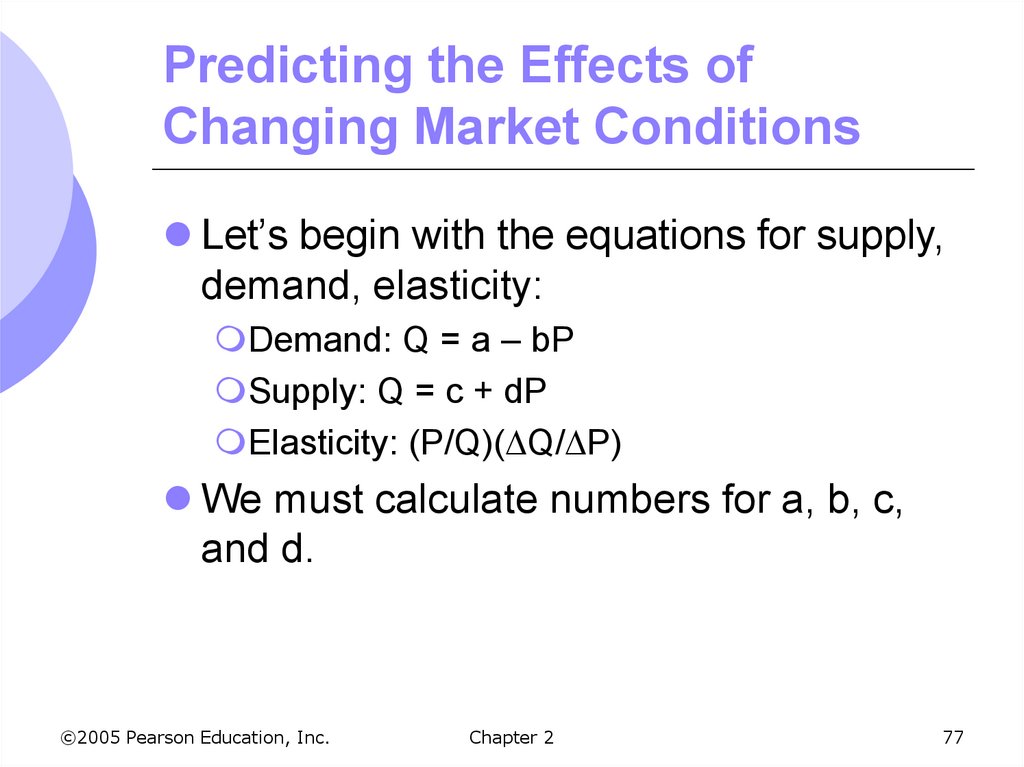
Let’s begin with the equations for supply,demand, elasticity:
Demand: Q = a – bP
Supply: Q = c + dP
Elasticity: (P/Q)( Q/ P)
We must calculate numbers for a, b, c,
and d.
©2005 Pearson Education, Inc.
Chapter 2
77
78. Predicting the Effects of Changing Market Conditions
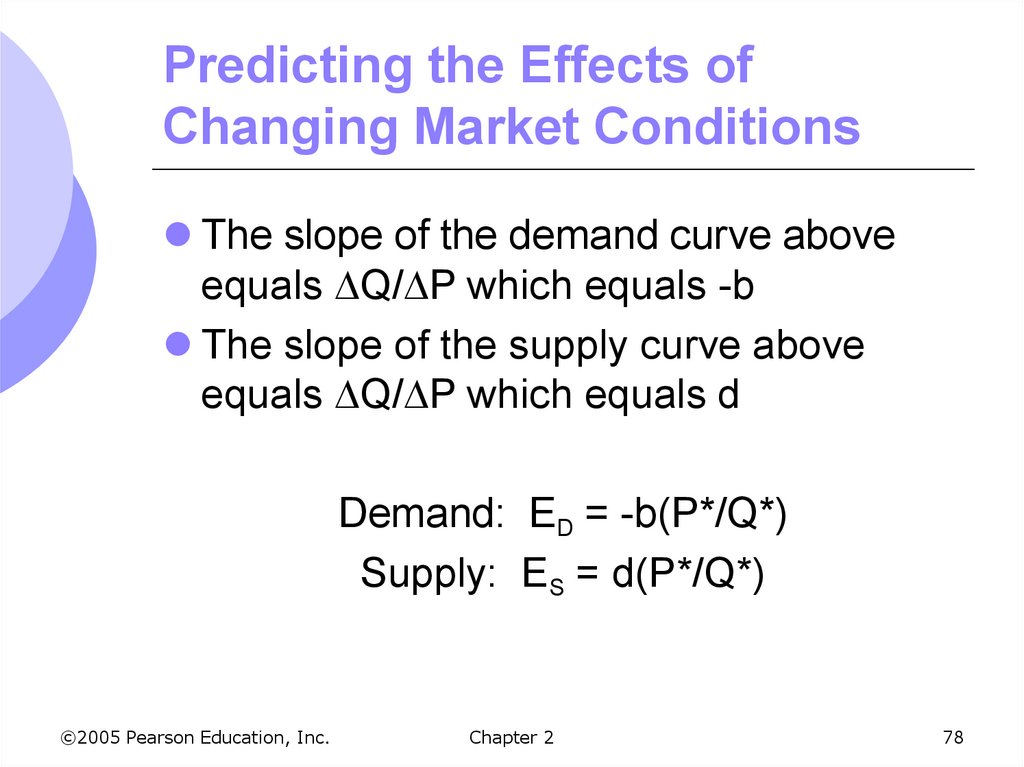
The slope of the demand curve aboveequals Q/ P which equals -b
The slope of the supply curve above
equals Q/ P which equals d
Demand: ED = -b(P*/Q*)
Supply: ES = d(P*/Q*)
©2005 Pearson Education, Inc.
Chapter 2
78
79. Predicting the Effects of Changing Market Conditions
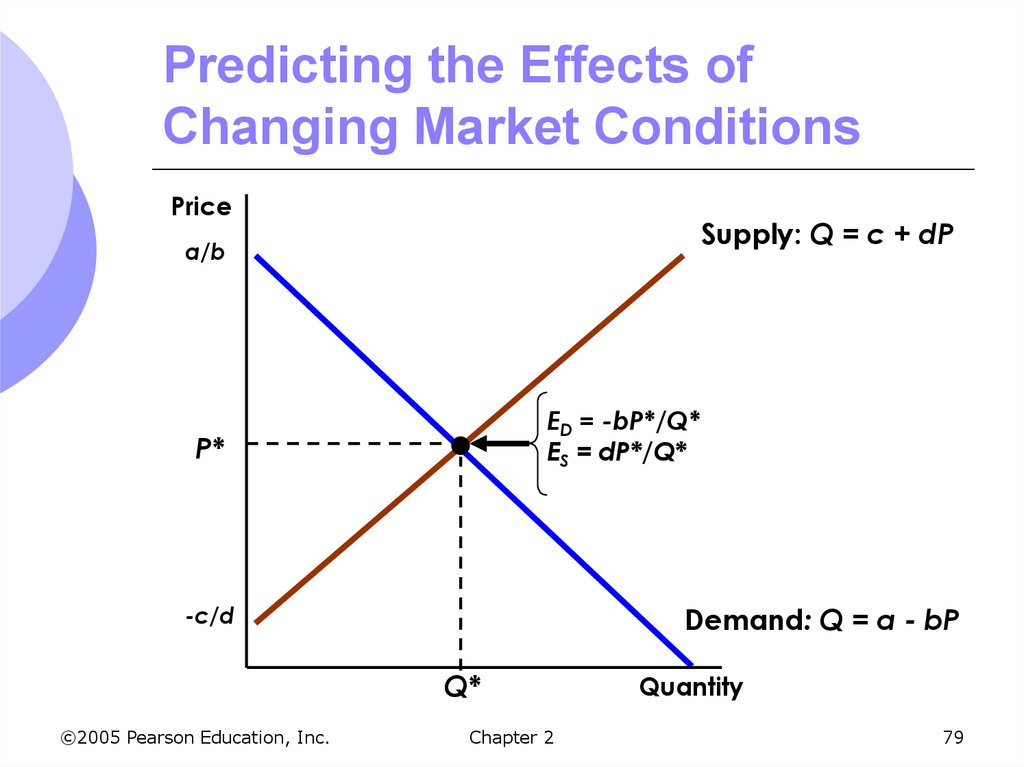
PriceSupply: Q = c + dP
a/b
ED = -bP*/Q*
ES = dP*/Q*
P*
Demand: Q = a - bP
-c/d
Q*
©2005 Pearson Education, Inc.
Chapter 2
Quantity
79
80. Predicting the Effects of Changing Market Conditions
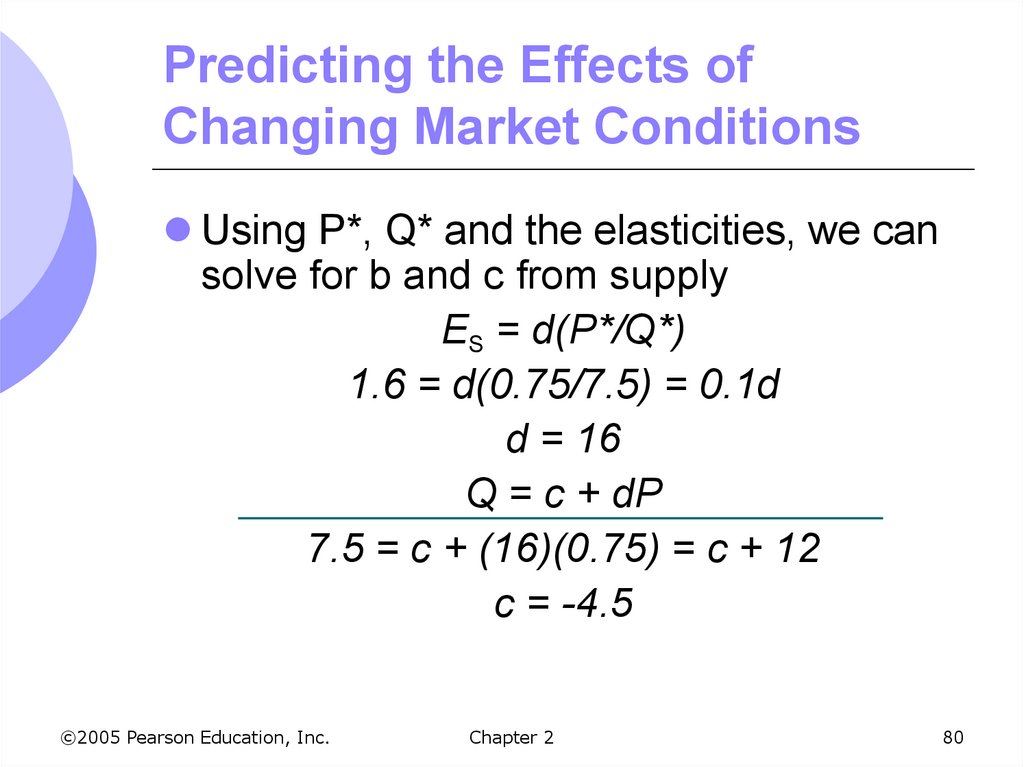
Using P*, Q* and the elasticities, we cansolve for b and c from supply
ES = d(P*/Q*)
1.6 = d(0.75/7.5) = 0.1d
d = 16
Q = c + dP
7.5 = c + (16)(0.75) = c + 12
c = -4.5
©2005 Pearson Education, Inc.
Chapter 2
80
81. Predicting the Effects of Changing Market Conditions
Using P*, Q* and the elasticities, we cansolve for a and b from demand
ED = –b(P*/Q*)
-0.8 = -b(0.75/7.5) = –0.1b
b=8
Q = a – bP
7.5 = a – (8)(0.75) = a – 6
a = 13.5
©2005 Pearson Education, Inc.
Chapter 2
81
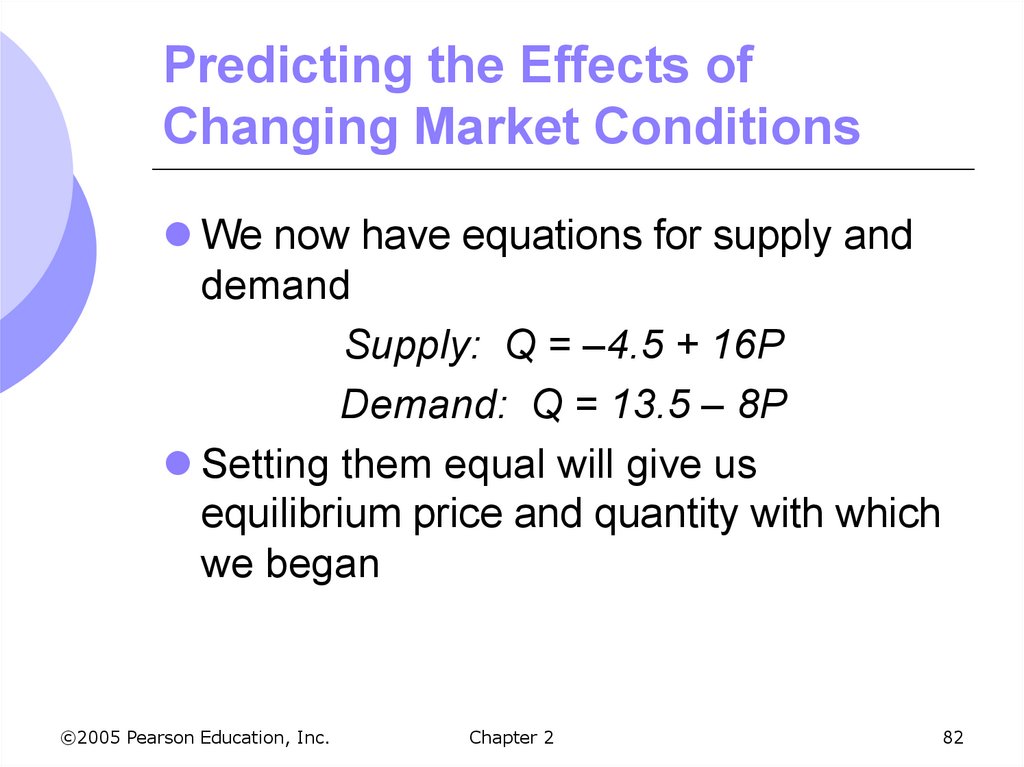
82. Predicting the Effects of Changing Market Conditions
We now have equations for supply anddemand
Supply: Q = –4.5 + 16P
Demand: Q = 13.5 – 8P
Setting them equal will give us
equilibrium price and quantity with which
we began
©2005 Pearson Education, Inc.
Chapter 2
82
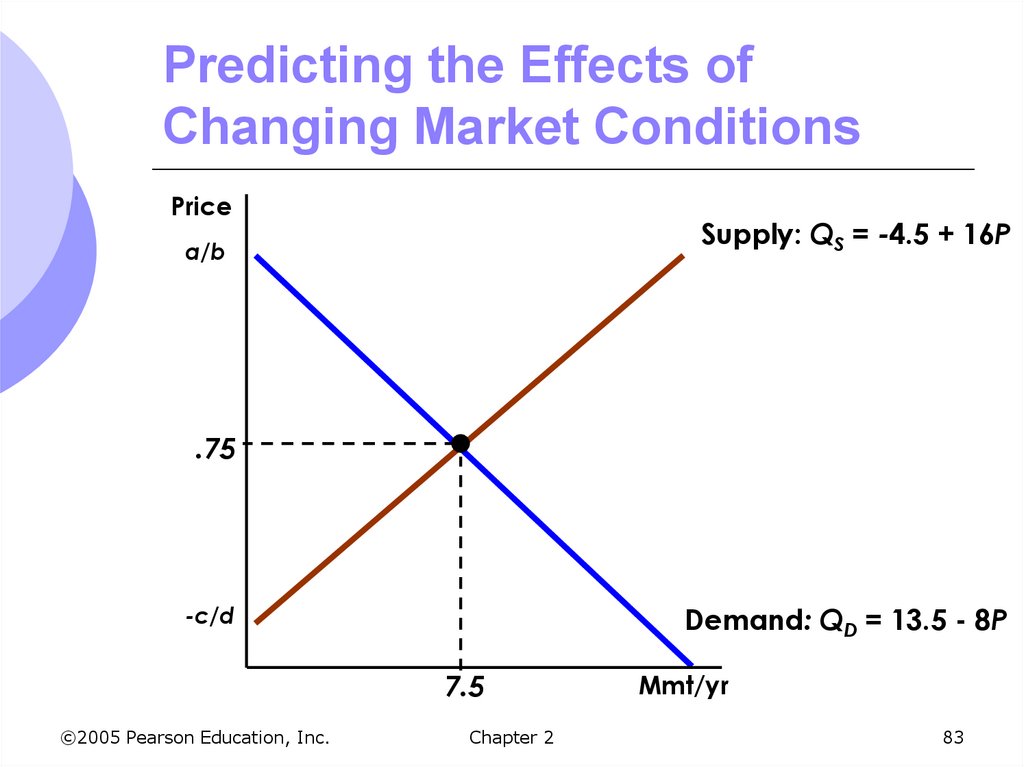
83. Predicting the Effects of Changing Market Conditions
PriceSupply: QS = -4.5 + 16P
a/b
.75
Demand: QD = 13.5 - 8P
-c/d
7.5
©2005 Pearson Education, Inc.
Chapter 2
Mmt/yr
83
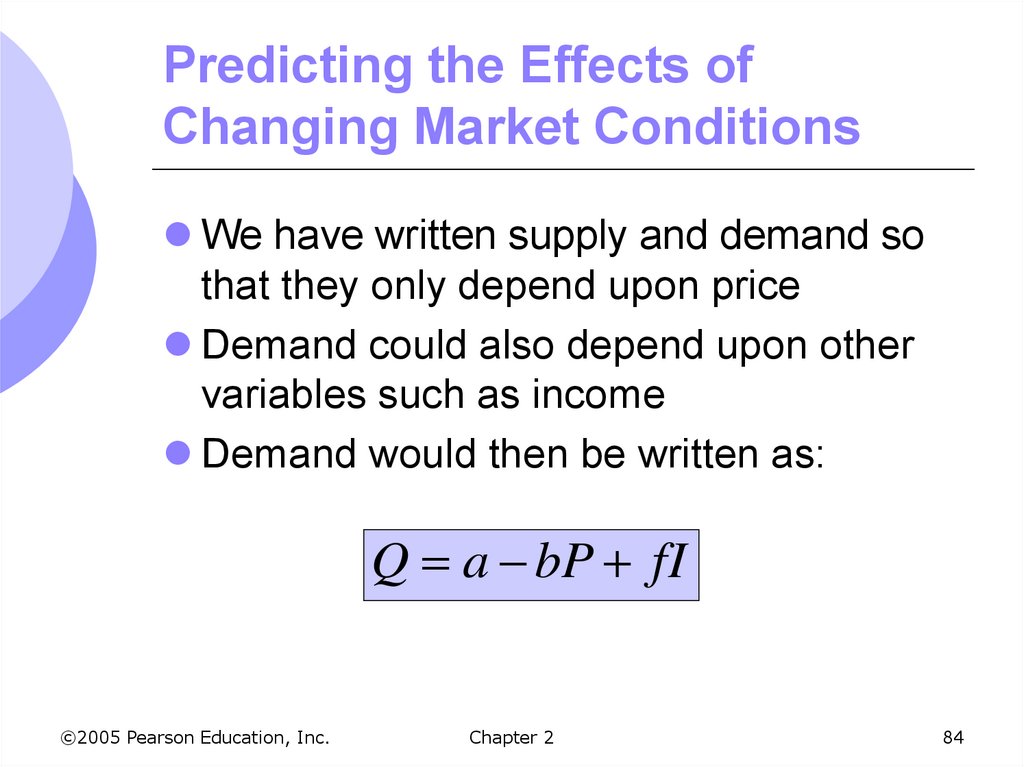
84. Predicting the Effects of Changing Market Conditions
We have written supply and demand sothat they only depend upon price
Demand could also depend upon other
variables such as income
Demand would then be written as:
Q a bP fI
©2005 Pearson Education, Inc.
Chapter 2
84
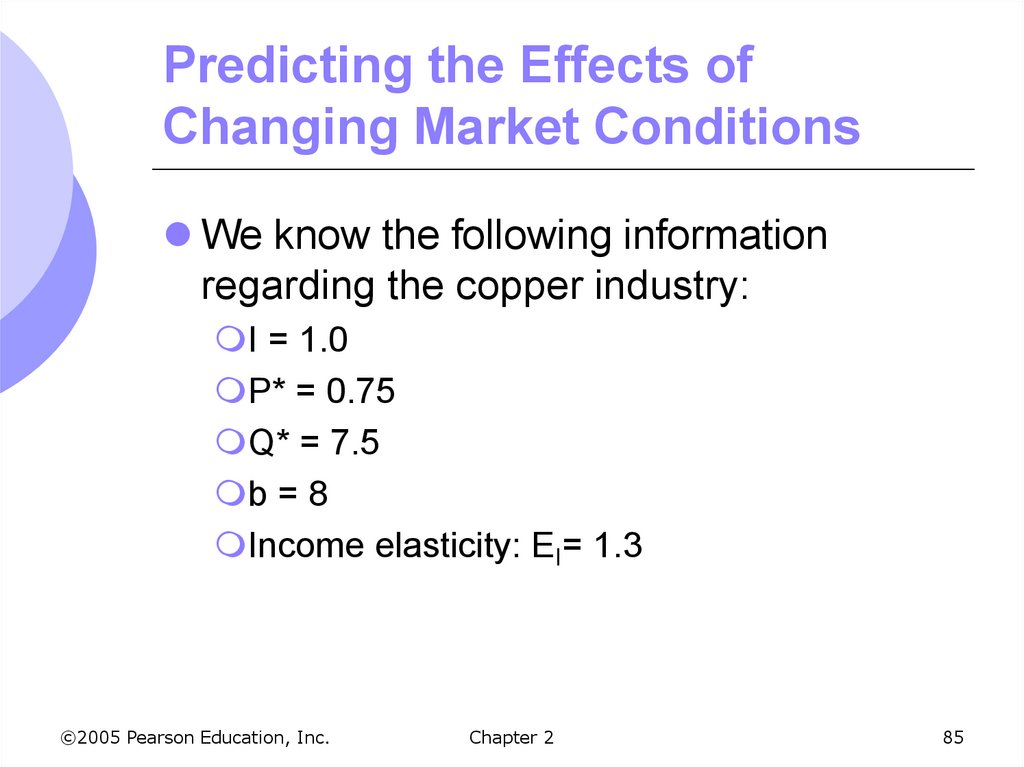
85. Predicting the Effects of Changing Market Conditions
We know the following informationregarding the copper industry:
I = 1.0
P* = 0.75
Q* = 7.5
b = 8
Income elasticity: EI= 1.3
©2005 Pearson Education, Inc.
Chapter 2
85
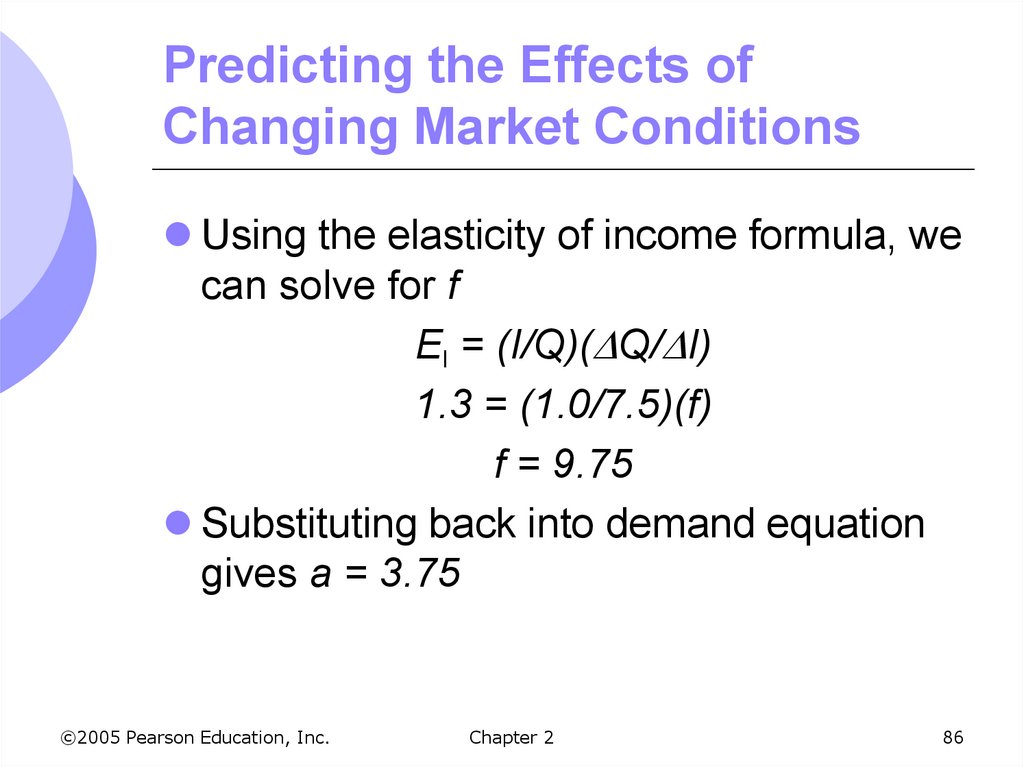
86. Predicting the Effects of Changing Market Conditions
Using the elasticity of income formula, wecan solve for f
EI = (I/Q)( Q/ I)
1.3 = (1.0/7.5)(f)
f = 9.75
Substituting back into demand equation
gives a = 3.75
©2005 Pearson Education, Inc.
Chapter 2
86
87. Declining Demand and the Behavior of Copper Prices
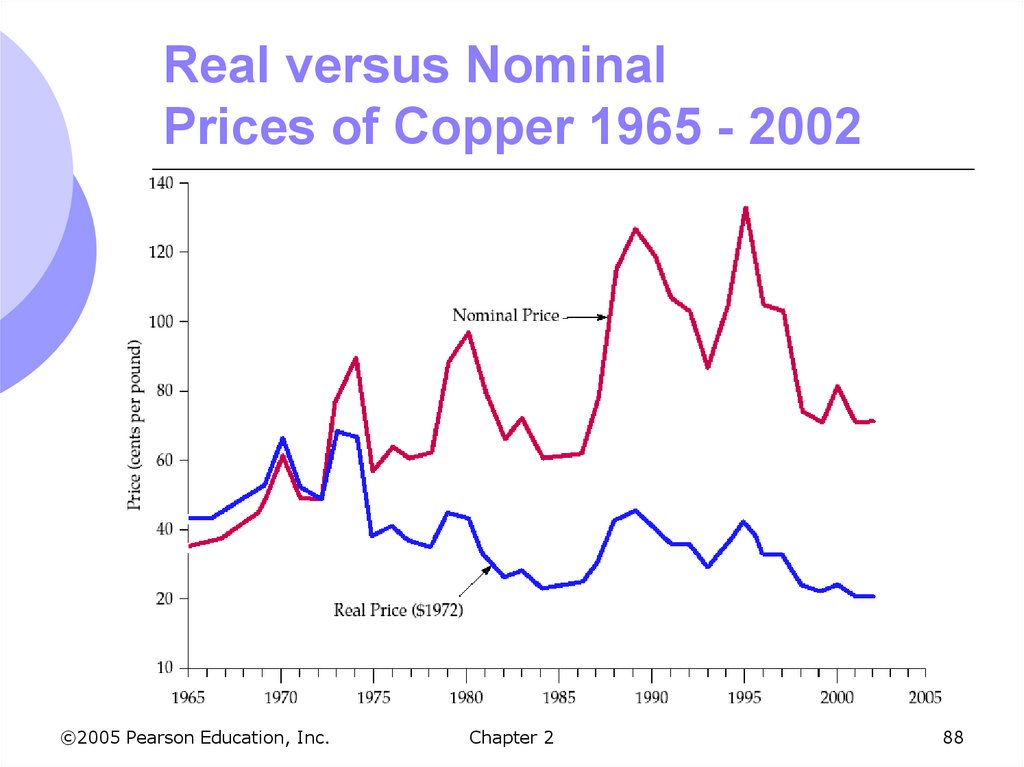
Copper has gone through difficult marketchanges leading the significantly reduced
prices most from decreased demand
from
A decrease in the growth rate of power
generation
The development of substitutes: fiber optics
and aluminum
©2005 Pearson Education, Inc.
Chapter 2
87
88. Real versus Nominal Prices of Copper 1965 - 2002
©2005 Pearson Education, Inc.Chapter 2
88
89. Declining Demand and the Behavior of Copper Prices
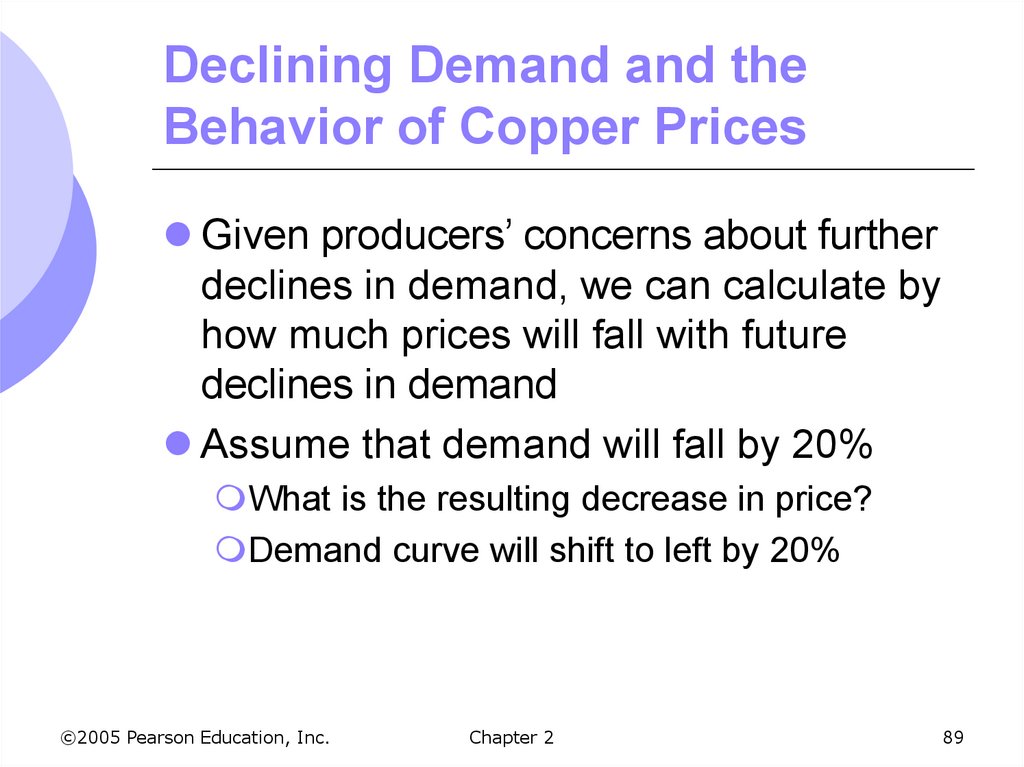
Given producers’ concerns about furtherdeclines in demand, we can calculate by
how much prices will fall with future
declines in demand
Assume that demand will fall by 20%
What is the resulting decrease in price?
Demand curve will shift to left by 20%
©2005 Pearson Education, Inc.
Chapter 2
89
90. Declining Demand and the Behavior of Copper Prices
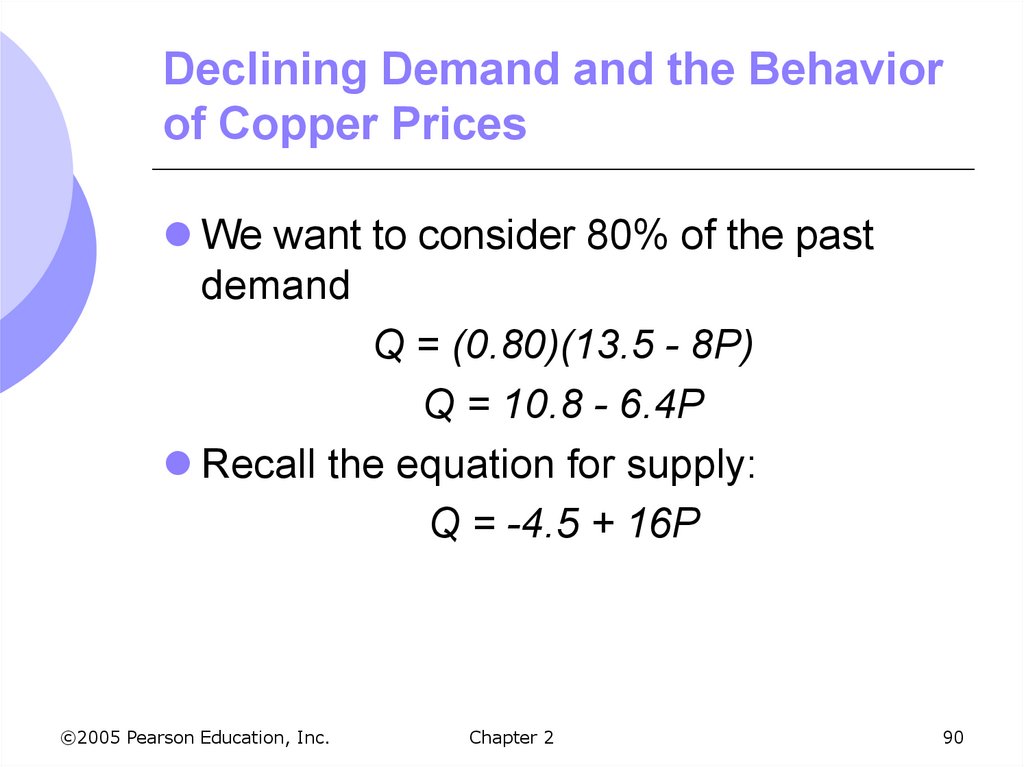
We want to consider 80% of the pastdemand
Q = (0.80)(13.5 - 8P)
Q = 10.8 - 6.4P
Recall the equation for supply:
Q = -4.5 + 16P
©2005 Pearson Education, Inc.
Chapter 2
90
91. Declining Demand and the Behavior of Copper Prices
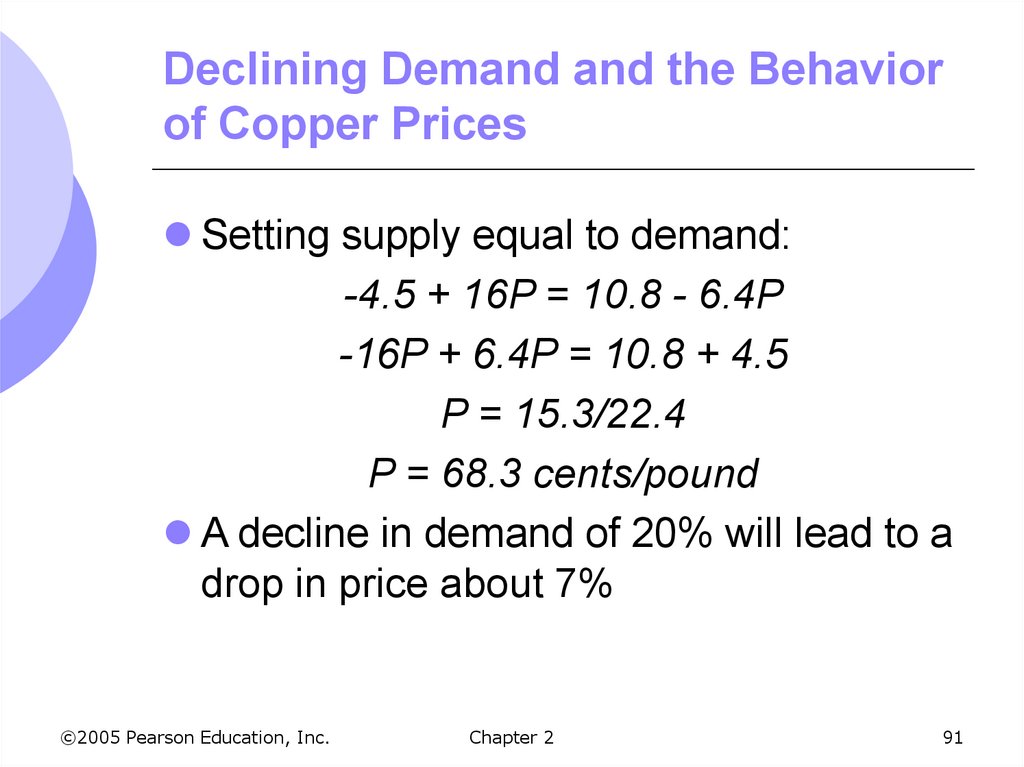
Setting supply equal to demand:-4.5 + 16P = 10.8 - 6.4P
-16P + 6.4P = 10.8 + 4.5
P = 15.3/22.4
P = 68.3 cents/pound
A decline in demand of 20% will lead to a
drop in price about 7%
©2005 Pearson Education, Inc.
Chapter 2
91
92. Effects of Price Controls
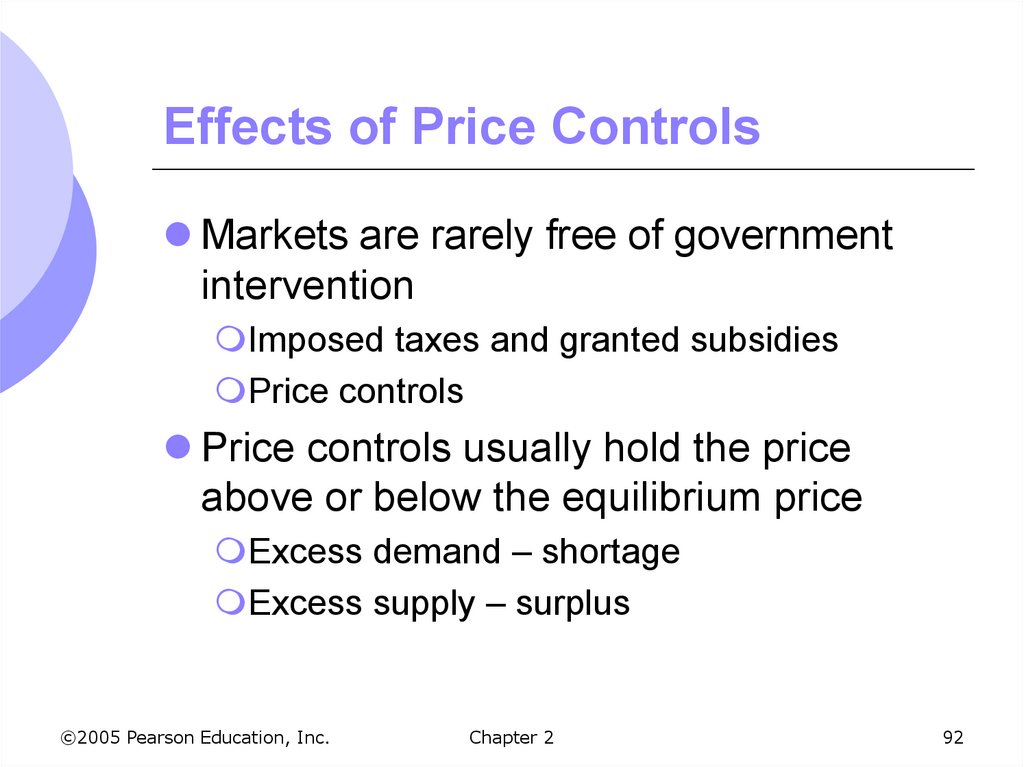
Markets are rarely free of governmentintervention
Imposed taxes and granted subsidies
Price controls
Price controls usually hold the price
above or below the equilibrium price
Excess demand – shortage
Excess supply – surplus
©2005 Pearson Education, Inc.
Chapter 2
92
93. Effects of Price Controls
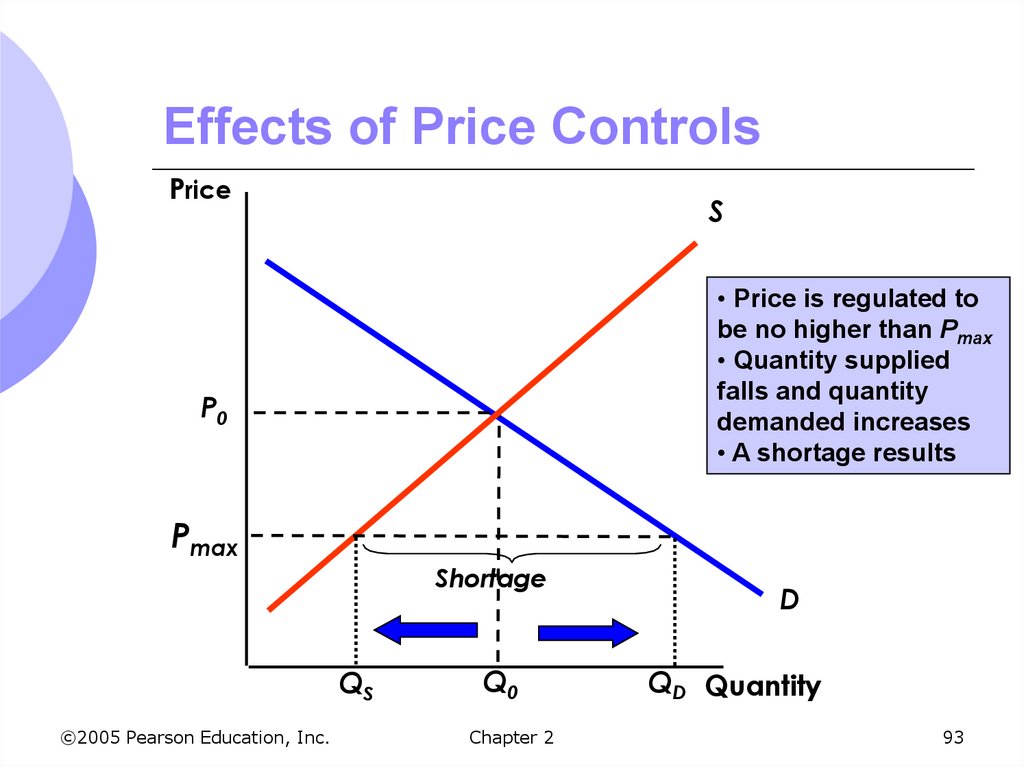
PriceS
• Price is regulated to
be no higher than Pmax
• Quantity supplied
falls and quantity
demanded increases
• A shortage results
P0
Pmax
Shortage
QS
©2005 Pearson Education, Inc.
Q0
Chapter 2
D
QD Quantity
93
94. Effects of Price Controls
Excess demand sometimes takes theform of queues
Lines at gas stations during 1974 shortage
Sometimes get curtailments and supply
rationing
Natural gas shortage of the mid ’70’s
Producers typically lose, but some
consumers gain. Some consumers lose.
©2005 Pearson Education, Inc.
Chapter 2
94
95. Price Controls and Natural Gas Shortages
In 1954, the federal government beganregulating the wellhead price of natural
gas
In 1962, the ceiling prices that were
imposed became binding and shortages
resulted
©2005 Pearson Education, Inc.
Chapter 2
95
96. Price Controls and Natural Gas Shortages
Price controls created an excess demandof 7 trillion cubic feet
Price regulation was a major component
of US energy policy in the 1960s and
1970s, and it continued to influence the
natural gas markets in the 1980s
©2005 Pearson Education, Inc.
Chapter 2
96