 Экономика
Похожие презентации:




Profit Maximization and Competitive Supply
1. Chapter 8
Profit Maximization andCompetitive Supply
2. Topics to be Discussed
Perfectly Competitive MarketsProfit Maximization
Marginal Revenue, Marginal Cost, and
Profit Maximization
Choosing Output in the Short Run
©2005 Pearson Education, Inc.
Chapter 8
2
3. Topics to be Discussed
The Competitive Firm’s Short-Run SupplyCurve
Short-Run Market Supply
Choosing Output in the Long Run
The Industry’s Long-Run Supply Curve
©2005 Pearson Education, Inc.
Chapter 8
3
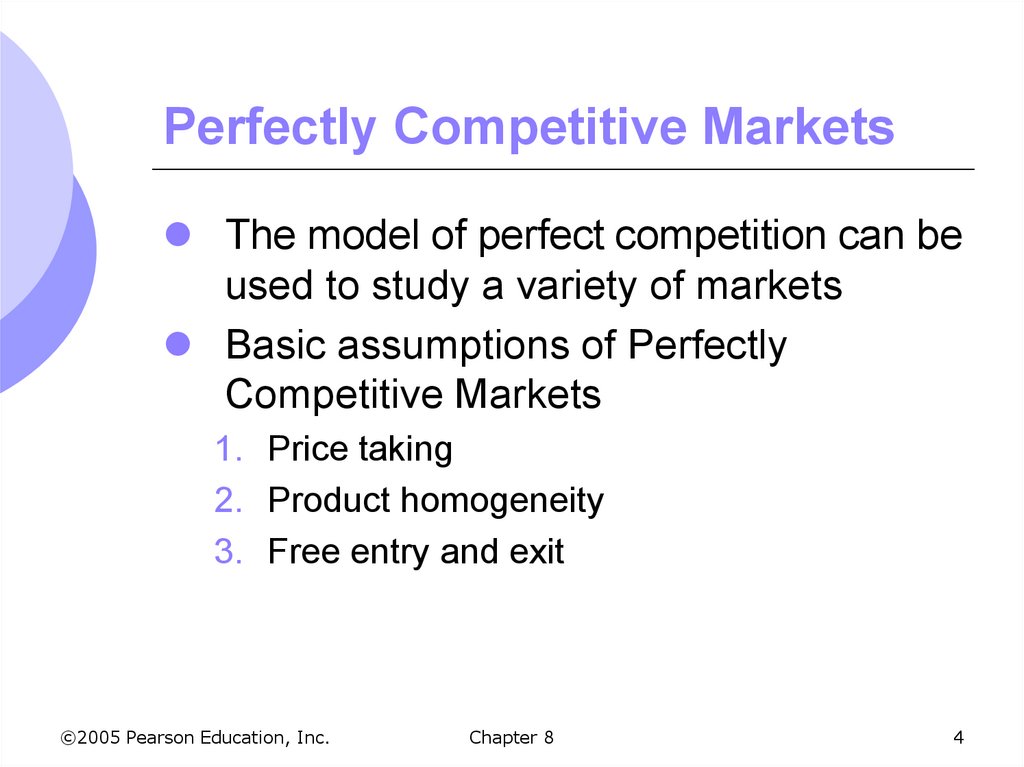
4. Perfectly Competitive Markets
The model of perfect competition can beused to study a variety of markets
Basic assumptions of Perfectly
Competitive Markets
1. Price taking
2. Product homogeneity
3. Free entry and exit
©2005 Pearson Education, Inc.
Chapter 8
4
5. Perfectly Competitive Markets
1. Price TakingThe individual firm sells a very small share
of the total market output and, therefore,
cannot influence market price
Each firm takes market price as given –
price taker
The individual consumer buys too small a
share of industry output to have any impact
on market price
©2005 Pearson Education, Inc.
Chapter 8
5
6. Perfectly Competitive Markets
2. Product HomogeneityThe products of all firms are perfect
substitutes
Product quality is relatively similar as well
as other product characteristics
Agricultural products, oil, copper, iron,
lumber
Heterogeneous products, such as brand
names, can charge higher prices because
they are perceived as better
©2005 Pearson Education, Inc.
Chapter 8
6
7. Perfectly Competitive Markets
3. Free Entry and ExitWhen there are no special costs that make
it difficult for a firm to enter (or exit) an
industry
Buyers can easily switch from one supplier
to another
Suppliers can easily enter or exit a market
Pharmaceutical companies are not perfectly
competitive because of the large costs of R&D
required
©2005 Pearson Education, Inc.
Chapter 8
7
8. When are Markets Competitive?
Few real products are perfectlycompetitive
Many markets are, however, highly
competitive
They face relatively low entry and exit costs
Highly elastic demand curves
No rule of thumb to determine whether a
market is close to perfectly competitive
Depends on how they behave in situations
©2005 Pearson Education, Inc.
Chapter 8
8
9. Profit Maximization
Do firms maximize profits?Managers in firms may be concerned with
other objectives
Revenue maximization
Revenue growth
Dividend maximization
Short-run profit maximization (due to bonus or
promotion incentive)
Could be at expense of long run profits
©2005 Pearson Education, Inc.
Chapter 8
9
10. Profit Maximization
Implications of non-profit objectiveOver the long run, investors would not
support the company
Without profits, survival is unlikely in
competitive industries
Managers have constrained freedom to
pursue goals other than long-run profit
maximization
©2005 Pearson Education, Inc.
Chapter 8
10
11. Marginal Revenue, Marginal Cost, and Profit Maximization
We can study profit maximizing output forany firm, whether perfectly competitive or
not
Profit ( ) = Total Revenue - Total Cost
If q is output of the firm, then total revenue is
price of the good times quantity
Total Revenue (R) = Pq
©2005 Pearson Education, Inc.
Chapter 8
11
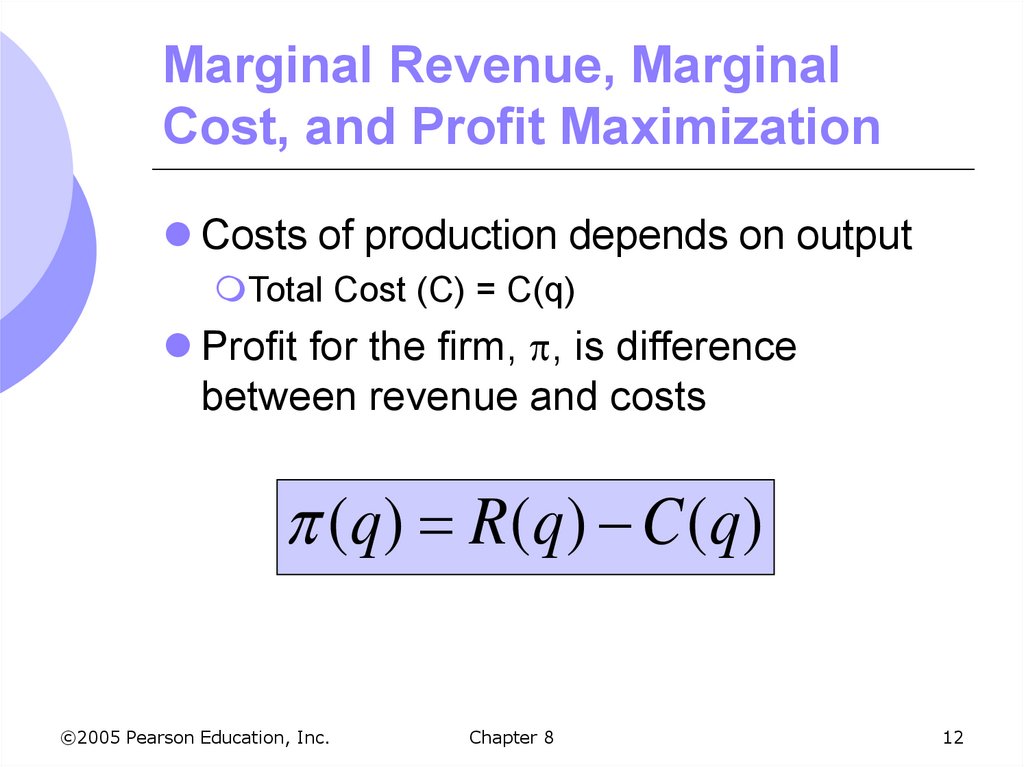
12. Marginal Revenue, Marginal Cost, and Profit Maximization
Costs of production depends on outputTotal Cost (C) = C(q)
Profit for the firm, , is difference
between revenue and costs
(q) R(q) C (q)
©2005 Pearson Education, Inc.
Chapter 8
12
13. Marginal Revenue, Marginal Cost, and Profit Maximization
Firm selects output to maximize thedifference between revenue and cost
We can graph the total revenue and total
cost curves to show maximizing profits
for the firm
Distance between revenues and costs
show profits
©2005 Pearson Education, Inc.
Chapter 8
13
14. Marginal Revenue, Marginal Cost, and Profit Maximization
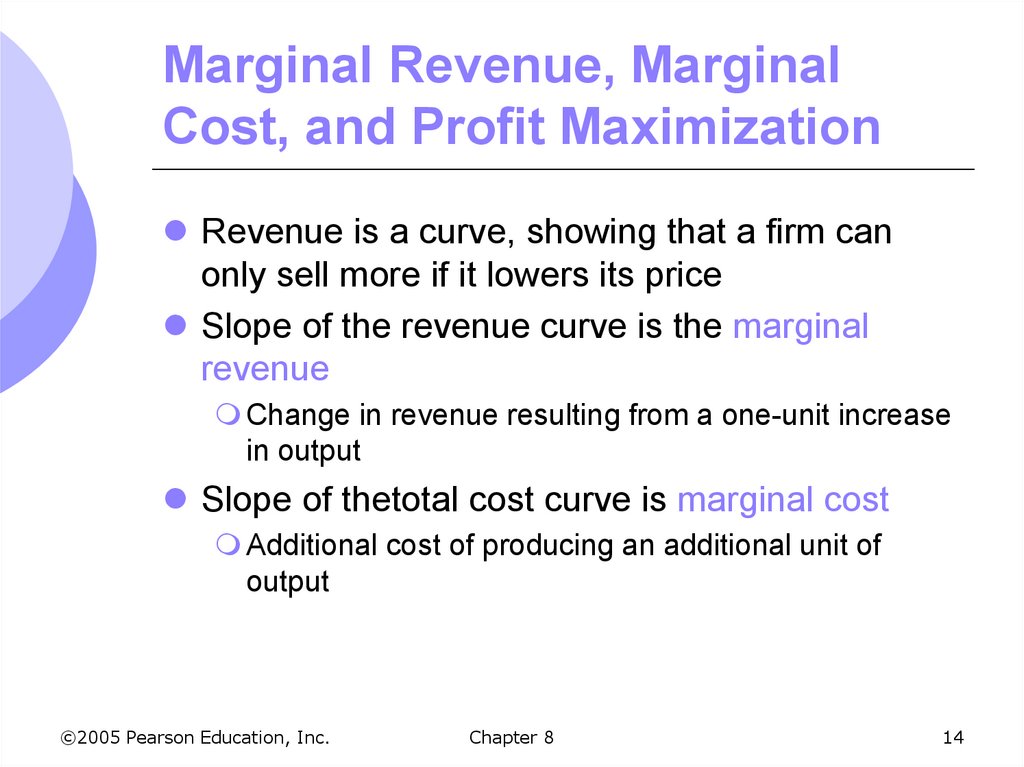
Revenue is a curve, showing that a firm canonly sell more if it lowers its price
Slope of the revenue curve is the marginal
revenue
Change in revenue resulting from a one-unit increase
in output
Slope of thetotal cost curve is marginal cost
Additional cost of producing an additional unit of
output
©2005 Pearson Education, Inc.
Chapter 8
14
15. Marginal Revenue, Marginal Cost, and Profit Maximization
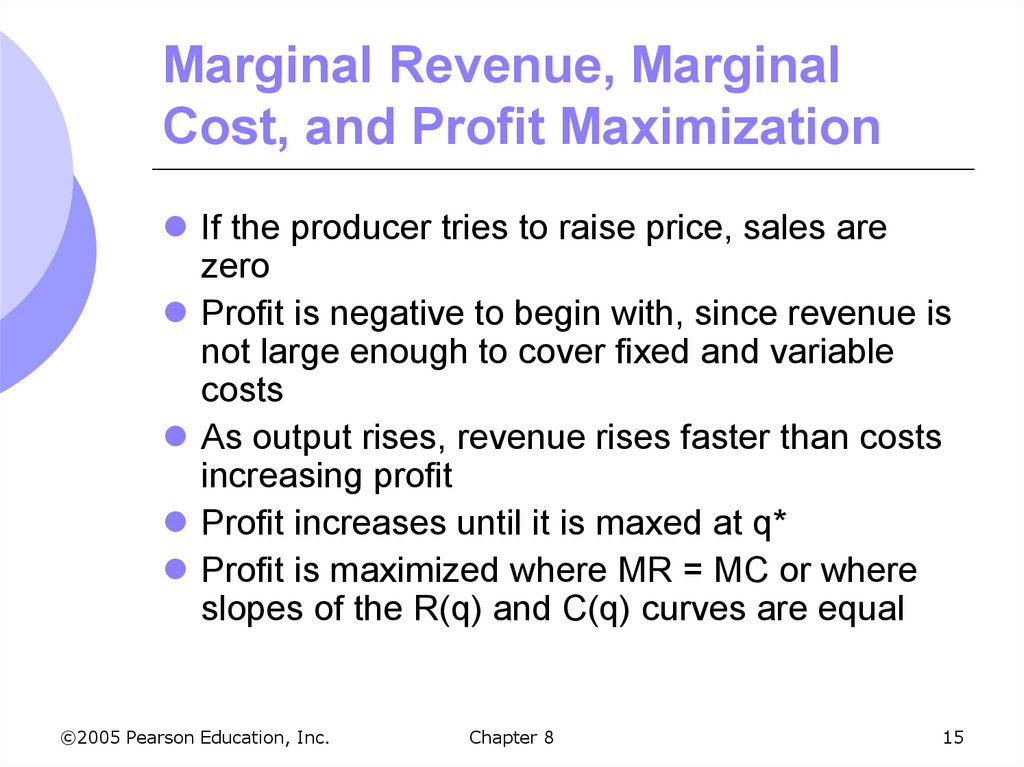
If the producer tries to raise price, sales arezero
Profit is negative to begin with, since revenue is
not large enough to cover fixed and variable
costs
As output rises, revenue rises faster than costs
increasing profit
Profit increases until it is maxed at q*
Profit is maximized where MR = MC or where
slopes of the R(q) and C(q) curves are equal
©2005 Pearson Education, Inc.
Chapter 8
15
16. Profit Maximization – Short Run
Cost,Revenue,
Profit
($s per
year)
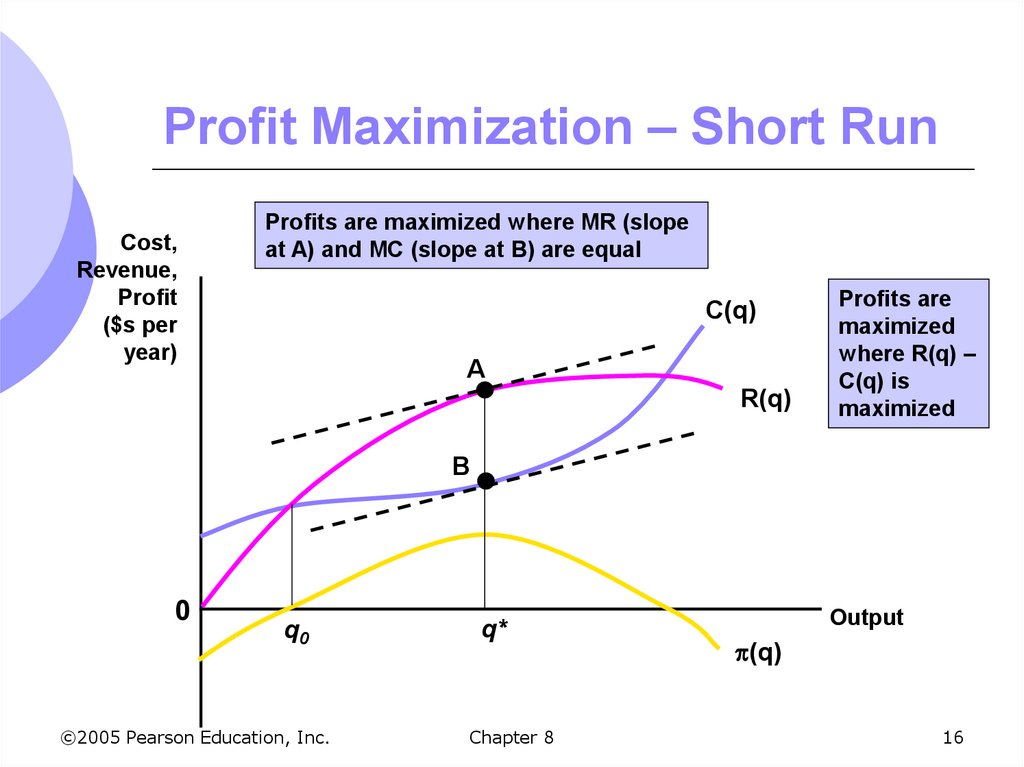
Profits are maximized where MR (slope
at A) and MC (slope at B) are equal
C(q)
A
R(q)
Profits are
maximized
where R(q) –
C(q) is
maximized
B
0
q0
©2005 Pearson Education, Inc.
q*
Chapter 8
Output
(q)
16
17. Marginal Revenue, Marginal Cost, and Profit Maximization
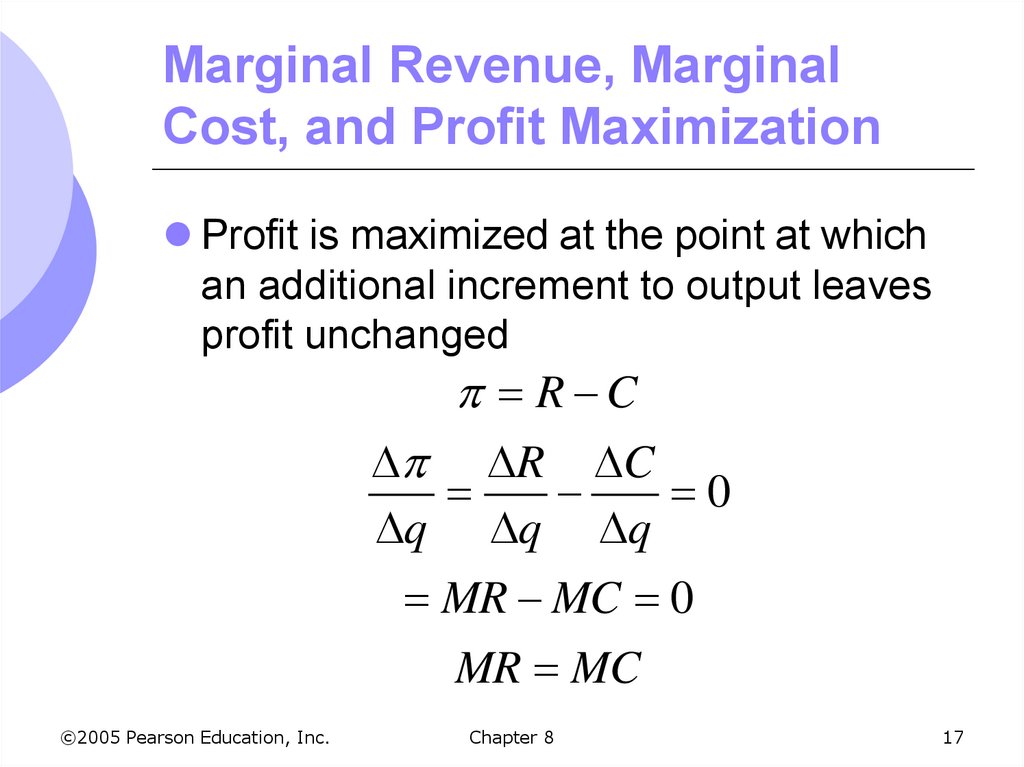
Profit is maximized at the point at whichan additional increment to output leaves
profit unchanged
R C
R C
0
q q q
MR MC 0
MR MC
©2005 Pearson Education, Inc.
Chapter 8
17
18. Marginal Revenue, Marginal Cost, and Profit Maximization
The Competitive FirmPrice taker – market price and output
determined from total market demand and
supply
Market output (Q) and firm output (q)
Market demand (D) and firm demand (d)
©2005 Pearson Education, Inc.
Chapter 8
18
19. The Competitive Firm
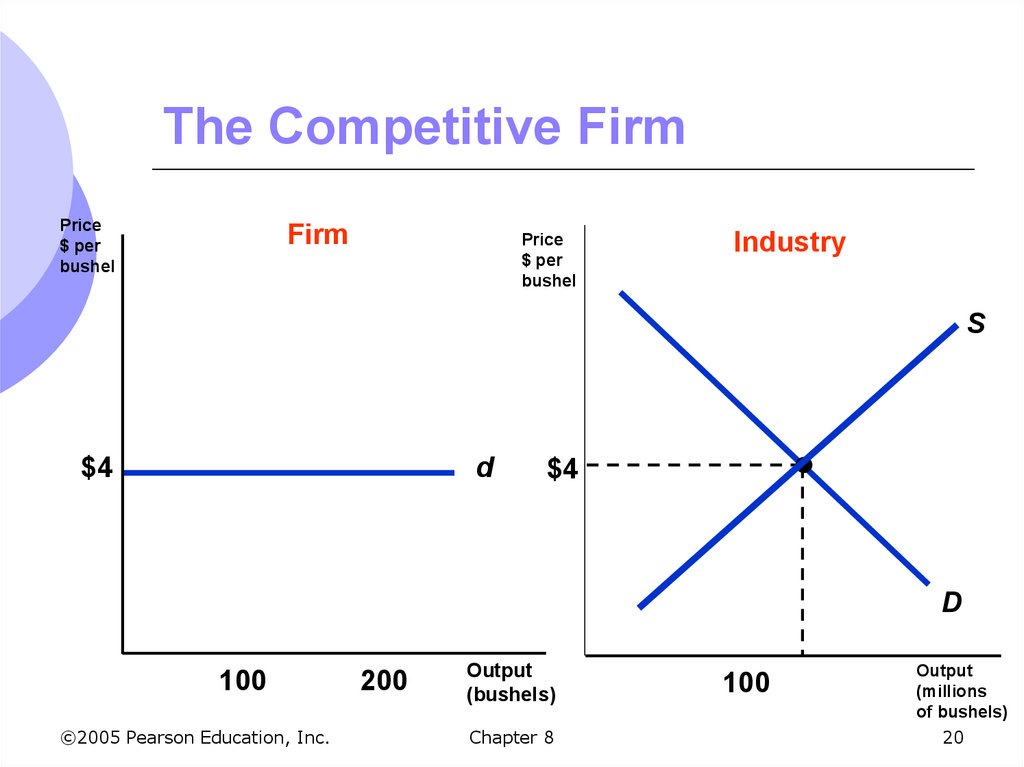
Demand curve faced by an individual firmis a horizontal line
Firm’s sales have no effect on market price
Demand curve faced by whole market is
downward sloping
Shows amount of goods all consumers will
purchase at different prices
©2005 Pearson Education, Inc.
Chapter 8
19
20. The Competitive Firm
Price$ per
bushel
Firm
Price
$ per
bushel
Industry
S
$4
d
$4
D
100
©2005 Pearson Education, Inc.
200
Output
(bushels)
Chapter 8
100
Output
(millions
of bushels)
20
21. The Competitive Firm
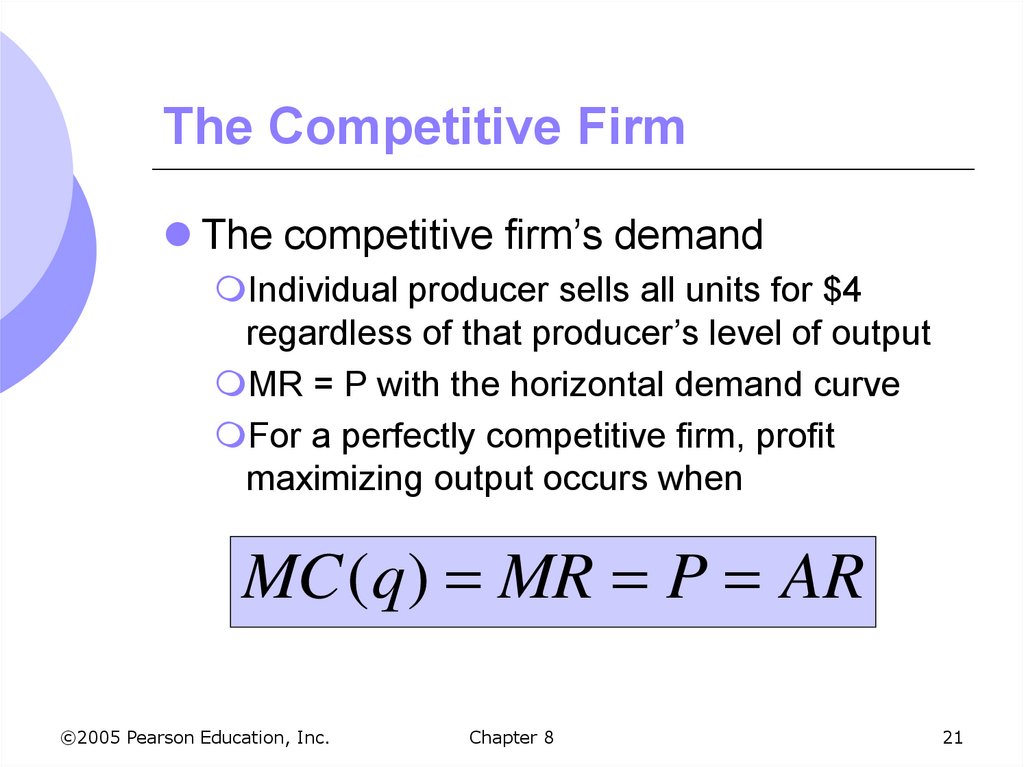
The competitive firm’s demandIndividual producer sells all units for $4
regardless of that producer’s level of output
MR = P with the horizontal demand curve
For a perfectly competitive firm, profit
maximizing output occurs when
MC (q) MR P AR
©2005 Pearson Education, Inc.
Chapter 8
21
22. Choosing Output: Short Run
We will combine revenue and costs withdemand to determine profit maximizing
output decisions
In the short run, capital is fixed and firm
must choose levels of variable inputs to
maximize profits
We can look at the graph of MR, MC,
ATC and AVC to determine profits
©2005 Pearson Education, Inc.
Chapter 8
22
23. Choosing Output: Short Run
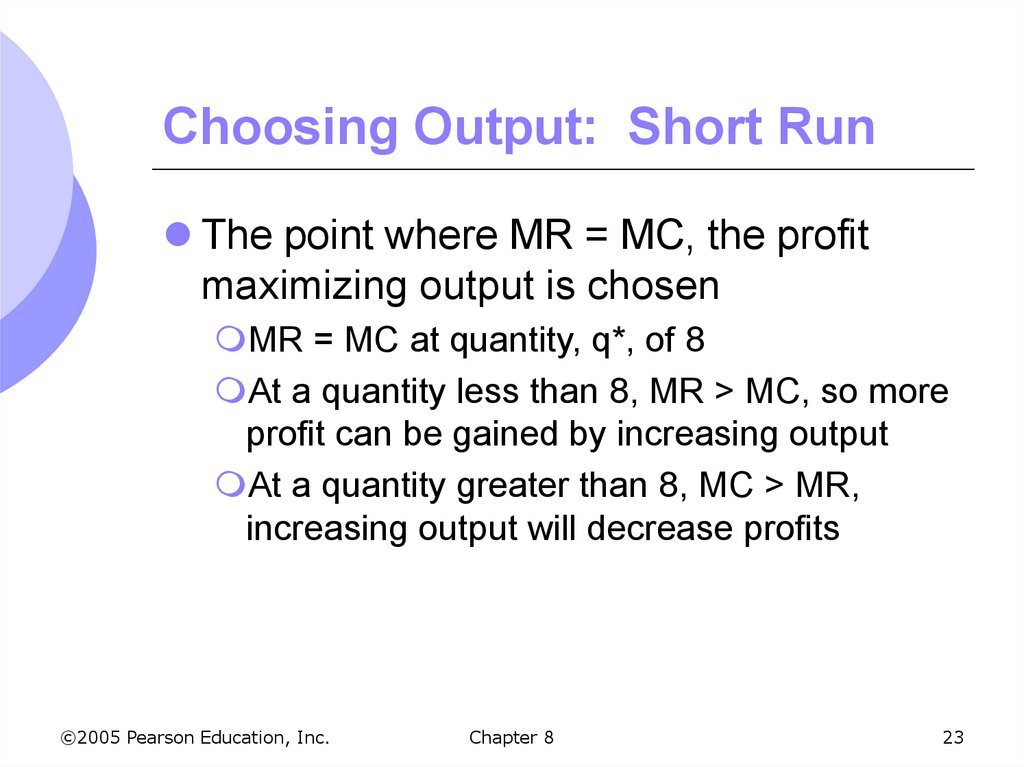
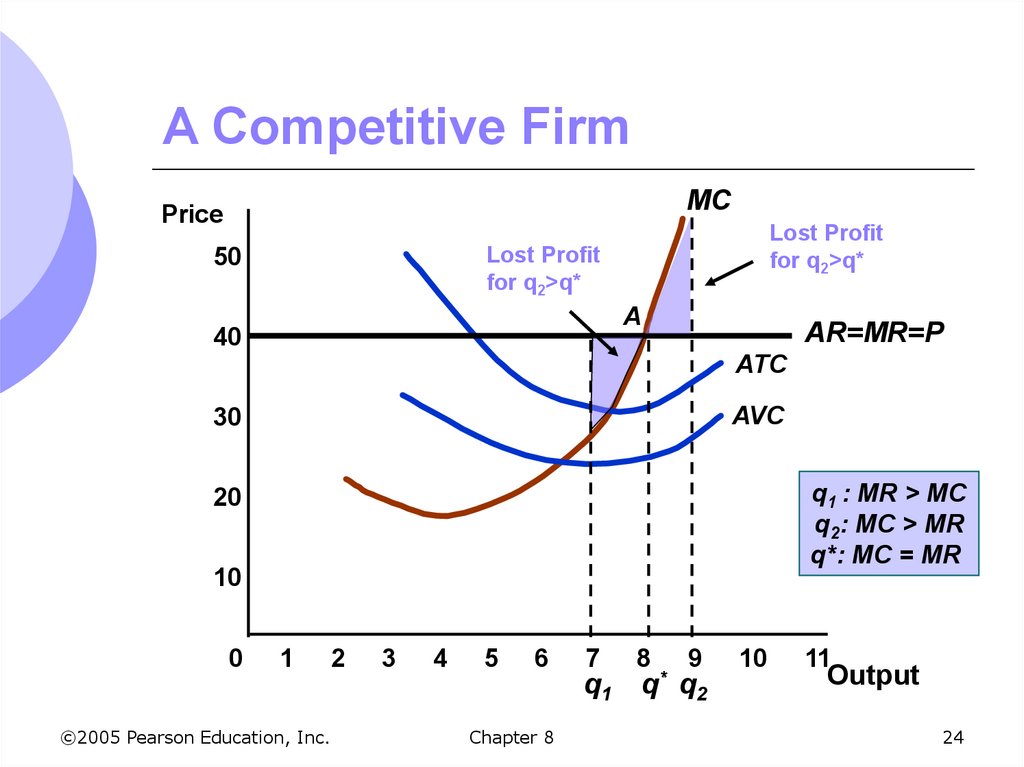
The point where MR = MC, the profitmaximizing output is chosen
MR = MC at quantity, q*, of 8
At a quantity less than 8, MR > MC, so more
profit can be gained by increasing output
At a quantity greater than 8, MC > MR,
increasing output will decrease profits
©2005 Pearson Education, Inc.
Chapter 8
23
24. A Competitive Firm
MCPrice
Lost Profit
for q2>q*
Lost Profit
for q2>q*
50
A
40
AR=MR=P
ATC
AVC
30
q1 : MR > MC
q2: MC > MR
q*: MC = MR
20
10
0
1
2
3
4
5
6
7
q1
©2005 Pearson Education, Inc.
Chapter 8
8
9
q* q2
10
11
Output
24
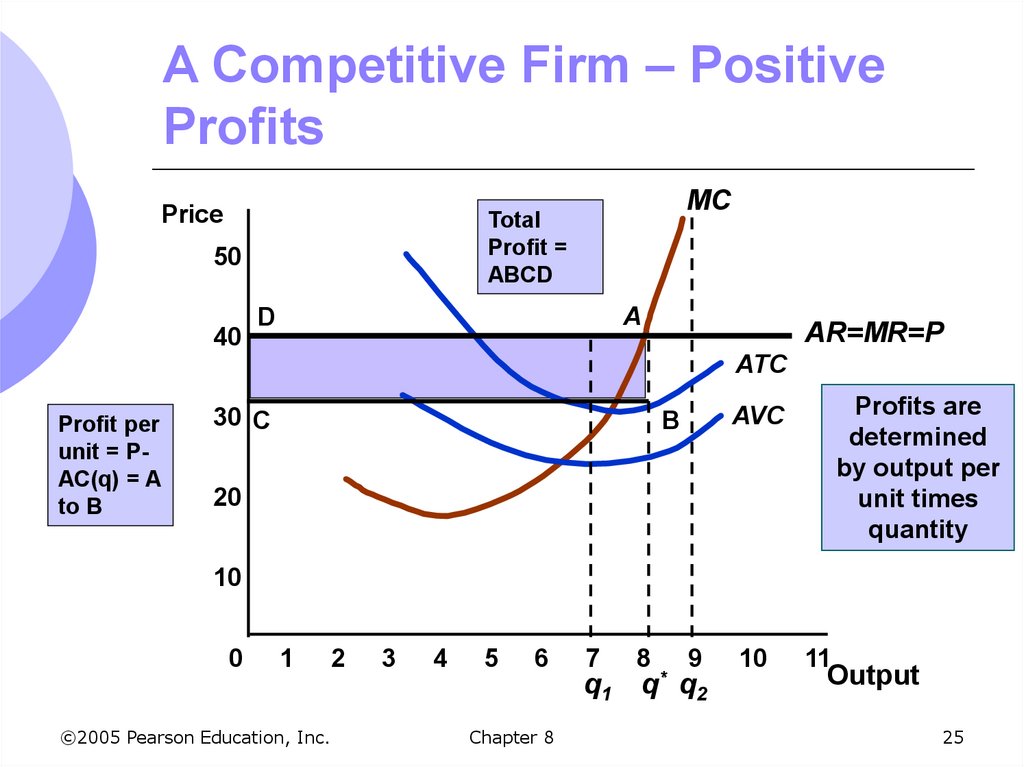
25. A Competitive Firm – Positive Profits
Price50
40
MC
Total
Profit =
ABCD
A
D
AR=MR=P
ATC
Profit per
unit = PAC(q) = A
to B
30 C
Profits are
determined
by output per
unit times
quantity
AVC
B
20
10
0
1
2
3
4
5
6
7
q1
©2005 Pearson Education, Inc.
Chapter 8
8
9
q* q2
10
11
Output
25
26. The Competitive Firm
A firm does not have to make profitsIt is possible a firm will incur losses if the
P < AC for the profit maximizing quantity
Still measured by profit per unit times
quantity
Profit per unit is negative (P – AC < 0)
©2005 Pearson Education, Inc.
Chapter 8
26
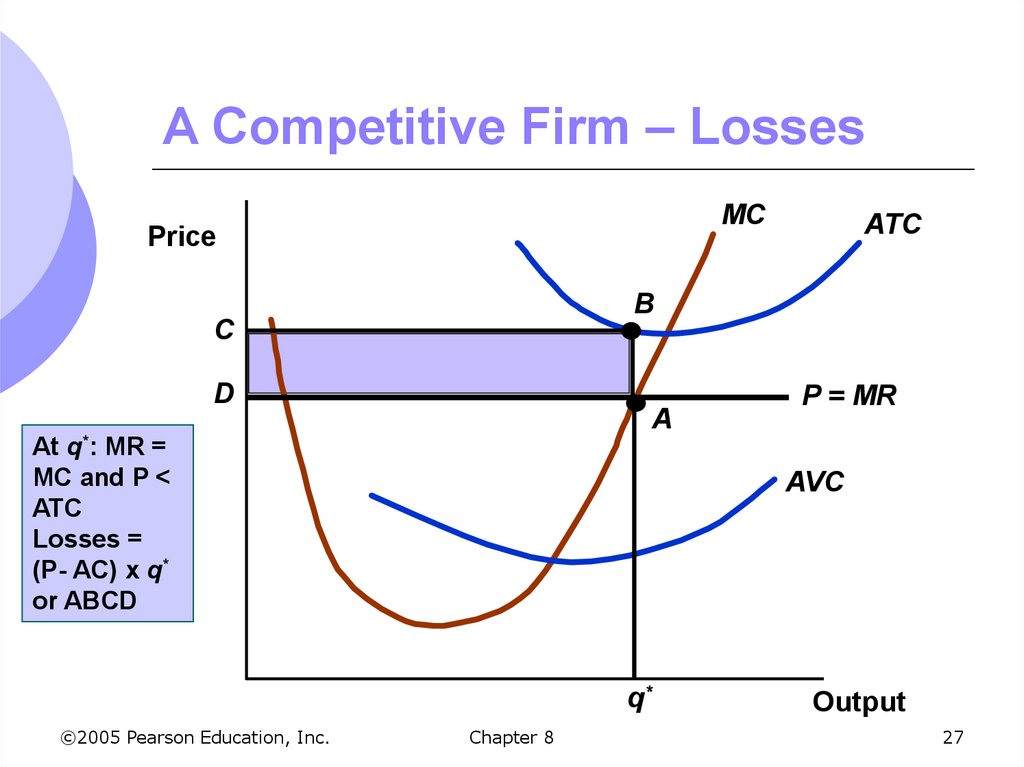
27. A Competitive Firm – Losses
MCPrice
ATC
B
C
D
A
P = MR
At q*: MR =
MC and P <
ATC
Losses =
(P- AC) x q*
or ABCD
AVC
q*
©2005 Pearson Education, Inc.
Chapter 8
Output
27
28. Choosing Output in the Short Run
Summary of Production DecisionsProfit is maximized when MC = MR
If P > ATC the firm is making profits
If P < ATC the firm is making losses
©2005 Pearson Education, Inc.
Chapter 8
28
29. Short Run Production
Why would a firm produce at a loss?Might think price will increase in near future
Shutting down and starting up could be
costly
Firm has two choices in short run
Continue producing
Shut down temporarily
Will compare profitability of both choices
©2005 Pearson Education, Inc.
Chapter 8
29
30. Short Run Production
When should the firm shut down?If AVC < P < ATC, the firm should continue
producing in the short run
Can cover all of its variable costs and some of
its fixed costs
If AVC > P < ATC, the firm should shut down
Cannot cover its variable costs or any of its
fixed costs
©2005 Pearson Education, Inc.
Chapter 8
30
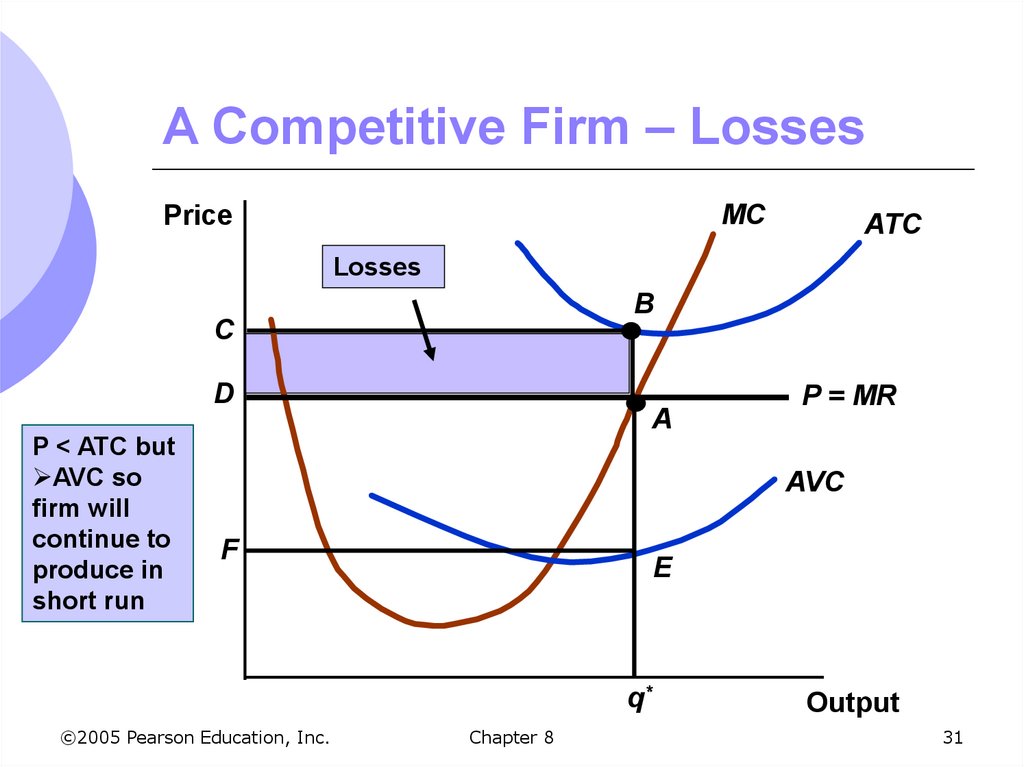
31. A Competitive Firm – Losses
MCPrice
ATC
Losses
B
C
D
P < ATC but
AVC so
firm will
continue to
produce in
short run
A
P = MR
AVC
F
E
q*
©2005 Pearson Education, Inc.
Chapter 8
Output
31
32. Some Cost Considerations for Managers
Three guidelines for estimating marginalcost:
1. Average variable cost should not be used
as a substitute for marginal cost
2. A single item on a firm’s accounting ledger
may have two components, only one of
which involves marginal cost
3. All opportunity costs should be included in
determining marginal cost
©2005 Pearson Education, Inc.
Chapter 8
32
33. Competitive Firm – Short Run Supply
Supply curve tells how much output willbe produced at different prices
Competitive firms determine quantity to
produce where P = MC
Firm shuts down when P < AVC
Competitive firms’ supply curve is portion
of the marginal cost curve above the AVC
curve
©2005 Pearson Education, Inc.
Chapter 8
33
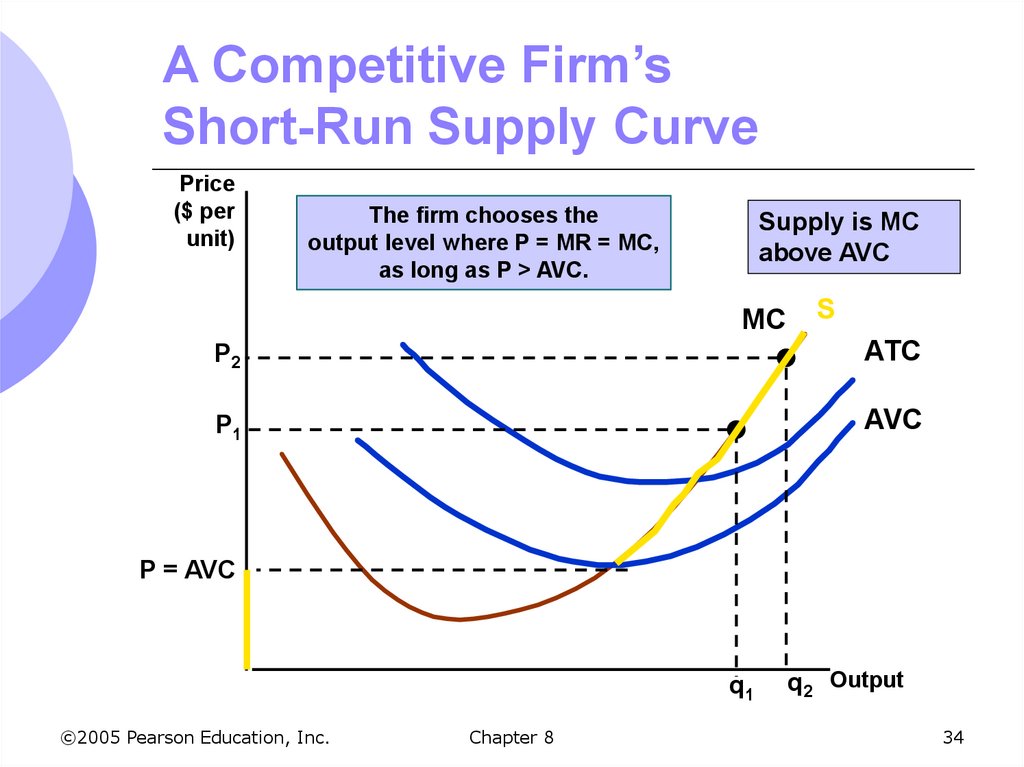
34. A Competitive Firm’s Short-Run Supply Curve
Price($ per
unit)
The firm chooses the
output level where P = MR = MC,
as long as P > AVC.
Supply is MC
above AVC
MC
S
P2
ATC
P1
AVC
P = AVC
q1
©2005 Pearson Education, Inc.
Chapter 8
q2 Output
34
35. A Competitive Firm’s Short-Run Supply Curve
Supply is upward sloping due todiminishing returns
Higher price compensates the firm for the
higher cost of additional output and
increases total profit because it applies to
all units
©2005 Pearson Education, Inc.
Chapter 8
35
36. A Competitive Firm’s Short-Run Supply Curve
Over time, prices of product and inputscan change
How does the firm’s output change in
response to a change in the price of an
input?
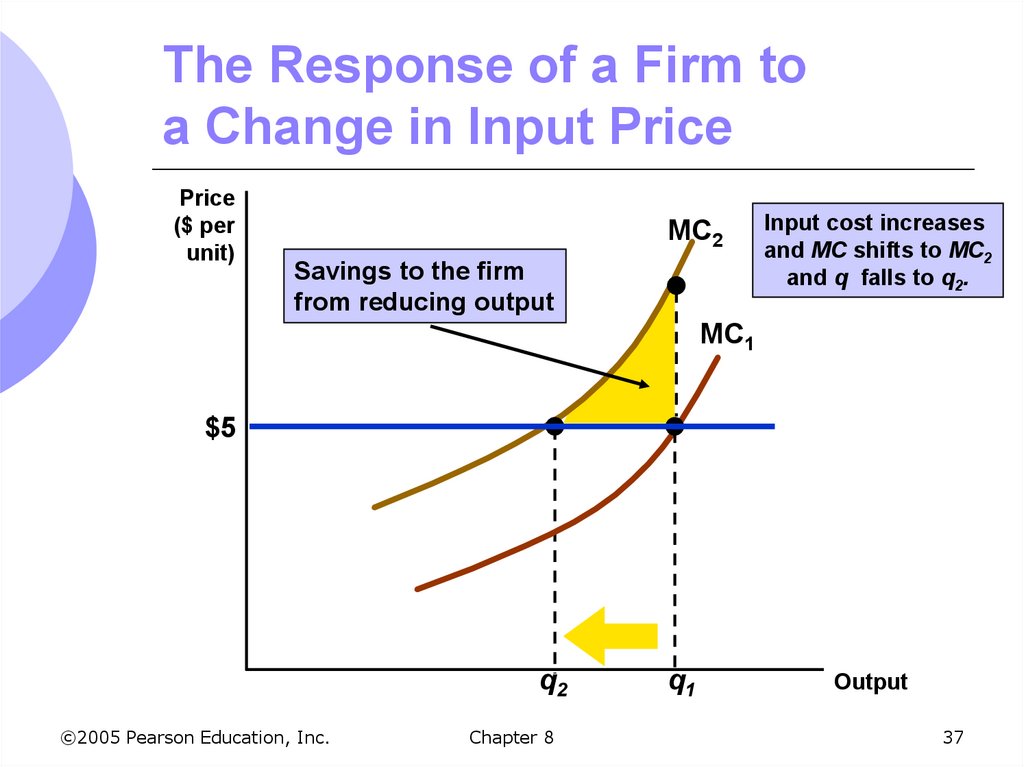
We can show an increase in marginal costs
and the change in the firm’s output decisions
©2005 Pearson Education, Inc.
Chapter 8
36
37. The Response of a Firm to a Change in Input Price
Price($ per
unit)
MC2
Savings to the firm
from reducing output
Input cost increases
and MC shifts to MC2
and q falls to q2.
MC1
$5
q2
©2005 Pearson Education, Inc.
Chapter 8
q1
Output
37
38. Short-Run Market Supply Curve
Shows the amount of product the wholemarket will produce at given prices
Is the sum of all the individual producers
in the market
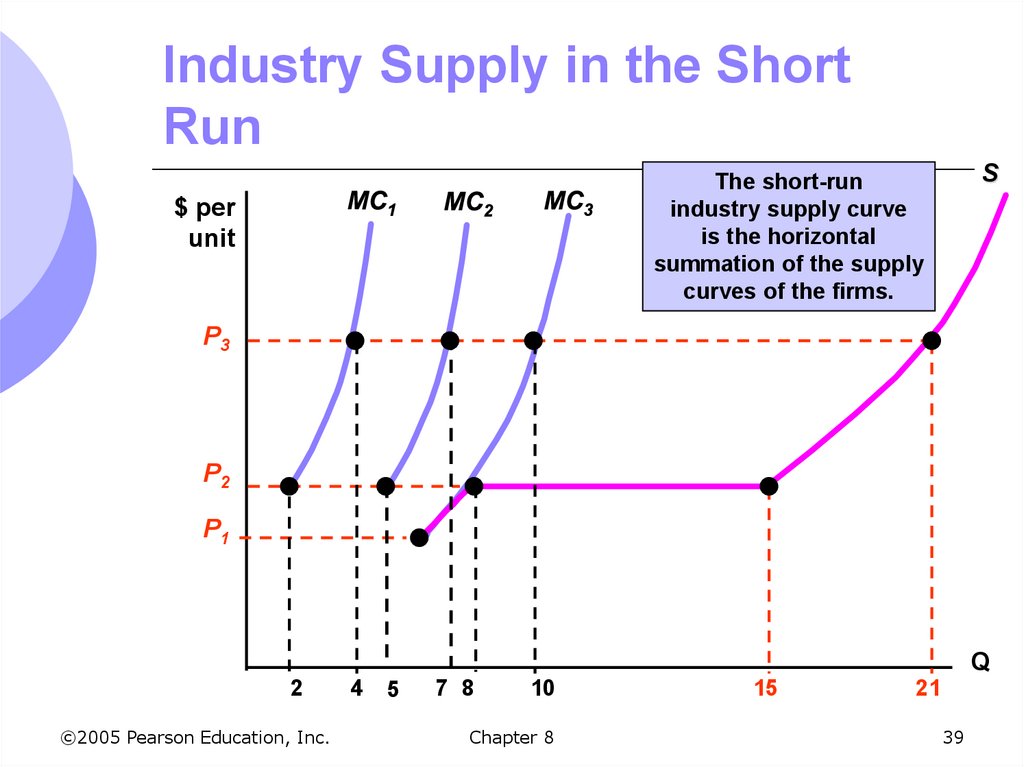
We can show graphically how we can
sum the supply curves of individual
producers
©2005 Pearson Education, Inc.
Chapter 8
38
39. Industry Supply in the Short Run
SThe short-run
industry supply curve
is the horizontal
summation of the supply
curves of the firms.
$ per
unit
P3
P2
P1
Q
2
©2005 Pearson Education, Inc.
4
5
7 8
10
Chapter 8
15
21
39
40. The Short-Run Market Supply Curve
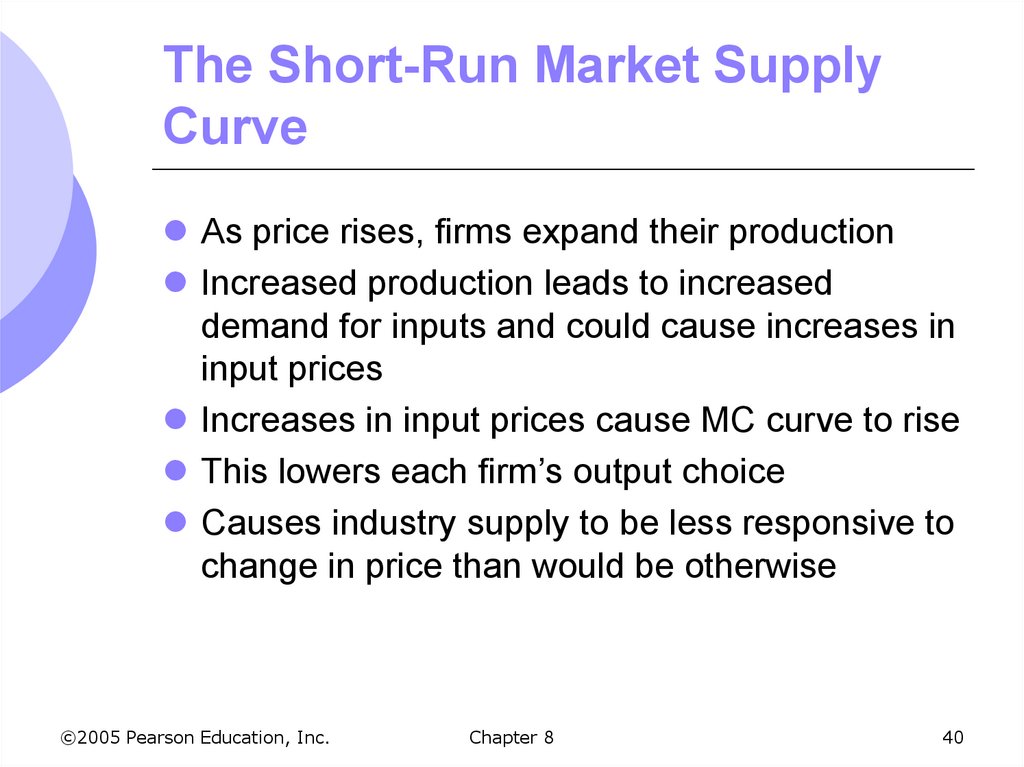
As price rises, firms expand their productionIncreased production leads to increased
demand for inputs and could cause increases in
input prices
Increases in input prices cause MC curve to rise
This lowers each firm’s output choice
Causes industry supply to be less responsive to
change in price than would be otherwise
©2005 Pearson Education, Inc.
Chapter 8
40
41. Elasticity of Market Supply
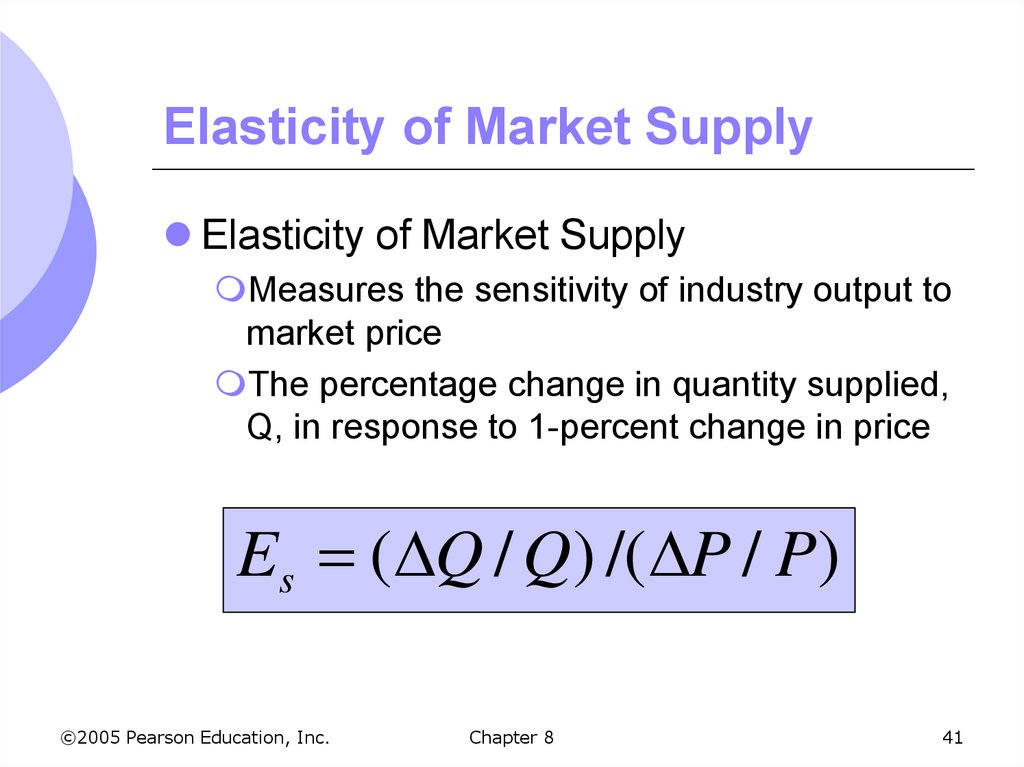
Elasticity of Market SupplyMeasures the sensitivity of industry output to
market price
The percentage change in quantity supplied,
Q, in response to 1-percent change in price
Es ( Q / Q) /( P / P)
©2005 Pearson Education, Inc.
Chapter 8
41
42. Elasticity of Market Supply
When MC increases rapidly in response toincreases in output, elasticity is low
When MC increases slowly, supply is relatively
elastic
Perfectly inelastic short-run supply arises
when the industry’s plant and equipment are so
fully utilized that new plants must be built to
achieve greater output
Perfectly elastic short-run supply arises when
marginal costs are constant
©2005 Pearson Education, Inc.
Chapter 8
42
43. Producer Surplus in the Short Run
Price is greater than MC on all but the last unitof output
Therefore, surplus is earned on all but the last
unit
The producer surplus is the sum over all units
produced of the difference between the market
price of the good and the marginal cost of
production
Area above supply curve to the market price
©2005 Pearson Education, Inc.
Chapter 8
43
44. Producer Surplus for a Firm
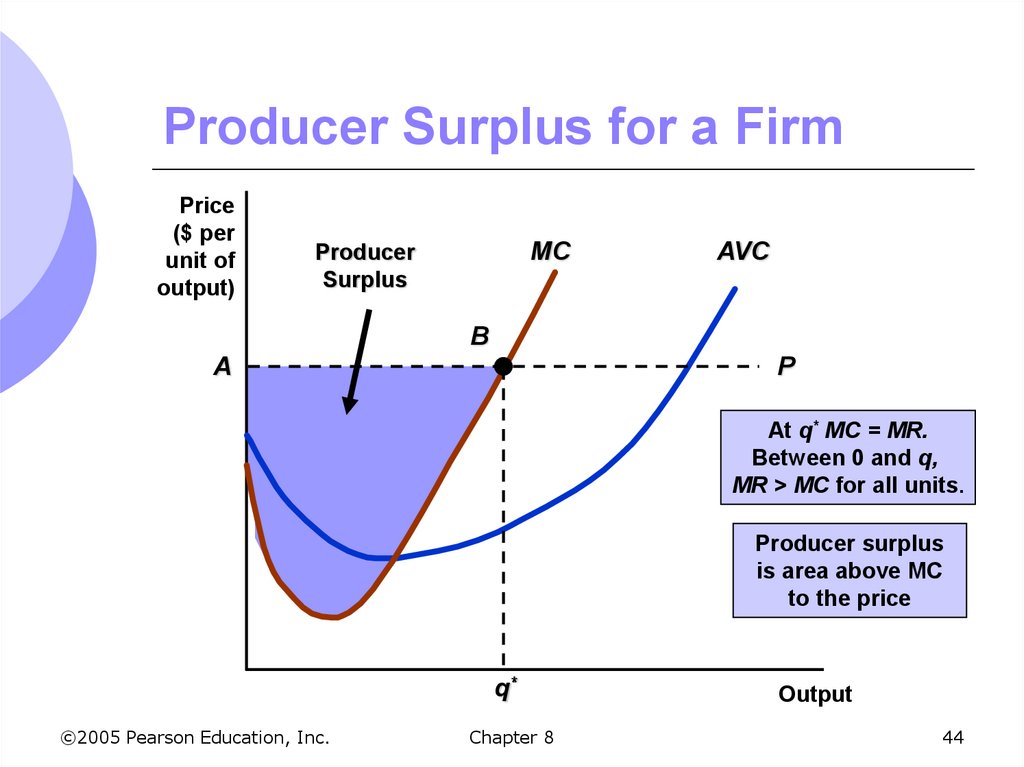
Price($ per
unit of
output)
MC
Producer
Surplus
AVC
B
A
P
At q* MC = MR.
Between 0 and q,
MR > MC for all units.
Producer surplus
is area above MC
to the price
q*
©2005 Pearson Education, Inc.
Chapter 8
Output
44
45. The Short-Run Market Supply Curve
Sum of MC from 0 to q*, it is the sum ofthe total variable cost of producing q*
Producer Surplus can be defined as the
difference between the firm’s revenue
and its total variable cost
We can show this graphically by the
rectangle ABCD
Revenue (0ABq*) minus variable cost
(0DCq*)
©2005 Pearson Education, Inc.
Chapter 8
45
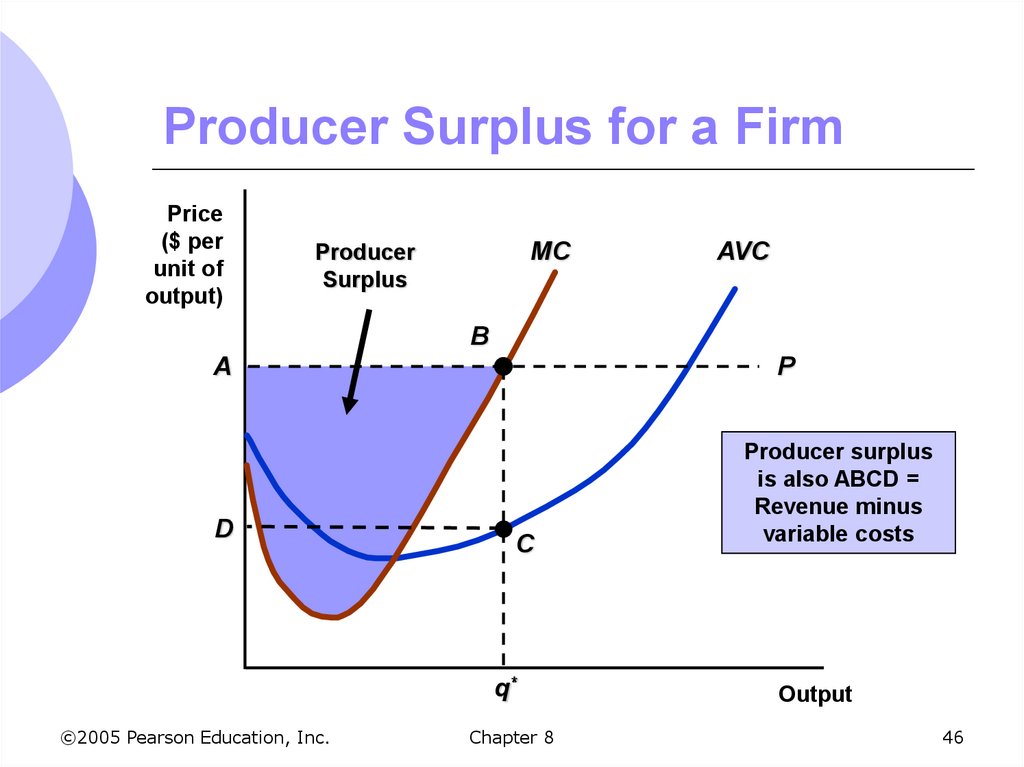
46. Producer Surplus for a Firm
Price($ per
unit of
output)
MC
Producer
Surplus
AVC
B
A
D
P
C
q*
©2005 Pearson Education, Inc.
Chapter 8
Producer surplus
is also ABCD =
Revenue minus
variable costs
Output
46
47. Producer Surplus Versus Profit
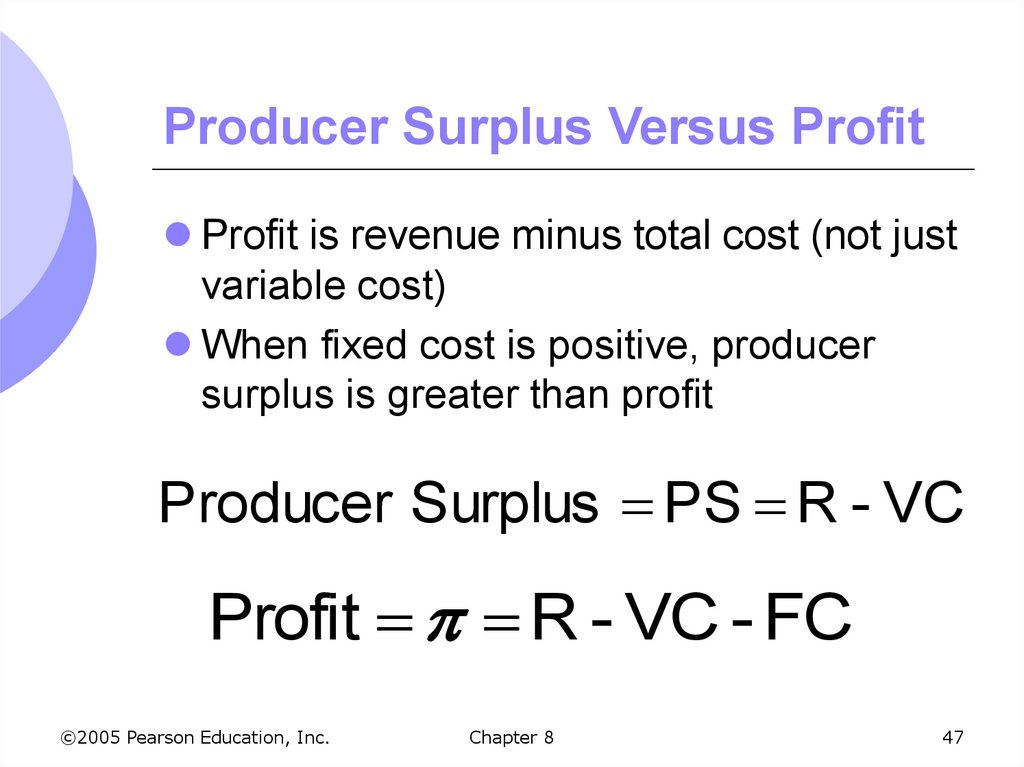
Profit is revenue minus total cost (not justvariable cost)
When fixed cost is positive, producer
surplus is greater than profit
Producer Surplus PS R - VC
Profit R - VC - FC
©2005 Pearson Education, Inc.
Chapter 8
47
48. Producer Surplus Versus Profit
Costs of production determine magnitudeof producer surplus
Higher cost firms have less producer surplus
Lower cost firms have more producer surplus
Adding up surplus for all producers in the
market given total market producer surplus
Area below market price and above supply
curve
©2005 Pearson Education, Inc.
Chapter 8
48
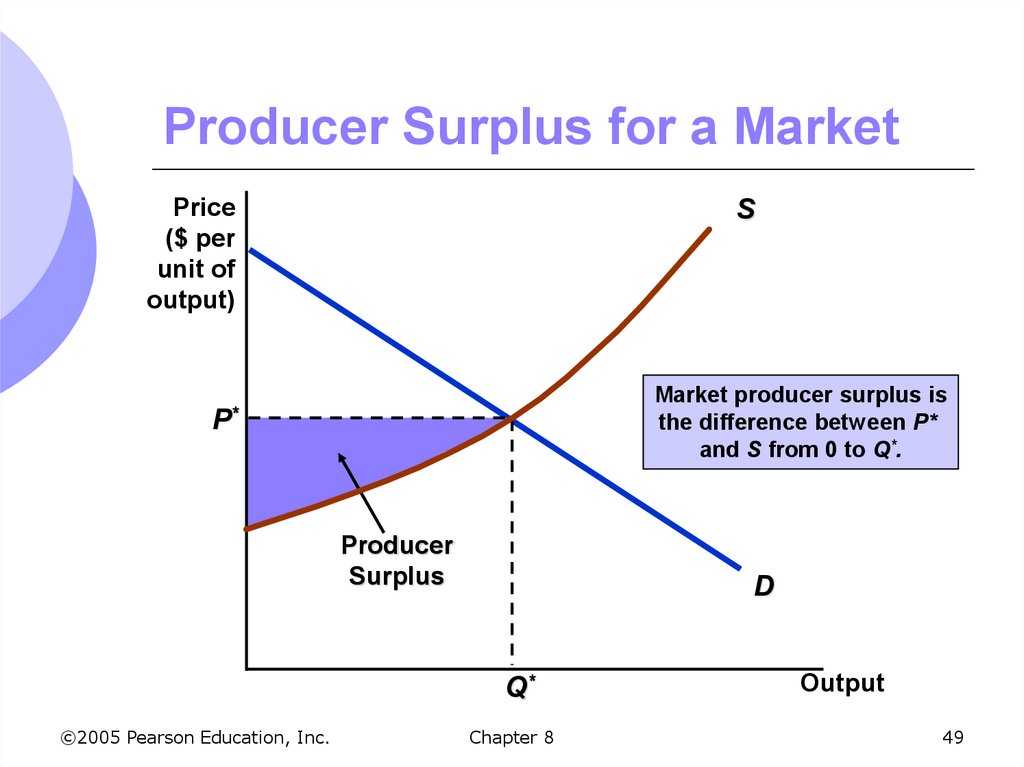
49. Producer Surplus for a Market
Price($ per
unit of
output)
S
Market producer surplus is
the difference between P*
and S from 0 to Q*.
P*
Producer
Surplus
D
Q*
©2005 Pearson Education, Inc.
Chapter 8
Output
49
50. Choosing Output in the Long Run
In short run, one or more inputs are fixedDepending on the time, it may limit the
flexibility of the firm
In the long run, a firm can alter all its
inputs, including the size of the plant
We assume free entry and free exit
No legal restrictions or extra costs
©2005 Pearson Education, Inc.
Chapter 8
50
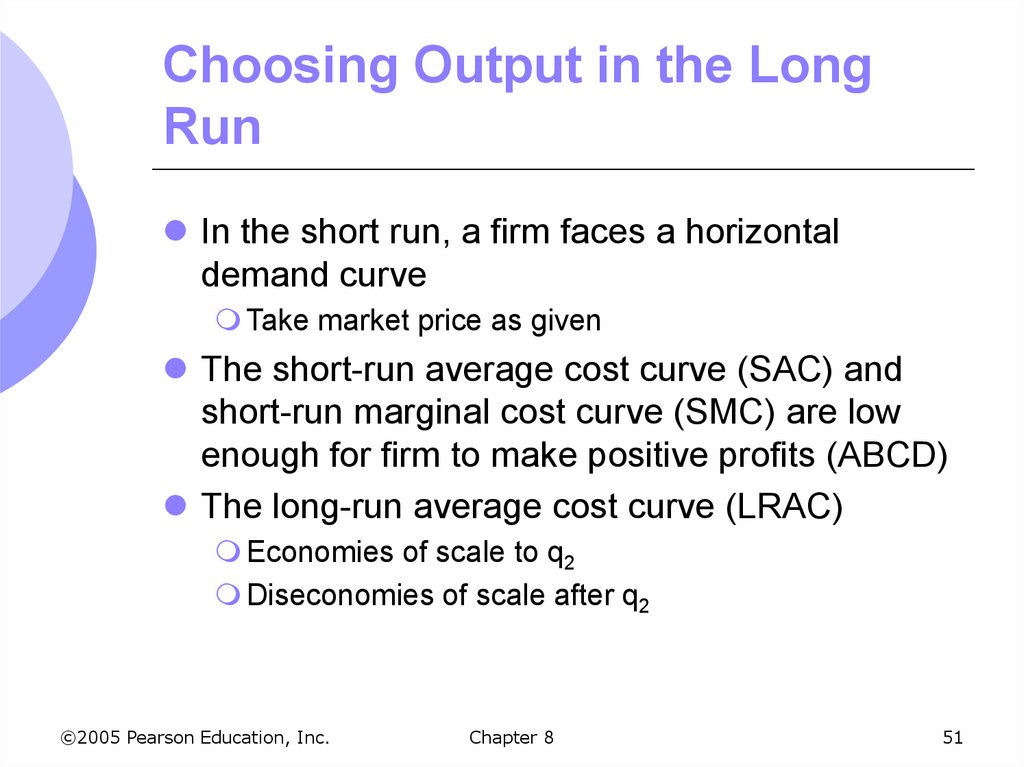
51. Choosing Output in the Long Run
In the short run, a firm faces a horizontaldemand curve
Take market price as given
The short-run average cost curve (SAC) and
short-run marginal cost curve (SMC) are low
enough for firm to make positive profits (ABCD)
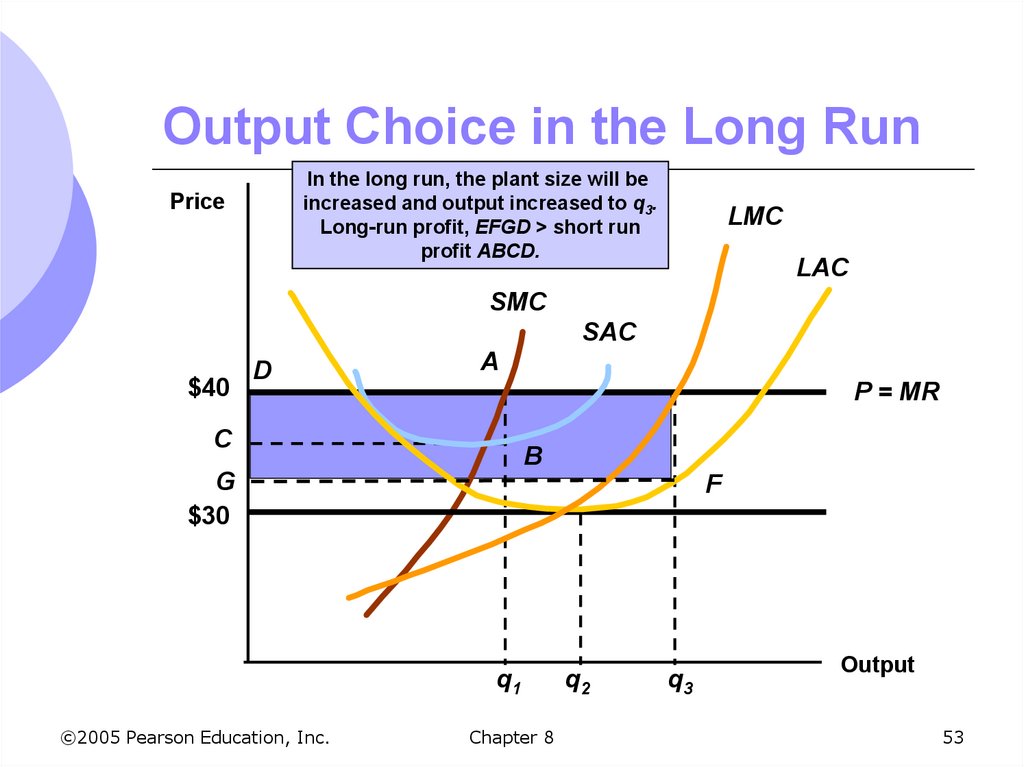
The long-run average cost curve (LRAC)
Economies of scale to q2
Diseconomies of scale after q2
©2005 Pearson Education, Inc.
Chapter 8
51
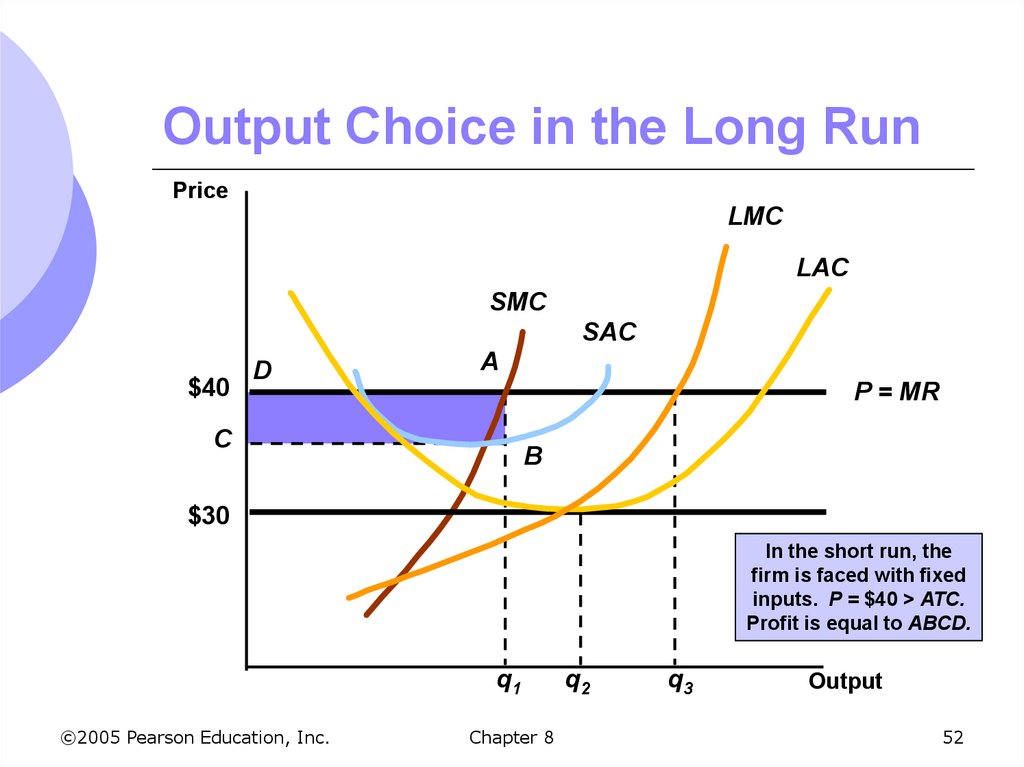
52. Output Choice in the Long Run
PriceLMC
LAC
SMC
SAC
$40
D
A
P = MR
C
B
$30
In the short run, the
firm is faced with fixed
inputs. P = $40 > ATC.
Profit is equal to ABCD.
q1
©2005 Pearson Education, Inc.
Chapter 8
q2
q3
Output
52
53. Output Choice in the Long Run
In the long run, the plant size will beincreased and output increased to q3.
Long-run profit, EFGD > short run
profit ABCD.
Price
LMC
LAC
SMC
SAC
$40
D
A
P = MR
C
B
G
$30
F
q1
©2005 Pearson Education, Inc.
Chapter 8
q2
q3
Output
53
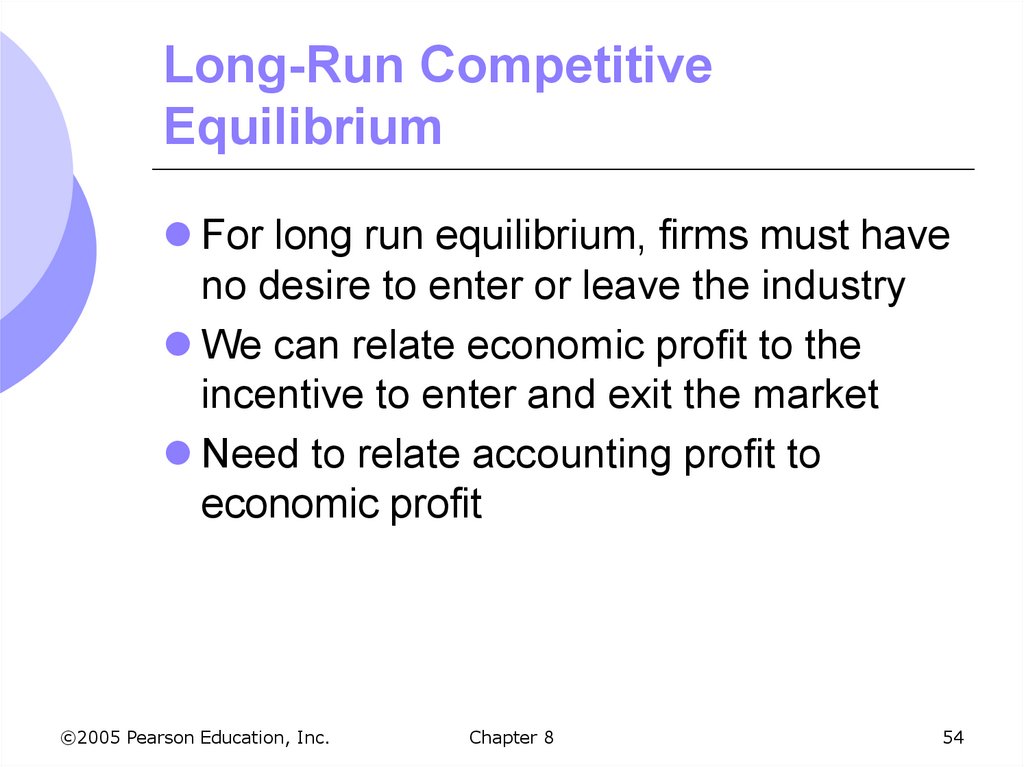
54. Long-Run Competitive Equilibrium
For long run equilibrium, firms must haveno desire to enter or leave the industry
We can relate economic profit to the
incentive to enter and exit the market
Need to relate accounting profit to
economic profit
©2005 Pearson Education, Inc.
Chapter 8
54
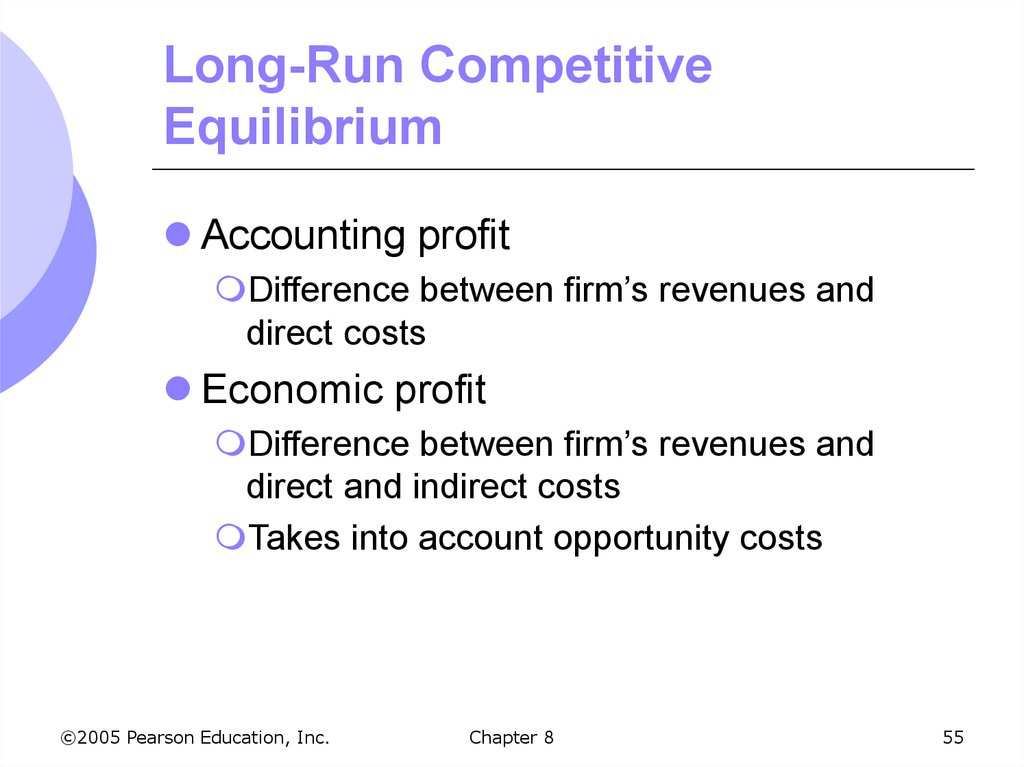
55. Long-Run Competitive Equilibrium
Accounting profitDifference between firm’s revenues and
direct costs
Economic profit
Difference between firm’s revenues and
direct and indirect costs
Takes into account opportunity costs
©2005 Pearson Education, Inc.
Chapter 8
55
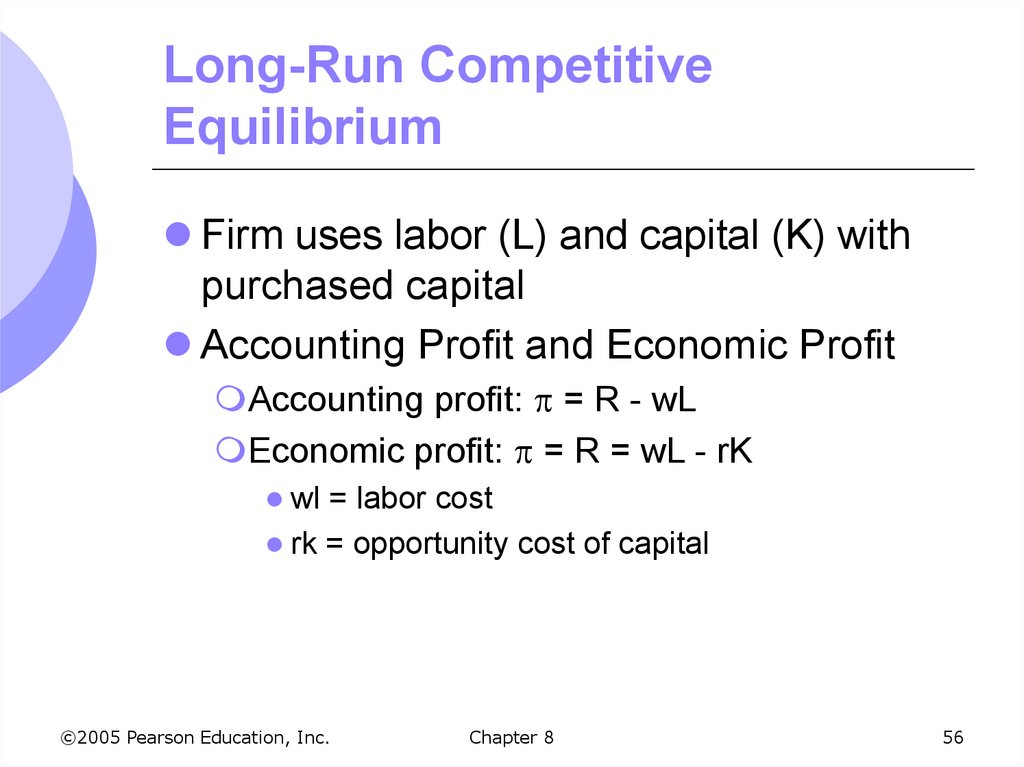
56. Long-Run Competitive Equilibrium
Firm uses labor (L) and capital (K) withpurchased capital
Accounting Profit and Economic Profit
Accounting profit: = R - wL
Economic profit: = R = wL - rK
wl = labor cost
rk = opportunity cost of capital
©2005 Pearson Education, Inc.
Chapter 8
56
57. Long-Run Competitive Equilibrium
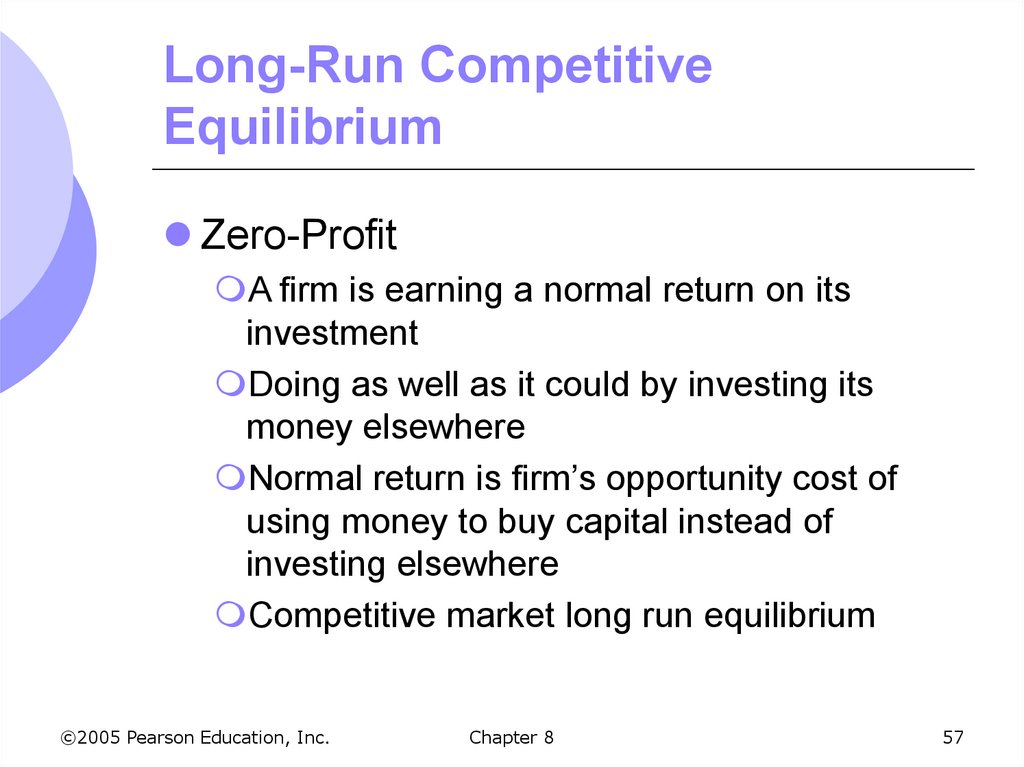
Zero-ProfitA firm is earning a normal return on its
investment
Doing as well as it could by investing its
money elsewhere
Normal return is firm’s opportunity cost of
using money to buy capital instead of
investing elsewhere
Competitive market long run equilibrium
©2005 Pearson Education, Inc.
Chapter 8
57
58. Long-Run Competitive Equilibrium
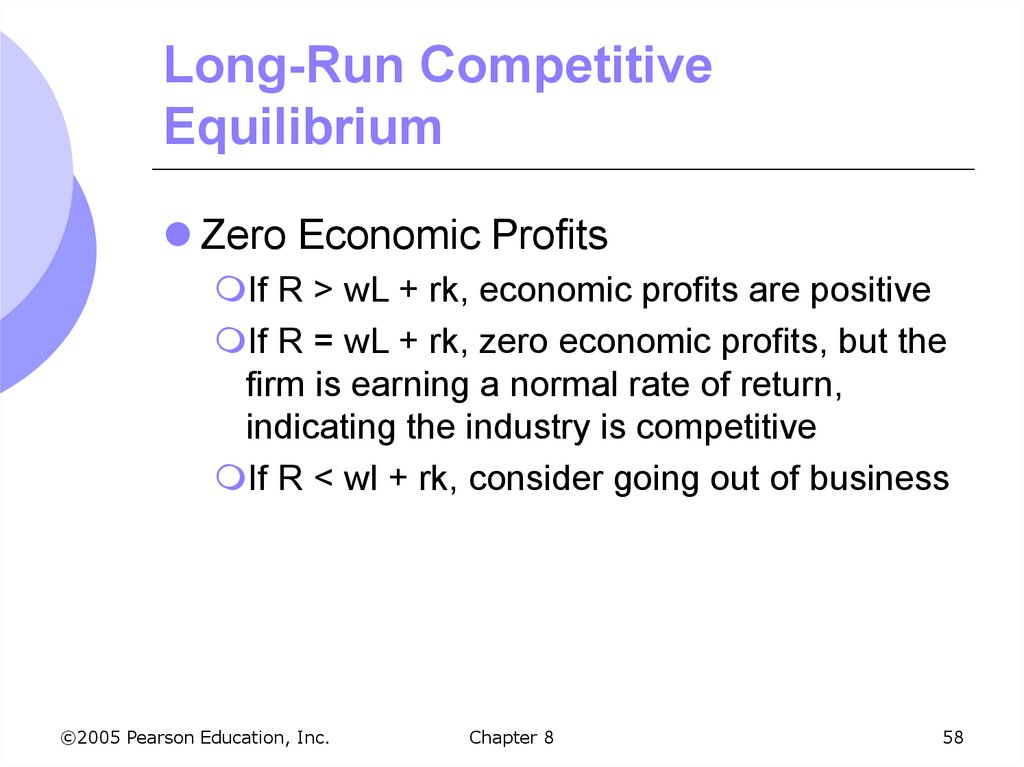
Zero Economic ProfitsIf R > wL + rk, economic profits are positive
If R = wL + rk, zero economic profits, but the
firm is earning a normal rate of return,
indicating the industry is competitive
If R < wl + rk, consider going out of business
©2005 Pearson Education, Inc.
Chapter 8
58
59. Long-Run Competitive Equilibrium
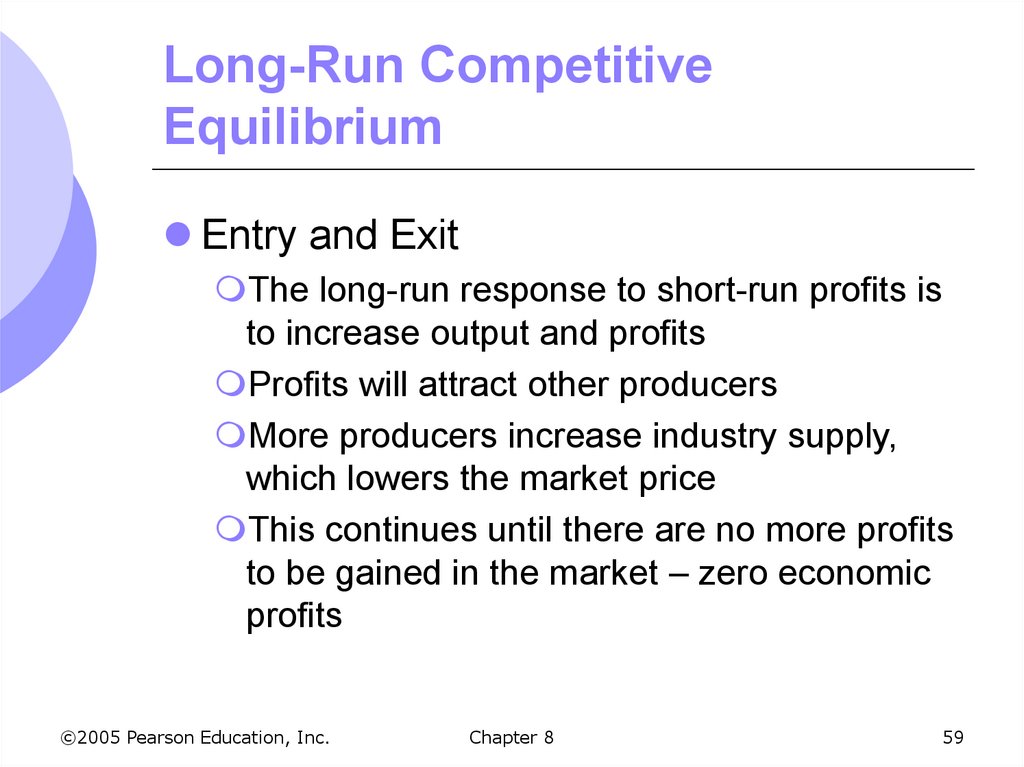
Entry and ExitThe long-run response to short-run profits is
to increase output and profits
Profits will attract other producers
More producers increase industry supply,
which lowers the market price
This continues until there are no more profits
to be gained in the market – zero economic
profits
©2005 Pearson Education, Inc.
Chapter 8
59
60. Long-Run Competitive Equilibrium – Profits
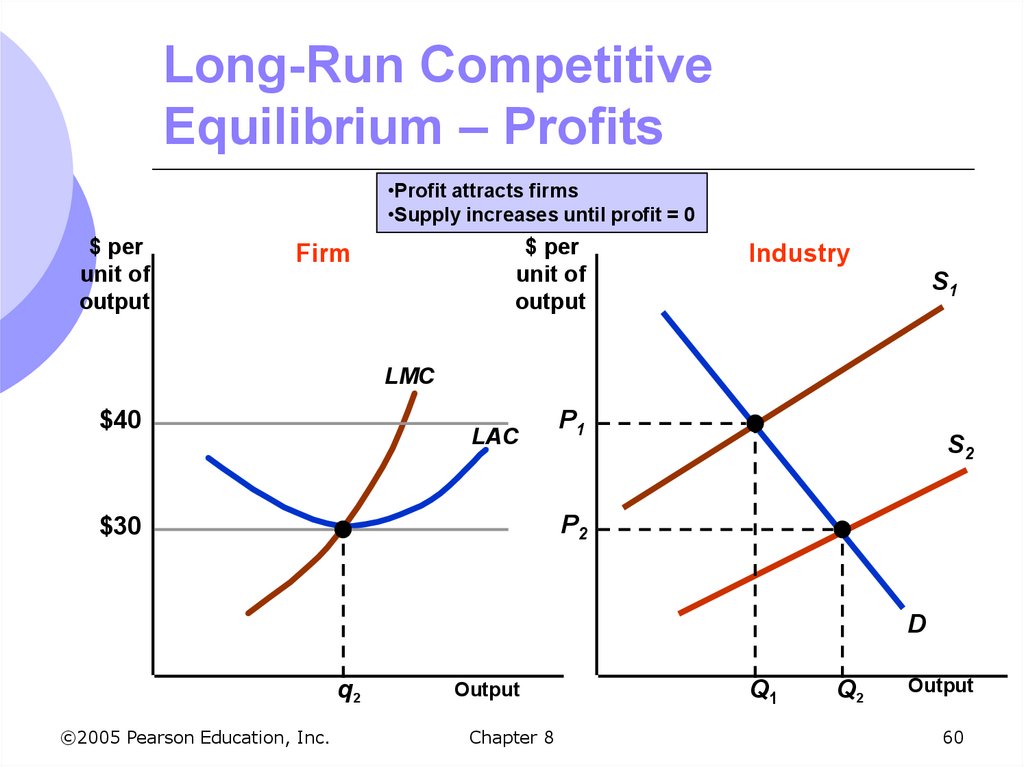
•Profit attracts firms•Supply increases until profit = 0
$ per
unit of
output
$ per
unit of
output
Firm
Industry
S1
LMC
$40
LAC
P1
S2
P2
$30
D
q2
©2005 Pearson Education, Inc.
Output
Chapter 8
Q1
Q2
Output
60
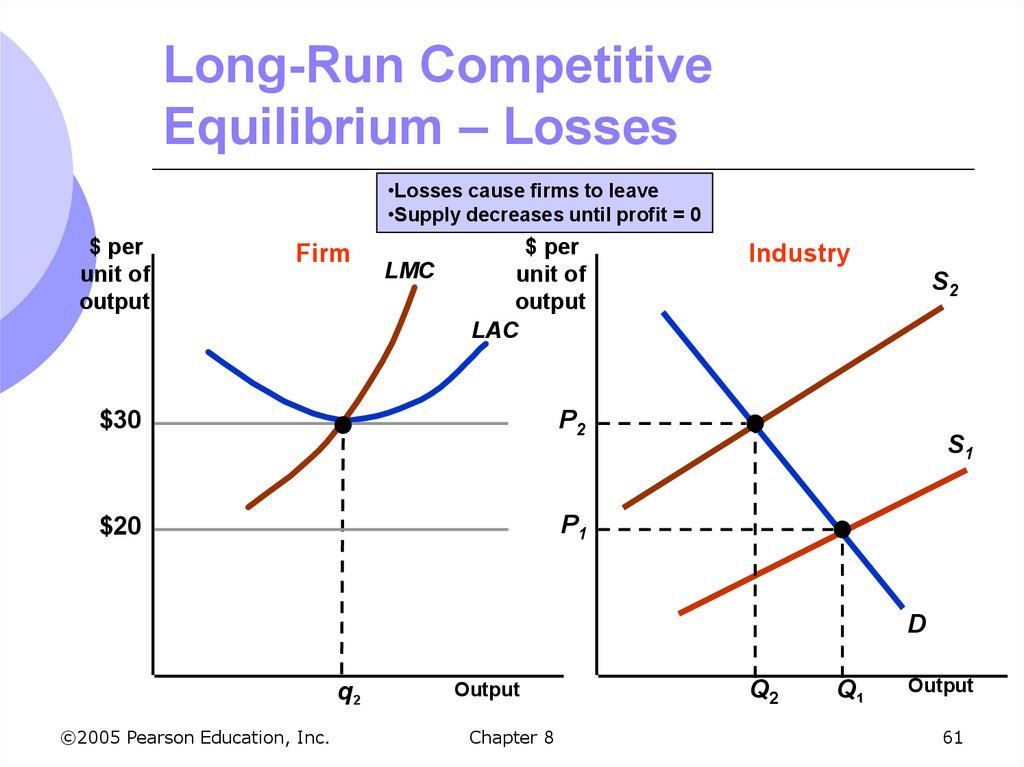
61. Long-Run Competitive Equilibrium – Losses
•Losses cause firms to leave•Supply decreases until profit = 0
$ per
unit of
output
Firm
LMC
$ per
unit of
output
LAC
$30
Industry
S2
P2
S1
P1
$20
D
q2
©2005 Pearson Education, Inc.
Output
Chapter 8
Q2
Q1
Output
61
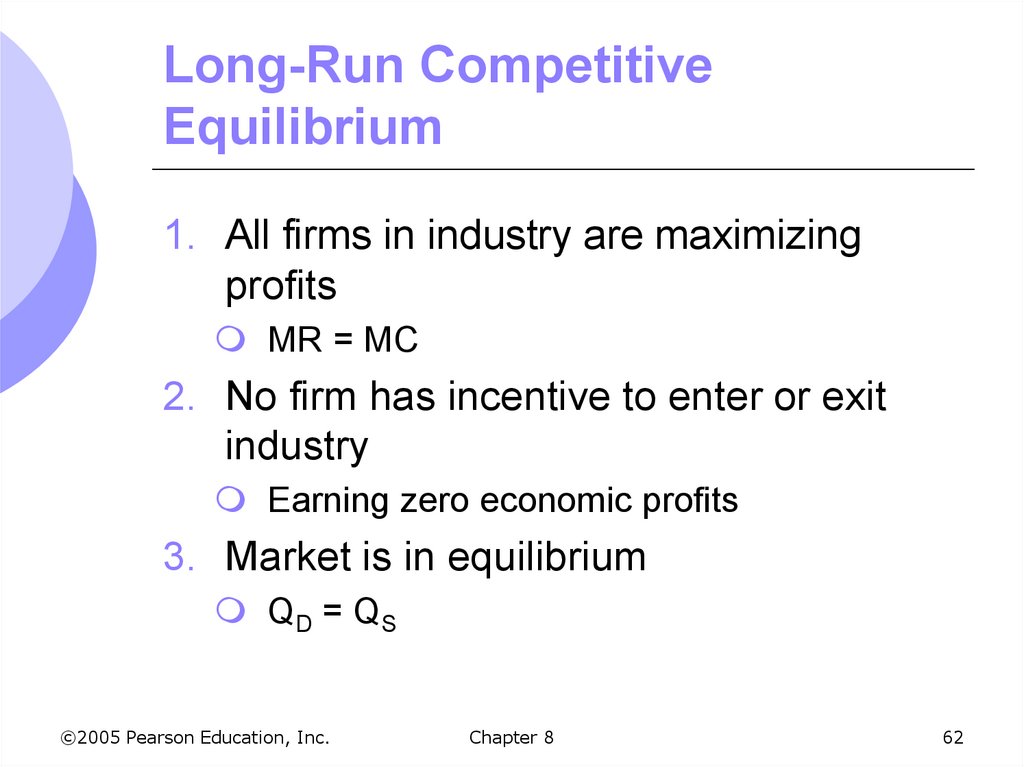
62. Long-Run Competitive Equilibrium
1. All firms in industry are maximizingprofits
MR = MC
2. No firm has incentive to enter or exit
industry
Earning zero economic profits
3. Market is in equilibrium
QD = Q S
©2005 Pearson Education, Inc.
Chapter 8
62
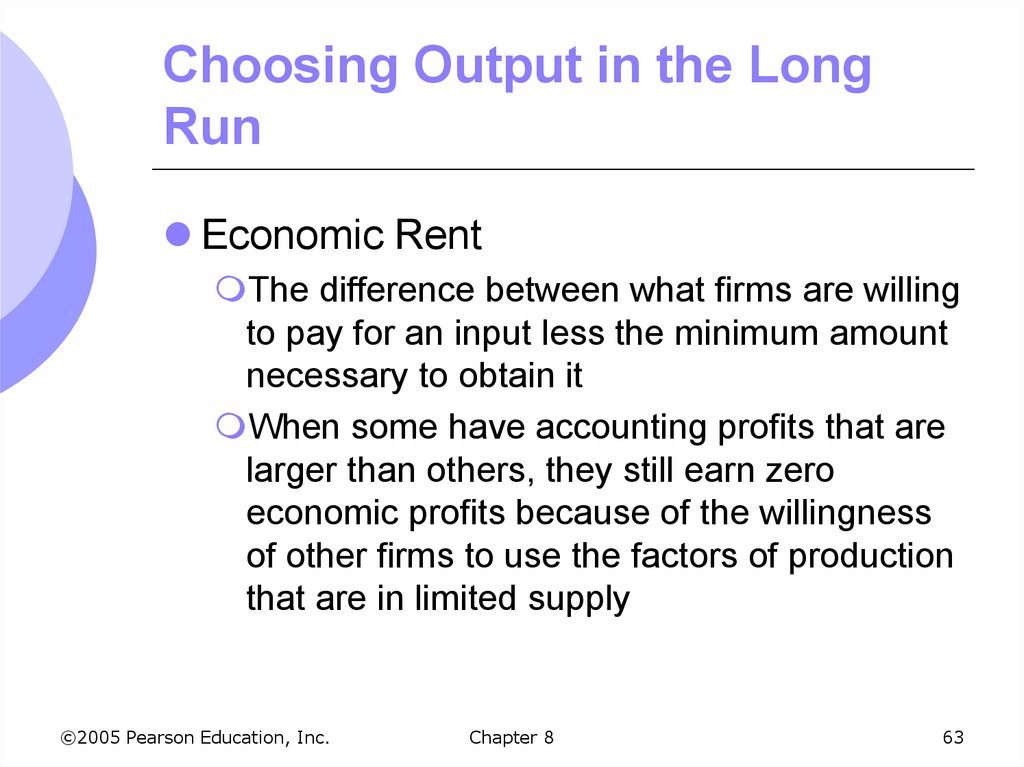
63. Choosing Output in the Long Run
Economic RentThe difference between what firms are willing
to pay for an input less the minimum amount
necessary to obtain it
When some have accounting profits that are
larger than others, they still earn zero
economic profits because of the willingness
of other firms to use the factors of production
that are in limited supply
©2005 Pearson Education, Inc.
Chapter 8
63
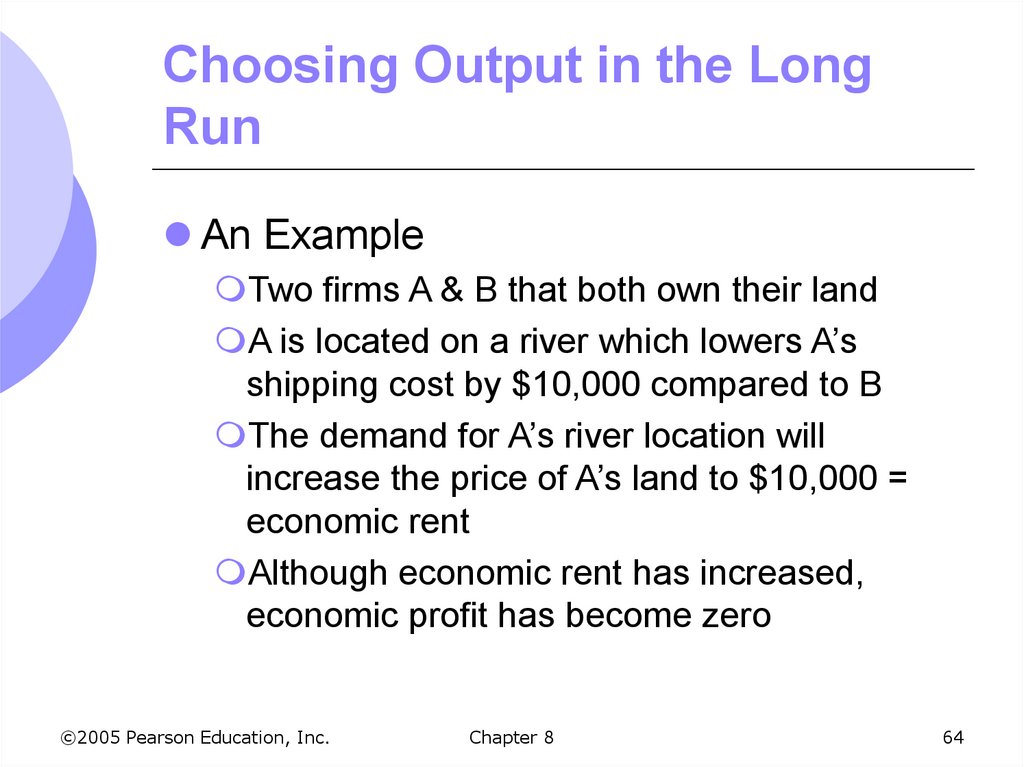
64. Choosing Output in the Long Run
An ExampleTwo firms A & B that both own their land
A is located on a river which lowers A’s
shipping cost by $10,000 compared to B
The demand for A’s river location will
increase the price of A’s land to $10,000 =
economic rent
Although economic rent has increased,
economic profit has become zero
©2005 Pearson Education, Inc.
Chapter 8
64
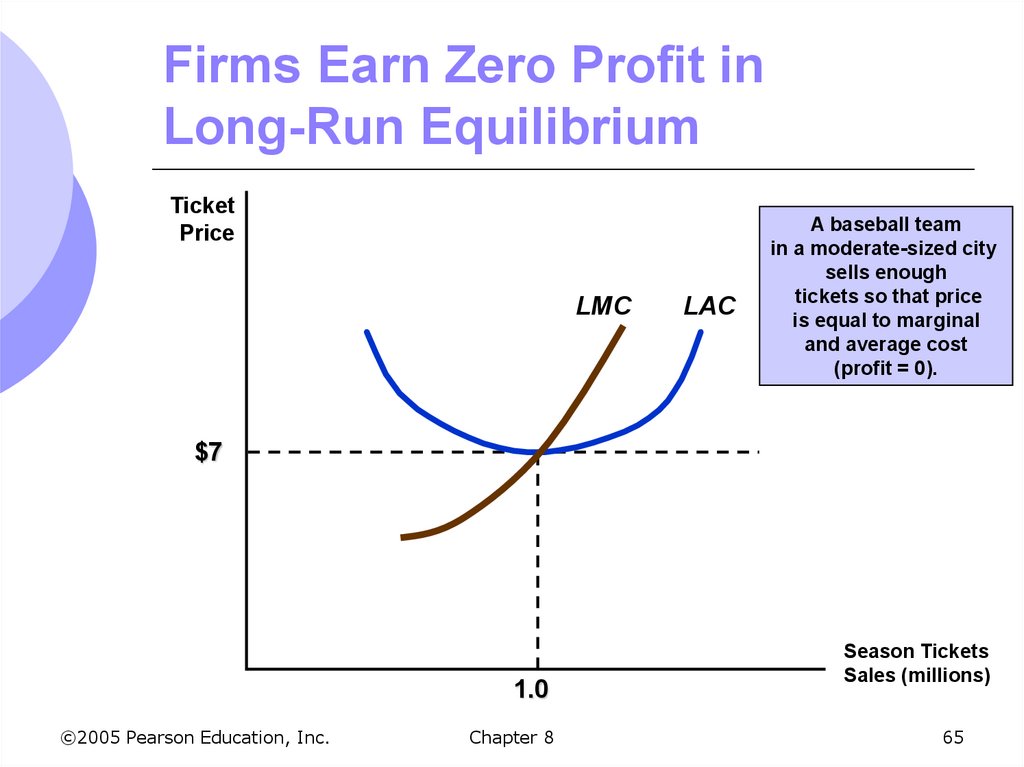
65. Firms Earn Zero Profit in Long-Run Equilibrium
TicketPrice
LMC
LAC
A baseball team
in a moderate-sized city
sells enough
tickets so that price
is equal to marginal
and average cost
(profit = 0).
$7
1.0
©2005 Pearson Education, Inc.
Chapter 8
Season Tickets
Sales (millions)
65
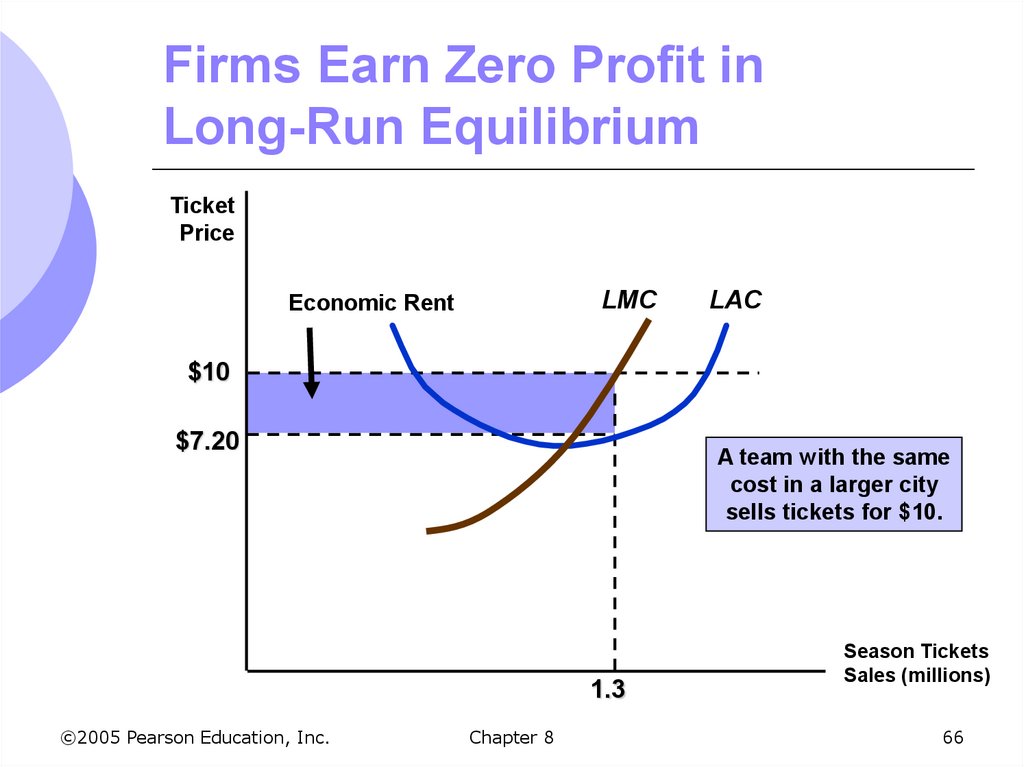
66. Firms Earn Zero Profit in Long-Run Equilibrium
TicketPrice
LMC
Economic Rent
LAC
$10
$7.20
A team with the same
cost in a larger city
sells tickets for $10.
1.3
©2005 Pearson Education, Inc.
Chapter 8
Season Tickets
Sales (millions)
66
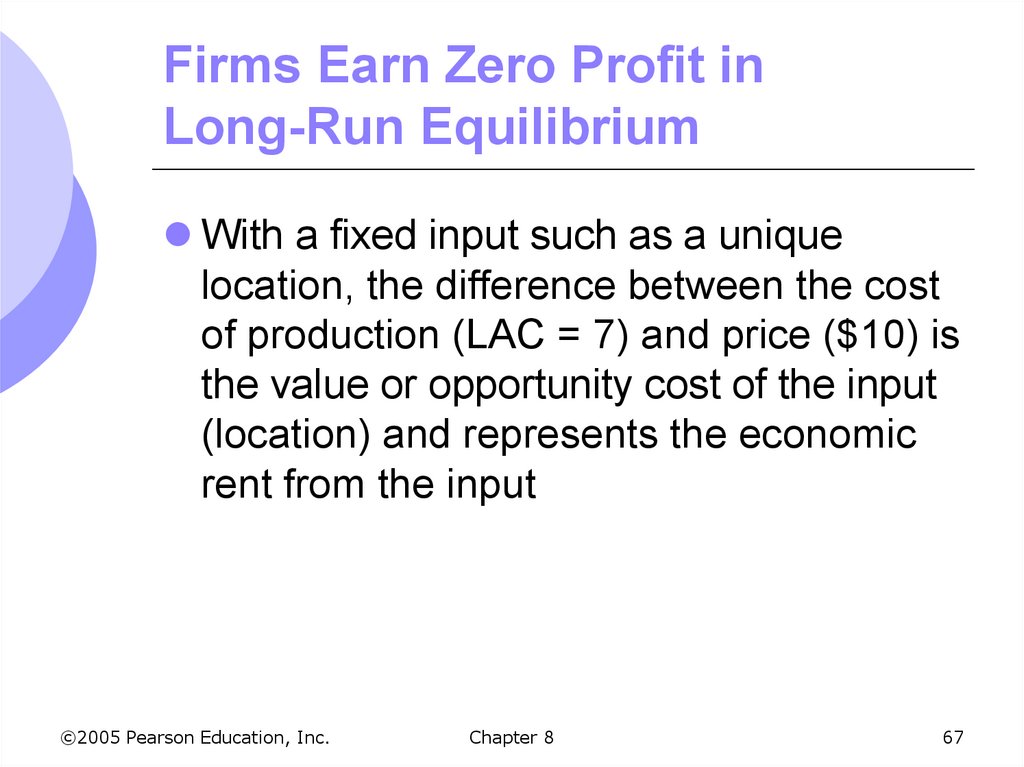
67. Firms Earn Zero Profit in Long-Run Equilibrium
With a fixed input such as a uniquelocation, the difference between the cost
of production (LAC = 7) and price ($10) is
the value or opportunity cost of the input
(location) and represents the economic
rent from the input
©2005 Pearson Education, Inc.
Chapter 8
67
68. Firms Earn Zero Profit in Long-Run Equilibrium
If the opportunity cost of the input (rent) isnot taken into consideration, it may
appear that economic profits exist in the
long run
©2005 Pearson Education, Inc.
Chapter 8
68
69. The Industry’s Long-Run Supply Curve
The shape of the long-run supply curvedepends on the extent to which changes
in industry output affect the prices the
firms must pay for inputs
©2005 Pearson Education, Inc.
Chapter 8
69
70. The Industry’s Long-Run Supply Curve
AssumeAll firms have access to the available
production technology
Output is increased by using more inputs,
not by invention
The market for inputs does not change with
expansions and contractions of the industry
©2005 Pearson Education, Inc.
Chapter 8
70
71. The Industry’s Long-Run Supply Curve
To analyze long-run industry supply, willneed to distinguish between three
different types of industries
1. Constant-Cost
2. Increasing-Cost
3. Decreasing-Cost
©2005 Pearson Education, Inc.
Chapter 8
71
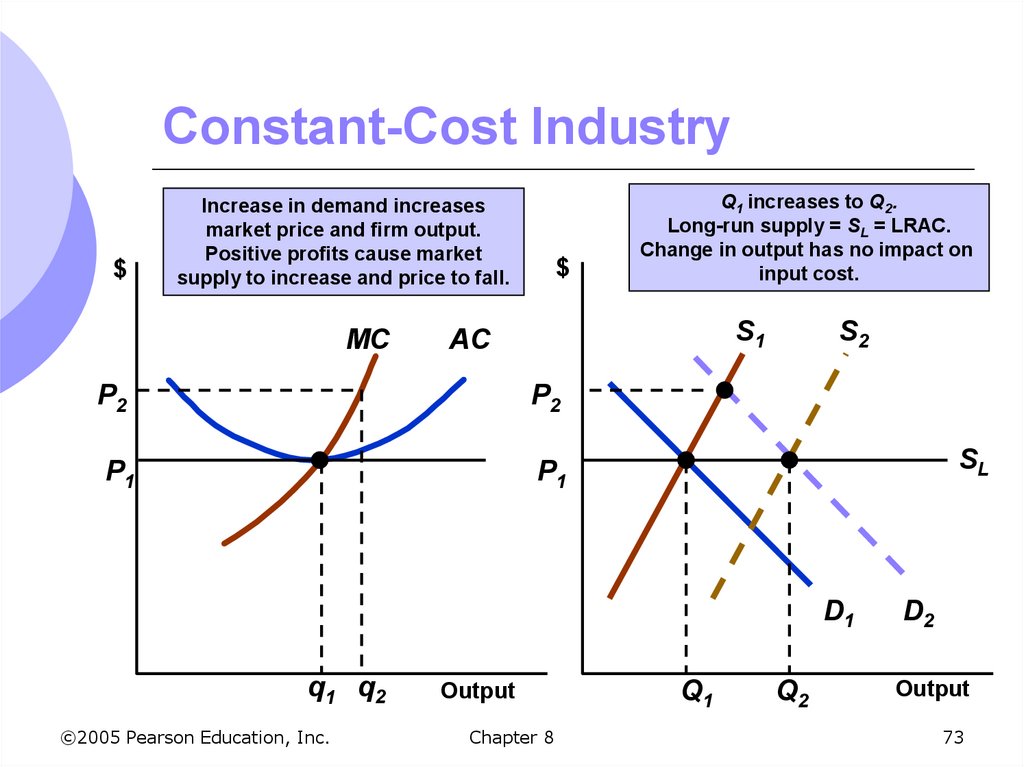
72. Constant-Cost Industry
Industry whose long-run supply curve ishorizontal
Assume a firm is initially in equilibrium
Demand increases, causing price to increase
Individual firms increase supply
Causes firms to earn positive profits in short
run
Supply increases, causing market price to
decrease
Long run equilibrium – zero economic profits
©2005 Pearson Education, Inc.
Chapter 8
72
73. Constant-Cost Industry
$Increase in demand increases
market price and firm output.
Positive profits cause market
supply to increase and price to fall.
MC
$
Q1 increases to Q2.
Long-run supply = SL = LRAC.
Change in output has no impact on
input cost.
S1
AC
P2
P2
P1
P1
S2
SL
D1
q1 q2
©2005 Pearson Education, Inc.
Output
Chapter 8
Q1
Q2
D2
Output
73
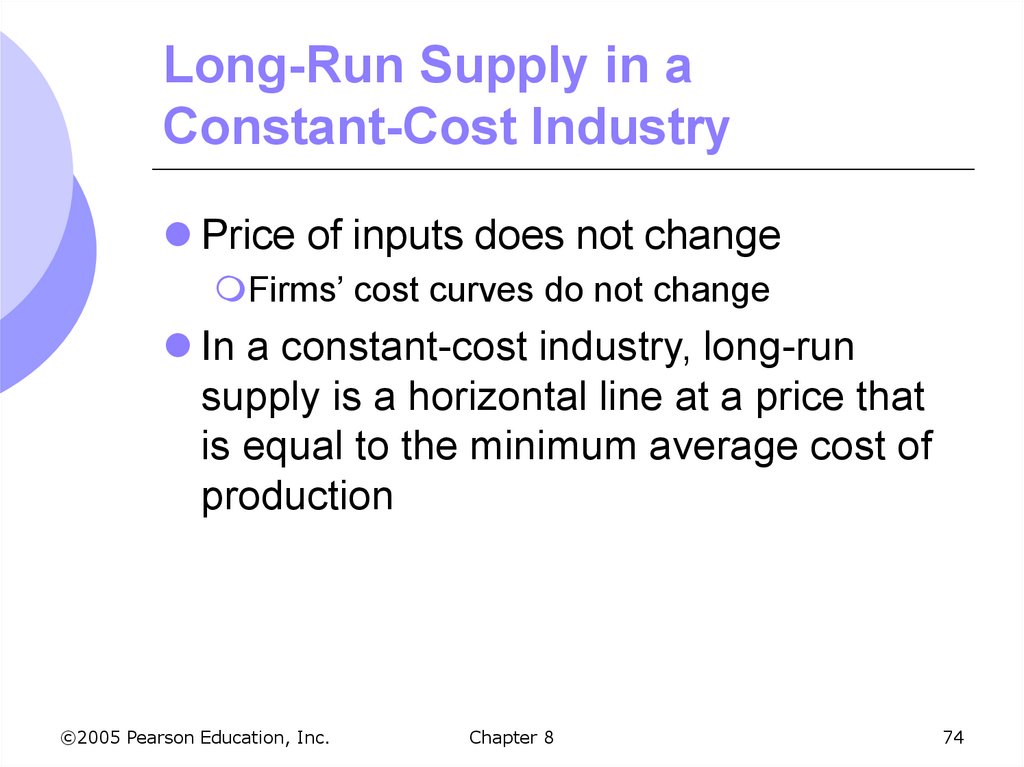
74. Long-Run Supply in a Constant-Cost Industry
Price of inputs does not changeFirms’ cost curves do not change
In a constant-cost industry, long-run
supply is a horizontal line at a price that
is equal to the minimum average cost of
production
©2005 Pearson Education, Inc.
Chapter 8
74
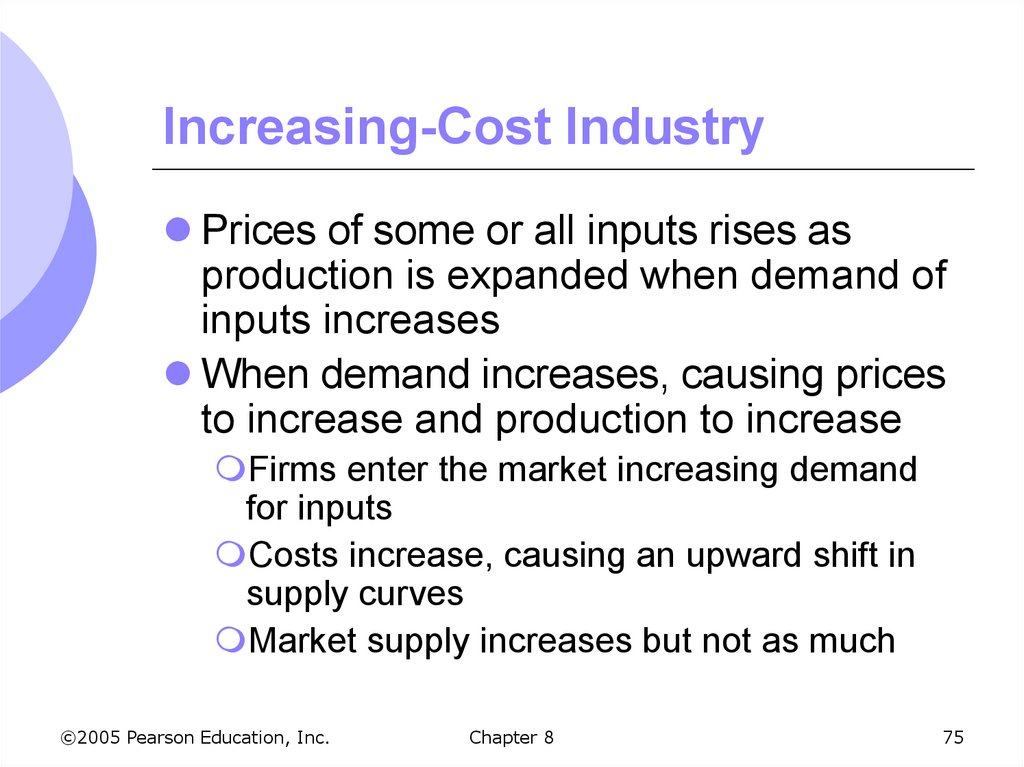
75. Increasing-Cost Industry
Prices of some or all inputs rises asproduction is expanded when demand of
inputs increases
When demand increases, causing prices
to increase and production to increase
Firms enter the market increasing demand
for inputs
Costs increase, causing an upward shift in
supply curves
Market supply increases but not as much
©2005 Pearson Education, Inc.
Chapter 8
75
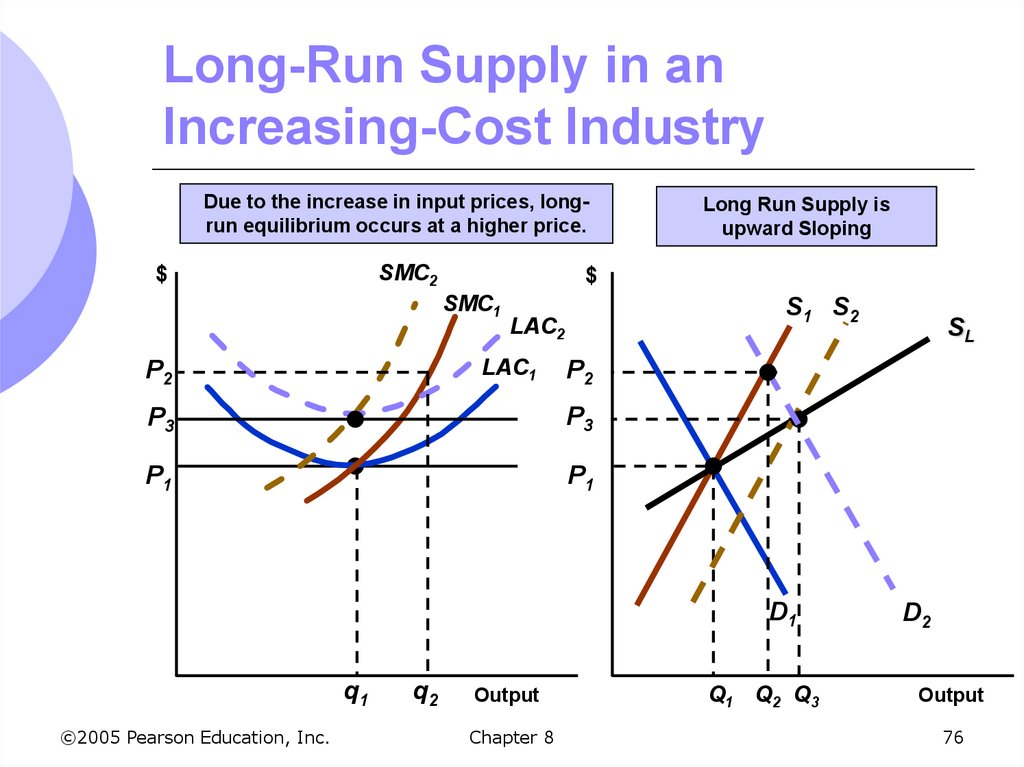
76. Long-Run Supply in an Increasing-Cost Industry
Due to the increase in input prices, longrun equilibrium occurs at a higher price.SMC2
$
$
SMC1
S1 S2
LAC2
LAC1
P2
Long Run Supply is
upward Sloping
P2
P3
P3
P1
P1
D1
q1
©2005 Pearson Education, Inc.
q2
Output
Chapter 8
SL
Q1 Q2 Q3
D2
Output
76
77. Long-Run Supply in an Increasing-Cost Industry
In an increasing-cost industry, long-runsupply curve is upward sloping
More output is produced, but only at the
higher price needed to compete for the
increased input costs
©2005 Pearson Education, Inc.
Chapter 8
77
78. Decreasing-Cost Industry
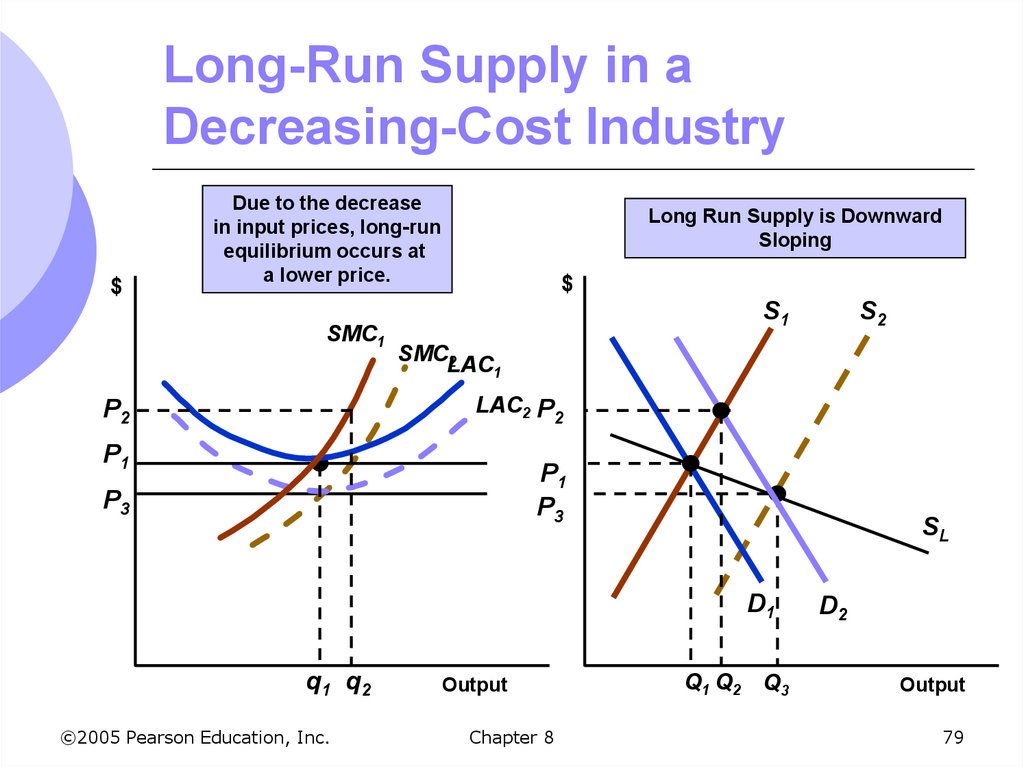
Industry whose long-run supply curve isdownward sloping
Increase in demand causes production to
increase
Increase in size allows firm to take
advantage of size to get inputs cheaper
Increased production may lead to better
efficiencies or quantity discounts
Costs shift down and market price falls
©2005 Pearson Education, Inc.
Chapter 8
78
79. Long-Run Supply in a Decreasing-Cost Industry
$Due to the decrease
in input prices, long-run
equilibrium occurs at
a lower price.
SMC1
Long Run Supply is Downward
Sloping
$
S1
S2
SMCLAC
2
1
LAC2 P2
P2
P1
P1
P3
P3
SL
D1
q 1 q2
©2005 Pearson Education, Inc.
Output
Chapter 8
Q1 Q2 Q3
D2
Output
79
80. The Industry’s Long-Run Supply Curve
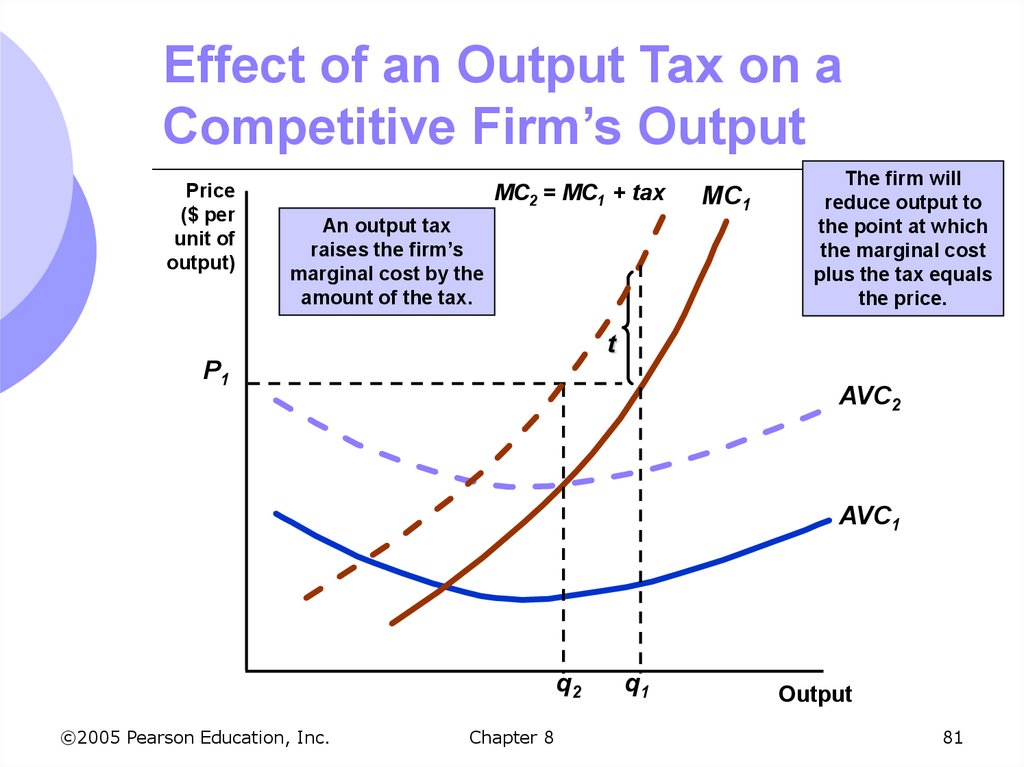
The Effects of a TaxIn an earlier chapter we studied how firms
respond to taxes on an input
Now, we will consider how a firm responds to
a tax on its output
©2005 Pearson Education, Inc.
Chapter 8
80
81. Effect of an Output Tax on a Competitive Firm’s Output
Price($ per
unit of
output)
MC2 = MC1 + tax
An output tax
raises the firm’s
marginal cost by the
amount of the tax.
MC1
The firm will
reduce output to
the point at which
the marginal cost
plus the tax equals
the price.
t
P1
AVC2
AVC1
q2
©2005 Pearson Education, Inc.
Chapter 8
q1
Output
81
82. Effect of an Output Tax on Industry Output
Price($ per
unit of
output)
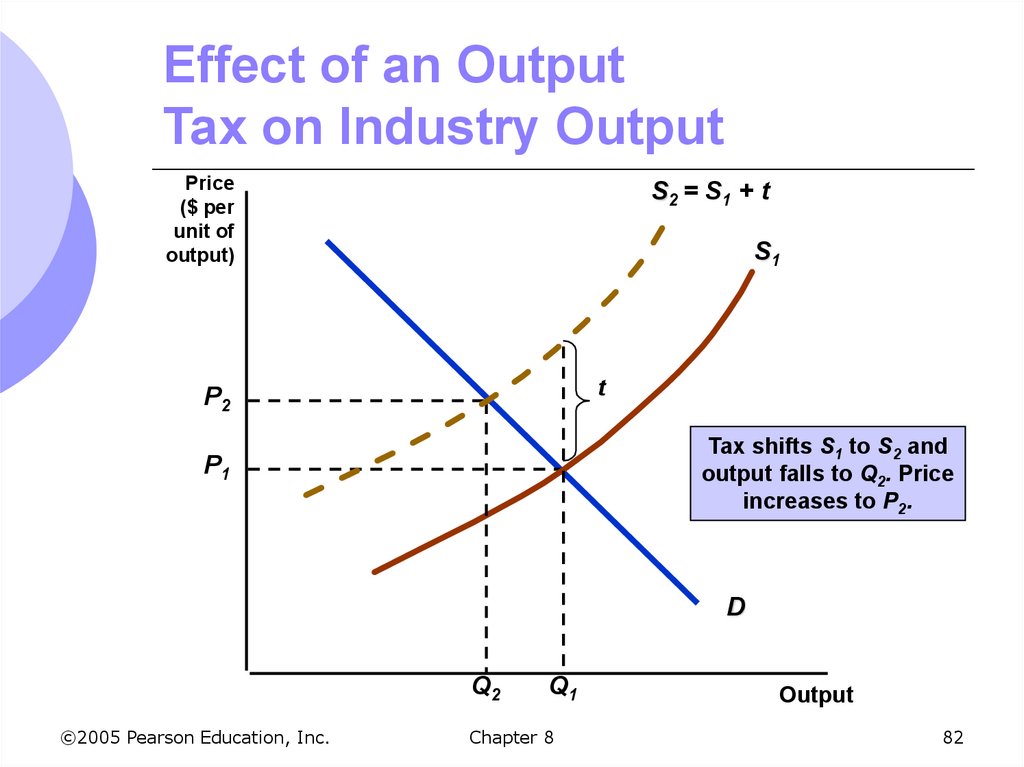
S2 = S1 + t
S1
t
P2
Tax shifts S1 to S2 and
output falls to Q2. Price
increases to P2.
P1
D
Q2
©2005 Pearson Education, Inc.
Q1
Chapter 8
Output
82
83. Long-Run Elasticity of Supply
1. Constant-cost industryLong-run supply is horizontal
Small increase in price will induce an
extremely large output increase
Long-run supply elasticity is infinitely large
Inputs would be readily available
©2005 Pearson Education, Inc.
Chapter 8
83
84. Long-Run Elasticity of Supply
2. Increasing-cost industryLong-run supply is upward-sloping and
elasticity is positive
The slope (elasticity) will depend on the rate
of increase in input cost
Long-run elasticity will generally be greater
than short-run elasticity of supply
©2005 Pearson Education, Inc.
Chapter 8
84