



 Бизнес
Похожие презентации:





Organizing the Business. Chapter 6
1.
Organizing theBusiness
Chapter 6
Copyright©
©2017
2012Pearson
PearsonEducation,
Education, Ltd.
Inc.
Copyright
Publishing as Prentice Hall
6-1
2.
IntroductionIn this chapter we
– examine factors that influence a firm’s
organizational structure
– discuss the building blocks of organizational
structure as well as the differences between
decision making in different types of
organizations
– look at a variety of organizational structures
– describe the most popular new forms of
organizational design
Copyright©
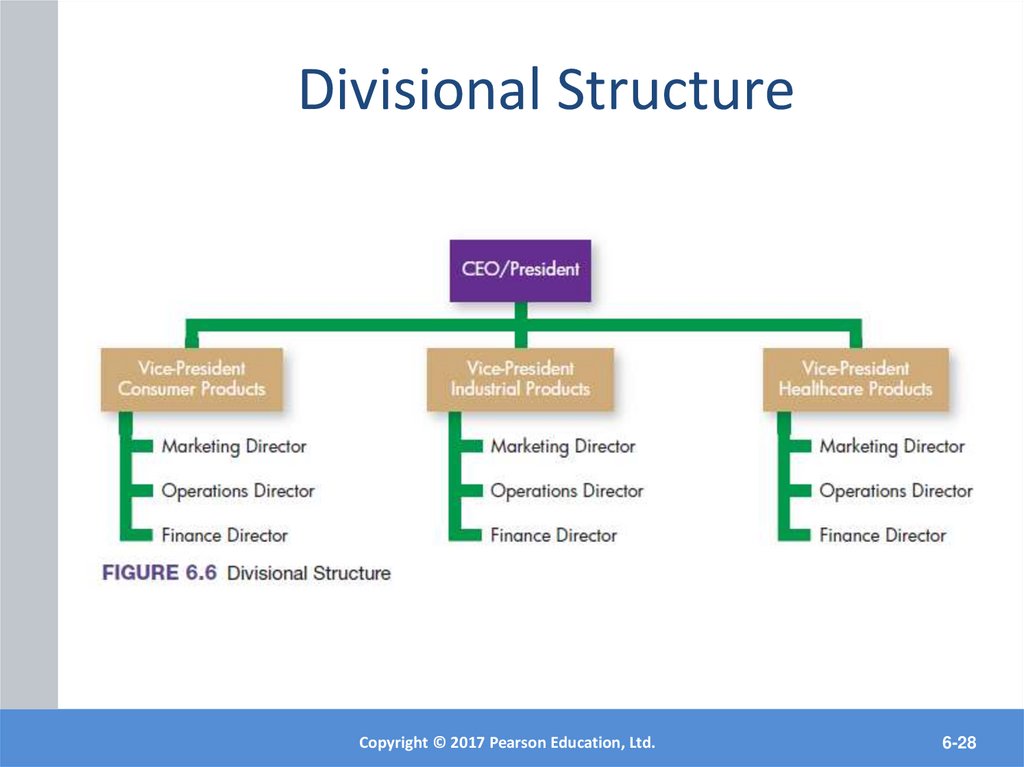
©2017
2012Pearson
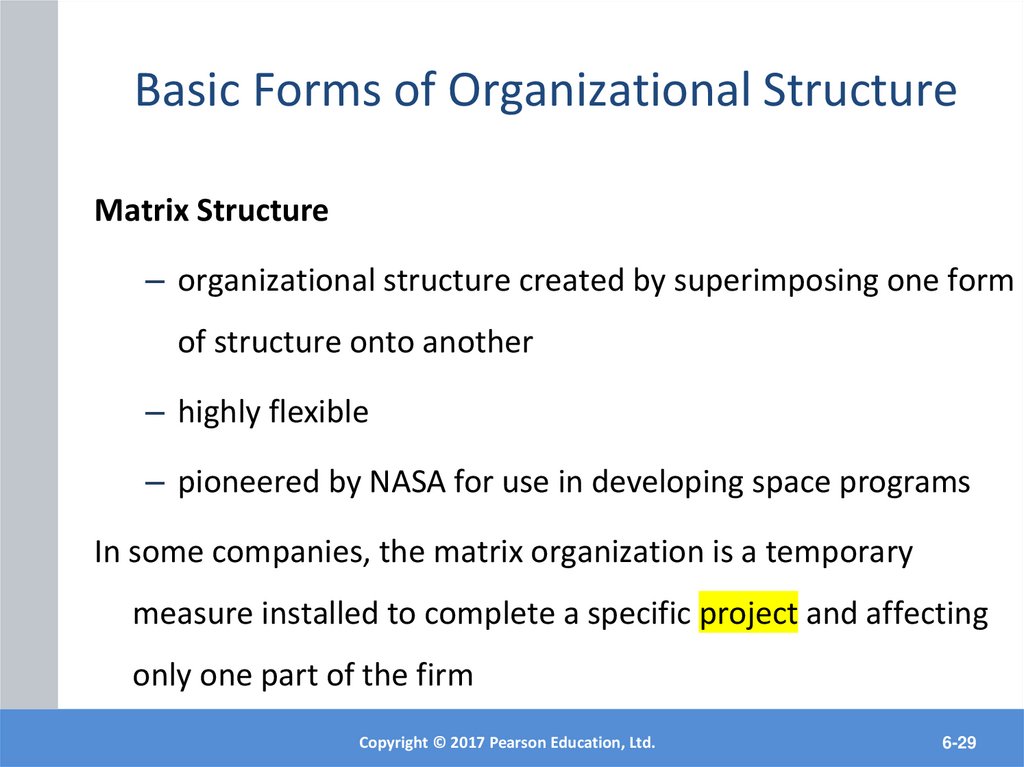
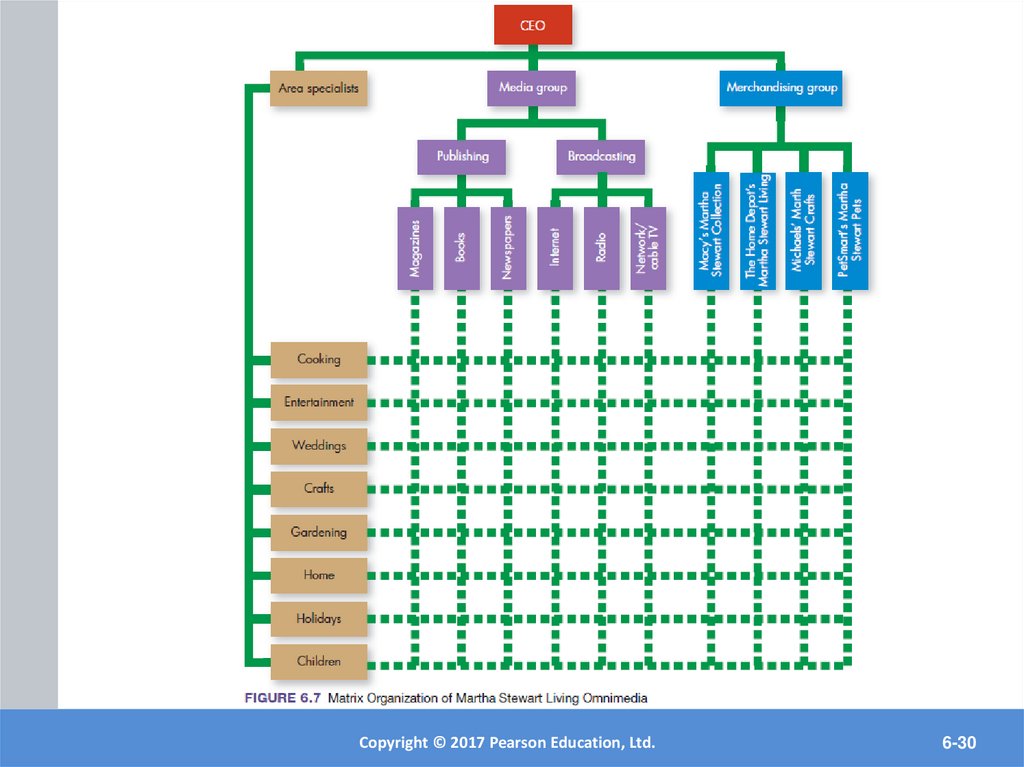
PearsonEducation,
Education, Ltd.
Inc.
Copyright
Publishing as Prentice Hall
6-2
3.
Learning Objectives1. Discuss the factors that influence a firm’s
organizational structure.
2. Explain specialization and departmentalization as
two of the building blocks of organizational
structure.
3. Describe centralization and decentralization,
delegation, and authority as the key ingredients in
establishing the decision-making hierarchy.
Copyright©
©2017
2012Pearson
PearsonEducation,
Education, Ltd.
Inc.
Copyright
Publishing as Prentice Hall
6-3
4.
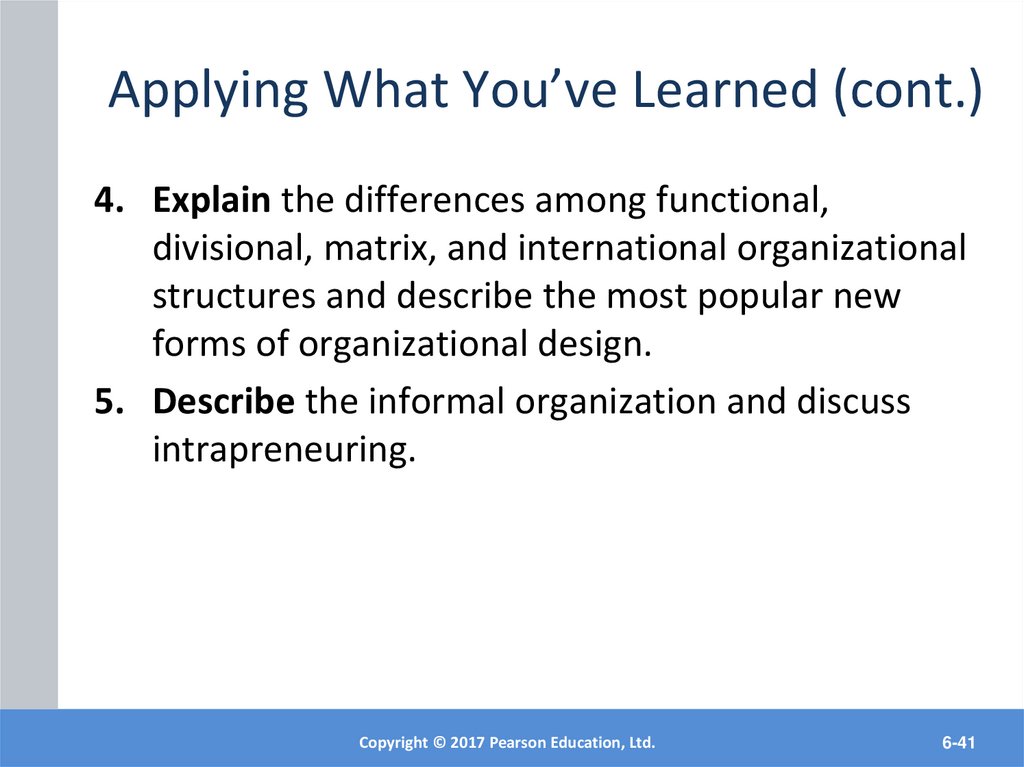
Learning Objectives4. Explain the differences among functional,
divisional, matrix, and international organizational
structures and describe the most popular new
forms of organizational design.
5. Describe the informal organization and discuss
intrapreneuring.
Copyright©
©2017
2012Pearson
PearsonEducation,
Education, Ltd.
Inc.
Copyright
Publishing as Prentice Hall
6-4
5.
What Is Organizational Structure?Organizational Structure
– specification of the jobs to be done within an
organization and the ways in which they relate
to one another
– an important decision for managers and
business owners is how to structure their
organization
Copyright©
©2017
2012Pearson
PearsonEducation,
Education, Ltd.
Inc.
Copyright
Publishing as Prentice Hall
6-5
6.
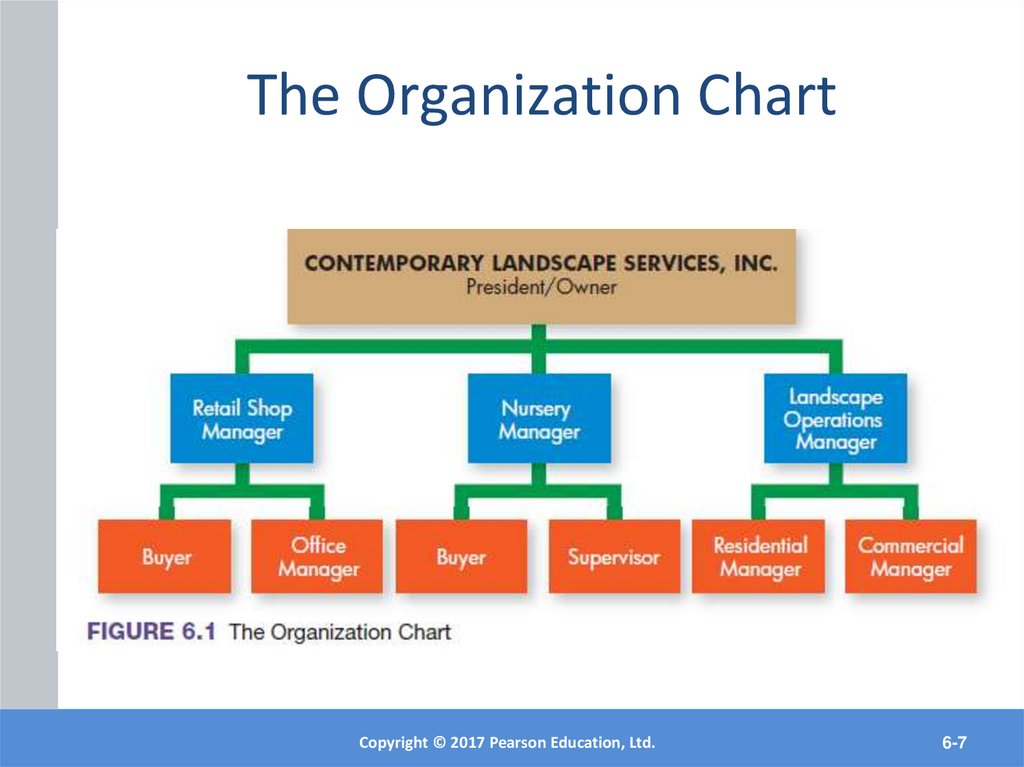
Organization ChartsOrganization Chart
– diagram depicting a company’s structure and
showing employees where they fit into its
operations
Chain of Command
– reporting relationships within a company
– reporting relationships follows a flow from
higher levels to lowers
Copyright©
©2017
2012Pearson
PearsonEducation,
Education, Ltd.
Inc.
Copyright
Publishing as Prentice Hall
6-6
7.
The Organization ChartCopyright©
©2017
2012Pearson
PearsonEducation,
Education, Ltd.
Inc.
Copyright
Publishing as Prentice Hall
6-7
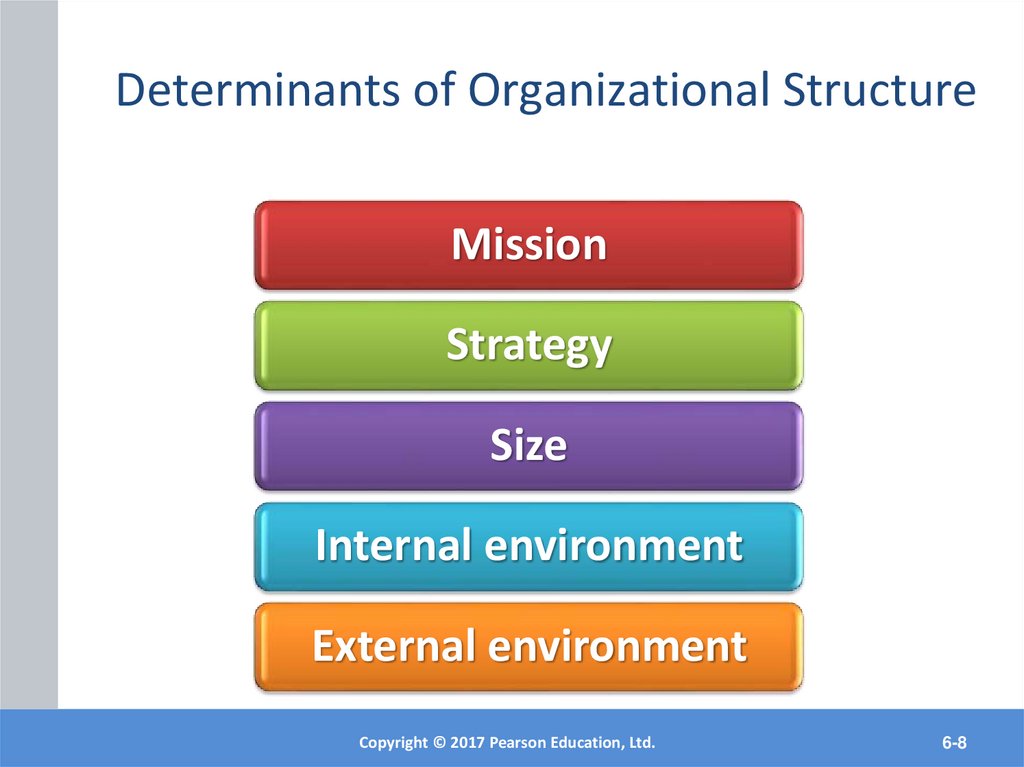
8.
Determinants of Organizational StructureMission
Strategy
Size
Internal environment
External environment
Copyright©
©2017
2012Pearson
PearsonEducation,
Education, Ltd.
Inc.
Copyright
Publishing as Prentice Hall
6-8
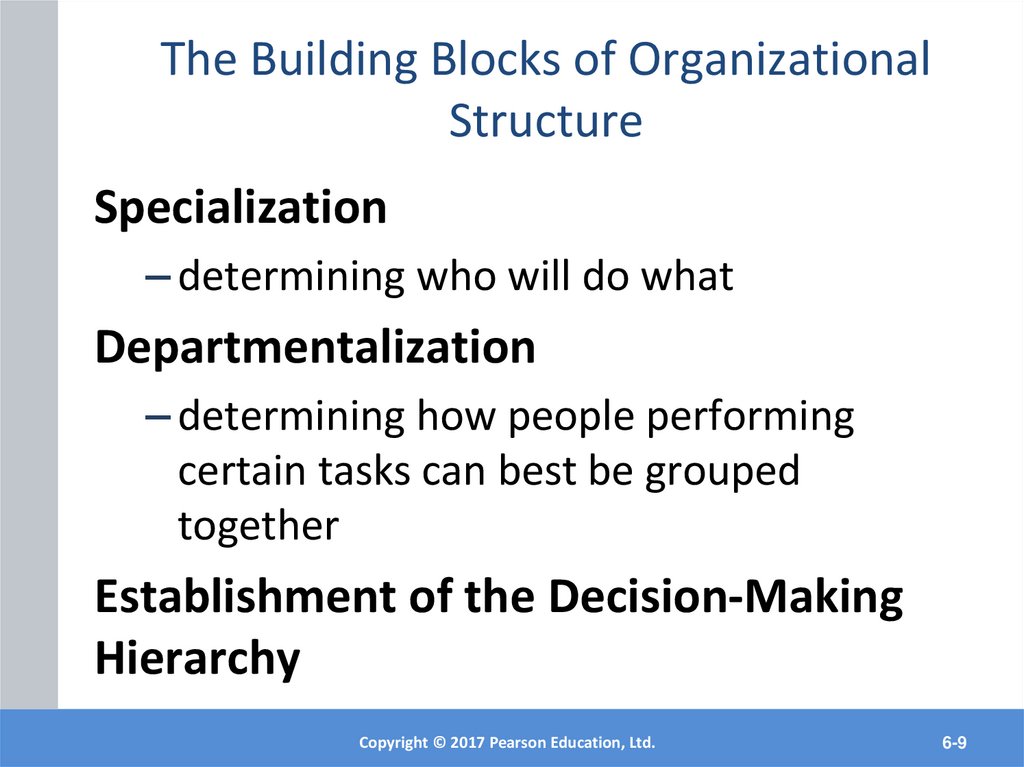
9.
The Building Blocks of OrganizationalStructure
Specialization
– determining who will do what
Departmentalization
– determining how people performing
certain tasks can best be grouped
together
Establishment of the Decision-Making
Hierarchy
Copyright©
©2017
2012Pearson
PearsonEducation,
Education, Ltd.
Inc.
Copyright
Publishing as Prentice Hall
6-9
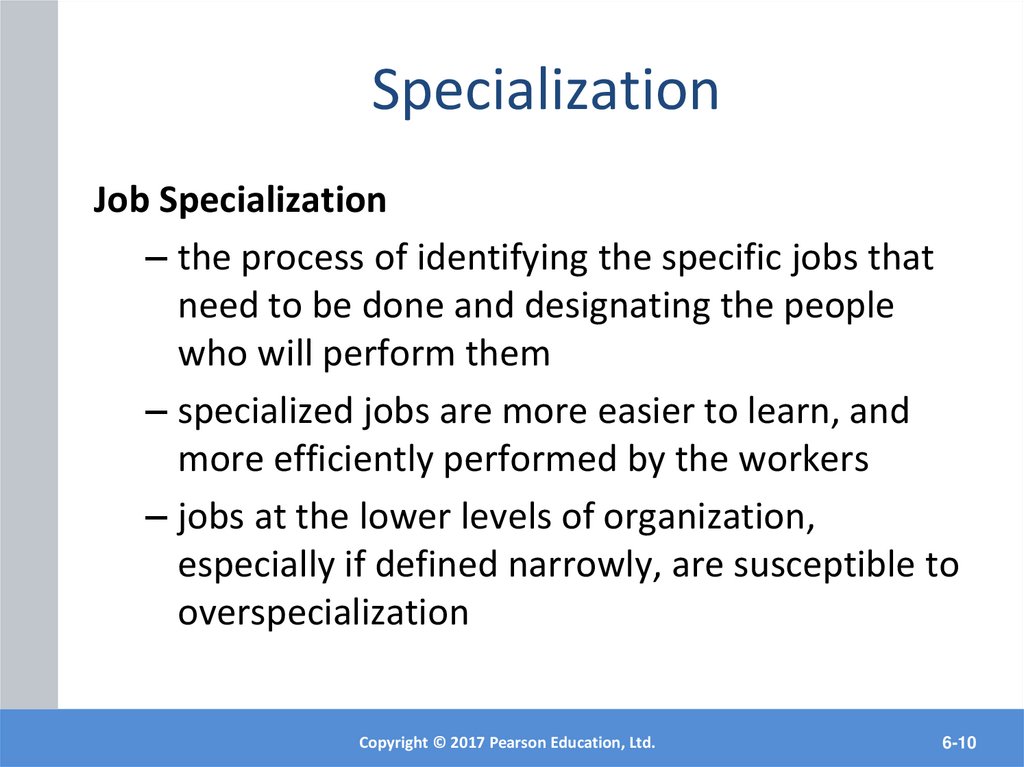
10.
SpecializationJob Specialization
– the process of identifying the specific jobs that
need to be done and designating the people
who will perform them
– specialized jobs are more easier to learn, and
more efficiently performed by the workers
– jobs at the lower levels of organization,
especially if defined narrowly, are susceptible to
overspecialization
Copyright©
©2017
2012Pearson
PearsonEducation,
Education, Ltd.
Inc.
Copyright
Publishing as Prentice Hall
6-10
11.
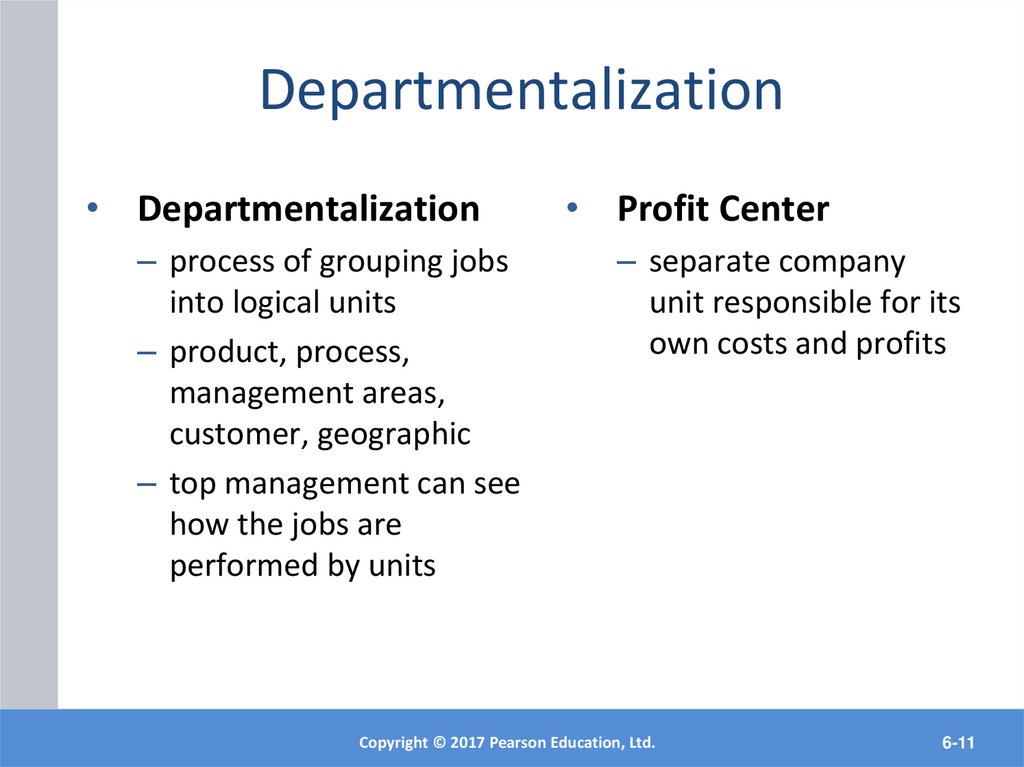
Departmentalization• Departmentalization
– process of grouping jobs
into logical units
– product, process,
management areas,
customer, geographic
– top management can see
how the jobs are
performed by units
• Profit Center
– separate company
unit responsible for its
own costs and profits
Copyright©
©2017
2012Pearson
PearsonEducation,
Education, Ltd.
Inc.
Copyright
Publishing as Prentice Hall
6-11
12.
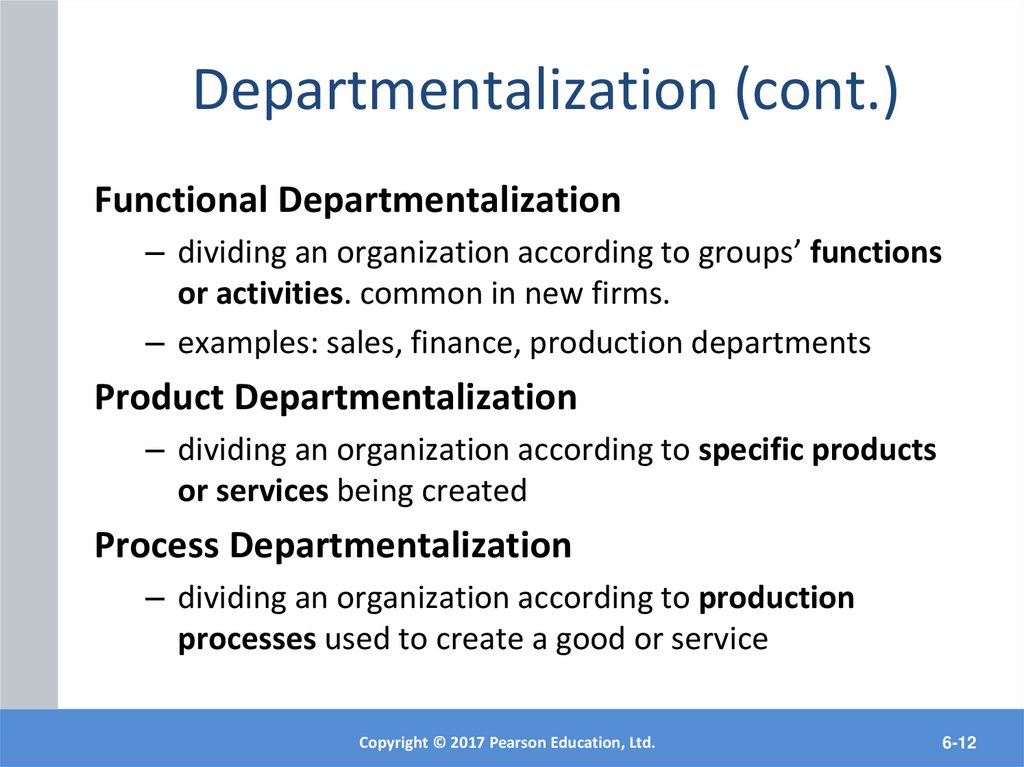
Departmentalization (cont.)Functional Departmentalization
– dividing an organization according to groups’ functions
or activities. common in new firms.
– examples: sales, finance, production departments
Product Departmentalization
– dividing an organization according to specific products
or services being created
Process Departmentalization
– dividing an organization according to production
processes used to create a good or service
Copyright©
©2017
2012Pearson
PearsonEducation,
Education, Ltd.
Inc.
Copyright
Publishing as Prentice Hall
6-12
13.
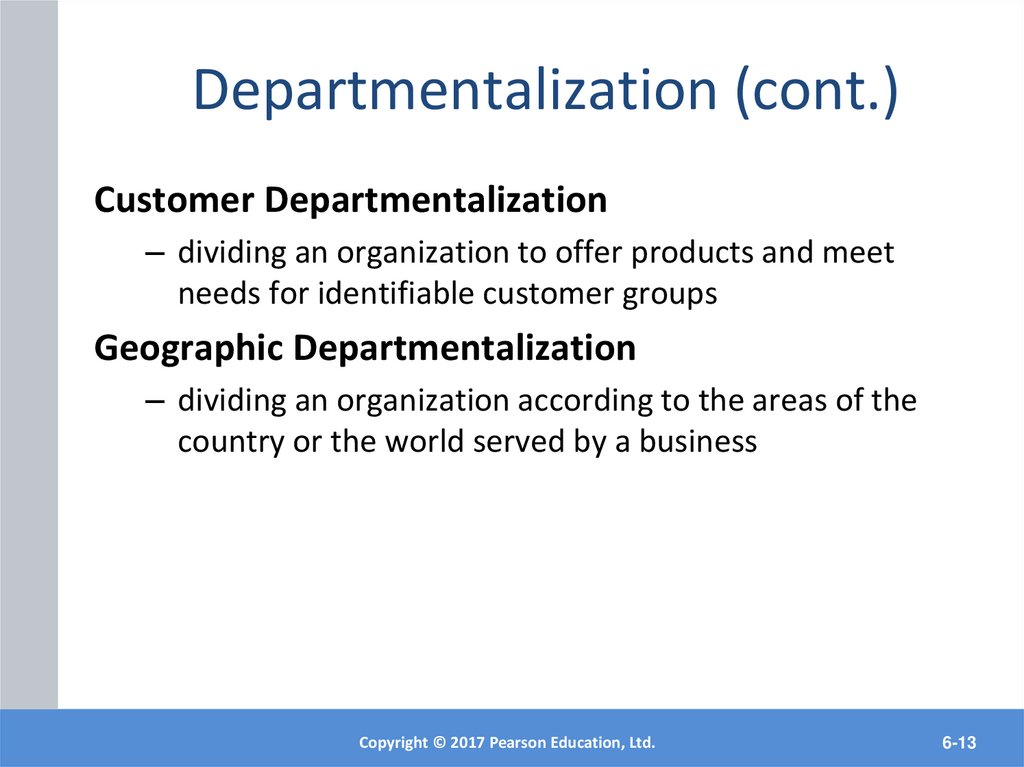
Departmentalization (cont.)Customer Departmentalization
– dividing an organization to offer products and meet
needs for identifiable customer groups
Geographic Departmentalization
– dividing an organization according to the areas of the
country or the world served by a business
Copyright©
©2017
2012Pearson
PearsonEducation,
Education, Ltd.
Inc.
Copyright
Publishing as Prentice Hall
6-13
14.
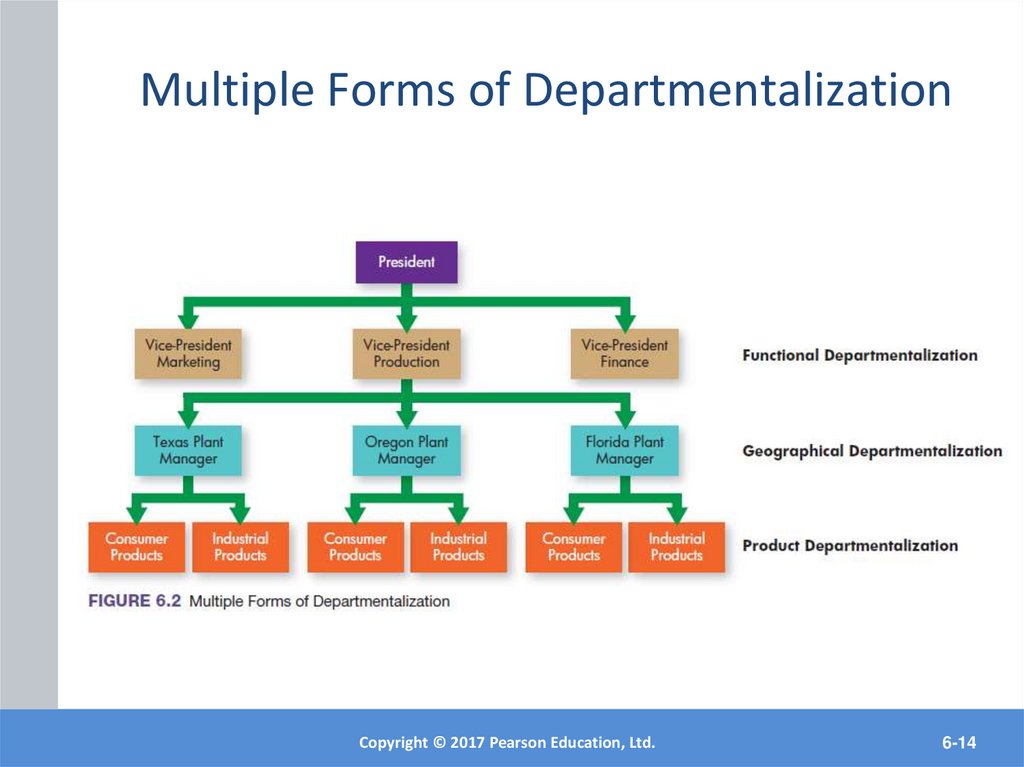
Multiple Forms of DepartmentalizationCopyright©
©2017
2012Pearson
PearsonEducation,
Education, Ltd.
Inc.
Copyright
Publishing as Prentice Hall
6-14
15.
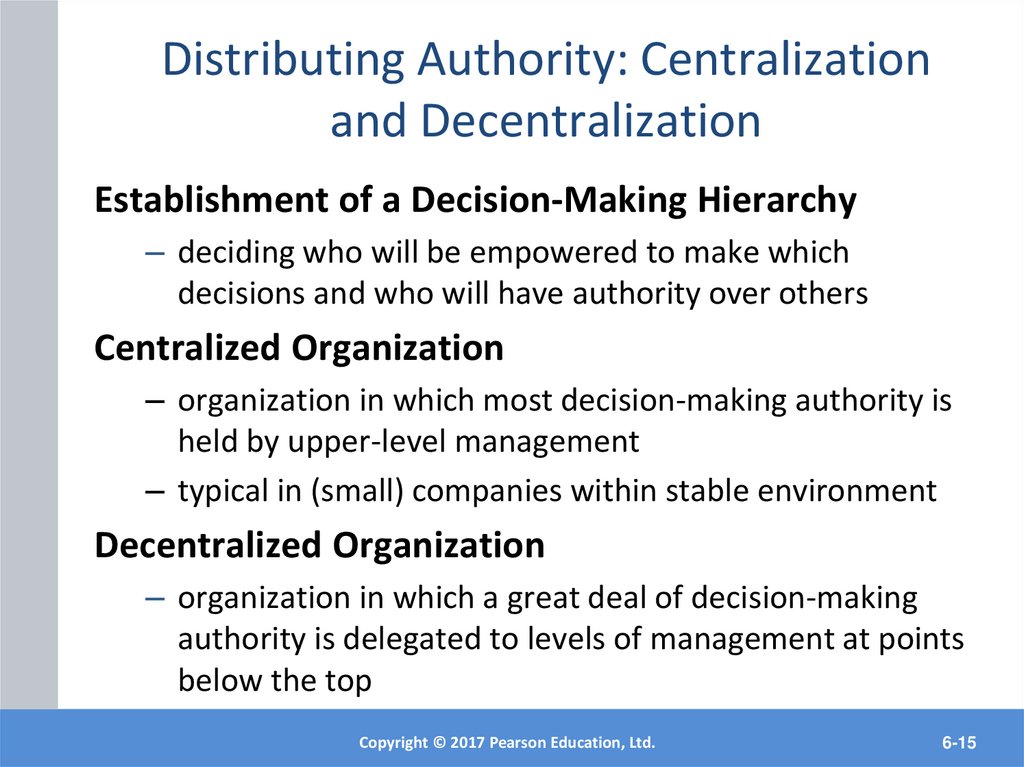
Distributing Authority: Centralizationand Decentralization
Establishment of a Decision-Making Hierarchy
– deciding who will be empowered to make which
decisions and who will have authority over others
Centralized Organization
– organization in which most decision-making authority is
held by upper-level management
– typical in (small) companies within stable environment
Decentralized Organization
– organization in which a great deal of decision-making
authority is delegated to levels of management at points
below the top
Copyright©
©2017
2012Pearson
PearsonEducation,
Education, Ltd.
Inc.
Copyright
Publishing as Prentice Hall
6-15
16.
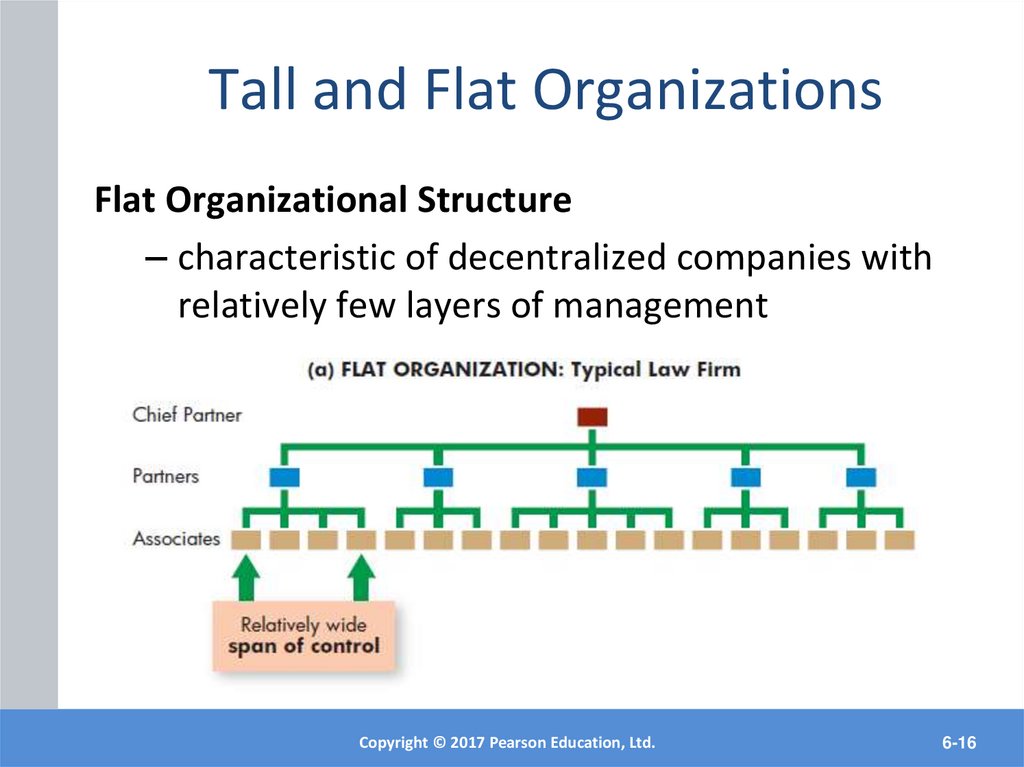
Tall and Flat OrganizationsFlat Organizational Structure
– characteristic of decentralized companies with
relatively few layers of management
Copyright©
©2017
2012Pearson
PearsonEducation,
Education, Ltd.
Inc.
Copyright
Publishing as Prentice Hall
6-16
17.
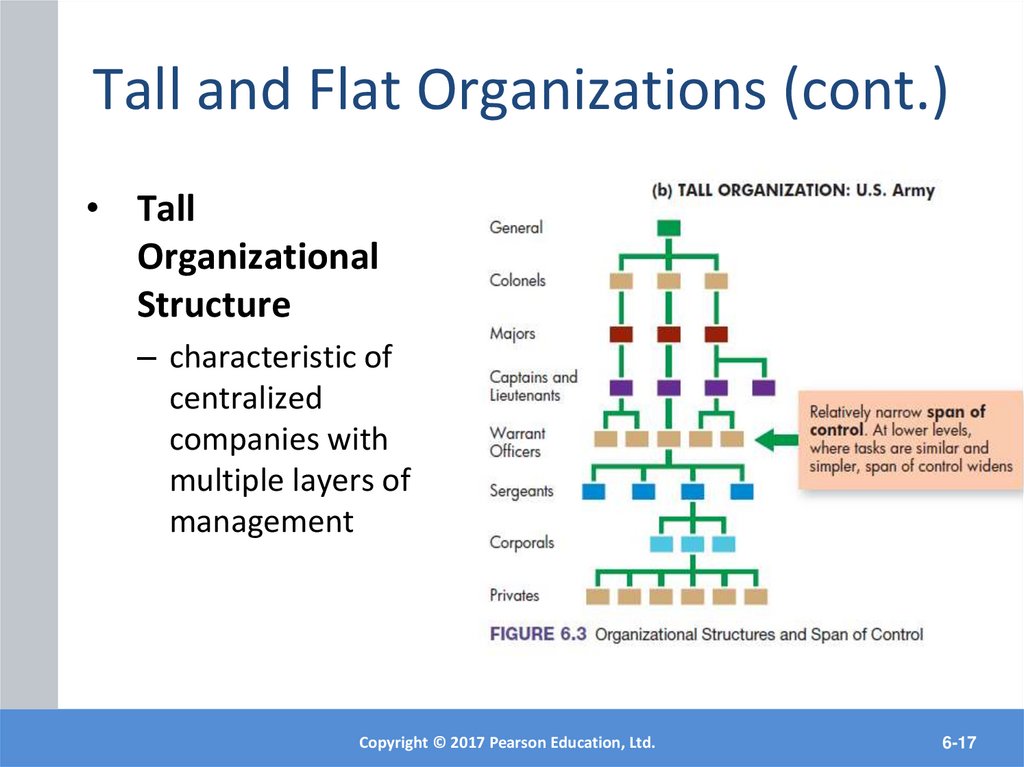
Tall and Flat Organizations (cont.)• Tall
Organizational
Structure
– characteristic of
centralized
companies with
multiple layers of
management
Copyright©
©2017
2012Pearson
PearsonEducation,
Education, Ltd.
Inc.
Copyright
Publishing as Prentice Hall
6-17
18.
Tall vs Flat Organizations• Since information must pass many organization
levels (either upward or downward), tall structures
are prone to delays in information flow.
• As organizations grow, a taller organization
structure becomes necessary.
• Too few layers might create chaos, inefficiency.
Too many layers might create rigidity and
bureaucracy.
Copyright©
©2017
2012Pearson
PearsonEducation,
Education, Ltd.
Inc.
Copyright
Publishing as Prentice Hall
6-18
19.
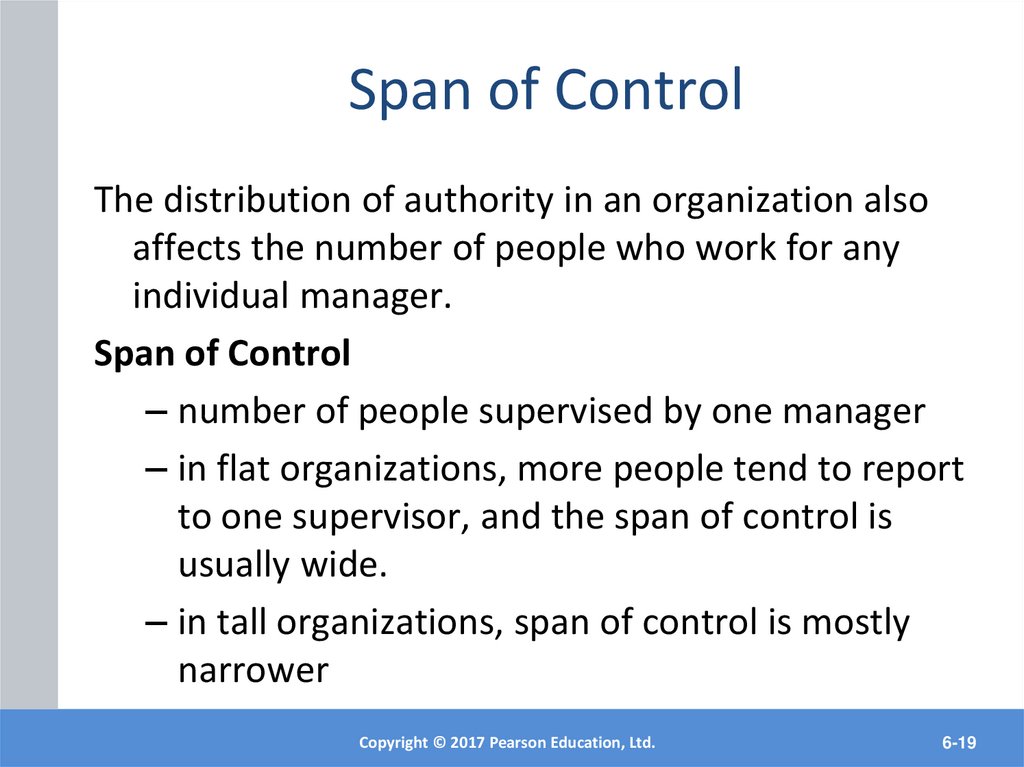
Span of ControlThe distribution of authority in an organization also
affects the number of people who work for any
individual manager.
Span of Control
– number of people supervised by one manager
– in flat organizations, more people tend to report
to one supervisor, and the span of control is
usually wide.
– in tall organizations, span of control is mostly
narrower
Copyright©
©2017
2012Pearson
PearsonEducation,
Education, Ltd.
Inc.
Copyright
Publishing as Prentice Hall
6-19
20.
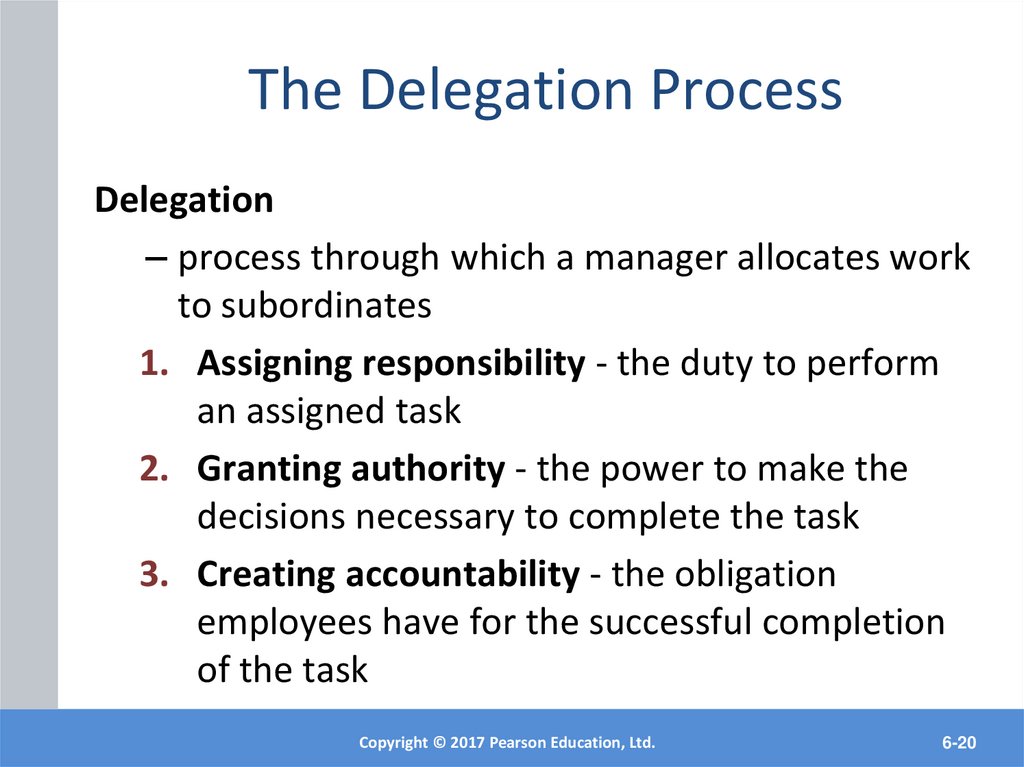
The Delegation ProcessDelegation
– process through which a manager allocates work
to subordinates
1. Assigning responsibility - the duty to perform
an assigned task
2. Granting authority - the power to make the
decisions necessary to complete the task
3. Creating accountability - the obligation
employees have for the successful completion
of the task
Copyright©
©2017
2012Pearson
PearsonEducation,
Education, Ltd.
Inc.
Copyright
Publishing as Prentice Hall
6-20
21.
Copyright©©2017
2012Pearson
PearsonEducation,
Education, Ltd.
Inc.
Copyright
Publishing as Prentice Hall
6-21
22.
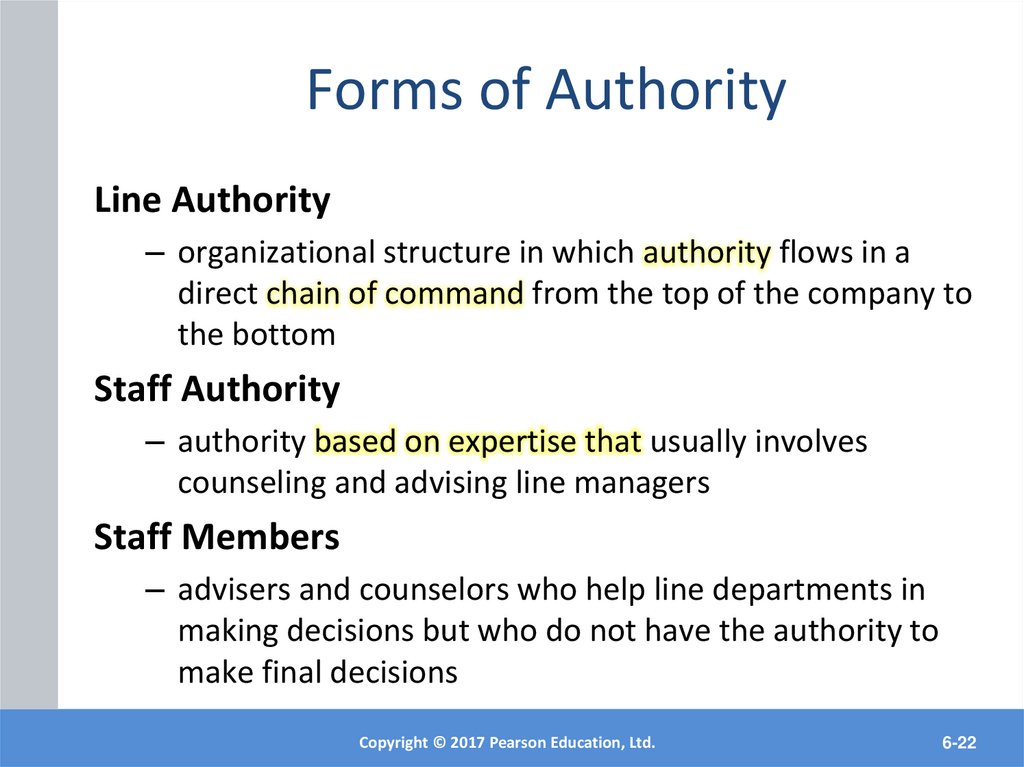
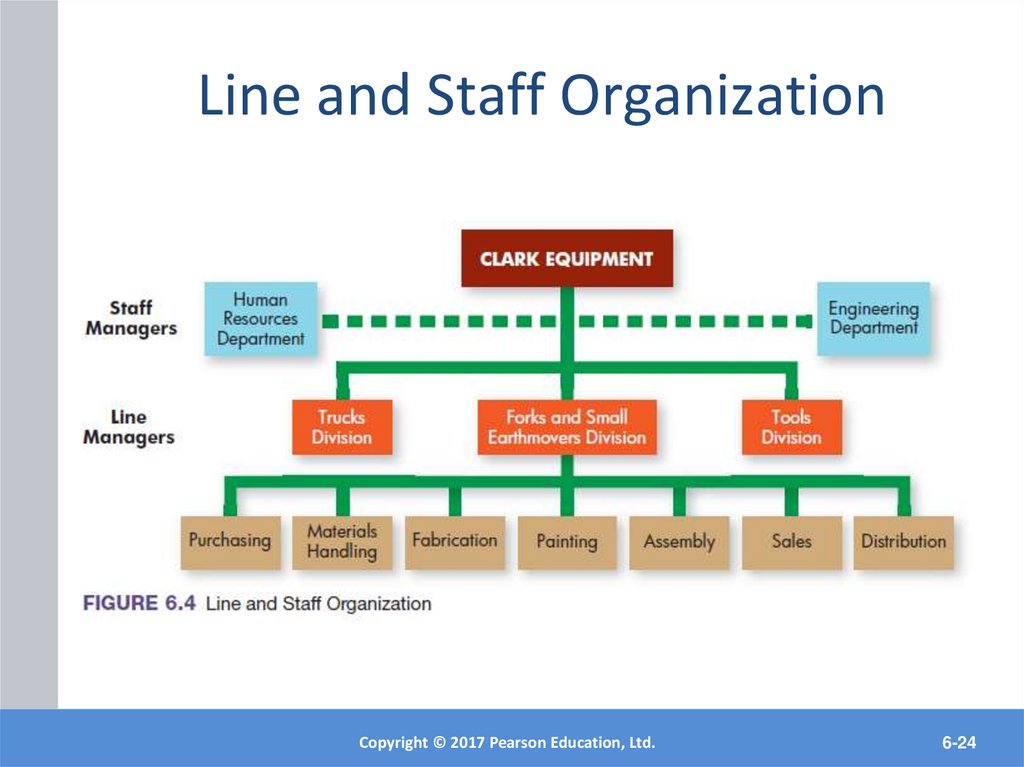
Forms of AuthorityLine Authority
– organizational structure in which authority flows in a
direct chain of command from the top of the company to
the bottom
Staff Authority
– authority based on expertise that usually involves
counseling and advising line managers
Staff Members
– advisers and counselors who help line departments in
making decisions but who do not have the authority to
make final decisions
Copyright©
©2017
2012Pearson
PearsonEducation,
Education, Ltd.
Inc.
Copyright
Publishing as Prentice Hall
6-22
23.
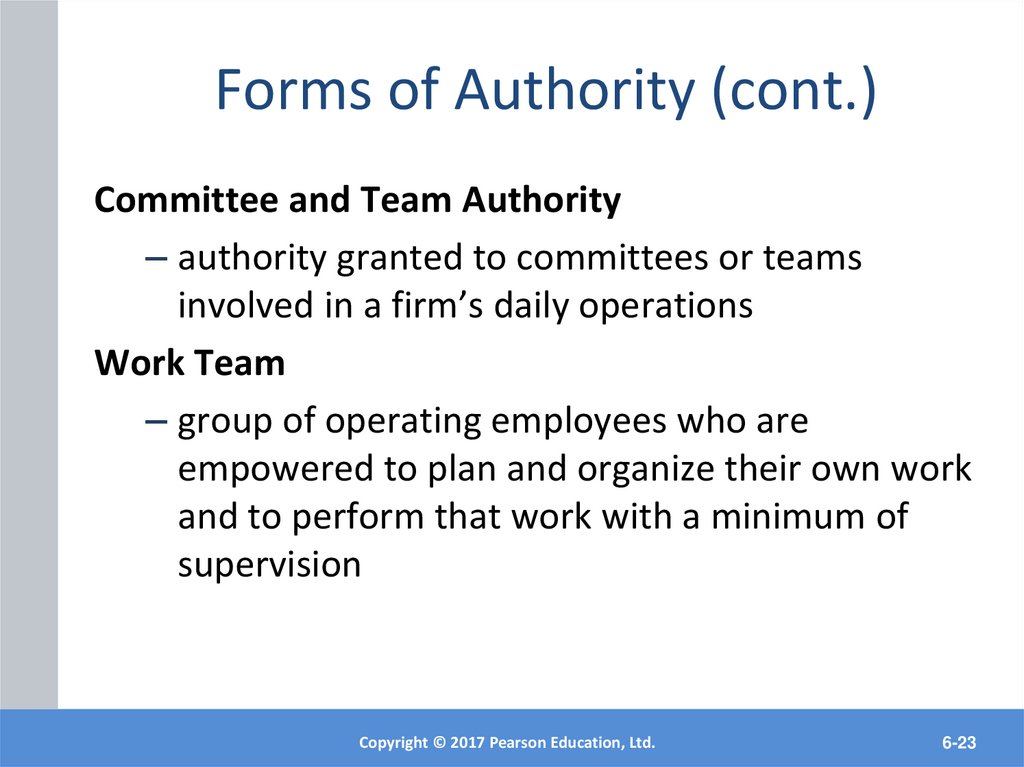
Forms of Authority (cont.)Committee and Team Authority
– authority granted to committees or teams
involved in a firm’s daily operations
Work Team
– group of operating employees who are
empowered to plan and organize their own work
and to perform that work with a minimum of
supervision
Copyright©
©2017
2012Pearson
PearsonEducation,
Education, Ltd.
Inc.
Copyright
Publishing as Prentice Hall
6-23
24.
Line and Staff OrganizationCopyright©
©2017
2012Pearson
PearsonEducation,
Education, Ltd.
Inc.
Copyright
Publishing as Prentice Hall
6-24
25.
Basic Forms of OrganizationalStructure
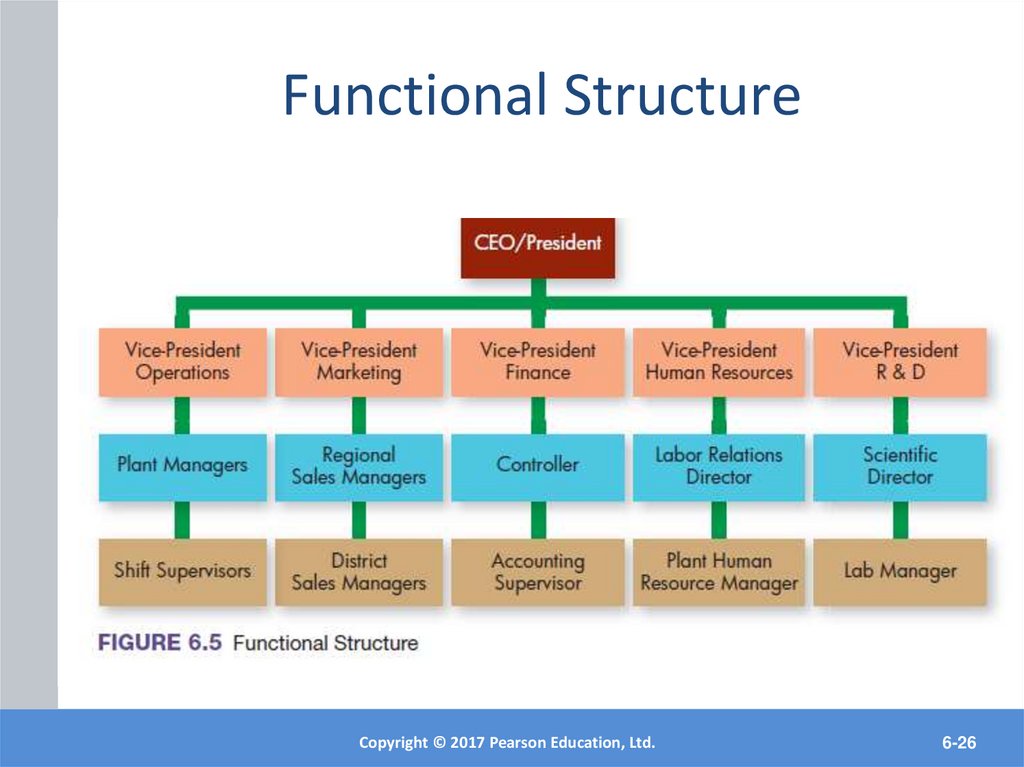
Functional Structure
– organization structure in which authority is
determined by the relationships between group
functions and activities
– used by most small to medium-sized firms
Copyright©
©2017
2012Pearson
PearsonEducation,
Education, Ltd.
Inc.
Copyright
Publishing as Prentice Hall
6-25
26.
Functional StructureCopyright©
©2017
2012Pearson
PearsonEducation,
Education, Ltd.
Inc.
Copyright
Publishing as Prentice Hall
6-26
27.
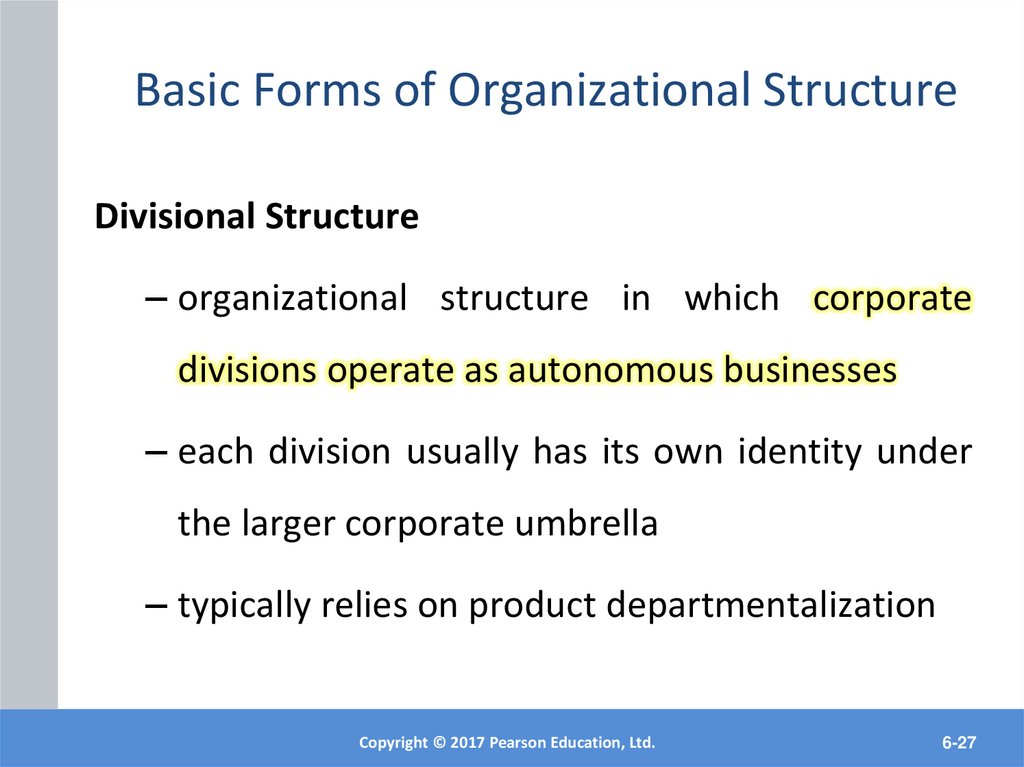
Basic Forms of Organizational StructureDivisional Structure
– organizational structure in which corporate
divisions operate as autonomous businesses
– each division usually has its own identity under
the larger corporate umbrella
– typically relies on product departmentalization
Copyright©
©2017
2012Pearson
PearsonEducation,
Education, Ltd.
Inc.
Copyright
Publishing as Prentice Hall
6-27
28.
Divisional StructureCopyright©
©2017
2012Pearson
PearsonEducation,
Education, Ltd.
Inc.
Copyright
Publishing as Prentice Hall
6-28
29.
Basic Forms of Organizational StructureMatrix Structure
– organizational structure created by superimposing one form
of structure onto another
– highly flexible
– pioneered by NASA for use in developing space programs
In some companies, the matrix organization is a temporary
measure installed to complete a specific project and affecting
only one part of the firm
Copyright©
©2017
2012Pearson
PearsonEducation,
Education, Ltd.
Inc.
Copyright
Publishing as Prentice Hall
6-29
30.
Copyright©©2017
2012Pearson
PearsonEducation,
Education, Ltd.
Inc.
Copyright
Publishing as Prentice Hall
6-30
31.
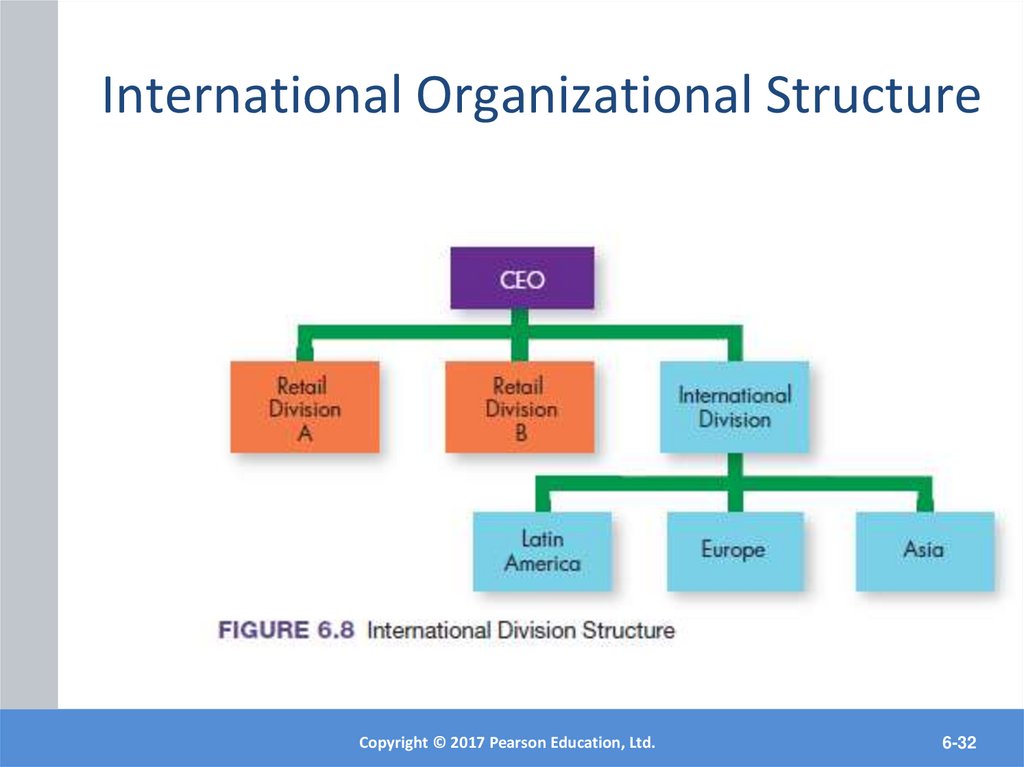
Basic Forms of Organizational StructureInternational Organizational Structures
– approaches to organizational structure
developed in response to the need to
manufacture, purchase, and sell in global
markets
Copyright©
©2017
2012Pearson
PearsonEducation,
Education, Ltd.
Inc.
Copyright
Publishing as Prentice Hall
6-31
32.
International Organizational StructureCopyright©
©2017
2012Pearson
PearsonEducation,
Education, Ltd.
Inc.
Copyright
Publishing as Prentice Hall
6-32
33.
Organizational Design for the TwentyFirst CenturyTeam organization
– relies almost exclusively on project-type teams,
with little or no underlying functional hierarchy
– team authority is the underlying foundation for
this structure
Copyright©
©2017
2012Pearson
PearsonEducation,
Education, Ltd.
Inc.
Copyright
Publishing as Prentice Hall
6-33
34.
Organizational Design for the TwentyFirst CenturyLearning organization
– works to facilitate the lifelong learning and
personal development of all of its employees
while continually transforming itself to respond
to changing demands and needs
– aims to achieve continuous improvement with
employee learning and development
Copyright©
©2017
2012Pearson
PearsonEducation,
Education, Ltd.
Inc.
Copyright
Publishing as Prentice Hall
6-34
35.
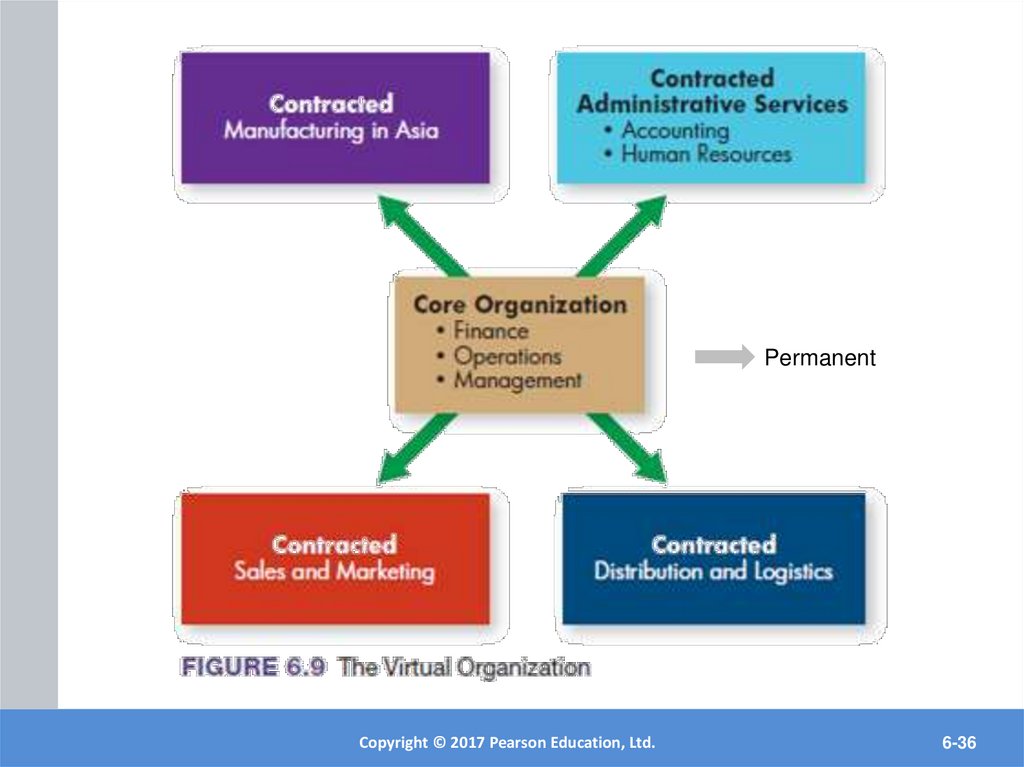
Organizational Design for the TwentyFirst Century (cont.)Virtual organization
– related to team organization
– has little or no formal structure, organization
exists only in response to its own needs
– has only a handful of permanent employees, a
very small staff, and a modest administrative
facility
– when necessary, managers might bring in
temporary workers, lease facilities, and
“outsource” basic support services
Copyright©
©2017
2012Pearson
PearsonEducation,
Education, Ltd.
Inc.
Copyright
Publishing as Prentice Hall
6-35
36.
PermanentCopyright©
©2017
2012Pearson
PearsonEducation,
Education, Ltd.
Inc.
Copyright
Publishing as Prentice Hall
6-36
37.
Informal OrganizationInformal Organization
– network, unrelated to the firm’s formal
authority structure, of everyday social
interactions among company employees
Informal groups
– groups of people who decide to interact among
themselves (during breaks, lunch, after work, ..)
Copyright©
©2017
2012Pearson
PearsonEducation,
Education, Ltd.
Inc.
Copyright
Publishing as Prentice Hall
6-37
38.
Organizational GrapevineGrapevine
– informal communication network that runs
through an organization
– prior research has identified two types of
grapevine: gossip chain (1->1) or cluster chain
(1->n)
– by maintaining open channels of communication
and responding vigorously to inaccurate
information, managers can minimize the
damage the grapevine can cause.
Copyright©
©2017
2012Pearson
PearsonEducation,
Education, Ltd.
Inc.
Copyright
Publishing as Prentice Hall
6-38
39.
IntrapreneuringIntrapreneuring
– process of creating and maintaining the
innovation and flexibility of a small-business
environment within the confines of a large
organization
– the idea is to innovate just as having the
flexibility of a small-business environment within
a large, bureaucratic structure
Copyright©
©2017
2012Pearson
PearsonEducation,
Education, Ltd.
Inc.
Copyright
Publishing as Prentice Hall
6-39
40.
Applying What You’ve Learned1. Discuss the factors that influence a firm’s
organizational structure.
2. Explain specialization and departmentalization as
two of the building blocks of organizational
structure.
3. Describe centralization and decentralization,
delegation, and authority as the key ingredients in
establishing the decision-making hierarchy.
Copyright©
©2017
2012Pearson
PearsonEducation,
Education, Ltd.
Inc.
Copyright
Publishing as Prentice Hall
6-40
41.
Applying What You’ve Learned (cont.)4. Explain the differences among functional,
divisional, matrix, and international organizational
structures and describe the most popular new
forms of organizational design.
5. Describe the informal organization and discuss
intrapreneuring.
Copyright©
©2017
2012Pearson
PearsonEducation,
Education, Ltd.
Inc.
Copyright
Publishing as Prentice Hall
6-41