 Английский язык
Похожие презентации:


Idioms “Brainwash”
1. Idioms
“Brainwash”2. Defenition
Phraseological units, or idioms, as theyare called by most western scholars,
represent what can probably be described
as the most picturesque, colourful and
expressive part of the language's
vocabulary.
3. Classifications
“Thematic” (Smith)Vinogradov's classification system
The structural principle of classifying
Smirnitsky’s classification
Koonin’s classification
4. “Thematic” (Smith)
The traditional and oldest principle for classifying phraseologicalunits is based on their original content and might be alluded to as
"thematic" (although the term is not universally accepted). The
approach is widely used in numerous English and American guides to
idiom, phrase books, etc. On this principle, idioms are classified
according to their sources of origin, "source" referring to the
particular sphere of human activity, of life of nature, of natural
phenomena, etc. So, L. P. Smith gives in his classification groups of
idioms used by sailors, fishermen, soldiers, hunters and associated
with the realia, phenomena and conditions of their occupations. In
Smith's classification we also find groups of idioms associated with
domestic and wild animals and birds, agriculture and cooking. There
are also numerous idioms drawn from sports, arts, etc.
5. Vinogradov's classification system
Vinogradov's classificationsystem
Vinogradov's classification system is founded on the
degree of semantic cohesion between the components of a
phraseological unit. Units with a partially transferred
meaning show the weakest cohesion between their
components. The more distant the meaning of a
phraseological unit from the current meaning of its
constituent parts, the greater is its degree of semantic
cohesion.
6. Vinogradov's classification system
Vinogradov's classificationsystem
Phraseological combinations are word-groups with a partially changed
meaning. They may be said to be clearly motivated, that is, the meaning of
the unit can be easily deduced from the meanings of its constituents. (to be at
one's wits' end, to be good at something, to be a good hand at something, to
have a bite, to come off a poor second)
Phraseological unities are word-groups with a completely changed meaning,
that is, the meaning of the unit does not correspond to the meanings of its
constituent parts. (to stick to one's guns (~ to be true to one's views or
convictions. The image is that of a gunner or guncrew who do not desert their
guns even if a battle seems lost); to sit on the fence (~ in discussion, politics,
etc. refrain from committing oneself to either side )
Phraseological fusions are word-groups with a completely changed meaning
but, in contrast to the unities, they are demotivated, that is, their meaning
cannot be deduced from the meanings of the constituent parts; the metaphor,
on which the shift of meaning was based, has lost its clarity and is obscure.
(to come a cropper (to come to disaster); neck and crop (entirely, altogether,
thoroughly, )
7. The structural principle of classifying
Verbal. E. g. to run for one's (dear) life, to get (win) the upper hand, to talkthrough one's hat, to make a song and dance about something.
Substantive. E. g. dog's life, cat-and-dog life, calf love, white lie, tall order,
birds of a feather, birds of passage, red tape, brown study.
Adjectival. E. g. high and mighty, spick and span, brand new, safe and
sound.
Adverbial. E. g. high and low (as in They searched for him high and low), by
hook or by crook (as in She decided that, by hook or by crook, she must
marry him), for love or money (as in He came to the conclusion that a really
good job couldn't be found for love or money).
Interjectional. E. g. my God/ by Jove! by George! goodness gracious! good
Heavens! sakes alive!
8. Smirnitsky’s classification
Professor Smirnitsky offered a classification system for Englishphraseological units which is interesting as an attempt to
combine the structural and the semantic principles.
Phraseological units in this classification system are grouped
according to the number and semantic significance of their
constituent parts. Accordingly two large groups are established:
A. one-summit units, which have one meaningful constituent
(e. g. to give up, to make out, to pull out, to be tired, to be
surprised1);
B. two-summit and multi-summit units which have two or
more meaningful constituents (e. g. black art, first night,
common sense, to fish in troubled waters).
9. Koonin’s classification
The classification system of phraseological unitssuggested by Professor A. V. Koonin is the latest outstanding achievement in the Russian theory of
phraseology. The classification is based on the
combined structural-semantic principle and it also
considers the quotient of stability of phraseological
units.
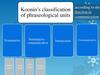
Phraseological units are subdivided into the following
four classes according to their function in
communication determined by their structuralsemantic characteristics.
10. Koonin’s classification
Nominative phraseological units are represented by word-groups,including the ones with one meaningful word, and coordinative
phrases of the type wear and tear, well and good.
The first class also includes word-groups with a predicative structure,
such as as the crow flies, and, also, predicative phrases of the type see
how the land lies, ships that pass in the night.
Nominative-communicative phraseological units include word-groups
of the type to break the ice — the ice is broken, that is, verbal wordgroups which are transformed into a sentence when the verb is used in
the Passive Voice.
Phraseological units which are neither nominative nor communicative
include interjectional word-groups.
Communicative phraseological units are represented by proverbs and
sayings.
11. Internet Resources
www.wikipedia.orgwww.english-test.net (Endlish idioms and
tests on this topic)
www.usenglish.com (a dictionary of 2089
English idioms)
www.english-at-home.com (thematic
classification of idioms)
12. Internet Resources
www.eslgold.com/idioms/teaching_idioms.htm(general idioms, phrasal verbs, slang and
expressions, proverbs and sayings; tests)
www.english_Zone.com
www.learn-english-today.com/idioms