 Английский язык
Похожие презентации:





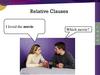


Relative clauses – это определительные придаточные предложения
1.
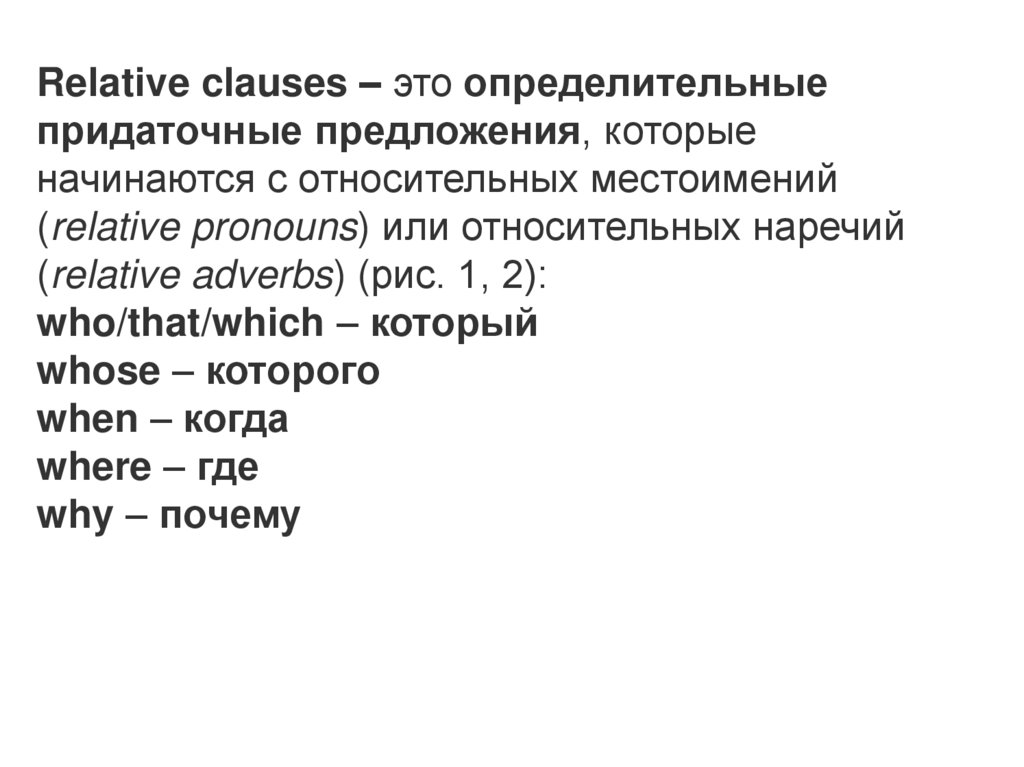
Relative clauses – это определительныепридаточные предложения, которые
начинаются с относительных местоимений
(relative pronouns) или относительных наречий
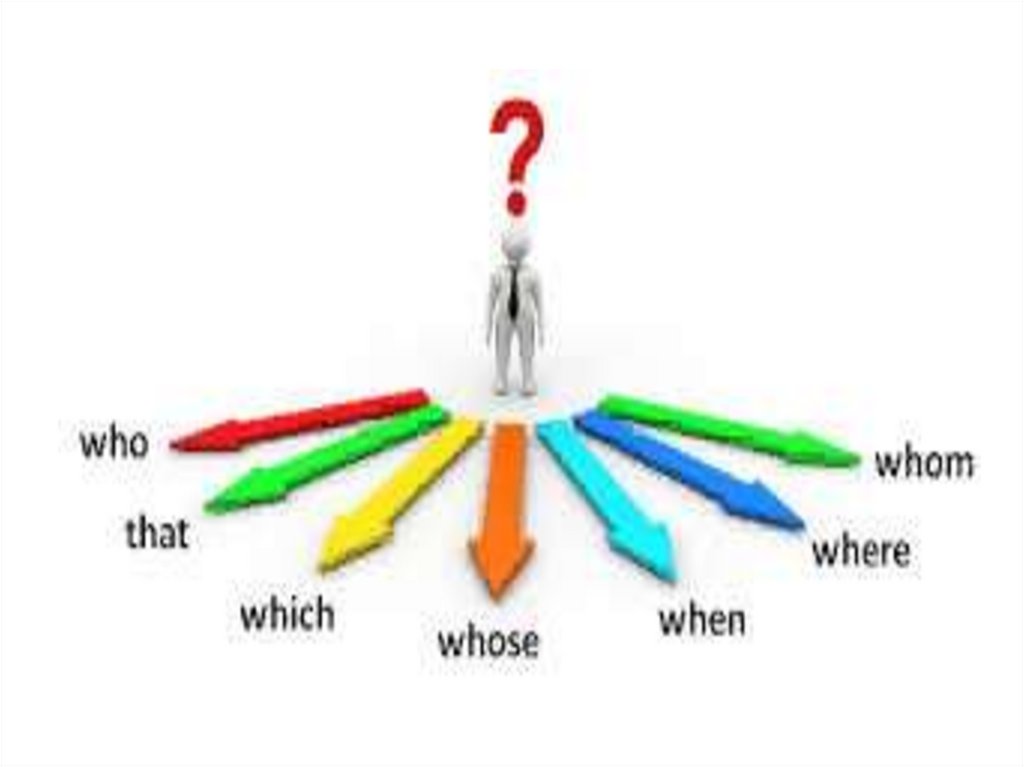
(relative adverbs) (рис. 1, 2):
who/that/which – который
whose – которого
when – когда
where – где
why – почему
2.
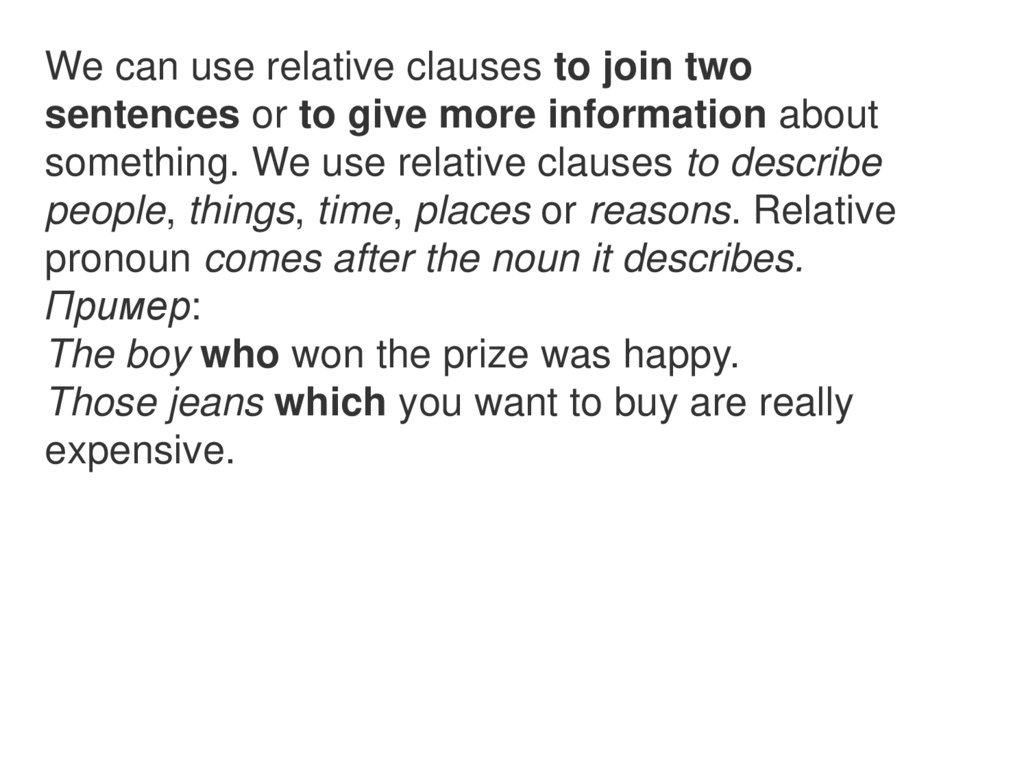
We can use relative clauses to join twosentences or to give more information about
something. We use relative clauses to describe
people, things, time, places or reasons. Relative
pronoun comes after the noun it describes.
Пример:
The boy who won the prize was happy.
Those jeans which you want to buy are really
expensive.
3.
4.
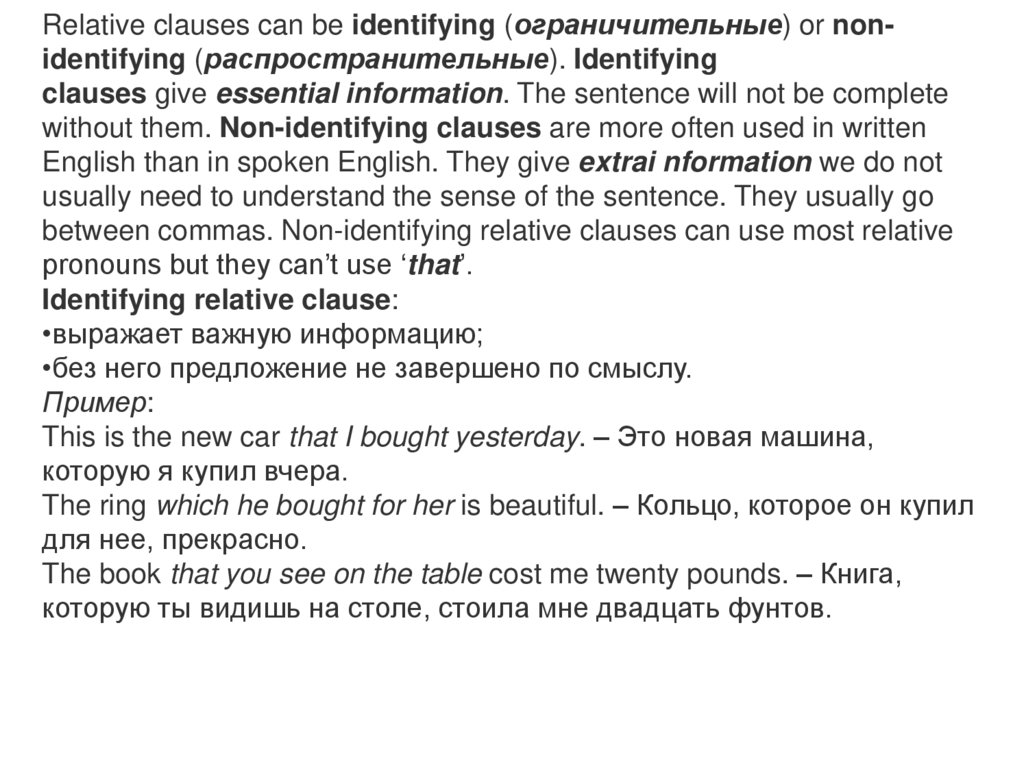
Relative clauses can be identifying (ограничительные) or nonidentifying (распространительные). Identifyingclauses give essential information. The sentence will not be complete
without them. Non-identifying clauses are more often used in written
English than in spoken English. They give extrai nformation we do not
usually need to understand the sense of the sentence. They usually go
between commas. Non-identifying relative clauses can use most relative
pronouns but they can’t use ‘that’.
Identifying relative clause:
•выражает важную информацию;
•без него предложение не завершено по смыслу.
Пример:
This is the new car that I bought yesterday. – Это новая машина,
которую я купил вчера.
The ring which he bought for her is beautiful. – Кольцо, которое он купил
для нее, прекрасно.
The book that you see on the table cost me twenty pounds. – Книга,
которую ты видишь на столе, стоила мне двадцать фунтов.
5.
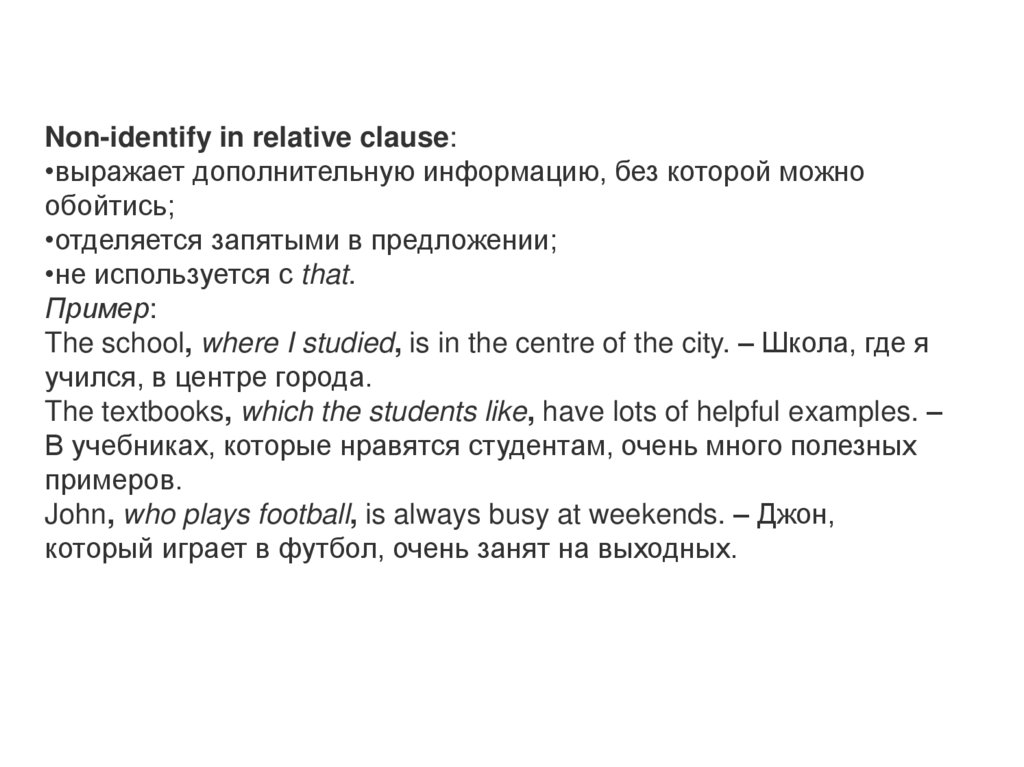
Non-identify in relative clause:•выражает дополнительную информацию, без которой можно
обойтись;
•отделяется запятыми в предложении;
•не используется с that.
Пример:
The school, where I studied, is in the centre of the city. – Школа, где я
учился, в центре города.
The textbooks, which the students like, have lots of helpful examples. –
В учебниках, которые нравятся студентам, очень много полезных
примеров.
John, who plays football, is always busy at weekends. – Джон,
который играет в футбол, очень занят на выходных.
6.
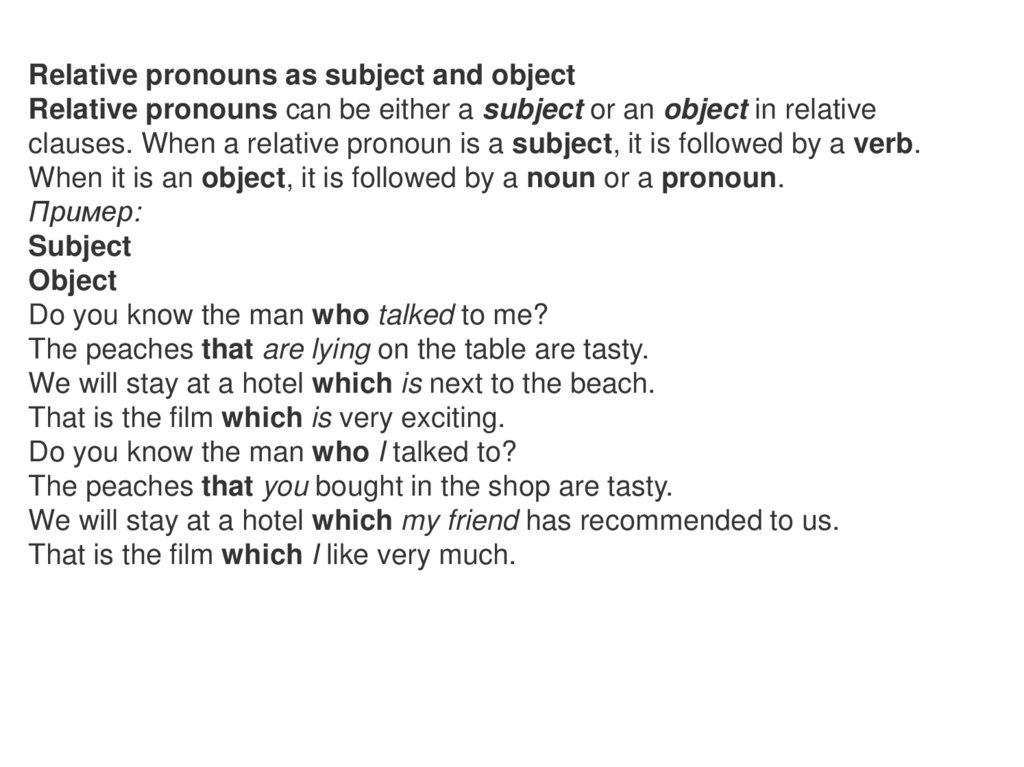
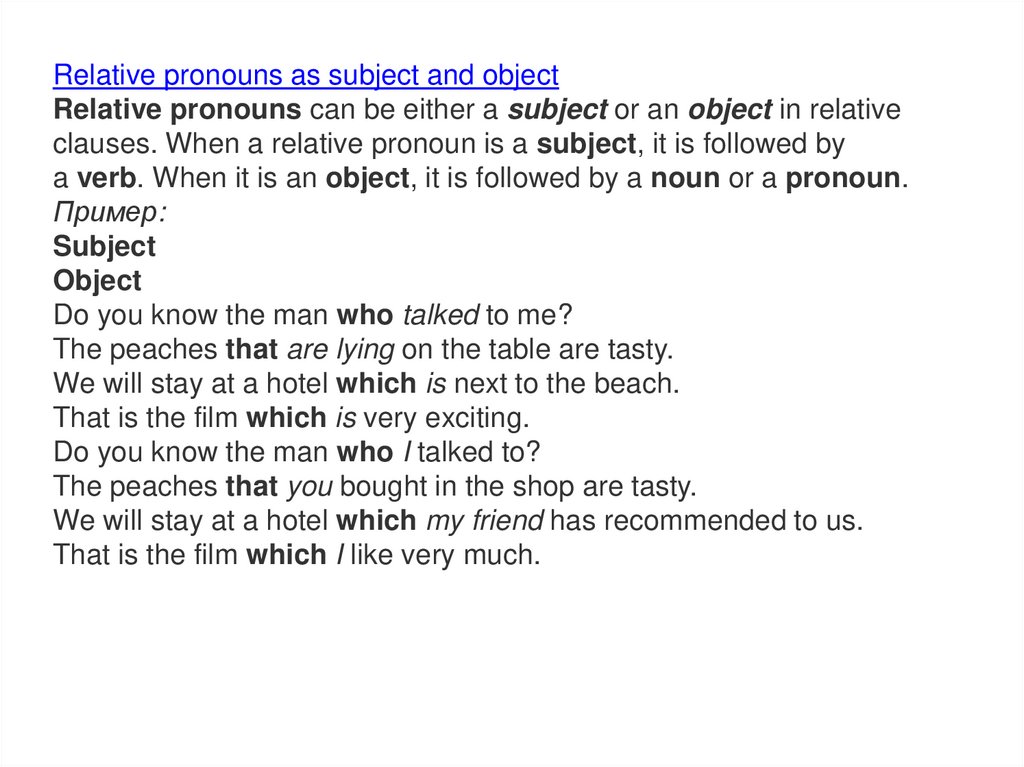
Relative pronouns as subject and objectRelative pronouns can be either a subject or an object in relative
clauses. When a relative pronoun is a subject, it is followed by a verb.
When it is an object, it is followed by a noun or a pronoun.
Пример:
Subject
Object
Do you know the man who talked to me?
The peaches that are lying on the table are tasty.
We will stay at a hotel which is next to the beach.
That is the film which is very exciting.
Do you know the man who I talked to?
The peaches that you bought in the shop are tasty.
We will stay at a hotel which my friend has recommended to us.
That is the film which I like very much.
7.
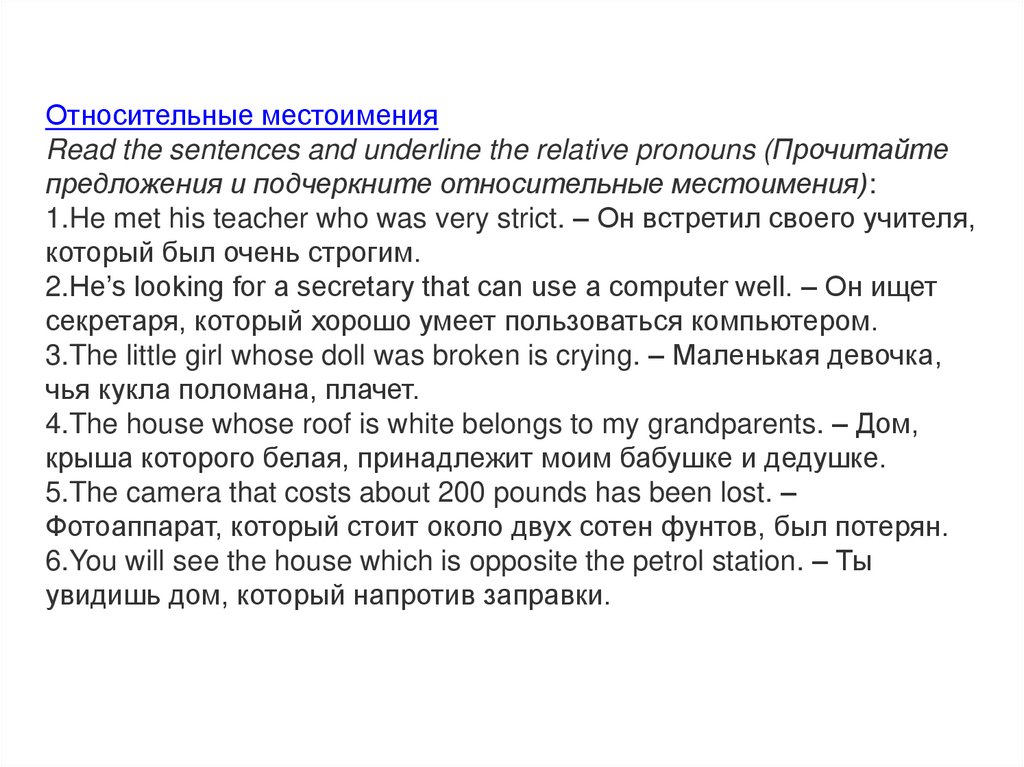
Относительные местоименияRead the sentences and underline the relative pronouns (Прочитайте
предложения и подчеркните относительные местоимения):
1.He met his teacher who was very strict. – Он встретил своего учителя,
который был очень строгим.
2.He’s looking for a secretary that can use a computer well. – Он ищет
секретаря, который хорошо умеет пользоваться компьютером.
3.The little girl whose doll was broken is crying. – Маленькая девочка,
чья кукла поломана, плачет.
4.The house whose roof is white belongs to my grandparents. – Дом,
крыша которого белая, принадлежит моим бабушке и дедушке.
5.The camera that costs about 200 pounds has been lost. –
Фотоаппарат, который стоит около двух сотен фунтов, был потерян.
6.You will see the house which is opposite the petrol station. – Ты
увидишь дом, который напротив заправки.
8.
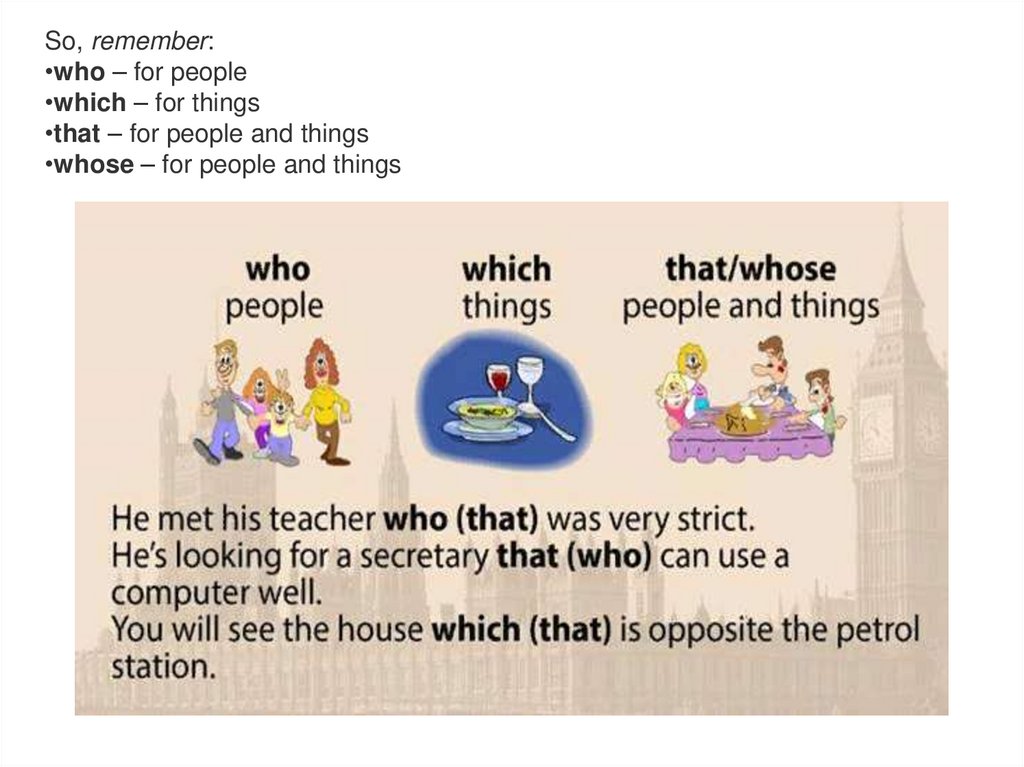
So, remember:•who – for people
•which – for things
•that – for people and things
•whose – for people and things
9.
Relative pronouns as subject and objectRelative pronouns can be either a subject or an object in relative
clauses. When a relative pronoun is a subject, it is followed by
a verb. When it is an object, it is followed by a noun or a pronoun.
Пример:
Subject
Object
Do you know the man who talked to me?
The peaches that are lying on the table are tasty.
We will stay at a hotel which is next to the beach.
That is the film which is very exciting.
Do you know the man who I talked to?
The peaches that you bought in the shop are tasty.
We will stay at a hotel which my friend has recommended to us.
That is the film which I like very much.
10.
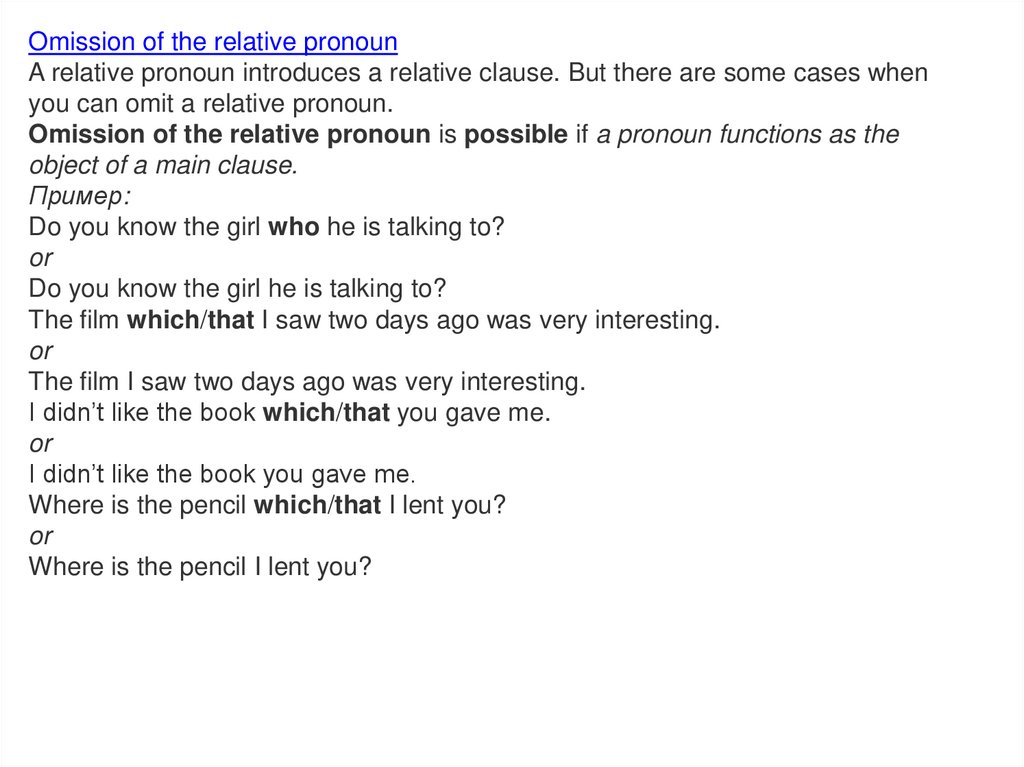
Omission of the relative pronounA relative pronoun introduces a relative clause. But there are some cases when
you can omit a relative pronoun.
Omission of the relative pronoun is possible if a pronoun functions as the
object of a main clause.
Пример:
Do you know the girl who he is talking to?
or
Do you know the girl he is talking to?
The film which/that I saw two days ago was very interesting.
or
The film I saw two days ago was very interesting.
I didn’t like the book which/that you gave me.
or
I didn’t like the book you gave me.
Where is the pencil which/that I lent you?
or
Where is the pencil I lent you?
11.
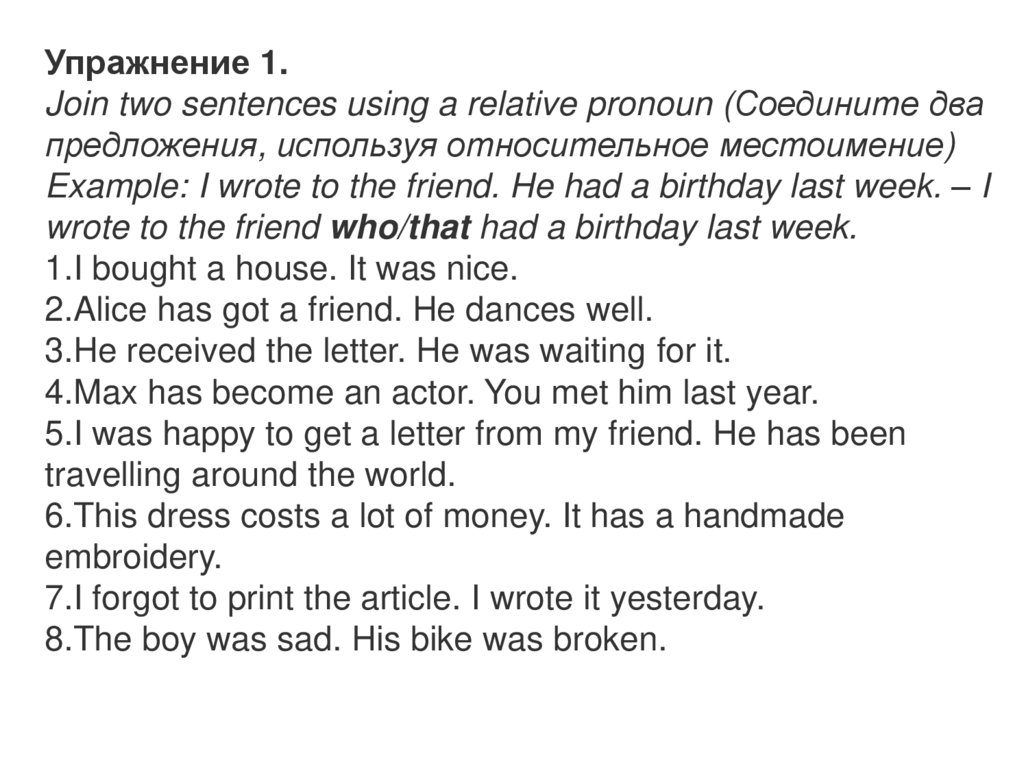
Упражнение 1.Join two sentences using a relative pronoun (Соедините два
предложения, используя относительное местоимение)
Example: I wrote to the friend. He had a birthday last week. – I
wrote to the friend who/that had a birthday last week.
1.I bought a house. It was nice.
2.Alice has got a friend. He dances well.
3.He received the letter. He was waiting for it.
4.Max has become an actor. You met him last year.
5.I was happy to get a letter from my friend. He has been
travelling around the world.
6.This dress costs a lot of money. It has a handmade
embroidery.
7.I forgot to print the article. I wrote it yesterday.
8.The boy was sad. His bike was broken.
12.
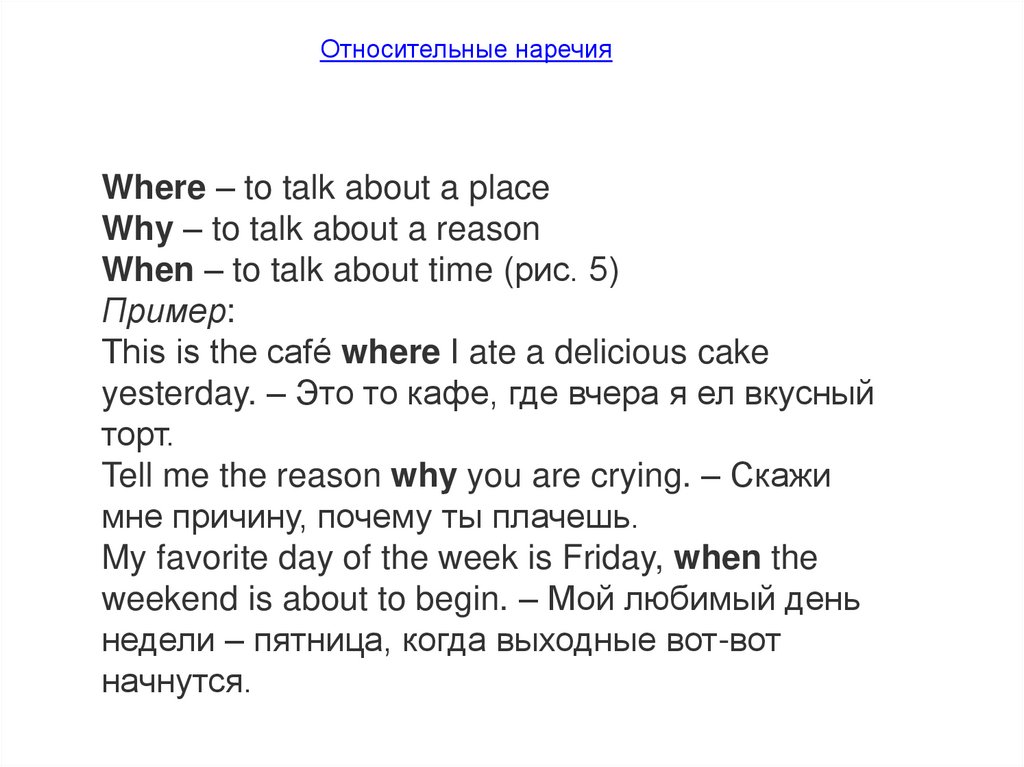
Относительные наречияWhere – to talk about a place
Why – to talk about a reason
When – to talk about time (рис. 5)
Пример:
This is the café where I ate a delicious cake
yesterday. – Это то кафе, где вчера я ел вкусный
торт.
Tell me the reason why you are crying. – Скажи
мне причину, почему ты плачешь.
My favorite day of the week is Friday, when the
weekend is about to begin. – Мой любимый день
недели – пятница, когда выходные вот-вот
начнутся.
13.
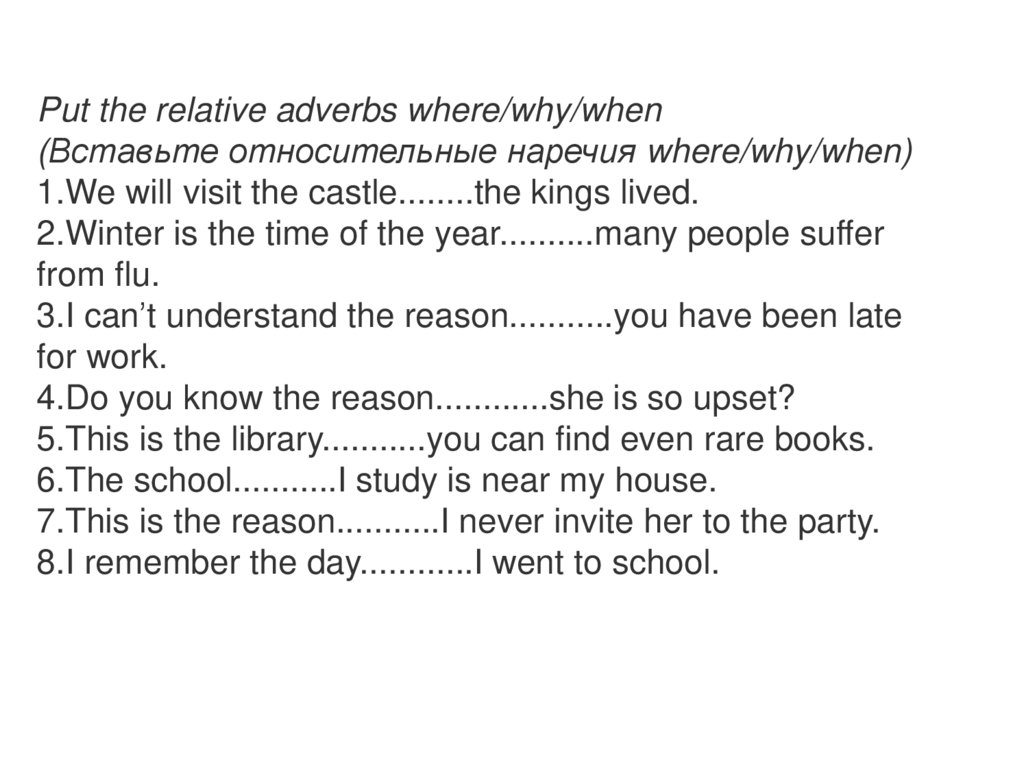
Put the relative adverbs where/why/when(Вставьте относительные наречия where/why/when)
1.We will visit the castle........the kings lived.
2.Winter is the time of the year..........many people suffer
from flu.
3.I can’t understand the reason...........you have been late
for work.
4.Do you know the reason............she is so upset?
5.This is the library...........you can find even rare books.
6.The school...........I study is near my house.
7.This is the reason...........I never invite her to the party.
8.I remember the day............I went to school.
14.
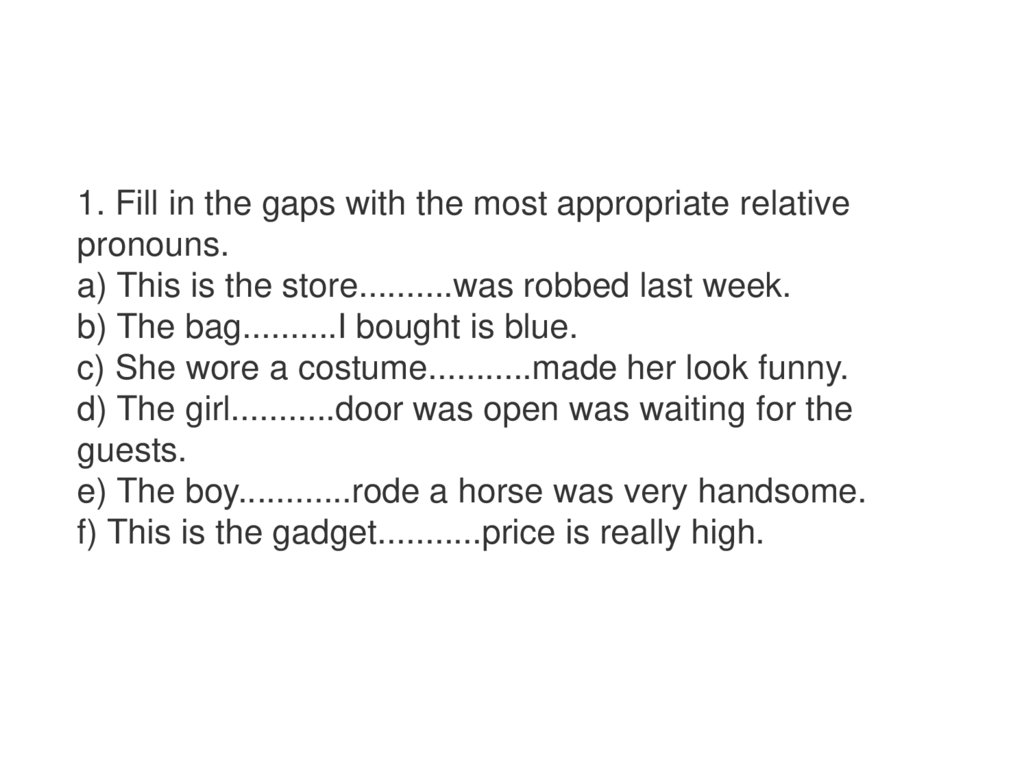
1. Fill in the gaps with the most appropriate relativepronouns.
a) This is the store..........was robbed last week.
b) The bag..........I bought is blue.
c) She wore a costume...........made her look funny.
d) The girl...........door was open was waiting for the
guests.
e) The boy............rode a horse was very handsome.
f) This is the gadget...........price is really high.
15.
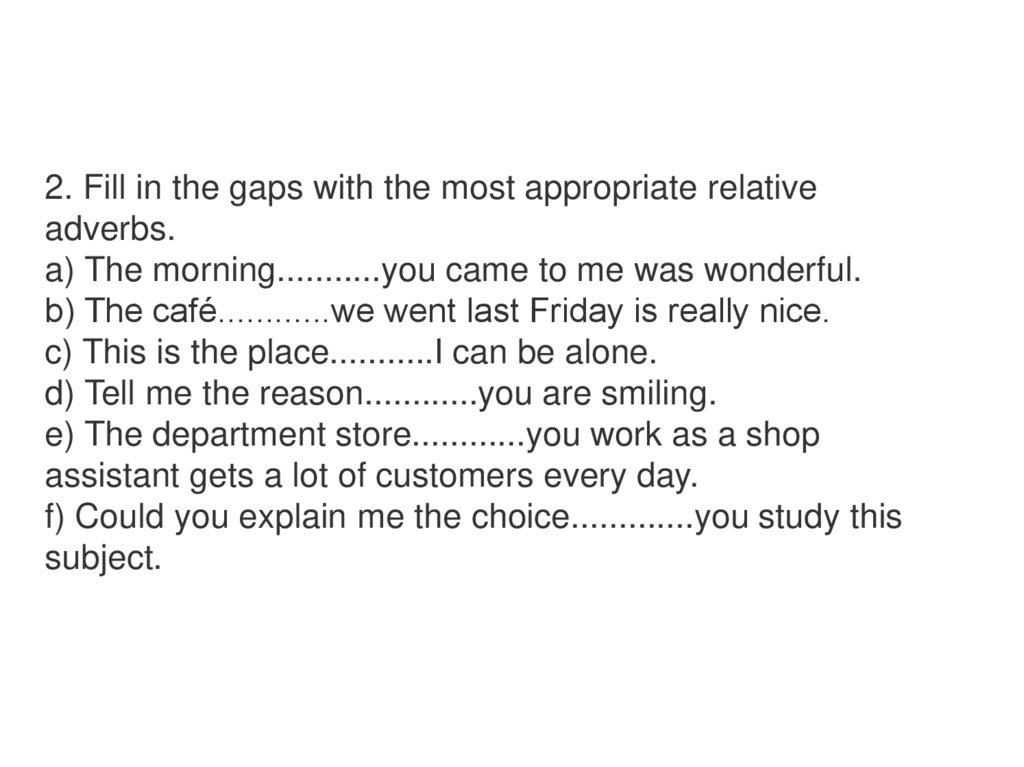
2. Fill in the gaps with the most appropriate relativeadverbs.
a) The morning...........you came to me was wonderful.
b) The café............we went last Friday is really nice.
c) This is the place...........I can be alone.
d) Tell me the reason............you are smiling.
e) The department store............you work as a shop
assistant gets a lot of customers every day.
f) Could you explain me the choice.............you study this
subject.
16.
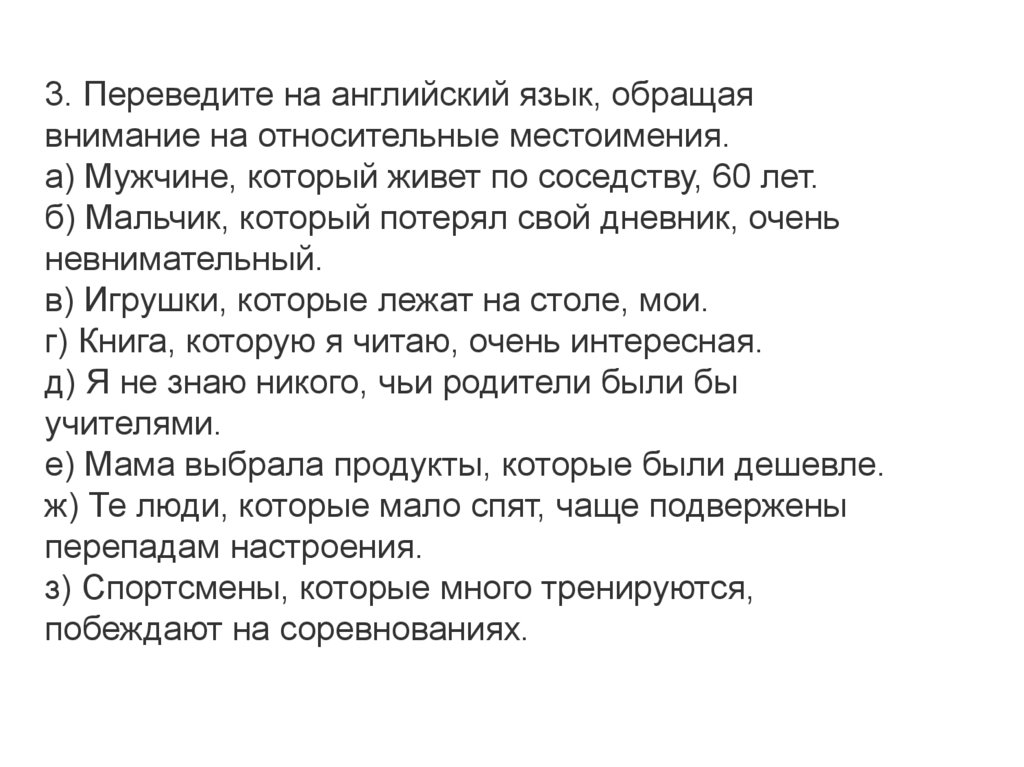
3. Переведите на английский язык, обращаявнимание на относительные местоимения.
а) Мужчине, который живет по соседству, 60 лет.
б) Мальчик, который потерял свой дневник, очень
невнимательный.
в) Игрушки, которые лежат на столе, мои.
г) Книга, которую я читаю, очень интересная.
д) Я не знаю никого, чьи родители были бы
учителями.
е) Мама выбрала продукты, которые были дешевле.
ж) Те люди, которые мало спят, чаще подвержены
перепадам настроения.
з) Спортсмены, которые много тренируются,
побеждают на соревнованиях.