

 Социология
Похожие презентации:







Introduction to intercultural communication
1.
INTRODUCTION TO INTERCULTURALCOMMUNICATION
2.
Prof. Yana Aleksandrovna Volkovavolkova-yaa@rudn.ru
This syllabus is subject to change throughout the semester. Sometimes we
need more or less time on a particular topic, and the lecturer reserves the
right to make changes to assignment deadlines and required readings. All
such changes will be communicated via email and in class.
Course Description: This is a combination of theoretical and practical
course on intercultural communication. It is designed to help you
understand how to communicate with people who are different from you.
We live in a global environment where individuals from diverse cultures
interact both face to face and online. You will examine your own cultural
identities and your interactions with others. Taking a communicative lens,
we will address how various cultural indicators (values, beliefs, traditions,
etc.) manifest through communication and how cultures use
communication in different ways. Through this course, I hope to broaden
your perspectives of live and people, and to build your capacity to adapt to a
changing world by exploring cultural and communication differences.
Intercultural communication is the study of communication patterns and
norms of diverse groups (both internal to Russia and in comparison with
members of other nations/cultures outside Russia). Students learn these
norms in order to appreciate and appropriately communicate with diverse
others.
3.
Class PoliciesAttendance: Because this course depends on your presence and
participation for its success, attendance is required. Excused
absences are only granted for personal emergencies (that are
accompanied by proper documentation). Meetings for other
classes, appointments with advisors, work excuses, sleeping
through alarm clocks, departure for breaks, roommate crises, car
failures, and computer/printer problems, etc. are not considered
“excused” absences.
Cultural Research Paper (Project)
In a 10-12 page paper, you will have to conduct an analysis of one
of the questions on your choice. Your paper will be graded on the
depth of your analysis and your class presentation.
4.
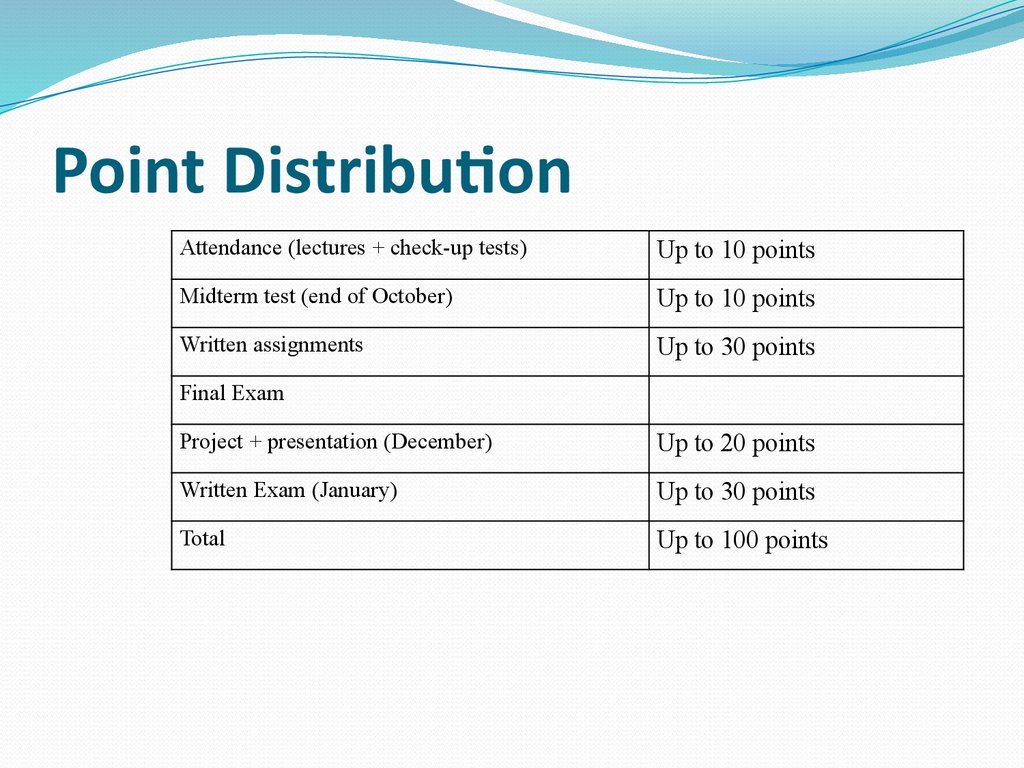
Point DistributionAttendance (lectures + check-up tests)
Up to 10 points
Midterm test (end of October)
Up to 10 points
Written assignments
Up to 30 points
Final Exam
Project + presentation (December)
Up to 20 points
Written Exam (January)
Up to 30 points
Total
Up to 100 points
5.
INTRODUCTION TO INTERCULTURALCOMMUNICATION
DEFINING CULTURE
6.
We live in an era whereintercultural communication
skills are not just an asset; they
are a requirement.
(Edwin R. McDaniel, Larry A. Samovar,
Richard E. Porter)
7.
Practical reasons for studyingintercultural communication
global and domestic diversity trends
interpersonal communication opportunities: “you may
not plan to travel the world, but the world is travelling
to you”
(Steven A. Beebe & Mark V. Redmond)
8.
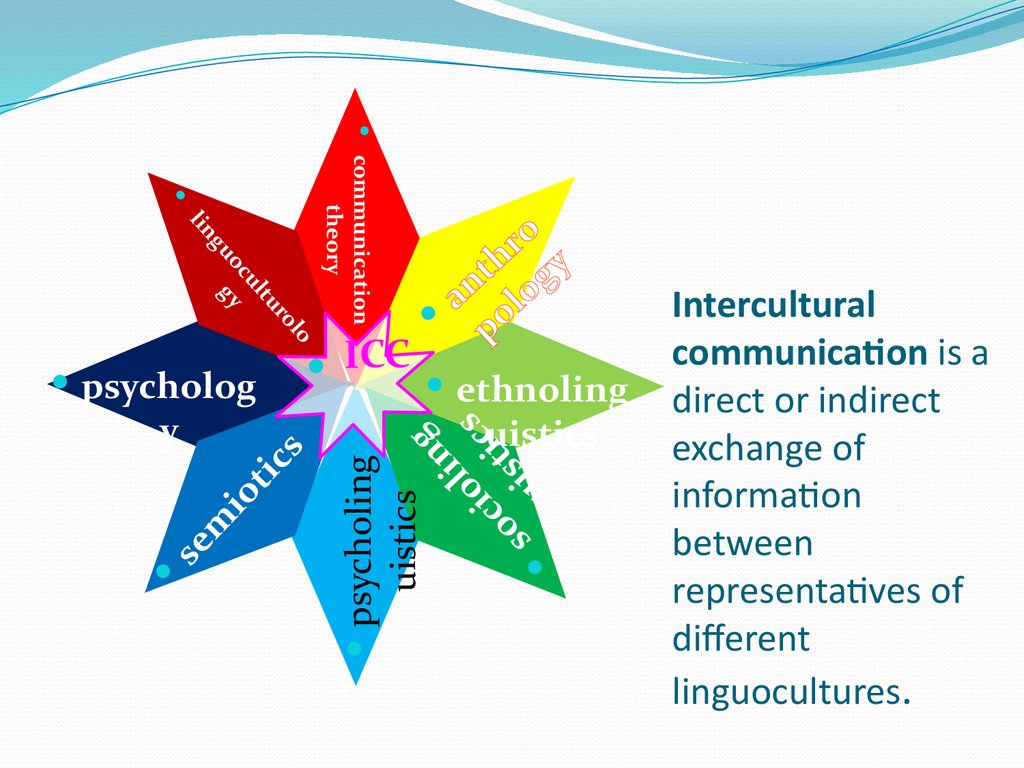
lro
tu
ul
oc y
gu g
lin
communication
theory
o
r
h gy
t
n lo
a
po
ethnoling
uistics
g
n
i
l
o ics
i
c t
o
s
s
i
u
se
m
io
t
ic
s
y
uistics
psycholog
psycholing
o
ICC
Intercultural
communication is a
direct or indirect
exchange of
information
between
representatives of
different
linguocultures.
9.
CULTURE - from Latin colo – colui – cultum - colere"to tend, guard; to till, cultivate"
Culture is the collective programming of the
mind which distinguishes the members of one
category of people from another.
(G. Hofstede)
10.
Culture: learned and shared human patterns ormodels for living; day- to-day living patterns. these
patterns and models pervade all aspects of human
social interaction. Culture is mankind's primary
adaptive mechanism.
(L. Damen )
Culture...consists in those patterns relative to
behavior and the products of human action which
may be inherited, that is, passed on from generation
to generation independently of the biological genes.
(T. Parson )
11.
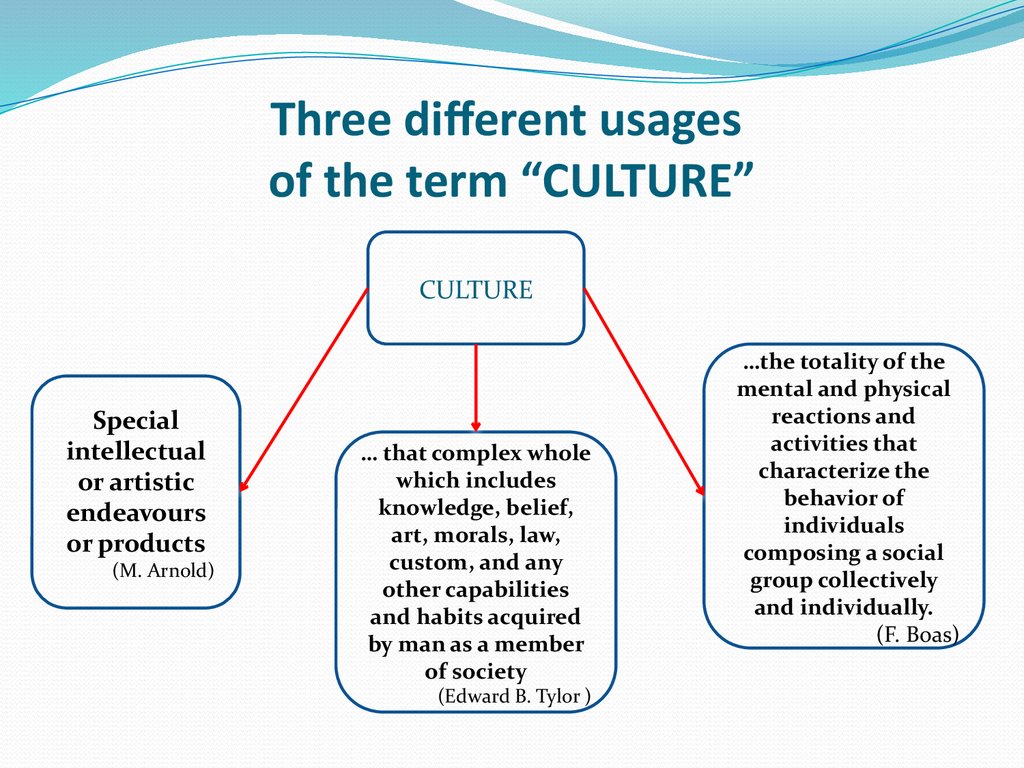
Three different usagesof the term “CULTURE”
CULTURE
Special
intellectual
or artistic
endeavours
or products
(M. Arnold)
… that complex whole
which includes
knowledge, belief,
art, morals, law,
custom, and any
other capabilities
and habits acquired
by man as a member
of society
(Edward B. Tylor )
…the totality of the
mental and physical
reactions and
activities that
characterize the
behavior of
individuals
composing a social
group collectively
and individually.
(F. Boas)
12.
CULTURE1) a pattern of shared symbols, meanings,
premises, and rules,
which are
2) socially constructed
and
3) historically transmitted.
13.
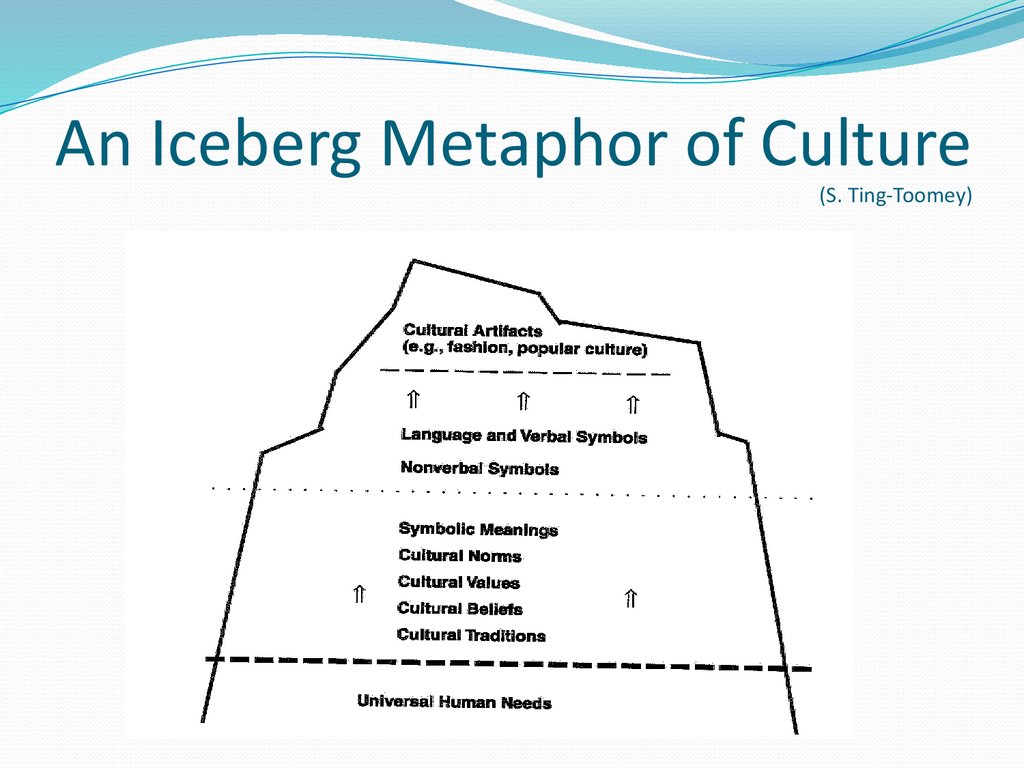
An Iceberg Metaphor of Culture(S. Ting-Toomey)
14.
Functions of Culture1) The identity meaning function: culture helps to
answer the most fundamental question of every
person – Who am I?
2) The group inclusion function: it satisfies our need for
belonging.
3) The intergroup boundary regulation function: it
shapes our attitudes in dealing with people who are
culturally dissimilar.
15.
Functions of Culture4) the ecological adaptation function: It facilitates the
adaptation processes among the self, the cultural
community, and the larger environment (i.e. habitat).
5) the cultural communication function which means the
coordination between culture and communication.
16.
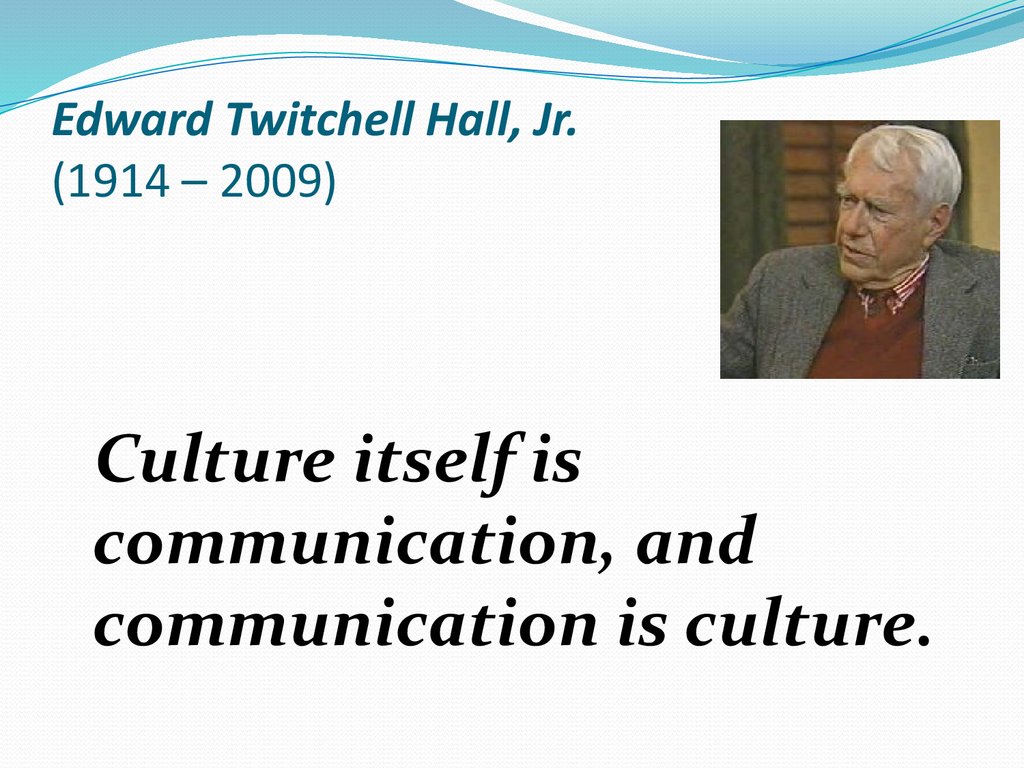
Edward Twitchell Hall, Jr.(1914 – 2009)
Culture itself is
communication, and
communication is culture.
17.
CONTEXTinternal context:
external context:
the past experience of the
physical environment, as well
communicant, programmed
in his mind and the structure
of the nervous system; a set of
presuppositions and
background knowledge,
values, cultural identity and
individual characteristics of
the language personality.
as other information implicit
in the communicative
interaction, including the
nature of interpersonal
relationships between
communicants and the social
circumstances of
communication.
18.
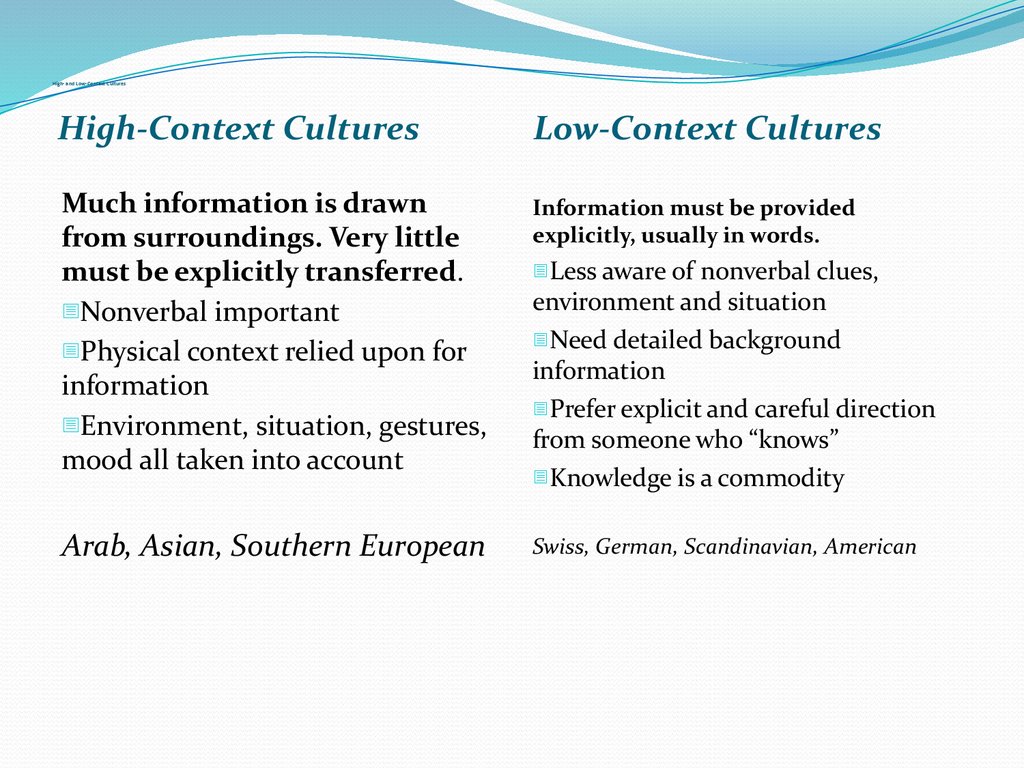
High- and Low-Context CulturesHigh-Context Cultures
Low-Context Cultures
Much information is drawn
from surroundings. Very little
must be explicitly transferred.
-Nonverbal important
-Physical context relied upon for
information
-Environment, situation, gestures,
mood all taken into account
Information must be provided
explicitly, usually in words.
Arab, Asian, Southern European
Swiss, German, Scandinavian, American
-Less aware of nonverbal clues,
environment and situation
-Need detailed background
information
-Prefer explicit and careful direction
from someone who “knows”
-Knowledge is a commodity
19.
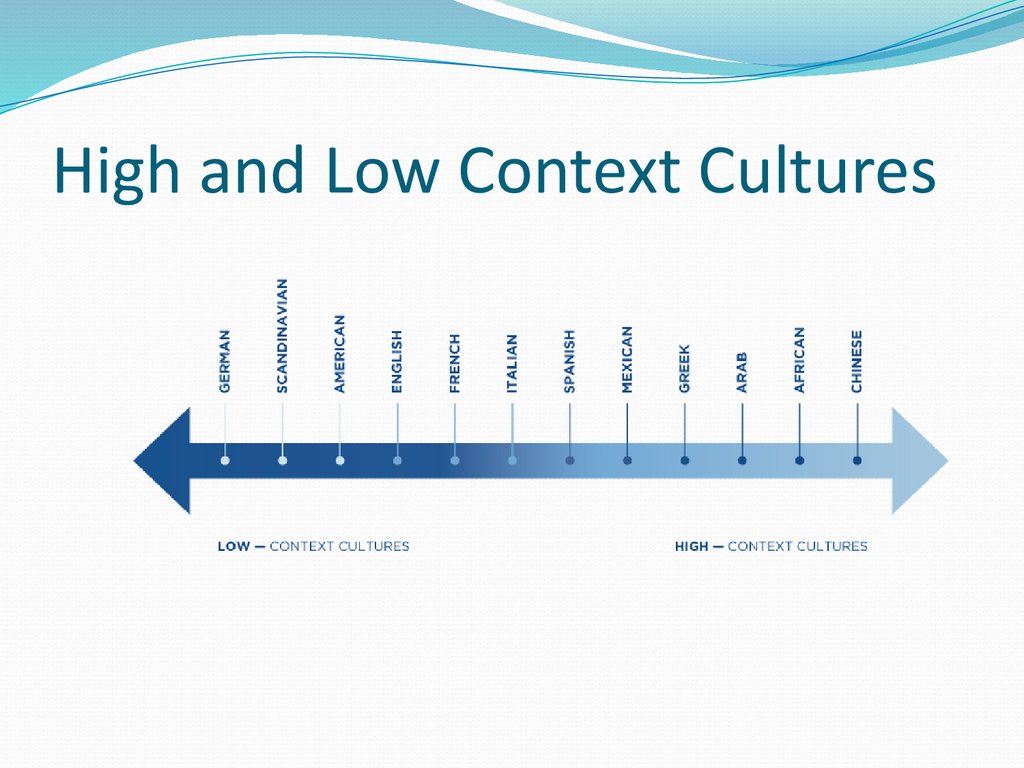
High and Low Context Cultures20.
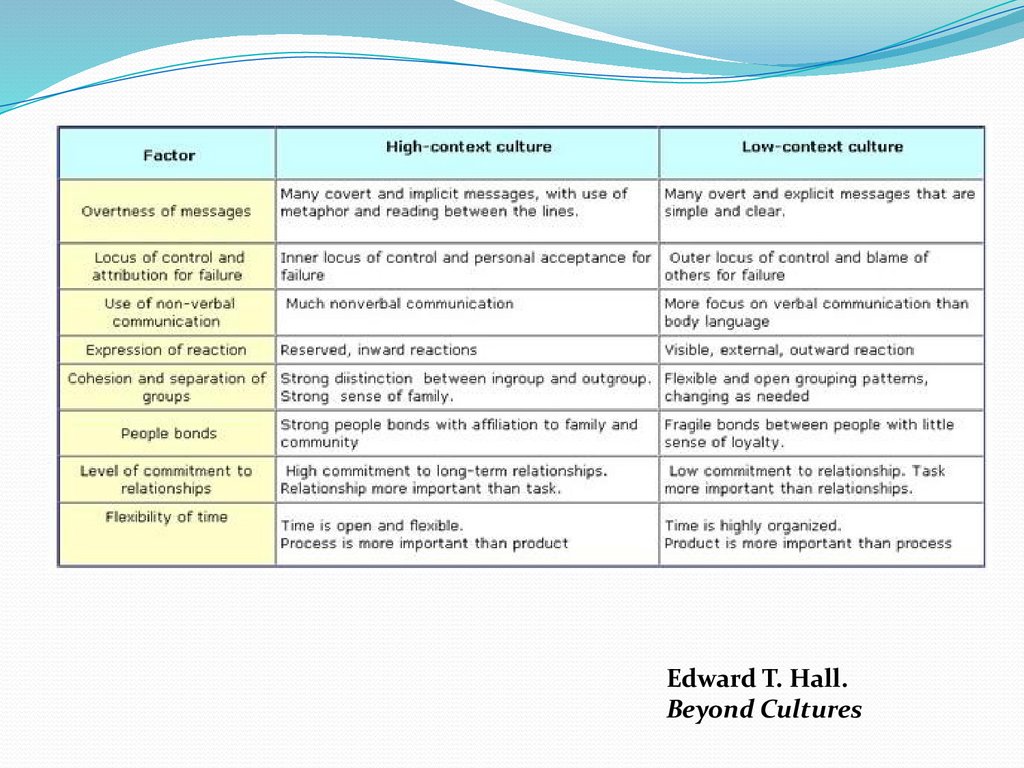
Edward T. Hall.Beyond Cultures
21.
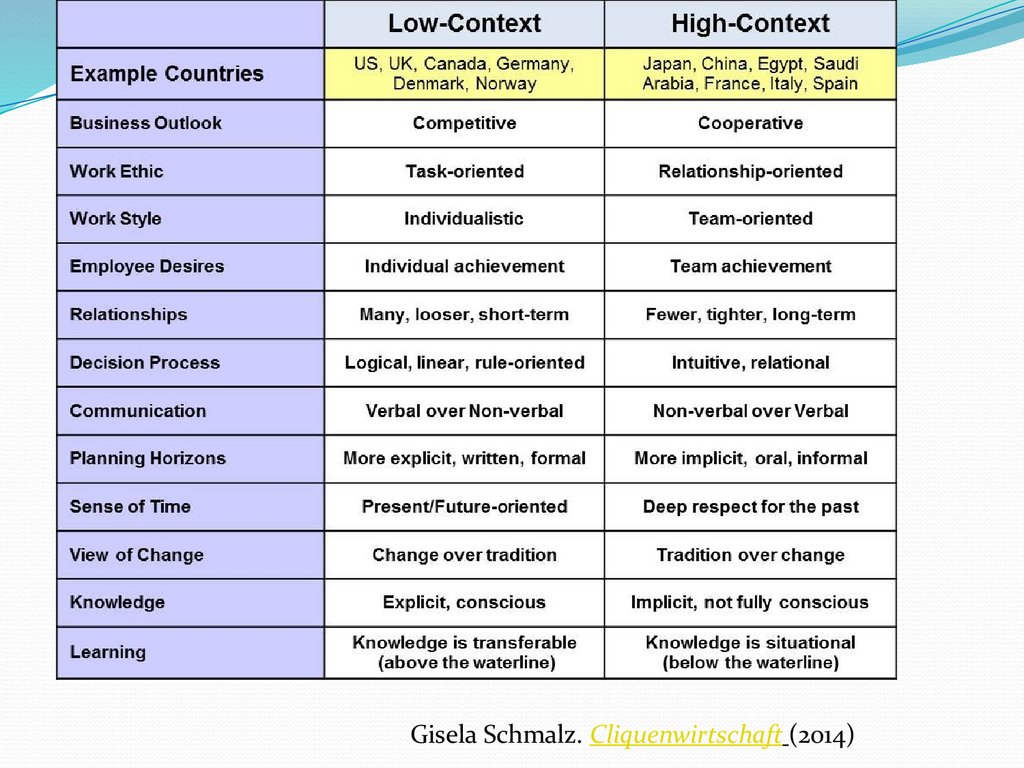
Gisela Schmalz. Cliquenwirtschaft (2014)22.
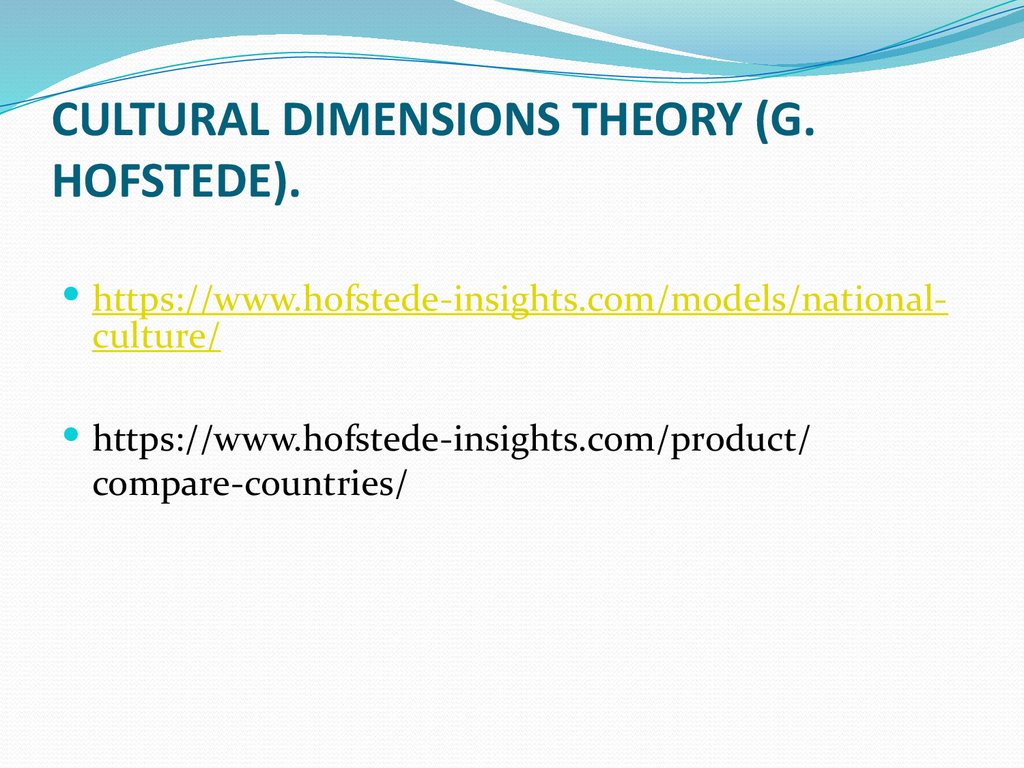
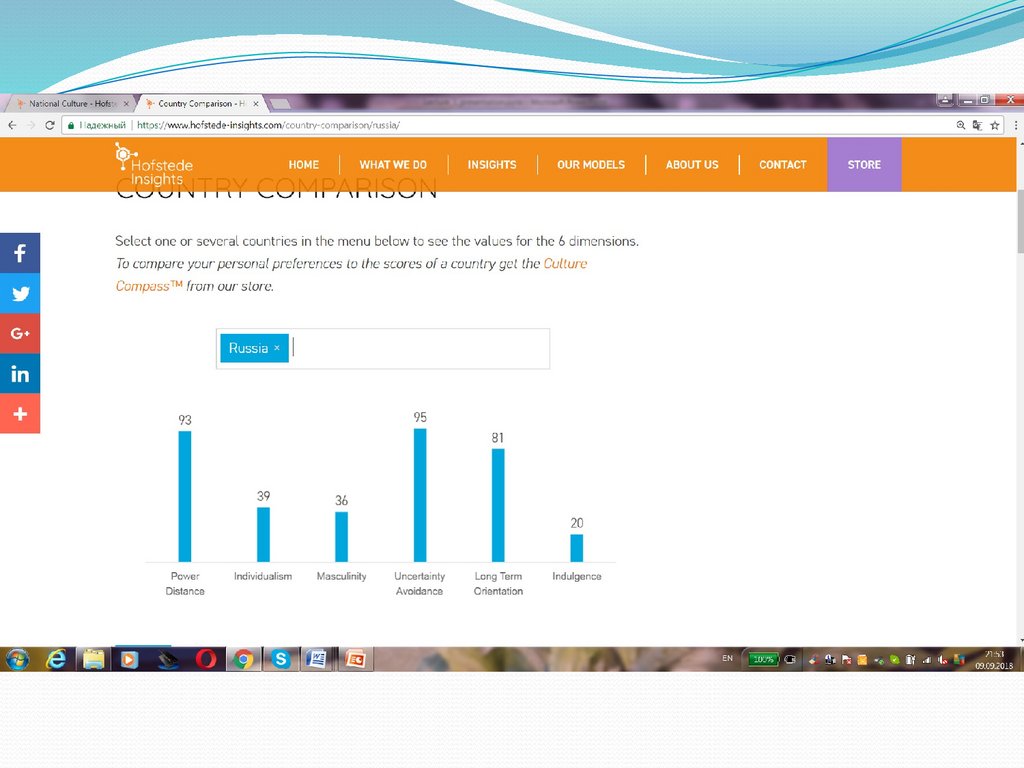
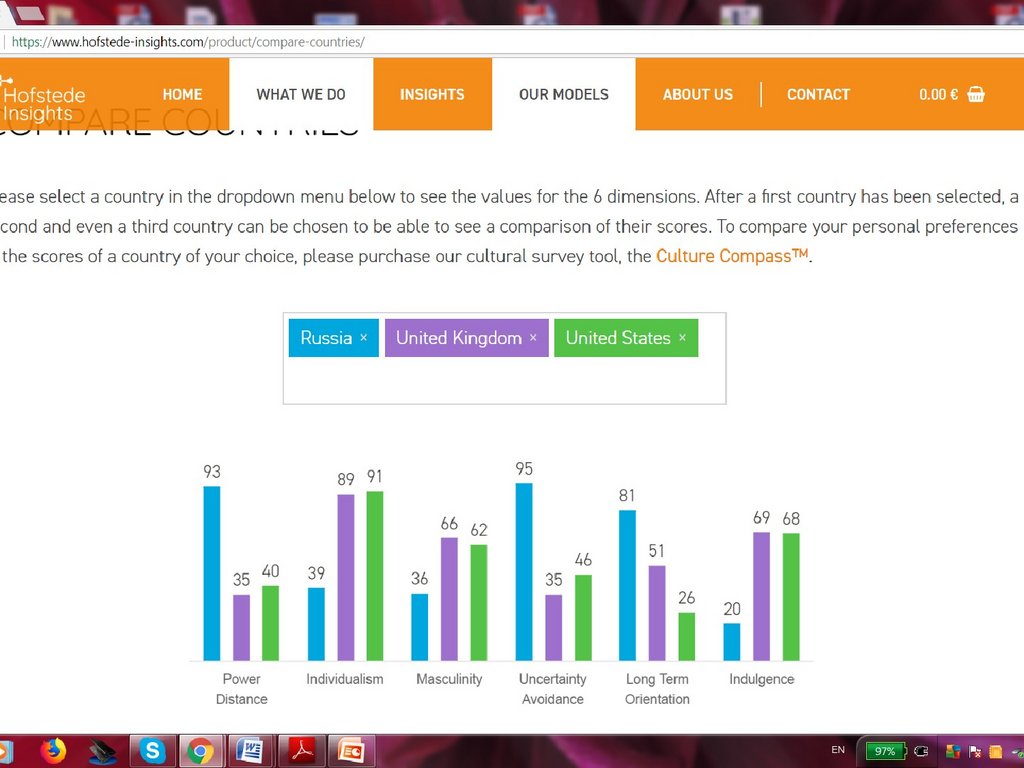
CULTURAL DIMENSIONS THEORY (G.HOFSTEDE).
https://www.hofstede-insights.com/models/national-
culture/
https://www.hofstede-insights.com/product/
compare-countries/
23.
24.
The original theory proposed fourdimensions along which cultural
values could be analyzed:
power distance (strength of social hierarchy)
masculinity-femininity (task orientation versus
person-orientation)
individualism-collectivism
uncertainty avoidance
25.
26.
POWER DISTANCE INDEX (PDI)This dimension expresses the degree to which the
less powerful members of a society accept and
expect that power is distributed unequally. The
fundamental issue here is how a society handles
inequalities among people.
27.
INDIVIDUALISM vs COLLECTIVISM (IVC)The high side of this dimension can be defined as
a preference for a loosely-knit social framework
in which individuals are expected to take care of
only themselves and their immediate families.
Its opposite, Collectivism, represents a preference
for a tightly-knit framework in society in which
individuals can expect their relatives or members
of a particular ingroup to look after them in
exchange for unquestioning loyalty.
A society’s position on this dimension is
reflected in whether people’s self-image is
defined in terms of “I” or “we.”
28.
MASCULINITY vs FEMININITY(MAS)
The Masculinity side of this dimension represents a
preference in society for achievement, heroism,
assertiveness, and material rewards for success.
Society at large is more competitive.
Its opposite, Femininity, stands for a preference for
cooperation, modesty, caring for the weak and quality
of life. Society at large is more consensus-oriented.
29.
UNCERTAINTY AVOIDANCE INDEX (UAI)The Uncertainty Avoidance dimension expresses the
degree to which the members of a society feel
uncomfortable with uncertainty and ambiguity.
Countries exhibiting strong UAI maintain rigid codes
of belief and behaviour, and are intolerant of
unorthodox behaviour and ideas. Weak UAI societies
maintain a more relaxed attitude in which practice
counts more than principles.
30.
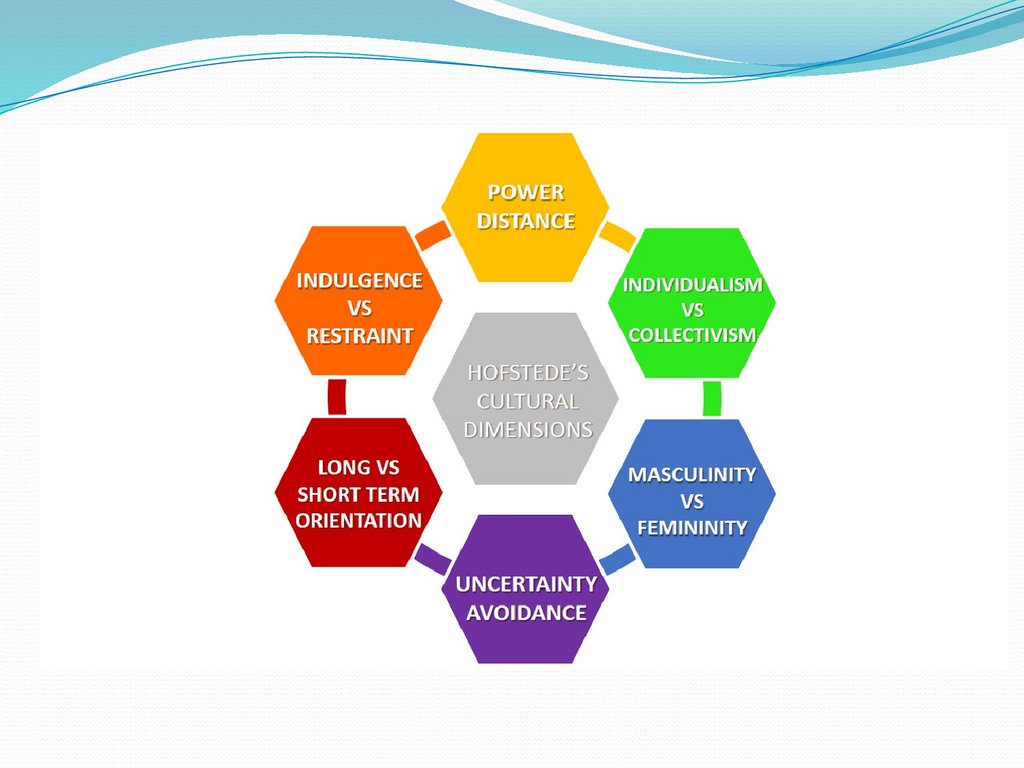
TWO more dimensions wereadded:
LONG TERM ORIENTATION VERSUS SHORT TERM
NORMATIVE ORIENTATION (LTO)
INDULGENCE VERSUS RESTRAINT (IND)
31.
LONG TERM ORIENTATION VERSUS SHORT TERM NORMATIVEORIENTATION (LTO)
Every society has to maintain some links with its
own past while dealing with the challenges of the
present and the future. Societies prioritize these
two existential goals differently.
Societies who score low on this dimension, for
example, prefer to maintain time-honoured
traditions and norms while viewing societal
change with suspicion.
Those which score high, on the other hand, take a
more pragmatic approach: they encourage thrift
and efforts in modern education as a way to
prepare for the future.
32.
INDULGENCE VERSUS RESTRAINT(IND) Indulgence stands for a society that allows
relatively free gratification of basic and natural
human drives related to enjoying life and having
fun. Restraint stands for a society that suppresses
gratification of needs and regulates it by means
of strict social norms.
33.
34.
35.
Culture as a "three-layered" entity(S.Dahl)
artifacts, other material phenomena of
culture, as well as language
norms and values
basic settings, assumptions, beliefs,
mentality